Unmasking Motion: A Researcher's Guide to Sources and Solutions for Artifacts in Mobile EEG
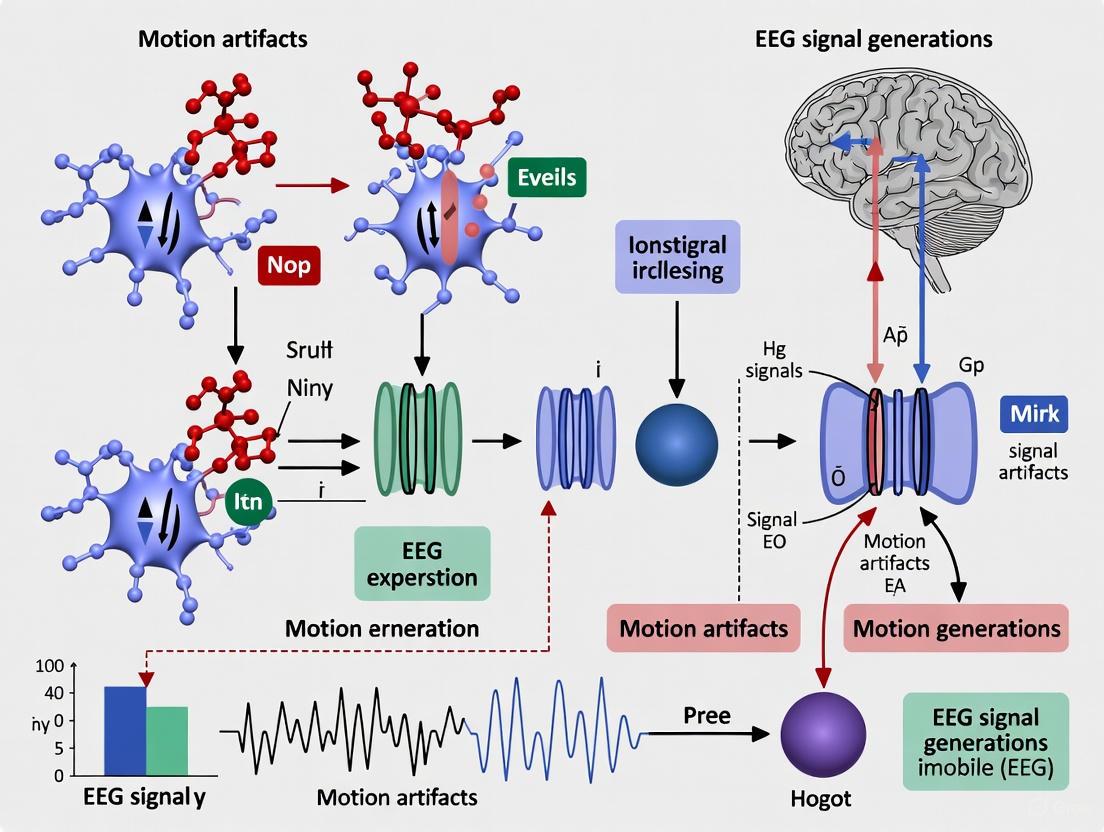
Mobile electroencephalography (EEG) enables unprecedented brain monitoring in real-world settings, from clinical trials to athletic performance.
Unmasking Motion: A Researcher's Guide to Sources and Solutions for Artifacts in Mobile EEG
Abstract
Mobile electroencephalography (EEG) enables unprecedented brain monitoring in real-world settings, from clinical trials to athletic performance. However, this mobility introduces significant motion artifacts that compromise data integrity. This article provides a comprehensive analysis for researchers and drug development professionals, detailing the physical and technical sources of these artifacts. We explore and compare a spectrum of correction methodologies, from established signal processing techniques like ICA and ASR to emerging deep learning and multi-modal approaches. The content further offers practical guidance for optimizing data collection and provides a framework for validating artifact removal pipelines to ensure the reliability of neural data in mobile contexts.
The Physics of Interference: Understanding the Core Sources of Motion Artifacts in Mobile EEG
The advancement of mobile electroencephalography (EEG) has enabled brain monitoring in real-world environments, moving beyond the constrained settings of traditional laboratories [1]. However, this transition to ambulatory recording presents significant challenges, primarily due to motion artifacts that degrade signal quality and complicate neurological data interpretation [1] [2]. These artifacts originate from complex electromechanical processes at the electrode-skin interface, where mechanical disturbances transform into electrical noise that masquerades as neural activity [3].
Understanding these artifact generation mechanisms is crucial for researchers and drug development professionals utilizing mobile EEG in clinical trials or neuropharmacological studies. Motion artifacts exhibit specific features in wearable EEG due to dry electrodes, reduced scalp coverage, and subject mobility, creating noise that can obscure genuine brain signals and lead to erroneous conclusions in neuromodulation studies [1]. This technical guide examines the fundamental principles behind motion artifact generation, detailing how mechanical changes at the electrode-skin interface translate into electrical noise that contaminates EEG recordings.
Fundamental mechanisms of artifact generation
The electrode-skin interface impedance model
The electrode-skin interface represents a complex electrochemical system whose impedance characteristics fundamentally influence signal quality in EEG recordings. This interface consists of multiple layers, each contributing to the overall impedance: the electrode material, the electrolyte layer (gel or hydrogel), and the skin strata, particularly the stratum corneum [4]. The stratum corneum, as the outermost skin layer, acts as the primary resistive barrier due to its lipid-corneocyte matrix structure [4].
This interface functions as a dynamic electrochemical circuit with both resistive and capacitive properties. The impedance is not static but varies with mechanical pressure, movement, and electrochemical conditions. Three-electrode system measurements reveal that different electrode types exhibit markedly different impedance profiles: wet electrodes demonstrate the lowest impedance, semidry electrodes show intermediate values, while dry electrodes typically exhibit the highest impedance amplitudes [5]. This impedance directly impacts signal fidelity, as higher interface impedance increases susceptibility to motion artifacts and external electrical interference.
Table 1: Electrode Types and Their Electrical Characteristics
| Electrode Type | Typical Impedance Range | Key Characteristics | Motion Artifact Susceptibility |
|---|---|---|---|
| Wet Electrodes | Lowest impedance [5] | Conductive gel enhances contact; Time-consuming setup [6] | Lower susceptibility due to stable interface [5] |
| Semidry Electrodes | Moderate impedance [5] | Jelly-like electrolyte; Compromise between wet and dry electrodes [5] [6] | Moderate susceptibility [6] |
| Dry Electrodes | Highest impedance [5] | No electrolyte; Quick setup; Higher noise [6] | Highest susceptibility due to unstable contact [5] [6] |
Mechanical transduction of motion to electrical noise
Motion artifacts originate from mechanical disturbances that modulate the electrical properties of the electrode-skin interface through several physical mechanisms:
Interface Potential Variations: Mechanical deformation of the skin alters the half-cell potential at the electrode-skin interface. This potential arises from the electrochemical equilibrium between the electrode material and the electrolyte solution (gel or natural skin moisture) [3]. Lateral stretching, rotational forces, or vertical pressure on the electrode change this equilibrium, generating potential shifts that manifest as low-frequency baseline wander in EEG signals [3].
Contact Area Fluctuations: Movement causes microscopic changes in the effective contact area between electrode and skin. As the contact area varies, the interface impedance changes inversely, following the relationship Z ∝ 1/A (where A is contact area) [3]. These impedance fluctuations modulate the signal path, creating artifacts particularly during head movements, gait cycles, or physical activity [2].
Electrolyte Layer Redistribution: For gel-based electrodes, motion causes lateral shifting and thickness variation of the conductive electrolyte layer. This redistribution creates changing electrical pathways and potential gradients across the electrode surface [3]. The resulting capacitance changes generate current flows that appear as high-frequency transients or slow baseline drifts in the recorded signal.
Electroporation Effects: Rapid movements or high-pressure points can create sufficiently strong electrical fields to induce electroporation - the formation of microscopic pores in the stratum corneum [4]. This process instantaneously changes local conductivity, creating nonlinear impedance changes and transient artifacts, especially during high-acceleration movements.
Diagram 1: Motion Artifact Generation Pathway
Experimental quantification and characterization
Pressure-impedance relationships in electrode systems
The relationship between wearing pressure and electrode-skin interface impedance has been systematically investigated using fabric electrodes with different organizational structures. Research demonstrates that applied pressure significantly affects contact impedance and consequently influences signal quality in both static and dynamic recording conditions [7].
Studies utilizing silver-plated nylon conductive yarn electrodes in plain, twill, and satin weave structures measured impedance under controlled pressures ranging from 2-5 kPa. Results revealed that twill and satin weave structured electrodes exhibited smaller and more stable contact impedance compared to plain weave electrodes [7]. The optimal pressure range for balancing comfort and signal quality was identified as 3-4 kPa for satin-structured electrodes, which provided both satisfactory comfort and stable ECG signal acquisition during daily exercise [7]. This pressure range minimizes motion artifacts while maintaining subject comfort during extended monitoring sessions.
Table 2: Electrode Performance Under Different Pressure Conditions
| Applied Pressure | Impedance Characteristics | Signal Quality | Subject Comfort |
|---|---|---|---|
| 2 kPa | Higher and less stable impedance [7] | Reduced signal quality, especially in dynamic conditions [7] | Highest comfort level [7] |
| 3-4 kPa | Optimal impedance stability [7] | High-quality signals in both static and dynamic conditions [7] | Satisfactory comfort for long-term monitoring [7] |
| 5 kPa | Lower but potentially unstable impedance | Improved signal but motion artifacts may persist | Reduced comfort, potential skin irritation [7] |
Electrode support structure design
The physical design of electrode support structures significantly influences motion artifact generation by modulating how mechanical forces are transmitted to the electrode-skin interface. Comparative studies of four different textile electrode support designs have demonstrated that structures stabilizing skin deformation around the electrode effectively reduce motion artifacts [3].
Research evaluating soft padding larger than electrode area, similar-sized soft padding with skin deformation restriction, same-sized soft padding, and rigid same-sized supports revealed that designs distributing force beyond electrode borders significantly outperform same-sized structures [3]. The optimal design incorporated a skin deformation restricting mechanism that stabilized the area around the electrical contact point, reducing artifact amplitude by up to 50% compared to rigid same-sized supports [3]. The relationship between motion artifact amplitude and electrode movement magnitude was approximately linear for smaller movements but became disproportionately larger for more significant displacements [3].
Additionally, studies showed that increasing applied mounting force up to 1000g progressively reduced motion artifacts, with diminishing returns beyond this threshold [3]. The mechanical properties of underlying tissue also significantly influenced artifact generation, with thicker subcutaneous layers providing better natural damping of mechanical disturbances [3].
Methodologies for experimental characterization
Controlled motion artifact assessment system
A specialized motion artifact generation and assessment system has been developed to quantitatively evaluate electrode performance under standardized and repeatable motion patterns [3]. This system employs a high-torque servo motor connected to a vertically movable platform to apply programmable lateral motion to test electrodes while simultaneously monitoring multiple parameters.
The system's data acquisition module simultaneously measures three key parameters: (1) skin-electrode impedance using a 100µA current at 100kHz frequency, (2) pure motion artifact in a biopotential measurement configuration, and (3) motion-corrupted physiological signals (e.g., ECG) [3]. A FlexiForce sensor positioned between the electrode and motion actuator monitors mounting force in real-time, enabling correlation of mechanical pressure with electrical artifacts [3].
This approach allows systematic investigation of how factors like electrode design, mounting force, anatomical location, and motion characteristics influence artifact generation. The system applies controlled motion patterns including lateral stretching, rotational forces, and vertical displacement, mimicking real-world movements while maintaining measurement consistency across experimental conditions [3].
Electrode-skin impedance measurement protocols
Characterizing the dynamic impedance of the electrode-skin interface requires specialized measurement methodologies. Electrochemical impedance spectroscopy (EIS) techniques measure impedance across a frequency spectrum from 0.1Hz to 10kHz, providing comprehensive interface characterization [5].
Standardized protocols utilize a three-electrode system with the test electrode as working electrode, complemented by reference and counter electrodes [5]. Measurements are typically performed at skin sites prepared with alcohol cleaning to remove oils and dead skin cells, with precise control of environmental conditions (25°C temperature, 51% humidity) to minimize variability [5].
For fabric electrodes, surface resistance tests employ a digital multimeter connected between the electrode and a clean copper plate, with insulated weights applied to maintain consistent pressure conditions during measurements [7]. Each electrode sample undergoes multiple measurements (typically n=5) with averaged results to ensure statistical reliability [7].
Diagram 2: Motion Artifact Assessment Workflow
The scientist's toolkit: research reagent solutions
Table 3: Essential Materials for Electrode-Skin Interface Research
| Research Material | Specifications | Research Application |
|---|---|---|
| Silver/Silver-Chloride (Ag/AgCl) Electrodes | Standard clinical electrode with conductive gel [5] | Reference standard for impedance and signal quality comparison studies [5] [8] |
| Silver-Plated Nylon Conductive Yarn | 70D, 3.8Ω/cm resistance [7] | Fabrication of textile electrodes for wearable monitoring applications [7] |
| Poly(3,4-ethylenedioxythiophene):Poly(Styrenesulfonate) (PEDOT:PSS) | Conductive polymer solution (Clevios PH 1000) [8] | Development of low-impedance hydrogel electrodes for long-term stable recordings [8] |
| Sodium Alginate (SA) Hydrogel | Biocompatible polymer base [6] | Formulation of semidry double-layer hydrogel electrodes with enhanced stability [6] |
| Lithium Chloride (LiCl) | Ionic conductivity enhancer [8] | Added to polymer mixtures to improve ionic conductivity of electrode coatings [8] |
| Triton X-100 | Nonionic surfactant [8] | Secondary additive to improve conductivity and mechanical properties of PEDOT:PSS [8] |
The electrode-skin interface represents a critical determinant of signal quality in mobile EEG systems, where mechanical disturbances transform into electrical artifacts through complex electromechanical processes. The dynamic impedance model of this interface reveals how pressure variations, mechanical deformation, and electrochemical factors collectively contribute to motion artifact generation. Understanding these fundamental mechanisms enables researchers to develop more effective artifact mitigation strategies, whether through electrode design innovations, signal processing algorithms, or experimental protocols. As mobile EEG continues to expand into clinical trials, neuromodulation studies, and real-world brain monitoring, comprehensive knowledge of these artifact generation principles becomes increasingly essential for producing reliable, interpretable neurological data.
In mobile electroencephalography (EEG) research, motion artifacts present a significant barrier to obtaining clean neural data during dynamic tasks. Among the various sources of these artifacts, cable movement remains a particularly challenging problem. The movement of cables connecting electrodes to amplification systems introduces non-physiological interference through multiple physical mechanisms, primarily capacitive coupling to environmental noise sources and triboelectric effects generated within the cable structure itself [9] [10]. These artifacts frequently exhibit amplitudes orders of magnitude greater than genuine cortical signals, severely compromising signal interpretation and analysis [10]. Understanding these fundamental principles is essential for developing effective mitigation strategies in mobile brain imaging applications.
This technical guide examines the underlying physical mechanisms of cable-induced artifacts, presents experimental methodologies for their systematic investigation, and synthesizes current technical and computational approaches for artifact mitigation. The insights provided aim to support researchers in designing more robust mobile EEG studies and advancing the development of next-generation acquisition systems.
Physical Mechanisms and Noise Models
Cable movement artifacts originate from distinct but often co-occurring physical phenomena. The table below summarizes the primary mechanisms, their characteristics, and impact on the EEG signal.
Table 1: Physical Mechanisms of Cable Movement Artifacts
| Mechanism | Physical Principle | Artifact Manifestation | Spectral Characteristics |
|---|---|---|---|
| Capacitive Coupling to Environmental Noise | Time-varying capacitive coupling between the cable and surrounding 50/60 Hz AC fields [9]. | Increased 50/60 Hz power line interference (PLI), often modulated by movement [10]. | Narrowband, centered at 50/60 Hz and their harmonics. |
| Triboelectric Effect | Generation of electrical charge due to friction between a cable's conductor and its insulator, caused by movement [9] [10]. | Sudden, high-amplitude, spike-like shifts in the signal baseline [9]. | Broadband, spanning the entire EEG spectrum (0.1-100 Hz) [10]. |
| Modulated Power Line Interference | Movement-induced changes in electrode-skin impedance unbalance, modulating the level of coupled PLI [10]. | PLI that varies in amplitude with movement, introducing non-stationary spectral components. | 50/60 Hz carrier with low-frequency modulation sidebands. |
The following diagram illustrates the signaling pathway through which these artifacts are introduced into the measurement chain.
Figure 1: Signaling pathway of artifact introduction via cable movement. Environmental noise and physical motion generate interference through capacitive and triboelectric effects, which adds to the pure EEG signal, resulting in a corrupted output.
Experimental Observation and Characterization
Standardized Experimental Protocols
To systematically study cable-induced artifacts, researchers employ controlled experimental protocols. A foundational approach involves a "worst-case scenario" test, where EEG is recorded from a subject at rest while an experimenter manually and vigorously shakes the connecting cables [10]. This method isolates the cable movement component from other motion artifacts.
For more ecologically valid studies, protocols involve recordings during whole-body movements like overground walking or running [11] [12]. In these paradigms, artifacts are typically time-locked to the gait cycle. The resulting signals are analyzed to quantify power at the step frequency and its harmonics, providing a metric for artifact severity [11].
Data Analysis and Feature Extraction
Characterizing the artifacts involves both time-domain and frequency-domain analysis:
- Time-Domain: Cable motion artifacts manifest as sudden, high-amplitude changes that are often non-repeatable and spike-like in nature [10].
- Frequency-Domain: The spectral components of these artifacts broadly overlap with the standard EEG bandwidth (0.1–100 Hz), making them particularly difficult to remove with simple frequency-based filters without also degrading the neural signal of interest [10].
Table 2: Quantitative Analysis of Motion Artifacts in Dynamic Recordings
| Analysis Metric | Experimental Condition | Key Finding | Research Implication |
|---|---|---|---|
| Spectral Power | Overground running [11] | Significant power at step frequency & harmonics | Simple filtering ineffective due to spectral overlap with EEG. |
| Component Dipolarity | Walking & running with ICA [11] [12] | Large motion artifacts reduce ICA quality | Preprocessing with ASR/iCanClean improves component dipolarity. |
| Amplitude | Dynamic tasks [10] | Can be 2 orders of magnitude > cortical signals | Obscures genuine brain activity and complicates analysis. |
Mitigation Strategies and Technical Solutions
Hardware and Design Solutions
Addressing cable artifacts at the hardware level is the first line of defense.
- Active Shielding: This technique involves shielding each lead with the signal itself via a small coaxial cable. This prevents mains interference from reaching the cable's core, thereby eliminating the capacitive coupling pathway [9]. It also allows the cable to move freely in a magnetic field without inducing triboelectric noise [9].
- Low-Noise Cable Components: Using specially designed cables with components that reduce internal friction can directly minimize the generation of triboelectric noise [9].
- Wireless Systems: Opting for wireless EEG systems entirely bypasses the problem of cable sway, though these systems may introduce other challenges related to data transmission and power consumption.
Signal Processing Approaches
When hardware solutions are insufficient or unavailable, advanced signal processing techniques are required.
- Artifact Subspace Reconstruction (ASR): ASR is an online, data-driven method that uses a sliding-window Principal Component Analysis (PCA) to identify and remove high-variance, high-amplitude artifacts from continuous EEG. It relies on a clean baseline recording for calibration. A key parameter is the threshold
k(standard deviations), with values between 10-30 recommended to avoid over-cleaning [11] [12]. - iCanClean: This method leverages reference noise signals and Canonical Correlation Analysis (CCA) to detect and subtract noise subspaces from the EEG. It works best with dual-layer sensors, where a dedicated noise sensor is mechanically coupled to the electrode but not in contact with the scalp. When such hardware is not available, pseudo-reference signals can be derived from the EEG itself (e.g., by notch-filtering). Studies show that an R² threshold of 0.65 with a 4-second sliding window is effective for human locomotion data [11] [12].
The following workflow diagram illustrates how these signal processing techniques are integrated into a mobile EEG analysis pipeline.
Figure 2: Motion artifact removal workflow. Raw EEG is preprocessed before specialized algorithms like ASR or iCanClean are applied to remove artifacts, enabling reliable downstream analysis.
The Researcher's Toolkit
Table 3: Essential Materials and Reagents for Research on Cable Motion Artifacts
| Tool / Material | Function / Application | Example Use in Experimental Protocol |
|---|---|---|
| Active Shielded Cables | Hardware reduction of capacitive coupling and triboelectric noise [9]. | Used in mobile EEG setup to minimize mains interference and cable movement artifacts during data collection. |
| Low-Noise Cable Components | Minimizes charge generation from internal friction (triboelectric effect) [9]. | Integrated into custom EEG headset designs for dynamic movement studies. |
| Wireless EEG Systems | Eliminates cable sway artifacts by removing physical cables. | Enables EEG recording during high-mobility activities like running or sports. |
| Dual-Layer Electrodes | Provides a dedicated noise reference channel for advanced signal processing [11] [12]. | Used with iCanClean algorithm to isolate and subtract motion artifact subspaces. |
| Artifact Subspace Reconstruction (ASR) | Algorithm for identifying and removing high-amplitude artifacts in continuous EEG [11] [12]. | Applied as a preprocessing step to clean data before Independent Component Analysis (ICA). |
| iCanClean Algorithm | CCA-based method for subtracting noise subspaces using reference signals [11] [12]. | Preprocessing of mobile EEG data to improve dipolarity of brain components in ICA. |
Cable movement introduces complex, multi-mechanism artifacts that significantly challenge the validity of mobile EEG research. The interference arises primarily through capacitive coupling to environmental electromagnetic fields and the triboelectric effect within the cables themselves. These artifacts are characterized by high amplitude, broad spectral overlap with neural signals, and non-stationary properties.
Addressing this issue requires a multi-faceted strategy combining hardware innovations like active shielding and low-noise cables with advanced signal processing techniques such as Artifact Subspace Reconstruction and iCanClean. A thorough understanding of these artifact sources and mitigation technologies is crucial for researchers aiming to conduct robust mobile EEG studies in dynamic settings, ultimately advancing the field of mobile brain-body imaging.
The advent of mobile electroencephalography (EEG) has unlocked unprecedented potential for studying brain dynamics during natural, whole-body movement, an approach known as Mobile Brain/Body Imaging (MoBI). [13] However, this advancement introduces a significant challenge: the contamination of recordings by pervasive movement artifacts. Gait-related artifacts present a particularly complex problem, as they are not random noise but rhythmic, time-locked signals that can mimic or obscure genuine neural activity. [14] [15] Within the broader context of motion artifact research, characterizing these periodic artifacts is a critical foundational step. It enables the development of effective attenuation strategies and ensures the validity of neurophysiological interpretations during locomotion. This technical guide synthesizes current research to detail the nature of gait artifacts, methodologies for their isolation and characterization, and the efficacy of subsequent processing techniques.
Physiological and Technical Origins of Gait Artifacts
EEG artifacts during gait are categorized by their origin, each with distinct signatures in the data.
Physiological Artifacts
- Muscle Activity (EMG Artifact): Contractions from neck, jaw, and scalp muscles during walking or running produce high-frequency, broadband noise that dominates beta (13–30 Hz) and gamma (>30 Hz) ranges, critically overlapping with frequencies essential for studying motor and cognitive activity. [16]
- Ocular Activity (EOG Artifact): While less frequent during steady gait, rapid eye movements or blinks produce high-amplitude, low-frequency deflections, particularly over frontal electrodes. [16]
- Cardiac & Sweat Artifacts: The electrocardiogram (ECG) can introduce rhythmic artifacts, while perspiration causes slow baseline drifts by modifying electrode impedance, contaminating delta and theta bands. [16]
Non-Physiological (Technical) Artifacts
- Electrode Motion: The most significant source during gait. Mechanical stress on electrodes—from cable sway, changes in the electrode-skin interface, or head acceleration—generates large, non-linear voltage shifts. [15] [16] These artifacts are often poorly correlated with head acceleration measured by accelerometers, indicating a complex, non-linear relationship. [15]
- External Interference: Ambient AC power lines (50/60 Hz) can introduce line noise, especially in non-shielded environments or with poor electrode contact. [16]
Table 1: Primary Gait-Related Artifact Types and Their Signatures
| Artifact Type | Origin | Main Characteristics in EEG Signal | Key Influencing Factors |
|---|---|---|---|
| Electrode Motion [15] [16] | Movement of electrode relative to skin | Large-amplitude, low-frequency shifts; rhythmic, time-locked to gait cycle | Gait speed, electrode fixation, cable inertia, subject anatomy |
| Muscle (EMG) [16] | Muscle contractions in head/neck | High-frequency, broadband noise; dominates beta/gamma bands | Head stability, jaw clenching, shoulder tension |
| Head Acceleration [15] | Physical acceleration of the head | Rhythmic fluctuation; harmonics of stepping frequency | Gait speed, terrain (even/uneven) |
| Sweat [16] | Changes in skin-electrode impedance | Very slow baseline drifts | Physical exertion, ambient temperature |
Experimental Methodologies for Isolating and Characterizing Artifacts
A definitive challenge in this field is disentangling artifact from genuine brain signal. Researchers have developed innovative protocols to isolate the pure artifact component.
The "Simulated Scalp" Model for Isolating Movement Artifact
A pivotal methodological approach involves creating a "simulated scalp" to record movement artifact in the absence of all neural signals. [15]
Detailed Protocol:
- Place a Non-Conductive Layer: A silicone swim cap is placed over the participant's natural scalp and hair. This layer blocks the propagation of all electrophysiological signals (neural, muscular, ocular) to the electrodes. [15]
- Create a Conductive Medium: A standard wig is coated with conductive gel to simulate the electrical properties of a human scalp with hair. This wig is placed directly over the non-conductive swim cap. [15]
- Apply Standard EEG Setup: The EEG cap is fitted over the simulated scalp, and electrodes are gelled according to standard procedures. [15]
- Validation:
- Physiological Signal Blocking: Subjects are asked to blink or clench their jaw while data is visually inspected to confirm the absence of ocular or muscle artifacts.
- Artifact Signal Induction: Subjects nod or shake their head to confirm the presence of large movement artifacts in the traces.
- Impedance Check: Resistance is measured to ensure it falls within a range comparable to a natural human scalp (~0.001–0.1 MΩ). [15]
This model confirmed that movement artifact varies considerably across walking speed, subject, and electrode location, and that it cannot be fully explained by or reconstructed from head accelerometry alone. [15]
The "Artifact Footprint" for Characterization in Real EEG
When working with real EEG data containing mixed neural and artifact signals, the multidimensional artifact footprint provides a systematic framework for characterization. [14]
This footprint is a seven-dimensional feature set that combines information across multiple domains to provide a holistic view of artifact properties: [14]
- Time Domain: Amplitude and morphology of the raw signal.
- Time-Frequency Domain: Spectral power across frequency bands.
- Spatial Domain: Topographic distribution across the scalp.
- Source Domain: Localization of artifact sources after source reconstruction.
This footprint allows for a quantitative comparison of artifact levels before and after applying different processing pipelines and can be used to optimize recording setups. [14]
Quantitative Characterization of Gait Artifacts
Systematic studies using the above methodologies have quantified how gait artifacts are influenced by key variables.
Impact of Gait Speed and Terrain
Research shows that gait speed is a primary modulator of artifact magnitude. In studies isolating movement artifact, its spectral power exhibits significant fluctuations that vary with treadmill walking speed across a range from 0.4 m/s to 1.6 m/s. [15] Furthermore, the complexity of the terrain directly impacts artifact properties. When walking over uneven terrain (e.g., a lawn) compared to even terrain (e.g., pavement), a more pronounced beta power decrease following heel strikes is observed, reflecting the altered cortical control demands and associated movement dynamics. [17]
Spatial Distribution Across the Scalp
Artifacts are not uniformly distributed across the scalp. The "simulated scalp" experiments found that movement artifact recorded with EEG electrodes varies significantly by electrode location. [15] This underscores the necessity of high-density EEG recordings to fully capture the spatial complexity of gait-related artifacts and avoid misinterpretations based on a limited number of channels.
Table 2: Impact of Experimental Conditions on Gait Artifact Properties
| Experimental Condition | Impact on Gait Artifact | Key Findings |
|---|---|---|
| Gait Speed [15] | Modulates artifact power and spectrum | Spectral power of isolated movement artifact shows significant fluctuations across speeds from 0.4 to 1.6 m/s. |
| Terrain [17] | Alters time-locked power modulations | Uneven terrain causes a greater beta power decrease following right-heel strikes compared to even terrain. |
| Electrode Location [15] | Affects artifact amplitude and morphology | Movement artifact varies considerably across different electrode locations on the scalp. |
| Subject [15] | Introduces inter-subject variability | Artifact characteristics show substantial variation between different individuals. |
Artifact Attenuation Strategies and Their Efficacy
No single method has proven fully sufficient for removing gait artifacts without potentially distorting neural signals, leading to the adoption of multi-stage pipelines.
- Blind Source Separation (BSS): Techniques like Independent Component Analysis (ICA) are powerful for separating and removing artifactual components from data, particularly for ocular and muscle artifacts. [14] [16] However, its effectiveness for gait artifacts can be limited by the lack of statistical independence between some noise and neural signals. [15]
- Artifact Subspace Reconstruction (ASR): An advanced, automated method that removes high-variance components from the data in sliding windows, making it particularly suitable for handling the large, non-stationary bursts of noise typical of movement. [14]
- Moving Average and Wavelet-Based Methods: Simpler methods like moving average templates can remove gait-locked artifacts but have a significant drawback: they also remove any brain activity that is time-locked to the gait cycle. [15] Wavelet techniques are useful for identifying and removing low-frequency spectral fluctuations. [15]
Evaluating Attenuation Specificity
A critical test for any processing pipeline is its specificity—it must remove artifacts without distorting underlying neural signals. Research using the artifact footprint has demonstrated that a combination of ASR followed by ICA effectively differentiates processing strategies, showing systematic differences in artifact reduction. [14] Importantly, the specificity of this processing can be validated by examining event-related potentials (ERPs) from a task performed during walking (e.g., button presses). Successful processing will show that gait-artifacts are reduced while the morphologies and signal-to-noise ratios (SNR) of the ERPs of interest remain largely unchanged. [14]
The Scientist's Toolkit: Essential Research Reagents and Materials
Table 3: Key Materials and Reagents for Gait Artifact Research
| Item | Critical Function & Specification | Research Context |
|---|---|---|
| High-Density EEG System [13] | Records brain signals with high spatial resolution. 64+ channels and active electrodes are recommended to reduce motion-induced current flow. | Essential for capturing the spatial distribution of artifacts and neural signals during walking. [15] [17] |
| MoBI-Compatible Amplifiers [17] [13] | Portable, battery-powered amplifiers that support wireless data streaming (e.g., via Bluetooth) to enable unrestricted movement. | Foundational for any mobile EEG recording during gait. |
| Silicone Swim Cap [15] | Serves as a non-conductive layer to block all electrophysiological signals in "simulated scalp" experiments. | Critical for protocols designed to isolate pure movement artifact. [15] |
| Conductive Gel & Wig [15] | Creates an electrically conductive, simulated scalp on top of the non-conductive cap, allowing motion artifacts to be recorded. | Critical for protocols designed to isolate pure movement artifact. [15] |
| Accelerometers / Inertial Measurement Units (IMUs) [15] | Measured head kinematics (acceleration, rotation) to correlate with motion artifacts in the EEG signal. | Used to study the relationship between head movement and artifact magnitude. [15] |
| Motion Capture System [17] | Provides precise kinematic data (e.g., stride time, joint angles) to synchronize EEG data with specific phases of the gait cycle. | Used to analyze neural and artifact signals time-locked to heel strikes. [17] [13] |
| Artifact Subspace Reconstruction (ASR) [14] | A sophisticated signal processing technique for removing large-amplitude, non-stationary artifacts from mobile EEG data. | Often used as an initial cleaning step before ICA. [14] |
| Independent Component Analysis (ICA) [14] [16] | A blind source separation algorithm used to identify and remove artifactual components from the data. | A standard tool in the pipeline for removing various artifacts, often applied after ASR. [14] |
In mobile electroencephalography (EEG) research, the quest for ecological validity has pushed experiments from static laboratory settings into dynamic, real-world environments. This transition, however, introduces significant challenges in data integrity, primarily due to motion artifacts. Among these, artifacts generated from vertical head displacements and brief muscle contractions represent two predominant and physiologically distinct categories that profoundly corrupt neural signals. Within the broader thesis on motion artifact sources in mobile EEG, understanding the differential characteristics, generation mechanisms, and removal strategies for these artifacts is paramount. These artifacts are not merely noise but complex physiological signals that can obscure genuine brain activity, leading to misinterpretations in cognitive neuroscience, clinical diagnosis, and pharmaceutical development. This technical guide provides an in-depth analysis of these artifact types, offering researchers a structured framework for their identification, characterization, and mitigation, thereby enhancing the reliability of mobile brain imaging in applied settings.
Physiological Origins and Artifact Genesis
The Neuromuscular Basis of Muscle Contractions
Muscle contractions, the source of myogenic artifacts, are neurogenic events initiated by motor neuron signals. A motor unit, comprising a single motor neuron and all the muscle fibers it innervates, is the fundamental functional component [18]. The force of contraction is graded through recruitment, where the nervous system activates additional motor units to increase tension [18].
- Concentric Contractions: The muscle shortens while generating force, for example, during the upward motion of a bicep curl [18] [19].
- Eccentric Contractions: The muscle lengthens under tension, acting as a braking force, such as when lowering a weight [18] [20]. These contractions are crucial for smooth, controlled movements.
- Isometric Contractions: The muscle generates tension without changing length, essential for maintaining posture and joint stability [18] [20].
These contractions, especially in the scalp, face, neck, and jaw muscles, generate electromyographic (EMG) signals. Their amplitude is often an order of magnitude greater than cortical EEG, and their frequency spectrum overlaps with, and often extends beyond, that of neural signals, making them a potent source of contamination [21] [2] [22].
Biomechanics of Vertical Head Displacements
Vertical head displacements are a common consequence of the human gait cycle during walking or running. These movements generate artifacts through several physical mechanisms at different points in the signal acquisition chain [23]:
- At the Skin-Electrode Interface: The relative movement between the electrode and the skin alters the ion distribution at the contact point, creating slow baseline voltage shifts highly correlated with the rhythm of the movement [23].
- Triboelectric Effects in Cables: Friction and deformation of the insulating material in connecting cables, as they move against surfaces or clothing, generate an additive input voltage potential due to triboelectric phenomena [23].
- Modulation of Power Line Interference (PLI): Brisk, partial electrode detachments or impedance changes can cause sudden variations in the electrode-skin imbalance. This modulates the residual input-referred 50/60 Hz PLI, creating spike-like artifacts with unpredictable morphologies [23].
Differentiating Artifact Characteristics
A clear differentiation between these artifacts is the first critical step toward their effective mitigation. The table below summarizes their contrasting features based on origin, temporal, and spectral properties.
Table 1: Characteristic Differences Between Muscle and Head-Movement Artifacts
| Characteristic | Muscle Contraction Artifacts | Vertical Head Displacement Artifacts |
|---|---|---|
| Primary Origin | Electromyogenic (EMG) activity from scalp, face, neck, and jaw muscles [21] [2] | Biomechanical perturbations at the skin-electrode interface, cable movement (triboelectric effect), and PLI modulation [23] |
| Temporal Signature | Brief, spike-like transients or sustained high-frequency bursts [2] | Slow, periodic baseline drifts (interface) or non-periodic, spike-like transients (cables, PLI modulation) [23] |
| Spectral Content | Broadband, high-frequency (> 13 Hz), often overlapping with and exceeding beta and gamma EEG bands [21] [22] | Low-frequency baseline wander (< 4 Hz) from interface; broadband, spike-like content from cables/PLI [23] |
| Topographic Distribution | Localized to electrode sites overlying active muscle groups (e.g., temporal sites for jaw clenching) [21] | Can be global, but often localized to individual electrodes with poor contact or directly affected cables [23] |
| Correlation with Motion | May be time-locked to voluntary or reflexive muscle activity | Highly time-locked to the gait cycle (for baseline drifts) or specific head movements [23] |
Experimental Protocols for Artifact Investigation
To systematically study these artifacts, controlled experimental protocols are essential. The following methodologies allow for the isolation and characterization of each artifact type.
Protocol for Inducing and Recording Head Movement Artifacts
Objective: To capture artifacts stemming specifically from vertical head motions and cable movements.
- Subject Preparation: Fit the subject with a standard mobile EEG system. Ensure electrode impedances are below 10 kΩ at the start of the experiment.
- Baseline Recording (2 minutes): Record EEG while the subject is seated and relaxed, with eyes open, focusing on a fixed point. This provides a clean baseline.
- Cable Perturbation (2 minutes): While the subject remains perfectly still, the experimenter manually shakes, taps, or displaces the cables connecting the cap to the amplifier. This isolates triboelectric artifacts [23].
- Stationary Head Bobbing (3 minutes): Instruct the subject to rhythmically bob their head up and down in a "yes" motion while seated, aiming for a frequency of 0.5-1.5 Hz. This induces artifacts primarily from the skin-electrode interface.
- Treadmill Walking (5-10 minutes): Have the subject walk on a treadmill at a slow, fixed pace (e.g., 3 km/h). The consistent gait cycle induces periodic vertical head displacements and associated artifacts [21].
Data Analysis: Correlate the timing of baseline shifts in the EEG with the heel-strike events (measured via a foot switch or accelerometer on the foot) to identify gait-locked artifacts.
Protocol for Inducing and Recording Muscle Contraction Artifacts
Objective: To capture myogenic artifacts from controlled, isolated muscle activations.
- Subject Preparation: Same as Protocol 4.1.
- Jaw Clenching (2 minutes): Instruct the subject to perform periodic jaw clenches (1-2 second duration, every 10 seconds) while keeping the rest of the body still.
- Neck Tensing (2 minutes): Instruct the subject to periodically tense the neck muscles, as if bracing for impact, with the same timing as above.
- Forehead Flexing (2 minutes): Instruct the subject to periodically raise their eyebrows or frown.
- Speaking (2 minutes): Have the subject read a standardized text passage to capture artifacts from complex, coordinated muscle activity.
Data Analysis: Use synchronized video recording to mark the onset and offset of each muscle contraction event for precise artifact identification in the EEG data.
Signal Processing and Removal Techniques
A variety of software and hardware techniques have been developed to address motion and muscle artifacts. Their efficacy varies significantly depending on the artifact type.
Table 2: Artifact Removal Techniques and Their Efficacy
| Technique Category | Example Methods | Effectiveness on Muscle Artifacts | Effectiveness on Head Motion Artifacts | Key Considerations |
|---|---|---|---|---|
| Filter-Based | High-pass (>1 Hz) & Low-pass (<60 Hz) filters [2] | Limited due to spectral overlap with neural signals. | Effective for slow baseline drifts only. Ineffective for cable/PLI artifacts. | Simple but crude; risks removing or distorting neural signals [2]. |
| Blind Source Separation | Independent Component Analysis (ICA) [24] [25] | High. Can effectively identify and remove components representing EMG. | Moderate for cable/PLI; Low for interface drifts. May struggle with non-stationary, movement-locked artifacts [24]. | Requires manual component inspection. Over-cleaning can remove neural data and inflate effect sizes [25]. |
| Advanced Signal Decomposition | Wavelet Transform, Empirical Mode Decomposition [22] | Moderate to High. Can target specific time-frequency characteristics of EMG. | Moderate. Can be effective for spike-like cable motion artifacts. | Complex parameter tuning is required. |
| Deep Learning | CNN-based models (e.g., Motion-Net), GANs (e.g., AnEEG) [2] [22] | High. Can learn to separate neural and myogenic signals when trained on clean data. | High for specific movements. Subject-specific models like Motion-Net show promise for real motion artifacts [2]. | Requires large, well-annotated datasets for training. Risk of overfitting. |
| Targeted Cleaning | RELAX pipeline [25] | High. Targets artifact periods/frequencies of components, preserving non-artifact data. | Moderate. Applied after ICA. | Reduces effect size inflation and source localization bias common in standard ICA [25]. |
The following diagram illustrates a recommended workflow for integrating these techniques into a processing pipeline, emphasizing decision points for handling different artifact types.
The Scientist's Toolkit: Research Reagent Solutions
Selecting the appropriate tools is critical for conducting robust mobile EEG research. The following table details key hardware, software, and methodological "reagents" essential for this field.
Table 3: Essential Research Tools for Mobile EEG Artifact Investigation
| Tool / Solution | Category | Primary Function | Relevance to Artifact Research |
|---|---|---|---|
| Mobile EEG System with Accelerometer | Hardware | Records brain signals and synchronized 3D motion data. | Critical. Correlates EEG artifacts with specific movements (gait, head bobs). Essential for validating removal algorithms [2]. |
| Active Electrodes | Hardware | Amplify signals directly at the electrode to reduce cable-borne interference. | Mitigates triboelectric noise from cable motion. May not fully address skin-electrode interface artifacts [23] [26]. |
| ICA Algorithm (e.g., in EEGLAB) | Software | Decomposes multi-channel EEG into statistically independent components. | The cornerstone for identifying and isolating both myogenic and non-biological artifact sources for subsequent removal [24] [25]. |
| RELAX Pipeline | Software | A fully automated pipeline for artifact reduction. | Provides a standardized, rigorous method to minimize subjective bias in cleaning, reducing effect size inflation [25]. |
| Motion-Net / AnEEG | Software | Deep learning models for artifact removal. | Represents the state-of-the-art for learning complex artifact patterns and cleaning signals with high precision, suitable for subject-specific applications [2] [22]. |
| Gait Event Detection System (e.g., Force Plates, Foot Switches) | Methodology | Precisely marks heel-strike and toe-off events during walking. | Allows for precise time-locking of EEG data to the gait cycle, enabling the study of movement-locked potential and artifact separation. |
The proliferation of mobile EEG technology demands a sophisticated understanding of motion artifacts. As detailed in this guide, vertical head displacements and brief muscle contractions generate artifacts with distinct physiological origins and signal properties. Effectively differentiating and mitigating these artifacts requires a multi-faceted strategy that combines rigorous experimental design, appropriate hardware selection, and advanced signal processing techniques. While traditional methods like ICA remain powerful, the field is moving towards targeted cleaning and deep learning approaches that promise greater precision and better preservation of neural information. For researchers in neuroscience and drug development, adopting these guidelines and leveraging the provided "toolkit" will be essential for extracting valid and reliable neural signals from the noisy backdrop of natural movement, thereby solidifying the role of mobile EEG as a robust tool for understanding brain function in real-world contexts.
The migration of electroencephalography (EEG) from controlled laboratory settings to dynamic real-world environments represents a paradigm shift in neuroscience and clinical monitoring. This transition, enabled by wearable technologies employing dry electrodes and reduced channel counts, introduces significant challenges in signal fidelity. This technical review examines the core mechanisms through which these design choices exacerbate motion artifacts, synthesizing recent experimental data and modeling studies. We analyze the compounded effects of increased electrode-skin impedance instability and the limitations of spatial filtering in low-density arrays. Furthermore, the review quantitatively compares the performance of emerging artifact mitigation pipelines, including combined independent component analysis (ICA) with spatial filtering and novel deep learning architectures, providing a structured resource for researchers navigating the complexities of mobile brain imaging.
Electroencephalography (EEG) is a cornerstone of neurophysiological investigation, prized for its non-invasive nature, high temporal resolution, and relatively low cost [27]. The advent of wearable EEG technology has expanded its application frontier into ecological settings, including brain-computer interfaces (BCIs) for daily use, neurorehabilitation therapies, and cognitive monitoring during physical activity [21] [26]. This shift is technologically facilitated by two key design adaptations: the replacement of traditional wet electrodes with dry electrodes and a reduction in the number of recording channels.
Dry electrodes forego the conductive gel of wet electrodes, offering rapid setup, enhanced user comfort, and suitability for long-term recordings without skin irritation [27] [28]. Concurrently, reducing channel counts from high-density systems (64+ channels) to a more manageable number (often <32) decreases system complexity, improves portability, and shortens preparation time [2] [26]. However, these pragmatic design choices fundamentally alter the physical and mathematical underpinnings of EEG signal acquisition, rendering the recordings more vulnerable to corruption by motion artifacts. These artifacts, with amplitudes potentially orders of magnitude greater than cortical signals, can severely compromise the interpretation of brain activity and the reliability of downstream applications [23]. This review delineates the specific mechanisms by which dry electrodes and reduced channel counts intensify these challenges and surveys the current landscape of experimental and computational solutions.
Core Technical Challenges and Underlying Mechanisms
The Inherent Vulnerability of Dry Electrodes
Dry electrodes introduce signal quality vulnerabilities primarily through their interface with the skin. Unlike wet electrodes, which use gel to create a stable, low-impedance connection by hydrating the skin and penetrating the stratum corneum, dry electrodes form a high-impedance interface directly with the skin surface [23] [29]. This fundamental difference is the source of several artifact-generation mechanisms:
- Unstable Electrode-Skin Impedance: The electrode-skin impedance ((Ze)) is highly sensitive to mechanical disturbances. Minor movements, such as those from walking or talking, cause fluctuations in the pressure and contact area between the electrode and the skin, leading to rapid changes in (Ze). These changes manifest in the recorded signal as large, slow baseline drifts or spike-like transients, as the unstable interface acts as a time-varying voltage divider with the amplifier's input impedance [23].
- Disruption of the Electrical Double Layer: In wet electrodes, the gel electrolyte facilitates a stable electrical double layer at the skin-electrode interface. This layer is critical for the transduction of ionic currents in the skin to electronic currents in the electrode. Dry electrodes lack this buffering medium. Any relative movement disrupts the nascent double layer, generating transient electrical potentials that are recorded as motion artifacts [29].
- Modulation of Power-Line Interference (PLI): An unstable (Z_e) unbalances the impedance network of the differential recording setup. This imbalance modulates the coupling of ambient PLI (e.g., 50/60 Hz), creating artifacts with complex morphologies that span the EEG frequency spectrum. Simple notch filters are ineffective against this modulated interference, as its spectral components are broad and non-stationary [23].
Table 1: Comparative Analysis of Dry vs. Wet Electrode Characteristics
| Feature | Dry Electrodes | Wet (Gel) Electrodes |
|---|---|---|
| Setup Time | Rapid (minutes) [28] | Lengthy (often >10 minutes) |
| Skin-Electrode Impedance | High and unstable [23] [29] | Low and stable |
| Susceptibility to Motion Artifacts | High [27] [23] | Lower (gel acts as a mechanical buffer) [27] |
| Long-Term Comfort | High (no gel, no skin preparation) | Can cause irritation as gel dries [29] |
| Ideal Use Case | Short-term, ecological monitoring, BCI | Clinical diagnostics, high-fidelity lab research |
The Compounding Effect of Reduced Channel Count
While dry electrodes increase the propensity for artifacts, a reduced channel count limits the computational ability to separate and remove them. High-density EEG systems (e.g., 64, 128, or 256 channels) provide rich spatial information that is critical for the effectiveness of many advanced artifact removal algorithms.
- Limitations for Source Separation Techniques: Algorithms like Independent Component Analysis (ICA) are powerful tools for blind source separation. They decompose multi-channel EEG data into statistically independent components, which can be manually or automatically classified as neural or artifactual. The efficacy of ICA is heavily dependent on having a sufficient number of recording channels (sensors) to estimate the underlying source signals (brain and non-brain) accurately. A reduced channel count provides fewer spatial samples, severely limiting the algorithm's ability to disentangle overlapping sources, resulting in incomplete artifact removal or, worse, the accidental removal of neural signals [27] [30].
- Reduced Efficacy of Spatial Filtering: Techniques like the Spatial Harmonic Analysis (SPHARA) and Common Average Reference (CAR) rely on the spatial distribution of electrodes to distinguish global artifacts from localized brain activity [27]. A sparse electrode montage, particularly one that does not provide comprehensive scalp coverage, offers a coarse spatial picture. This makes it difficult for these methods to reliably compute a reference that represents only the common noise, leading to residual artifacts or distortion of the genuine neural signal.
The combination of these two factors—increased artifact generation at the sensor level and diminished artifact removal capacity at the processing level—creates a central challenge for the wearable EEG paradigm.
Quantitative Analysis of Artifact Impact and Mitigation Performance
Recent empirical studies have quantified the impact of motion artifacts and the performance of various denoising methods on dry EEG data. The following tables synthesize key findings from the literature.
Table 2: Quantitative Performance of Artifact Removal Pipelines on Dry EEG [27]
| Denoising Method | Standard Deviation (SD) (μV) | Root Mean Square Deviation (RMSD) (μV) | Signal-to-Noise Ratio (SNR) (dB) |
|---|---|---|---|
| Reference (Preprocessed) | 9.76 | 4.65 | 2.31 |
| Fingerprint + ARCI (ICA) | 8.28 | 4.82 | 1.55 |
| SPHARA (Spatial Filter) | 7.91 | 6.32 | 4.08 |
| Fingerprint + ARCI + SPHARA | 6.72 | 6.32 | 4.08 |
| Fingerprint + ARCI + Improved SPHARA | 6.15 | 6.90 | 5.56 |
A study on 64-channel dry EEG during a motor performance paradigm demonstrated that a combination of temporal/statistical (Fingerprint+ARCI) and spatial (SPHARA) methods yielded superior noise reduction compared to either approach alone [27]. The "improved SPHARA," which included an additional step for zeroing artifactual jumps in single channels, produced the best results across all metrics, highlighting the benefit of integrated pipelines.
Table 3: Performance of Deep Learning Models for Motion Artifact Removal
| Model / Approach | Key Performance Metrics | Context |
|---|---|---|
| Motion-Net (CNN with VG features) | Artifact reduction (η): 86% ± 4.13; SNR improvement: 20 ± 4.47 dB [2] | Subject-specific, real motion artifacts |
| AnEEG (LSTM-based GAN) | Improved NMSE, RMSE, CC, SNR, and SAR vs. wavelet methods [22] | General artifact removal (ocular, muscle) |
| GCTNet (GAN + CNN + Transformer) | 11.15% reduction in RRMSE; 9.81 improvement in SNR [22] | Semi-simulated and real datasets |
Deep learning approaches, particularly Convolutional Neural Networks (CNNs) and Generative Adversarial Networks (GANs), show remarkable promise. For instance, Motion-Net, a subject-specific CNN, was designed to handle real motion artifacts and achieved high artifact reduction percentages and SNR improvements [2]. These models learn complex, non-linear mappings from noisy to clean EEG signals, often surpassing the capabilities of traditional linear filters.
Experimental Protocols for Artifact Analysis
To systematically study and validate artifact removal techniques, researchers employ rigorous experimental protocols. The following are detailed methodologies from key studies.
- Objective: To investigate if the combination of ICA-based methods (Fingerprint and ARCI) and a spatial filter (SPHARA) improves dry EEG signal quality beyond the performance of each method separately.
- Equipment: 64-channel dry EEG cap (waveguardtouch), eego amplifier.
- Paradigm: 11 healthy volunteers performed a motor execution paradigm involving repetitive movements of the left hand, right hand, feet, and tongue following visual cues. Each trial lasted 7s.
- Signal Processing Workflow:
- Preprocessing: Data was likely band-pass filtered and segmented.
- ICA-based Cleaning (Fingerprint + ARCI): The Fingerprint method was used to automatically classify ICA components as brain or artifact. The ARCI method was then applied to reconstruct the signal, removing components identified as artifactual (e.g., ocular, muscle, cardiac).
- Spatial Filtering (SPHARA): The cleaned data was further processed using SPHARA, which acts as a spatial low-pass filter based on the eigenvectors of the EEG sensor array's Laplacian matrix, reducing high-frequency spatial noise.
- Improved SPHARA: An additional step was introduced to detect and zero large-amplitude, short-duration jumps in single channels before applying the SPHARA filter.
- Quality Metrics: Standard Deviation (SD), Signal-to-Noise Ratio (SNR), and Root Mean Square Deviation (RMSD) were calculated for the output of each processing stage and compared using a generalized linear mixed effects (GLME) model.
- Objective: To develop a subject-specific deep learning model for removing motion artifacts from EEG signals using real-world data.
- Data Acquisition: EEG signals were recorded alongside accelerometer (Acc) data to capture motion. The protocol involved tasks that induced real motion artifacts.
- Preprocessing: Data were synchronized using triggers and resampled. Baseline correction was performed by deducting a fitted polynomial. The Pearson correlation between motion artifact (MA) and ground-truth (GT) signals was used to validate synchronization.
- Model Architecture (Motion-Net): A 1D U-Net Convolutional Neural Network (CNN) was employed. The model was trained and tested separately for each subject.
- Input Feature Engineering: The model incorporated Visibility Graph (VG) features, which transform a time series into a graph network, to provide structural information about the signal and enhance learning on smaller datasets.
- Training and Validation: The model was trained in three experimental setups to assess its robustness. Performance was evaluated using Motion Artifact Reduction Percentage (η), SNR improvement, and Mean Absolute Error (MAE).
Diagram 1: The causal pathway from wearable design choices to signal corruption.
The Scientist's Toolkit: Research Reagent Solutions
Navigating the challenges of dry, low-density EEG requires a toolkit of hardware and software solutions. The following table catalogs key resources as cited in recent literature.
Table 4: Essential Research Tools for Dry EEG Artifact Management
| Tool / Resource | Function / Description | Relevance to Dry EEG & Low-Channel Count |
|---|---|---|
| ICA-based Algorithms (Fingerprint, ARCI) [27] | Automates identification and removal of physiological artifacts (EOG, EMG, ECG) from ICA components. | Critical for temporal artifact rejection, though less effective with very low channel counts. |
| Spatial Filters (SPHARA, CAR) [27] | Reduces noise by leveraging the spatial geometry of the electrode array. | SPHARA can be adapted to arbitrary sensor layouts; performance degrades with sparse coverage. |
| Deep Learning Models (Motion-Net, AnEEG) [2] [22] | Learns a direct mapping from artifact-corrupted EEG to clean EEG using CNNs, GANs, or LSTMs. | Promising for subject-specific correction; can be trained on low-channel data but requires large datasets. |
| Auxiliary Motion Sensors (IMU, Accelerometer) [2] | Provides a direct measurement of head movement as a reference for artifact cancellation. | Highly valuable for correlating motion with signal artifacts, enabling model-based removal. |
| Dry Electrode Material Kits [29] | Test different materials (e.g., stainless steel, platinum, conductive polymer) for optimal impedance and comfort. | Allows empirical testing to find the best skin-electrode interface for a specific study paradigm. |
Diagram 2: A generalized experimental workflow for dry EEG artifact removal.
The pursuit of truly mobile and user-friendly EEG through dry electrodes and reduced channel counts presents a classic engineering trade-off: a sacrifice of inherent signal integrity for gains in practicality. The core challenge is systemic, originating from the fundamental physics of the dry electrode-skin interface and being compounded by the mathematical constraints of source separation in low-density arrays. As quantitative research demonstrates, no single algorithm is a panacea. The most promising results, such as those from combined ICA-spatial filtering pipelines and subject-specific deep learning models, point toward a future where hybrid, multi-stage approaches are essential. For researchers and drug development professionals, the path forward requires a careful matching of experimental design to technological capability, a thorough understanding of artifact mitigation strategies, and a critical evaluation of cleaned data to ensure that the brain-derived signal, and not just residual artifact, forms the basis for scientific and clinical conclusions.
From Signal to Noise: A Technical Review of Motion Artifact Removal Algorithms
The advent of mobile electroencephalography (mo-EEG) has enabled neuroscientists to investigate brain dynamics during whole-body movement, offering unprecedented insights into neural function in naturalistic contexts. This progress, however, is contingent upon effectively solving the blind source separation (BSS) problem—mathematically unmixing the recorded scalp signals into their underlying neural and non-neural sources. Independent Component Analysis (ICA) has emerged as a predominant BSS method for this purpose, leveraging statistical independence to separate sources. Within mobile brain imaging, ICA faces particular challenges when confronted with the pervasive, high-amplitude motion artifacts inherent to movement, especially when using low-density electrode arrays. This technical guide examines the role of ICA in this context, its fundamental limitations, and the advanced methodologies being developed to overcome them, thereby framing the discussion within the broader challenge of motion artifacts in mobile EEG research.
Theoretical Foundations of ICA and Motion Artifacts
Principles of Independent Component Analysis
Independent Component Analysis (ICA) is a blind source separation technique that linearly decomposes multi-channel EEG data into temporally maximally independent components (ICs) [31] [32]. The core mathematical assumption is that the recorded EEG data matrix X ∈ ℝ^(N × M) (where N is the number of channels and M is the number of samples) is a linear mixture of underlying statistically independent sources S ∈ ℝ^(N × M). This relationship is expressed as X = AS, where A ∈ ℝ^(N × N) is the mixing matrix. ICA algorithms heuristically estimate the demixing matrix W = A^(-1) to recover the sources via S = WX [33]. The quality of this decomposition in identifying brain sources is often evaluated through component dipolarity, quantified by the residual variance (RV) of a fitted equivalent current dipole, with RV < 15% considered a marker of a clear, potentially cerebral, source [32] [34].
Motion artifacts in mobile EEG are mechanical and non-physiological signals that contaminate the EEG time series. They are typically time-locked to the gait cycle during locomotion and manifest in several ways [12] [2]:
- Electrode Cable Sway: Causes slow, high-amplitude oscillatory artifacts.
- Electrode Displacement: Head motion during whole-body movements can lead to changes in the electrode-scalp interface, producing baseline shifts and periodic oscillations.
- Mechanical Stress: Transient spikes occur from electrode movement during events like the heel strike in the gait cycle, causing gait-related amplitude bursts. These artifacts produce broadband spectral power, particularly prominent at the step frequency and its harmonics, which can overwhelm true electrocortical signals [12] [35].
ICA Workflow and the Challenge of Motion
The standard workflow for ICA in mobile EEG involves a multi-stage process to isolate brain sources from artifacts, with motion presenting a fundamental challenge at every stage.
Figure 1: ICA workflow for mobile EEG, highlighting points where motion artifacts and low-density setups introduce challenges (dashed lines).
Standard ICA Processing Pipeline
The canonical ICA procedure for EEG analysis involves several sequential steps [31]:
- Data Preprocessing: This includes high-pass filtering (e.g., 1 Hz cutoff to remove slow drifts), channel average re-referencing, and the identification and rejection of bad channels with abnormally high amplitude [32] [34].
- ICA Decomposition: The preprocessed data is decomposed using an algorithm such as Infomax, FastICA, or the highly effective Adaptive Mixture ICA (AMICA) [33]. This step produces a set of independent components, each with an activation time course and a scalp topography.
- Component Classification and Rejection: Components are classified as brain or artifact (e.g., eye, muscle, heart, motion) using tools like ICLabel, which employs a convolutional neural network, and by assessing dipole quality [32]. Artifactual components are subsequently subtracted from the data.
How Motion Artifacts Degrade ICA Performance
The presence of large motion artifacts fundamentally undermines the efficacy of this pipeline. Motion artifacts reduce the quality of ICA decomposition by contaminating the EEG and reducing the algorithm's ability to identify maximally independent brain sources [12]. The continued presence of large motion artifacts may contaminate ICA's ability to identify maximally independent sources [12]. In severe cases, the high-amplitude, semi-periodic nature of gait-related artifacts can "capture" a disproportionate amount of variance, leading ICA to produce components that represent these artifacts rather than underlying neural sources. This directly results in fewer components being identified as well-localized, dipolar brain sources [32].
Quantitative Limitations of ICA with Low-Density Mobile EEG
The challenges posed by motion are critically exacerbated when working with low-density EEG systems. The following table summarizes the core limitations and their experimental evidence.
Table 1: Key Limitations of ICA in Low-Density Mobile EEG Setups
| Limitation | Experimental Evidence | Impact on Analysis |
|---|---|---|
| Reduced Number of Recoverable Brain Sources | A study using a 120-electrode array found iCanClean preprocessing increased "good" brain components from 8.4 to 13.2 on average [32] [34]. Low-density systems have an inherently lower upper limit. | Limits the complexity and number of neural networks that can be simultaneously studied. |
| Poorer Source Separation & Localization | ICA relies on having more sensors than significant sources. Low-density systems provide insufficient spatial sampling to resolve multiple overlapping sources [36]. | Increased residual variance of dipoles, blurred topographies, and reduced accuracy in source localization. |
| Inadequate Representation of Artifact Subspaces | Algorithms like ASR and iCanClean rely on multi-channel information to identify and remove artifact subspaces. Performance degrades with fewer noise channels [32]. | Reduced effectiveness of advanced artifact removal methods, leaving more residual motion contamination. |
| Increased Mutual Information Between Components | With fewer electrodes, the demixing matrix is less able to find truly independent sources, leading to components that represent mixed neural and artifactual activity [33]. | Components are harder to classify and interpret, risking the removal of neural signals or retention of artifacts. |
Advanced Methodologies to Overcome Limitations
To address the inherent constraints of ICA, particularly in low-density mobile settings, researchers have developed sophisticated preprocessing and decomposition strategies.
Preprocessing Algorithms for Motion Artifact Removal
Rather than relying on ICA alone to separate artifacts, these methods clean the data before ICA decomposition.
1. Artifact Subspace Reconstruction (ASR) ASR is an automated, data-driven cleaning method that uses a sliding-window principal component analysis (PCA) to identify and remove high-variance artifact components [12]. It compares the data to a clean baseline calibration period (e.g., from quiet standing) and removes segments that exceed a user-defined standard deviation threshold ("k"). A higher k (e.g., 20-30) is less aggressive, while a lower k cleans more aggressively but risks removing brain signals [12]. ASR has been shown to significantly reduce power at the gait frequency and its harmonics, improving subsequent ICA decomposition [12].
2. iCanClean iCanClean is a powerful algorithm that uses canonical correlation analysis (CCA) and reference noise signals to detect and remove noise subspaces from the EEG [12] [32] [34]. Its operation can be visualized as a two-stage process:
Figure 2: The iCanClean workflow uses reference noise and CCA to identify and remove motion artifact subspaces from the EEG signal.
When dual-layer electrodes are available, the noise signals come from mechanically coupled but scalp-disconnected electrodes. For standard systems, iCanClean can create "pseudo-reference" noise signals by applying a temporary notch filter (e.g., below 3 Hz) to the raw EEG to isolate noise [12]. Optimal parameters for walking data are a window length of 4 seconds and an R² threshold of 0.65 [32] [34]. iCanClean has been shown to be somewhat more effective than ASR in recovering dipolar brain components and identifying expected ERP effects during running [12].
3. AMICA with Integrated Sample Rejection The AMICA algorithm includes a model-driven sample rejection feature that iteratively removes data samples with a low log-likelihood (poor model fit) during decomposition [33]. This process automatically targets artifacts that hinder ICA without requiring manual intervention. Studies show that moderate cleaning (5-10 iterations) improves decomposition, and AMICA is robust even with limited data cleaning, making it suitable for mobile data [33].
Table 2: Performance Comparison of Key Artifact Removal Methods
| Method | Key Principle | Quantified Performance | Advantages | Disadvantages |
|---|---|---|---|---|
| ICA (Standalone) | Blind source separation based on statistical independence. | Varies greatly with artifact severity; often yields few dipolar components in high-motion conditions [12] [35]. | No need for reference signals; can separate both neural and artifactual sources. | Performance degrades severely with high-amplitude motion and low channel count. |
| Artifact Subspace Reconstruction (ASR) | PCA-based identification and removal of high-variance components. | Reduces power at gait frequency; improves ICA dipolarity [12]. | Fast, automated processing. | Performance is highly sensitive to the threshold parameter (k) and quality of baseline data [12] [33]. |
| iCanClean | CCA-based subtraction of noise using reference signals. | Increases "good" ICA components by ~57%; achieves 86% artifact reduction in DL models [12] [32] [34]. | Highly effective; can use pseudo-references for standard systems. | Optimal performance requires dual-layer hardware; parameters need tuning. |
| AMICA Sample Rejection | In-model rejection of low log-likelihood samples during ICA. | Moderate cleaning (5-10 iterations) improves decomposition quality across mobility levels [33]. | Model-driven; targets only artifacts that hurt decomposition; robust. | Integrated into AMICA only; less direct control over what is removed. |
Emerging Machine Learning Approaches
Deep learning offers a paradigm shift towards end-to-end artifact removal. Motion-Net, a subject-specific 1D Convolutional Neural Network (CNN) based on a U-Net architecture, has been developed to map motion-corrupted EEG signals to their clean counterparts [2]. Trained on individual subjects using real EEG with ground-truth references, it incorporates visibility graph (VG) features to enhance learning on smaller datasets. Motion-Net has reported an average motion artifact reduction of 86% ± 4.13 and a signal-to-noise ratio (SNR) improvement of 20 ± 4.47 dB [2], demonstrating the potential of subject-specific AI models.
The Scientist's Toolkit: Essential Research Reagents and Materials
Table 3: Key Materials and Tools for Mobile EEG Motion Artifact Research
| Item | Function/Description | Example Use Case |
|---|---|---|
| Dual-Layer EEG Cap | A cap with inner (scalp) and outer (noise) electrodes. The noise electrodes are mechanically coupled but electrically isolated and not in contact with the scalp, providing pure reference noise recordings [32] [34]. | Essential for obtaining optimal performance with the iCanClean algorithm, as it provides direct measurements of motion artifacts [12] [32]. |
| Mobile Phantom Head Device | A head model with simulated electrical properties and embedded dipolar sources, placed on a motion platform [37]. | Provides a ground-truth signal for validating motion artifact removal algorithms without biological variability [37]. |
| Silicone Cap & Simulated Scalp | A non-conductive silicone swim cap covered by a conductive, gel-soaked layer (e.g., a wig) [35]. | Allows for the collection of pure movement artifact data devoid of any brain signals, crucial for characterizing artifacts [35]. |
| High-Density EEG System (64+ channels) | An EEG system with a high number of electrodes (e.g., 120, 256) [32] [35]. | Provides the spatial sampling necessary for effective ICA decomposition and for testing the limits of source separation before translating methods to low-density systems. |
| Motion Capture System | A system (e.g., camera-based) to synchronously record body kinematics [35]. | Allows for the precise time-locking of motion events (e.g., heel strikes) to EEG artifacts for analysis and removal. |
Independent Component Analysis remains a cornerstone of source separation in mobile EEG, but its application is fundamentally constrained by the twin challenges of motion artifacts and low-electrode density. While ICA is powerful in isolating neural and artifactual sources in principle, its performance degrades markedly in the presence of the high-amplitude, semi-periodic artifacts generated during locomotion, a limitation that is acutely pronounced in low-density setups. The path forward lies not in abandoning ICA, but in augmenting it with sophisticated preprocessing pipelines incorporating algorithms like ASR and iCanClean, leveraging hardware solutions like dual-layer electrodes, and adopting robust decomposition algorithms like AMICA. The emerging field of deep learning offers a complementary, data-driven approach for end-to-end denoising. Overcoming these limitations is crucial for advancing mobile brain imaging and unlocking a deeper understanding of brain function in natural, ecologically valid environments.
Electroencephalography (EEG) data recorded during full-body movement is prone to a complex array of artifacts that severely compromise signal quality, presenting a significant barrier to advancing real-world brain-computer interfaces and mobile neuroimaging research [38]. Motion artifacts originate from multiple sources, including electrode movement relative to the scalp, muscle activity from neck and jaw movements, and cable sway, all of which generate signals that can be orders of magnitude stronger than neural activity [39] [2]. These artifacts are particularly challenging because their frequency content often overlaps with physiologically relevant neural signals, they manifest as non-stationary patterns, and they can be spatially uncorrelated across electrodes, rendering simple filtering approaches ineffective [39]. Within this context, Artifact Subspace Reconstruction (ASR) has emerged as a powerful, adaptive method for cleaning multichannel EEG recordings both online and offline, making it particularly suitable for mobile EEG applications where traditional artifact removal techniques fall short [40].
Understanding ASR: Core Algorithm and Mathematical Foundation
The ASR Workflow: Calibration and Processing
Artifact Subspace Reconstruction operates through two distinct phases: calibration and processing. The calibration phase establishes a baseline statistical model of "clean" EEG data, typically requiring 30 seconds to 2 minutes of artifact-free data recorded from the participant during rest under conditions comparable to the experimental setting [39] [40]. During this phase, the algorithm computes a robust covariance matrix of the calibration data using the L1-median of sample covariance matrices, which is then decomposed via Principal Component Analysis (PCA) to obtain eigenvectors and eigenvalues that characterize the normal variance structure of clean data [40]. The algorithm preserves EEG-specific data by first subtracting the mean and applying an IIR filter to remove alpha activity before computing PCA, ensuring that rhythmic brain activity is not mistakenly identified as artifact [39].
The processing phase applies this calibrated model to new EEG data, working on short, sequential chunks of data (typically 500ms to 1 second windows) [40]. For each data window, ASR calculates the covariance matrix and compares its statistical properties to the calibration baseline. When artifacts are detected based on deviation thresholds, the method reconstructs the data using only components identified as "clean," effectively removing artifact-contaminated components while preserving neural signals [39] [40].
Table: Key Mathematical Components of the ASR Algorithm
| Component | Mathematical Representation | Function |
|---|---|---|
| Calibration Covariance Matrix | U ∈ ℝ^(c×c) where c = number of channels |
Establishes baseline statistics of clean EEG data |
| Mixing Matrix | M where MM^T = U |
Projects data into component space |
| Eigenvectors & Eigenvalues | V ∈ ℝ^(1×c), D ∈ ℝ^(1×c) |
Characterize variance structure of calibration data |
| Threshold Operator | T = μ + k × σ where k = tuning parameter |
Defines limits of normal data for artifact detection |
| Artifact Reconstruction | X_clean = M(V_clean^T M)^+ V^T X |
Reconstructs signal after removing artifact components |
ASR Signal Processing Pathway
The following diagram illustrates the complete ASR signal processing workflow from calibration through real-time processing:
Implementation Guide: Parameter Tuning and Methodologies
Critical ASR Parameters and Tuning Recommendations
Successful implementation of ASR requires careful attention to several key parameters that control its sensitivity and specificity. The most crucial parameter is the threshold value k, which regulates the standard deviation cutoff beyond which components are considered artifactual [11] [12]. For mobile EEG applications during locomotion, research suggests that a k value between 10-20 provides an optimal balance between artifact removal and preservation of neural signals, with lower values producing more aggressive cleaning but potentially removing brain activity of interest [11] [12]. Other important parameters include the window length (typically 500ms for real-time processing), the step size between processed windows, and the criteria for selecting calibration data [40].
Recent comparative studies have established detailed guidelines for parameter selection based on the specific movement context and research objectives. For example, during high-motion activities like running, slightly more conservative k values (closer to 20) may prevent overcleaning while still effectively addressing gait-related artifacts [11] [12].
Table: ASR Parameter Selection Guidelines for Different Motion Conditions
| Motion Context | Recommended k Value | Calibration Data Length | Window Length | Key Considerations |
|---|---|---|---|---|
| Stationary/Sedentary | 20-30 | 1-2 minutes | 500ms | Conservative approach preserves neural signals |
| Walking/Light Motion | 15-20 | 1.5-2 minutes | 500ms | Balances artifact removal with signal preservation |
| Running/High Motion | 10-15 | 2+ minutes | 500ms | More aggressive cleaning needed for strong artifacts |
| Real-time BCI Applications | 15-25 | 1-2 minutes | 500ms | Stability across sessions is critical |
Experimental Protocols for ASR Validation
When implementing ASR in mobile EEG research, rigorous validation using standardized experimental protocols is essential. The following methodology has been demonstrated effective for evaluating ASR performance during locomotion tasks [11] [12]:
Participant Preparation: Apply a high-density EEG system (minimum 24 channels) following standard scalp preparation procedures to ensure optimal signal quality and electrode impedance below 10 kΩ.
Calibration Data Collection: Record 2 minutes of resting-state EEG with participants standing quietly, focusing on a fixation point to minimize eye movements.
Experimental Tasks:
- Standing Condition: Perform target task (e.g., Flanker task) while standing still to establish baseline neural responses without motion artifacts.
- Locomotion Conditions: Perform the same task during walking (0.8-1.6 m/s) and/or running (2.0 m/s) on a treadmill or overground.
Data Acquisition: Synchronize EEG with motion capture systems or inertial measurement units (IMUs) to precisely track head movements and gait cycles.
Processing Pipeline:
- Apply ASR with predetermined parameters to all conditions.
- Compute independent component analysis (ICA) to evaluate component dipolarity.
- Compare power spectral density at gait frequency and harmonics.
- Analyze event-related potentials (ERPs) for expected neural components (e.g., P300).
Performance Metrics: Quantify artifact reduction using signal-to-noise ratio (SNR) improvements, reduction in power at gait frequencies, and preservation of expected ERP components compared to the standing condition.
Comparative Performance and Advanced Applications
ASR Performance Benchmarks Against Alternative Methods
Recent comparative studies have quantified ASR performance against other state-of-the-art artifact removal methods in realistic motion conditions. During overground running, ASR preprocessing significantly reduces power at the gait frequency and its harmonics while improving the dipolarity of independent components derived from ICA decomposition [11] [12]. However, evidence suggests that iCanClean with pseudo-reference noise signals may outperform ASR in some metrics, particularly in recovering expected P300 congruency effects during running tasks [11] [12].
Table: Quantitative Performance Comparison of Motion Artifact Removal Techniques
| Method | Artifact Reduction (η) | SNR Improvement | Component Dipolarity | P300 Recovery | Computational Demand |
|---|---|---|---|---|---|
| ASR | 75-85%* | 15-20 dB* | Significant improvement | Moderate | Low-Moderate |
| iCanClean (with reference signals) | 85-90%* | 18-25 dB | Greatest improvement | Strong | Moderate |
| Motion-Net (Deep Learning) | 86% ±4.13 | 20 ±4.47 dB | Not reported | Not reported | High (GPU required) |
| Traditional ICA | 60-75% | 10-15 dB | Variable | Weak | Moderate-High |
| rASR (Riemannian) | Not quantified | Superior to ASR for VEPs | Similar to ASR | Not reported | Higher than ASR |
*Performance ranges estimated from comparative studies [11] [12]
Advanced ASR Implementations and Hybrid Approaches
Riemannian ASR (rASR) Enhancement
A significant mathematical advancement to the original ASR algorithm replaces the Euclidean geometry with Riemannian geometry for covariance matrix processing [40]. This Riemannian ASR (rASR) approach more accurately accounts for the curved, high-dimensional space of covariance matrices and has demonstrated superior performance compared to standard ASR in reducing eye-blink artifacts, improving visual-evoked potential signal-to-noise ratios, and decreasing computation time [40].
IMU-Enhanced Artifact Removal
The integration of inertial measurement units (IMUs) with ASR represents a promising multi-modal approach for motion artifact correction [41] [42]. IMUs directly capture head movement dynamics that correlate with motion artifacts in EEG signals. Recent research has demonstrated that incorporating IMU data through attention-based neural architectures can significantly improve artifact removal robustness across varying motion intensities [41] [42]. These approaches leverage spatial channel relationships between IMU data and EEG to identify motion-related artifacts with greater precision than single-modality methods.
Resource-Constrained Implementation
For real-world applications requiring portable processing, ASR has been successfully implemented on limited hardware platforms, including single-board computers, demonstrating its utility for fully mobile brain-computer interfaces operating outside laboratory environments [43]. Optimization techniques include efficient covariance matrix updates and dimensionality reduction to maintain real-time performance on resource-constrained devices while preserving cleaning efficacy [43].
Table: Research Reagent Solutions for ASR Implementation
| Resource | Function | Implementation Notes |
|---|---|---|
| EEGLAB with clean_rawdata Plugin | Primary implementation platform for ASR | Includes standard ASR implementation; requires MATLAB |
| BCILAB Extension | Provides real-time ASR for BCI applications | Supports Riemannian ASR variants |
| iCanClean Pipeline | Alternative/companion method for motion artifacts | Particularly effective with dual-layer electrode systems |
| Motion-Net Framework | Deep learning alternative for artifact removal | Subject-specific training; requires substantial data |
| LaBraM (Large Brain Models) | Foundation models for EEG processing | Can be fine-tuned with IMU data for enhanced artifact removal |
| OpenVIBE Platform | Open-source BCI platform with ASR components | Supports real-time processing pipelines |
Artifact Subspace Reconstruction represents a versatile and effective approach for addressing the critical challenge of motion artifacts in mobile EEG research. When properly implemented and tuned for specific movement contexts, ASR can significantly enhance data quality while preserving neural signals of interest. The continuing evolution of ASR through Riemannian geometric modifications, multi-modal sensor integration, and deep learning hybrids promises further advances in real-world brain imaging applications. Researchers should carefully consider their specific experimental requirements, motion contexts, and computational resources when selecting and tuning ASR parameters, leveraging the comparative performance data and methodological guidelines presented herein to optimize their artifact removal pipelines.
Electroencephalography (EEG) is a powerful tool for non-invasively recording brain activity with high temporal resolution, making it ideal for studying neural dynamics during natural movement and in real-world settings [44] [45]. However, a significant drawback of EEG, particularly in mobile applications, is its vulnerability to contamination from a wide variety of artifacts. Motion artifacts pose a critical challenge because they can be orders of magnitude larger than the underlying neural signals of interest, severely compromising data quality and interpretation [23]. These artifacts originate from multiple sources, including cable sway, electrode-skin interface perturbations, and muscle activity, each with distinct characteristics that complicate removal [44] [23].
Traditional artifact removal methods, such as Independent Component Analysis (ICA), often prove inadequate for mobile EEG. ICA is computationally intensive, potentially requiring hours to process high-density data, and is generally not suitable for real-time applications [44] [45]. While other techniques like Artifact Subspace Reconstruction (ASR) and Adaptive Filtering are useful, they have limitations. ASR requires clean calibration data, which can be difficult to obtain, and Adaptive Filtering assumes a simple linear relationship between reference noise signals and the artifact contaminating the EEG, an assumption often violated in practice [44] [45].
This technical context creates a pressing need for robust, versatile cleaning methods. The iCanClean algorithm emerges as a novel solution designed to overcome these limitations. It operates as an all-in-one cleaning solution capable of removing multiple artifact types—including motion, muscle, eye, and line-noise—without requiring clean calibration data or perfectly matched reference signals [44] [45]. This guide details the implementation of iCanClean using two primary noise-recording strategies: dual-layer EEG hardware and software-generated pseudo-reference signals.
The Genesis of Motion Artifacts in Mobile EEG
Understanding the physical origins of motion artifacts is essential for developing effective countermeasures. Research has identified three primary sources of motion artifacts in traditional biopotential acquisition chains [23].
Artifacts from the Electrode-Skin Interface
Relative movement between an electrode and the skin disturbs the ionic distribution at the interface, generating slow voltage shifts in the recorded signal. These artifacts are often correlated with the movement's frequency and can manifest as baseline wander in individual channels [23].
Artifacts from Connecting Cable Movements
Cable sway is a dominant source of motion artifacts [44] [23]. As cables move, triboelectric effects—friction and deformation of the cable insulator—generate additive spike-like voltages. These artifacts are non-repeatable, span the EEG frequency bandwidth, and are notoriously difficult to remove with conventional filtering techniques [23].
Artifacts from Electrode-Amplifier System and PLI Modulation
Unstable electrode-skin contact can cause sudden changes in impedance imbalance between exploring and reference electrodes. This modulates any residual Power Line Interference (PLI), injecting unpredictable, movement-locked artifacts with spectral components that can spread across the entire EEG spectrum, making them resistant to simple notch filtering [23].
The following diagram illustrates the pathways through which these artifacts corrupt the EEG signal.
The iCanClean Algorithm: Core Principles and Workflow
The iCanClean algorithm addresses the artifact removal challenge through a sophisticated signal processing framework based on Canonical Correlation Analysis (CCA). Its core principle involves identifying and subtracting subspaces of corrupted data that are strongly correlated with subspaces of reference noise recordings [44] [46].
Mathematical Foundation and Key Parameters
iCanClean uses CCA to find linear combinations of the corrupted EEG signals and the reference noise signals that are maximally correlated. These correlated subspaces are identified as noise components. The algorithm then projects these noise components back onto the EEG channels and subtracts them using a least-squares solution [44] [11]. The cleaning process is governed by two primary user-defined parameters:
- r² Threshold: This value (range 0-1) sets the cleaning aggressiveness. Components with correlations above this threshold are removed. A lower r² results in more aggressive cleaning [34].
- Window Length: The length of the sliding window used for local CCA computation. Shorter windows (e.g., 1-4 seconds) adapt to non-stationary artifacts, while an "infinite" window uses the entire dataset [34].
Operational Workflow
The following diagram illustrates the step-by-step process of the iCanClean algorithm, from input to cleaned output.
Implementation Methods: Dual-Layer vs. Pseudo-Reference Configurations
iCanClean can be implemented with two distinct noise-capture strategies, each with specific hardware and software requirements.
Dual-Layer EEG with Physical Noise Electrodes
The dual-layer approach uses a specialized EEG cap where each standard "scalp" electrode is mechanically coupled with an inverted "noise" electrode [47] [34].
- Scalp Electrodes: Record the typical mixture of brain activity and artifacts.
- Noise Electrodes: Positioned close to scalp electrodes but electrically isolated from the skin. They record the same environmental and motion artifacts but not the brain signals [47].
- Mechanical Coupling: The electrode pairs are connected using 3D-printed couplers, and their cables are wrapped together, ensuring both experience nearly identical motion, thus providing a faithful reference of the motion artifacts affecting the scalp channel [47].
This hardware configuration theoretically provides an optimal noise reference because the noise electrodes capture the same cable sway and electromagnetic interference as the scalp electrodes without the neural signals [47].
Pseudo-Reference Noise Signals
When physical noise electrodes are unavailable, iCanClean can generate its own pseudo-reference noise signals from the corrupted EEG data itself [11]. This is achieved by:
- Temporarily applying a user-selected notch filter (e.g., below 3 Hz) to the raw EEG to isolate content dominated by noise [11].
- Using these filtered signals as the pseudo-reference noise channels for the CCA process.
This software-based approach increases the method's accessibility, allowing researchers to apply iCanClean with standard EEG systems without specialized dual-layer hardware.
Experimental Validation and Performance Comparison
The efficacy of iCanClean has been rigorously tested in both controlled phantom studies and human experiments, demonstrating superior performance against established methods.
Phantom Head Validation
A foundational study used an electrically conductive phantom head with 10 embedded brain sources and 10 contaminating sources to quantitatively evaluate iCanClean's performance. The results across multiple artifact conditions are summarized in the table below [44] [45].
Table 1: Performance Comparison of Artifact Removal Methods on Phantom EEG Data (Data Quality Score %)
| Artifact Condition | No Cleaning | iCanClean | ASR | Auto-CCA | Adaptive Filtering |
|---|---|---|---|---|---|
| Brain Only | 57.2 | — | — | — | — |
| Brain + Eyes | 29.5 | 53.7 | 37.7 | 34.9 | 35.6 |
| Brain + Neck Muscles | 25.4 | 51.4 | 33.2 | 35.3 | 35.7 |
| Brain + Facial Muscles | 26.3 | 53.8 | 35.2 | 36.6 | 37.6 |
| Brain + Walking Motion | 21.3 | 52.6 | 31.1 | 27.3 | 32.9 |
| Brain + All Artifacts | 15.7 | 55.9 | 27.6 | 27.2 | 32.9 |
The most striking result was in the "Brain + All Artifacts" condition, where iCanClean improved the Data Quality Score from 15.7% to 55.9%, bringing it close to the uncontaminated "Brain Only" baseline (57.2%). This performance consistently surpassed that of Artifact Subspace Reconstruction (ASR), Auto-CCA, and Adaptive Filtering, demonstrating its robustness against diverse and simultaneous artifact types [44] [45].
Human Studies and Parameter Optimization
Research involving human participants walking on a treadmill has been crucial for determining iCanClean's optimal operational parameters for real-world mobile brain imaging [34].
- Optimal Parameters: A comprehensive parameter sweep established that a 4-second window length and an r² threshold of 0.65 maximized the number of "good" independent brain components recovered through subsequent ICA [34].
- Performance Gain: Using these settings, iCanClean increased the average number of high-quality, dipolar brain components from 8.4 to 13.2—a 57% improvement over basic preprocessing alone [34].
- Noise Channel Requirements: The algorithm maintained strong performance even with reduced noise channels, yielding 12.7, 12.2, and 12.0 good components with 64, 32, and 16 noise channels, respectively, demonstrating efficiency and scalability [34].
More recent studies comparing artifact removal during overground running found that both iCanClean (with pseudo-references) and ASR successfully reduced power at the gait frequency and its harmonics. Notably, only iCanClean successfully recovered the expected P300 event-related potential congruency effect during a dynamic Flanker task, highlighting its superior ability to preserve neural signals of interest while removing artifacts [11].
Practical Implementation Guide
The Scientist's Toolkit: Essential Research Reagents
Table 2: Key Materials and Tools for Implementing iCanClean
| Item | Function/Description | Example Use Case |
|---|---|---|
| Dual-Layer EEG Cap | Specialized cap with paired scalp and noise electrodes; provides optimal reference signals. | Mobile brain imaging during walking, running, or sports [47] [34]. |
| Active Electrode System | Amplifies signals at the source to mitigate cable-related artifacts before digitization. | General mobile EEG studies to improve initial signal quality [44]. |
| iCanClean EEGLAB Plugin | Implements the core algorithm within the popular EEGLAB environment; supports both dual-layer and pseudo-reference modes. | Accessible artifact removal for researchers with standard or dual-layer EEG systems [48]. |
| 3D-Printed Electrode Couplers | Mechanically links scalp and noise electrodes to ensure matched motion exposure. | Custom assembly of a dual-layer EEG system for research purposes [47]. |
| High-Density Amplifier | Records from a large number of channels (e.g., 120+); necessary for high-density dual-layer setups. | Capturing sufficient data for robust ICA and iCanClean decomposition [47] [34]. |
Step-by-Step Experimental Protocol
- System Setup: For dual-layer recordings, apply a custom dual-layer EEG cap (e.g., 120 scalp + 120 noise electrodes). Ensure noise electrodes are electrically isolated but mechanically coupled to their scalp counterparts. Verify impedances are stable and below a target threshold (e.g., 20 kΩ) [47] [34].
- Data Collection: Record EEG during the mobile task of interest (e.g., walking on a treadmill, overground running, or table tennis). For validation, it is beneficial to also collect a stationary baseline or a task with known neural correlates (e.g., a Flanker task) [34] [11].
- Basic Preprocessing: Import data into EEGLAB. Apply a high-pass filter (e.g., 1 Hz cutoff). Perform average re-referencing separately for scalp and noise channels. Identify and remove blatantly bad channels based on extreme amplitude or variance [34].
- iCanClean Processing:
- Method Selection: Choose between dual-layer noise channels or generate pseudo-reference signals (e.g., by notch filtering raw EEG below 3 Hz for motion artifacts) [11].
- Parameter Configuration: Set the sliding window length (4 seconds is a robust starting point for human locomotion) and the r² threshold (0.65 is recommended for an aggressive yet safe clean) [34].
- Execution: Run the iCanClean algorithm to subtract noise-correlated subspaces from the scalp EEG data.
- Downstream Analysis: Proceed with standard analysis pipelines, such as running ICA for source separation, time-frequency analysis, or ERP analysis on the cleaned data [34] [11].
iCanClean represents a significant advancement in reference-based artifact removal for mobile EEG. Its ability to leverage both dedicated hardware (dual-layer electrodes) and sophisticated software (pseudo-references) makes it a uniquely flexible and powerful tool. Validation across phantom and human studies confirms its superior performance in restoring data quality and enabling the recovery of neural signals in challenging, high-motion environments. By integrating this technique, researchers can more reliably investigate the neural correlates of human behavior in ecologically valid, real-world settings, thereby pushing the boundaries of mobile brain imaging.
Electroencephalography (EEG) is a vital tool in neuroscience and clinical diagnosis, but its utility in natural, mobile settings is severely hampered by motion artifacts. These artifacts, stemming from head movements, muscle activity, and electrode displacement during motion, contaminate the neural signal and complicate accurate brain activity analysis [2] [21]. The pursuit of robust motion artifact removal is a cornerstone of modern mobile brain-body imaging research, forming a critical chapter in the broader thesis on artifact sources in mobile EEG. Traditional methods, including signal processing techniques like blind source separation (e.g., Independent Component Analysis - ICA) and adaptive filtering, often rely on linear assumptions and manual parameter tuning, limiting their effectiveness with the complex, non-linear nature of motion artifacts [49] [50].
The advent of deep learning has revolutionized this domain. Convolutional Neural Networks (CNNs), in particular, have demonstrated a remarkable capacity to learn complex, non-linear mappings directly from raw EEG data, enabling end-to-end artifact removal without the need for rigid statistical assumptions [49] [51]. This whitepaper provides an in-depth technical exploration of state-of-the-art CNN-based architectures, such as Motion-Net and MLMRS-Net, for tackling motion artifacts. It further examines the emerging role of attention mechanisms and other advanced network designs, offering a comprehensive guide to their operational principles, performance, and implementation for researchers and drug development professionals working at the intersection of neuroscience and advanced signal processing.
Core CNN-based Architectures for Artifact Removal
CNN-based models have become the workhorse for deep learning approaches in EEG denoising due to their ability to automatically extract salient spatio-temporal features from signal data.
Motion-Net: A Subject-Specific Deep Learning Framework
Motion-Net is a specialized 1D convolutional network based on a U-Net architecture, designed specifically for subject-specific motion artifact removal. Its key innovation lies in being trained and tested separately for each individual, acknowledging the significant variability in both EEG signals and artifact characteristics across different subjects [2].
A defining feature of Motion-Net is its incorporation of Visibility Graph (VG) features. The Visibility Graph algorithm transforms a time-series EEG signal into a graph structure, converting local signal properties into topological features. This provides the model with structural information about the signal, which enhances learning stability and model accuracy, particularly when working with smaller, subject-specific datasets [2]. The model is trained using a loss function that minimizes the divergence between the estimated clean signal and the ground truth, typically using Mean Squared Error (MSE).
The performance of Motion-Net has been rigorously evaluated on datasets containing real-world motion artifacts. As shown in Table 1, it achieves an average motion artifact reduction of 86% ± 4.13 and an SNR improvement of 20 ± 4.47 dB, demonstrating its effectiveness in reconstructing clean EEG signals [2].
MLMRS-Net: A Multi-Layer Multi-Resolution Approach
MLMRS-Net represents another significant advancement in 1D-CNNs for signal reconstruction. This architecture introduces a Multi-Layer Multi-Resolution Spatially Pooled structure within a U-Net framework [50].
The core innovation of MLMRS-Net is the Multi-Resolution Pooling (MRP) block present in each encoder and decoder layer. This block utilizes a Modified Spatial Pooling (MSP) layer that performs mixed pooling with a pool size that increases at each level (e.g., 2⁰, 2¹, 2²...). This multi-resolution approach allows the network to capture and integrate features at different temporal scales simultaneously, which is crucial for handling the broadband nature of motion artifacts that often affect multiple frequency bands [50]. Furthermore, the network employs deep supervision, where side-outputs are generated at each decoder level, all contributing to the training loss. This helps guide the learning process and improves gradient flow, leading to more robust feature extraction.
As evidenced in Table 1, MLMRS-Net has set a high benchmark for performance, reporting an outstanding average artifact reduction (η) of 90.52% and an SNR improvement (ΔSNR) of 26.64 dB on a benchmark PhysioNet dataset [50].
The U-Net Foundation and 1D Convolutional Design
Both Motion-Net and MLMRS-Net share a common architectural foundation in the U-Net, which is characterized by a symmetric encoder-decoder structure with skip connections. The encoder (contracting path) progressively reduces the temporal resolution of the input signal while learning high-level, abstract features through convolutional layers and pooling. The decoder (expanding path) then upsamples these features to reconstruct a clean signal at the original resolution. The skip connections are vital, as they concatenate feature maps from the encoder to the decoder at corresponding levels. This mechanism helps preserve fine-grained temporal details from the input that might otherwise be lost during the downsampling process, ensuring the reconstructed EEG signal maintains its temporal integrity [2] [50].
The following diagram illustrates the logical workflow and core components of a typical U-Net based EEG denoising model.
Beyond Standard CNNs: Hybrid Models and Attention Mechanisms
While pure CNN architectures are powerful, research has evolved to include hybrid models and attention mechanisms to address specific challenges in EEG decoding and artifact removal.
Integration of Attention for Enhanced Feature Selection
Attention mechanisms allow a model to dynamically weigh the importance of different parts of the input signal. In the context of EEG, this means the network can learn to focus on specific temporal segments or frequency components that are more relevant for artifact removal or the subsequent task, while ignoring irrelevant or noisy sections [52].
A novel approach is the SVM-enhanced attention mechanism, which integrates the margin-maximization objective of a Support Vector Machine (SVM) directly into a self-attention computation. This hybrid attention mechanism does not just highlight relevant features; it explicitly works to improve interclass separability during feature learning. This is particularly beneficial for tasks like Motor Imagery EEG classification, where different mental commands can produce overlapping EEG patterns that are difficult to distinguish. By embedding SVM's large-margin principle, the model learns feature representations that not only are relevant but also are geometrically well-separated, leading to improved robustness and classification performance [52].
Transformer-based Architectures
Transformers, built solely on self-attention mechanisms, represent the cutting edge in sequence modeling. The Artifact Removal Transformer (ART) is an end-to-end model designed for denoising multichannel EEG signals. ART leverages the transformer's ability to capture global, long-range dependencies within the signal, effectively modeling the transient, millisecond-scale dynamics characteristic of both neural activity and artifacts. It has been shown to outperform other deep learning models in restoring multichannel EEG and significantly improving Brain-Computer Interface (BCI) performance by simultaneously addressing multiple artifact types [53].
Quantitative Performance Comparison
The table below summarizes the performance metrics of key deep learning models discussed, providing a clear basis for comparison. The SNR Improvement (ΔSNR) is calculated as SNR_cleaned - SNR_noisy, and the Artifact Reduction Percentage (η) represents the percentage of artifact power removed from the contaminated signal.
Table 1: Performance Comparison of Deep Learning Models for EEG Motion Artifact Removal
| Model Name | Architecture Type | Average ΔSNR (dB) | Average Artifact Reduction (η%) | Mean Absolute Error (MAE) | Key Application Context |
|---|---|---|---|---|---|
| Motion-Net [2] | 1D U-Net with VG Features | 20.0 ± 4.47 | 86.0 ± 4.13 | 0.20 ± 0.16 | Subject-specific removal |
| MLMRS-Net [50] | Multi-Resolution U-Net | 26.64 | 90.52 | 0.056 | Single-channel denoising |
| ART [53] | Transformer | N/A | N/A | Outperformed other DL models | Multichannel denoising |
Experimental Protocols and Methodologies
Implementing and validating these architectures requires rigorous experimental protocols. Below is a detailed methodology for a typical experiment, such as training and evaluating a model like Motion-Net.
Data Preparation and Preprocessing
The first step involves gathering a suitable dataset. This can be a benchmark dataset like the one from PhysioNet which contains 23 sets of motion-corrupted EEG with reference ground-truth signals [50], or custom data collected from subjects performing tasks while motion is recorded.
- Synchronization: Preprocessing begins with synchronizing the corrupted EEG with any available reference signals, such as data from accelerometers, which can provide a noise reference. This is often done using trigger points marking the start and end of experimental tasks [2].
- Resampling: Data from different sources (e.g., EEG and accelerometer) are resampled to a common sampling rate.
- Baseline Correction: A polynomial is often fitted and subtracted from the signal to correct for low-frequency baseline drifts [2].
- Segmentation: The continuous data is then segmented into shorter, fixed-length epochs (e.g., several seconds long) to serve as individual training samples.
- Data Splitting: For subject-specific models, data from a single subject is split into training, validation, and test sets. For cross-subject models, a leave-one-subject-out (LOSO) protocol is used, where the model is trained on data from multiple subjects and tested on a held-out subject, ensuring generalizability is assessed [50].
Model Training and Evaluation
The model is trained in a supervised manner, learning the mapping from the motion-corrupted input to the clean ground-truth output.
- Loss Function: The most common loss function is the Mean Squared Error (MSE) between the model's output and the ground-truth clean signal. This directly penalizes large deviations in the reconstructed signal [49].
- Optimization: Optimization algorithms like Adam or RMSprop are typically used to minimize the loss function by updating the model's weights and biases [49].
- Evaluation Metrics: Models are evaluated on held-out test data using multiple metrics:
- Artifact Reduction (η): Measures the percentage of artifact power removed.
- ΔSNR: The improvement in Signal-to-Noise Ratio.
- Mean Absolute Error (MAE): The average absolute difference between the cleaned and ground-truth signal.
- Dipolarity of ICA Components: After denoising, ICA is run. A higher number of dipolar components indicates better preservation of brain-like sources [11].
The following diagram outlines the key stages of a standard experimental workflow for training and validating an EEG denoising model.
The Scientist's Toolkit: Essential Research Reagents and Materials
This section details the key hardware, software, and algorithmic "reagents" required to implement the deep learning frameworks discussed in this whitepaper.
Table 2: Essential Research Toolkit for Deep Learning-Based EEG Artifact Removal
| Tool / Resource | Type | Function & Application Context |
|---|---|---|
| Benchmark EEG Datasets (e.g., PhysioNet) | Data | Provides standardized, publicly available motion-corrupted EEG data with ground-truth signals for model training and benchmarking [50]. |
| Mobile EEG Systems with Accelerometers | Hardware | Enables collection of real-world EEG data. Integrated accelerometers provide pseudo-reference noise signals crucial for algorithms like iCanClean [11]. |
| iCanClean Algorithm | Software/Algorithm | A non-deep learning method that uses Canonical Correlation Analysis (CCA) with noise references. Often used as a preprocessing step or a performance benchmark against deep learning models [54] [11]. |
| Artifact Subspace Reconstruction (ASR) | Software/Algorithm | A popular method for removing high-amplitude artifacts in real-time. Used in comparative studies to evaluate the performance of new deep learning models [11]. |
| Visibility Graph (VG) Algorithm | Algorithm | Transforms 1D time-series signals into graph structures, providing topological features that can be fed into CNN models to improve performance on smaller datasets [2]. |
| Independent Component Analysis (ICA) | Algorithm | A classic blind source separation method. Used for generating noisy-clean data pairs for training supervised models and for evaluating denoising quality via component dipolarity [53]. |
| U-Net Architecture | Model Framework | The foundational 1D convolutional backbone for many state-of-the-art EEG denoising models, providing the encoder-decoder structure with skip connections [2] [50]. |
The utility of electroencephalography (EEG) in real-world Brain-Computer Interface (BCI) applications is significantly hindered by motion artifacts. These artifacts, which corrupt the microvolt-level brain signals, are particularly problematic in mobile settings where subjects are no longer stationary but engage in natural behaviors like walking, running, or professional sports [41]. Even subtle movements, such as slight head tilts, can introduce substantial noise, making the recorded signal highly vulnerable and degrading the signal-to-noise ratio (SNR) [41].
The Genesis of Motion Artifacts
Motion artifacts in EEG originate from multiple physical sources, which can be categorized into three main types based on their point of genesis in the acquisition chain [23]:
- Electrode-Skin Interface Artifacts: Relative movement between the electrode and the skin alters the ion distribution at the interface. This manifests in the EEG as relatively slow, periodic baseline shifts that are highly correlated with the frequency of movement, such as those observed during overground walking [23].
- Cable Movement Artifacts: The friction and deformation of cable insulators due to movement generate triboelectric effects, leading to an additive input voltage potential. These artifacts are non-time-locked, exhibit a spike-like behavior, and their spectral components overlap with the typical EEG bandwidth (0.1–100 Hz), making them particularly difficult to remove with conventional filtering [23].
- Power Line Interference (PLI) Modulation: Unstable electrode-skin contact during movement can cause sudden variations in electrode-skin impedance. This modulates the residual, input-referred power line interference (e.g., 50/60 Hz), introducing spurious, unpredictable spectral components throughout the entire EEG spectrum [23].
Understanding these sources is critical for developing effective artifact removal strategies. While traditional signal processing techniques like Artifact Subspace Reconstruction (ASR) and Independent Component Analysis (ICA) have been foundational, they often operate on the EEG signal alone and struggle with the non-stationary and unpredictable nature of motion artifacts [41] [21]. This limitation has driven the exploration of multi-modal approaches that directly measure motion to inform the cleaning process.
The Role of IMUs in Motion Artifact Removal
Inertial Measurement Units (IMUs) are compact sensor devices that measure acceleration, angular velocity, and orientation [41]. Their integration into EEG systems provides a direct and quantitative measure of the motion causing the artifacts. Leveraging IMUs as reference signals for artifact removal is intuitive because these sensors capture the intensity and dynamics of the movements that corrupt EEG recordings [41] [55].
Early approaches used IMU-derived signals as references for adaptive filters, such as the Normalized Least-Mean-Square (NLMS) algorithm, to suppress motion artifacts [41] [55]. For instance, one study embedded IMUs directly into EEG electrodes to capture local movement data, which was then used with an adaptive filter to reduce motion contamination in scenarios like chest movement and head swinging [55]. A key finding was that motion artifacts on the bio-signals were often better correlated with velocity rather than raw acceleration, requiring numerical integration of the accelerometer signal [55].
However, these methods often share limitations, including the need for precise synchronization and limited generalizability beyond specific movement patterns [41]. The emergence of advanced deep learning models has enabled more sophisticated fusion of EEG and IMU data, moving beyond simple adaptive filtering to learn complex, non-linear relationships between motion and the resulting artifacts.
Advanced Correlation Mapping and Deep Learning Fusion
Recent state-of-the-art approaches leverage large-scale deep neural networks to integrate IMU data directly for EEG motion artifact removal. A prominent method involves fine-tuning pre-trained large brain models (LaBraM) using a correlation attention mapping mechanism [41].
Core Architecture: Fine-Tuned Large Brain Model with Correlation Attention
This framework uses a transformer-based neural architecture (LaBraM) initially pre-trained on over 2,500 hours of heterogeneous EEG data to learn versatile EEG representations [41]. The model is then fine-tuned for the specific task of motion artifact removal using a much smaller dataset of concurrently recorded EEG and IMU data.
The core innovation is an attention mechanism that explicitly models the correlations between EEG and IMU channels. The workflow is as follows [41]:
- Encoding: Motion-contaminated EEG segments are encoded into a 64-dimensional latent space using the pre-trained LaBraM encoder. Simultaneously, the 9-axis IMU signals are projected into the same latent space using a separate three-layer 1D convolutional encoder.
- Correlation Attention Mapping: The model uses EEG embeddings as "queries" and IMU embeddings as "keys" to compute an attention weight matrix. This matrix captures the pairwise relationships between EEG and IMU channels, effectively identifying which IMU channels are most correlated with motion artifacts in the EEG.
- Supervised Alignment: To ensure meaningful attention weights, a supervision loss aligns the attention scores with a pre-computed, scaled correlation matrix derived from time-frequency analysis. This guides the model to focus on physiologically plausible relationships.
- Artifact Removal: An Artifact Gate Layer, implemented as a Multilayer Perceptron (MLP), uses the weighted IMU information to remove the artifact component from the contaminated EEG signal.
This approach is notably data-efficient. The fine-tuned model contains approximately 9.2 million parameters and was trained on just 5.9 hours of EEG-IMU data, which is only 0.2346% of the data used to pre-train the base model [41]. The following diagram illustrates this architecture and data flow.
Alternative Deep Learning Approaches
Other deep learning models have also shown promise for artifact removal, though not all explicitly integrate IMU data. For context, these include:
- Motion-Net: A subject-specific, U-Net-based Convolutional Neural Network (CNN) designed to remove motion artifacts from EEG using a single model per subject. It can incorporate features like Visibility Graphs (VG) to enhance performance on smaller datasets, achieving an average artifact reduction of 86% and an SNR improvement of 20 dB [2].
- Generative Adversarial Networks (GANs): Models like AnEEG and EEGENet use GANs, often combined with Long Short-Term Memory (LSTM) networks or transformers, to generate artifact-free EEG signals. The generator creates cleaned signals, while the discriminator guides the process by comparing them to clean ground-truth data [22].
- Denoising Autoencoders (DAE): Used for removing gradient and ballistocardiogram artifacts in simultaneous EEG-fMRI, these models learn a direct mapping from noisy to clean signal segments using a 1D convolutional structure [56].
- State Space Models (SSMs): Multi-modular networks based on SSMs have excelled at removing complex artifacts, such as those from transcranial Alternating Current Stimulation (tACS) and transcranial Random Noise Stimulation (tRNS) [57].
Quantitative Performance Comparison
The integration of IMU data via advanced correlation mapping provides a significant performance improvement over established techniques. The following table summarizes key quantitative metrics reported for various artifact removal methods, allowing for a direct comparison of their effectiveness.
Table 1: Performance Metrics of EEG Artifact Removal Methods
| Method | Core Technology | Key Performance Metrics | Reported Advantages |
|---|---|---|---|
| IMU-LaBraM Fusion [41] | Fine-tuned Large Brain Model + IMU Attention | Compared against ASR-ICA benchmark; significantly improves robustness under diverse motion scenarios. | Data-efficient (fine-tuned with 5.9 hrs of data). Uses direct motion reference (IMU). |
| Motion-Net [2] | Subject-specific 1D CNN (U-Net) | Artifact reduction (η): 86% ± 4.13; SNR improvement: 20 ± 4.47 dB; MAE: 0.20 ± 0.16 | Effective on small datasets; subject-specific modeling. |
| AnEEG (GAN-LSTM) [22] | GAN with LSTM | Lower NMSE & RMSE; Higher CC, SNR, and SAR values compared to wavelet techniques. | Effectively captures temporal dependencies in EEG. |
| DAE for EEG-fMRI [56] | Denoising Autoencoder | RMSE: 0.0218 ± 0.0152; SSIM: 0.8885 ± 0.0913; SNR gain: 14.63 dB | Effective for gradient and BCG artifacts; generalizes well to unseen subjects. |
| ICA / ASR [41] | Blind Source Separation | Used as a performance benchmark. | Established, widely-used method. |
Experimental Protocols and Methodologies
To implement and validate IMU-enhanced EEG artifact removal, researchers must follow rigorous experimental protocols. Below is a detailed methodology based on the featured approach and related work.
Dataset Curation and Preprocessing
Dataset:
- A common dataset used for training and evaluation is the Mobile BCI dataset by Lee et al. [41]. It includes scalp EEG and head-mounted IMU recordings during various paradigms (e.g., Event-Related Potentials) under movement conditions: standing, slow walking (0.8 m/s), fast walking (1.6 m/s), and slight running (2.0 m/s).
- Data Volume: The model in [41] was trained on approximately 5.9 hours of data from 11 participants, selecting recordings from active conditions (slow walk, fast walk, run) and using the standing condition as a benchmark.
EEG Preprocessing Pipeline [41]:
- Channel Removal: Discard unused or bad EEG channels.
- Filtering: Apply a bandpass filter (e.g., 0.1 to 75 Hz) followed by a notch filter (e.g., 60 Hz) to remove line noise.
- Resampling: Resample the signal to a consistent rate (e.g., 200 Hz).
- Unit Conversion: Convert the signal to microvolts (µV).
- Segmentation: Divide the continuous signal into epochs (e.g., 1-second frames).
IMU Preprocessing Pipeline [55]:
- Sensor Fusion: Combine data from accelerometer, gyroscope, and magnetometer (if used).
- Integration (if needed): Integrate acceleration signals to obtain velocity, which may correlate better with certain artifacts [55].
- Filtering: Apply a Savitzky-Golay filter or similar to reduce high-frequency noise from the gyroscope [55].
- Synchronization: Precisely synchronize IMU and EEG data streams, often using trigger events or by comparing artifact peak locations [2].
Model Training and Evaluation Protocol
For the IMU-LaBraM Model [41]:
- Feature Encoding: Process 1-second EEG frames (32 channels x 200 time points) through the frozen LaBraM encoder. Simultaneously, process 9-axis IMU data through the trainable CNN encoder. Both outputs are 64-dimensional vectors.
- Attention Training: Train the correlation attention layers with supervision from the pre-computed ground-truth correlation matrix to ensure meaningful weights.
- Artifact Gate Training: Train the MLP-based gate to subtract the artifact component from the input EEG.
- Fine-tuning: Only the projection layers and artifact gate are trained, while the pre-trained EEG encoder remains frozen, ensuring stability and data efficiency.
Evaluation Metrics:
- Signal Quality: Signal-to-Noise Ratio (SNR) and Signal-to-Artifact Ratio (SAR) [22].
- Similarity to Ground Truth: Correlation Coefficient (CC), Root Mean Square Error (RMSE), and Normalized MSE (NMSE) [22].
- Artifact Reduction Percentage (η): A specific metric used to quantify the proportion of artifact power removed [2].
- Benchmarking: Compare performance against established benchmarks like the ASR-ICA pipeline [41].
The workflow for this experimental process is outlined below.
The Scientist's Toolkit: Essential Research Reagents and Materials
To replicate and advance research in this field, the following tools, datasets, and computational resources are essential.
Table 2: Key Research Reagents and Materials for IMU-EEG Fusion
| Item | Function / Role in Research | Example Specifications / Notes |
|---|---|---|
| Mobile EEG System | Acquires scalp neural signals in dynamic settings. | 32+ Ag/AgCl electrodes; Active electrodes recommended to reduce cable motion artifacts [23] [55]. Wireless systems preferred for mobility. |
| Inertial Measurement Unit (IMU) | Measures motion dynamics of the head/body. | 9-axis IMU (3-axis accelerometer, gyroscope, magnetometer); ideally mounted on each electrode for local motion capture [55]. Sample rate ≥128 Hz [41]. |
| Synchronization Hardware | Ensures temporal alignment of EEG and IMU data streams. | Hardware trigger boxes or specialized software platforms that record both modalities with a shared clock [41] [2]. |
| Mobile BCI Dataset [41] | Provides benchmark data for training and validation. | Includes EEG and head-IMU during standing, walking, and running. Essential for comparative studies. |
| Pre-trained LaBraM Model [41] | Provides a foundation for data-efficient model fine-tuning. | Base model pre-trained on 2,500+ hours of EEG. Used as a frozen feature extractor. |
| High-Performance Computing (HPC) | Supports training of large deep learning models. | GPU clusters (e.g., NVIDIA A100/V100) are typically required for efficient training of transformer and CNN models. |
| Signal Processing Toolboxes | Used for data preprocessing and baseline method implementation. | MATLAB (EEGLAB, BCILAB), Python (MNE-Python, Scikit-learn, NumPy, SciPy). |
Optimizing Your Mobile EEG Setup: Practical Strategies for Minimizing Motion Artifacts
Electroencephalography (EEG) has expanded beyond the static, controlled environment of the laboratory. The rise of mobile brain-computer interfaces (BCIs) and the need for neuroimaging in real-world scenarios now demand hardware that can function reliably during subject movement [21]. However, this transition introduces a significant obstacle: motion artifacts. These artifacts are not a single entity but a complex problem arising from multiple sources, including electrode-skin interface instability, cable sway, and electromyogenic (EMG) noise from muscle activity [21] [39]. The selection of appropriate hardware and electrodes is therefore not merely a matter of convenience but a critical, foundational step in ensuring the validity and fidelity of data collected in mobile EEG research. This guide provides an in-depth technical examination of electrode technologies and shielding strategies designed to mitigate these artifacts, serving as a crucial resource for researchers and scientists designing robust mobile EEG studies.
Electrode Technologies: A Performance Comparison
The core of any EEG system is the electrode, which serves as the transducer between ionic currents in the body and the electronic measurement system. The choice of electrode technology directly influences signal quality, setup time, participant comfort, and susceptibility to motion artifacts. The following sections break down the key considerations and available technologies.
Active vs. Passive Electrodes
A fundamental distinction in modern EEG systems is between active and passive electrodes.
Passive Electrodes are the traditional approach. They consist of a conductive material (typically Ag/AgCl or gold) that transmits the scalp's electrical potential directly to the amplifier via a wire. This simple design makes them less expensive and simpler to manufacture [58]. However, the long wires act as antennas, making the signal highly susceptible to electromagnetic interference and motion-induced cable noise [59] [58]. To achieve a sufficiently high signal-to-noise ratio (SNR) with passive electrodes, extensive skin preparation (abrasion and conductive gel) is necessary to achieve very low electrode-skin impedance, typically below 5-10 kΩ [59].
Active Electrodes incorporate a miniature pre-amplifier integrated directly into the electrode housing on the scalp. This configuration provides two key advantages. First, the high-input impedance amplifier mitigates the impact of higher electrode-skin impedance, reducing or eliminating the need for skin abrasion [59] [58]. Second, by amplifying the signal close to the source, the subsequently transmitted signal is much stronger and less susceptible to corruption from cable swing and environmental noise [59] [58]. This makes active electrode technology particularly well-suited for mobile applications and environments with electromagnetic noise.
Table 1: Comparison of Active and Passive Electrode Technologies
| Feature | Active Electrodes | Passive Electrodes |
|---|---|---|
| Core Principle | Integrated pre-amplifier at the electrode site | Direct transmission of potential via wire |
| Typical Target Impedance | 25-50 kΩ (gel-based) [59] | 5-10 kΩ [59] |
| Susceptibility to Noise | Lower, due to signal buffering near the source | Higher, the cable acts as an antenna [59] |
| Skin Preparation | Minimal to none required | Often requires abrasion and conductive gel |
| Cost & Complexity | Higher cost, more complex design [58] | Lower cost, simpler design [58] |
| Ideal Use Case | Mobile EEG, noisy environments, dry electrode systems | Controlled lab settings, budget-conscious projects |
Electrode-Scalp Contact Modalities
The method of establishing electrical contact with the scalp is another critical dimension of electrode selection, with significant trade-offs between signal quality, setup time, and comfort.
Gel-Based Electrodes: Considered the traditional "gold standard" for highest signal quality, these electrodes use conductive electrolyte gels or pastes to bridge the electrode and scalp [59] [60]. They ensure stable, low-impedance contact suitable for long-duration experiments. The primary drawbacks are the messy, time-consuming application process and the potential for gel to dry out, degrading signal quality over many hours [61] [60].
Dry Electrodes: These electrodes make direct contact with the scalp without any liquid or gel, enabling a very fast setup and eliminating the risk of gel drying [59]. Their main challenge is maintaining a stable, low-impedance contact, especially through hair, which can lead to higher and more variable impedance. They often require mechanical pressure to hold in place, which can cause discomfort during extended use [59] [8]. Active electronics are almost always used with dry electrodes to compensate for the higher impedance [59].
Novel "Hairlike" & Hydrogel Electrodes: Recent research has yielded innovative form factors aimed at chronic, high-fidelity monitoring. For instance, researchers have developed a 3D-printed, hairlike electrode made from a conductive polymer hydrogel and a specialized bioadhesive [61] [60]. This device is designed to attach directly to the scalp without gel or skin prep, mimicking human hair for discreteness and comfort. Its lightweight, flexible nature allows it to maintain stable skin contact for over 24 hours, effectively resisting motion artifacts from head movements [61]. Another approach involves advanced hydrogel composites like POLiTAG, which combine conductive polymers with high water-content hydrogels to achieve low electrode-skin impedance and exceptional long-term stability, maintaining performance for up to 29 days [8].
Table 2: Comparison of Electrode-Scalp Contact Modalities
| Contact Type | Signal Stability | Setup Time | Subject Comfort | Key Innovations |
|---|---|---|---|---|
| Gel-Based | High (Gold Standard) [59] | Long [59] | Moderate (gel can cause irritation) [60] | N/A |
| Sponge-Based | Good (for 60-90 mins) [59] | Moderate (pre-soaking required) [59] | High [59] | Saline-soaked sponges for comfort and speed |
| Dry Electrodes | Moderate to Good (short-term) [59] | Very Fast [59] | Moderate (pressure can cause discomfort) [59] | Active electronics, flexible designs like "spider" sensors [59] |
| Advanced Hydrogel/Bioadhesive | Very High (chronic, >24 hrs) [61] [8] | Fast ("stick-and-play") [60] | High (lightweight, discreet) [61] [60] | 3D-printed conductive polymers (e.g., PEDOT:PSS) [60] [8], bioadhesive inks [60] |
Experimental Protocols for Electrode Validation
To objectively evaluate and select electrodes for a specific mobile EEG protocol, researchers can adopt standardized experimental paradigms. The following methodologies, drawn from recent literature, provide a framework for assessing key performance metrics like stability, signal quality, and robustness to motion.
Protocol for Chronic Stability and Impedance Testing
Objective: To evaluate the long-term electrical stability and electrode-skin interfacial impedance of a novel electrode over extended periods (e.g., 24 hours to 29 days) [60] [8].
- Electrode Preparation: Fabricate the test electrodes (e.g., POLiTAG hydrogel electrodes or 3D-printed hairlike devices) and prepare control electrodes (standard Ag/AgCl gel electrodes) [8].
- Application: Apply the electrodes to the scalps of human participants without abrasive skin preparation. The test electrodes may use their integrated bioadhesive, while control electrodes are applied with conductive gel according to standard protocols [60] [8].
- Data Acquisition: Connect electrodes to an impedance spectrometer or a high-input impedance EEG amplifier. Record the electrode-skin impedance at regular intervals (e.g., hourly) over the entire test duration while participants go about their normal activities, including sleep [8].
- Motion Robustness Test: During the wearing period, subjects perform standardized movements (e.g., walking, jogging in place, head rotations, donning/removing a baseball cap) to simulate real-world motion artifacts [61]. Simultaneously record EEG data.
- Signal Analysis: Calculate the SNR and identify motion artifacts in the recorded EEG data. For the hairlike electrode, studies have shown stable performance and minimal signal degradation over 24 hours of continuous wear, even during motion, outperforming traditional systems where gel drying introduces non-stationarity [61] [60].
Protocol for BCI Paradigm Performance
Objective: To validate the performance of a new electrode technology in realistic BCI applications, such as detecting event-related potentials (ERPs) or motor imagery rhythms [8].
- Subject Setup: Apply the test and control electrodes according to their respective protocols on the same subject for a within-subjects design.
- Experimental Tasks:
- Eye-Open/Close: Record EEG from the occipital lobe during blocks of eyes-open and eyes-close conditions. The power in the alpha band (8-13 Hz) should show a marked increase during eyes-close with a high-quality electrode [8].
- Motor Imagery: Instruct participants to imagine movements of a specific limb (e.g., right hand) without physically moving. Analyze the recorded signals for event-related desynchronization (ERD) in the mu/beta rhythms over the sensorimotor cortex [8].
- Auditory ERP: Present rare "deviant" tones among frequent "standard" tones. The electrode should reliably capture the P300/Mismatch Negativity (MMN) component time-locked to the deviant stimuli [58].
- Data Analysis: Compare the amplitude, clarity, and statistical significance of the expected neural responses (alpha power, ERD, P300) between the test and control electrodes. High-performing electrodes like the POLiTAG have demonstrated capability equivalent or superior to gel-based electrodes in capturing these signals [8].
The Scientist's Toolkit: Research Reagent Solutions
The development and testing of next-generation electrodes rely on specialized materials. The following table details key components used in the fabrication of the advanced hydrogel and hairlike electrodes discussed in this guide.
Table 3: Essential Materials for Advanced Electrode Fabrication
| Material/Reagent | Function in Electrode Fabrication |
|---|---|
| PEDOT:PSS | A conductive polymer that provides mixed ionic and electronic conductivity, forming the core conductive element of the electrode [60] [8]. |
| Polyurethane (PU) | A flexible and stretchable polymer used as a base material to enhance the mechanical compliance and durability of the hydrogel [60]. |
| Poly(acrylic) acid (PAA) | A key component of bioadhesive inks; its carboxylic acid groups form hydrogen and covalent bonds with skin proteins, creating robust adhesion [60]. |
| Acrylic Acid | The monomer that is polymerized (via UV) to form PAA directly within the adhesive ink formulation [60]. |
| NHS/EDC | Crosslinking agents (N-hydroxysuccinimide / N-(3-Dimethylaminopropyl)-N′-ethylcarbodiimide) that activate carboxylic acid groups on PAA, enhancing covalent bonding to skin for stronger adhesion [60]. |
| Triton X-100 | A surfactant that improves the conductivity of PEDOT:PSS by increasing polymer chain linearity and also acts as a plasticizer [8]. |
| Glycerol | A plasticizer and humectant that improves the water-retaining ability of the hydrogel, preventing drying and maintaining stable electrical properties over time [8]. |
| Lithium Chloride (LiCl) | A salt added to the hydrogel to vastly improve its ionic conductivity [8]. |
Motion Artifact Mitigation: From Hardware to Algorithms
While optimal hardware selection is the first line of defense against motion artifacts, signal processing algorithms provide a powerful secondary layer of protection. A leading method for handling motion corruption in real-time is Artifact Subspace Reconstruction (ASR) [39].
ASR is a component-based cleaning algorithm that relies on a short initial segment of "clean" EEG data for calibration. During this calibration phase, it computes the principal component analysis (PCA) mixing matrix that characterizes the normal, artifact-free brain signal space. Once running, ASR continuously monitors the incoming EEG data. It identifies and reconstructs signal components that deviate significantly from the calibrated "clean" subspace, which typically represent large-amplitude, non-stationary artifacts caused by motion, muscle activity, or electrode pops [39]. This makes ASR particularly effective for mobile BCI applications where artifacts are complex and have overlapping frequency content with neural signals.
The successful implementation of a mobile EEG system requires a holistic approach, where thoughtful hardware and electrode selection work in concert with advanced signal processing. By choosing electrodes with stable interfaces, leveraging active shielding, and employing robust algorithms like ASR, researchers can significantly mitigate the confounding effects of motion, thereby unlocking new possibilities for brain research in naturalistic and dynamic environments.
In the pursuit of ecological validity, mobile electroencephalography (EEG) has moved research from shielded laboratory rooms into real-world environments. This shift introduces a significant obstacle: motion artifacts. These artifacts, originating from head movement, cable tugging, and electrode displacement, contaminate the electrophysiological signal and can severely compromise data quality and interpretation. Motion artifacts pose a particular threat to the integrity of clinical trial data in drug development, where accurately measuring neurophysiological biomarkers is paramount. This guide details practical, evidence-based strategies for mitigating these artifacts at their physical source through secure montage design and comprehensive strain relief.
Motion artifacts in mobile EEG are primarily mechanical. Understanding these sources is the first step toward developing effective countermeasures.
- Cable Motion and Tugging: When EEG cables sway or are accidentally pulled, several phenomena occur. Mechanical forces are transferred directly to the electrodes, causing physical displacement or changes in the electrode-skin interface. Furthermore, cable movement itself can generate triboelectric artifacts—static electricity from friction between the cable's internal conductors and insulation. [12]
- Electrode Displacement: Even minor shifts in electrode position alter the electrical contact impedance. This change can manifest as slow voltage drifts or large-amplitude spikes in the EEG signal. Movement can also cause the electrode to lift partially from the scalp, creating a fluctuating impedance that severely corrupts the signal. [12]
- Head Movement and Biomechanical Artifacts: During whole-body movement like walking or running, the head accelerates, and scalp muscles contract and relax. These factors introduce motion artifacts that are often time-locked to the gait cycle, producing rhythmic, high-amplitude noise that can mask neural signals of interest. [12]
Strain Relief: The First Line of Defense
Strain relief is any method designed to secure cables at their connection points, preventing external mechanical forces from adversely affecting the vulnerable electrical terminations within the connector or at the electrode.
Core Principles and Methods
The primary goal of strain relief is to create a gradual transition from a flexible cable to a rigid connector, thereby distributing mechanical stress over a broader area and preventing sharp bends that lead to cable fracture. [62]
Table 1: Comparison of Strain Relief Methods
| Method | Advantages | Disadvantages | Ideal Application |
|---|---|---|---|
| Clamping [63] | Strong, reliable, versatile, good for large/heavy cables | Can damage cables if improperly installed, less aesthetically pleasing | Heavy-duty applications, industrial settings, power cables |
| Strain Relief Bushings [63] | Easy installation, various materials (rubber, plastic) available | May be unsuitable for high-vibration environments | General-purpose use; good balance of protection and ease of use |
| Adhesive Methods [63] | Simple, cost-effective for small applications | Can degrade over time, less robust | Low-stress applications, small/delicate cables |
| Overmolding [62] | Superior durability, moisture/chemical resistance, seamless design | Not a post-installation solution; requires manufacturing | Demanding environments (factory, outdoors); high-flex life needs |
Practical Implementation and Installation
A successful strain relief installation follows a logical sequence. The diagram below outlines the key decision points and actions.
For optimal cable routing in multi-cable setups, bend the cable in the "good" direction (keeping interior conductors at consistent lengths) first, then make a 90-degree twist along its length. This is easier to achieve when cables are loosely held rather than bunched tightly together. At the cable exit, allow cables to splay out naturally to achieve a gentler bend radius without stressing the connector. [64]
Securing EEG Montages to Minimize Displacement
The choice of EEG system and montage has profound implications for stability during movement. The core challenge is balancing signal quality with robustness against motion.
Electrode Technology: Dry vs. Wet Electrodes
The emergence of dry-electrode EEG systems represents a significant advancement for mobile research, primarily by reducing set-up time and technician burden. [65]
Table 2: Dry-Electrode EEG Performance in a Clinical Trial Context
| Metric | Standard (Wet) EEG | Dry-Electrode EEG (DSI-24) | Dry-Electrode EEG (Quick-20r) | Dry-Electrode EEG (zEEG) |
|---|---|---|---|---|
| Set-up Time (min) | 23.57 | 10.98 | 17.42 | 15.48 |
| Clean-up Time (min) | 16.59 | 3.6 | 4.24 | 3.82 |
| Technician Ease of Set-up (0-10) | 6.65 | 8.66 | 6.44 | 6.87 |
| Participant Comfort (0-10) | 8.22 | 7.86 | 5.98 | 4.88 |
Data shown are means from a 32-participant study emulating clinical trial procedures. [65]
However, the table reveals a critical trade-off: while some dry-electrode systems offer superior speed and ease, they may, at best, only match the comfort of standard EEG and can be less comfortable, potentially affecting participant compliance over long sessions. [65] Furthermore, dry-electrode EEG can face signal quality challenges with certain neural signals, such as very low-frequency activity (<6 Hz) and induced gamma activity (40–80 Hz). [65]
Montage Selection: Fixed vs. Customizable Layouts
The physical design of the EEG headset is a key factor in stability.
Table 3: Fixed vs. Customizable EEG Montages
| Feature | Fixed Montages | Customizable Montages |
|---|---|---|
| Ease of Use | High - Predefined, standardized placement [66] | Lower - Requires expertise for configuration [66] |
| Consistency | High across sessions [66] | Variable, depends on operator skill [66] |
| Stability | Typically higher, often integrated into a rigid headset | Can be lower, often more loose-fitting to allow flexibility |
| Flexibility | Low - Cannot target specific brain regions [66] | High - Can be tailored to the research question [66] |
| Best For | Routine applications, out-of-lab studies, Phase 3 trials [66] | Exploratory research, Phase 1 studies, targeting non-standard areas [66] |
The Criticality of Accurate Electrode Placement
Regardless of the system used, accurate initial placement is non-negotiable. A displacement as small as 1-1.5 cm from the intended location on the scalp can significantly alter the current profile in the brain during stimulation protocols and distort spatial measurements. [67] Computational models show that using idealized "artificial" electrode locations instead of "real" placement data from MRI can lead to an underestimation of current density in the brain by 6.59% to 35.54%. [67] Therefore, rigorous documentation of electrode locations during live sessions is essential for accurate data interpretation and modeling. [67]
Experimental Protocols for Validating Secure Setups
Before deploying a mobile EEG paradigm, researchers should validate their setup using controlled protocols. The following workflow integrates mechanical securing steps with signal quality verification.
Detailed Protocol:
- Preparation: Apply the chosen EEG montage (wet or dry) according to the 10-20 system or manufacturer's instructions. Implement the planned strain relief strategy, such as clipping cables to a backpack or clothing, and use bushings or adhesive anchors at connector points. [63] [62]
- Baseline Recording: Record 3-5 minutes of data with the subject seated and eyes open. This provides a benchmark for signal quality with minimal motion artifact.
- Motion Artifact Provocation: Conduct a series of standardized movements. This can include walking or jogging on a treadmill, head rotations, and even carefully administered, gentle tugs on the cable bundle to simulate real-world accidents. [12] The key is to standardize these activities across participants.
- Signal Quality Assessment: Analyze the data from the provocation phase using these key metrics:
- Power at Gait Frequency: Compute the power spectral density and examine power at the step frequency and its harmonics. Effective securing and subsequent signal processing should reduce this power. [12]
- Impedance Monitoring: Continuously monitor electrode impedance. A stable impedance throughout the protocol indicates a secure electrode-skin interface, while fluctuations signal displacement.
- Component Dipolarity: After processing the data with algorithms like Independent Component Analysis (ICA), a higher number of dipolar brain components indicates a successful recording and effective artifact removal. [12]
The Scientist's Toolkit: Essential Research Reagents and Materials
Table 4: Essential Materials for Mobile EEG Strain Relief and Secure Montage
| Item | Function in Research | Example/Specification |
|---|---|---|
| Dry-Electrode EEG Headset | Enables rapid set-up and reduces burden for longitudinal studies. | Systems like DSI-24, Quick-20r, or CGX systems. [65] |
| Strain Relief Bushings | Protects cable-entry points on the amplifier/headset from sharp bends and pull forces. | Rubber or plastic grommets in various sizes to fit different cable diameters. [63] |
| Reusable Cable Ties | Bundles multiple cables together to reduce swinging and snagging. | Velcro or plastic ties that can be adjusted and reused. [68] |
| Wire Management Tray | Organizes and secures cable bundles and amplifier units under a desk or on a mobile cart. | Often included in wire management kits (e.g., Uplift Desk kits). [68] |
| Adhesive Mounts & Clips | Routes and secures cables along fixed paths (e.g., on clothing, a backpack, or a mobile cart). | Adhesive-backed clips with a snap-on closure for easy cable placement. [68] |
| Artifact Removal Software | Algorithmically removes residual motion artifacts after physical securing. | Tools like iCanClean or Artifact Subspace Reconstruction (ASR). [12] |
Motion artifacts remain a significant hurdle in mobile EEG research, but they are not insurmountable. A proactive, two-pronged approach that combines robust physical securing methods—thoughtful strain relief and stable montage design—with rigorous experimental validation is essential for obtaining clean, reliable neural data in dynamic environments. For researchers in clinical trials and drug development, where data quality directly impacts outcomes, mastering these practical steps is not merely a technical detail but a fundamental requirement for advancing our understanding of the brain in action.
In mobile brain-body imaging (MoBI) research, the fidelity of electroencephalography (EEG) data is paramount for accurate source localization and interpretation of neural dynamics. Motion artifacts pose a significant challenge, often originating from electrode displacement, cable sway, and muscle activation during movement [2] [69]. While algorithms such as Artifact Subspace Reconstruction (ASR) and iCanClean have emerged as powerful tools for artifact removal, their efficacy is critically dependent on appropriate parameter configuration. Overly aggressive cleaning can inadvertently remove neural signals of interest, while overly conservative approaches may leave problematic artifacts intact [12] [44]. This technical guide provides evidence-based guidelines for parameter tuning of ASR's k-value and iCanClean's R² threshold, framed within the broader context of motion artifact sources in mobile EEG research. By establishing optimal parameter ranges and methodological frameworks, we aim to empower researchers to maintain signal integrity while effectively mitigating motion-related contaminants.
Physiological and Technical Origins
Motion artifacts in mobile EEG stem from multiple interdependent sources, each with distinct characteristics and implications for signal processing:
Electrode-skin interface artifacts: Mechanical disturbances at the electrode-skin interface occur during head movements, causing changes in impedance that manifest as low-frequency drifts or sharp transients in the EEG signal [2] [26]. These artifacts are particularly problematic in dry electrode systems which lack the stabilizing conductive gel of traditional wet electrodes [69].
Cile sway artifacts: As EEG cables move during participant locomotion, they generate triboelectric effects and electromagnetic interference, introducing high-amplitude, broadband noise that can overwhelm genuine neural signals [26] [44].
Muscle artifacts: Contractions of cranial, neck, and facial muscles during movement generate electromyographic (EMG) signals that contaminate EEG recordings across multiple frequency bands, with particular overlap in the beta and gamma ranges [2] [44].
Implications for Algorithm Parameter Selection
The diverse nature of motion artifacts necessitates tailored approaches to parameter selection. Low-frequency artifacts from electrode movement require different handling than high-frequency muscle artifacts or impulsive gait-related artifacts. Effective parameter tuning must account for this variability while preserving the neural signals of interest for subsequent analysis.
Artifact Subspace Reconstruction (ASR) Parameter Tuning
ASR Algorithm Fundamentals
Artifact Subspace Reconstruction operates on the principle of identifying and removing components of EEG data that exceed a statistically defined threshold relative to a clean calibration period. The algorithm employs a sliding-window approach to perform principal component analysis (PCA) on multivariate EEG data, identifying artifactual components as those whose variance exceeds the threshold defined by the k-value parameter [12] [70].
The k-value represents the standard deviation cutoff for identifying artifacts, with lower values resulting in more aggressive cleaning. ASR requires clean reference data for calibration, which can be explicitly collected during stationary baselines or automatically extracted from contaminated data by identifying periods with minimal artifact presence [12] [71].
Guidelines for k-value Selection
Empirical research provides specific guidance for selecting appropriate k-values across different experimental conditions:
Table 1: Recommended ASR k-values for different research applications
| Research Context | Recommended k-value | Rationale | Empirical Support |
|---|---|---|---|
| General human locomotion studies | 20-30 | Balances artifact removal with neural signal preservation | [12] |
| High-motion activities (e.g., running, juggling) | 10 | More aggressive cleaning needed for pronounced artifacts | [12] [70] |
| Conservative approach (minimal data loss) | 30-50 | Prioritizes signal preservation over complete artifact removal | [12] |
| Standard laboratory conditions | 20 | Default balance for moderate motion environments | [12] [71] |
Recent advancements in ASR implementation have led to modified approaches that improve handling of high-motion scenarios. The ASRDBSCAN and ASRGEV algorithms address limitations in calibration data identification in the original ASR implementation, demonstrating improved performance during intensive motor tasks like juggling [70].
Experimental Protocol for k-value Optimization
Researchers should employ the following methodological approach to determine optimal k-values for specific experimental paradigms:
Calibration Data Collection: Record 2-5 minutes of clean EEG data during stationary resting conditions with minimal movement. This serves as the reference for ASR calibration [12] [70].
Parameter Sweep Implementation: Process representative data segments across a range of k-values (e.g., 5-50 in increments of 5).
Quality Metric Assessment: Evaluate each parameter set using multiple quantitative measures:
Validation with Ground Truth: When possible, compare cleaned signals with known ground truth data or stationary conditions to quantify signal preservation [44].
iCanClean Parameter Tuning
iCanClean Algorithm Fundamentals
iCanClean employs a fundamentally different approach from ASR, utilizing canonical correlation analysis (CCA) with reference noise signals to identify and remove artifact subspaces from EEG data. The algorithm operates by comparing cortical electrode signals (containing mixed brain activity and noise) with reference noise signals to identify correlated components exceeding the R² threshold [32] [44].
A key advantage of iCanClean is its flexibility in noise signal acquisition. In dual-layer EEG configurations, mechanically coupled but electrically isolated noise electrodes provide optimal reference signals. When dedicated noise sensors are unavailable, iCanClean can generate pseudo-reference signals by applying temporary notch filtering to existing EEG channels [12] [32].
Guidelines for R² Threshold and Window Length Selection
Comprehensive parameter sweeps have established optimal settings for iCanClean across various applications:
Table 2: Optimal iCanClean parameters for motion artifact removal
| Parameter | Recommended Value | Effect | Performance Impact |
|---|---|---|---|
| R² Threshold | 0.65 | Primary aggressiveness control | Higher values (→1.0) preserve more brain activity; lower values remove more artifacts [32] [44] |
| Window Length | 4 seconds | Temporal localization balance | Shorter windows adapt faster to changing artifacts; longer windows provide more stable correlation estimates [32] |
| Noise Channels | 16-64 | Reference signal density | Performance plateaus with ≥16 well-distributed noise channels [32] [34] |
The R² threshold represents the correlation criterion for identifying noise components, with lower values resulting in more aggressive cleaning. The window length parameter determines the temporal scope for correlation analysis, balancing adaptation speed against statistical stability [32].
Experimental Protocol for iCanClean Optimization
Methodological optimization of iCanClean parameters should follow this structured approach:
Noise Signal Configuration:
- For dual-layer systems: ensure proper coupling between scalp and noise electrodes
- For pseudo-reference approaches: implement appropriate notch filtering (e.g., <3 Hz for motion artifacts) [12]
Parameter Space Exploration:
- Test R² values from 0.05 to 1.0 in increments of 0.05
- Evaluate window lengths of 1s, 2s, 4s, and full recording duration [32]
Quality Assessment:
Computational Efficiency Evaluation: Consider processing time requirements, especially for real-time applications [44].
Comparative Performance Analysis
Algorithm Efficacy Across Artifact Types
Direct comparisons between ASR and iCanClean reveal distinct performance characteristics across different artifact conditions:
Table 3: Performance comparison of artifact removal algorithms
| Algorithm | Motion Artifacts | Muscle Artifacts | Ocular Artifacts | Data Quality Improvement |
|---|---|---|---|---|
| iCanClean | Excellent removal with optimal parameters [44] | Effective suppression [44] | Robust identification and removal [44] | 55.9% from 15.7% baseline (all artifacts) [44] |
| ASR | Moderate effectiveness, improves with modified algorithms [70] | Variable performance [44] | Moderate effectiveness [71] | 27.6% from 15.7% baseline (all artifacts) [44] |
| Adaptive Filtering | Limited without specialized modification [44] | Limited effectiveness [44] | Good performance with proper reference [44] | 32.9% from 15.7% baseline (all artifacts) [44] |
| Auto-CCA | Moderate for high-frequency content [44] | Moderate for high-frequency content [44] | Risk of brain signal removal [44] | 27.2% from 15.7% baseline (all artifacts) [44] |
In phantom head studies with known ground truth signals, iCanClean consistently outperformed other methods across all artifact categories, particularly when multiple artifact types were present simultaneously [44].
Impact on Downstream Analysis
The choice of cleaning algorithm and parameters significantly influences subsequent analytical steps in mobile EEG research:
ICA Decomposition Quality: iCanClean with optimal parameters (R²=0.65, 4s window) increased high-quality brain components by 57% compared to basic preprocessing alone [32]. ASR with appropriate k-values (10-20) similarly improves ICA decompositions during locomotion tasks [12].
Event-Related Potential Analysis: Both ASR (k=20) and iCanClean (R²=0.65) successfully recover expected P300 congruency effects during running tasks, demonstrating preservation of cognitive neural signatures [12].
Spectral Analysis: Effective artifact reduction with either algorithm significantly reduces power at gait frequency and harmonics while preserving neural oscillatory patterns [12].
The Scientist's Toolkit: Essential Research Reagents and Materials
Table 4: Essential materials and solutions for mobile EEG artifact research
| Research Reagent/Material | Function/Application | Implementation Example |
|---|---|---|
| Dual-Layer EEG Systems | Provides mechanically coupled noise reference for optimal artifact removal | 120+120 electrode configuration with electrically isolated layers [32] [44] |
| Phantom Head Apparatus | Validation of algorithms with known ground truth brain signals | Conductive head model with embedded source antennae [44] |
| Mobile EEG Caps with Active Electrodes | Minimizes cable sway artifacts and improves signal quality | BIOSEMI ActiveTwo, Cognionics CGX MOBILE-128 [69] |
| Accelerometer/IMU Sensors | Motion reference for validation and specialized filtering | Synchronized motion recording for artifact identification [2] |
| ICA Decomposition Tools | Source separation and component classification | EEGLAB with ICLabel for component quality assessment [12] [32] |
Optimal parameter selection for artifact removal algorithms is crucial for maintaining data integrity in mobile EEG research. For Artifact Subspace Reconstruction, a k-value of 10-30 appropriately balances artifact removal and signal preservation across most experimental conditions, with more aggressive values (k=10) recommended for high-motion scenarios. For iCanClean, an R² threshold of 0.65 with a 4-second window length provides optimal performance across diverse artifact types. Researchers should prioritize empirical parameter validation using quantitative quality metrics specific to their experimental paradigms, particularly when investigating the neural correlates of human movement in real-world contexts. The continued refinement of these parameter guidelines will enhance the validity and reliability of mobile brain imaging research, ultimately advancing our understanding of neural function in naturalistic environments.
The advancement of mobile brain/body imaging (MoBI) has enabled neuroscientific research to move beyond static, laboratory-controlled settings and into dynamic, real-world environments. This paradigm shift is critical for increasing the ecological validity of studies on brain function during natural behavior, such as locomotion, sports, or daily activities. However, the core challenge undermining the reliability of these mobile electroencephalography (EEG) recordings is the pervasive contamination by motion artefacts (MAs). These artefacts are undesired signals with an amplitude that can be up to two orders of magnitude greater than the brain signals of interest, severely compromising the interpretation of cortical signals [23]. Effective removal of these artefacts is therefore a prerequisite for valid data analysis, and this process fundamentally depends on the precise synchronization of EEG with other data streams, such as inertial measurement units (IMUs) and other reference signals [41] [24]. This guide, framed within a broader thesis on the sources of motion artefacts, outlines the best practices for achieving this critical synchronization.
Understanding Motion Artefacts at the Source
To design an effective synchronization strategy, one must first understand the genesis of motion artefacts. They arise from multiple distinct sources within the data acquisition chain, each with unique characteristics [23].
Table: Primary Sources of Motion Artefacts in Mobile EEG
| Artefact Source | Physical Cause | Manifestation in EEG Signal | Synchronization Implication |
|---|---|---|---|
| Electrode-Skin Interface | Relative movement between electrode and skin alters ion distribution [23]. | Slow baseline shifts or oscillations correlated with movement frequency [23]. | Requires alignment to characterize movement-locked low-frequency drifts. |
| Connecting Cables | Triboelectric effect: friction/deformation of cable insulation generates voltage [23]. | Spike-like, non-repeatable transients with broad spectral content (0.1-100 Hz) [23]. | Difficult to filter; needs precise timing to identify non-brain, motion-locked spikes. |
| Electrode-Amplifier System | Unstable electrode-skin contact causes modulation of Power Line Interference (PLI) [23]. | PLI (50/60 Hz sinewave) amplitude modulated by movement, creating unpredictable spectral components [23]. | Synchronization helps distinguish genuine PLI modulation from other high-frequency brain activity. |
| Head in MRI Field (Simultaneous EEG-fMRI) | Head rotation in the static magnetic field induces voltages (Faraday's Law) [72]. | Large, complex voltage fluctuations that can mimic brain activity [72]. | Requires specialized reference layers (e.g., RLAS) or motion tracking (e.g., MPT) for correction [72]. |
A key insight is that motion artefacts are often time-locked to the performed movements but highly variable in shape and spectral content, making them notoriously difficult to remove with standard post-processing techniques like filtering [23] [24]. Consequently, the prevailing strategy is to use reference signals that directly quantify the motion, such as IMUs, to inform artefact removal algorithms. The efficacy of this approach is entirely dependent on the precision with which the EEG and reference signals are aligned in time [41].
Synchronization Methods: From Hardware Triggers to Software Frameworks
Synchronization errors can be categorized into three types: constant offset, drift (linear or random), and jitter (random variations) [73]. The chosen synchronization method must minimize these to ensure data integrity.
Paradigms for Synchronization
A comparative study of synchronisation methods provides clear quantitative data on the performance of different approaches [74]. The study evaluated three primary paradigms for synchronizing Transcranial Magnetic Stimulation (TMS) with EEG, the principles of which are directly transferable to EEG-IMU synchronization.
Table: Comparison of Synchronization Paradigms for Multimodal Data Acquisition
| Synchronization Paradigm | Description | Key Advantages | Key Disadvantages | Reported Performance (Time Interval Error) |
|---|---|---|---|---|
| Paradigm 1: Software-Based (Simultaneous) | A software command sends simultaneous pulse triggers to both EEG and external device (e.g., IMU) [74]. | Allows for additional device integration and inter-pulse control [74]. | Higher latency and variability; lower precision and accuracy [74]. | Wider distribution, greater variability [74]. |
| Paradigm 2: Software-Based (Sequential) | A software command sends a pulse to the external device (e.g., IMU) first, then to the EEG amplifier [74]. | More flexible for complex experimental designs [74]. | Even greater latency and variability than Paradigm 1 [74]. | Lower precision than hardware-based methods [74]. |
| Paradigm 3: Hardware-Based (Direct) | Pulses generated by the external device are directly routed to the EEG amplifier's auxiliary input via a physical cable (e.g., BNC) [74]. | Superior performance: narrowest TIE distribution, lowest latency, highest precision and accuracy [74]. | Requires high sample rate from EEG amplifier; limits additional device integration [74]. | Narrowest distribution, lowest TIE and latency values [74]. |
The Role of the Lab Streaming Layer (LSL)
For complex setups involving more than two devices, hardware synchronization is often preferred, where one device's hardware clock is designated as the master [73]. However, this can prevent the use of consumer-grade technology. The Lab Streaming Layer (LSL) is a software framework that provides a flexible alternative, enabling the synchronization of multiple data streams on a local network via software [73] [74]. LSL handles microsecond-precision timestamping and automatically aligns data streams in a central recorder. While hardware-based direct connection (Paradigm 3) generally provides superior performance, LSL-based paradigms achieve latency and timing errors within acceptable limits for many EEG applications and offer unparalleled flexibility for multi-device experiments [74].
Experimental Protocols for Validation and Artefact Removal
Once a synchronization method is implemented, its proper function and the efficacy of the subsequent artefact removal must be validated through rigorous experimental protocols.
Protocol 1: Synchronization Validation
Objective: To verify that the temporal alignment between EEG and IMU data streams is accurate and stable over time.
- Equipment: EEG amplifier, IMU sensor, device for generating a shared physical event (e.g., a small, manual tap sensor or a LED light trigger visible to a sync box).
- Procedure: Generate a series of discrete events (e.g., short taps or light flashes) while simultaneously recording from both the EEG and IMU. The event should be detectable by both systems—the physical shock from a tap can be registered by the IMU's accelerometer and will also induce a visible artefact in the EEG signal.
- Validation: Visually inspect the aligned data to ensure that the event onset is simultaneous in both streams. The calculated latency should be consistent across multiple trials and should fall within the expected range based on the synchronization method used (e.g., <10 ms for hardware systems) [73] [74].
Protocol 2: IMU-Enhanced Deep Learning for Artefact Removal
Objective: To leverage synchronized IMU data as a reference for a deep learning model to remove motion artefacts from EEG.
- Data Acquisition: Record simultaneous EEG and IMU data from a participant performing a task under various movement conditions (e.g., standing, slow walking, fast walking, running) [41]. The IMU should be head-mounted to best capture the motion affecting the EEG cap.
- Preprocessing: Preprocess the EEG signals (bandpass filtering, e.g., 0.1-75 Hz, notch filtering) and resample all data to a common sampling rate. Synchronize the streams using a high-precision method (e.g., hardware trigger or LSL).
- Model Implementation: Employ a fine-tuned large brain model (e.g., LaBraM) as demonstrated in recent research [41]. The model uses a correlation attention mechanism to map the relationship between spatially aligned EEG and IMU channels.
- Artefact Removal: The model learns to project both EEG and IMU signals into a shared latent space. An attention gate uses the IMU features ("keys") to identify and gate out motion-related components from the EEG signal ("queries"), effectively cleaning the neural data [41].
The following workflow diagram illustrates this sophisticated IMU-enhanced artefact removal process:
Protocol 3: Reference Layer Artefact Subtraction (RLAS) in EEG-fMRI
Objective: To correct for motion-induced artefacts in the specific context of simultaneous EEG-fMRI, where artefacts are generated by head movement in the magnetic field.
- Equipment: A specialized EEG cap with an electrically conducting reference layer that is isolated from the scalp [72].
- Procedure: Electrode pairs are mounted on the cap, with one electrode contacting the scalp and its paired counterpart contacting the overlying reference layer. As the head moves, artefacts are induced in both the scalp and reference layer electrodes.
- Artefact Correction: The signal from the reference layer electrode, which contains only the motion artefact and no brain signal, is used as a subject- and movement-specific reference. This signal is subtracted from the scalp EEG signal to remove the motion artefact [72]. This method's efficacy can vary with the type of head movement (e.g., head shake vs. head nod) due to non-rigid movement of the skull and skin [72].
The Scientist's Toolkit: Essential Materials and Reagents
The following table details key hardware and software solutions used in advanced synchronization and artefact removal pipelines.
Table: Essential Research Reagents and Solutions for Synchronized Mobile EEG
| Item | Function / Purpose | Example in Research |
|---|---|---|
| Research-Grade EEG Amplifier with Auxiliary Inputs | Allows direct hardware connection for TTL pulses from IMUs or other devices, enabling low-latency synchronization [74]. | BrainAmp systems (Brain Products GmbH) used with a 9-axis IMU for artefact removal [41]. |
| Inertial Measurement Unit (IMU) | Provides quantified kinematic data (acceleration, angular velocity) that is intrinsically synchronized with motion artefacts, serving as a reference signal [41]. | A 9-axis IMU (APDM wearable technologies) with accelerometer, gyroscope, and magnetometer, sampled at 128 Hz [41]. |
| Lab Streaming Layer (LSL) | An open-source software framework for the unified collection of measurement time series in research experiments, enabling network-based synchronization [73] [74]. | Used to implement and compare software-based synchronization paradigms for TMS-EEG, achieving acceptable latency [74]. |
| Reference Layer Cap (RLAS) | A specialized EEG cap with an isolated conductive layer to measure motion artefacts directly in challenging environments like MRI scanners [72]. | Caps with hydrogel reference layer used to disentangle motion artefacts from brain signals in simultaneous EEG-fMRI [72]. |
| Large Brain Models (LaBraM) | Pre-trained deep learning models on massive EEG datasets, which can be fine-tuned with IMU data for superior artefact removal [41]. | LaBraM base model fine-tuned with ~5.9 hours of EEG-IMU data for a correlation attention mapping method [41]. |
The move towards naturalistic, mobile EEG research is inevitable for advancing our understanding of the brain in action. However, this transition is fraught with the challenge of motion artefacts. As outlined in this guide, a successful MoBI study rests on a foundation of rigorous multi-modal synchronization. The integration of reference signals from IMUs or specialized EEG caps, through either high-performance hardware triggers or flexible software frameworks like LSL, is no longer optional but essential. By adopting these best practices for synchronization and leveraging emerging deep learning methods that capitalize on aligned data, researchers can confidently isolate the neural signals of interest, thereby unlocking the full potential of mobile brain/body imaging.
Motion artifacts represent a significant challenge in mobile electroencephalography (EEG) research, particularly as studies move beyond traditional laboratory settings to investigate brain dynamics during natural, whole-body movement. These artifacts can obfuscate electrocortical signals, potentially compromising data interpretation and validity. Motion artifacts originate from multiple sources, including electrode-skin interface disturbances, cable movements, head movements, and muscle activity, each generating distinctive signal contamination patterns [26]. The amplitude of motion artifacts can be at least ten times greater than that of underlying neural signals, presenting a formidable obstacle for brain-computer interfaces (BCIs) and mobile brain/body imaging (MoBI) applications [26]. This technical guide examines the sources of motion artifacts and provides evidence-based study design considerations to mitigate their impact, enabling more robust mobile EEG research in neural, cognitive, and rehabilitation engineering applications.
Motion artifacts in EEG recordings can be categorized into physiological and non-physiological sources. Physiological artifacts arise from body movements, including muscle activity (electromyogenic artifacts), fasciculation, and pulse artifacts. Non-physiological artifacts stem from external factors such as cable swings, magnetic induction, and changes in electrode-skin impedance [21] [26]. The table below summarizes major artifact sources and their characteristics:
Table 1: Motion Artifact Sources and Characteristics in Mobile EEG
| Artifact Category | Specific Source | Characteristics | Frequency Range |
|---|---|---|---|
| Non-Physiological | Cable swing/microphonics | Large amplitude, transient spikes | Broad spectrum |
| Electrode-skin interface disruption | Slow drifts, baseline wander | Low frequency (<1 Hz) | |
| Magnetic induction | Periodic interference | Specific to motion frequency | |
| Physiological | Muscle activity (EMG) | High-frequency, non-rhythmic | >30 Hz |
| Fasciculation | Localized, transient spikes | Variable | |
| Head movement | Rhythmical, gait-locked | 1-3 Hz (walking) |
Motion Artifact Dynamics During Movement
The magnitude of motion artifacts is directly influenced by movement parameters. Studies using phantom head devices have demonstrated that motion can reduce signal-to-noise ratio (SNR) by up to 80% and increase power spectrum by up to 3600% as a function of motion amplitude and frequency [37]. Interestingly, research during treadmill walking showed that with proper experimental design, motion artifacts may be negligible at slower walking speeds (1.5-3.0 km/h) but become more pronounced at higher speeds (approaching 4.5 km/h) [75] [76]. This speed-dependent effect highlights the importance of task parameterization in study design to control artifact introduction.
Experimental Design Framework for Artifact Mitigation
Task Selection and Parameterization
Strategic task design represents the first line of defense against motion artifacts. The following principles guide effective task selection:
Movement Graduation: Implement progressive movement protocols that begin with stationary conditions and gradually increase movement complexity. For gait studies, this might include standing → slow walking (1.5 km/h) → moderate walking (3.0 km/h) → fast walking (4.5 km/h) [75]. This graduated approach provides built-in control conditions and helps identify movement thresholds where artifacts become problematic.
Task Decomposition: Complex movements should be broken down into constituent parts to isolate specific artifact sources. For example, studying upper body movements separately from lower body movements helps identify localization-specific artifacts.
Paced Movement Design: Incorporating rhythmic, predictable movements enables better artifact modeling and separation. The periodic nature of gait, for instance, allows for artifact characterization locked to specific movement phases [75].
Hardware and Sensor Integration Strategies
Appropriate hardware selection and integration significantly reduce motion artifact susceptibility at the acquisition stage:
Table 2: Hardware Solutions for Motion Artifact Mitigation
| Component | Recommended Solution | Artifact Reduction Mechanism |
|---|---|---|
| Electrode Type | Active electrode systems [75] | Reduced cable motion artifacts, improved signal quality |
| In-ear EEG electrodes [26] | Shielded placement, reduced movement | |
| Headset Design | Wireless systems [75] | Eliminates cable sway artifacts |
| Secure, snug-fitting caps | Minimizes electrode movement relative to scalp | |
| Additional Sensors | Inertial Measurement Units (IMUs) [75] | Direct motion measurement for artifact regression |
| Footswitches/heel strike sensors [75] | Gait phase identification | |
| Electrooculography (EOG) [77] | Ocular artifact identification |
Protocol Design for Artifact Characterization
Building artifact characterization directly into experimental protocols enables more effective post-processing:
Baseline Recording: Collect stationary data before and after movement tasks using identical systems to establish reference signals and quantify artifact introduction [37].
Structured Artifact Provocation: Include specific maneuvers known to generate artifacts (e.g., head rotations, jaw clenching, cable tugging) to create a "artifact library" for subsequent identification and removal.
Multi-modal Synchronization: Precisely time-lock EEG with motion capture (IMUs), video, and other physiological recordings to establish temporal relationships between movement and artifact emergence [75].
The following diagram illustrates a comprehensive experimental workflow integrating these design considerations:
Quantitative Assessment of Motion Artifacts
Metrics for Artifact Quantification
Systematic artifact assessment requires quantitative metrics to evaluate both contamination levels and mitigation effectiveness:
Table 3: Quantitative Metrics for Motion Artifact Assessment
| Metric | Calculation Method | Interpretation |
|---|---|---|
| Signal-to-Noise Ratio (SNR) | Power of neural signal / Power of noise | Reduction up to 80% reported during motion [37] |
| Power Spectrum Increase | Spectral power during motion vs. stationary | Increases up to 3600% reported [37] |
| ICA Component Correlation | Correlation between ICs in stationary vs. motion | High correlation (r > 0.85) indicates stability [37] |
| Wavelet Coherence | Time-frequency coherence between EEG and motion | Identifies motion-coupled signal components [75] |
Signal Processing Approaches for Artifact Removal
Advanced signal processing represents the final layer of artifact mitigation, with several approaches demonstrating effectiveness:
Independent Component Analysis (ICA): ICA has proven highly effective in isolating motion artifacts from neural signals, successfully separating controlled dipolar sources across motion conditions with high component correlation (r > 0.85) between stationary and motion conditions [37]. ICA can improve SNR by 400-700% compared to raw channel data [37].
Motion Regression Techniques: Using simultaneously recorded motion data (e.g., from IMUs) as regressors enables direct subtraction of motion-related components from EEG signals [75] [26].
Multi-stage Processing Pipelines: Combined approaches using ICA followed by motion regression and temporal filtering typically outperform single-method approaches [21] [26].
Table 4: Research Reagent Solutions for Motion Artifact Research
| Tool Category | Specific Tools | Function in Artifact Research |
|---|---|---|
| Experimental Platforms | Mobile phantom head devices [37] | Controlled induction and study of motion artifacts |
| Treadmill with synchronized EEG [75] | Study of gait-related artifacts | |
| Signal Processing Tools | Independent Component Analysis (ICA) [37] | Blind source separation of neural signals and artifacts |
| Wavelet coherence analysis [75] | Identification of motion-coupled signal components | |
| IMU-based regression algorithms [75] | Direct motion artifact regression | |
| Validation Approaches | SNR comparison [37] | Quantification of artifact impact on signal quality |
| Component power spectrum analysis [37] | Assessment of artifact-induced spectral changes | |
| Stationary vs. motion component correlation [37] | Validation of neural signal preservation |
Strategic study design represents a powerful approach to mitigating predictable motion artifact patterns in mobile EEG research. Through careful task parameterization, appropriate hardware selection, multi-modal synchronization, and targeted signal processing, researchers can significantly reduce artifact contamination while preserving neural signals of interest. The integration of motion characterization directly into experimental protocols enables more effective artifact identification and removal, enhancing data quality and reliability. As mobile EEG applications continue to expand into more dynamic environments, these methodological considerations will play an increasingly critical role in ensuring the validity and interpretability of research findings in neural engineering, cognitive neuroscience, and clinical rehabilitation applications.
Benchmarking Performance: How to Validate and Compare Artifact Removal Techniques
Electroencephalography (EEG) is a vital tool for analyzing brain activity, with mobile EEG (mo-EEG) extending its utility to real-world scenarios involving human movement [2]. However, the very mobility that enables these naturalistic recordings also introduces significant motion artifacts, which can severely degrade signal quality. These artifacts originate from various sources, including electrode displacement, cable sway, and muscle activity, often obfuscating the underlying neural signals [2] [78]. Establishing reliable ground truth is therefore a fundamental challenge in mobile EEG research. Without a known signal source, it is impossible to definitively validate the efficacy of any artifact removal algorithm. This technical guide explores how phantom head models, combined with stationary control tasks, provide a robust solution for validating motion artifact removal techniques, thereby enhancing the reliability of mobile brain imaging.
Phantom Head Models: Engineered Ground Truth for Motion Artifact Research
Phantom head devices are engineered to mimic the electrical and mechanical properties of the human head. They serve as a controlled platform for generating known electrocortical signals while introducing precisely measured motion artifacts, thus creating an essential benchmark for testing signal processing methods.
Core Components and Design of a Phantom Head System
A comprehensive phantom head system, as described by Oliveira et al., consists of several key components [37]:
- Anatomically Accurate Head Phantom: Often constructed from materials like ballistics gelatin, designed to replicate the head's electrical conductivity and geometry [78].
- Embedded Dipole Signal Sources: Multiple internal antennas or wires that broadcast simulated brain activity, typically as sinusoidal bursts or other well-defined waveforms [37] [78].
- Motion Induction Platform: A robotic or mechanical platform that imposes controlled, reproducible motions (e.g., sinusoidal vertical movements) on the phantom head [37].
- Multi-Sensor Recording Setup: Integration with high-density EEG systems, including conventional disk electrodes and advanced designs like Tripolar Concentric Ring Electrodes (TCREs) [78]. Some systems also incorporate dual-layer electrodes, where the top layer records a mixture of brain signal and noise, and the bottom layer records only noise [2].
Table 1: Quantitative Impact of Motion Artifacts on EEG Signal Quality (Phantom Head Data)
| Condition | Reduction in Signal-to-Noise Ratio (SNR) | Increase in Power Spectrum | Key Findings |
|---|---|---|---|
| Sinusoidal Vertical Motion (Varied amplitude & frequency) | Up to 80% reduction [37] | Up to 3600% increase [37] | Artifact severity is a function of motion amplitude and frequency [37]. |
| Gait-Induced Myoelectric Artifact (Scaled amplitudes) | Varies with artifact amplitude; TCREs showed better signal recovery at higher amplitudes [78] | --- | Conventional electrodes identified fewer neural spectral power peaks at high artifact amplitudes [78]. |
Experimental Protocol for Phantom-Based Validation
A typical validation experiment follows this workflow [37] [78]:
- Signal Broadcast: Predefined "ground truth" neural signals (e.g., random sinusoidal bursts at prime number frequencies within EEG bands) are broadcast from the internal dipoles.
- Motion and Artifact Induction: The motion platform moves the phantom head while electromyographic (EMG) signals, recorded from human subjects during walking, can be simultaneously broadcast to simulate muscle artifacts [78].
- Data Recording: EEG is recorded from the phantom's surface under both stationary and motion conditions using the systems under evaluation.
- Algorithm Testing and Comparison: Motion artifact removal algorithms (e.g., ICA, ASR, iCanClean) are applied to the contaminated recordings.
- Performance Quantification: The cleaned signal is compared against the original ground truth broadcast. Key metrics include Signal-to-Noise Ratio (SNR), artifact reduction percentage, spectral power changes at gait frequencies, and the dipolarity of Independent Components [2] [12].
The following diagram illustrates this structured validation workflow:
Stationary Control Tasks: The In-Vivo Benchmark
While phantom heads provide a physical ground truth, stationary control tasks establish a functional benchmark in human subjects. These tasks are performed under conditions where motion artifacts are minimized, providing a "gold standard" for neural correlates against which data from mobile conditions can be compared.
Implementing Stationary Controls in Experimental Design
A common approach is to use the same cognitive task in both static and dynamic conditions. For instance, studies have employed a Flanker task—a cognitive conflict protocol—where participants respond to directional arrows while either standing still (stationary control) or jogging (dynamic condition) [12]. The stationary recording, being largely free of gross motion artifacts, provides a reference for expected neural activity, such as the characteristic P300 event-related potential (ERP). The efficacy of an artifact removal algorithm is then gauged by its ability to recover this known ERP from the data collected during motion [12].
Table 2: Performance of Artifact Removal Algorithms in a Flanker Task Study
| Artifact Removal Method | Dipolarity of Independent Components | Reduction in Gait-Frequency Power | Recovery of P300 ERP Congruency Effect |
|---|---|---|---|
| iCanClean (with pseudo-reference) | Most dipolar brain components [12] | Significant reduction [12] | Yes, expected effect was identified [12] |
| Artifact Subspace Reconstruction (ASR) | More dipolar components than raw data [12] | Significant reduction [12] | ERP components similar to standing task [12] |
| Independent Component Analysis (ICA) | Effective in isolating target electrocortical events [37] | --- | Used as a benchmark for other methods [37] |
The Researcher's Toolkit: Essential Materials and Methods
Table 3: Key Research Reagents and Solutions for Phantom Head Validation
| Item | Function / Description | Example in Use |
|---|---|---|
| Electrical Head Phantom | Mimics electrical properties of the human head; contains embedded dipoles to simulate brain activity [37] [78]. | Ballistics gelatin model with 14 dipolar sources used to test electrode designs [78]. |
| Robotic Motion Platform | Induces precise, repeatable motions (e.g., sinusoidal patterns) on the phantom head [37]. | Platform creating vertical motions to simulate gait-related artifacts [37]. |
| Tripolar Concentric Ring Electrodes (TCREs) | Electrode geometry that enables calculation of a surface Laplacian, enhancing spatial selectivity and noise cancellation [78]. | Showed improved myoelectric artifact removal compared to conventional disk electrodes [78]. |
| Dual-Layer EEG System | A setup with mechanically coupled but electrically isolated primary (signal+noise) and secondary (noise-only) electrodes [2]. | Allows for spectral subtraction of noise components; validated using a phantom head device [2]. |
| Artifact Subspace Reconstruction (ASR) | A PCA-based algorithm that identifies and removes high-variance, non-stationary artifacts from continuous EEG in a sliding window [12]. | Effectively reduced motion artifacts during running, improving subsequent ICA decomposition [12]. |
| iCanClean Plugin | An algorithm that uses Canonical Correlation Analysis (CCA) and reference noise signals to detect and remove multiple artifact types [12]. | Effectively recovered P300 ERP during running when used with pseudo-reference signals [12]. |
Integrated Validation Framework: From Bench to Brain
The most powerful validation strategy synergistically combines phantom and human control data. This integrated framework provides a complete pipeline from controlled engineering tests to real-world biological application. The process begins with initial algorithm development and testing on a phantom head, where the ground truth is perfectly known. Promising algorithms then proceed to human validation using stationary control tasks, which confirm the method's ability to preserve genuine neural signals in a living system. Finally, the validated algorithms can be deployed with confidence in mobile EEG studies involving natural human movement, such as walking or running.
This end-to-end process, which bridges engineering controls and neuroscience, is summarized below:
The advancement of mobile EEG as a reliable brain imaging modality hinges on the rigorous validation of artifact removal techniques. Phantom head models provide an indispensable, objective ground truth for this purpose, enabling the direct quantification of algorithm performance against a known signal. When this engineering approach is coupled with stationary control tasks in human subjects—which serve as a biological benchmark—researchers can establish a robust validation framework. This integrated methodology ensures that the motion artifact removal strategies deployed in real-world mobile EEG studies are both effective and trustworthy, paving the way for new discoveries in the neurophysiology of human movement.
The advent of mobile electroencephalography (EEG) has revolutionized brain research by enabling neuroscientific studies in naturalistic settings, from everyday activities to rehabilitation therapies [26]. Unlike traditional laboratory-based EEG systems, mobile EEG allows for the monitoring of brain activity during physical movement, providing invaluable insights into brain function during real-world tasks. However, this advancement comes with a significant challenge: the introduction of motion artifacts that severely corrupt signal quality. Motion artifacts are unwanted distortions in the EEG signal caused by head movements, muscle activity, cable swings, or changes in electrode-skin impedance during movement [21] [2]. These artifacts can be orders of magnitude larger than the neural signals of interest, obscuring genuine brain activity and leading to misinterpretation of data [79].
The sources of motion artifacts in mobile EEG are diverse and complex. During walking, vertical head movements with each step can cause baseline shifts and periodic oscillations in EEG readings [2]. Muscle twitches in the skeletal and neck muscles produce sharp transients that can mimic epileptic spikes or other neural activities of interest [2]. Furthermore, initial heel strikes in the gait cycle generate sudden electrode displacements that cause gait-related amplitude bursts [2]. A critical study that isolated gait-related movement artifacts using a novel experimental method (blocking electrophysiological signals with a non-conductive silicone swim cap) found that this artifact varies considerably across walking speed, subject, and electrode location, does not correlate well with head acceleration, and cannot be completely removed using traditional signal processing methods [79]. Understanding these sources is fundamental to developing effective artifact removal techniques and accurately interpreting mobile EEG data in movement contexts.
Key Performance Metrics for Evaluation
To objectively evaluate the efficacy of motion artifact removal methods, researchers rely on specific quantitative metrics. These metrics provide standardized measures to compare different algorithms and approaches under consistent parameters. The three primary metrics are Artifact Reduction Percentage, Signal-to-Noise Ratio Improvement, and Mean Absolute Error.
Artifact Reduction Percentage (η)
The Artifact Reduction Percentage (η) quantifies the proportion of unwanted motion artifacts successfully eliminated from the contaminated EEG signal. It measures the effectiveness of a method in removing noise while preserving the underlying neural information. The calculation typically involves comparing the cleaned signal to a ground-truth reference, often obtained in stationary conditions or through specialized experimental setups [2]. A higher percentage indicates more effective artifact removal. For instance, the Motion-Net deep learning framework achieved an impressive average artifact reduction percentage of 86% ± 4.13 across experimental setups, demonstrating its high efficacy in isolating clean EEG signals from motion-corrupted data [2].
Signal-to-Noise Ratio Improvement (ΔSNR)
Signal-to-Noise Ratio Improvement (ΔSNR) measures the enhancement in the ratio between the power of the desired EEG signal and the power of background noise after artifact removal. It is expressed in decibels (dB) and provides crucial information about how much a method enhances the interpretability of the EEG signal. The Motion-Net algorithm reported an average SNR improvement of 20 ± 4.47 dB, indicating substantial enhancement in signal quality [2]. Another study combining spatial and temporal denoising techniques demonstrated significant SNR improvements, with values changing from 2.31 dB in reference preprocessed EEG to 5.56 dB after applying combined Fingerprint, ARCI, and improved SPHARA methods [27].
Mean Absolute Error (MAE)
Mean Absolute Error (MAE) assesses the accuracy of artifact removal by measuring the average absolute difference between the cleaned signal and a ground-truth reference. Unlike metrics that focus solely on noise removal, MAE evaluates how well the method preserves the original neural signal characteristics. A lower MAE value indicates superior performance in maintaining signal fidelity. In evaluations of the Motion-Net model, researchers reported an MAE of 0.20 ± 0.16, reflecting high accuracy in reconstructing clean EEG signals [2].
Table 1: Key Performance Metrics for EEG Motion Artifact Removal Methods
| Metric | Definition | Ideal Value | Reported Performance |
|---|---|---|---|
| Artifact Reduction Percentage (η) | Proportion of motion artifacts successfully removed | Higher | 86% ± 4.13 (Motion-Net) [2] |
| SNR Improvement (ΔSNR) | Enhancement in signal-to-noise ratio (dB) | Higher | 20 ± 4.47 dB (Motion-Net) [2]; 5.56 dB (Fingerprint+ARCI+improved SPHARA) [27] |
| Mean Absolute Error (MAE) | Average absolute difference from ground truth | Lower | 0.20 ± 0.16 (Motion-Net) [2] |
| Standard Deviation (SD) | Variation in signal amplitude | Lower | Improved from 9.76 μV to 6.15 μV (Fingerprint+ARCI+improved SPHARA) [27] |
| Root Mean Square Deviation (RMSD) | Overall difference between cleaned and reference signal | Lower | Improved from 4.65 μV to 6.90 μV (Fingerprint+ARCI+improved SPHARA) [27] |
Experimental Protocols for Method Validation
Data Acquisition Paradigms
Valid experimental protocols for evaluating motion artifact removal methods require carefully designed data acquisition paradigms that incorporate both controlled movements and ground truth recordings. A standard approach involves recording EEG data during specific motor tasks while simultaneously capturing reference signals. One validated protocol involves a motor execution paradigm where participants perform repetitive movements of left hand, right hand, feet, and tongue while EEG is recorded [27]. Each trial typically lasts 7 seconds, beginning with a fixation period followed by movement cues. Throughout the recording, parameters such as electrode type (dry or wet), impedance levels (kept below 50 kΩ for gel-based references), and sampling rates (typically 250-1024 Hz) must be meticulously controlled and documented [80] [27].
Critical to proper validation is the acquisition of ground truth references, which enables quantitative calculation of performance metrics. Specialist experimental setups may use a non-conductive layer (such as a silicone swim cap) to block electrophysiological signals, effectively isolating and recording pure movement artifact [79]. Other approaches employ dual-layer EEG systems that simultaneously record from both scalp and reference layers [2]. Additionally, synchronizing EEG recordings with motion capture systems or accelerometers provides valuable data on head movements that correlate with motion artifacts, creating a robust framework for algorithm validation [2] [79].
Performance Validation Workflows
A standardized validation workflow begins with data acquisition from human participants during movement tasks, simultaneously collecting EEG, ground truth references, and motion sensor data [27] [2] [79]. The next stage involves data preprocessing, including synchronization of all recorded signals, resampling to uniform sampling rates, and application of baseline corrections [2]. The preprocessed data then undergoes artifact removal using the method under evaluation, with careful documentation of all parameters and computational requirements [27] [2].
The core of validation involves metric calculation, where the cleaned signals are quantitatively compared against ground truth references to compute artifact reduction percentage, SNR improvement, MAE, and other relevant metrics [27] [2]. Finally, statistical analysis determines the significance of results, typically employing methods such as generalized linear mixed effects (GLME) models to account for within-subject and between-subject variability while identifying significant changes in signal quality parameters [27].
Diagram 1: Performance validation workflow for EEG artifact removal methods
Comparative Analysis of Artifact Removal Methods
Signal Processing-Based Approaches
Traditional signal processing methods form the foundation of EEG artifact removal, employing various mathematical techniques to separate neural signals from motion-induced noise. Independent Component Analysis (ICA) and its variants, including fast blind source separation, are among the most widely used methods [81] [82]. These approaches leverage statistical principles to decompose multi-channel EEG recordings into temporally independent and spatially fixed components, many of which can be identified as artifacts based on their topographic distributions and time-frequency characteristics [82]. Validation studies have demonstrated that ICA-based methods can successfully remove 88% of artifacts from continuous EEG recordings, with particularly high efficacy for muscle artifacts (98%) and powerline interference (100%) [81].
Spatial filtering techniques represent another important category of signal processing approaches. The Spatial Harmonic Analysis (SPHARA) method employs spatial filters derived from the eigenbasis of the discrete Laplace-Beltrami operator defined on the sensor configuration to reduce noise and artifacts [27]. This method is particularly effective for improving signal-to-noise ratio in high-density EEG systems. When researchers combined SPHARA with ICA-based methods (Fingerprint and ARCI), they observed synergistic effects, with the combined approach yielding superior performance compared to either method alone [27]. Specifically, the standard deviation (SD) of EEG signals improved from 9.76 μV in reference preprocessed EEG to 6.15 μV after applying the combined Fingerprint, ARCI, and improved SPHARA methods, indicating enhanced signal quality and reduced artifact contamination [27].
Table 2: Performance Comparison of Artifact Removal Methods
| Method Category | Specific Technique | Reported Performance | Advantages | Limitations |
|---|---|---|---|---|
| Signal Processing | ICA & Blind Source Separation | 88% artifact removal [81] | No reference channels needed; handles various artifact types | Requires multiple channels; computationally intensive |
| Spatial Filtering | SPHARA | SD: 9.76→7.91 μV [27] | Effective for high-density systems; complements other methods | Limited efficacy alone for movement artifacts |
| Combined Methods | Fingerprint+ARCI+SPHARA | SD: 9.76→6.15 μV; SNR: 2.31→5.56 dB [27] | Superior overall performance; complementary strengths | Increased complexity; parameter tuning challenges |
| Deep Learning | Motion-Net (CNN) | η: 86%; ΔSNR: 20 dB; MAE: 0.20 [2] | High accuracy; subject-specific adaptation | Requires extensive training data; computational demands |
Deep Learning Approaches
Convolutional Neural Networks (CNNs) represent the cutting edge in motion artifact removal, offering subject-specific adaptation and high performance metrics. The Motion-Net framework exemplifies this approach, utilizing a U-Net architecture trained on real EEG recordings with ground-truth references [2]. This model incorporates visibility graph (VG) features that provide structural information about EEG signals, enhancing learning stability and performance particularly with smaller datasets [2]. Unlike traditional methods that often require manual intervention or parameter tuning, deep learning approaches can automatically learn complex patterns associated with motion artifacts from training data, making them highly adaptable to individual subjects and varying movement conditions.
A significant advantage of deep learning methods is their subject-specific implementation. Rather than employing a generalized model for all users, approaches like Motion-Net are trained and tested separately for each subject, acknowledging the substantial variability in both EEG characteristics and motion artifact patterns across individuals [2]. This personalized approach contributes to the impressive performance metrics reported, including 86% artifact reduction and 20 dB SNR improvement [2]. However, these methods require substantial computational resources for training and careful management to prevent overfitting, particularly with limited training data.
Implementation Framework
Technical Requirements and Equipment
Implementing effective motion artifact removal requires specific technical equipment and computational resources. For data acquisition, modern mobile EEG systems with dry electrodes (such as the waveguardtouch) offer practical advantages for movement studies despite being more susceptible to motion artifacts compared to gel-based systems [27]. These systems typically feature 24-64 channels, sampling rates of 250-1024 Hz, and Bluetooth Low Energy (BLE) for wireless data transmission [80] [27]. The DreamMachine mobile EEG device exemplifies such systems, offering 24-channel recordings at 250 Hz with capabilities for electrooculography (EOG) and electrocardiography (ECG), providing essential reference signals for artifact removal [80].
Computational infrastructure must support the significant processing demands of artifact removal algorithms. Standard workstations with multi-core processors, sufficient RAM (≥16GB), and GPU acceleration are recommended, particularly for deep learning approaches [2]. Software environments typically include MATLAB with toolboxes (EEGLAB, ICA) [82], Python with specialized libraries (MNE-Python, Scikit-learn, TensorFlow/PyTorch for deep learning) [2], and specialized mobile processing applications such as EEGDroid for Android platforms [80].
Processing Pipelines and Workflows
A robust processing pipeline for motion artifact removal follows a structured sequence of operations. The workflow begins with data acquisition and synchronization, simultaneously collecting EEG, ground truth references when available, and motion sensor data [2]. The next stage involves preprocessing, which includes resampling to a uniform rate, applying bandpass filters (typically 0.5-50 Hz), and performing baseline correction [2]. The core artifact removal phase applies the selected method (signal processing, deep learning, or hybrid approach) with appropriate parameter settings [27] [2]. Finally, validation and metric calculation quantitatively assess performance against ground truth references [27] [2].
Diagram 2: Implementation framework for EEG artifact removal systems
The Scientist's Toolkit: Essential Research Reagents and Materials
Table 3: Essential Materials for EEG Motion Artifact Research
| Item | Specifications | Research Function |
|---|---|---|
| Mobile EEG System | 24-64 channels, dry electrodes, 250+ Hz sampling rate, Bluetooth/WiFi | Primary data acquisition; ensures mobility and natural movement [80] [27] |
| Accelerometers/Motion Sensors | 3-axis, synchronized with EEG sampling | Captures head movement data correlating with motion artifacts [2] [79] |
| Reference Electrodes | Gel-based ground and reference electrodes (<50 kΩ impedance) | Provides stable electrical reference; improves signal quality [27] |
| Processing Software | MATLAB (EEGLAB), Python (MNE, TensorFlow/PyTorch) | Implements artifact removal algorithms and performance validation [2] [82] |
| Ground Truth Validation Setup | Non-conductive caps, conductive gel wigs | Isolates pure motion artifact for method validation [79] |
The systematic evaluation of motion artifact removal methods through standardized performance metrics—artifact reduction percentage, SNR improvement, and Mean Absolute Error—provides critical insights for advancing mobile EEG research. Current evidence demonstrates that combined signal processing approaches and emerging deep learning methods offer the most promising results, with techniques like Fingerprint+ARCI+SPHARA and Motion-Net showing significant improvements across all key metrics [27] [2]. However, substantial challenges remain, including the development of standardized validation protocols, management of computational demands, and adaptation to individual variability in both neural signals and motion artifacts [2] [79].
Future research directions should prioritize the creation of open-access benchmark datasets with high-quality ground truth references, enabling direct comparison of different methods [83]. Additionally, efforts to optimize computational efficiency will be essential for real-time applications, particularly in clinical and rehabilitation settings where immediate feedback is valuable [2] [81]. The integration of multimodal data fusion, combining EEG with motion capture, accelerometry, and other physiological signals, presents another promising avenue for enhancing artifact removal efficacy [83] [26]. As these methodologies continue to evolve, standardized performance metrics will remain indispensable for guiding development and ensuring reliable interpretation of neural signals in mobile contexts.
- Introduction: Overview of motion artifacts in mobile EEG and validation challenges.
- Motion Artifacts: Classification, sources, and impact on EEG data.
- ICA Framework: Theory, application, and dipolarity assessment.
- ERP Validation: P300 recovery as a fidelity metric and experimental protocols.
- Implementation: Integrated workflow, hardware, and software tools.
- Conclusion: Summary of key findings and future directions.
Assessing Neurophysiological Fidelity: Measuring ICA Component Dipolarity and Recovery of Expected ERP Components (e.g., P300)
This technical guide provides a comprehensive framework for assessing neurophysiological fidelity in mobile electroencephalography (EEG) research, with particular emphasis on validating signal processing approaches through independent component analysis (ICA) component dipolarity and event-related potential (ERP) recovery. As EEG research expands beyond controlled laboratory settings into dynamic, real-world environments, researchers face significant challenges in distinguishing genuine neural activity from motion-induced artifacts. This whitepaper details standardized methodologies for evaluating signal processing techniques using both physiological (dipolarity) and functional (P300 recovery) validation metrics. We present experimental protocols, quantitative assessment frameworks, and implementation guidelines to establish rigorous validation standards for mobile brain-computer interfaces (BCIs), clinical applications, and cognitive neuroscience research. The proposed framework addresses a critical need in the field for standardized validation approaches that can reliably establish the preservation of neural signals during artifact removal procedures.
The rapid advancement of mobile EEG technologies has enabled neuroscientific investigation in naturalistic environments, creating unprecedented opportunities for studying brain function during real-world activities. However, this transition from static to dynamic recording paradigms has introduced significant methodological challenges, primarily stemming from motion-induced artifacts that can compromise data integrity and interpretation. Unlike traditional laboratory-based EEG recordings, mobile EEG data collected during movement contains complex artifacts generated from multiple sources including muscle activity, electrode cable movements, and changes in electrode-skin impedance [23]. These artifacts often exhibit amplitudes orders of magnitude greater than neural signals of interest and frequently overlap with both temporal and spectral characteristics of genuine brain activity [24].
The research context for this whitepaper stems from a broader thesis investigating sources of motion artifacts in mobile EEG recordings. While numerous signal processing techniques have been developed to address these artifacts—including ICA, artifact subspace reconstruction (ASR), and deep learning approaches [2] [39]—the field lacks standardized methodologies for validating whether these techniques successfully preserve neurophysiological signals while removing artifacts. This creates a critical gap in mobile EEG research, where the removal of artifacts might inadvertently remove or distort genuine neural activity, leading to erroneous scientific conclusions or impaired performance in applied settings such as BCI applications [21] or clinical monitoring [84].
This technical guide addresses this gap by presenting a rigorous framework for assessing neurophysiological fidelity through two complementary approaches: (1) evaluation of ICA component dipolarity as an indicator of cerebral origin, and (2) quantification of expected ERP component recovery as a functional validation metric. The P300 component, a well-established cognitive ERP marker [85] [84], serves as our primary validation target due to its robust literature and importance in both basic cognitive neuroscience and clinical applications. By integrating these validation approaches, researchers can establish stronger evidence for the preservation of neural signals during artifact removal procedures, thereby enhancing the reliability and interpretability of mobile EEG findings across basic and applied domains.
Motion Artifacts in Mobile EEG Recordings
Motion artifacts in mobile EEG recordings constitute a diverse category of signal contaminants that originate from multiple distinct sources throughout the signal acquisition chain. Understanding these sources is essential for developing effective artifact removal strategies and validation approaches. The primary sources of motion artifacts can be categorized into three main types:
Electrode-skin interface artifacts: These occur when mechanical forces cause relative movement between electrodes and the skin, altering the electrochemical equilibrium at the interface. This results in slow baseline drifts and low-frequency oscillations that are often synchronized with movement rhythms such as gait cycles [23]. These artifacts are particularly challenging because they directly affect the signal transduction mechanism and can be highly variable across different electrode locations and subjects.
Cable-related artifacts: Movements of the cables connecting electrodes to amplifiers generate artifacts through triboelectric effects, where friction between the cable insulator and other surfaces creates electrical charges that manifest as high-amplitude, spike-like transients in the EEG signal [23]. These artifacts are characterized by their non-stationary properties and broad spectral content that often overlaps with neural signals of interest, making them particularly difficult to remove with conventional filtering approaches.
Physiological artifacts: These include artifacts generated from non-cerebral biological sources such as muscle activity (electromyogenic artifacts), eye movements (electrooculographic artifacts), and cardiac signals (electrocardiographic artifacts) [2]. During movement, muscle artifacts become especially prominent due to activation of cranial, neck, and jaw muscles. These artifacts typically exhibit high-frequency content that can mask genuine neural oscillations and complicate analysis of event-related potentials.
Impact on EEG Data Quality and Interpretation
The contamination of EEG signals by motion artifacts has profound implications for data quality and interpretation across research and applied settings. Motion artifacts can obscure genuine neural activity through multiple mechanisms:
- Signal masking: Artifacts with amplitudes 10-100 times greater than neural signals can completely obscure event-related potentials and neural oscillations, leading to Type II errors (false negatives) in statistical analyses [23].
- Spectral contamination: Motion artifacts often introduce power across multiple frequency bands, complicating the interpretation of band-limited neural oscillations such as alpha, beta, and gamma rhythms [21].
- Spurious correlations: Artifacts time-locked to behavioral events or experimental conditions can create false positives that mimic genuine neural effects, leading to erroneous scientific conclusions [25].
The challenge of overlap between artifact and neural signal characteristics is particularly problematic for mobile EEG research. Unlike eye blink artifacts, which have relatively stereotyped morphologies and can be reliably identified and removed, motion artifacts exhibit considerable variability in their temporal, spectral, and spatial characteristics [24]. This variability necessitates validation approaches that can establish both the removal of artifacts and the preservation of neural signals, which we address through the dipolarity and ERP recovery frameworks presented in this guide.
ICA and Component Dipolarity Assessment
Theoretical Framework of ICA for EEG Decomposition
Independent component analysis (ICA) has emerged as one of the most widely used approaches for blind source separation in EEG signal processing. The fundamental premise of ICA is that multichannel EEG recordings represent linear mixtures of statistically independent source signals originating from both cerebral and non-cerebral sources. Mathematically, this relationship is expressed as:
X = AS
Where X is the observed EEG data matrix (channels × time points), A is the mixing matrix that describes how sources project to sensors, and S contains the time courses of the independent sources [85]. The goal of ICA is to estimate a demixing matrix W that separates the observed signals into statistically independent components:
S = WX
The resulting independent components (ICs) represent putative source signals that may include genuine neural generators, ocular artifacts, muscle activity, line noise, and motion-related artifacts. A critical advantage of ICA for mobile EEG is its ability to separate sources based on statistical independence rather than predefined temporal or spectral characteristics, making it particularly valuable for dealing with the non-stationary artifacts common in dynamic recording environments [24].
Dipolarity as a Validation Metric for Neural Origins
The concept of dipolarity stems from the physiological principle that cerebral EEG generators consist of synchronized post-synaptic potentials in pyramidal cells arranged in parallel columns. These configurations create electrical dipole fields that propagate volume conduction through head tissues to be recorded at the scalp. ICs with primarily cerebral origins should therefore project to the scalp with a pattern consistent with a single equivalent dipole source [25].
Dipolarity is typically assessed by measuring how well an IC's scalp topography can be explained by a single equivalent dipole source. This involves:
- Topography mapping: The scalp projection pattern of each IC is derived from the corresponding column of the mixing matrix A.
- Dipole fitting: A single equivalent dipole is fitted to the IC topography using a forward head model (e.g., spherical or boundary element model).
- Goodness-of-fit assessment: The agreement between the actual IC topography and the topography generated by the fitted dipole is quantified, typically using metrics such as residual variance (RV) or explained variance.
Components with low residual variance (typically <15%) are considered to have strong dipolar characteristics and are more likely to represent genuine cerebral sources [25]. This physiological validation approach provides a crucial means for distinguishing neural from non-neural components, especially important in mobile EEG where traditional artifact rejection methods may be insufficient.
Practical Implementation of Dipolarity Assessment
Implementing dipolarity assessment in research workflows requires careful attention to multiple methodological considerations:
Table 1: ICA Implementation Parameters for Mobile EEG
| Parameter | Recommended Setting | Rationale |
|---|---|---|
| ICA Algorithm | Infomax or Extended Infomax | Robust to non-stationarity in mobile EEG data |
| Data Preprocessing | High-pass filter (1-2 Hz), bad channel removal | Removes slow drifts, improves ICA stability |
| Data Length | Minimum 5-10 minutes of continuous data | Ensures sufficient data for reliable ICA estimation |
| Channel Count | 32+ channels | Higher channel counts improve spatial resolution and dipole fitting |
| Dipolarity Threshold | RV < 15% for neural components | Balances sensitivity and specificity for cerebral sources |
The practical workflow for dipolarity assessment involves:
- Data preprocessing: Filtering, bad channel identification and interpolation, and data normalization to prepare signals for ICA decomposition.
- ICA decomposition: Application of ICA algorithm to obtain independent components and their scalp topographies.
- Dipole fitting: Using realistic head models to compute equivalent dipoles for each component.
- Component classification: Categorizing components based on dipolarity, topography, time course, and spectral characteristics into neural and non-neural classes.
- Signal reconstruction: Retaining components classified as neural while removing artifactual components before further analysis.
Recent advancements have introduced automated component classification approaches that combine dipolarity with additional features such as time-course statistics, spectral characteristics, and pattern recognition to improve classification accuracy [25]. These automated approaches are particularly valuable for mobile EEG studies with large datasets where manual component inspection becomes impractical.
ERP Recovery as a Functional Validation Metric
The P300 as a Validation Target
The P300 component (also known as P3) of the event-related potential serves as an ideal validation target for assessing neurophysiological fidelity in mobile EEG research due to its well-established neural generators, robust experimental paradigms for elicitation, and importance across multiple applied domains. The P300 is a positive-going deflection that typically peaks between 250-500 ms post-stimulus following the presentation of task-relevant, infrequent stimuli in oddball paradigms [85] [84].
From a physiological perspective, the P300 is believed to reflect neural processes related to context updating in working memory and attention allocation. Its primary neural generators include temporoparietal regions, the hippocampus, and various prefrontal areas, creating a distributed network that produces a characteristic midline-central scalp distribution with maximum amplitude at parietal electrode sites (e.g., Pz) [84]. This well-defined spatial and temporal profile makes the P300 particularly valuable for validating whether artifact removal procedures preserve genuine neural signals.
In applied contexts, the P300 has demonstrated significant utility in BCI communication systems [85] and as a prognostic marker in clinical populations, such as predicting recovery of consciousness following traumatic brain injury [84]. These applications further underscore the importance of establishing validation approaches that ensure the integrity of P300 measurements in mobile settings where traditional laboratory controls may be unavailable.
Standardized experimental protocols are essential for reliably eliciting the P300 component during validation studies. The following protocols represent well-established approaches with demonstrated effectiveness across diverse populations:
Auditory Oddball Paradigm: Participants listen to a series of tones with two distinct frequencies (e.g., 1000 Hz vs. 2000 Hz). The infrequent "target" tones (typically 20% probability) are randomly interspersed among frequent "standard" tones (80% probability). Participants perform a discrimination task, such as counting target tones or pressing a button in response to them [84].
Visual Oddball Paradigm: Similar to the auditory version but using visual stimuli (e.g., different shapes, colors, or letters). The infrequent target stimuli require a behavioral response, while frequent standard stimuli are ignored. This paradigm is particularly suitable for mobile EEG studies where auditory stimulation might interfere with environmental awareness.
Three-Stimulus Paradigm: Includes target stimuli (low probability, requiring response), standard stimuli (high probability, no response), and novel distractor stimuli (low probability, no response). This variant provides additional information about attentional processes and can help distinguish different subcomponents of the P300 complex.
For mobile EEG validation studies, we recommend implementing these paradigms in both static (seated, stationary) and dynamic (walking, performing other movements) conditions to directly assess the impact of motion artifacts and the effectiveness of artifact removal procedures across different movement intensities.
Quantitative Assessment of P300 Recovery
The effectiveness of artifact removal procedures should be quantified using multiple complementary metrics that capture different aspects of P300 preservation:
Table 2: P300 Quantification Metrics for Validation Studies
| Metric | Calculation | Interpretation |
|---|---|---|
| Peak Amplitude | Maximum positive value 250-500 ms at Pz | Higher values indicate stronger P300 responses |
| Peak Latency | Time of maximum amplitude 250-500 ms | Delays may indicate signal distortion |
| Area Under Curve | Mean amplitude 250-500 ms | Integrates across entire component |
| Signal-to-Noise Ratio | Ratio of P300 power to baseline power | Higher values indicate better component visibility |
| Topographical Consistency | Spatial correlation with canonical P300 map | Preservation of expected scalp distribution |
Statistical comparisons should be performed between data processed with and without artifact removal procedures to establish whether these procedures preserve the essential characteristics of the P300 component. Key aspects to evaluate include:
- Amplitude preservation: Whether artifact removal procedures attenuate P300 amplitude, potentially indicating removal of neural signals along with artifacts.
- Latency stability: Whether component timing remains consistent across processing approaches, as latency shifts could indicate temporal distortion.
- Topographical integrity: Whether the characteristic parietal-maximum distribution is maintained following processing.
- Between-condition effects: Whether expected experimental effects (e.g., larger P300 to targets vs. standards) are preserved following artifact removal.
The pioneering work by Khan et al. demonstrates the potential effectiveness of advanced processing approaches, with constrained ICA (cICA) achieving 97% accuracy in P300 detection from healthy subjects and 91.6% from disabled subjects, significantly outperforming conventional ICA approaches [85]. This level of quantitative validation provides a benchmark for evaluating new artifact removal methods in mobile EEG research.
Implementation and Workflow Integration
Integrated Validation Framework
A comprehensive validation framework for mobile EEG research should integrate both dipolarity assessment and ERP recovery within a structured processing pipeline. This integrated approach enables researchers to establish multiple lines of evidence for neurophysiological fidelity, addressing both the physiological plausibility of preserved signals (through dipolarity) and their functional integrity (through ERP recovery).
The following diagram illustrates the recommended workflow for implementing this validation framework:
This workflow emphasizes the importance of parallel processing paths that enable direct comparison between unprocessed and processed data, facilitating quantitative assessment of how artifact removal procedures impact both signal quality and neural component preservation.
Research Reagents and Tools
Implementation of the proposed validation framework requires specific software tools, hardware configurations, and methodological approaches. The following table summarizes key resources for establishing this workflow:
Table 3: Research Reagent Solutions for Mobile EEG Validation
| Category | Specific Tools/Approaches | Application in Validation |
|---|---|---|
| Software Platforms | EEGLAB, FieldTrip, MNE-Python | ICA implementation, dipole fitting, ERP analysis |
| ICA Algorithms | Infomax, Extended Infomax, SOBI, cICA | Component separation with different assumptions |
| Dipole Fitting | DIPFIT (EEGLAB), BESA, BrainStorm | Equivalent dipole calculation and residual variance |
| ERP Paradigms | Auditory/Visual Oddball, 3-Stimulus | P300 elicitation with known properties |
| Hardware Solutions | Active electrode systems, Wireless amplifiers, Motion stabilization | Artifact prevention at acquisition stage |
| Quality Metrics | Residual Variance, SNR, Topographic correlation | Quantitative assessment of processing outcomes |
When selecting and implementing these tools, several practical considerations emerge:
- Software integration: Choose tools that facilitate automated processing pipelines to ensure consistency and reproducibility across datasets.
- Algorithm selection: Different ICA variants may perform differently depending on the specific characteristics of mobile EEG data; comparative evaluation is recommended.
- Hardware compatibility: Ensure that analysis tools support data formats from mobile EEG systems, which may differ from traditional laboratory systems.
- Validation benchmarks: Establish baseline performance metrics using simulated data or stationary recordings before applying to mobile data.
Guidelines for Methodological Reporting
Transparent and comprehensive reporting is essential for enabling replication and evaluation of validation studies. We recommend including the following elements in methodological sections:
- ICA parameters: Specific algorithm used, data length, preprocessing steps, and convergence criteria.
- Dipolarity assessment: Head model used, dipole fitting approach, residual variance thresholds for classification.
- ERP protocols: Detailed description of oddball paradigm parameters, including stimulus probabilities, timing, and behavioral task requirements.
- Artifact removal approaches: Clear specification of which components were removed and the criteria for their classification as artifacts.
- Validation metrics: Complete reporting of effect sizes and statistical comparisons for both dipolarity and ERP recovery measures.
Additionally, we recommend including validation results from both approaches (dipolarity and ERP recovery) in publications to provide readers with comprehensive evidence regarding neurophysiological fidelity.
This technical guide has presented a comprehensive framework for assessing neurophysiological fidelity in mobile EEG research through the complementary approaches of ICA component dipolarity measurement and ERP component recovery. As EEG research continues to expand into dynamic, real-world environments, establishing rigorous validation standards becomes increasingly critical for ensuring the reliability and interpretability of research findings.
The integrated framework presented here addresses a significant methodological gap in mobile EEG research by providing standardized approaches for evaluating whether artifact removal procedures successfully preserve genuine neural signals. By combining physiological validation (through dipolarity assessment) with functional validation (through P300 recovery), researchers can establish multiple lines of evidence for neurophysiological fidelity, strengthening conclusions derived from mobile EEG data across basic and applied domains.
Future directions in this area should include the development of standardized validation datasets with ground-truth neural signals, establishment of community-wide benchmarks for artifact removal performance, and creation of automated validation tools that can be readily incorporated into mobile EEG processing pipelines. Additionally, further research is needed to extend these validation approaches to other neural signals beyond the P300, including event-related oscillations, connectivity metrics, and various cognitive ERP components.
By adopting the validation framework outlined in this guide, researchers can enhance methodological rigor in mobile EEG studies, ultimately advancing our understanding of brain function in naturalistic environments while maintaining the highest standards of scientific evidence.
Electroencephalography (EEG) is a non-invasive method for measuring brain activity with high temporal resolution, valued for its versatility across both clinical and research domains [41]. However, the transition from controlled laboratory settings to real-world applications presents a significant challenge: motion artifacts. These artifacts severely degrade EEG signal quality, complicating data interpretation and hindering the deployment of reliable brain-computer interfaces (BCIs) in naturalistic environments [41] [23]. Motion artifacts originate from multiple sources, including mechanical and electrical phenomena at the skin-electrode interface, connecting cables, and the electrode-amplifier system [23]. These artifacts manifest as low-frequency baseline shifts, high-frequency spike-like variations, and power-line interference modulation, often overlapping with the spectral and temporal characteristics of neural signals of interest [2] [23]. This paper provides a comparative analysis of traditional and modern motion artifact removal methodologies, evaluating their performance, computational demands, and suitability for real-world mobile EEG applications.
Traditional Signal Processing Approaches
Traditional methods for motion artifact removal primarily rely on statistical decomposition and subspace reconstruction techniques without requiring extensive training data.
Independent Component Analysis (ICA)
ICA is a blind source separation technique that linearly decomposes multi-channel EEG data into maximally independent components [12] [11]. The underlying assumption is that artifacts and neural signals originate from statistically independent sources.
- Mechanism: ICA identifies components representing brain activity, ocular movements, muscle activity, and motion artifacts. After classification, artifactual components are removed, and the signal is reconstructed from the remaining components [12].
- Protocol for Implementation:
- Data Preparation: Apply band-pass filter (e.g., 1-40 Hz) to raw EEG.
- Decomposition: Perform ICA (e.g., using Infomax algorithm in EEGLAB).
- Component Classification: Use ICLabel or similar tools to classify components.
- Artifact Removal: Reject components identified as motion artifacts.
- Signal Reconstruction: Reconstruct clean EEG from retained components.
- Limitations: ICA performance degrades with high-amplitude motion artifacts, as they can corrupt the decomposition itself. Its efficacy is also limited when motion artifacts are not statistically independent from neural signals [12] [11].
Artifact Subspace Reconstruction (ASR)
ASR is an online-capable method that uses a sliding window approach to identify and remove high-variance signal components indicative of motion artifacts [12] [11].
- Mechanism: ASR performs principal component analysis (PCA) on a clean baseline calibration period to establish a reference covariance matrix. During processing, it identifies and removes signal subspaces in subsequent data windows where the variance exceeds a user-defined threshold (
k) [12] [11]. - Protocol for Implementation:
- Calibration: Select a clean, artifact-free baseline segment (e.g., during quiet standing).
- Parameter Setting: Set the
kthreshold (typically 10-30; lower values trigger more aggressive correction). - Processing: Apply ASR with a sliding window (e.g., 500 ms) to the continuous EEG data.
- Reconstruction: Reconstruct data from components within the acceptable variance bound.
- Limitations: ASR's performance is sensitive to the quality of the calibration data and the chosen
kvalue. Overly aggressive cleaning (ktoo low) can remove neural signals, while conservative settings may leave significant artifacts [12].
The following diagram illustrates the core workflow of the traditional ASR approach.
Modern Computational Approaches
Modern techniques leverage deep learning and multi-modal sensor fusion to address the nonlinear and dynamic nature of motion artifacts.
Deep Learning Models
Deep learning models, particularly Convolutional Neural Networks (CNNs) and autoencoders, learn complex, nonlinear mappings from noisy to clean EEG signals in an end-to-end fashion [2] [49].
- Motion-Net Architecture: Motion-Net is a subject-specific, 1D CNN-based framework that uses a U-Net architecture for motion artifact removal [2]. A key innovation is its incorporation of Visibility Graph (VG) features, which convert EEG time series into graph structures, capturing signal morphology to enhance learning on smaller datasets [2].
- Protocol for Implementation:
- Data Preparation: Segment synchronized noisy and clean (ground-truth) EEG pairs.
- Feature Extraction: Compute VG features from EEG segments.
- Model Training: Train Motion-Net using mean square error loss between denoised output and ground truth.
- Validation: Evaluate on held-out test segments using metrics like Signal-to-Noise Ratio (SNR) and Artifact Reduction Percentage (ARP).
- Performance: Motion-Net achieved an average artifact reduction of 86% ± 4.13 and an SNR improvement of 20 ± 4.47 dB [2].
IMU-Enhanced Multi-Modal Fusion
Incorporating Inertial Measurement Unit (IMU) data provides a direct physical measurement of head motion, offering a reference signal to guide artifact removal [41] [42].
- LaBraM-IMU Model: This approach fine-tunes a large pretrained brain model (LaBraM) using a correlation attention mechanism to integrate IMU data [41] [42].
- Mechanism: The model projects EEG and 9-axis IMU signals (accelerometer, gyroscope, magnetometer) into a shared 64-dimensional latent space. An attention mechanism then computes channel-wise weights to identify motion-related artifacts in the EEG based on their correlation with IMU channels [41].
- Protocol for Implementation:
- Data Synchronization: Precisely synchronize EEG and IMU data streams.
- Encoding: Encode 1-second EEG windows using LaBraM and IMU data via a CNN encoder.
- Attention Mapping: Compute attention weights between EEG queries and IMU keys.
- Artifact Gating: Apply a gating layer to subtract the estimated artifact component.
- Fine-Tuning: Fine-tune the model on a target dataset (requiring only ~5.9 hours of training data) [41].
The diagram below illustrates the multi-modal fusion process of the IMU-enhanced LaBraM approach.
Comparative Performance Analysis
The following tables synthesize quantitative performance metrics and key characteristics of the discussed artifact removal methods.
Table 1: Quantitative Performance Comparison of Motion Artifact Removal Methods
| Method | Category | Key Metric: Artifact Reduction | Key Metric: SNR Improvement | Computational Load |
|---|---|---|---|---|
| ICA [12] [11] | Traditional | Qualitative component rejection | Not specified | Low |
| ASR [12] [11] | Traditional | Significant power reduction at gait frequency | Not specified | Low to Medium |
| iCanClean [12] [11] | Hybrid (Traditional) | Superior power reduction at gait frequency; enables P300 effect identification | Not specified | Medium |
| Motion-Net [2] | Deep Learning | 86% ± 4.13 (Artifact Reduction Percentage) | 20 ± 4.47 dB | High (Subject-specific training) |
| IMU-LaBraM [41] [42] | Deep Learning (Multi-modal) | Improved robustness vs. ASR-ICA benchmark across motion scenarios | Not specified | High (Requires IMU fusion) |
Table 2: Characteristics and Applicability of Motion Artifact Removal Methods
| Method | Primary Strength | Primary Limitation | Ideal Use Case |
|---|---|---|---|
| ICA | Effective for semi-stationary data | Fails with large, non-independent artifacts | Laboratory settings with minimal motion |
| ASR | Online processing capability | Sensitive to parameter (k) tuning |
Preprocessing for mobile EEG with moderate motion |
| iCanClean | Effective with pseudo-reference signals | Requires noise reference creation/recording | Mobile studies without dedicated hardware |
| Motion-Net | High performance; subject-specific | Computationally intensive; needs ground truth | Offline analysis with available clean data |
| IMU-LaBraM | Leverages physical motion reference | Requires synchronized EEG-IMU setup | High-fidelity mobile brain imaging |
The Scientist's Toolkit: Essential Research Reagents and Materials
Successful implementation of motion artifact removal methods, particularly in mobile settings, relies on specific hardware, software, and data resources.
Table 3: Essential Research Materials and Reagents for Mobile EEG Artifact Research
| Item Name | Type | Function/Purpose | Example/Specification |
|---|---|---|---|
| Mobile EEG System with Active Electrodes | Hardware | Records neural activity; active electrodes reduce cable motion artifacts [23]. | Systems from Brain Products, LiveAmp, or similar with >24 channels. |
| Synchronized IMU Sensor | Hardware | Provides reference signal for motion artifact removal algorithms [41] [42]. | 9-axis IMU (3-axis accelerometer, gyroscope, magnetometer), 128 Hz+ sampling. |
| Dual-Layer EEG Electrodes | Hardware | Provides dedicated noise reference for methods like iCanClean [12] [11]. | Custom electrodes with a primary (scalp) and secondary (noise) contact layer. |
| ICLabel | Software/Algorithm | Automates classification of independent components from ICA [12] [11]. | EEGLAB plugin trained on labeled component dataset. |
| Artifact Subspace Reconstruction (ASR) | Software/Algorithm | Removes high-amplitude, non-stationary artifacts in continuous data [12] [11]. | Implemented in EEGLAB (clean_rawdata plugin) or BCILAB. |
| iCanClean Algorithm | Software/Algorithm | Uses CCA with reference noise signals to remove motion artifacts [12] [11]. | Available MATLAB implementation; works with dual-layer or pseudo-reference signals. |
| Large Brain Model (LaBraM) | Software/Algorithm | Pretrained model for EEG representation learning; base for fine-tuning [41] [42]. | Transformer-based architecture pretrained on >2,500 hours of EEG data. |
| Mobile BCI Dataset | Data | Benchmark dataset for training and evaluating algorithms [41]. | Includes EEG and IMU during standing, walking, running [41]. |
The evolution from traditional, assumption-heavy methods like ICA and ASR to modern, data-driven deep learning and multi-modal approaches marks significant progress in tackling motion artifacts in mobile EEG. Traditional methods provide a foundation and remain valuable for online processing or when computational resources are limited. However, modern approaches like Motion-Net and IMU-enhanced LaBraM demonstrate superior performance by leveraging deep learning's capacity to model complex, nonlinear relationships and by incorporating physical motion references from IMUs [41] [2] [42]. Future research directions will likely focus on developing more computationally efficient deep learning models suitable for real-time BCI applications, creating larger standardized datasets with ground-truth clean signals, and further exploring self-supervised learning to reduce reliance on labeled data [49]. The integration of hybrid architectures that combine the strengths of signal processing models and the adaptability of neural networks presents a promising path toward achieving robust, real-world mobile brain imaging.
The advancement of mobile electroencephalography (EEG) has enabled neuroscientific research to move beyond controlled laboratory settings into dynamic, real-world environments. However, motion artifacts induced by participant movement remain a significant challenge, contaminating neural signals and compromising data integrity. This whitepaper examines the robustness of contemporary motion artifact removal algorithms when tested across a spectrum of motion intensities, from slow walking to running. By synthesizing findings from recent studies and evaluating quantitative performance metrics, we provide a technical guide for researchers seeking to implement reliable artifact correction methodologies in mobile brain imaging research. The analysis is contextualized within a broader thesis on the sources of motion artifacts in mobile EEG recordings, emphasizing how algorithmic performance varies with increasing movement complexity and intensity.
Mobile EEG systems have unlocked unprecedented opportunities for studying brain dynamics during natural, whole-body movement, a paradigm known as Mobile Brain/Body Imaging (MoBI) [86]. The core challenge in this domain is the pervasive contamination of EEG signals by motion artifacts, which are generated through multiple physical mechanisms, including electrode-skin interface fluctuations, cable movements, and variable electrode-skin impedance [23]. These artifacts often exhibit amplitudes orders of magnitude greater than cortical signals of interest, necessitating sophisticated processing algorithms for their removal [26].
The "real-world performance" of these algorithms is not constant; it is intrinsically linked to the intensity and nature of the physical motion undertaken by the subject. As motion progresses from slow walking to running, the characteristics of the resulting artifacts change dramatically in amplitude, frequency, and spatial distribution. This paper provides an in-depth analysis of how state-of-the-art artifact removal techniques perform across this intensity spectrum, offering a framework for their validation and application within mobile EEG research.
Experimental Protocols for Testing Algorithm Robustness
Evaluating the efficacy of artifact removal algorithms requires carefully designed experimental protocols that systematically introduce motion of varying intensities. The following methodologies are representative of approaches used in the field.
Protocol for Overground Walking and Running
This protocol is designed to capture EEG data across a range of locomotor intensities, incorporating cognitive tasks to assess dual-tasking effects [86] [11].
- Participant Preparation: Participants are fitted with a high-density mobile EEG system (e.g., 64-channel setup with active electrodes). Electrode impedances should be maintained below 10 kΩ. Inertial Measurement Units (IMUs) or accelerometers are securely placed on the footwear and/or the EEG amplifier to record gait events and head acceleration.
- Task Design:
- Static Baseline: Participants stand quietly for a 2-minute baseline recording.
- Slow Walking: Participants walk at a self-selected slow pace (~0.8-1.2 m/s) along a straight, even overground path for 5-10 minutes.
- Fast Walking/Jogging: Participants jog or run at a moderate pace (~1.8-2.5 m/s) along the same path for 5-10 minutes.
- Dual-Task Condition: Each locomotion intensity is repeated while the participant performs a concurrent cognitive-motor task, such as a Flanker task presented on a handheld device or self-paced button pressing with both thumbs [86] [11]. This assesses the algorithm's performance under increased cognitive load.
- Data Synchronization: EEG data, accelerometer data, and experimental event markers are synchronized using a platform such as Lab Streaming Layer (LSL) [86].
Protocol for Variable Terrain Walking
This protocol tests algorithm robustness to changes in gait patterns and stability beyond simple speed changes [86].
- Terrain Conditions:
- Even Terrain: Walking on a smooth, paved surface.
- Uneven Terrain: Walking on an uneven surface, such as a grassy lawn or cobblestones.
- Data Recording: EEG and motion capture data are recorded as in the previous protocol. Stride time and stride time variability are key gait performance metrics to be extracted, as they are known to change with terrain difficulty [86].
Quantitative Performance Metrics and Comparative Analysis
The performance of artifact removal algorithms is quantified using several key metrics, derived from both the signal processing domain and gait analysis.
Table 1: Quantitative Metrics for Evaluating Motion Artifact Removal
| Metric Category | Specific Metric | Description | Interpretation |
|---|---|---|---|
| Signal Quality | Artifact Reduction Percentage (η) [2] | The percentage of motion artifact power removed from the contaminated signal. | Higher values indicate better artifact removal. |
| Signal-to-Noise Ratio (SNR) Improvement [2] [87] | The increase in SNR (in dB) after processing. | Higher values indicate a cleaner signal. | |
| Mean Absolute Error (MAE) [2] | The average absolute difference between processed signal and a ground-truth reference, if available. | Lower values indicate higher fidelity. | |
| Component Quality | ICA Dipolarity [11] | Measures how well Independent Components (ICs) conform to a dipolar scalp map, indicating a likely neural origin. | A higher number of dipolar components suggests a better decomposition. |
| Gait-Related Power | Power at Gait Frequency & Harmonics [11] | The residual spectral power at the fundamental step frequency and its harmonics after processing. | Lower residual power indicates more effective removal of movement-locked artifact. |
| Event-Related Potential (ERP) | P300 Amplitude & Latency [11] | The amplitude and timing of the P300 component in a cognitive task (e.g., Flanker). | Successful recovery of expected ERP components (e.g., larger P300 for incongruent stimuli) indicates preserved neural information. |
Table 2: Algorithm Performance Across Motion Intensities (Synthesized Data)
| Motion Intensity | Algorithm | Key Performance Observations | Gait/Physiological Correlates |
|---|---|---|---|
| Slow Walking (Even Terrain) | ICA-based | Effective for removing rhythmic, time-locked artifacts. May preserve gait-phase related spectral perturbations (GPMs) [86]. | Increased stride time vs. standing [86]. |
| ASR (k=20-30) | Good performance for lower-amplitude artifacts. Improves ICA dipolarity [11]. | ||
| Fast Walking / Jogging | iCanClean (R²=0.65) | Superior reduction of power at gait frequency harmonics; improves ICA decomposition quality [11]. | Significant power at step frequency and multiple harmonics in raw EEG [11]. |
| ASR (k=10) | More aggressive cleaning (lower k) required, but risks over-cleaning; still effective for ERP recovery [11]. | ||
| Uneven Terrain Walking | iCanClean with Dual-Layer | Effectively identifies cortical beta power suppression linked to gait adaptation, suggesting robust artifact handling [11]. | Longer stride times and greater stride time variability compared to even terrain [86]. Pronounced beta power decrease following heel strike [86]. |
| Running | iCanClean (Pseudo-Reference) | Effectively reduces gait-frequency power and recovers expected P300 congruency effects in a Flanker task during running [11]. | Broadband spectral power correlated with the higher-impact gait cycle. |
The Scientist's Toolkit: Key Research Reagents and Materials
Successful experimentation in this field relies on a specific set of hardware, software, and methodological "reagents."
Table 3: Essential Research Toolkit for Motion Artifact Testing
| Tool Category | Item | Function & Importance |
|---|---|---|
| Hardware | Mobile EEG System with Active Electrodes | Reduces environmental noise and provides high-fidelity signal acquisition essential for dynamic recordings. |
| Inertial Measurement Units (IMUs) / Accelerometers | Provides objective measures of motion intensity, gait events (heel strike), and head acceleration for artifact analysis and validation. | |
| Dual-Layer EEG Electrodes [11] | The top layer, disconnected from the scalp, serves as a dedicated noise reference, dramatically improving algorithms like iCanClean. | |
| Software & Algorithms | Independent Component Analysis (ICA) | A blind source separation workhorse for isolating and removing artifactual components, though its quality degrades with high-motion data [11]. |
| Artifact Subspace Reconstruction (ASR) | An automated, online-capable method that removes high-variance artifacts by comparing data to a clean baseline period [11]. | |
| iCanClean [11] | A method leveraging canonical correlation analysis (CCA) and reference noise signals (real or pseudo) to identify and subtract noise subspaces from the EEG. | |
| Deep Learning Models (e.g., Motion-Net [2], CLEnet [87]) | Subject-specific models that can learn to separate artifact from neural signal, showing high performance even with unknown artifact types. | |
| Methodological Resources | Standardized Motion-Artifact EEG Datasets [88] | Open-access datasets (e.g., from EMOTIV headsets) with synchronized motion sensor data are crucial for benchmarking new algorithms. |
| Lab Streaming Layer (LSL) [86] | A framework for synchronized, multi-modal data acquisition (EEG, motion, triggers), which is fundamental for time-locked analysis. |
Visualization of Experimental and Analytical Workflows
The following diagrams outline the core experimental and analytical processes for testing algorithm robustness.
Motion Intensity Testing Protocol
Algorithm Evaluation Pipeline
The robustness of motion artifact removal algorithms is highly dependent on motion intensity. For low-intensity movements like slow walking, traditional methods like ICA and standard ASR settings remain effective. However, as motion intensifies to running or traversing uneven terrain, more sophisticated approaches like iCanClean and subject-specific deep learning models demonstrate superior performance [11] [2] [87]. These advanced methods are better equipped to handle the broadband, high-amplitude artifacts characteristic of vigorous movement, while more effectively preserving underlying neural signals such as ERPs and gait-phase-related modulations.
The selection of an appropriate algorithm must therefore be guided by the specific movement paradigm of the study. Furthermore, optimal performance often requires a hybrid approach, combining hardware solutions (e.g., dual-layer electrodes), careful experimental design, and tailored signal processing pipelines. Future work should focus on the development and standardization of open-source datasets [88] and benchmarking platforms to facilitate the direct comparison of existing and emerging algorithms across the full spectrum of human movement.
Conclusion
Effectively managing motion artifacts is not merely a signal processing challenge but a fundamental requirement for generating valid and reliable data from mobile EEG. A successful strategy involves a holistic approach: understanding the physical sources of artifacts, selecting and tuning removal algorithms appropriate for the research context, and rigorously validating the impact on the neural signals of interest. The future of mobile brain monitoring lies in the development of adaptive, multi-modal pipelines that intelligently fuse data from EEG, IMU, and other sensors. For biomedical and clinical research, particularly in drug development where precise biomarkers are critical, these advances will enable the transition of EEG from a controlled laboratory tool to a robust, ecologically valid measure for use in real-world therapeutic and diagnostic applications.
References
- 1. A Systematic Review of Techniques for Artifact Detection ... [https://pmc.ncbi.nlm.nih.gov/articles/PMC12473706/]
- 2. Motion Artifact Removal from EEG Signals Using the ... [https://www.sciencedirect.com/science/article/pii/S1746809425013886]
- 3. Investigating the possible effect of electrode support structure ... [https://biomedical-engineering-online.biomedcentral.com/articles/10.1186/s12938-015-0044-2]
- 4. Dynamic Impedance Model of the Skin-Electrode Interface for ... [https://journals.plos.org/plosone/article?id=10.1371/journal.pone.0125609]
- 5. Insight into the Contact Impedance between the Electrode ... [https://pmc.ncbi.nlm.nih.gov/articles/PMC9088920/]
- 6. Hydrogel electrodes with conductive and substrate ... [https://www.nature.com/articles/s41378-023-00524-0]
- 7. Study on Electrical Characteristics and ECG Signal ... [https://pmc.ncbi.nlm.nih.gov/articles/PMC12298527/]
- 8. A highly stable electrode with low electrode-skin ... [https://www.sciencedirect.com/science/article/abs/pii/S0956566322007965]
- 9. Common non-physiological (external) EEG artifacts - TMSi [https://www.tmsi.artinis.com/blog/common-non-physiological-external-eeg-artifacts]
- 10. Motion Artifacts in Dynamic EEG Recordings [https://pmc.ncbi.nlm.nih.gov/articles/PMC11479364/]
- 11. A Comparison of Approaches for Motion Artifact Removal ... [https://www.mdpi.com/1424-8220/25/15/4810]
- 12. A Comparison of Approaches for Motion Artifact Removal from ... [https://pmc.ncbi.nlm.nih.gov/articles/PMC12349273/]
- 13. High-density EEG mobile brain/body imaging data ... [https://www.nature.com/articles/s41597-019-0223-2]
- 14. A walk in the park? Characterizing gait-related artifacts in ... [https://pubmed.ncbi.nlm.nih.gov/32909315/]
- 15. Isolating gait-related movement artifacts in ... - PubMed Central [https://pmc.ncbi.nlm.nih.gov/articles/PMC4946867/]
- 16. EEG Artifacts: Types, Detection, and Removal Techniques ... [https://www.bitbrain.com/blog/eeg-artifacts]
- 17. Mobile electroencephalography captures differences of ... [https://www.frontiersin.org/journals/sports-and-active-living/articles/10.3389/fspor.2022.945341/full]
- 18. Nervous System Control of Muscle Tension [https://courses.lumenlearning.com/suny-ap1/chapter/nervous-system-control-of-muscle-tension/]
- 19. Muscle Attachments and Actions | Learn Muscle Anatomy [https://www.visiblebody.com/learn/muscular/muscle-movements]
- 20. Muscle contraction [https://en.wikipedia.org/wiki/Muscle_contraction]
- 21. Methods for motion artifact reduction in online brain ... [https://pmc.ncbi.nlm.nih.gov/articles/PMC10619676/]
- 22. AnEEG: leveraging deep learning for effective artifact ... [https://www.nature.com/articles/s41598-024-75091-z]
- 23. Motion Artifacts in Dynamic EEG Recordings [https://www.mdpi.com/1424-8220/24/19/6363]
- 24. Removal of movement-induced EEG artifacts: current state ... [https://pubmed.ncbi.nlm.nih.gov/35147512/]
- 25. EEG is better when cleaning effectively targets artifacts [https://pubmed.ncbi.nlm.nih.gov/41092567/]
- 26. Motion Artifact Removal Techniques for Wearable EEG and ... [https://www.frontiersin.org/journals/electronics/articles/10.3389/felec.2021.685513/full]
- 27. Frontiers | Combination of spatial and temporal de-noising and artifact ... [https://www.frontiersin.org/journals/neuroscience/articles/10.3389/fnins.2025.1576954/full]
- 28. Home - Wearable Sensing | Dry EEG [https://wearablesensing.com/]
- 29. ECG signal quality in intermittent long-term dry recordings... electrode [https://www.nature.com/articles/s41598-024-56595-0?error=cookies_not_supported&code=63b2127b-f337-4f47-861a-2a471250b960]
- 30. A Systematic Review of Techniques for Artifact Detection and Artifact ... [https://pubmed.ncbi.nlm.nih.gov/41013007/]
- 31. Independent Component Analysis for artifact removal [https://eeglab.org/tutorials/06_RejectArtifacts/RunICA.html]
- 32. iCanClean Improves Independent Component Analysis of ... [https://pmc.ncbi.nlm.nih.gov/articles/PMC9863946/]
- 33. Optimizing EEG ICA decomposition with data cleaning in ... [https://www.nature.com/articles/s41598-024-64919-3]
- 34. iCanClean Improves Independent Component Analysis of Mobile Brain Imaging with EEG [https://www.mdpi.com/1424-8220/23/2/928]
- 35. Independent Component Analysis of Gait-Related ... [https://www.frontiersin.org/journals/human-neuroscience/articles/10.3389/fnhum.2015.00639/full]
- 36. Designing Efficient Blind Source Separation Methods for EEG Motion Artifact Removal Based on Statistical Evaluation | Wireless Personal Communications [https://link.springer.com/article/10.1007/s11277-019-06470-3]
- 37. Induction and separation of motion artifacts in EEG data ... [https://pubmed.ncbi.nlm.nih.gov/27137818/]
- 38. EEG-cleanse: an automated pipeline for cleaning ... [https://www.sciencedirect.com/science/article/pii/S2215016125005461]
- 39. Motion artifact removal using Artifact Subspace ... [https://mbraintrain.com/motion-artifact-removal-using-artifact-subspace-reconstruction/]
- 40. A Riemannian Modification of Artifact Subspace ... [https://www.frontiersin.org/journals/human-neuroscience/articles/10.3389/fnhum.2019.00141/full]
- 41. IMU-Enhanced EEG Motion Artifact Removal with Fine ... [https://arxiv.org/html/2509.01073v1]
- 42. [2509.01073] IMU-Enhanced EEG Motion Artifact Removal ... [https://arxiv.org/abs/2509.01073]
- 43. Mobile EEG artifact correction on limited hardware using ... [https://arxiv.org/abs/2204.13444]
- 44. iCanClean Removes Motion, Muscle, Eye, and Line-Noise ... [https://pmc.ncbi.nlm.nih.gov/articles/PMC10574843/]
- 45. iCanClean Removes Motion, Muscle, Eye, and Line-Noise ... [https://www.mdpi.com/1424-8220/23/19/8214]
- 46. How to Remove Artifacts using Reference Noise Recordings [https://arxiv.org/abs/2201.11798]
- 47. Characterizing and Removing Artifacts Using Dual-Layer ... [https://pmc.ncbi.nlm.nih.gov/articles/PMC9371038/]
- 48. iCanClean EEGLAB plugin [https://github.com/downeyryanj/iCanClean]
- 49. A comprehensive review of deep learning models for ... [https://link.springer.com/article/10.1007/s42452-025-07808-2]
- 50. MLMRS-Net: Electroencephalography (EEG) motion ... [https://link.springer.com/article/10.1007/s00521-022-08111-6]
- 51. Exploring Convolutional Neural Network Architectures for EEG ... [https://pmc.ncbi.nlm.nih.gov/articles/PMC10856895/]
- 52. SVM-enhanced attention mechanisms for motor imagery ... [https://www.frontiersin.org/journals/neuroscience/articles/10.3389/fnins.2025.1622847/full]
- 53. Augmenting brain-computer interfaces with ART: An artifact ... [https://www.sciencedirect.com/science/article/pii/S1053811925001259]
- 54. A Comparison of Approaches for Motion Artifact Removal from ... [https://pubmed.ncbi.nlm.nih.gov/40807974/]
- 55. Motion artefact removal in electroencephalography and ... [https://pmc.ncbi.nlm.nih.gov/articles/PMC8450177/]
- 56. Deep Learning for Gradient and BCG Artifacts Removal in ... [https://www.arxiv.org/abs/2507.22263]
- 57. A deep learning approach to artifact removal in ... [https://www.sciencedirect.com/science/article/pii/S030645222500990X]
- 58. Active And Passive Electrodes - What Are They, Pros & Cons [https://zeto-inc.com/blog/active-and-passive-electrodes-what-are-they-pros-cons/]
- 59. How to decide which EEG electrode technology best fits ... [https://pressrelease.brainproducts.com/choosing-your-electrode-technology/]
- 60. Stick-and-play bioadhesive hairlike electrodes for chronic ... [https://www.nature.com/articles/s44385-025-00009-x]
- 61. The future of brain activity monitoring may look like a strand ... [https://www.psu.edu/news/research/story/future-brain-activity-monitoring-may-look-strand-hair]
- 62. Cable Strain Relief: Critical Protection for Your Cables - CAI [https://www.sig4cai.com/cable-strain-relief-critical-protection-for-your-cables/]
- 63. Master Cable Strain Relief: Prevent Damage, Boost Reliability ... [https://cable-strain-relief.pages.dev/posts/cable-strain-relief/]
- 64. Best Practices for Cable Management [https://blog.samtec.com/post/best-practices-for-cable-management/]
- 65. Benchmarking the utility of dry-electrode ... - PubMed Central [https://pmc.ncbi.nlm.nih.gov/articles/PMC12480468/]
- 66. EEG Electrode Placement: Fixed vs. Variable [https://www.bitbrain.com/blog/eeg-electrode-placement]
- 67. The Importance of Accurately Representing Electrode ... [https://pmc.ncbi.nlm.nih.gov/articles/PMC10644834/]
- 68. Uplift Desk Wire Management Guide: Organize Cables in ... [https://fluidstance.com/blogs/news/uplift-desk-wire-management?srsltid=AfmBOopuXxj10wznRDc9NH2G-DAHP7j73criYcQGZGmg2cIHL4eGJ8MM]
- 69. Mobile Electroencephalography for Studying Neural Control of ... [https://pmc.ncbi.nlm.nih.gov/articles/PMC8631362/]
- 70. Juggler's ASR: Unpacking the principles of artifact ... [https://www.sciencedirect.com/science/article/pii/S0165027025001062]
- 71. Optimizing EEG Signal Integrity: A Comprehensive Guide ... [https://pmc.ncbi.nlm.nih.gov/articles/PMC11505294/]
- 72. Exploring the origins of EEG motion artefacts during ... [https://pmc.ncbi.nlm.nih.gov/articles/PMC5929889/]
- 73. Timing Synchronization in EEG Experiments [https://sccn.ucsd.edu/~mgrivich/Synchronization.html]
- 74. A comparative study to assess synchronisation methods for ... [https://pmc.ncbi.nlm.nih.gov/articles/PMC11997080/]
- 75. Frontiers | Negligible Motion Artifacts in Scalp Electroencephalography (EEG) During Treadmill Walking [https://www.frontiersin.org/journals/human-neuroscience/articles/10.3389/fnhum.2015.00708/full]
- 76. Negligible Motion Artifacts in Scalp Electroencephalography (EEG) During Treadmill Walking - PubMed [https://pubmed.ncbi.nlm.nih.gov/26793089/]
- 77. Minimum standards for recording routine and sleep EEG [https://www.ilae.org/guidelines/guidelines-and-reports/proposed-guideline-minimum-standards-for-recording-routine-and-sleep-eeg]
- 78. Gait-Induced Myoelectric EEG Artifact Removal Validation ... [https://www.mdpi.com/2076-3417/15/22/12103]
- 79. Isolating gait-related movement artifacts in electroencephalography... [https://pubmed.ncbi.nlm.nih.gov/26083595/]
- 80. Enhancing mobile EEG: Software development and ... [https://www.sciencedirect.com/science/article/pii/S2468067225000677]
- 81. Ongoing EEG artifact correction using blind source ... [https://pubmed.ncbi.nlm.nih.gov/38219404/]
- 82. EEG artifact removal with Blind Source Separation [https://sccn.ucsd.edu/~jung/Site/EEG_artifact_removal.html]
- 83. Artificial Intelligence Approaches for EEG Signal Acquisition ... [https://pmc.ncbi.nlm.nih.gov/articles/PMC12390113/]
- 84. Post-acute P300 predicts recovery of consciousness from traumatic vegetative state - PubMed [https://pubmed.ncbi.nlm.nih.gov/19831494/]
- 85. Robust extraction of P300 using constrained ICA for BCI applications - PubMed [https://pubmed.ncbi.nlm.nih.gov/22249575/]
- 86. Mobile electroencephalography captures differences of ... [https://pmc.ncbi.nlm.nih.gov/articles/PMC9582531/]
- 87. A novel EEG artifact removal algorithm based on an ... [https://www.nature.com/articles/s41598-025-98653-1]
- 88. Motion artifact contaminated multichannel EEG dataset [https://www.sciencedirect.com/science/article/pii/S2352340924009569]