Overcoming the Signal-to-Noise Ratio Challenge in Non-Invasive Brain-Computer Interfaces: Strategies for Biomedical Research
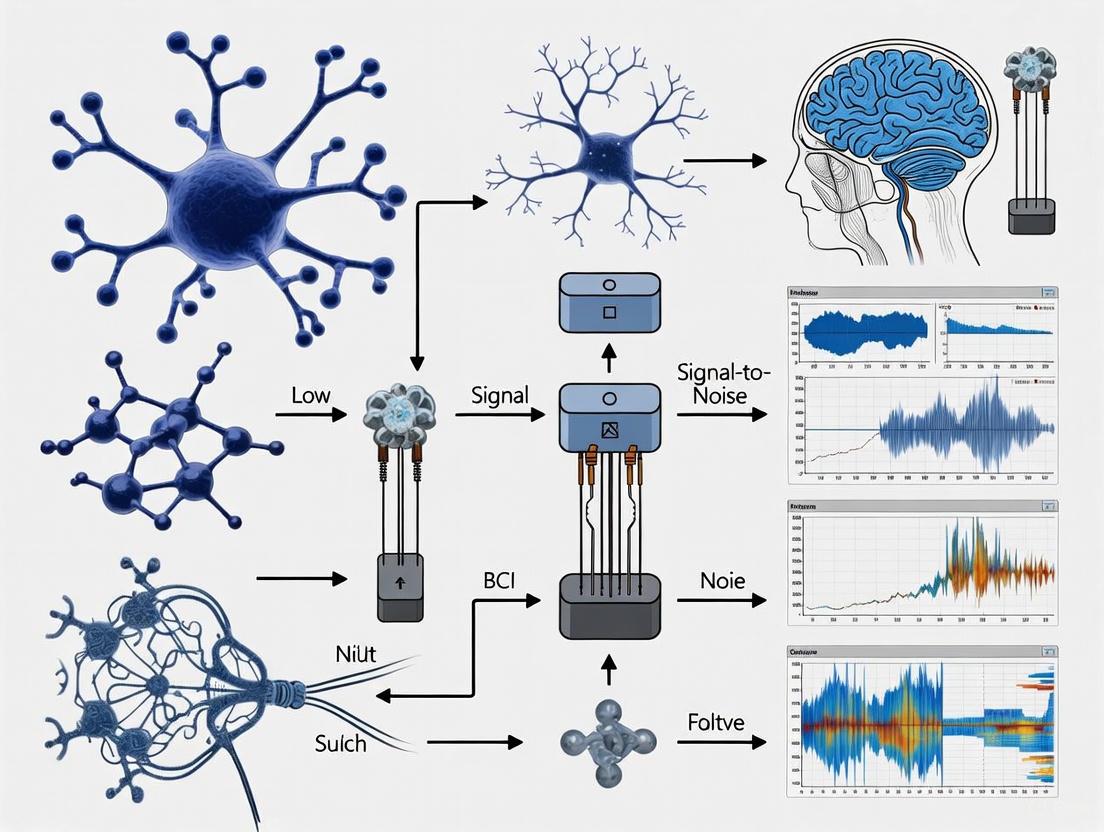
Non-invasive Brain-Computer Interfaces (BCIs) offer tremendous potential for clinical diagnostics, neurorehabilitation, and cognitive research, yet their widespread adoption is hampered by a fundamental challenge: the low signal-to-noise ratio (SNR) of...
Overcoming the Signal-to-Noise Ratio Challenge in Non-Invasive Brain-Computer Interfaces: Strategies for Biomedical Research
Abstract
Non-invasive Brain-Computer Interfaces (BCIs) offer tremendous potential for clinical diagnostics, neurorehabilitation, and cognitive research, yet their widespread adoption is hampered by a fundamental challenge: the low signal-to-noise ratio (SNR) of neural recordings. This article provides a comprehensive analysis for researchers and drug development professionals, exploring the physiological and technical origins of poor SNR in systems like EEG. It details cutting-edge methodological advances in signal processing, electrode technology, and hybrid approaches that enhance signal fidelity. The article further offers practical optimization frameworks for real-world deployment, presents a comparative analysis of BCI modalities, and concludes with future trajectories for integrating high-fidelity BCIs into biomedical research and therapeutic development.
Understanding the SNR Bottleneck: The Core Challenge in Non-Invasive BCI
Defining Signal-to-Noise Ratio in the Context of EEG and fNIRS
Frequently Asked Questions (FAQs)
FAQ 1: What is Signal-to-Noise Ratio (SNR) and why is it a critical challenge in non-invasive BCI research?
Answer: Signal-to-Noise Ratio (SNR) quantifies the strength of a desired neural signal relative to the background noise. A high SNR indicates a clear, detectable signal, while a low SNR means the signal is obscured by noise. In non-invasive BCI research, this is a fundamental challenge because the signals of interest (neural electrical activity for EEG, hemodynamic responses for fNIRS) are inherently weak when measured through the scalp and skull [1] [2]. The resulting low SNR can severely limit the reliability, accuracy, and information transfer rate of BCI systems, making it difficult to distinguish a user's intentional commands from irrelevant brain activity or artifacts [3] [1].
FAQ 2: What are the primary sources of noise in EEG and fNIRS experiments?
Answer: The two modalities are susceptible to different types of noise, which can be categorized as follows:
Table: Common Noise Sources in EEG and fNIRS
| Modality | Physiological Noise | Motion & Environmental Noise | Instrumental Noise |
|---|---|---|---|
| EEG | Ocular artifacts (EOG), muscle activity (EMG), cardiac activity (ECG) [4] | Head movement, line noise (50/60 Hz) from power sources [5] [1] | Electrode impedance fluctuations, amplifier noise [1] |
| fNIRS | Cardiac pulsation, respiration, blood pressure changes (Mayer waves), systemic scalp blood flow [4] [6] [7] | Head movement, which directly disrupts optode-scalp coupling [5] [6] | Instrument instability, ambient light leakage [6] |
A key challenge in fNIRS is that task-evoked systemic physiology (e.g., changes in heart rate or blood pressure) can create hemodynamic changes in the scalp that mimic the genuine cortical brain signal, leading to potential "false positives" if not properly corrected [7].
FAQ 3: How does the combination of EEG and fNIRS help to overcome low SNR limitations?
Answer: EEG and fNIRS are highly complementary modalities. Their integration, known as multimodal fusion, leverages the strengths of one to compensate for the weaknesses of the other, thereby effectively increasing the system's overall SNR for decoding brain states [5] [4] [8].
- Temporal-Spectral Complementarity: EEG provides millisecond-scale temporal resolution, capturing the direct electrical firing of neurons, while fNIRS tracks the slower, secondary hemodynamic response (over seconds) with better spatial resolution [5] [8].
- Physiological Cross-Validation: The signals are linked via neurovascular coupling—the process where neural activity triggers a localized hemodynamic response [5]. An observed change in hemoglobin concentrations from fNIRS that coincides with a specific EEG rhythm pattern provides built-in validation that a genuine neural event has occurred, increasing confidence over a single-modality measurement [5] [4].
- Noise Resistance: fNIRS is relatively robust to motion artifacts and electrical noise that severely corrupt EEG signals. Conversely, advanced data-driven fusion methods can use the fast electrical information from EEG to help model and remove physiological noise (like cardiac pulsation) from the fNIRS signal [4].
Research using multilayer network models has demonstrated that this integrated approach provides a richer and more comprehensive understanding of brain function than unimodal analyses alone [8].
Troubleshooting Guides
Guide 1: Troubleshooting Low SNR in fNIRS Data
Problem: The measured fNIRS signal shows a weak or non-existent hemodynamic response, or the signal is dominated by large, irregular artifacts.
Solution: Implement a robust pre-processing and processing pipeline.
Table: Common fNIRS Pre-processing and Processing Techniques
| Step | Technique | Function | Key Parameters |
|---|---|---|---|
| Pre-processing | Bandpass Filtering [6] | Removes high-frequency noise (e.g., cardiac) and low-frequency drift (e.g., respiration). | High-pass: ~0.01 Hz; Low-pass: ~0.2-0.3 Hz |
| Wavelet Filtering [6] | Effective for removing specific, structured noise like motion artifacts. | Decomposes signal into time-frequency components. | |
| Short-Channel Regression [7] | Critical step. Uses a short source-detector separation channel (~8-10 mm) to measure and regress out scalp hemodynamics. | Source-detector distance < 15 mm | |
| Processing | General Linear Model (GLM) [6] | Models the expected hemodynamic response to task conditions, statistically isolating the task-related signal. | Canonical Hemodynamic Response Function (HRF) |
| Multi-Channel Regression [7] | An alternative when short channels are unavailable; regresses out a global component common to multiple long-distance channels. | Requires multiple channels over the head. |
Important Considerations:
- The choice of processing pipeline significantly impacts results and reproducibility. Studies show that nearly 80% of research teams agreed on group-level findings when using proper methods, but agreement was lower for individual-level data, largely due to differences in how poor-quality data and physiological confounders were handled [9].
- Avoid using manufacturer-provided standard processing as a "black box" without understanding the steps, as this can lead to false positives from uncorrected systemic artifacts [7].
Guide 2: Troubleshooting Low SNR in EEG Data
Problem: The EEG signal is noisy, making it difficult to detect event-related potentials (ERPs) or distinct brain rhythms (e.g., alpha, beta).
Solution: Focus on artifact removal and signal enhancement techniques.
- Artifact Removal: Use advanced algorithms to identify and remove contaminants.
- Ocular Artifacts: Apply regression-based methods or Blind Source Separation (e.g., Independent Component Analysis - ICA) to identify and remove components associated with eye blinks and movements [4] [1].
- Muscle Artifacts: Utilize filtering and ICA to target the high-frequency components characteristic of EMG noise [4].
- Spatial Filtering: Implement techniques like Common Average Reference (CAR) or Laplacian filtering to reduce global noise and enhance the locality of brain signals [1].
- Trial Averaging: For evoked responses like ERPs, averaging multiple trials together will suppress random noise and reinforce the time-locked neural signal.
Guide 3: A Methodological Protocol for Multimodal fNIRS-EEG to Enhance SNR
This protocol outlines a concurrent fNIRS-EEG experiment based on a motor imagery paradigm, a common BCI task [8].
Objective: To simultaneously record and analyze electrophysiological (EEG) and hemodynamic (fNIRS) brain activity during a motor imagery task, leveraging their complementarity to achieve a higher effective SNR for brain state classification.
Materials and Setup:
- EEG System: A high-density EEG system with compatible electrode cap.
- fNIRS System: A continuous-wave fNIRS system with wavelengths typically at 760 nm and 850 nm, integrated into the same cap or worn separately [5] [8].
- Optode Placement: Optodes should be positioned over the brain regions of interest (e.g., the sensorimotor cortex for motor imagery, using the international 10-20 system for placement) [8].
- Short-Separation Channels: Incorporate fNIRS source-detector pairs with short separations (e.g., < 15 mm) to record superficial scalp hemodynamics for later regression [4] [7].
- Stimulus Presentation: Software to present visual cues (e.g., arrows indicating "left-hand" or "right-hand" motor imagery).
Procedure:
- Participant Preparation: Fit the participant with the integrated EEG-fNIRS cap. Apply electrolyte gel for EEG electrodes and ensure good optical contact for fNIRS optodes. Check signal quality before starting.
- Experimental Paradigm:
- Use a block design consisting of alternating periods of rest and task.
- Each trial begins with a fixation cross (rest period, e.g., 20 seconds).
- A visual cue is then displayed, instructing the participant to perform either left-hand or right-hand motor imagery (task period, e.g., 10 seconds).
- Repeat for multiple trials (e.g., 20-30 per condition).
- Data Acquisition: Start simultaneous recording of EEG and fNIRS data. Synchronize the timing of the paradigm with the data acquisition systems using trigger signals.
- Data Processing:
- fNIRS Processing: Convert raw light intensity to changes in oxygenated (HbO) and deoxygenated hemoglobin (HbR) concentration. Apply a bandpass filter, then use the short-separation channels to regress out superficial noise. Model the hemodynamic response using a GLM [6] [7].
- EEG Processing: Apply bandpass filtering (e.g., 0.5-45 Hz). Correct for artifacts using ICA. For motor imagery, focus on extracting power in specific frequency bands (e.g., sensorimotor rhythms in the mu/beta band) [1].
- Data Fusion and Analysis: Employ data-driven fusion methods (e.g., concatenating features, joint classification) to combine the temporal features from EEG with the spatial features from fNIRS to improve the classification accuracy of the motor imagery tasks [4] [8].
Signaling Pathways and Experimental Workflows
Neural Activity to Measured Signals
Research Reagent Solutions
Table: Essential Materials for Concurrent fNIRS-EEG Experiments
| Item | Function in Research | Technical Considerations |
|---|---|---|
| Integrated EEG-fNIRS Cap | A head cap with pre-configured positions for both EEG electrodes and fNIRS optodes. | Ensures consistent and co-registered placement of both modalities on the scalp according to the 10-20 system [8]. |
| Short-Separation fNIRS Channels | fNIRS source-detector pairs placed 8-15 mm apart. | Critical for measuring and subsequently regressing out hemodynamic noise originating from the scalp, which is a major confounder for cortical signals [4] [7]. |
| Electrolyte Gel | A conductive medium used for EEG electrodes. | Reduces impedance between the scalp and electrode, improving the quality of the recorded electrical signal and reducing noise [1]. |
| General Linear Model (GLM) Software | A statistical framework (e.g., in MATLAB, Python) for analyzing fNIRS data. | Used to model the expected hemodynamic response to stimuli and statistically evaluate the presence of a task-related signal, isolating it from noise [6]. |
| Independent Component Analysis (ICA) Algorithm | A blind source separation algorithm for EEG data. | Effectively identifies and removes stereotypical artifacts like eye blinks and muscle activity from the continuous EEG signal [4] [1]. |
| Data Fusion Toolbox | Software libraries (e.g., in Python) for multimodal data analysis. | Enables the integration of EEG and fNIRS features at the data, feature, or decision level to improve the SNR and performance of brain state decoding [4] [8]. |
Multimodal fNIRS-EEG Experimental Workflow
For researchers and scientists working in non-invasive Brain-Computer Interface (BCI) development, understanding the physiological origins of signal degradation is fundamental to improving the signal-to-noise ratio (SNR). Non-invasive BCIs, particularly those using electroencephalography (EEG), face inherent challenges because the electrical signals generated by the brain are significantly attenuated and distorted as they pass through various biological tissues before reaching electrodes on the scalp [10] [11].
The brain's electrical activity originates from the summed postsynaptic potentials of pyramidal neurons. To be detectable at the scalp, this activity must propagate through the cerebrospinal fluid (CSF), skull, and scalp—each with different electrical conductive properties. This journey results in substantial signal weakening, spatial blurring, and contamination by various biological and environmental artifacts [11] [12]. This guide provides a structured troubleshooting framework to identify, understand, and mitigate these sources of signal degradation in your experimental setups.
Frequently Asked Questions (FAQs)
Q1: What are the primary physiological sources of the low signal-to-noise ratio in non-invasive EEG?
The low SNR stems from multiple physiological factors [11]:
- Signal Attenuation and Spatial Smearing: The skull acts as a low-pass filter, severely attenuating signals (especially higher frequencies) and blurring their spatial origin. The electrical signal can be weakened by as much as 100 times as it passes through these layers [10] [12].
- Non-Neural Biological Artifacts: These include electrical activity from eye movements (electrooculogram, EOG), muscle contractions (electromyogram, EMG), and heart activity (electrocardiogram, ECG). These signals are often orders of magnitude stronger than cortical EEG, making them a predominant source of contamination [11].
- Physiological Variability: Brain signals are inherently non-stationary and influenced by the subject's age, psychology, fatigue, and testing environment, leading to significant intra- and inter-subject variability [11].
Q2: How does the choice between wet and dry electrodes impact signal quality?
The electrode-skin interface is a critical factor in signal quality [13] [14]:
- Wet Electrodes: Use a conductive gel to reduce impedance between the scalp and electrode. They provide higher signal quality and lower impedance, making them the standard for clinical-grade research. The main trade-offs are the lengthy setup time, need for expert application, and subject discomfort during prolonged use. Gel can also dry out, degrading signal over long sessions [13].
- Dry Electrodes: Are quick to set up and more comfortable for users, ideal for consumer wearables and long-term monitoring. However, the convenience comes with a tradeoff: they typically have a higher and more variable electrode-skin impedance, resulting in a noisier signal more susceptible to motion artifacts [13] [14]. Modern designs with active electronics help mitigate this issue.
Q3: What are the most effective signal processing techniques to isolate neural signals from noise?
A combination of denoising and advanced feature extraction techniques is required [11]:
- Preprocessing & Denoising: Use band-pass filters to isolate frequency bands of interest (e.g., Alpha: 8-13 Hz, Beta: 13-30 Hz). Apply techniques like Independent Component Analysis (ICA) to identify and remove stereotypical artifacts like eye blinks and heartbeats.
- Feature Extraction: To overcome the low SNR, move beyond raw signal analysis. Extract informative features such as temporal patterns (e.g., event-related potentials like P300), spectral power in specific bands, or connectivity measures between electrodes [11].
- Machine Learning Classification: Employ classifiers like Support Vector Machines (SVM) or deep learning models such as Convolutional Neural Networks (CNNs) to recognize patterns in the extracted features that correlate with the user's intent, even in a noisy background [11] [15].
Troubleshooting Guide: Common Issues and Solutions
| Symptom | Potential Physiological Cause | Recommended Solution |
|---|---|---|
| High-frequency noise and slow drift in signal | Poor electrode-skin contact; sweating; dry gel. | Re-prep or replace the electrode. Ensure skin is clean and lightly abraded. For wet electrodes, check for sufficient gel [11] [14]. |
| Large, slow voltage shifts | Ocular artifacts (eye blinks and movements). | Apply ICA to remove components correlated with EOG. Instruct the subject to minimize eye movements and fixate on a point [11]. |
| High-frequency, burst-like noise | Muscle artifacts (EMG) from jaw clenching, forehead frowning, or neck tension. | Use spectral analysis to identify EMG contamination (typically 20-300 Hz). Apply notch or high-pass filtering. Encourage the subject to relax facial and neck muscles [11]. |
| Periodic, sharp spikes in the signal | Cardiogenic artifacts (ECG) or pulse artifacts. | This can be removed using ICA or template subtraction algorithms that are synchronized with the heartbeat [11]. |
| Unstable signal and high impedance across multiple channels | Mechanical motion of cables or the subject; poor grounding. | Secure the headset and cables to prevent tugging. Ensure the ground/reference electrode has excellent contact. Use a head cap for stability [12]. |
| Inconsistent BCI performance across subjects or sessions | High inter-subject variability and non-stationary nature of EEG signals. | Employ subject-specific calibration and adaptive machine learning models like Transfer Learning (TL) to personalize the BCI system [15]. |
Experimental Protocols for Signal Quality Validation
Protocol 1: Systematic Impedance Checking and artifact Labeling
Objective: To establish a baseline for signal quality at the start of an experiment. Materials: EEG system, abrasive skin prep gel, conductive gel, impedance checker. Methodology:
- Application: Apply electrodes according to the international 10-20 system.
- Impedance Check: Measure impedance at every electrode. The target is typically < 10 kΩ for wet electrode systems [14]. For dry electrodes, consistent impedance across channels is more critical than an absolute value.
- Baseline Recording: Before the main task, record a 2-minute resting-state baseline (eyes-open and eyes-closed). This helps identify subject-specific noise profiles.
- Artifact Labeling: During the experiment, use a trigger or marker to label periods of known artifacts (e.g., experimenter-tagged eye blinks, subject-reported swallows). Outcome: A log of initial impedance values and a baseline recording that can be used for data-driven cleaning (e.g., ICA) later.
Protocol 2: Validation of Dry Electrode Performance Against Wet Electrodes
Objective: To quantitatively compare the signal quality of a dry electrode system against a clinical-grade wet system. Materials: A wet EEG system, a dry EEG headset, and a data synchronization unit. Methodology:
- Setup: Fit the subject with both systems simultaneously, ensuring electrodes are as co-located as possible.
- Task Paradigm: Conduct a block-designed experiment with alternating periods of rest and a known neural response task (e.g., alternating eyes-open/eyes-closed to evoke Alpha rhythm, or a visual P300 task).
- Data Analysis:
- Calculate the Signal-to-Noise Ratio (SNR) of the event-related potential (ERP) for both systems.
- Compare the band power in the Alpha band during eyes-closed vs. eyes-open conditions.
- Compute the Cohen's Kappa agreement for sleep staging or another well-defined neural state classification, if applicable [14]. Outcome: A direct, quantitative comparison of SNR and classification accuracy, validating the dry electrode system's performance for a specific research application.
Signaling Pathways and Workflows
Signal Degradation Pathway
The following diagram illustrates the journey of a neural signal from its origin in the cortex to the scalp electrode, highlighting the points of degradation.
Experimental Workflow for SNR Improvement
This workflow outlines a systematic approach to diagnosing and improving SNR in BCI experiments.
The Scientist's Toolkit: Research Reagent Solutions
| Essential Material / Tool | Function in BCI Research | Key Considerations |
|---|---|---|
| Abrasive Skin Prep Gel | Removes dead skin cells and oils to lower electrode-skin impedance. | Critical for achieving stable impedances <10 kΩ. Avoid excessive abrasion that causes irritation [14]. |
| Electrolyte Gel (Wet Systems) | Forms a stable ionic bridge between skin and electrode, reducing impedance and half-cell potential. | Choose a chloride-based gel for stable DC potentials. Beware of drying over long sessions [13]. |
| Active Dry Electrodes | Amplifies the signal directly at the source to mitigate noise from high electrode-skin impedance. | Ideal for consumer applications and quick setups. Signal quality is improving but may not yet match high-end wet systems [13] [14]. |
| ICA Algorithm Software | Statistically separates neural signals from non-neural artifacts (EOG, EMG) in recorded data. | A powerful blind source separation tool. Requires good-quality input data and is computationally intensive [11]. |
| Machine Learning Toolboxes (e.g., SVM, CNN, TL) | Classifies noisy neural signals into intended commands by learning complex patterns. | Transfer Learning (TL) is key for overcoming inter-subject variability and reducing calibration time [15]. |
| Multimodal Fusion (fNIRS/EEG) | fNIRS provides complementary hemodynamic data that is less susceptible to electrical artifacts. | Helps validate EEG findings and can improve robustness of state detection in hybrid BCI systems [14] [16]. |
Frequently Asked Questions (FAQs)
FAQ 1: What are the most common technical noise sources in non-invasive BCI experiments? The most common technical noise sources can be categorized into hardware limitations and environmental artifacts. Hardware limitations include the physical and electrical properties of the electrodes and the recording equipment itself, such as high impedance at the skin-electrode interface and amplifier noise [10]. Environmental artifacts encompass electromagnetic interference from power lines (50/60 Hz) and other electronic equipment, as well as fluctuations in environmental conditions that can affect signal stability [17].
FAQ 2: How can I tell if my EEG signal is contaminated by environmental noise versus a hardware problem? Environmental noise, like 50/60 Hz power line interference, often appears as a distinct, persistent peak in the frequency spectrum. Hardware problems, such as a faulty electrode with high impedance, typically manifest as abnormal signal patterns on a specific channel, including unusually low amplitude, flatlining, or high-frequency noise that isn't coherent across other channels [17]. A systematic check of each electrode's impedance is the first step in diagnosing a hardware issue.
FAQ 3: What is the impact of these noise sources on the signal-to-noise ratio (SNR) in BCI research? Noise sources directly degrade the SNR by introducing unwanted signal variance that obscures the neural signals of interest. A low SNR makes it difficult to detect event-related potentials (like the P300) or classify motor imagery tasks accurately, leading to reduced BCI performance and reliability [10]. Effectively managing these noise sources is therefore critical for overcoming the inherent challenge of low SNR in non-invasive BCI research [3].
FAQ 4: Are there specific experimental protocols to minimize environmental artifacts? Yes, several protocols can help. These include:
- Artifact Avoidance: Using electrically shielded rooms, increasing the distance between the subject and electromagnetic sources, and employing active electrodes that amplify the signal closer to the source [17].
- Subject Preparation: Properly preparing the scalp to reduce skin-electrode impedance and instructing participants to minimize blinks and muscle movements during critical trial periods. However, note that asking users to refrain from blinking can lead to mental fatigue [17].
- Online Parity in Filtering: Applying digital filters to short, segmented data epochs in real-time (as would be done during online BCI use) rather than only filtering the entire dataset offline after collection. This approach has been shown to improve model performance [17].
FAQ 5: What recent hardware innovations are helping to overcome traditional limitations? Recent innovations focus on improving the quality and stability of the signal acquisition at the source. A key development is the creation of wearable microneedle sensors that slightly penetrate the skin. These sensors avoid hair follicles, reduce impedance, and get closer to the neural signal source, resulting in higher-fidelity recordings that are robust to motion artifacts. Such devices have demonstrated high classification accuracy (e.g., 96.4%) during activities like walking and running [18].
Troubleshooting Guides
Guide 1: Diagnosing and Resolving High Impedance Electrode Issues
| Step | Action | Expected Outcome & Notes | |
|---|---|---|---|
| 1 | Visual Inspection | Check for dried electrolyte gel, poor skin contact, or damaged wires. | Ensure all electrodes are firmly attached with sufficient conductive medium. |
| 2 | Impedance Check | Use your amplifier's built-in impedance measurement function. | Impedance should ideally be below 10 kΩ for each channel. Mark channels with significantly higher readings. |
| 3 | Re-prep Skin | Gently abrade the skin site and apply fresh conductive gel or paste. | This is the most common solution for high impedance. |
| 4 | Re-test Impedance | Measure the impedance again after re-prepping. | If impedance remains high, proceed to hardware checks. |
| 5 | Hardware Check | Swap the problematic electrode with one from a known good channel. | If the problem moves with the electrode, the electrode/cable is faulty. If the problem stays on the original channel, the amplifier input may be faulty. |
Guide 2: Mitigating Power Line (50/60 Hz) Interference
| Step | Action | Expected Outcome & Notes | |
|---|---|---|---|
| 1 | Environment Scan | Identify and turn off non-essential electronic devices near the subject and recording setup. | Common sources: monitors, power supplies, unshielded cables. |
| 2 | Impedance Balancing | Ensure all electrode impedances are low and, crucially, balanced. | Balanced impedances help reject common-mode noise. A difference of >10 kΩ between electrodes can cause issues. |
| 3 | Check Grounding | Verify the subject ground electrode has excellent contact and low impedance. | A poor ground is a frequent cause of 50/60 Hz noise. |
| 4 | Apply Notch Filter | As a last resort, apply a 50 Hz or 60 Hz notch filter in your acquisition software. | Use cautiously, as it may remove neural signals in the same frequency band. Always document filter settings [17]. |
Quantitative Data on Noise and Performance
Table 1: Comparison of Non-Invasive BCI Sensor Technologies and Noise Characteristics
| Sensor Type | Key Feature | Reported Advantage / Impact on Noise | Classification Accuracy (Example) |
|---|---|---|---|
| Traditional Wet Electrodes | Conductive gel for low impedance [10] | Gold standard for signal quality but cumbersome; gel can dry, increasing noise over time. | Varies widely with paradigm and subject. |
| Dry Electrodes | No gel required [10] | Higher and more variable impedance, prone to motion artifacts. Faster setup. | Generally lower than wet electrodes due to higher noise. |
| Wearable Microneedle Sensors | Minimal skin penetration [18] | Reduces impedance by avoiding hair and getting closer to signal source; stable for up to 12 hours. | 96.4% (Visual stimulus classification during movement) [18]. |
| Optimized Channel Selection (SPEA-II) | Algorithmically selects best EEG channels [19] | Reduces redundant data and noise from non-informative channels, improving SNR for Motor Imagery. | Outperformed conventional methods in MI-based BCI systems [19]. |
Table 2: Common Artifact Types and Filtering Approaches
| Artifact Type | Origin | Typical Frequency Range | Recommended Filtering Approach |
|---|---|---|---|
| Power Line Interference | Environment | 50 Hz or 60 Hz (narrowband) | Notch Filter [17] |
| Ocular Artifacts (Blinks, Eye Movements) | Physiological | Low-frequency (< 4 Hz) | High-pass filter (e.g., 0.5-1.0 Hz); Advanced techniques like Independent Component Analysis (ICA) [17] |
| Muscle Artifacts (EMG) | Physiological | High-frequency (20+ Hz) | Low-pass filter (e.g., 40-70 Hz); Careful to not remove neural gamma activity [17] |
| Motion Artifacts | Physical Movement | Broadband | Hardware solutions (e.g., microneedle sensors) [18]; Online digital filtering with segmented epochs [17] |
Experimental Protocols for Noise Mitigation
Protocol 1: Implementing Online Parity in Signal Filtering
This protocol ensures that the data processing steps used during offline analysis match those used during real-time, closed-loop BCI operation, which is crucial for generalizable performance [17].
- Data Acquisition: Record EEG data during your BCI paradigm (e.g., P300 speller task).
- Online Simulation (Segmented Filtering): Instead of filtering the entire continuous dataset, break the data into short epochs (e.g., 1-second segments following a stimulus). Apply your chosen digital filter (e.g., a 0.1-30 Hz bandpass filter) to each of these individual segments.
- Model Training: Train your classification model (e.g., for P300 detection) using features extracted from these segmented-and-filtered epochs.
- Online Application: During real-time BCI use, apply the exact same filtering process to the incoming, real-time data streams segmented into the same epoch length.
This method has shown significant benefits to model performance compared to conventional offline filtering of the entire dataset [17].
Protocol 2: Regularized CSP with SPEA-II for Optimal Channel Selection
This protocol reduces the number of EEG channels, which minimizes setup time, improves user comfort, and, crucially, enhances the SNR by eliminating noisy or redundant channels for Motor Imagery (MI) tasks [19].
- Data Collection: Collect multi-channel EEG data from a subject performing MI tasks (e.g., left-hand vs. right-hand movement imagery).
- Feature Extraction: Apply Regularized Common Spatial Patterns (RCSP) to the data from all channels to extract features that maximize the variance between the two MI classes.
- Multi-Objective Optimization: Use the Strength Pareto Evolutionary Algorithm II (SPEA-II) to find the optimal subset of channels. The algorithm evaluates different channel subsets based on two objectives: a) maximizing classification accuracy and b) minimizing the number of channels used.
- Model Training & Validation: Train a classifier (e.g., SVM, LDA) using the features from the optimal channel subset identified by SPEA-II. Validate the performance on a separate test set. This approach has been demonstrated to optimize performance in MI-based BCI systems by effectively managing noise and redundancy [19].
Signaling Pathways and Workflows
The Scientist's Toolkit: Research Reagent Solutions
Table 3: Essential Materials and Algorithms for Noise-Resilient BCI Research
| Item / Solution | Function in BCI Research | Relevance to Noise Mitigation |
|---|---|---|
| Conductive Gel/Paste | Establishes a low-impedance electrical connection between the scalp and electrode [10]. | Directly addresses hardware-level noise from poor skin-contact. |
| Active Electrodes | Incorporate a miniature amplifier within the electrode itself to boost the signal at the source. | Reduces environmental interference picked up along the cable to the main amplifier. |
| Impedance Checker | A tool (often built into modern amplifiers) to measure the electrical impedance at each electrode site. | Critical for diagnosing hardware noise and ensuring balanced impedances for noise cancellation. |
| Wearable Microneedle BCI Sensor | A sensor that slightly penetrates the skin, avoiding hair follicles [18]. | Directly tackles hardware and motion artifacts by providing a stable, high-fidelity interface. |
| Regularized CSP (RCSP) | A feature extraction algorithm for discriminating between different Motor Imagery tasks [19]. | Improves signal separability, making the classifier more robust to noise. |
| SPEA-II Algorithm | A multi-objective evolutionary algorithm for selecting an optimal subset of EEG channels [19]. | Removes noisy or redundant channels, thereby improving the overall SNR for the system. |
| Online Digital Filtering | A processing technique where filters are applied to short, real-time data segments [17]. | Maintains "online parity," ensuring noise removal is consistent and effective during actual BCI use. |
The Impact of Low SNR on Information Transfer Rate (ITR) and System Performance
FAQs: Understanding SNR and ITR in Non-Invasive BCI
What is Signal-to-Noise Ratio (SNR) in the context of non-invasive BCI? Signal-to-Noise Ratio (SNR) is a metric, often expressed in decibels (dB), that quantifies the strength of a desired neural signal relative to the background noise. In non-invasive BCI systems like electroencephalography (EEG), a high SNR means the brain signals of interest (such as SSVEPs or ERDs) are clear and distinct from noise, enabling more accurate decoding. A low SNR indicates that the system struggles to distinguish the neural signal from noise, leading to degraded BCI performance and reliability [20].
How does low SNR directly impact the Information Transfer Rate (ITR)?
Low SNR directly reduces the Information Transfer Rate (ITR), a key metric for BCI communication speed measured in bits per minute (bpm). The mathematical relationship between classification accuracy (P), the number of possible choices (N), and the selection time per character (T) is given by the ITR formula [21]:
Since classification accuracy (P) drops significantly with low SNR, the ITR decreases accordingly. For instance, one study noted that classification accuracy below 80% substantially hinders free communication, directly reducing the practical ITR a user can achieve [21].
What are the most common sources of noise degrading SNR in non-invasive BCI? The common sources of noise that degrade SNR in non-invasive BCI include [22]:
- Biological Artifacts: Electrical activity from eye movements (EOG), muscle contractions (EMG), and heart rhythms (ECG).
- Environmental Noise: Electromagnetic interference (EMI) from power lines, fluorescent lighting, motors, or other electronic equipment [20].
- Improper Setup: Dirty or damaged electrodes and connectors, incorrect application of conductive gel, and using the wrong type of electrodes (e.g., dry vs. gel-based) can introduce significant signal loss and noise [22] [20].
- Inherent Physiological Limitations: Non-invasive signals like EEG measure the average activity of neurons from the scalp. The signal is attenuated and spatially blurred as it passes through the cerebrospinal fluid, skull, and scalp, which is an intrinsic cause of lower SNR compared to invasive methods [1] [23].
Why is achieving a high ITR in a real-world "free communication" scenario more difficult than in a cued lab experiment? Cued lab experiments (e.g., repetitively typing "HIGH SPEED BCI") simplify the user's cognitive task and minimize eye movements, which helps maintain a stable SNR. In contrast, genuine free communication involves the continuous generation of novel thoughts, spelling unfamiliar words, and locating characters on a keyboard. This increased cognitive load and visual scanning can introduce more neural "noise" and variability, which reduces classification accuracy and, consequently, the achieved ITR [21].
Troubleshooting Guide: Resolving Low SNR to Improve ITR
Follow this systematic guide to identify and resolve common issues that cause low SNR.
Step 1: Verify Signal Acquisition Integrity
Begin by inspecting the physical setup of your BCI system.
- Action: Visually inspect and clean all electrodes and connectors. Ensure electrodes are properly seated with good electrical contact. For gel-based systems, check that the conductive gel is correctly applied. For research systems using fiber optics, ensure connectors are clean and undamaged [20].
- Rationale: Dirty or poorly connected electrodes are a primary cause of signal loss and increased noise [20].
Step 2: Check for Environmental Interference
- Action: Identify and isolate the system from potential sources of electromagnetic interference (EMI), such as power cables, fluorescent lights, and unshielded electrical equipment [20].
- Rationale: EMI can be inductively or capacitively coupled into the recording equipment, corrupting the neural signal with high-frequency noise.
Step 3: Optimize Experimental and Signal Processing Parameters
If the hardware and environment are correct, optimize your experimental paradigm and processing chain.
The following table summarizes parameter adjustments to enhance SNR and ITR, supported by recent research:
| Parameter | Low SNR/ITR Approach | High SNR/ITR Approach | Experimental Support & Rationale |
|---|---|---|---|
| Stimulation Frequency | Using limited or traditional frequency bands (e.g., 8-15 Hz for SSVEP). | Implementing a broadband white noise stimulus across a wider frequency spectrum [24]. | A 2024 study demonstrated that a broadband BCI outperformed a standard SSVEP BCI by 7 bps, achieving a record 50 bps ITR by improving the channel's spectral resources [24]. |
| Stimulation Duration | Very short trial durations (e.g., 0.5-1.0 s). | Moderately longer trial durations (e.g., 1.5 s) combined with a flicker-free period (0.75 s) [21]. | Longer durations allow the SSVEP response to build up, increasing SNR. A flicker-free period reduces user fatigue, indirectly supporting sustained attention and signal quality [21]. |
| Classification Algorithm | Using standard Canonical Correlation Analysis (CCA). | Employing Filter-Bank CCA and incorporating individualized template optimization [21]. | These advanced methods improve the discrimination between target and non-target signals, boosting classification accuracy (P in the ITR equation) even at lower SNRs [21]. |
| User Training & Paradigm | Testing only on cued, repetitive phrases with experienced users. | Evaluating systems with naïve users in genuine free communication tasks [21]. | This reveals the true cognitive load and performance under realistic conditions. Providing real-time character feedback can improve usability and help users maintain better control [21]. |
Experimental Protocol: Validating SNR Improvements using a Broadband BCI Paradigm
Objective: To empirically demonstrate that a broadband visual stimulus can surpass the ITR of traditional Steady-State Visual Evoked Potential (SSVEP) BCIs by improving the SNR in the frequency domain [24].
Methodology:
- Stimulus Design:
- Control Condition: Use a conventional SSVEP speller with stimuli flickering at specific, discrete frequencies.
- Experimental Condition: Implement a broadband "white noise" stimulus where the visual flicker's intensity changes randomly according to a white noise sequence, stimulating a broader range of frequencies [24].
- Information Theory Analysis:
- Use information theory to estimate the upper and lower bounds of the information rate for the white noise stimulus. The key is to analyze the SNR in the frequency domain, which reflects the available spectrum resources of the visual-evoked channel [24].
- Signal Decoding:
Expected Outcome: The broadband BCI paradigm is expected to yield a significantly higher ITR (as demonstrated by a 7 bps increase, reaching 50 bps) compared to the SSVEP BCI, validating that optimizing the stimulus spectrum is an effective strategy to overcome low SNR limitations [24].
The Scientist's Toolkit: Research Reagent Solutions
This table lists key computational and experimental "reagents" essential for modern non-invasive BCI research focused on overcoming low SNR.
| Research Reagent | Function / Explanation |
|---|---|
| Filter-Bank CCA | A signal processing algorithm that decomposes the EEG signal into multiple sub-bands. It enhances the detection of SSVEPs by leveraging harmonic components, thereby improving classification accuracy and ITR [21]. |
| Transfer Learning (TL) | A machine learning technique that uses data from previous subjects or sessions to reduce the calibration time for a new user. This addresses the high variability in neural signals across individuals, a major source of effective "noise" [25] [15]. |
| Convolutional Neural Networks (CNNs) | A class of deep learning models adept at automatically learning optimal spatial and spectral features from raw or preprocessed EEG signals, reducing the reliance on hand-crafted features that may be sensitive to noise [25] [15]. |
| Dry EEG Electrodes | Electrodes that make direct contact with the scalp without conductive gel. They offer a trade-off: faster setup improves practicality but can sometimes result in higher impedance and susceptibility to motion artifacts compared to wet electrodes [22]. |
| High-Density EEG Montages | Arrays with a large number of electrodes (e.g., 64, 128, or 256) placed according to the international 10-20 system. This allows for sophisticated source localization and noise cancellation through spatial filtering [22]. |
Workflow and Signaling Pathways
The following diagram illustrates the logical pathway from low SNR to its ultimate impact on system performance, and the corresponding optimization strategies.
SNR Impact and Optimization Pathway
This workflow maps the critical steps for diagnosing and resolving low SNR issues. The red nodes indicate problems, while the green nodes represent the corresponding solutions. Implementing the optimization strategies directly counteracts the negative cascade that leads to poor system performance.
Technical Comparison of BCI Signal Acquisition Modalities
The core challenge in selecting a Brain-Computer Interface (BCI) methodology involves balancing signal fidelity against practical and clinical risks. The table below provides a quantitative comparison of key signal acquisition technologies.
Table 1: Technical Specifications of BCI Signal Acquisition Methods
| Feature | EEG (Non-Invasive) | MEG (Non-Invasive) | fNIRS (Non-Invasive) | ECoG (Minimally-Invasive) | Intracortical Recording (Invasive) |
|---|---|---|---|---|---|
| Spatial Resolution | ~10 mm [26] | ~5 mm [26] | ~5 mm [26] | ~1 mm [26] | ~0.05-0.5 mm [26] |
| Temporal Resolution | ~0.05 s [26] | ~0.05 s [26] | ~1 s [26] | ~0.003 s [26] | ~0.003 s [26] |
| Signal-to-Noise Ratio (SNR) | Low [27] | Acceptable | Low (Slow, metabolic) [26] | High [1] [26] | Very High [26] |
| Invasiveness & Risk | Non-Invasive, Safe [10] [28] | Non-Invasive, No Surgical Risk [28] | Non-Invasive, Minimal Risk [28] | Invasive, Surgical Risks [28] [29] | Invasive, Highest Surgical Risks [28] [29] |
| Key Signal Source | Scalp potentials from post-synaptic currents [23] | Magnetic fields from neuronal activity [28] | Hemodynamic response (Hb concentration) [28] | Cortical surface potentials [1] [28] | Local Field Potentials (LFP) & Action Potentials (AP) [23] [26] |
| Primary Limitations | Sensitive to noise/artifacts, low spatial resolution [10] [28] | Bulky equipment, high cost, limited portability [28] [26] | Low temporal resolution, limited penetration depth [28] | Limited coverage, requires surgery [1] | Tissue response, signal stability over time [1] [29] |
Troubleshooting Guide: FAQs on Signal Fidelity Challenges
FAQ 1: What are the fundamental neurophysiological reasons for the lower signal quality in non-invasive BCIs like EEG compared to invasive methods?
The lower signal quality stems from several intrinsic physical and biological barriers:
- Signal Attenuation and Distortion: The skull and other tissues between the brain and scalp electrodes act as a low-pass filter, severely attenuating high-frequency neural signals and burying them in background noise [23]. These tissues also have varying electrophysiological properties, causing significant spatial distortion of the electric fields before they reach the scalp [23].
- Neuronal Source Requirements: For the microvolt-level electrical fields to reach the scalp, a massive number of neurons (pyramidal neurons) must be activated synchronously in a confined area [23]. This means non-invasive EEG largely misses the activity of small, specialized neuronal clusters that invasive methods can detect.
- Limited Information Content: Non-invasive signals are predominantly restricted to lower frequency bands (<90 Hz) and are dominated by a specific type of neuronal activity (post-synaptic potentials), whereas invasive methods can capture the full spectrum of brain signals, including high-frequency action potentials and local field potentials that carry rich information about local processing and output [23].
FAQ 2: What specific signal processing techniques can help overcome the low Signal-to-Noise Ratio (SNR) in non-invasive Motor Imagery (MI)-BCI systems?
Overcoming low SNR is a multi-stage process involving advanced algorithmic approaches:
- Spatial Filtering: Use algorithms like Common Spatial Patterns (CSP) to maximize the variance of the EEG signal for one class (e.g., left-hand imagery) while minimizing it for the other, effectively enhancing the discriminability of MI tasks [30].
- Deep Learning (DL) Models: Employ Convolutional Neural Networks (CNNs) for their ability to perform end-to-end learning from raw or pre-processed EEG data, automatically extracting relevant spatio-temporal features. Recurrent Neural Networks (RNNs) are particularly effective for decoding the time-series nature of EEG signals [30].
- Data Augmentation: Combat limited dataset sizes and overfitting by artificially expanding your training data. Techniques include:
- Adding Gaussian noise to original signals.
- Cropping and Segmentation/Recombination (S&R) of trials in the time domain.
- Window Warping to expand or contract random windows of data [30].
- Transfer Learning (TL): To address the high inter-subject variability that necessitates frequent recalibration, use TL to adapt a model pre-trained on a large group of subjects to a new individual, significantly reducing training time and data requirements [15] [30].
FAQ 3: Are there any emerging hardware technologies that aim to bridge the gap between non-invasive and invasive signal quality?
Yes, recent research focuses on developing novel sensors that improve signal acquisition at the hardware level:
- Wearable Microneedle Sensors: Researchers at Georgia Tech have developed a painless, wearable wireless microneedle BCI sensor. The micro-needles slightly penetrate the skin, bringing the electrodes closer to the neural signal source and avoiding the hair follicle interference that plagues traditional scalp EEG. This design achieves higher-fidelity signals and stable recording over many hours, even during user movement, marking a significant step toward practical daily BCI use [18].
Experimental Protocol: Motor Imagery (MI) Workflow for Non-Invasive BCI
This protocol outlines a standard procedure for conducting an EEG-based MI-BCI experiment, from setup to data analysis.
Figure 1: Experimental workflow for a standard MI-BCI protocol.
Step-by-Step Methodology:
Subject Preparation & Hardware Setup
- Fit the subject with an EEG cap following the international 10-20 system for electrode placement [10].
- Apply conductive electrode gel to achieve and maintain impedance below 5 kΩ throughout the experiment to ensure high-quality signal acquisition [18].
- Configure the EEG amplifier settings (e.g., sampling rate typically at 250 Hz or higher, appropriate band-pass filter).
Experimental Paradigm Design
- Use a cue-based paradigm. Present visual cues on a screen instructing the subject to perform kinesthetic motor imagery (e.g., imagining left-hand vs. right-hand movement without any physical motion).
- Each trial should consist of: (1) a fixation cross, (2) a visual cue indicating the task, (3) the MI period, and (4) a rest period. Randomize the order of cues.
Signal Preprocessing
- Filtering: Apply a band-pass filter (e.g., 8-30 Hz) to isolate the mu and beta rhythms, which are most relevant for MI [30].
- Artifact Removal: Use algorithms like Independent Component Analysis (ICA) to identify and remove artifacts from eye blinks, eye movements, and muscle activity.
Feature Extraction & Classification
- Feature Extraction: Apply the Common Spatial Patterns (CSP) algorithm to the preprocessed EEG epochs. CSP finds spatial filters that maximize the variance of the signals from one class while minimizing the variance from the other, providing highly discriminative features [30].
- Feature Classification: Feed the CSP features into a classifier. For initial studies, a Linear Discriminant Analysis (LDA) or Support Vector Machine (SVM) is recommended due to their simplicity and robustness. For more complex patterns, a Convolutional Neural Network (CNN) can be used [15] [30].
Online Testing & Feedback
- Using the trained model, run an online session where the subject's brain signals are processed and classified in real-time.
- Provide immediate performance feedback to the subject, for example, by moving a cursor on a screen or controlling a simple game. This closed-loop feedback is critical for user learning and engagement [15] [26].
The Scientist's Toolkit: Research Reagent Solutions
Table 2: Essential Materials and Tools for BCI Research
| Item/Tool | Function/Purpose | Example Use-Case |
|---|---|---|
| High-Density EEG Cap | Records electrical brain activity from the scalp using multiple electrodes (e.g., 64, 128 channels). | Primary sensor for non-invasive signal acquisition in MI, P300, and SSVEP paradigms [10] [30]. |
| Conductive Electrode Gel | Improves electrical contact between scalp and electrodes, reducing impedance and improving signal quality. | Applied during EEG cap setup to ensure high-fidelity signal acquisition; crucial for gel-based systems [18]. |
| Common Spatial Patterns (CSP) | A spatial filtering algorithm that optimizes the discrimination between two classes of EEG signals. | Extracting features from multi-channel EEG data during motor imagery tasks (e.g., left vs. right hand) [30]. |
| OpenBCI/BCI2000 Software | Open-source software platforms for BCI data acquisition, stimulus presentation, and protocol design. | Providing a standardized, accessible framework for developing and testing BCI experiments [1]. |
| Transfer Learning (TL) Toolboxes | Machine learning tools that adapt pre-trained models to new subjects, reducing calibration time. | Addressing the challenge of high inter-subject variability in EEG signals, enabling faster subject-specific model training [15] [30]. |
| Wearable Microneedle Sensors | Novel dry electrodes that minimally penetrate the skin for higher SNR and long-term stability. | Enabling high-fidelity, mobile EEG recording for BCIs outside the lab environment; a emerging hardware solution [18]. |
Advanced Signal Acquisition and Processing Methodologies for Enhanced Fidelity
Electrode Performance Comparison
The core challenge in non-invasive Brain-Computer Interface (BCI) research is overcoming the low signal-to-noise ratio (SNR). The choice of electrode technology directly impacts signal quality. The table below compares the key characteristics of different EEG electrode types.
Table 1: Comparison of Non-Invasive EEG Electrode Types
| Electrode Type | Contact Medium | Key Advantages | Key Limitations | Typical Contact Impedance | Best Suited For |
|---|---|---|---|---|---|
| Wet Electrodes [31] | Electrolyte gel (e.g., NaCl) | Stable, low impedance, high-quality signal gold standard [31] | Long setup time, gel dries out, skin irritation, messy [31] | < 10 kΩ (with gel) [31] | Laboratory research requiring the highest signal quality [31] |
| Dry Electrodes [31] | Direct metal/solid contact (no gel) | Quick setup, no skin preparation, long-term use, user-friendly [31] | Higher impedance, more susceptible to motion artifacts [31] | Can be > 100 kΩ [31] | Rapid, mobile BCI applications and consumer products [31] |
| Semi-Dry Electrodes [31] | Minimal liquid (e.g., from a reservoir) | Compromise between wet and dry; lower impedance than dry, less messy than wet [31] | Liquid may still dry out or cause irritation; more complex design [31] | Lower than dry electrodes [31] | Applications requiring good signal quality with faster setup than wet electrodes [31] |
Troubleshooting Guide & FAQs
This section addresses common experimental issues related to electrode use and signal quality.
FAQ 1: Why is my EEG signal consistently noisy, and how can I improve the SNR?
- Problem: A consistently low signal-to-noise ratio (SNR) makes it difficult to isolate neural signals of interest.
- Solution:
- Verify Electrode-Skin Impedance: High impedance is a primary cause of noise. Ensure impedance is below 10 kΩ for wet electrodes and as low as achievable for dry electrodes. Reapply conductive gel or adjust electrode placement if necessary [31].
- Check for Proper Grounding: A faulty ground electrode can introduce 50/60 Hz line noise and other environmental interference into all recording channels. Ensure your ground electrode has a stable, low-impedance connection [31].
- Control Environmental Noise: Perform experiments in a shielded room, if possible, and keep cables away from power sources and monitors to reduce electromagnetic interference [31].
- Consider Advanced Materials: For dry electrodes, explore designs using highly conductive and biocompatible materials like graphene or polymer-based composites, which can offer a better trade-off between impedance and usability [31].
FAQ 2: My dry electrodes show unstable signals and are sensitive to motion. What can I do?
- Problem: Dry electrodes are prone to motion artifacts and signal instability due to poor mechanical contact with the scalp.
- Solution:
- Optimize Mechanical Design: Use electrodes with flexible, spring-loaded, or finger-like structures that can maintain consistent pressure and adapt to scalp and hair movement [31].
- Implement Signal Processing: Apply advanced artifact removal algorithms in real-time, such as Adaptive Filtering or Independent Component Analysis (ICA), to identify and subtract motion-related signal components [26].
- Ensure Proper Fit: Use a cap or headset with a tight but comfortable fit to minimize relative movement between the electrodes and the scalp.
FAQ 3: How can I achieve higher spatial resolution for more precise brain signal mapping?
- Problem: Standard low-density electrode arrays (e.g., 32-64 channels) provide limited spatial resolution.
- Solution:
- Adopt High-Density Arrays: Move to high-density EEG (HD-EEG) systems with 128, 256, or more channels. This provides superior spatial sampling for more accurate source localization of brain activity [32].
- Utilize Flexible MEAs: Flexible High-Density Microelectrode Arrays (FHD-MEAs) offer mechanical compliance, improved long-term biocompatibility, and stable contact, enabling high-resolution neural recording [32].
- Explore Novel Signals: Investigate emerging non-invasive technologies like Digital Holographic Imaging (DHI), which can detect nanometer-scale tissue deformations associated with neural activity, potentially offering a new high-resolution signal source [2].
Experimental Protocols for Electrode Validation
Protocol 1: Validating Electrode Performance and Signal Quality
This protocol provides a methodology for quantitatively comparing the performance of different electrode types in a controlled setting.
Diagram: Electrode Validation Workflow
- Objective: To systematically evaluate and compare the signal quality and performance of wet, dry, and semi-dry EEG electrodes.
- Materials:
- EEG acquisition system with multiple channels.
- Different electrode types (wet, dry, semi-dry) to be tested.
- Conductive gel and skin preparation supplies (abrasive gel, alcohol wipes).
- A standardized headcap or holder that allows for consistent placement of different electrode types.
- A computer with a monitor for visual stimulus presentation.
- Data analysis software (e.g., MATLAB, Python with MNE, BrainVision Analyzer [33]).
- Procedure:
- Subject & Setup Preparation: Recruit subjects following ethical guidelines. Explain the experiment and obtain informed consent. Set up the EEG system according to the manufacturer's instructions.
- Electrode Application & Impedance Check: Apply the different electrode types to the subject's scalp according to the international 10-20 system (e.g., at positions C3, C4, Pz). For wet electrodes, prepare the skin and apply gel. Measure and record the initial contact impedance for every electrode. The target for wet electrodes is typically < 10 kΩ [31].
- Data Acquisition Protocol: Record EEG data under the following conditions:
- Resting State: 5 minutes with eyes open and 5 minutes with eyes closed. . Event-Related Potentials (ERPs): Present a visual P300 oddball paradigm. This involves displaying a series of frequent (non-target) and rare (target) stimuli on a screen. Instruct the subject to mentally count the target stimuli. . Motor Imagery (MI): Instruct the subject to imagine moving their right hand or left hand in response to a visual cue, following a standard timing protocol.
- Signal Analysis & Metric Calculation: For each condition and electrode type, calculate the following quantitative metrics [31] [26]:
- Signal-to-Noise Ratio (SNR): Calculate as the ratio of the power of the neural signal (e.g., alpha band during eyes closed) to the power of the noise (e.g., during a pre-stimulus baseline).
- Noise Amplitude: Measure the root mean square (RMS) of the signal during a resting baseline period.
- ERP Amplitude/Latency: For the P300 paradigm, measure the peak amplitude and latency of the P300 component at the Pz electrode. . Task Classification Accuracy: For the MI data, use a machine learning classifier (e.g., Linear Discriminant Analysis) to decode left vs. right hand imagery and report the cross-validated accuracy.
- Statistical Comparison: Perform statistical tests (e.g., repeated-measures ANOVA) to determine if there are significant differences in the calculated metrics (SNR, P300 amplitude, classification accuracy) between the different electrode types.
Protocol 2: Testing a Novel Non-Invasive Signal Source
This protocol outlines the methodology for experimenting with a cutting-edge signal modality, as demonstrated by Johns Hopkins APL [2].
Diagram: Novel Signal Acquisition Setup
- Objective: To detect and validate neural activity through non-invasive recording of associated neural tissue deformations using a Digital Holographic Imaging (DHI) system [2].
- Materials:
- Digital Holographic Imaging system (including a laser source, specialized camera, and processing unit).
- (Note: This protocol is based on a laboratory setup and may not be immediately feasible for all researchers due to the specialized equipment required.)
- Procedure:
- System Calibration: Calibrate the DHI system for nanometer-scale sensitivity. This involves ensuring the laser and camera are aligned to precisely measure the phase of the scattered light, which is affected by tiny tissue movements [2].
- Signal Acquisition: Position the laser to illuminate the subject's scalp over the primary motor cortex. Record the scattered light with the camera while the subject performs a motor task (e.g., finger tapping) or motor imagery.
- Clutter Mitigation: The primary challenge is separating the neural signal from physiological "clutter" like blood flow and respiration. Use signal processing techniques to filter out these known noise sources based on their characteristic frequencies [2].
- Signal Validation: Correlate the extracted tissue deformation signal with the onset and offset of the motor task. Simultaneous recording with a validated method like EEG or fMRI can be used to confirm that the detected signal is temporally correlated with neural activity [2].
The Scientist's Toolkit: Essential Research Reagents & Materials
Table 2: Key Materials for Next-Generation BCI Electrode Research
| Item / Reagent | Function / Application | Key Characteristics & Examples |
|---|---|---|
| Conductive Electrolyte Gels [31] | Establishes electrical connection for wet electrodes; reduces skin-electrode impedance. | NaCl-based, chloride-based; must be non-irritating and have stable conductivity [31]. |
| Flexible Substrate Materials [32] | Base material for flexible MEAs and comfortable dry electrodes; improves long-term wearability and contact. | Soft polymers like PDMS, polyimide; biocompatible; allow for conformal contact with the scalp [31] [32]. |
| Advanced Conductive Coatings [31] [32] | Coating for dry electrodes to enhance charge transfer and lower contact impedance. | Materials like graphene, CNTs (Carbon Nanotubes), PEDOT:PSS; offer high conductivity and biocompatibility [31]. |
| High-Density EEG Caps | Holds a large number of electrodes (128-256+) for high spatial resolution mapping. | Durable, precisely mapped according to 10-10/10-5 systems; often use Ag/AgCl sintered electrodes [32]. |
| Digital Holographic Imaging System [2] | A novel non-invasive system for detecting neural activity via nanometer-scale tissue deformations. | Includes laser, specialized camera; measures changes in scattered light phase; high spatial resolution potential [2]. |
Leveraging Machine Learning and Deep Learning for Noise Filtering and Feature Extraction
Frequently Asked Questions (FAQs)
Q1: What are the most effective deep learning architectures for removing noise and artifacts from non-invasive BCI data? Convolutional Neural Networks (CNNs) are highly effective for this task. Architectures like EEGNet are specifically optimized for EEG-based BCI systems, automatically learning hierarchical representations from raw signals to isolate neural patterns from noise [34] [35]. For handling temporal dependencies and non-stationary data, Recurrent Neural Networks (RNNs) or Long Short-Term Memory (LSTM) networks are often employed [35]. Furthermore, hybrid models that combine a CNN with a Kalman filter (CNN-KF) have demonstrated a significant performance boost, improving task performance by a factor of nearly 4 times in some real-time control experiments by effectively filtering noisy time-series data [36].
Q2: Our BCI system's performance drops with new users. How can we reduce calibration time? Transfer Learning (TL) is the primary technique to address this. It allows a model pre-trained on a large dataset from multiple subjects to be rapidly fine-tuned with a minimal amount of data from a new user [25]. For instance, one protocol involves training a base model on an initial session, then fine-tuning it with same-day data from a new user, which has been shown to significantly enhance task performance across sessions [34]. Domain adaptation networks, such as those used for SSVEP, can transform source user data to align with a new user's signal template, drastically reducing calibration needs [35].
Q3: Which feature extraction methods work best for decoding motor imagery? The Common Spatial Patterns (CSP) algorithm is a classic and powerful method for feature extraction in motor imagery paradigms, as it maximizes the variance between two classes of signals [37] [35]. For more nuanced tasks, such as individual finger movement decoding, time-frequency analysis using wavelet transforms is highly effective [37] [34]. With the advancement of deep learning, end-to-end models that perform automatic feature extraction from raw or minimally pre-processed EEG signals are increasingly demonstrating superior performance, eliminating the need for manual feature engineering [34] [25].
Q4: How can we improve the real-time performance of our BCI decoding pipeline? Implementing adaptive filtering techniques, such as the Recursive Least Squares algorithm, can robustly denoise signals in real-time [35]. Leveraging edge computing platforms allows for powerful on-device signal processing, reducing latency [38]. Additionally, applying online smoothing algorithms to the decoder's output can stabilize control signals, making the real-time operation more robust and reliable [34].
Troubleshooting Guides
Problem: Poor Classification Accuracy Despite Strong Raw Signals
Potential Causes and Solutions:
Inadequate Pre-processing:
- Cause: Residual noise from eye movements (EOG), muscle activity (EMG), or power line interference is confounding the classifier.
- Solution: Implement a robust pre-processing pipeline. Use band-pass and notch filtering to isolate relevant frequency bands and remove line noise. Follow this with Independent Component Analysis (ICA) to identify and remove stereotypical artifact components [37] [35].
Non-Stationary EEG Signals:
- Cause: Brain signals change over time due to user fatigue, learning, or changes in attention, causing a model trained on initial data to become obsolete.
- Solution: Employ adaptive classification algorithms. These models can update their parameters in a closed-loop system during use. Utilizing error-related potentials as feedback for reinforcement learning agents is a cutting-edge approach to maintain system accuracy [35].
Suboptimal Feature Set:
- Cause: The manually selected features do not adequately capture the discriminative information in the signal for the specific task or user.
- Solution: Transition to a deep learning-based approach. Models like EEGNet can learn the most informative spatiotemporal features directly from the data, often leading to higher accuracy than traditional methods [34].
Problem: High Latency in Real-Time Control Systems
Potential Causes and Solutions:
Computationally Expensive Feature Extraction:
- Cause: Time-frequency decompositions (e.g., wavelets) or other complex feature calculations are creating a bottleneck.
- Solution: Simplify the feature space or adopt an end-to-end deep learning model that operates on raw data. Alternatively, optimize code and leverage GPU acceleration for faster computation [34].
Inefficient Model Architecture:
- Cause: The machine learning model is too large or complex for the hardware.
- Solution: Use models optimized for embedded and real-time use, such as the lightweight EEGNet architecture. Consider model pruning or quantization to reduce computational load without significantly sacrificing performance [34].
Lack of an AI Copilot:
- Cause: The BCI is relying solely on the noisy neural decode for every aspect of control.
- Solution: Implement a shared autonomy model. An AI copilot can interpret the user's high-level intent from the neural signals and handle the low-level details of device control, drastically improving speed and accuracy. This has been shown to enable paralyzed users to perform tasks that were otherwise impossible [36].
Experimental Protocols & Methodologies
Protocol 1: CNN-KF with AI Copilot for Real-Time Control
This protocol is based on a UCLA study that significantly improved BCI performance for cursor and robotic arm control [36].
1. Objective: To achieve high-performance, real-time control of an external device using a non-invasive BCI enhanced by an AI copilot.
2. Methodology Summary:
- Signal Acquisition: Record EEG from a 64-channel cap.
- Pre-processing: Apply standard band-pass filtering and artifact removal.
- Decoding: Use a Convolutional Neural Network (CNN) to decode the user's intended movement from the EEG signals.
- Filtering: A Kalman Filter (KF) is used to smooth the CNN's output, providing a stable estimate of the user's intent from the noisy time-series data.
- AI Copilot: A second AI module uses task structure and environmental observations (e.g., target locations) to "collaborate" with the user, changing the distribution of actions to achieve the goal more efficiently.
3. Key Workflow Diagram:
Protocol 2: Deep Learning for Individual Finger Movement Decoding
This protocol, derived from a study in Nature Communications, enables real-time robotic hand control at the individual finger level [34].
1. Objective: To decode and classify movement execution (ME) and motor imagery (MI) of individual fingers from EEG signals for dexterous robotic control.
2. Methodology Summary:
- Paradigm: Participants execute or imagine movements of individual fingers (thumb, index, pinky) on their dominant hand.
- Model: Use the EEGNet-8,2 architecture for real-time decoding.
- Training & Fine-tuning:
- Train a subject-specific base model on data from an initial offline session.
- In subsequent online sessions, collect new data and use it to fine-tune the base model, mitigating inter-session variability.
- Feedback: Provide users with both visual (on-screen) and physical (robotic hand movement) feedback.
3. Key Workflow Diagram:
The following table quantifies the performance of various ML/DL techniques as reported in recent studies.
Table 1: Performance Metrics of Advanced BCI Decoding Models
| Model / Technique | Application / Paradigm | Reported Performance | Reference |
|---|---|---|---|
| CNN-KF with AI Copilot | Cursor & robotic arm control | 3.9x performance improvement for a paralyzed participant; tasks impossible without AI copilot. | [36] |
| EEGNet with Fine-Tuning | Individual finger MI (2-finger task) | Real-time decoding accuracy of 80.56%. | [34] |
| EEGNet with Fine-Tuning | Individual finger MI (3-finger task) | Real-time decoding accuracy of 60.61%. | [34] |
| LSTM-CNN-RF Ensemble | Hybrid prosthetic arm control (BRAVE system) | Achieved high decoding accuracy of 96%. | [35] |
| POMDP-based Model | RSVP typing communication | Symbol recognition accuracy of >85%. | [35] |
The Scientist's Toolkit: Research Reagent Solutions
Table 2: Essential Materials and Computational Tools for BCI Experimentation
| Item / Technique | Function / Purpose | Example in Use |
|---|---|---|
| High-Density EEG Systems | Captures brain electrical activity with high temporal resolution. Essential for source localization of fine motor commands. | 64-channel caps used for decoding individual finger movements [34]. |
| Dry EEG Sensors | Increases portability and user comfort by eliminating the need for electrolytic gel. Key for practical, long-term use. | Implemented in commercial headsets like Synaptrix's "Neuralis" for wheelchair navigation [38]. |
| Digital Holographic Imaging (DHI) | A breakthrough non-invasive method that detects nanometer-scale tissue deformations from neural activity, offering a potential new signal source. | Johns Hopkins APL used DHI to identify a novel neural signal through the scalp and skull [2]. |
| EEGNet Architecture | A compact convolutional neural network specifically designed for EEG-based BCIs. Balances performance with computational efficiency. | Used as the core decoder for real-time finger movement classification [34]. |
| Transfer Learning (TL) | Adapts a pre-trained model to a new subject with minimal calibration data, solving the problem of inter-user variability. | Fine-tuning a base EEGNet model with a small amount of same-day data to boost online performance [34] [25]. |
| Common Spatial Patterns (CSP) | A spatial filtering algorithm optimal for distinguishing two classes of motor imagery (e.g., left vs. right hand). | A standard technique for feature extraction in motor imagery paradigms before classification [35]. |
Motor Imagery Paradigms and ERD/ERS Analysis for Robust Control Signals
Frequently Asked Questions & Troubleshooting
FAQ 1: Why is my Motor Imagery (MI) classification accuracy low, and how can I improve it?
- Potential Cause: The most common issue is a low signal-to-noise ratio (SNR) in the Event-Related Desynchronization (ERD) and Event-Related Synchronization (ERS) patterns. This can be due to suboptimal frequency band selection, inadequate user training, or contamination by artifacts.
- Solution:
- Optimize Frequency Bands: Do not rely on a standard frequency range for all subjects. The reactive frequencies in the mu (8-12 Hz) and beta (13-30 Hz) bands can vary significantly between individuals [39] [40]. Implement a subject-specific band selection protocol by analyzing the power spectrum density during a resting state and during motor imagery to identify the most responsive frequencies.
- Employ Advanced Feature Extraction: Move beyond simple band power features. Consider using a filter bank approach, which applies multiple narrower bandpass filters (e.g., 4-8 Hz, 8-12 Hz, 12-16 Hz, etc.). This allows the classifier to determine which frequency bands are most discriminative for the specific user, thereby improving performance [40].
- Utilize Transfer Learning: If the user is a low performer or finds MI difficult, consider using a transfer learning approach. Research shows that a classification model trained on data from Motor Execution (ME) can achieve statistically similar accuracy on MI tasks. Combining a small amount of a user's MI data with ME data from other subjects can significantly boost performance, especially for users with initial accuracy below 70% [41].
FAQ 2: The ERD/ERS patterns for my ALS patient participants are weak or delayed. Is this normal?
- Potential Cause: Yes, this is a documented neuropathological effect of ALS. Studies have quantified that ALS patients often exhibit reduced and delayed ERD during motor imagery tasks compared to age-matched healthy controls. This is particularly pronounced during right-hand MI [39].
- Solution:
- Adjust Expectations and Protocols: Account for these abnormalities in your experimental design. The magnitude and timing of sensorimotor oscillations are valid cortical markers of the disease and should not be solely interpreted as poor task performance.
- Correlate with Clinical Scores: These weakened ERD features have been shown to correlate with clinical scores, including disease duration, bulbar function, and cognitive scores [39]. Quantifying these relationships can be part of your analysis rather than a problem to be solved.
- Ensure Proper Task Engagement: For patients with advanced ALS and communication difficulties, use alternative methods like a P300 speller or eye-tracking systems to verify task understanding and engagement before and during the experiment [39].
FAQ 3: How can I reduce the long and tedious calibration time for a new BCI user?
- Potential Cause: The standard calibration phase requires users to perform numerous MI trials to collect enough data to train a subject-specific model. This is tiring and can lead to user frustration [41].
- Solution:
- Implement Task-to-Task Transfer Learning: As mentioned in FAQ 1, use data from easier tasks like Motor Execution (ME) or Motor Observation (MO) to pre-train your model. These tasks share similar neural mechanisms with MI but are less fatiguing and yield better initial data. You can then fine-tune this model with a small amount of the user's own MI data [41].
- Incorporate User-State Estimation: System performance can drop if the user is fatigued or not engaged. Implement a system that estimates the user's state (e.g., focused, resting) based on brain functional connectivity or other signals. This allows the BCI to pause or switch modes when the user is not in an optimal state, making training time more efficient [42].
- Use Predictive Screening: Some studies suggest that resting-state EEG metrics or heart rate variability can partially predict a user's future BCI performance [43]. This can help set realistic expectations and tailor the training protocol from the very beginning.
FAQ 4: My EEG signals are contaminated with noise. How can I ensure my ERD/ERS analysis is robust?
- Potential Cause: Non-invasive EEG is susceptible to various artifacts, including eye blinks (EOG), muscle activity (EMG), and line noise.
- Solution:
- Apply Robust Pre-processing: Always use artifact removal techniques. Common Average Referencing (CAR) can help reduce the effect of noise common to all electrodes [40].
- Leverage Time-Frequency Analysis: Instead of analyzing raw EEG traces, use time-frequency analysis (e.g., wavelet transform) to quantify ERD/ERS. This method is excellent for visualizing and capturing non-phase-locked oscillatory dynamics in specific frequency bands over time, making the signal of interest more robust against background noise [39].
- Validate with Topographic Maps: After processing, generate topographic maps of the ERD/ERS activity. The resulting brain activity should be localized over the sensorimotor cortex contralateral to the imagined hand movement. If the pattern is diffuse or located in an irrelevant brain area, it may indicate residual noise or poor task performance [39].
Experimental Protocols for Robust ERD/ERS Detection
The following table summarizes key methodologies from cited studies for designing experiments and analyzing ERD/ERS.
| Study Objective | Participant Details | Core Experimental Protocol | Data Acquisition & Pre-processing | Feature Extraction & Analysis |
|---|---|---|---|---|
| Exploring MI neural dynamics in ALS [39] | 6 ALS patients, 11 healthy controls. | MI task of right/left hand movement. | EEG recorded; Wavelet-based time-frequency analysis applied. | ERD/ERS features extracted in μ (8-12 Hz) and β (13-25 Hz) bands; compared magnitude/timing between groups. |
| Task-to-task transfer learning for MI-BCI [41] | 28 healthy subjects. | Participants performed ME, MO, and MI tasks. | EEG acquired during all three motor tasks. | Classification model trained on one task (e.g., ME) and tested on another (e.g., MI); performance compared to within-task accuracy. |
| BCI-supported stroke rehabilitation [44] | 5 chronic hemiplegic stroke sufferers. | Protocol combined Physical Practice (PP) and MI practice. 2 sessions/week for 6 weeks. | EEG recorded during MI; online classification performed. | Sensorimotor rhythm (SMR) modulation patterns (lateralized ERD/ERS) classified to provide neurofeedback in a "ball-basket" game. |
The Scientist's Toolkit: Essential Research Reagents & Materials
| Item / Concept | Function / Explanation in MI-BCI Research |
|---|---|
| Electroencephalography (EEG) | Non-invasive method for recording electrical activity from the scalp. It is the primary hardware for acquiring brain signals in non-invasive BCI research [39] [44]. |
| Event-Related Desynchronization (ERD) | A decrease in band power (e.g., in μ or β rhythms) during motor imagery or execution. It reflects an activated cortical state and is a primary feature for controlling SMR-based BCIs [39] [40] [42]. |
| Event-Related Synchronization (ERS) | An increase in band power following an ERD, often after movement or imagination. It reflects a deactivated or idle cortical state and can also be used as a control signal [39] [40]. |
| Wavelet Transform | A time-frequency analysis method used to quantify the dynamics of ERD/ERS patterns in both time and frequency domains, which is crucial for capturing non-phase-locked signals [39]. |
| Common Average Referencing (CAR) | A pre-processing technique that reduces noise common to all EEG electrodes, thereby improving the signal quality for subsequent analysis [40]. |
| Butterworth Bandpass Filter | A common digital filter used to isolate specific frequency bands of interest (e.g., 8-35 Hz for MI) from the raw EEG signal for feature extraction [40]. |
| Sensorimotor Rhythms (SMR) | Oscillatory activity in the mu and beta frequency bands originating from the sensorimotor cortex. Their modulation (ERD/ERS) is the foundation for MI-BCIs [42] [44]. |
| P300 Speller | A BCI communication paradigm based on the P300 event-related potential. It can be used as an alternative communication channel to verify task understanding in severely paralyzed patients [39]. |
Workflow for a Robust MI-BCI Experiment
The following diagram illustrates a systematic workflow for designing a robust MI-BCI experiment, integrating solutions to common pitfalls.
ERD/ERS Analysis and Feature Processing Pathway
This diagram details the core computational pathway for transforming raw EEG into discriminative ERD/ERS features for classification.
Frequently Asked Questions (FAQs)
Q1: What are the fundamental advantages of combining EEG and fNIRS over using either modality alone?
Combining EEG and fNIRS creates a hybrid system that leverages their complementary strengths. EEG measures the brain's electrical activity with high temporal resolution, capturing neural events in milliseconds, but it suffers from low spatial resolution and sensitivity to electrical noise and motion artifacts [45] [46] [47]. fNIRS measures hemodynamic activity (changes in blood oxygenation) with higher spatial resolution and is significantly more robust against motion and electrical artifacts [45] [46]. However, fNIRS has a slow hemodynamic response, creating a physiological lag of several seconds [45] [46]. By fusing these signals, a hybrid BCI can achieve higher classification accuracy and reliability than a uni-modal system, overcoming the inherent limitations of each [45] [47].
Q2: What is the typical preparation time for a combined EEG-fNIRS system, and how are the sensors physically arranged?
With modern active electrode systems, the preparation time for a combined setup with 32 EEG channels and fNIRS can be as little as 10 minutes [48]. The key to spatial co-registration is the cap design. The EEG electrodes and fNIRS optodes (sources and detectors) are integrated into a single cap. Typically, the smaller EEG electrodes are placed between the fNIRS optodes [48]. For optimal data correlation, a common configuration places an EEG electrode midway between a fNIRS source and detector, ensuring they are probing the same cortical region [49].
Q3: What is the core challenge in non-invasive BCI that this integration aims to overcome?
The primary challenge is the inherently low signal-to-noise ratio (SNR) in non-invasive brain signals [46]. EEG signals are weak and easily contaminated by noise from various sources, including environmental electrical interference, muscle activity (EMG), and motion artifacts [46] [50]. fNIRS signals, while less susceptible to electrical noise, are affected by physiological noise (e.g., heart rate, blood pressure) and motion artifacts [49]. Hybrid EEG-fNIRS fusion is a strategic approach to enhance the overall system's robustness and reliability by providing redundant and complementary information streams, thereby mitigating the low SNR problem inherent in each separate modality [50] [47].
Troubleshooting Guides
Low Classification Accuracy in Hybrid BCI
Problem: The classification accuracy of your hybrid EEG-fNIRS system is not showing the expected improvement over uni-modal systems.
| Potential Cause | Diagnostic Steps | Recommended Solution |
|---|---|---|
| Poor Signal Synchronization | Verify timestamps in data streams; check for jitter or drift between EEG and fNIRS recordings. | Implement hardware-driven synchronization; use the "Data Ready" (DRDY) pin of the EEG amplifier to trigger fNIRS sampling [49]. |
| Suboptimal Feature Fusion | Check individual modality performance; test simple feature concatenation versus advanced fusion methods. | Employ advanced fusion algorithms like Multi-resolution Singular Value Decomposition (MSVD) [45] or Mixture-of-Graphs-driven Information Fusion (MGIF) [50]. |
| Signal Crosstalk | Inspect EEG data for high-frequency noise correlated with fNIRS source switching. | Configure fNIRS sources with a high switching frequency (e.g., above 100 Hz) to move interference outside the relevant EEG frequency bands [49]. |
| Inadequate Channel Selection | Analyze the performance of channels from different brain regions. | Apply channel selection algorithms, such as those based on joint mutual information (JMI), to focus on the most informative signals from both modalities [45]. |
Poor Signal Quality and Artifacts
Problem: Recorded signals from one or both modalities contain excessive noise, making feature extraction difficult.
| Symptom | Likely Cause | Corrective Action |
|---|---|---|
| High-frequency noise in EEG | Environmental electrical interference (50/60 Hz line noise). | Use active electrodes; ensure proper grounding/shielding; apply a 50/60 Hz notch filter in hardware or software [48] [49]. |
| Baseline drift in fNIRS | Physiological noise (heartbeat, respiration) and instrumental drift. | Apply detrending algorithms (e.g., polynomial fitting) and band-pass filtering (e.g., 0.01-0.2 Hz) to isolate the hemodynamic response [49]. |
| Motion artifacts in both signals | Subject movement causing sensor displacement. | Use a tight but comfortable cap to minimize movement; implement motion correction algorithms in post-processing (e.g., using accelerometer data if available) [49]. |
| Low-amplitude EEG signals | High impedance at the electrode-scalp interface. | Clean the scalp and use conductive gel/paste; ensure electrode contacts are firm and impedance is below 20 kΩ [46] [48]. |
Experimental Protocols for Hybrid EEG-fNIRS
To ensure reproducible and high-quality research, below are detailed methodologies for two common paradigms that have been successfully implemented using publicly available datasets.
Table 1: Motor Execution Task Protocol (Based on Buccino Dataset)
| Parameter | Specification |
|---|---|
| Objective | Classify four motor execution tasks: right/left arm and right/left hand movements. |
| Subjects | 15 healthy subjects (age 23-54) [45]. |
| Paradigm | Block design. Each trial starts with a 6s rest, followed by 6s of movement [45]. |
| EEG Setup | Follow international 10-20 system for electrode placement. |
| fNIRS Setup | Optodes placed over the motor cortex. |
| Key Processing Steps | 1. Synchronization: Align EEG and fNIRS data streams by event markers.2. EEG Processing: Bandpass filter, extract band power features (e.g., Mu/Beta rhythms).3. fNIRS Processing: Convert raw light intensity to HbO/HbR concentrations, then extract mean/slope/peak features.4. Fusion & Classification: Apply fusion method (e.g., MSVD) and classify using KNN or Tree classifiers [45]. |
Table 2: Cognitive Task (n-back) Protocol (Based on TU Berlin Dataset)
| Parameter | Specification |
|---|---|
| Objective | Discriminate between different cognitive load levels (0-, 2-, and 3-back tasks). |
| Subjects | 26 healthy subjects (age 17-33) [45]. |
| Paradigm | Each task block is preceded by a 2s instruction screen, followed by a 40s task period and a 20s rest period [45]. |
| EEG Setup | Electrodes focused on prefrontal and frontal areas. |
| fNIRS Setup | Optodes covering the prefrontal cortex (PFC). |
| Key Processing Steps | 1. Synchronization: Align data using task period triggers.2. EEG Processing: Analyze Event-Related Potentials (ERPs) or power spectral densities in frontal areas.3. fNIRS Processing: Focus on HbO changes in the PFC as a primary indicator of cognitive load.4. Fusion & Classification: Use canonical correlation analysis (CCA) or deep learning models (e.g., tensor fusion) to integrate features before classification [45]. |
Signaling Pathways and Experimental Workflows
The following diagram illustrates the complementary nature of EEG and fNIRS signals and a generalized workflow for a hybrid BCI system.
Diagram 1: Hybrid EEG-fNIRS BCI Workflow
The Scientist's Toolkit: Research Reagent Solutions
Table 3: Essential Materials and Equipment for Hybrid EEG-fNIRS Research
| Item | Function & Specification | Example Use Case |
|---|---|---|
| Active EEG Electrodes | Measure electrical potential with integrated pre-amplification. Reduces environmental noise, allows for faster setup [48]. | g.SCARABEO electrodes for high-quality recordings with a g.Nautilus amplifier [48]. |
| fNIRS Optodes | Sources (LEDs/Lasers) emit NIR light; detectors (photodiodes) measure reflected light. Dual wavelengths (~760nm, ~850nm) are standard for measuring HbO and HbR [49]. | Ushio Epitex L760/850-04A LEDs with Hamamatsu S5972 photodiodes [49]. |
| Integrated Cap System | Holds EEG electrodes and fNIRS optodes in a fixed, co-registered spatial arrangement. Dark material prevents ambient light from affecting fNIRS [48]. | g.GAMMAcap with holder rings for both electrodes and optodes [48]. |
| Biosignal Amplifier | Acts as the central unit for data acquisition, synchronization, and streaming. Can be a hybrid device or a master (EEG) slave (fNIRS) setup [48] [49]. | g.USBamp or g.Nautilus with g.SENSOR fNIRS add-on; systems integrated with NIRx's NIRSport2 [48]. |
| Conductive Gel/Paste | Improces conductivity and reduces impedance between EEG electrodes and the scalp. Critical for obtaining high-fidelity EEG signals [46]. | Standard EEG conductive gels (e.g., NeuroPrep) or pastes (e.g., Ten20) [46]. |
Open-Source BCI Toolboxes and Standardized Processing Pipelines
Frequently Asked Questions (FAQs)
1. What are the most common causes of low Signal-to-Noise Ratio (SNR) in non-invasive BCIs, and how can I mitigate them?
Non-invasive BCIs, particularly those using Electroencephalography (EEG), inherently suffer from a low SNR because the skull dampens and blurs electrical signals from the brain [30] [51]. Common causes and their solutions include:
- Environmental and Biological Noise: EEG signals are susceptible to interference from muscle activity (EMG), eye movements (EOG), and line noise [30].
- Individual Variability: EEG signals have high inter-subject variability, meaning a model trained on one person often performs poorly on another [30] [54].
- Non-Stationary Signals: Brain signals can change over time, even within the same session, making consistent detection difficult [30].
- Mitigation: Implement adaptive algorithms and use data augmentation methods (e.g., cropping, window warping, adding noise) to create more robust models that handle signal variations [30].
2. My BCI performance is inconsistent across users. How can I create a more generalized model?
This is a primary challenge in BCI research due to the "individual differences in the EEG signal of different subjects" [30]. A standardized pipeline to improve generalization involves:
- Start with a Large, Public Dataset: Train your initial model on large, diverse public datasets like those from BCI Competitions or OpenNeuro to capture a wide range of neural signatures [55].
- Apply Transfer Learning (TL): Instead of training from scratch for each user, use TL to fine-tune the general model. A promising method uses "partial target-aware optimal transport" to align data distributions from different users, significantly reducing calibration time [54].
- Utilize Data Augmentation: Artificially expand your training data using methods like cropping, window warping, or adding Gaussian noise. This helps prevent overfitting and makes the model more resilient to variability [30].
- Choose Generalizable Features: For motor imagery tasks, filter-bank Common Spatial Patterns (FBCSP) is a robust feature extraction method that performs well across subjects [30].
3. Which open-source toolbox is best for a beginner starting with EEG-based BCI experiments?
For beginners, the recommended toolchain prioritizes ease of use, good documentation, and a gentle learning curve.
- Primary Toolkit: MUSE 2 Headband combined with the Muse LSL or BrainFlow library [55]. The MUSE is an affordable, consumer-grade device that is easy to set up. BrainFlow provides a simple API to stream data into your analysis code.
- Analysis Software: MNE-Python is a comprehensive and well-documented Python library for EEG processing [52] [55]. Its active community and extensive tutorials make it ideal for beginners.
- Experiment Design: PsychoPy Builder offers a user-friendly graphical interface for creating experiments without extensive programming [52].
4. How can I objectively evaluate and compare the performance of my BCI system to others?
Standardized performance metrics are crucial for meaningful comparison. Beyond simple accuracy, consider these metrics:
- Information Transfer Rate (ITR): Measured in bits per minute, ITR incorporates both speed and accuracy, providing a more comprehensive performance metric [56]. It is the standard for item-selection tasks (like a P300 speller).
- Information Gain (Relative Entropy): A more flexible metric than ITR, it quantifies how much a user's performance exceeds chance, and it can be applied to movement control tasks beyond item selection [56].
- Adaptive Staircase Methods: To efficiently measure a user's performance range, use adaptive psychophysical methods that automatically adjust task difficulty. This provides a reliable and repeatable measure of a user's capability across a wide performance spectrum [56].
5. What is the state of real-time, closed-loop (bi-directional) non-invasive BCI systems?
Real-time, closed-loop BCIs that both "read" neural signals and "write" stimulation feedback are an active research frontier. A key challenge has been stimulation artifacts, where the "write" signal corrupts the "read" signal [57]. A recent innovative solution proposes:
- Temporal Interference (TI) Stimulation: This paradigm uses high-frequency stimulation currents to target deep brain regions without affecting surface EEG recordings.
- Minimal Skull Modification: A minimally invasive procedure to reduce skull impedance, which improves signal quality for both recording and stimulation.
- Result: This combined approach has been shown to eliminate stimulation artifacts at the source while significantly improving evoked potential signals, making real-time, artifact-free bi-directional BCI feasible [57].
Troubleshooting Guides
Issue: Poor Classification Accuracy in Motor Imagery Experiments
Problem: Your model fails to reliably distinguish between different motor imagery tasks (e.g., left hand vs. right hand vs. feet).
Solution Protocol:
Verify Data Quality:
- Check electrode impedances to ensure good contact with the scalp.
- Visually inspect the raw data for excessive noise or artifacts using MNE-Python's
raw.plot()function [52].
Preprocessing and Feature Engineering:
- Bandpass Filter: Apply a filter to isolate the relevant frequency bands (e.g., Mu rhythm: 8-13 Hz, Beta rhythm: 13-30 Hz) [30].
- Spatial Filtering: Implement Common Spatial Patterns (CSP) to maximize the variance of one class while minimizing the variance of the other classes. This is highly effective for motor imagery [30].
- Trial Epoching: Ensure you are analyzing data from the correct time window after the imagery cue.
Model and Training Adjustments:
- Data Augmentation: If your dataset is small, use augmentation techniques like cropping or adding Gaussian noise to prevent overfitting [30].
- Try Deep Learning Models: For complex patterns, use architectures like EEGNet or ConvNet, which can extract features directly from raw data [30].
- Cross-Validation: Always use k-fold cross-validation to get a robust estimate of your model's performance and avoid over-optimistic results [30].
Issue: Model Fails to Generalize to New Subjects
Problem: Your BCI classifier works well on the initial user but performs poorly when a new subject uses the system.
Solution Protocol:
Apply Transfer Learning (TL):
- Feature-based TL: Use algorithms like Riemannian geometry to align the covariance matrices of the new subject's data with those in the existing model [30].
- Model-based TL: Fine-tune a pre-trained model on a small amount of data from the new user. Research has shown this can reduce calibration time "by an order of magnitude" [54].
Implement Subject-Specific Parameter Tuning:
- Do not rely on one-size-fits-all frequency bands. Use algorithms to identify subject-specific frequency bands for feature extraction.
- Adjust the hyperparameters of your classifier (e.g., regularization strength) based on a small validation set from the new user.
Leverage Federated Learning for Privacy: If data privacy is a concern, use federated learning to train a global model across multiple users without centralizing their raw data.
Issue: Real-Time System Suffers from High Latency
Problem: There is a noticeable delay between the user's mental command and the system's response, breaking the sense of real-time control.
Solution Protocol:
Optimize the Processing Pipeline:
- Streaming Processing: Use libraries like Lab Streaming Layer (LSL) to create a robust, time-synchronized pipeline for acquiring and processing data [52] [53].
- Feature Extraction Efficiency: Optimize your feature extraction code. Precompute spatial filters and use efficient matrix operations.
- Model Simplification: Consider using a simpler, more efficient classifier (e.g., Linear Discriminant Analysis) for real-time operation, while a more complex model runs in the background for periodic updates.
Hardware and System Checks:
- Ensure your computer meets the processing demands. A slow CPU or insufficient RAM can cause buffering.
- Close unnecessary applications to free up system resources.
The Scientist's Toolkit: Essential Research Reagents
Table 1: Key Software Toolboxes and Libraries for BCI Research
| Toolbox/Library | Primary Function | Key Advantage | Best For |
|---|---|---|---|
| MNE-Python [52] [55] | EEG processing, analysis, and visualization | Comprehensive, open-source, research-grade, excellent documentation | End-to-end analysis pipelines from raw data to publication-ready figures |
| OpenViBE [52] | Designing, testing, and using BCIs | Dedicated graphical design environment for BCI | Rapid prototyping of real-time BCI applications without deep coding |
| BCI2000 [52] | Data acquisition, stimulus presentation, brain monitoring | A complete, GUI-based software suite | Classic, well-validated BCI research paradigms |
| EEGLAB (MATLAB) [52] [55] | Interactive EEG analysis, ICA | Powerful GUI, extensive plugin ecosystem | Researchers comfortable with MATLAB, detailed component analysis |
| BrainFlow [55] [53] | Unified data acquisition library | Uniform API for 10+ hardware devices (OpenBCI, Muse, etc.) | Simplifying code when switching between different EEG hardware |
Table 2: Critical Public Datasets for Model Training and Benchmarking
| Dataset | Primary Content | Use Case | Key Feature |
|---|---|---|---|
| BCI Competition IV [55] | Motor Imagery, ERP, SSVEP | Algorithm benchmarking | Standardized data and protocols for fair comparison of new methods |
| PhysioNet EEGMMI [55] | Motor Movement/Imagery | Training movement decoders | Large, public dataset; standard benchmark for MI-BCI |
| TUH EEG Corpus [55] | Clinical EEG (e.g., epilepsy) | Pathology detection, transfer learning | Massive volume of real-world clinical data |
| SEED / SEED-IV [55] | Emotion-labelled EEG | Affective computing, emotion recognition | Clean experimental labels for emotional states |
Table 3: Experimental Hardware for Non-Invasive BCI
| Device | Type | Key Characteristic | Typical Use |
|---|---|---|---|
| OpenBCI Cyton [55] | Open-Source EEG | Full raw data access, hackable, flexible | Research-grade prototyping, motor imagery, multimodal BCI |
| Muse 2 [55] | Consumer EEG | Affordable, easy setup, lightweight | Beginner projects, neurofeedback, educational demos |
| Emotiv Epoc X [55] | Prosumer EEG | Good channel count, polished SDK | Affective computing, cognitive workload, industry research |
| g.tec g.USBamp [55] | Clinical-Grade EEG | Highest signal fidelity, medical certification | Clinical BCI trials, high-precision laboratory research |
Standardized Experimental Protocols & Visualizations
Protocol: An Adaptive Staircase Method for BCI Performance Measurement
This protocol addresses the need for efficient, comparable performance metrics across different BCI systems and users [56].
Methodology:
- Task Design: Design a BCI task where difficulty can be controlled by a single, abstract variable (e.g., the size of a target, the speed of a cursor, or the complexity of a sequence).
- Staircase Procedure: Implement an adaptive weighted up-down staircase procedure (e.g., Kaernbach's method). After a successful trial, difficulty increases slightly; after a failure, it decreases.
- Performance Calculation: The staircase converges on a difficulty level corresponding to a ~70% success rate. This difficulty level is the user's performance threshold.
- Metric Conversion: Convert this threshold into a universal metric like Information Transfer Rate (bits/min). For non-selection tasks, use a matched random-walk simulation to estimate chance performance and then calculate the Information Gain [56].
Workflow Diagram: Adaptive Performance Measurement
Protocol: A Deep Learning Pipeline for Motor Imagery Classification
This protocol leverages deep learning to handle the complex, non-stationary nature of EEG signals for Motor Imagery (MI) classification [30].
Methodology:
- Input Formulation: Convert raw, preprocessed EEG trials into a 2D format (Channels × Time Points) or a 3D format (Channels × Time Points × Frequency Bands).
- Model Architecture: Use a compact Convolutional Neural Network (CNN) like EEGNet, which uses depthwise and separable convolutions to learn robust spatial and temporal features efficiently.
- Training with Regularization: To combat overfitting on small datasets:
- Apply strong regularization (L2 norm, dropout).
- Use explicit data augmentation techniques like cropping (a sliding window within a trial) or adding Gaussian noise [30].
- Cross-Subject Validation: Evaluate the model using leave-one-subject-out cross-validation to test its generalization capability.
Workflow Diagram: MI Deep Learning Pipeline
Protocol: A Transfer Learning Framework for Cross-Subject Generalization
This protocol directly addresses the critical challenge of individual variability by adapting a pre-trained model to a new user with minimal data [30] [54].
Methodology:
- Base Model Pre-training: Train a model on a large, public dataset (source domain) containing data from multiple subjects.
- Feature Space Alignment: For a new user (target domain), use a small amount of their calibration data to align their feature distribution with the source domain. Advanced methods like Partial Target-Aware Optimal Transport can be used for this step to mitigate "covariate shift" [54].
- Few-Shot Fine-Tuning: Further adapt the final layers of the model using the new user's data. This "few-shot learning" approach can reduce calibration time by an "order of magnitude" [54].
- Deployment: Deploy the personalized model for the new user.
Workflow Diagram: Cross-Subject Transfer Learning
Optimizing BCI Systems: Practical Frameworks for Reliable Performance
Adaptive Calibration and Personalization Techniques for Individual Neural Signatures
Non-invasive Brain-Computer Interfaces (BCIs) face a fundamental challenge: the brain signals they measure through the scalp are characterized by a low signal-to-noise ratio (SNR). This inherent noise, stemming from both biological sources (like eye blinks and muscle movements) and technical limitations, obscures the individual's unique neural signatures and hampers the system's ability to accurately decode their intent. This technical support center outlines adaptive calibration and personalization techniques designed to overcome this central obstacle, enabling BCIs to track the user's changing brain states and improve decoding accuracy for research and clinical applications.
Core Concepts: Understanding the "Why"
FAQ: The Challenge of Non-Stationarity
Q1: Why can't a BCI classifier be trained once and used forever? A: Electroencephalogram (EEG) signals and the states of subjects are nonstationary. The patterns of brain activity associated with a specific thought or task can vary considerably within and between recording sessions for the same user, even under the same experimental paradigm. A static classifier, trained on data from a previous session, will often fail to decode the user's intent as their brain state changes over time [58].
Q2: How does improving SNR relate to adaptive calibration? A: Research has demonstrated that when a user is in control of a BCI, the brain's whole-brain signal-to-noise ratio for the covert task actually increases compared to when performing the task without control. This suggests that effective BCI engagement can enhance the very signal we are trying to measure. Adaptive calibration techniques leverage this by continuously refining the system to this improved, engaged state, thereby boosting effective SNR and classification accuracy [3].
Troubleshooting Guides
Problem: Declining Classification Accuracy During Extended Sessions
Symptoms: The BCI system's command recognition accuracy starts high but degrades as the experiment progresses. The user may appear fatigued or frustrated.
| Possible Cause | Diagnostic Check | Solution |
|---|---|---|
| Changing User State | Review initial training data vs. current signal features for statistical drift. | Implement an adaptive calibration framework to update the training set [58]. |
| Unreliable New Samples | Check if auto-labeled data has low confidence scores from the classifier. | Combine SVM and fuzzy C-mean clustering to select only highly reliable new samples for the training set [58]. |
| Outdated Training Set | Confirm the training set contains only old data from the session's start. | Clip the expanded training set by removing old samples recorded long before the current blocks [58]. |
Experimental Protocol: Adaptive Calibration Framework This methodology uses a dynamic training set to keep the classifier aligned with the user's current brain state [58].
- Initialization: Train a classifier (e.g., Support Vector Machine) on a small set of initial calibration data.
- Online Operation: As new, unlabeled EEG data blocks are recorded during online use, the system attempts to classify them.
- Reliable Sample Selection: For each new block, the framework combines the SVM classifier with a data-driven fuzzy C-mean (fCM) clustering algorithm. Samples that receive congruent labels from both the supervised (SVM) and unsupervised (fCM) methods are deemed highly reliable.
- Training Set Update: These reliably labeled new samples are added to the training set.
- Old Sample Removal: The oldest samples in the training set are concurrently removed to prevent infinite growth and to discard information that no longer reflects the current state.
- Classifier Retraining: The classifier is retrained on the newly constituted, relevant training set, calibrating it to the user's present neural patterns.
Problem: Cumbersome System Requiring Extensive Initial Training
Symptoms: Users experience fatigue during the lengthy initial calibration phase. The system is resistant to use by new or naive participants.
| Possible Cause | Diagnostic Check | Solution |
|---|---|---|
| Large Training Set Requirement | The system demands a large amount of training data before it can be used online. | Incorporate Error-related Potentials (ErrPs) to create a self-verifying system that expands its own training set during operation [59]. |
| Inflexible Decoder | The classifier parameters are fixed after the initial training. | Use an online neurofeedback closed-loop system that continuously optimizes the classifier through the detection of ErrPs [59]. |
Experimental Protocol: ErrP-based Adaptive Classification This protocol uses the brain's inherent error-detection response to correct mistakes and self-improve [59].
- Setup: Begin with a very small initial training set, or a generic classifier.
- Neurofeedback Task: The user performs a task (e.g., motor imagery) and the BCI provides real-time feedback on its decoded command.
- ErrP Detection: When the BCI's decoded command is incorrect, the user's brain generates an Error-related Potential (ErrP). The system continuously monitors the EEG for this signature.
- Label Correction & Data Expansion: When an ErrP is detected, the system marks the previous command decoding as incorrect. The EEG data from that trial, along with the corrected label, is then added to the training set.
- Classifier Optimization: The classifier is periodically retrained on the growing, auto-corrected dataset, improving its decoding ability as the experiment proceeds. This eliminates the need for extensive pre-experiment data collection.
The Scientist's Toolkit: Research Reagent Solutions
The following table details key hardware and software components for building and researching non-invasive BCIs.
| Item | Function & Explanation | Example/Specification |
|---|---|---|
| OpenBCI Ultracortex [60] | A modular, 3D-printable headset frame. It holds electrodes in standardized positions (based on the 10-20 system) on the scalp, ensuring consistent signal acquisition. | Available in small, medium, and large sizes; open-source design allows for customization. |
| Dry Electrodes [60] | Active dry electrodes (e.g., Conscious Labs ThinkPulse) acquire brain signals without conductive gel. This improves user comfort and setup speed, crucial for daily use, though they can be more susceptible to noise than wet electrodes. | ThinkPulse Active Dry Electrodes |
| PiEEG Board [60] | An EEG data acquisition board that interfaces directly with a Raspberry Pi's GPIO pins. It serves as the signal acquisition component, reading low-voltage signals from the electrodes for processing. | 8 or 16 channels; compatible with Raspberry Pi 4 or 5. |
| Common Spatial Patterns (CSP) [58] [59] | A feature extraction algorithm that finds spatial filters to maximize variance for one class while minimizing it for another. It is highly efficient for distinguishing between brain states (e.g., left vs. right hand motor imagery). | Often used before classification with Linear Discriminant Analysis or SVM. |
| Channel-Weighted CSP (CWCSP) [59] | A novel variant of the CSP algorithm that assigns weights to EEG channels, increasing the influence of high-contribution channels and partially excluding noisy ones, thereby improving feature quality and SNR. | Used for motor imagery classification in conjunction with K-Nearest Neighbors (KNN). |
| Digital Holographic Imaging (DHI) [2] | An emerging, non-invasive technology that measures nanometer-scale tissue deformations associated with neural activity. It represents a potential future path for high-resolution non-invasive BCI. | Johns Hopkins APL system; capable of sensing neural signals through the skull. |
Advanced Technical Notes
Leveraging Opposing Brain Networks for Personalization
Brain signatures for personalization can extend beyond correcting errors. Research into how individuals process information differently reveals that people vary in their activation of large-scale brain networks. The Opposing Domains Hypothesis posits that the Empathy Network (involved in social/emotional reasoning) and the Analytic Network (involved in logical, task-oriented reasoning) are often anticorrelated [61].
- Application: An individual's brain signature can be characterized by the strength of their differential response to analytic versus emotional health information. This signature can predict subsequent behavior change. In a BCI context, understanding a user's dominant processing network could allow for personalization of the neurofeedback paradigm itself—for example, using more emotive versus more analytical visual cues to better engage the user and improve SNR for their specific cognitive phenotype [61].
The following table summarizes key quantitative findings from the research supporting the techniques discussed in this guide.
| Study Technique | Key Performance Metric | Result | Context & Explanation |
|---|---|---|---|
| Adaptive Calibration (SVM+fCM) [58] | Classification Performance | Improved performance vs. traditional static classifier. | Framework effectively tracked changing subject states, yielding a new training set that improved online BCI performance. |
| BCI Control & SNR [3] | Classification Accuracy | C/C: Highest AccuracynoC/noC: Lower Accuracy | Training and testing on data from controlled BCI runs (C/C) significantly increased accuracy vs. non-controlled runs (noC/noC). |
| ErrP-based Correction [59] | System Classification Accuracy | Accuracy improved to 88.6% after automatic error correction. | In a P300 speller, using a dual-ErrP detection method for error correction increased accuracy from a baseline of 85.4%. |
Channel and Feature Selection Strategies to Maximize Relevant Information
Core Concepts: The Role of Selection in Overcoming Low SNR
In non-invasive Brain-Computer Interface (BCI) research, the electroencephalography (EEG) signal is inherently weak and susceptible to contamination from various sources of noise, such as muscle activity, eye movements, and environmental interference [62]. This results in a characteristically low Signal-to-Noise Ratio (SNR), which is the primary obstacle to developing robust and accurate BCI systems [63] [62]. Channel and feature selection are not merely optimization steps; they are critical preprocessing stages designed to overcome this fundamental challenge.
The strategic selection of a subset of EEG channels serves three key purposes: it reduces computational complexity, minimizes the risk of overfitting models to noisy or redundant data, and can significantly improve final classification accuracy [64] [65]. Similarly, feature selection works to identify the most discriminative aspects of the signal, further enhancing the model's ability to generalize from noisy data [66] [67]. The overarching goal is to isolate the neurally relevant information from the background noise, thereby effectively increasing the system's usable SNR.
Troubleshooting Guides
Poor Classification Accuracy Despite High Channel Count
- Problem: Your model uses many channels but performance is unsatisfactory or worse than with fewer channels.
- Diagnosis: This is a classic symptom of the "curse of dimensionality." Noisy and non-informative channels are acting as confounders, introducing redundant features that lead the classifier to overfit to noise rather than the underlying neural patterns [64] [65].
- Solution:
- Implement a Channel Selection Algorithm: Do not rely on a fixed neuroanatomical template. Use a data-driven method to identify the optimal subset.
- Start Simple: Begin with a filter method, such as evaluating channels based on a criterion like mutual information or variance. These are computationally efficient and provide a good baseline [65].
- Progress to Wrappers or Embedded Methods: If simple filters are insufficient, employ a wrapper method (e.g., using a classifier like SVM to evaluate channel subsets) or an embedded method (e.g., algorithms with built-in feature importance like certain tree-based methods) which often yield better performance at a higher computational cost [68] [65].
- Validate Rigorously: Always use a held-out test set or nested cross-validation to ensure the selected channels generalize to new data.
Channel Data Appears "Dead" or Saturated
- Problem: One or more channels report flat-lined signals, values in the microvolt (µV) range, or are fully saturated.
- Diagnosis: This is typically a hardware or data acquisition issue, not an algorithmic one. Causes can include poor electrode-scalp contact, disconnected or broken electrodes, or incorrect gain settings in the acquisition software [69].
- Solution:
- Inspect Physical Connections: Check the electrode, the gel/saline quality, and the cable for the affected channel.
- Verify Software Settings: Confirm that the channel gain parameters are set correctly in your BCI software (e.g., BCI2000). An incorrect
SourceChGainorChannelsGainparameter can lead to erroneous signal scaling [69]. - Check in Raw Viewer: Before processing, always visually inspect the raw signal from all channels to identify and disable (or re-prep) faulty channels early in the pipeline.
Motion Artifacts Corrupting Signal Integrity
- Problem: The EEG signal is contaminated with high-amplitude, low-frequency noise caused by subject movement, muscle fasciculation, or cable sway.
- Diagnosis: Motion artifacts can mask event-related neural activity and severely degrade SNR, making them a major challenge for real-world BCI applications [63].
- Solution:
- Spatial Filtering: Apply a Common Average Reference (CAR) filter. A CAR filter can sometimes cause artifacts from a single channel to "bleed" into others, so it must be used with caution [70].
- Advanced Artifact Removal: Use specialized algorithms like Independent Component Analysis (ICA) to separate and remove components correlated with motion.
- Automated Detection: Integrate algorithms designed for online motion artifact detection and rejection into your real-time pipeline. A systematic review of such methods can be found in [63].
Feature Set is Too Large, Causing Model Overfitting
- Problem: The number of extracted features is very large compared to the number of training samples, leading to a model that performs well on training data but poorly on new, unseen data.
- Diagnosis: This is a direct consequence of high-dimensional feature vectors with limited data, a common scenario in EEG analysis [66] [67].
- Solution:
- Create a Feature Pool: Extract a wide range of features from different domains (time, frequency, fractal, etc.) to create a comprehensive pool [66].
- Apply Feature Selection: Use a systematic feature selection technique.
- Performance-Based Additive Method: Add features one-by-one based on their contribution to cross-validated classification accuracy [66].
- Multivariate Methods: Employ techniques like Minimum Redundancy Maximum Relevance (MRMR) or Bhattacharyya Distance to select features that are both informative and non-redundant [62] [67].
- Regularization: Use classifiers with built-in regularization (e.g., L1-SVM) which perform implicit feature selection by driving the weights of less important features to zero.
Frequently Asked Questions (FAQs)
Q1: What is the fundamental difference between channel selection and feature selection? A1: Channel selection is the process of choosing a subset of physical recording locations (electrodes) from the full array. This happens early in the pipeline and reduces the dimensionality of the raw data. Feature selection occurs after features have been extracted from the (selected or full set of) channels. It involves choosing the most discriminative calculated variables (e.g., band power, entropy) for the classification task [65] [66].
Q2: For motor imagery tasks, what percentage of channels can typically be discarded? A2: Research indicates that it is often possible to select a relatively small subset of channels without sacrificing performance. Studies have shown that a set comprising only 10–30% of the total channels can provide excellent performance, sometimes even outperforming the use of all channels by eliminating noisy and redundant data [64].
Q3: How does the complexity of the BCI paradigm affect channel selection? A3: The optimal number of channels is not fixed and depends on the experimental paradigm. Studies have demonstrated that moving from a simple motor imagery task to a two-class control paradigm with feedback, and further to a more complex four-class control paradigm, requires an increase in the number of channels to achieve optimal classification accuracy [71]. Simpler tasks can be decoded with fewer channels.
Q4: Are subject-specific channel selection strategies necessary? A4: Yes, inter-subject variability in EEG signals is high. A channel set that is optimal for one subject may not be for another. Subject-specific selection is therefore highly recommended. Wrapper and filter methods can be applied to individual subject data to find their personalized optimal channel set, which has been shown to improve accuracy over a one-size-fits-all approach [68] [71].
Q5: What are the main categories of channel selection algorithms? A5: Channel selection methods can be broadly classified as follows [65]:
- Filter Methods: Use an independent criterion (e.g., variance, mutual information) to score and select channels. They are fast and classifier-agnostic.
- Wrapper Methods: Use the performance of a specific classifier (e.g., SVM) to evaluate channel subsets. They are computationally expensive but can yield better performance.
- Embedded Methods: Perform selection as part of the classifier's training process (e.g., regularization in linear models). They offer a good balance of efficiency and performance.
- Hybrid Methods: Combine elements of filter and wrapper techniques.
Experimental Protocols & Data
Detailed Methodology: IterRelCen for Channel Selection
The following workflow details the enhanced Relief-based channel selection method (IterRelCen) used in [71], which was tested on two-class and four-class motor imagery paradigms with feedback.
Experimental Workflow: IterRelCen Channel Selection
1. Data Acquisition & Paradigms:
- Dataset 1 (MI Task): Subjects imagine left/right hand movement upon visual cue. No feedback. 59 channels, 100 Hz [71].
- Dataset 2 (Two-Class Control): Subjects control a cursor horizontally to a target using left/right hand MI with real-time visual feedback. 62 channels [71].
- Dataset 3 (Four-Class Control): Subjects control a cursor in four directions (left, right, up, down) using a corresponding MI code. 62 channels [71].
2. Data Preprocessing:
- Spatial Filtering: A Common Average Reference (CAR) filter is often applied to reduce noise common to all channels.
- Temporal Filtering: A bandpass filter (e.g., 8-30 Hz) is applied to isolate the mu (8-12 Hz) and beta (13-30 Hz) rhythms, which are most relevant to motor imagery [71] [66].
3. Feature Extraction:
- For each channel, multiple features are comprehensively extracted from the frequency and spatial domains to characterize the motor imagery state.
4. Channel Selection via IterRelCen:
- This method enhances the standard Relief algorithm by:
- Changing the target sample selection strategy to be more robust to noise.
- Adopting an iterative computation process to stabilize the estimation of feature weights.
- The output is a ranked list of channels based on their computed importance weights.
5. Classification & Validation:
- A classifier (e.g., Multi-class Support Vector Machine) is trained and tested using only the features from the top N selected channels.
- Performance is evaluated using classification accuracy, comparing the use of optimal channels against using all channels or a fixed neuroanatomical set (C3, C4, Cz).
Performance Comparison of Selection Strategies
Table 1: Channel Selection Algorithm Performance on MI Tasks
| Algorithm | Core Methodology | Key Advantage | Reported Performance | Source |
|---|---|---|---|---|
| IterRelCen | Enhanced Relief with iterative center-distance sampling | Robustness to noise in the data | 85.2% - 94.1% acc. on 2-class & 4-class paradigms | [71] |
| MRMR with Hybrid Optimization | Minimum Redundancy Maximum Relevance + War Strategy & Chimp Optimization | Combines relevance and redundancy analysis | 95.06% accuracy on BCI Competition IV 2a dataset | [62] |
| Cross Correlation-based Discriminant Criteria (XCDC) | Uses cross-correlation and discriminant criteria | Effective baseline for use with deep learning classifiers | High performance when combined with CNN | [64] |
| Genetic Algorithm (GA) with SVM | Evolutionary search using SVM accuracy as fitness function | Subject-specific optimization for hybrid BCI | 4-5% average accuracy improvement for hybrid EEG-EMG/fNIRS | [68] |
Table 2: Feature Selection Methods for Mental Task Classification
| Feature Selection Method | Type | Reported Utility |
|---|---|---|
| Minimum Redundancy Maximum Relevance (MRMR) | Multivariate | Selects features that are maximally relevant to the target while being minimally redundant with each other [67]. |
| Bhattacharya's Distance | Multivariate | A distance measure used to evaluate the separability of classes based on a feature [67]. |
| Ratio of Scatter Matrices | Multivariate | Uses within-class and between-class scatter to evaluate feature discriminancy [67]. |
| Performance-Based Additive Fusion | Wrapper | Features are added sequentially based on their contribution to cross-validated classification accuracy [66]. |
The Scientist's Toolkit
Table 3: Essential Research Reagents & Materials
| Item / Algorithm | Function / Application | Key Consideration |
|---|---|---|
| BCI2000 | A general-purpose software platform for BCI research and data acquisition. | Highly configurable; supports many acquisition systems. Critical for ensuring correct gain settings [69]. |
| Common Average Reference (CAR) | A spatial filter that subtracts the average of all channels from each individual channel. | Reduces common-mode noise; can sometimes spread artifacts from a single bad channel [70]. |
| Butterworth Bandpass Filter | A temporal filter to isolate frequency bands of interest (e.g., 8-30 Hz for MI). | Preserves the phase characteristics of the signal, which is important for time-domain analysis [66]. |
| Support Vector Machine (SVM) | A powerful classifier often used as the evaluation function in wrapper-based channel/feature selection. | Effective in high-dimensional spaces; L1 regularization can perform implicit feature selection [68] [71]. |
| Convolutional Neural Network (CNN) | A deep learning architecture capable of automatically learning spatial and temporal features from EEG. | Can eliminate the need for manual feature engineering; often used in state-of-the-art models [64] [62]. |
| Independent Component Analysis (ICA) | A blind source separation technique for isolating and removing artifacts like eye blinks and muscle noise. | Computationally intensive; requires careful manual component inspection for best results. |
Algorithm Selection Workflow
The following diagram provides a logical pathway for choosing an appropriate channel or feature selection strategy based on your experimental goals and constraints.
Algorithm Selection Guide
Real-Time Error Detection and Correction Mechanisms
Troubleshooting Guides
Guide 1: Addressing Poor Signal-to-Noise Ratio in EEG Recordings
Problem: Recorded EEG signals are contaminated with excessive noise, making it difficult to distinguish true neural activity.
Questions and Answers:
Q: My EEG data has a consistently low signal-to-noise ratio (SNR). What are the primary sources of this noise?
- A: The SNR in non-invasive BCIs is fundamentally challenged by signal attenuation through the skull and scalp [10]. Common noise sources include physiological clutter (e.g., blood flow, heart rate, respiration), muscle activity (EMG), eye blinks (EOG), and environmental electromagnetic interference [2]. Hardware limitations of the EEG system itself can also contribute to signal degradation [10].
Q: What steps can I take during experimental setup to improve the SNR?
- A: Ensure proper scalp preparation and electrode application according to the 10-20 system to achieve stable, low-impedance connections [10]. Utilize a high-quality, shielded recording environment to minimize ambient electronic noise. For tasks involving individual finger movements, ensure the participant is comfortable and instructed to minimize non-task-related muscle movements [34].
Q: What signal processing techniques can be applied to correct for these issues in real-time?
- A: Implement real-time spatial filters (e.g., Common Average Reference or Laplacian filters) to reduce widespread noise. Use artifact subspace reconstruction (ASR) to automatically identify and remove transient, high-amplitude artifacts like eye blinks or muscle twitches. Temporal filtering (e.g., a bandpass filter of 1-40 Hz) is essential to isolate frequency bands of interest [1].
Guide 2: Optimizing Real-Time Neural Decoding Performance
Problem: The BCI's decoding algorithm performs well on offline data but fails to maintain accuracy during real-time operation.
Questions and Answers:
Q: The accuracy of my real-time decoder is unstable and fluctuates significantly. Why might this be happening?
- A: Real-time performance can be affected by "inter-session variability," where the statistical properties of the EEG signals change between recording sessions or even within a single session [34]. This can cause a model trained on previous data to perform poorly in a new context.
Q: What strategies can I use to stabilize and improve real-time decoding?
- A: Incorporate an online fine-tuning mechanism. Train a base model on initial offline data, then continuously update it with data collected at the beginning of the real-time session [34]. Additionally, apply online smoothing techniques, such as majority voting over a short temporal window, to the decoder's outputs to create more stable control commands [34].
Q: Are there specific algorithms better suited for decoding complex intentions, like individual finger movements?
- A: Yes, deep learning models have shown significant promise. For example, convolutional neural networks like EEGNet are optimized for EEG-based BCIs and can automatically learn hierarchical features from raw signals, capturing the nuanced patterns required to discriminate between highly overlapping neural responses from adjacent fingers [34].
Guide 3: Managing High-Density Data Streams for Real-Time Processing
Problem: The data throughput from high-density neural recording systems is too high for real-time processing and wireless transmission.
Questions and Answers:
Q: My neural recording implant or high-density EEG system generates more data than can be processed or transmitted in real-time. What is the core challenge?
- A: This is a known bottleneck in next-generation neural interfaces. With microelectrode arrays now containing thousands of electrodes, the raw data rate can easily exceed the limits of wireless transmission power budgets and allocated bandwidth [72].
Q: What is the most effective solution to this data bottleneck?
- A: The most effective solution is to perform on-implant or on-device signal processing for data reduction prior to transmission [72]. This involves extracting only the most informative features from the raw signal.
Q: What specific processing techniques are used for this data compression?
- A: Techniques include spike detection (identifying action potentials from individual neurons), spike sorting (classifying spikes to specific neurons), and temporal/spatial compression of the neural data [72]. The choice of technique depends on whether the signal of interest is local field potentials (LFPs) or action potentials [72].
Frequently Asked Questions (FAQs)
Q: What are the key differences between invasive and non-invasive BCIs concerning error correction?
- A: Invasive BCIs provide high-fidelity signals, allowing for precise error detection and correction of neural spiking activity on the implant itself [72]. Non-invasive BCIs primarily deal with a lower SNR, so "error correction" often focuses on artifact rejection and robust decoding algorithms to infer intention from noisy signals [10] [1].
Q: Can I use a standard computer for real-time BCI experiments?
- A: Yes, research demonstrates that real-time neural signal extraction and decoding can be achieved without expensive, special-purpose computing hardware [73]. The critical factor is employing efficient algorithms and software architectures, such as dataflow programming, which allows for strategic management of computational tasks [73].
Q: What is a novel signal that could improve non-invasive BCI in the future?
- A: Recent research has identified neural tissue deformation—tiny nanometer-scale physical changes that occur when neurons fire—as a promising novel signal. Digital Holographic Imaging (DHI) systems have been developed to non-invasively record this signal through the scalp, potentially offering a new path for high-resolution non-invasive BCI [2].
Experimental Protocols & Data
Protocol: Real-Time Robotic Finger Control via EEG
This protocol is based on a state-of-the-art study demonstrating individual finger-level control of a robotic hand [34].
- Participant Setup: Fit the participant with a high-density EEG cap according to the 10-20 system. Ensure electrode impedances are below 5 kΩ.
- Paradigm Design: Participants perform cued Motor Execution (ME) or Motor Imagery (MI) of individual fingers (e.g., thumb, index, pinky) on their dominant hand.
- Offline Training Session:
- Record EEG data during known cued tasks.
- Use this data to train a subject-specific base decoding model (e.g., the EEGNet deep neural network).
- Online Real-Time Session:
- At the start of the session, collect a new block of data to adapt the base model to the day's signal characteristics (fine-tuning).
- The fine-tuned model decodes the EEG signals in real-time.
- Decoded outputs are converted into commands to actuate the corresponding finger on a robotic hand, providing physical feedback to the user.
- Performance Validation: Accuracy is calculated by comparing the decoder's output to the cued task. Smoothing techniques like majority voting are applied to the continuous output to stabilize control.
Quantitative Performance Data
The table below summarizes the real-time decoding performance achieved in the robotic finger control study [34].
Table: Real-Time Decoding Accuracy for Finger-Level BCI Control
| Paradigm | Task Complexity | Number of Participants | Mean Decoding Accuracy | Key Methodological Enhancement |
|---|---|---|---|---|
| Motor Imagery (MI) | 2-Finger (Binary) | 21 | 80.56% | Online model fine-tuning |
| Motor Imagery (MI) | 3-Finger (Ternary) | 21 | 60.61% | Online model fine-tuning |
| Motor Execution (ME) | 2-Finger (Binary) | 21 | >80.56%* | Online model fine-tuning |
| Motor Execution (ME) | 3-Finger (Ternary) | 21 | >60.61%* | Online model fine-tuning |
The study noted that ME generally yielded higher performance than MI, though specific accuracy values for ME in the abstract were not directly comparable to the MI values without consulting the full article [34].
Research Reagent Solutions
Table: Essential Materials and Tools for Real-Time BCI Research
| Item | Function / Description | Relevance to Error Detection/Correction |
|---|---|---|
| High-Density EEG System | Records electrical potentials from the scalp with many electrodes (e.g., 64+ channels). | Provides higher spatial sampling, improving the ability of spatial filters to isolate neural signals from noise. |
| Deep Learning Models (e.g., EEGNet) | Convolutional Neural Networks designed for EEG signal processing. | Automatically learn robust features from raw data, improving decoding accuracy of complex intentions and handling non-stationarities in the signal [34]. |
| Dataflow Programming Framework | A computing model where programs are directed graphs of actors processing data streams. | Enables the design of real-time neural signal processing systems that are efficient, adaptable, and portable across hardware platforms [73]. |
| Digital Holographic Imaging (DHI) | An emerging optical technique that measures nanometer-scale tissue deformation from neural activity. | Represents a potential future modality for non-invasive BCI that could bypass the SNR limitations of EEG by using a different, higher-resolution signal [2]. |
| On-Implant Signal Processor | A microchip in implantable BCIs that performs spike detection and data compression. | Critical for error correction in high-density neural interfaces; reduces data bandwidth, allowing for real-time operation within strict power constraints [72]. |
Signaling Pathways and Workflows
Real-Time BCI Error Correction Pipeline
On-Implant Data Reduction for High-Density BCIs
Mitigating Motion Artifacts and Environmental Interference in Lab Settings
Troubleshooting Guides
Guide 1: Identifying Common EEG Artifacts in Laboratory Recordings
Problem: Researchers observe unusual signal patterns in EEG data but are unsure if they are neural signals or artifacts.
Solution: Use this guide to identify common artifact signatures based on their temporal and spectral characteristics.
Table: Common EEG Artifacts and Their Identification Characteristics
| Artifact Type | Source | Time-Domain Signature | Frequency-Domain Signature | Topographic Distribution |
|---|---|---|---|---|
| Ocular (EOG) | Eye blinks, movements | Slow, high-amplitude deflections (100-200 µV) [74] | Dominant in delta/theta bands (0.5-8 Hz) [74] | Primarily frontal electrodes (Fp1, Fp2) [74] |
| Muscle (EMG) | Jaw clenching, facial movements | High-frequency, low-amplitude noise [74] | Broadband, dominates beta/gamma (>13 Hz) [74] [75] | Widespread, especially temporal regions |
| Motion/Cable | Head movement, cable swings | Sudden spikes or rhythmic drifts [74] [76] | Variable; rhythmic movement creates spectral peaks [74] | Channel-specific or global |
| Electrode Pop | Poor electrode contact | Abrupt, high-amplitude transients [74] [75] | Broadband, non-stationary [74] | Typically isolated to single channel |
| Cardiac (ECG) | Heartbeat | Rhythmic waveforms at heart rate [74] [75] | Overlaps multiple EEG bands [74] | Central/neck-adjacent channels |
Guide 2: Systematic Approach to Motion Artifact Reduction
Problem: Motion artifacts are significantly degrading signal quality in mobile or movement-based BCI experiments.
Solution: Implement a multi-stage processing pipeline combining prevention, detection, and removal strategies.
Experimental Protocol: Motion Artifact Removal Using Deep Learning
Based on the Motion-Net approach [76], implement this protocol for subject-specific artifact removal:
Data Collection Setup:
- Record simultaneous EEG and accelerometer data
- Include ground-truth clean EEG segments for training
- Collect data during both motion and stationary conditions
Preprocessing:
- Synchronize EEG and accelerometer data using trigger points
- Resample signals to common sampling rate
- Apply baseline correction using polynomial fitting
Model Training:
- Use subject-specific training (train and test on same individual)
- Implement 1D CNN architecture with U-Net structure
- Incorporate visibility graph features for enhanced performance on small datasets
- Train to map artifact-contaminated signals to clean references
Validation:
- Evaluate using artifact reduction percentage (η) and SNR improvement
- Compare with traditional methods (ICA, filtering)
- Validate on separate testing dataset
Frequently Asked Questions (FAQs)
FAQ Category: Artifact Prevention and Laboratory Setup
Q: What are the most effective ways to prevent motion artifacts during EEG setup? A: Prevention begins with proper laboratory configuration and subject preparation. Ensure proper electrode application with impedances below 5 kΩ, use shielded cables secured to prevent swinging, and implement a quiet recording environment with controlled temperature to reduce perspiration. For movement studies, consider using additional stabilization like neck supports or firm seating to minimize head motion [74] [75].
Q: How can we optimize our lab environment to reduce technical artifacts? A: Create an electrically controlled environment by: using a single isolated earth for the entire setup, separating EEG system power from other laboratory equipment, shielding cables and potential noise sources with metal tape connected to common earth, and maintaining sufficient distance from fluorescent lights, monitors, and AC power sources. These measures significantly reduce 50/60 Hz line noise and electromagnetic interference [74] [75].
FAQ Category: Signal Processing and Analysis
Q: When should we use traditional filtering versus advanced methods like ICA or deep learning for artifact removal? A: Simple filtering is sufficient for artifacts outside your frequency range of interest but ineffective for overlapping frequencies. Use ICA when artifacts have distinct spatial distributions from neural signals. Implement deep learning approaches like Motion-Net for complex, non-stationary motion artifacts in mobile EEG, particularly when you have sufficient training data for subject-specific applications [74] [76].
Q: What is the practical difference between artifact rejection and artifact removal? A: Artifact rejection completely discards contaminated epochs from analysis, preserving data integrity but reducing overall data quantity. Artifact removal attempts to separate and eliminate artifacts while preserving neural signals, maintaining data quantity but potentially introducing processing artifacts. Choose rejection for severe contamination in event-related paradigms, and removal for continuous recordings or when data preservation is critical [63] [75].
FAQ Category: Method Selection and Validation
Q: How do we validate that our artifact removal method isn't distorting genuine neural signals? A: Implement multiple validation strategies: (1) Compare results from different removal methods; (2) Use ground-truth clean data segments when available; (3) Check for biologically plausible outcomes; (4) Verify that known neural responses (e.g., event-related potentials) remain intact after processing; (5) For deep learning approaches, use quantitative metrics like artifact reduction percentage (η) and SNR improvement across multiple experimental conditions [76].
Q: What are the key considerations when choosing between real-time and offline artifact processing? A: Real-time processing is essential for BCI applications requiring immediate feedback but offers limited processing options. Offline processing allows for more sophisticated methods (ICA, deep learning) and careful parameter optimization but doesn't support immediate interaction. Consider your application: choose real-time for BCIs, neurofeedback, or clinical monitoring, and offline for research analysis, clinical diagnosis, or method development [63] [15].
Research Reagent Solutions: Essential Materials for Motion Artifact Research
Table: Key Resources for Motion Artifact Mitigation Experiments
| Resource/Category | Specific Examples | Function/Application | Implementation Notes |
|---|---|---|---|
| Processing Algorithms | Independent Component Analysis (ICA), Motion-Net (CNN-based), Adaptive Filtering, Regression Methods [63] [76] | Separate neural signals from artifacts using spatial, temporal, or learning-based approaches | Motion-Net specifically designed for subject-specific motion artifact removal with small datasets [76] |
| Reference Sensors | EOG electrodes, EMG sensors, Accelerometers, ECG monitors [74] [76] | Provide reference signals for artifact identification and removal | Accelerometers crucial for detecting motion patterns correlated with EEG artifacts [76] |
| Software Toolboxes | EEGLAB, BCILAB, OpenBMI, AMICA [63] [1] | Provide implemented algorithms and pipelines for artifact processing | AMICA shows particular effectiveness for EMG artifact reduction [63] |
| Hardware Solutions | Active electrode systems, Shielded cables, Mobile EEG systems, Impedance checkers [74] | Prevent artifact generation at source through improved signal acquisition | Active dry electrodes reduce cable motion artifacts but may have other limitations [63] |
| Validation Metrics | Artifact Reduction Percentage (η), SNR improvement, Mean Absolute Error (MAE), Information Transfer Rate (ITR) [76] [77] | Quantify effectiveness of artifact mitigation methods | Motion-Net reported η of 86% ±4.13 and SNR improvement of 20 ±4.47 dB [76] |
Method Selection Workflow
Frequently Asked Questions (FAQs)
Q1: What is BCI illiteracy, and how prevalent is it? BCI illiteracy describes the phenomenon where a significant portion of users are unable to achieve effective control of a Brain-Computer Interface system. It is estimated that between 15% to 30% of users struggle to produce the distinct brain patterns necessary for reliable BCI operation [78]. This inability can limit the widespread application of BCI technology.
Q2: What are the main causes of performance instability in non-invasive BCIs? Instability in BCI performance stems from several factors related to the low signal-to-noise ratio of non-invasive signals like EEG. Key causes include:
- Non-stationary EEG Signals: Neural recordings are inherently unstable over time due to factors like changes in electrode-scalp impedance, slight shifts in electrode position, and variations in the user's cognitive state (e.g., attention levels, frustration, or boredom) [79] [80].
- Inter-subject Variability: Brain signals and the ability to modulate them vary greatly between individuals, meaning a classifier that works for one user may fail for another [78].
- Transition from Calibration to Feedback: Some users exhibit good performance during initial calibration (without feedback) but struggle when the system transitions to real-time, closed-loop control [81].
Q3: How does co-adaptive learning help overcome BCI illiteracy? Co-adaptive learning is a powerful strategy where both the user and the machine learning algorithm adapt to each other in real-time.
- User Learning: With continuous feedback, the user's brain gradually learns to produce more distinct and stable signals for BCI control [79].
- Machine Learning: The BCI's decoding algorithm is regularly updated based on the user's most recent brain signals. This allows the system to track and adapt to the user's unique and evolving brain patterns, effectively "meeting the user halfway" [79] [81]. This mutual adaptation has been shown to help users who were previously classified as BCI illiterate gain significant control over the system [81].
Q4: My BCI classifier performance drops between sessions. How can I stabilize it? Performance drops between sessions are often caused by the neural instabilities mentioned above. A proven solution is to use algorithms that stabilize the interface without requiring full recalibration.
- Neural Manifold Stabilization: Research has demonstrated that while individual neuron signals may change, the overall low-dimensional "neural manifold" – which represents the fundamental computation – remains stable. Machine learning algorithms can be designed to leverage this stable manifold, allowing the BCI to maintain performance even when the raw signals appear different [80]. This can drastically reduce or even eliminate the need for tedious recalibration sessions.
Troubleshooting Guides
Problem: Poor Initial Performance for Naive Users
Issue: A new user is unable to achieve any successful control during their first BCI session.
Solution: Implement a Guided Co-adaptive Protocol. Start with a subject-independent classifier and gradually introduce complexity to guide the user's learning process [81].
Recommended Protocol:
- Level 1 (Runs 1-3): Begin with a pre-trained, subject-independent classifier that uses simple features (e.g., band-power in alpha and beta rhythms). Use a supervised adaptation method, updating the classifier after each trial using a Recursive-Least-Squares algorithm. This provides a robust starting point for both user and machine [81].
- Level 2 (Runs 4-6): Introduce a more complex, subject-specific classifier. Use data from the first level to automatically identify optimal frequency bands and spatial filters (e.g., using Common Spatial Patterns). Continue with supervised adaptation, recalculating the classifier based on the most recent trials to refine it for the user [81].
- Level 3 (Runs 7-8): Finalize the session with a classifier trained on the optimized features from Level 2. Switch to unsupervised adaptation, where only the bias of the classifier is updated without using task labels. This provides an unbiased measure of the user's performance and system stability [81].
Table: Three-Level Co-adaptive Training Protocol
| Level | Runs | Classifier & Features | Adaptation Method | Primary Goal |
|---|---|---|---|---|
| 1: Foundation | 1-3 | Pre-trained; Simple band-power features | Supervised (After each trial) | Provide robust initial control and gather user-specific data |
| 2: Optimization | 4-6 | Subject-specific; Optimized CSP & Laplacian features | Supervised (Using last 100 trials) | Refine classifier to user's unique brain patterns |
| 3: Validation | 7-8 | Finalized subject-specific classifier | Unsupervised (Bias-only update) | Assess stable, unbiased performance |
Graphical Abstract: Guided Co-adaptive Protocol
Problem: Performance Decay Within and Between Sessions
Issue: User control is good at the start of a session but degrades over time, or performance on day two is worse than day one.
Solution: Employ Continuous Co-adaptation and Gamification. Systematically update the classifier and maintain user engagement to combat non-stationarity and motivation drop-off.
Recommended Protocol: A Multi-Day Co-adaptive Framework [79]
- Experimental Group Protocol: In a multi-day study, the experimental group performed significantly better when their classifier was regularly updated based on the most recent brain activity from the last two runs.
- Fixed Classifier Protocol (Control): The control group, which used a fixed classifier from day one, showed performance decreases both within and between days.
- Key Finding: Continuous classifier adaptation compensates for within-day and between-day performance drops, leading to an overall positive trend in learning [79].
Enhancement: Gamify the Training Protocol Monotonous training is a major cause of performance decay. Integrate game elements to boost engagement and motivation [82].
- Effective Game Elements:
- Avatar: The user controls a graphical representation (e.g., a spaceship) in a virtual environment [79].
- Goal & Feedback: The user must complete a clear objective (e.g., hitting a target spaceship) and receives immediate, intuitive visual feedback (e.g., a laser beam) on their performance [79] [82].
- Points System: Provide a score for successful trials, inversely proportional to the time taken, to encourage both accuracy and speed [79].
Table: Impact of Continuous Adaptation on Multi-Day Performance
| Training Group | Classifier Update Rule | Within-Day Performance | Between-Day Performance | Overall Trend |
|---|---|---|---|---|
| Experimental | Updated regularly using the most recent runs (e.g., last 2 runs) | Increased within each day | Decreased, but compensated by within-day gains | Significantly larger improvement after training |
| Control (Fixed) | Fixed after Day 1 | Decreased | Decreased | Decreased performance over time |
Workflow for Stabilizing Longitudinal Performance
Problem: Classifier Bias from Unbalanced Stimulus Properties
Issue: The BCI classifier seems to be learning based on unintended properties of the training stimuli (e.g., image contrast, word frequency) rather than the intended brain signals.
Solution: Conduct a Covariate Analysis and Adjust the Region of Interest. Instead of the time-consuming process of perfectly balancing all stimulus properties, model their effects to isolate the true neural signal.
Recommended Protocol [83]:
- Record EEG during a task with well-defined categories (e.g., viewing images of living vs. non-living entities).
- Design a Model that includes the category of interest and all other observable covariates (e.g., psycho-linguistic variables, image contrast, compactness).
- Apply Linear Parametric Analysis (e.g., using the LIMO EEG toolbox) to regress the ERP signals against the categories and covariates.
- Identify Spatio-Temporal Regions:
- Find regions with high categorical contrast (where the brain response differs between categories).
- Find regions significantly influenced by covariates.
- Focus Classification on the regions with high categorical contrast but minimal covariate influence. This makes the classification more reliable without needing perfectly balanced stimuli [83].
The Scientist's Toolkit: Research Reagent Solutions
Table: Essential Computational & Methodological "Reagents" for BCI Illiteracy Research
| Research Reagent | Type | Primary Function | Key Reference |
|---|---|---|---|
| Co-adaptive LDA Classifier | Algorithm | Adapts its parameters in real-time to track changes in the user's brain signals, enabling mutual learning. | [79] [81] |
| Common Spatial Patterns (CSP) | Algorithm (Spatial Filter) | Extracts subject-specific spatial filters that maximize the variance between two motor imagery classes, improving signal separability. | [81] [84] |
| Neural Manifold Stabilization | Algorithm (Stabilization) | Maintains BCI calibration by identifying a stable, low-dimensional representation of neural population activity, overcoming instabilities in raw signals. | [80] |
| Subject-to-Subject Semantic Style Transfer (SSSTN) | Algorithm (Deep Transfer Learning) | Transfers the "class-discrimination style" from a high-performing BCI expert to a novice user at the feature level, addressing inter-subject variability. | [78] |
| Gamified Feedback Environment | Experimental Protocol | Increases user engagement and motivation during lengthy training through avatars, goals, and points, which is crucial for learning success. | [79] [82] |
| Linear Parametric Analysis (LIMO EEG) | Analytical Toolbox | Quantifies and separates the effects of experimental categories from confounding covariates in EEG signals, ensuring classifier validity. | [83] |
Benchmarking BCI Technologies: Accuracy, Applications, and Clinical Validation
Brain-Computer Interface (BCI) technology enables direct communication between the brain and external devices, translating neural activity into executable commands [10] [85]. The fundamental division in BCI approaches lies between invasive interfaces (surgically implanted) and non-invasive interfaces (typically head-worn) [86]. A core challenge, particularly for non-invasive systems, is the low signal-to-noise ratio (SNR), where desired neural signals are corrupted by physiological clutter and environmental interference [15] [2]. This technical analysis provides a comparative overview of performance metrics and offers evidence-based troubleshooting guidance for researchers aiming to overcome these limitations in experimental settings.
Quantitative Performance Comparison
The following tables summarize key performance metrics and application-specific results for invasive and non-invasive BCIs, highlighting the direct impact of SNR on system capabilities.
Table 1: Core Performance Metrics of Invasive vs. Non-Invasive BCIs
| Performance Metric | Invasive BCIs (e.g., ECoG, Intracortical) | Non-Invasive BCIs (e.g., EEG, fNIRS) |
|---|---|---|
| Spatial Resolution | Millimetre-scale (ECoG) to single-neuron level [87] [34] | Centimetre-scale; limited by signal dispersion through skull and scalp [10] [86] |
| Temporal Resolution | Very High (milliseconds) [87] | High (milliseconds for EEG) [10] |
| Signal-to-Noise Ratio (SNR) | High; direct neural signal measurement [10] [34] | Low; signals attenuated and contaminated [15] [2] |
| Typical Control Complexity | High-dimensional (e.g., individual finger control) [34] | Low-to-mid-dimensional (e.g., limb-level control, binary selection) [34] |
| Primary Technical Challenge | Surgical risks, long-term stability, biocompatibility [86] | Low SNR, susceptibility to artifacts, inter-subject variability [10] [15] |
Table 2: Comparative Task Performance Accuracy
| BCI Type & Paradigm | Task Description | Reported Accuracy | Source/Study |
|---|---|---|---|
| Invasive (Intracortical) | Individual finger movement decoding | High precision enabling real-time robotic control | [34] |
| Non-Invasive (EEG - MI) | 2-finger motor imagery task (Online) | 80.56% (across 21 subjects) | [34] |
| Non-Invasive (EEG - MI) | 3-finger motor imagery task (Online) | 60.61% (across 21 subjects) | [34] |
| Non-Invasive (EEG) | Stroke rehabilitation (Motor recovery) | Significant improvement vs. control (SMD=0.72) | [88] |
Experimental Protocols for Enhancing SNR
Deep Learning-Enhanced EEG Decoding for Fine Motor Control
A 2025 study demonstrated real-time robotic hand control at the individual finger level using EEG, overcoming historical limitations of non-invasive BCIs for dexterous tasks [34].
- Objective: To achieve naturalistic, real-time control of a robotic hand using executed (ME) and imagined (MI) movements of individual fingers via a non-invasive EEG-BCI.
- System Components: EEG acquisition system, a deep neural network (EEGNet-8.2) for decoding, and a robotic hand for physical feedback [34].
- Protocol Workflow:
- Signal Acquisition: EEG data is collected from participants performing specified finger tasks.
- Offline Model Training: A subject-specific base decoder model is trained using data from an initial offline session.
- Online Fine-Tuning: The base model is fine-tuned at the start of each online session using a small amount of same-day data to combat inter-session variability.
- Real-Time Execution & Feedback: In online sessions, decoded brain signals are converted into commands to control a robotic hand, providing users with real-time visual and physical feedback.
- Key Technique for Improving SNR: The use of a fine-tuning mechanism adapts a pre-trained model to individual users and session-specific conditions, significantly improving online decoding accuracy compared to using a static base model [34].
Novel Signal Acquisition: Digital Holographic Imaging
Researchers at Johns Hopkins APL are pioneering a fundamentally new non-invasive approach that detects nanometre-scale tissue deformations associated with neural activity [2].
- Objective: To identify and validate a novel neural signal that can be recorded through the scalp and skull with high resolution for future BCI devices.
- Core Technology: A Digital Holographic Imaging (DHI) system that uses laser illumination and a specialized camera to precisely measure tiny velocity changes in brain tissue that occur when neurons fire [2].
- Addressing the SNR Challenge: This method treats the low-SNR problem as a remote sensing challenge. The system is designed to detect a weak neural signal within a complex, cluttered physiological environment (e.g., blood flow, heart rate) [2].
- Potential Impact: This technology establishes a new, high-resolution modality for non-invasive brain recording, with potential applications in basic neuroscience and clinical monitoring of brain health [2].
The Scientist's Toolkit: Essential Research Reagents & Materials
Table 3: Key Materials and Technologies for BCI Experimentation
| Item/Technology | Function in BCI Research |
|---|---|
| Electroencephalography (EEG) | Non-invasive recording of electrical brain activity via scalp electrodes. Characterized by high temporal resolution and portability [10] [86]. |
| Electrocorticography (ECoG) | Invasive recording of electrical activity from the surface of the brain. Offers higher spatial resolution than EEG [87] [34]. |
| Intracortical Electrodes | Invasive recording of neural activity within brain tissue, providing the highest signal resolution for precise control [34]. |
| Dry Electrodes | Enable faster EEG setup without conductive gels, improving usability for consumer and repeated research applications [87]. |
| Functional Near-Infrared Spectroscopy (fNIRS) | Non-invasive optical method that measures blood oxygenation changes, providing an alternative signal to EEG [86]. |
| Digital Holographic Imaging (DHI) | Emerging non-invasive optical technique that measures neural tissue deformation, representing a novel signal source [2]. |
| Deep Neural Networks (e.g., EEGNet) | Algorithm for feature extraction and classification of noisy, complex neural signals, boosting decoding performance [15] [34]. |
| Transfer Learning / Fine-Tuning | Machine learning technique to adapt a pre-trained model to a new subject or session, reducing calibration time and improving accuracy [15] [34]. |
Troubleshooting Guide & FAQ: Addressing Low SNR
Q: What are the most common causes of a persistently low Signal-to-Noise Ratio in my EEG-BCI experiment? A: Common causes include physiological artifacts (eye blinks, muscle movement, heart rate), environmental electrical noise, poor electrode contact with the scalp, and hardware limitations of the EEG system itself [10] [15]. The inherent attenuation and dispersion of electrical signals as they pass through the skull and scalp is a fundamental physical limitation [10].
Q: What signal processing and machine learning solutions can mitigate low SNR? A: Employ advanced algorithms like Convolutional Neural Networks (CNNs) such as EEGNet, which can automatically learn to extract robust features from noisy data [15] [34]. Transfer learning fine-tunes a general model with a small amount of subject-specific data, dramatically improving online performance and combating inter-session variability [15] [34].
Q: Beyond software, what hardware and experimental design choices can improve SNR? A:
- Sensor Technology: Consider using high-density EEG arrays or emerging sensors like tri-polar concentric ring electrodes which can improve signal quality [89].
- Hybrid Systems: Combine multiple modalities, such as EEG with fNIRS, to gather complementary information and create a more robust decoding system [89].
- Paradigm Design: Design intuitive tasks, such as mapping individual finger movements to corresponding robotic motions (ME/MI paradigms), which can produce clearer neural signals than abstract tasks [34].
Q: A new subject cannot achieve any control in a motor imagery task. Is this a technical issue? A: Not necessarily. This may be a case of "BCI inefficiency" or "BCI illiteracy," where a portion of users cannot produce classifiable brain patterns for a given paradigm. Investigate this by:
- Checking Data Quality: Verify all electrodes have good impedance.
- Analyzing Functional Connectivity: Examine resting-state EEG connectivity, which may predict MI-BCI performance [89].
- Providing Training: Use extensive feedback and training sessions to help the user learn to modulate their brain signals effectively.
Visualizing BCI Workflows and Signaling Pathways
The following diagrams illustrate a standard non-invasive BCI workflow and the novel signal pathway explored by emerging technologies.
For researchers and clinicians developing non-invasive Brain-Computer Interfaces (BCIs), the low signal-to-noise ratio (SNR) of neural signals recorded through the scalp and skull presents a fundamental bottleneck. This challenge significantly impedes the path from experimental proof-of-concept to reliable clinical and assistive technologies for individuals with motor disabilities [12] [2]. The volume conduction effect, where signals attenuate and scatter as they pass through various tissues, severely limits the spatial resolution and fidelity of non-invasive recordings [34]. However, recent advances in signal processing, deep learning, and novel sensing modalities are creating new pathways to overcome these barriers, enabling more dexterous and naturalistic control for communication and rehabilitation. This technical support guide outlines these key strategies and provides practical troubleshooting for associated experimental challenges.
FAQs and Troubleshooting Guide for Non-Invasive BCI Research
1. How can we improve the real-time decoding accuracy of complex motor intentions, such as individual finger movements, from noisy EEG signals?
- Challenge: Differentiating the neural patterns for finely graded movements, like individual finger motions, is difficult due to the highly overlapping cortical representations and low SNR of EEG [34].
- Solution: Implement deep learning-based decoders with fine-tuning mechanisms. Convolutional neural networks like EEGNet are optimized for EEG signal characteristics and can automatically learn hierarchical features from raw data, capturing nuances that conventional methods miss [34].
- Experimental Protocol:
- Data Acquisition: Record high-density EEG during cued movement execution (ME) and motor imagery (MI) of individual fingers.
- Model Training: Pre-train a base model (e.g., EEGNet-8.2) on data from an initial offline session to familiarize the model with general task-related brain patterns.
- Model Fine-tuning: In subsequent online sessions, use data from the first half of the session to fine-tune the base model. This adapts the model to the user's specific brain patterns and mitigates inter-session variability.
- Real-time Validation: Use the fine-tuned model for real-time decoding in the second half of the session, providing continuous feedback via a robotic hand that mirrors the decoded finger movement [34].
2. What are the primary sources of physiological clutter in non-invasive neural recordings, and how can they be mitigated?
- Challenge: The target neural signal is often obscured by physiological noise from cardiac, respiratory, and muscular activity [2].
- Solution: Treat the problem as a remote sensing challenge. Develop specialized imaging systems and signal processing techniques to isolate the neural signal.
- Digital Holographic Imaging (DHI): This emerging technique uses laser illumination and precise phase measurement to detect nanometer-scale tissue deformations associated with neural activity. Advanced algorithms are then used to separate this signal from competing physiological clutter [2].
- Standard Pre-processing: Always employ a robust pipeline of spatial and frequency filters (e.g., band-pass filters for frequency-specific rhythms, notch filters for line noise) as a first step to improve SNR [90].
3. Our BCI system is unstable over time. How can we maintain consistent performance across multiple user sessions?
- Challenge: BCI performance can degrade due to changes in the user's mental state, electrode placement, or skin-electrode impedance, a phenomenon known as "inter-session variability."
- Solution: Adopt hybrid BCI (hBCI) architectures and adaptive algorithms.
- Hybrid BCI: Combine a BCI channel with other biosignals (e.g., Electromyography (EMG) from residual muscle activity) or assistive technology inputs. This allows users to switch between control channels, ensuring continuous operation even if one modality temporarily fails [91].
- Adaptation: Implement algorithms that weight the contribution of each control signal based on its real-time reliability, which can be derived from the user's mental state (e.g., error-related potentials) or physiological parameters [91].
4. How can we objectively compare the performance of different BCI systems to guide our research and development?
- Challenge: The lack of standardized, application-agnostic metrics makes it difficult to compare the true capabilities of different BCI technologies.
- Solution: Utilize rigorous benchmarking standards like the SONIC (Standard for Optimizing Neural Interface Capacity) benchmark. SONIC measures two critical, interdependent parameters:
- Achieved Information Transfer Rate (ITR): The actual amount of useful information communicated per second (in bits per second, bps). This reflects the system's speed and accuracy.
- Latency: The total system delay from signal generation to output. This is critical for real-time, interactive applications [92].
- Adopting such benchmarks allows for transparent comparison and focuses engineering efforts on improving underlying system properties rather than optimizing for a single, application-specific metric [92].
Performance Benchmarking and Comparison
The table below summarizes key performance metrics from recent non-invasive and invasive BCI systems, highlighting the progress and ongoing challenges in the field.
Table 1: Benchmarking BCI Performance for Clinical Applications
| System / Study | Type | Key Application | Information Transfer Rate (ITR) | Latency | Key Finding/Advantage |
|---|---|---|---|---|---|
| Paradromics Connexus BCI [92] | Invasive (Implant) | Platform Technology | >200 bps (with 56ms latency)>100 bps (with 11ms latency) | 11 - 56 ms | Sets a high-performance benchmark; exceeds the ITR of transcribed human speech (~40 bps). |
| EEG-based Robotic Finger Control [34] | Non-invasive (EEG) | Individual Finger Control | N/A (Accuracy reported) | N/A | Achieved ~81% online decoding accuracy for 2-finger motor imagery tasks using deep learning (EEGNet). |
| Utah Array / BrainGate [92] | Invasive (Implant) | Communication & Control | ~10 bps (Representative rate) | N/A | A long-standing research platform; provides a baseline for comparing newer invasive technologies. |
| Digital Holographic Imaging [2] | Non-invasive (Optical) | Signal Discovery | N/A | N/A | Identified a novel neural signal (tissue deformation); potential for high-resolution non-invasive recording. |
Table 2: Essential Research Reagents and Solutions for Non-Invasive BCI Experiments
| Item Category | Specific Example(s) | Function in BCI Research |
|---|---|---|
| EEG Acquisition Systems | g.tec g.USBamp, OpenBCI Cyton, Emotiv EPOC+ [90] | Hardware for capturing electrophysiological brain signals from the scalp. Systems vary in channel count, portability, and cost. |
| Deep Learning Decoders | EEGNet, Convolutional Neural Networks (CNNs) [34] | Software algorithms for feature extraction and classification of brain signals. Enable decoding of complex patterns from noisy data. |
| Hybrid BCI Components | EMG sensors, Eye-trackers, Joysticks [91] | Additional input modalities to be combined with EEG, creating more robust and adaptable control systems. |
| Stimulation & Feedback Devices | Robotic Hands, Functional Electrical Stimulation (FES) systems [90] [34] | Provide physical, real-time feedback to the user, closing the loop and facilitating motor learning or enabling direct control. |
| Signal Processing Tools | Spatial filters (Laplacian), Band-pass filters, Notch filters [90] | Software tools for cleaning raw EEG data by reducing noise and isolating frequency bands of interest. |
Experimental Workflows and System Architectures
Diagram: Workflow for Real-Time EEG Decoding of Finger Movements
Diagram: Hybrid BCI Architecture for Robust Assistive Control
Stentrodes (Stent-electrode Recording Array)
Stentrodes represent a breakthrough in brain-computer interface (BCI) technology by providing a minimally invasive method for recording neural signals. Unlike traditional BCIs that require open brain surgery, this device is a stent-mounted electrode array that is permanently implanted into a blood vessel in the brain via the jugular vein, avoiding direct penetration of brain tissue [93]. The device measures approximately 5 cm long with a maximum diameter of 8 mm and is implanted next to cortical tissue near the motor and sensory cortex [93].
The Stentrode system records neural signals and transmits them to a wireless antenna unit implanted in the chest, which then sends the data to an external receiver for interpretation [93]. This technology has been successfully tested in human trials, with patients achieving the ability to wirelessly control operating systems to text, email, shop, and bank using direct thought with at least 92% accuracy within 3 months of use [93].
Experimental Protocols & Methodologies
Surgical Implantation Protocol:
- Patient Selection: Candidates include those with severe bilateral upper-limb paralysis from conditions such as amyotrophic lateral sclerosis (ALS), spinal cord injuries, strokes, muscular dystrophy, and amputations [93]
- Pre-operative Assessment: Conduct MRI/CT imaging to assess venous anatomy and confirm preserved motor cortex activity [94]
- Implantation Procedure:
- Access via the jugular vein using catheter-based neurointerventional techniques
- Deploy the stent-electrode array in the superior sagittal sinus adjacent to the motor cortex
- Connect to subcutaneous electronic units in the chest wall
- Post-operative Monitoring: Assess for vessel occlusion, device migration, or other serious adverse events over 12 months [94]
Signal Acquisition Parameters:
- Mean signal bandwidth: 233 Hz (SD: 16 Hz) [94]
- Signal stability maintained throughout study (SD range across all sessions: 7-32 Hz) [94]
- Capable of decoding at least 5 distinct attempted movement types [94]
Troubleshooting Guide: Stentrodes
FAQ 1: What should I do if signal quality degrades over time?
- Check signal integrity using the built-in diagnostics to confirm the system is properly connected
- Verify wireless transmission between the implanted unit and external receiver
- Assess patient positioning to ensure optimal communication between components
- Consult clinical team to rule out device migration or vessel occlusion, though studies showed no occurrence of these issues in trial patients [94]
FAQ 2: How can I optimize classification accuracy for BCI control?
- Implement regular calibration sessions to account for individual signal variations
- Utilize multiple decoding approaches for different attempted movements (study confirmed ≥5 distinct commands) [94]
- Apply machine learning algorithms such as support vector machines (SVMs) and convolutional neural networks (CNNs) that have proven effective for BCI signal classification [15]
- Ensure adequate training duration - clinical trials showed proficiency developing within 3 months [93]
FAQ 3: What safety monitoring is required post-implantation?
- Regular vascular imaging to monitor for blood vessel occlusion (none observed in clinical trials) [94]
- Device position verification to check for migration (none reported in studies) [94]
- Monitor for serious adverse events - clinical trials reported no device-related serious adverse events resulting in death or permanent increased disability [94]
Stentrode SNR Performance Data
Table: Stentrode Signal Characteristics from Clinical Trials
| Parameter | Performance Value | Stability | Clinical Significance |
|---|---|---|---|
| Signal Bandwidth | 233 Hz (SD: 16 Hz) | Stable over 12 months (SD range: 7-32 Hz) | Enables high-fidelity neural recording |
| Classification Accuracy | >92% for text/email | Maintained up to 9 months | Provides reliable communication channel |
| Distinct Commands | ≥5 attempted movement types | Consistent across sessions | Allows multidimensional control |
| Safety Profile | No serious adverse events | 12-month follow-up | Promotes wider adoption |
Functional Ultrasound (fUS)
Functional ultrasound (fUS) is an emerging neuroimaging technique that measures cerebral hemodynamics with high spatiotemporal resolution [95]. Unlike traditional ultrasound, fUS utilizes plane-wave ultrasound to generate 2D images of blood flow across the brain in seconds, enabling researchers to follow changes in neuronal activation over time through neurovascular coupling [96].
fUS provides a significant advantage over fMRI by offering higher spatial and temporal resolution while being more accessible than large, expensive MRI systems [95]. The technology can image both anesthetized and awake animals, with growing applications in clinical research [96]. fUS detects changes in cerebral blood volume (CBV) as a correlate of neural activity, allowing researchers to map brain-wide functional connectivity and monitor neuromodulation effects [95].
Experimental Protocols & Methodologies
fUS Imaging Experimental Setup:
- Animal Preparation:
- Utilize C57BL/6J mice (ages 8-12 weeks)
- Apply isoflurane anesthesia (3% for induction; 0.8-1% during imaging)
- Perform large-window craniotomy (9mm × 5mm) for higher signal-to-noise ratio [95]
Equipment Configuration:
- Use 128-element linear imaging transducer (L22-14vXLF) connected to ultrasound research system
- Implement single-element 4 MHz FUS transducer (H-215) coaxially aligned with imaging transducer
- Position transducers using 3D-motorized positioning system [95]
Data Acquisition Parameters:
- Imaging plane: Bregma -0.5 mm (AP: -0.5 mm)
- Record hemodynamic responses evoked by FUS
- Measure cerebral blood volume (CBV) changes peaking at 4 seconds post-FUS [95]
FUS Neuromodulation Protocol:
- Target Confirmation: Perform displacement imaging to verify accurate targeting
- Stimulation Delivery: Apply focused ultrasound with precise parameters
- Response Monitoring: Capture CBV changes indicating neural activity
- Data Analysis: Map displacement and hemodynamic response correlations [95]
Troubleshooting Guide: Functional Ultrasound
FAQ 1: How can I improve targeting accuracy for FUS neuromodulation?
- Implement displacement imaging to confirm in situ targeting before stimulation [95]
- Account for brain viscoelastic properties that can affect beam propagation
- Use high-frequency FUS (4 MHz) for more targeted neuromodulation with lateralization of evoked hemodynamic responses [95]
- Verify alignment using B-mode imaging referenced to Bregma coordinates [95]
FAQ 2: What if I observe weak hemodynamic responses?
- Optimize ultrasonic dose - studies show dose-dependent CBV response with peak CBV, activated area, and correlation coefficient increasing with ultrasonic dose [95]
- Verify transducer coupling using degassed water in a 3D-printed collimator
- Confirm craniotomy quality - large-window craniotomy significantly improves SNR [95]
- Check anesthesia levels - maintain at 0.8-1% isoflurane during imaging for optimal results [95]
FAQ 3: How can I validate that observed hemodynamic changes reflect neural activity?
- Establish correlation with displacement - research shows displacement colocalizes and linearly correlates with CBV increase [95]
- Map activation patterns - stronger hemodynamic activation in subcortical regions than cortical aligns with brain elasticity maps [95]
- Perform control experiments to verify neurovascular coupling specificity
- Utilize simultaneous electrophysiology where possible to correlate with neural spiking activity
fUS Signal Optimization Data
Table: fUS Signal Characteristics and Optimization Parameters
| Parameter | Effect on Signal Quality | Optimal Setting | Impact on SNR |
|---|---|---|---|
| FUS Frequency | Spatial specificity | 4 MHz for targeted modulation | Higher frequency improves localization |
| Imaging Depth | Signal attenuation | Cortical and subcortical regions | Stronger activation in subcortical areas |
| Craniotomy Size | Acoustic access | Large window (9mm×5mm) | Significant SNR improvement |
| Hemodynamic Timing | Response detection | Peak at 4s post-FUS | Consistent temporal window for analysis |
Comparative Analysis: Addressing SNR Challenges
SNR Improvement Strategies
Table: SNR Enhancement Techniques for Minimally-Invasive BCIs
| Technology | Primary SNR Challenge | Solution | Experimental Evidence |
|---|---|---|---|
| Stentrodes | Signal extraction from vascular environment | Implant positioning adjacent to motor cortex | Stable signal bandwidth (233±16 Hz) over 12 months [94] |
| fUS | Hemodynamic response detection | Large-window craniotomy & dose optimization | Dose-dependent CBV responses with precise localization [95] |
| Both | Individual variability | Machine learning adaptation | Transfer learning, SVMs, CNNs improve classification [15] |
Research Reagent Solutions
Table: Essential Materials for Stentrode and fUS Research
| Item | Function | Specifications | Application |
|---|---|---|---|
| Stentrode Device | Neural signal recording | Platinum electrodes on nitinol stent (5cm length, 8mm diameter) | Endovascular BCI implantation [93] |
| fUS Imaging System | Hemodynamic activity mapping | 128-element linear transducer with research system | Cerebral blood volume measurement [95] |
| FUS Transducer | Neuromodulation stimulation | Single-element 4 MHz (H-215) | Targeted neuronal activation [95] |
| Surgical Materials | Access and implantation | Catheter-based delivery system | Minimally-invasive stentrode deployment [94] |
Signaling Pathways and Experimental Workflows
Stentrode Signal Pathway
fUS Experimental Workflow
Neurovascular Coupling Mechanism
Market Trends and Adoption Drivers in Healthcare and Pharmaceutical Research
Brain-Computer Interfaces (BCIs) are revolutionizing healthcare and pharmaceutical research by creating a direct communication pathway between the brain and external devices [97]. For researchers and drug development professionals, non-invasive BCIs hold immense promise for neurorehabilitation, cognitive assessment, and quantifying therapeutic efficacy [1] [97]. However, the widespread adoption of these technologies is critically hampered by a fundamental limitation: the low signal-to-noise ratio (SNR) in non-invasive neural recordings [98]. The skull and scalp act as significant barriers, attenuating and distorting neural signals, which results in data that is often noisy and lacks the spatial and temporal resolution required for high-precision applications [1] [98]. This technical support center is designed to provide scientists with practical methodologies and troubleshooting guides to overcome these challenges, thereby enhancing the reliability and impact of non-invasive BCI in research and clinical trials.
BCI Fundamentals & The Core SNR Problem
Non-Invasive BCI Signal Acquisition Modalities
Non-invasive BCI technologies offer a trade-off between convenience and signal quality. The primary modalities are summarized in the table below.
Table 1: Comparison of Primary Non-Invasive BCI Modalities and Their SNR Characteristics
| Modality | Measured Signal | Temporal Resolution | Spatial Resolution | Key SNR Limitations |
|---|---|---|---|---|
| Electroencephalography (EEG) [1] [98] | Electrical potentials from scalp | High (milliseconds) | Low (several cm) | Signal attenuation by skull & scalp; highly susceptible to motion artifacts and muscle noise (EMG) [98]. |
| Functional Near-Infrared Spectroscopy (fNIRS) [87] [98] | Hemodynamic (blood oxygenation) | Low (seconds) | Moderate (~1 cm) | Slow signal; measures secondary metabolic response rather than direct neural activity [98]. |
| Magnetoencephalography (MEG) [1] [99] | Magnetic fields induced by neural currents | High (milliseconds) | High (millimeters) | Extremely bulky, expensive, and typically requires a magnetically shielded room [99]. |
The following diagram illustrates the general workflow of a BCI system, highlighting where SNR degradation occurs and key mitigation strategies.
Figure 1: The Non-Invasive BCI Workflow and SNR Challenge. The red-highlighted area indicates the primary source of the low signal-to-noise ratio, which subsequent processing stages aim to mitigate.
Technical Support & Troubleshooting Guides
Frequently Asked Questions (FAQs)
Q1: Our EEG data for a motor imagery task is consistently contaminated with high-frequency noise. What are the primary sources and solutions? A: High-frequency noise is often from muscle activity (EMG) from jaw clenching, forehead flexing, or neck tension [98].
- Prevention: Instruct participants to relax facial muscles and maintain a comfortable, supported posture. Use a chin rest if possible.
- Mitigation: Apply a 50/60 Hz notch filter to remove line interference. Implement a bandpass filter (e.g., 0.5-40 Hz for movement-related potentials) and use Independent Component Analysis (ICA) to identify and remove components correlated with EMG [1].
Q2: We are using fNIRS to monitor prefrontal cortex activity, but the signal has a strong, slow drift. What could be causing this? A: Slow drifts in fNIRS are frequently caused by physiological noise from heart rate, respiration, and blood pressure changes [2] [98].
- Solution: Apply a high-pass filter with a very low cutoff frequency (e.g., 0.01 Hz) to remove the drift. More advanced methods include using accelerometer data (if available on the headset) to model motion artifacts or employing General Linear Model (GLM) approaches that regress out the physiological noise based on short-distance channels [98].
Q3: How can we improve the poor spatial resolution of our EEG setup for source localization? A: While the skull fundamentally limits resolution, you can improve it by:
- Increasing Electrode Density: Move from a 32-channel to a 64- or 128-channel system [1].
- Structural MRI Co-registration: Create an accurate head model by registering the electrode positions to the participant's individual MRI scan. This allows for more precise source imaging algorithms like sLORETA or beamforming to estimate the origin of signals [100].
Q4: Our BCI system's performance is highly variable between participants. Is this normal and how can we account for it? A: Yes, this is a well-known challenge called "BCI illiteracy" or inefficiency. A significant portion of users cannot produce classifiable brain patterns without extensive training [1].
- Strategy: Implement a calibration session for each new user. Use adaptive machine learning models that personalize the decoder to the individual's unique neural signature. Consider transfer learning, where a model pre-trained on a large dataset is fine-tuned with a small amount of the new user's data [1].
Advanced Experimental Protocols to Enhance SNR
Protocol 1: A Motor Imagery Paradigm with Haptic Feedback for Stroke Rehabilitation
This protocol is designed to trigger neuroplasticity by creating a closed-loop system where motor intention is coupled with sensory feedback [97].
- Participant Setup: Fit a high-density (≥64 channels) EEG cap. Place electrodes according to the 10-10 system, focusing on C3, Cz, and C4 over the motor cortex. For hemiparetic stroke patients, ensure the cap covers the ipsilesional hemisphere thoroughly [97].
- Experimental Task:
- The participant sits before a screen displaying a virtual hand.
- A cue (e.g., an arrow) instructs them to imagine grasping with either their left or right hand without moving.
- The BCI system decodes the Sensorimotor Rhythms (SMR) or Motor-Related Cortical Potentials (MRCPs) in real-time [1].
- Upon successful detection of the motor imagery, the virtual hand closes, and a vibrating motor (haptic actuator) strapped to the participant's wrist provides simultaneous tactile feedback.
- Data Processing Workflow:
- Pre-processing: Apply a 1-40 Hz bandpass filter and artifact subspace reconstruction (ASR) to remove large transient noises.
- Feature Extraction: Calculate the log-band power in the mu (8-12 Hz) and beta (18-25 Hz) frequency bands over the motor cortex.
- Classification: Use a Common Spatial Patterns (CSP) algorithm combined with a Linear Discriminant Analysis (LDA) classifier to discriminate between left and right hand imagery [1].
- Feedback: The classifier's output drives the visual and haptic feedback with a latency target of <200ms to maintain the closed-loop illusion.
Protocol 2: A Novel Approach Using Digital Holographic Imaging (DHI)
This protocol is based on cutting-edge research from Johns Hopkins APL and aims to bypass traditional limitations by measuring a different physical signal [2].
- Objective: To validate the recording of neural tissue deformations (nanometer-scale displacements) associated with neuronal firing as a novel, high-resolution non-invasive signal.
- Setup: A digital holographic imaging (DHI) system is configured. It actively illuminates the target neural tissue with a laser and records the scattered light on a high-sensitivity camera to form a complex image of the tissue [2].
- Experimental Procedure:
- The system is calibrated to measure nanometer-scale velocity changes in brain tissue.
- A participant performs a repeated motor task (e.g., finger tapping) or is presented with a visual stimulus.
- The DHI system records from the corresponding cortical area (e.g., primary motor or visual cortex) through a cranial window or, in future applications, potentially the scalp and skull [2].
- Signal Processing:
- The primary challenge is isolating the neural signal from competing physiological clutter (e.g., blood flow, heart rate, respiration).
- This is treated as a remote sensing problem. Advanced signal processing techniques are used to separate the fast, small-amplitude neural tissue deformation from the larger, slower hemodynamic and physiological signals [2].
The Scientist's Toolkit: Research Reagents & Essential Materials
The following table details key hardware, software, and analytical tools essential for modern non-invasive BCI research.
Table 2: Essential Research Tools for Non-Invasive BCI Experiments
| Item / Solution | Function / Application | Key Considerations for Researchers |
|---|---|---|
| High-Density EEG System (e.g., 64-256 channels) | Captures scalp electrical potentials with higher spatial sampling, improving source localization [1]. | Choice: Balance channel count with setup complexity. Usage: Ensure consistent, low-impedance connections (<10 kΩ) at all electrodes. |
| Dry vs. Gel-Based Electrodes | Sensor interface for EEG. Dry electrodes offer faster setup; gel-based provide superior, more stable conductivity [87]. | Dry Electrodes: Ideal for quick-donning consumer applications but may have higher contact impedance [87]. Gel Electrodes: Preferred for high-fidelity research despite longer preparation time [98]. |
| fNIRS Headset | Measures hemodynamic responses using near-infrared light, robust to motion artifacts [98]. | Configuration: Optimize source-detector separation (typically ~3 cm) to ensure sufficient cortical penetration. |
| Open-Source BCI Software Platforms (e.g., OpenBCI, BCI2000) | Provides standardized, customizable frameworks for stimulus presentation, data acquisition, and real-time processing [1]. | Benefit: Accelerates development, ensures reproducibility, and has a strong community support system. |
| Advanced Biomaterials (e.g., Conductive Polymers, Carbon Nanotubes) | Used in developing next-generation electrodes to improve signal quality and biocompatibility [100]. | Research Application: Coating electrodes with these materials can enhance signal-to-noise ratio by reducing interface impedance [100]. |
| Machine Learning Toolboxes (e.g., Scikit-learn, TensorFlow, PyTorch) | Core to developing decoding algorithms for translating neural signals into commands [1]. | Application: Used to implement CSP, LDA, Deep Learning models (CNNs, LSTMs) for robust pattern recognition in noisy data [1] [100]. |
The relationships and data flow between these core toolkits and the experimental process can be visualized as follows.
Figure 2: The Interplay of Core Research Tools in the BCI Data Pipeline. Advanced hardware and materials improve the initial signal acquisition, while sophisticated software and algorithms are critical for processing this data into a clean, usable resource.
Regulatory Pathways and Validation Standards for Medical-Grade BCI Systems
Regulatory Pathways for Medical-Grade BCI Systems
Navigating the regulatory landscape is a critical first step in the development of any medical-grade Brain-Computer Interface (BCI) system. The following section outlines the primary global regulatory frameworks and their specific requirements for BCI devices.
United States (FDA) Regulatory Pathway
The U.S. Food and Drug Administration (FDA) regulates neural-interface devices through the Center for Devices and Radiological Health (CDRH) [101]. The classification and approval pathway depends on the device's risk profile, invasiveness, and intended use.
FDA Device Classification and Approval Routes:
| Device Class | BCI Examples | Approval Pathway | Evidence Requirements |
|---|---|---|---|
| Class III | Implantable BCIs, deep-brain stimulators, cortical implants | Premarket Approval (PMA) | Extensive clinical data demonstrating safety and effectiveness; typically requires randomized controlled trials [101] |
| Class II | Non-invasive EEG-based systems, neurofeedback tools | 510(k) clearance | Demonstration of substantial equivalence to a legally marketed predicate device [101] |
| Novel moderate-risk devices with no predicate | New non-invasive BCI architectures | De Novo classification | Clinical evidence establishing safety and effectiveness for new device types [101] |
For clinical investigation before market approval, developers typically conduct trials under an Investigational Device Exemption (IDE), which allows human use for data collection purposes [101]. The FDA has also established a Breakthrough Device Program for life-improving implants, which can expedite the development and review process [101] [102].
European Union (EU MDR) Compliance
Under the EU Medical Device Regulation (MDR 2017/745), BCI devices are typically classified as Class IIb or Class III [101]. The compliance process requires:
- Assessment by a Notified Body [101]
- Submission of a Clinical Evaluation Report [101]
- Maintenance of ISO 13485 (Quality Management Systems) compliance [101]
- Demonstration of biocompatibility per ISO 10993 for implanted components [101]
- Implementation of Post-Market Surveillance systems for performance tracking [101]
China (NMPA) Regulatory Framework
China's National Medical Products Administration (NMPA) has implemented a risk-based classification model for medical devices, which it also applies to BCI technologies [103]. The regulatory approach distinguishes between invasive and non-invasive BCI based on their physical penetration into the human brain [103]. China requires clinical trials and local type testing before approval [101].
Global Regulatory Alignment
Other major regulatory authorities include [101]:
- Japan (PMDA): Requires local testing and clinical evaluation for Class III devices
- Health Canada: Class IV devices need evidence of safety and effectiveness
- Australia (TGA): Conformity assessment required for all implantable systems
Technical Support: Troubleshooting Low Signal-to-Noise Ratio in Non-Invasive BCI
FAQ: Signal Quality Fundamentals
Q: What are the fundamental limitations causing low signal-to-noise ratio (SNR) in non-invasive BCI systems?
A: Non-invasive BCI approaches, particularly EEG, face inherent SNR challenges because they measure electrical signals through the skull, which acts as a natural low-pass filter [98]. The signals of interest are typically in the microvolt range (5-100 μV for EEG), while environmental and physiological artifacts can be significantly stronger [12]. Key limitations include:
- Signal Attenuation: The skull and other tissues attenuate neural signals by up to 100 times [98]
- Spatial Smearing: Scalp distributions represent blurred versions of the underlying cortical activity [98]
- Physiological Artifacts: Ocular, cardiac, muscular, and movement artifacts contaminate neural signals [12]
- Environmental Noise: 50/60 Hz power line interference and electromagnetic noise from nearby equipment [12]
Q: How can I determine if my SNR issues stem from equipment problems versus experimental design?
A: Follow this systematic diagnostic workflow:
Systematic Diagnostic Workflow for SNR Issues
Signal Acquisition Optimization Protocols
Q: What specific protocols can improve signal acquisition quality in non-invasive BCI systems?
A: Implement these evidence-based acquisition protocols:
Electrode Placement and Skin Preparation Protocol:
- Skin Abrasion: Gently abrade skin with prep gel or paste until impedance is below 10 kΩ [12]
- Electrode Selection: Use sintered Ag/AgCl electrodes for stable DC potentials; gold-coated for high-frequency applications
- Reference Strategy: Utilize linked-ear references or average reference for widespread activation; CMS-DRL active shielding for common-mode noise rejection
- Electrode Placement: Follow the 10-10 international system for denser spatial sampling in regions of interest
Experimental Design for SNR Enhancement:
- Trial Structure: Implement multiple short trials (≥30 repetitions per condition) rather than fewer long trials
- Inter-Stimulus Intervals: Use jittered ISIs (1.5-2.5s) to prevent anticipatory potentials and habituation
- Stimulus Characteristics: Ensure salient visual stimuli (≥5° visual angle) with high contrast (>80%) for VEP paradigms
- Participant Instruction: Provide clear task instructions with practice trials to minimize cognitive load variations
Advanced Signal Processing Methodologies
Q: What advanced signal processing techniques can enhance SNR in non-invasive BCI applications?
A: Contemporary BCI systems employ sophisticated processing pipelines that address SNR challenges at multiple stages:
Feature Extraction and Classification Workflow:
Signal Processing Pipeline for SNR Enhancement
Implementation Protocol for Artifact Removal:
- Blind Source Separation: Implement Extended Infomax ICA with ICLabel for automatic component classification
- Adaptive Filtering: Use Recursive Least Squares (RLS) filters with reference signals for ocular and movement artifacts
- Wavelet Denoising: Apply multi-resolution analysis with soft thresholding for non-stationary noise
- Spatial Filtering: Implement Common Spatial Patterns (CSP) or beamformers for task-relevant signal enhancement
Validation Methodology:
- Perform k-fold cross-validation (k=5-10) with subject-wise splitting to avoid inflated performance estimates
- Calculate both within-subject and across-subject performance metrics
- Report accuracy, precision, recall, F1-score, and information transfer rate (bits/min)
- Compare against chance-level performance using binomial tests
Performance Validation and Clinical Outcome Assessment
Quantitative Performance Metrics for BCI Systems
Regulatory validation of BCI systems requires demonstration of both technical performance and clinical utility. The table below summarizes key metrics required for regulatory submissions:
BCI Performance and Validation Metrics:
| Metric Category | Specific Metrics | Target Values for Medical Devices | Validation Protocol |
|---|---|---|---|
| Technical Performance | Signal-to-noise ratio (SNR) | >10 dB for evoked potentials | Calculate as 20log₁₀(Asignal/Anoise) across 20+ participants |
| Bit rate (information transfer rate) | >0.5 bits/trial for communication BCIs | Calculate using Wolpaw's method with error correction | |
| Accuracy/Error rate | >90% for clinical control applications | k-fold cross-validation with separate test set | |
| Safety Metrics | Device incident rate | <1% serious adverse events | Monitor throughout IDE trials |
| Biocompatibility (invasive) | ISO 10993 compliance | Extensive material testing | |
| Cybersecurity | No critical vulnerabilities | Penetration testing and audit | |
| Clinical Outcomes | Activities of Daily Living (ADL) | Significant improvement on standardized scales | ADL scales pre-post intervention |
| Digital ADLs (DADLs) | Improved digital task performance | Digital IADL Scale [104] | |
| User satisfaction | >80% satisfaction rate | QUEST 2.0 or custom surveys |
Clinical Outcome Assessment Framework
Recent regulatory science emphasizes the importance of Clinical Outcome Assessments that reflect real-world functionality [104]. The framework has evolved to include:
Digital Activities of Daily Living (DADLs): A modern extension of traditional ADLs that recognizes digital competence as central to autonomy [104]. DADLs include:
- Managing digital health portals
- Online banking and financial management
- Digital communication (email, messaging)
- Telehealth appointment scheduling
Performance Quality Measures: Beyond independence in task completion, regulators increasingly emphasize performance quality [104]:
- Time to task completion
- Error rates and correction patterns
- Cognitive load during operation (via secondary task performance)
- Frustration levels and user experience
Research Reagent Solutions for BCI Development
Essential Materials and Research Reagents:
| Reagent/Equipment Category | Specific Examples | Function in BCI Research | Implementation Notes |
|---|---|---|---|
| Signal Acquisition Systems | High-density EEG systems (256+ channels) | Neural signal capture with high spatial resolution | Ensure sampling rate ≥1000 Hz for ERP components [98] |
| fNIRS systems with multiple wavelengths | Hemodynamic response measurement | Provides complementary information to EEG [98] | |
| Active electrode systems | Motion artifact reduction | Essential for mobile or clinical applications | |
| Electrode Technologies | Sintered Ag/AgCl electrodes | Stable potential measurements | Preferred for DC-coupled systems [12] |
| Multi-electrode arrays (Utah arrays) | Invasive signal acquisition | Provides single-neuron resolution [98] | |
| Dry electrode systems | Rapid application without skin preparation | Compromise between convenience and signal quality | |
| Signal Processing Tools | ICA algorithms (Extended Infomax) | Artifact separation and removal | Requires multi-channel data (≥16 channels) |
| Common Spatial Patterns | Task-relevant signal enhancement | Particularly effective for motor imagery BCIs [12] | |
| Deep learning frameworks (TensorFlow, PyTorch) | Adaptive classification | Requires substantial training data | |
| Validation Tools | BCI simulation environments | Protocol testing and optimization | Reduces participant burden during development |
| Standardized task paradigms | System validation and comparison | Facilitates cross-study comparisons |
Regulatory Submission Preparation
Q: What evidence package is typically required for regulatory submission of a medical-grade BCI system?
A: A complete regulatory submission should include:
Technical Documentation:
- Complete system specifications and architecture diagrams
- Signal processing algorithms and validation studies
- Cybersecurity risk assessment and mitigation strategies
- Software verification and validation reports
- Electromagnetic compatibility testing results
Preclinical Validation:
- Biocompatibility testing (for implanted components)
- Accelerated aging studies for device longevity
- Mechanical and electrical safety testing
- Usability engineering reports
Clinical Evidence:
- Clinical investigation results under IDE
- Statistical analysis of primary and secondary endpoints
- Adverse event reporting and analysis
- Long-term follow-up data (for implanted devices)
- Clinical outcome assessment results
Manufacturing and Quality:
- Quality management system certification (ISO 13485)
- Manufacturing process validation
- Sterilization validation (for implanted devices)
- Labeling and instructions for use
Post-Market Surveillance:
- Plan for post-market clinical follow-up
- Adverse event reporting procedures
- Periodic Safety Update Report (PSUR) framework
Conclusion
Overcoming the low signal-to-noise ratio in non-invasive BCIs is not a singular challenge but a multi-front effort requiring advances in hardware, algorithms, and system design. The convergence of high-density dry electrodes, sophisticated AI-driven signal processing, and multimodal integration is steadily bridging the performance gap with invasive methods. For biomedical researchers and drug development professionals, these advancements herald a new era of tools for high-fidelity neural monitoring, objective assessment of neurological therapeutics, and advanced neurorehabilitation. Future progress hinges on developing even more personalized and adaptive systems, establishing robust regulatory and ethical frameworks, and fostering cross-disciplinary collaboration. The successful enhancement of non-invasive BCI SNR will fundamentally accelerate their transformation from research prototypes into indispensable tools for understanding brain function and treating neurological disorders.
References
- 1. Non-Invasive Brain-Computer Interfaces: State of the Art and ... [https://pmc.ncbi.nlm.nih.gov/articles/PMC11861396/]
- 2. A New Path to Noninvasive Brain-Computer Interface [https://www.jhuapl.edu/news/news-releases/241114-noninvasive-brain-computer-interface]
- 3. Brain–computer interfaces increase whole-brain signal to noise [https://pmc.ncbi.nlm.nih.gov/articles/PMC3746889/]
- 4. Multimodal fNIRS–EEG sensor fusion: Review of data-driven ... [https://pmc.ncbi.nlm.nih.gov/articles/PMC12592382/]
- 5. Concurrent fNIRS and EEG for Brain Function Investigation [https://pmc.ncbi.nlm.nih.gov/articles/PMC9371171/]
- 6. Data Processing in Functional Near-Infrared Spectroscopy ... [https://pmc.ncbi.nlm.nih.gov/articles/PMC8151801/]
- 7. Signal Processing in Functional Near-Infrared ... [https://www.frontiersin.org/journals/human-neuroscience/articles/10.3389/fnhum.2017.00641/full]
- 8. Investigating the interaction between EEG and fNIRS [https://www.sciencedirect.com/science/article/pii/S1877750324002096]
- 9. fNIRS reproducibility varies with data quality, analysis ... [https://www.nature.com/articles/s42003-025-08412-1]
- 10. The history, current state and future possibilities of the non- ... [https://www.sciencedirect.com/science/article/pii/S2590093525000049]
- 11. Electroencephalography Signal Processing [https://pmc.ncbi.nlm.nih.gov/articles/PMC10385593/]
- 12. Brain–computer interface: trend, challenges, and threats - PMC [https://pmc.ncbi.nlm.nih.gov/articles/PMC10403483/]
- 13. BCIs for Beginners: Guide to Neurotechnology Terms [https://www.neurable.com/blog-posts/bcis-for-beginners-a-newbies-guide-to-basic-neurotechnology-terms]
- 14. Why Brain Wearables Are Making Traditional EEG Labs ... [https://globalrph.com/2025/10/why-brain-wearables-are-making-traditional-eeg-labs-obsolete-in-2025/]
- 15. Advancing Brain-Computer Interface Closed-Loop Systems for ... [https://pmc.ncbi.nlm.nih.gov/articles/PMC12588595/]
- 16. Progress in Brain Computer Interface: Challenges and ... [https://www.frontiersin.org/journals/systems-neuroscience/articles/10.3389/fnsys.2021.578875/full]
- 17. Artifact filtering application to increase online parity in a ... - PMC [https://pmc.ncbi.nlm.nih.gov/articles/PMC11914135/]
- 18. New Wearable Brain-Computer Interface [https://research.gatech.edu/new-wearable-brain-computer-interface]
- 19. Optimizing Brain-Computer Interface Performance [https://arxiv.org/html/2405.00721v1]
- 20. Low SNR on a Tile - Support - Megapixel [https://support.megapixelvr.com/support/solutions/articles/103000326126-low-snr-on-a-tile]
- 21. Optimising non-invasive brain-computer interface systems ... [https://www.nature.com/articles/s41598-019-55166-y]
- 22. A Comprehensive Review on Critical Issues and Possible ... [https://pmc.ncbi.nlm.nih.gov/articles/PMC8003721/]
- 23. Invasive vs. Non-Invasive Neuronal Signals for Brain- ... [https://www.frontiersin.org/journals/neuroscience/articles/10.3389/fnins.2016.00295/full]
- 24. Estimating and approaching the maximum information rate ... [https://www.sciencedirect.com/science/article/pii/S1053811924000430]
- 25. Advancing Brain-Computer Interface Closed-Loop Systems for ... [https://biomedeng.jmir.org/2025/1/e72218]
- 26. Progress in Brain Computer Interface: Challenges and ... [https://pmc.ncbi.nlm.nih.gov/articles/PMC7947348/]
- 27. Brain–computer interface: trend, challenges, and threats [https://braininformatics.springeropen.com/articles/10.1186/s40708-023-00199-3]
- 28. Brain–computer interfaces: the innovative key to unlocking ... [https://pmc.ncbi.nlm.nih.gov/articles/PMC11392146/]
- 29. 3.4 Comparison of invasive and non-invasive techniques [https://fiveable.me/brain-computer-interfaces/unit-3/comparison-invasive-non-invasive-techniques/study-guide/zessvADvpYjeDIN7]
- 30. A review of critical challenges in MI-BCI: From conventional ... [https://www.sciencedirect.com/science/article/abs/pii/S016502702200262X]
- 31. State of the Art of Non-Invasive Electrode Materials for ... [https://pmc.ncbi.nlm.nih.gov/articles/PMC8705666/]
- 32. Advances in flexible high-density microelectrode arrays for ... [https://www.sciencedirect.com/science/article/pii/S0956566325009790]
- 33. Support & Resources [https://www.brainproducts.com/support-resources/]
- 34. EEG-based brain-computer interface enables real-time ... [https://www.nature.com/articles/s41467-025-61064-x]
- 35. Non-Invasive Brain–Computer Interfaces [https://www.emergentmind.com/topics/non-invasive-brain-computer-interfaces-bcis]
- 36. AI Copilot Boosts Brain-Computer Interface's Performance [https://www.psychologytoday.com/us/blog/the-future-brain/202509/ai-copilot-boosts-brain-computer-interfaces-performance]
- 37. Preprocessing and feature extraction techniques for brain– ... [https://www.sciencedirect.com/science/article/abs/pii/B9780443334146000022]
- 38. Noise To Signal: Cuban Backs Synaptrix Labs Non- ... [https://www.forbes.com/sites/naveenrao/2025/10/24/noise-to-signal-cuban-backs-synaptrix-labs-non-invasive-bci-platform/]
- 39. An exploration of neural dynamics of motor imagery for people ... [https://pmc.ncbi.nlm.nih.gov/articles/PMC7158070/]
- 40. Feature Engineering For Brain-Computer Interfaces With ... [https://medium.com/the-ultimate-bedroom-bci-guide/feature-engineering-for-motor-imagery-bcis-with-code-examples-b296992b0936]
- 41. Motor task-to-task transfer learning for motor imagery brain- ... [https://www.sciencedirect.com/science/article/pii/S1053811924004038]
- 42. Studies to Overcome Brain–Computer Interface Challenges [https://www.mdpi.com/2076-3417/12/5/2598]
- 43. Heading for new shores! Overcoming pitfalls in BCI design [https://pmc.ncbi.nlm.nih.gov/articles/PMC5884128/]
- 44. Applying a brain-computer interface to support motor imagery ... [https://pmc.ncbi.nlm.nih.gov/articles/PMC3017056/]
- 45. Hybrid EEG-fNIRS BCI Fusion Using Multi-Resolution ... [https://pmc.ncbi.nlm.nih.gov/articles/PMC7753369/]
- 46. Exploring Imagined Movement for Brain–Computer Interface ... [https://pmc.ncbi.nlm.nih.gov/articles/PMC12468679/]
- 47. A systematic review on hybrid EEG/fNIRS in brain- ... [https://www.sciencedirect.com/science/article/abs/pii/S1746809421001920]
- 48. A Practical Guide for Combined fNIRS & EEG Recordings [https://www.gtec.at/2021/04/12/combined-fnirs-eeg-recordings/?srsltid=AfmBOorf1xp2sdclf-LS8rXwRHyz3mY8jgbk3F-RzfzUCCDh5xrs3rOH]
- 49. Hybrid Integrated Wearable Patch for Brain EEG-fNIRS ... [https://www.mdpi.com/1424-8220/24/15/4847?]
- 50. A reliability-enhanced Brain–Computer Interface via ... [https://www.sciencedirect.com/science/article/pii/S1566253525001423]
- 51. The Brain-Computer Interface Signals Future Quality of Life ... [https://transmitter.ieee.org/the-brain-computer-interface-signals-future-quality-of-life-improvements/]
- 52. NeuroTechEDU's Awesome List of BCI-related Resources [https://github.com/NeuroTechX/awesome-bci]
- 53. MATLAB [https://docs.openbci.com/Software/CompatibleThirdPartySoftware/Matlab/]
- 54. Brain-Computer Interfaces Research [https://gnan.ece.gatech.edu/BCI1.html]
- 55. 25+ Tools, Datasets & Libraries for Building Brain-AI Systems [https://sharikazareen.medium.com/bci-toolkit-25-tools-datasets-libraries-for-building-brain-ai-systems-b25bc4b3e0cd]
- 56. A General Method for Assessing Brain-Computer Interface ... [https://pmc.ncbi.nlm.nih.gov/articles/PMC4113089/]
- 57. A Real-Time Non-Implantation Bi-Directional Brain ... [https://pubmed.ncbi.nlm.nih.gov/37665696/]
- 58. An Adaptive Calibration Framework for mVEP-Based Brain ... [https://pmc.ncbi.nlm.nih.gov/articles/PMC5846352/]
- 59. Online adaptive classification system for brain–computer ... [https://www.sciencedirect.com/science/article/abs/pii/S1746809422010084]
- 60. Hacking the Mind: A Step-by-Step Guide to Building a BCI [https://mindgardenai.com/blog/2024-09-11-lets-build-a-bci/]
- 61. Characterization of Brain Signatures to Add Precision to Self ... [https://pmc.ncbi.nlm.nih.gov/articles/PMC6490684/]
- 62. EEG-based motor imagery channel selection and ... [https://www.sciencedirect.com/science/article/abs/pii/S0165027024001602]
- 63. Methods for motion artifact reduction in online brain ... [https://pmc.ncbi.nlm.nih.gov/articles/PMC10619676/]
- 64. EEG Channel Selection Techniques in Motor Imagery ... [https://pmc.ncbi.nlm.nih.gov/articles/PMC9774545/]
- 65. A review of channel selection algorithms for EEG signal ... [https://asp-eurasipjournals.springeropen.com/articles/10.1186/s13634-015-0251-9]
- 66. A performance based feature selection technique for ... [https://pmc.ncbi.nlm.nih.gov/articles/PMC6684676/]
- 67. On the utility of power spectral techniques with feature ... [https://arxiv.org/abs/2111.08154]
- 68. Subject based feature selection for hybrid brain computer ... [https://www.sciencedirect.com/science/article/pii/S2590123025017207]
- 69. OpenBCI Channel Gain specification - Page 2 [https://www.bci2000.org/bbs/viewtopic.php?t=3786&start=15]
- 70. Signal generator and offline analysis - bci2000.org BBS [https://www.bci2000.org/bbs/viewtopic.php?t=766]
- 71. A novel channel selection method for optimal classification ... [https://pmc.ncbi.nlm.nih.gov/articles/PMC4618360/]
- 72. Real-time, neural signal processing for high-density brain ... [https://pmc.ncbi.nlm.nih.gov/articles/PMC12275325/]
- 73. Real-Time Neuron Detection and Neural Signal Extraction ... [https://www.frontiersin.org/journals/computational-neuroscience/articles/10.3389/fncom.2020.00043/full]
- 74. EEG Artifacts: Types, Detection, and Removal Techniques ... [https://www.bitbrain.com/blog/eeg-artifacts]
- 75. A Brief Summary of EEG Artifact Handling [https://www.intechopen.com/chapters/77731]
- 76. Motion Artifact Removal from EEG Signals Using the ... [https://www.sciencedirect.com/science/article/pii/S1746809425013886]
- 77. Optimizing Computer–Brain Interface Parameters for Non- ... [https://www.frontiersin.org/journals/neuroinformatics/articles/10.3389/fninf.2020.00001/full]
- 78. Bridging the BCI illiteracy gap: a subject-to- ... [https://www.frontiersin.org/journals/human-neuroscience/articles/10.3389/fnhum.2023.1194751/full]
- 79. Co-adaptive Training Improves Efficacy of a Multi-Day EEG ... [https://pmc.ncbi.nlm.nih.gov/articles/PMC6802491/]
- 80. Stabilizing brain-computer interfaces [https://engineering.cmu.edu/news-events/news/2020/04/20-bci-recalibration.html]
- 81. Towards a Cure for BCI Illiteracy - PMC [https://pmc.ncbi.nlm.nih.gov/articles/PMC2874052/]
- 82. Gamification of motor imagery brain-computer interface ... [https://www.sciencedirect.com/science/article/pii/S2451958824001416]
- 83. Biases in BCI experiments: Do we really need to balance ... [https://www.frontiersin.org/journals/computational-neuroscience/articles/10.3389/fncom.2022.900571/full]
- 84. A Functional Model for Unifying Brain Computer Interface ... [https://pmc.ncbi.nlm.nih.gov/articles/PMC8901026/]
- 85. Brain computer interface advancement in neurosciences [https://www.sciencedirect.com/science/article/pii/S2214751920300098]
- 86. Science & Tech Spotlight: Brain-Computer Interfaces [https://www.gao.gov/products/gao-22-106118]
- 87. Brain Computer Interfaces 2025-2045: Technologies, ... [https://www.idtechex.com/en/research-report/brain-computer-interfaces/1024]
- 88. The impact of non-invasive brain-computer interface ... [https://pmc.ncbi.nlm.nih.gov/articles/PMC12642192/]
- 89. Editorial: Methods and protocols in Brain-Computer ... [https://pmc.ncbi.nlm.nih.gov/articles/PMC11288932/]
- 90. Eeg Brain-Computer Interface As An Assistive Technology [https://www.resna.org/sites/default/files/conference/2017/emerging_technology/Obiedat.html]
- 91. Combining Brain–Computer Interfaces and Assistive ... [https://pmc.ncbi.nlm.nih.gov/articles/PMC2944670/]
- 92. Think Fast | Setting new standards and new records for ... [https://www.paradromics.com/blog/bci-benchmarking]
- 93. Stent-electrode recording array [https://en.wikipedia.org/wiki/Stent-electrode_recording_array]
- 94. Assessment of Safety of a Fully Implanted Endovascular Brain ... [https://pubmed.ncbi.nlm.nih.gov/36622685/]
- 95. Functional ultrasound (fUS) imaging of displacement-guided ... [https://pmc.ncbi.nlm.nih.gov/articles/PMC11014490/]
- 96. Iconeus - Functional Ultrasound (fUS) preclinical imaging ... [https://iconeus.com/]
- 97. Brain-Computer Interface (BCI) in Healthcare [https://www.delveinsight.com/blog/brain-computer-interface-bci-in-healthcare]
- 98. The Future of Brain-Computer Interfaces... | Technology Networks [https://www.technologynetworks.com/informatics/articles/the-promise-and-challenges-of-braincomputer-interfaces-397268]
- 99. Brain-Computer Interfaces: Exploring the Last Frontier [https://www.byfounders.vc/insights/brain-computer-interfaces]
- 100. Neural decoding reliability: Breakthroughs and potential of ... [https://www.sciencedirect.com/science/article/pii/S1571064525001265]
- 101. Regulatory Pathways for Neural-Interface Devices - MediGear [https://medigear.uk/blog/what-are-the-regulatory-pathways-for-neural-interface-devices]
- 102. Brain-computer interfaces are closer than you think [https://www.clinicaltrialsarena.com/analyst-comment/brain-computer-interfaces-closer/]
- 103. Paradigm Shift in Global Governance of Medical Brain ... [https://www.dovepress.com/paradigm-shift-in-global-governance-of-medical-brain-computer-interfac-peer-reviewed-fulltext-article-RMHP]
- 104. Measuring What Matters in BCI | A genuine commitment to ... [https://www.paradromics.com/blog/measuring-what-matters-in-bci]