Optimizing Neuromodulation: A Research-Focused Guide to Deep Brain Stimulation Parameters for Neurological Disorders
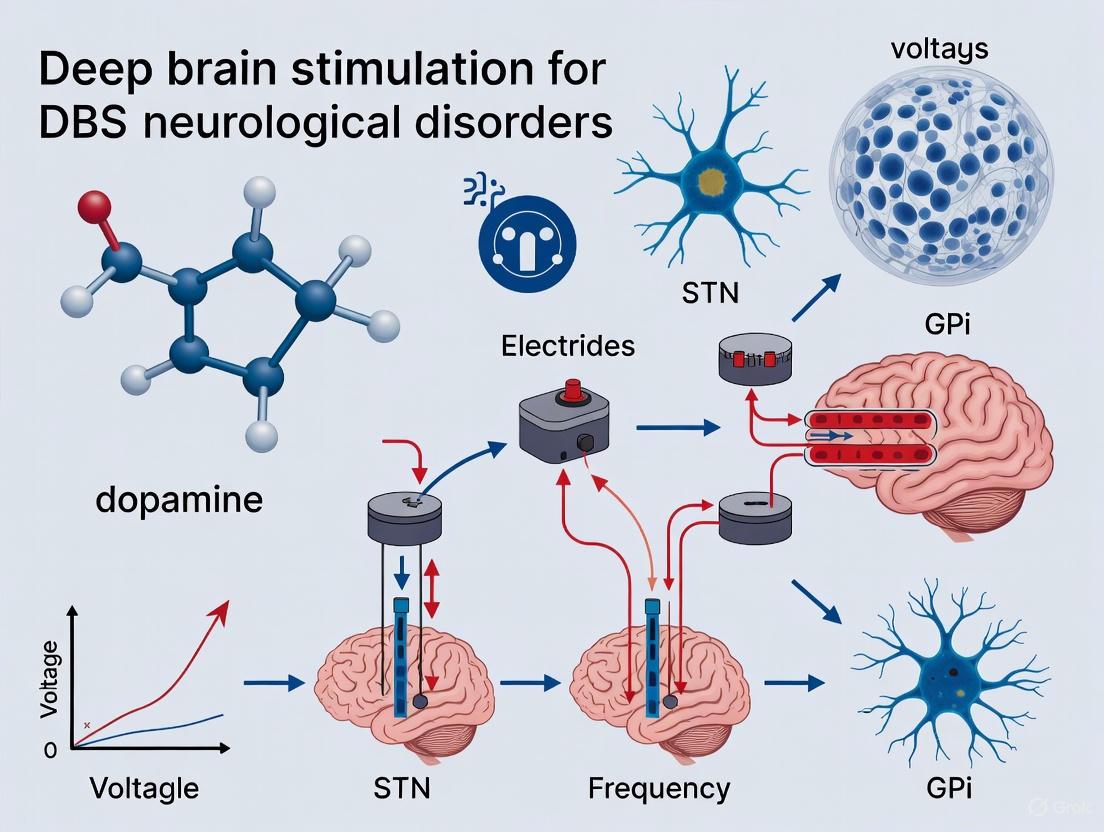
This article provides a comprehensive analysis of Deep Brain Stimulation (DBS) parameter selection and optimization for researchers, scientists, and drug development professionals.
Optimizing Neuromodulation: A Research-Focused Guide to Deep Brain Stimulation Parameters for Neurological Disorders
Abstract
This article provides a comprehensive analysis of Deep Brain Stimulation (DBS) parameter selection and optimization for researchers, scientists, and drug development professionals. It explores the foundational principles of DBS mechanisms and its expanding clinical applications across neurological and neuropsychiatric disorders. The scope covers established and emerging methodological approaches for parameter application, including conventional programming, image-guided planning, and computational modeling. It further delves into advanced troubleshooting and optimization strategies for suboptimal outcomes, leveraging novel technologies like directional leads and closed-loop systems. Finally, the article validates these approaches through a comparative examination of long-term efficacy, safety data, and cognitive outcomes across different stimulation targets, synthesizing evidence to inform future clinical trial design and therapeutic development.
Core Principles and Expanding Indications of Deep Brain Stimulation
Deep brain stimulation (DBS) involves the chronic implantation of electrodes into specific brain regions to deliver electrical stimulation for therapeutic benefit in neurologic and neuropsychiatric disorders [1]. While initially developed as a reversible alternative to lesioning procedures, DBS has evolved into a sophisticated brain interface technology. The mechanistic understanding of DBS has similarly progressed from focal theories of excitation or inhibition to a more nuanced appreciation of its network-level effects [2] [1]. This application note synthesizes current knowledge on DBS mechanisms, with a focus on the transition from focal modulation to circuit-level effects, providing researchers with structured experimental data and protocols for investigating DBS actions.
Theoretical Framework: Evolving Concepts of DBS Mechanisms
Historical Progression of Mechanistic Theories
The understanding of how DBS exerts its therapeutic effects has evolved significantly through several theoretical frameworks:
- Initial Theories of Excitation and Inhibition: Early explanations proposed simple excitation or inhibition of neural elements in the stimulated target region [2].
- Informational Lesion Hypothesis: This theory suggests DBS prevents the transmission of pathological neural activity through the stimulated region by masking or antidromically blocking synaptic inputs, effectively creating a reversible "informational lesion" [2] [1].
- Circuit Modulation Hypothesis: Current leading theories propose DBS modulates activity throughout target networks, with therapeutic benefits arising from restoration of normal network dynamics in disorders considered circuitopathies [1].
Network-Level Effects of DBS
Recent evidence strongly supports that DBS functions as a network therapy [1]. The identification of appropriate target networks has become vital for optimizing DBS outcomes across indications. Key findings supporting network-level effects include:
- Normalization of hyperactivity in the orbitofrontal cortex (OFC), anterior cingulate cortex (ACC), and medial prefrontal cortex (mPFC) after effective DBS for OCD [2]
- Reduction in overconnectivity between prefrontal cortex and striatal targets correlating with symptom relief in OCD [2]
- Modulation of specific fiber tracts (e.g., pallidosubthalamic, corticospinal, pallidothalamic) associated with optimal outcomes for different clinical presentations [1]
Quantitative Data on DBS Efficacy and Network Modulation
Table 1: Clinical Outcomes of DBS Across Neurological Disorders
| Disorder | DBS Target | Clinical Outcome | Network/Circuit Modulated |
|---|---|---|---|
| Parkinson's Disease | STN | 50.5% reduction in UPDRS-III motor score [3] | Cortico-basal ganglia-thalamo-cortical circuit [1] |
| Parkinson's Disease | GPi | 29.8% reduction in UPDRS-III motor score [3] | Pallidothalamic tracts [1] |
| Essential Tremor | Vim | 53-63% tremor reduction (unilateral), 66-78% (bilateral) [3] | Cerebellar-thalamic-cortical pathway |
| Dystonia | GPi | 60.6% improvement in motor score, 57.5% in disability score [3] | Sensorimotor cortico-striato-pallido-thalamo-cortical loop |
| Obsessive-Compulsive Disorder | ALIC/VS | 60% response rate overall [2] | Cortico-striatal-thalamo-cortical (CSTC) circuits [2] |
Table 2: Key Neural Oscillations as Potential Biomarkers for Adaptive DBS
| Oscillation Band | Frequency Range | Pathological Association | Potential Role in aDBS |
|---|---|---|---|
| Beta | 13-35 Hz | Parkinsonian bradykinesia and rigidity [4] | Primary biomarker for PD symptoms [4] |
| Theta | 4-8 Hz | OCD pathophysiology [2] | Investigational biomarker for CSTC circuit modulation |
| Gamma | 35-100 Hz | Pro-kinetic state in PD [4] | Potential closed-loop control signal |
| Alpha | 8-13 Hz | Tremor-related activity | Emerging biomarker for essential tremor |
Experimental Protocols for Investigating DBS Mechanisms
Protocol: Sweet Spot Mapping for Optimal Target Engagement
Purpose: To identify the optimal anatomical region and structural connections for DBS in specific disorders.
Materials: Post-operative imaging (CT/MRI), computational modeling software, clinical outcome measures.
Methodology:
- Localization: Precisely identify electrode placement using post-operative imaging co-registered with preoperative planning scans [1].
- Volume of Tissue Activated (VTA) Modeling: Generate computational models of stimulation spread based on individual patient's electrode location and stimulation parameters [1].
- Fiber Filtering: Identify modulated structural networks using tractography and fiber filtering techniques [1].
- Clinical Correlation: Correlate VTAs and modulated networks with clinical outcomes to define treatment "sweet spots" [1].
- Validation: Cross-validate sweet spots across patient cohorts to establish generalizable therapeutic targets.
Applications: Optimizing surgical targeting and post-operative programming for individual patients; identifying novel therapeutic targets.
Protocol: fMRI Investigation of DBS Network Effects
Purpose: To characterize whole-brain effects of DBS and identify network-level biomarkers of clinical response.
Materials: MRI-compatible DBS systems, fMRI acquisition protocols, analysis software.
Methodology:
- Paradigm Selection: Choose between (1) continuous cycling of stimulation during rest or (2) comparison of task performance during DBS ON/OFF states [1].
- Data Acquisition: Acquire BOLD fMRI data during chosen paradigm with appropriate controls for stimulation artifacts.
- Functional Connectivity Analysis: Examine DBS effects on functional connectivity between network nodes.
- Correlation with Clinical Effects: Relate changes in BOLD activity and connectivity patterns to clinical improvement.
- Longitudinal Assessment: Repeat assessments to distinguish acute versus chronic stimulation effects [1].
Applications: Verifying and guiding selection of therapeutic stimulation parameters; understanding temporal evolution of DBS effects.
Protocol: Local Field Potential (LFP) Sensing for Adaptive DBS
Purpose: To utilize neural signals for closed-loop DBS control.
Materials: Bidirectional DBS systems capable of sensing and stimulation, signal processing tools.
Methodology:
- Biomarker Identification: Record LFPs from implanted electrodes to identify pathological oscillations (e.g., beta oscillations in PD) [4].
- Control Policy Development: Establish algorithms that define how stimulation parameters should change in response to biomarker fluctuations [4].
- System Implementation: Program closed-loop systems to deliver stimulation only when pathological signals exceed predetermined thresholds.
- Efficacy Validation: Compare adaptive DBS with conventional continuous stimulation for therapeutic efficacy and battery consumption.
- Multi-Modal Integration: Incorporate additional inputs (e.g., kinematic data, other physiological signals) to improve symptom detection [4].
Applications: Developing more efficient, symptom-specific DBS paradigms; understanding dynamic brain states in neurological disorders.
Visualization of DBS Mechanisms and Methodologies
Diagram 1: Conceptual framework of DBS mechanisms evolution and investigation methodologies. The flow illustrates the progression from focal to network-level theories and corresponding experimental approaches for mechanistic studies.
Diagram 2: Comprehensive workflow for investigating DBS mechanisms of action. The protocol integrates multiple methodological approaches from subject preparation through data analysis to derive mechanistic insights.
Table 3: Essential Research Tools for DBS Mechanisms Investigation
| Tool/Resource | Specification/Function | Research Application |
|---|---|---|
| Directional DBS Electrodes | Segmented contacts enabling current steering | Precise spatial targeting of neural structures [5] |
| Bidirectional Implantable Pulse Generators | Simultaneous sensing and stimulation capabilities | Closed-loop DBS; biomarker discovery [1] [4] |
| Computational Modeling Software | VTA and fiber activation modeling | Predicting stimulation effects; target optimization [1] |
| MRI-Compatible DBS Systems | Safe for 1.5T/3T MRI scanning | Investigating network effects with fMRI [1] |
| Local Field Potential Recording Systems | Neural signal acquisition and analysis | Identifying pathological oscillations for aDBS [4] |
| Clinical Rating Scales | Disorder-specific outcome measures (e.g., UPDRS, Y-BOCS) | Quantifying therapeutic efficacy [2] [3] |
| Tractography Analysis Tools | White matter pathway reconstruction | Identifying structural connectivity modulated by DBS [1] |
The mechanistic understanding of DBS has progressively evolved from focal modulation to network-level effects, with current evidence supporting its role as a circuit-modulating therapy. The experimental protocols and tools outlined provide researchers with comprehensive methodologies for investigating DBS mechanisms across neurological disorders. Future directions include refining closed-loop systems responsive to multiple biomarkers, developing personalized stimulation paradigms based on individual circuit abnormalities, and expanding applications to additional network disorders. Integration of multi-modal data through computational approaches and artificial intelligence will further advance our understanding of DBS mechanisms and therapeutic optimization.
Application Notes: Target Profiles and Clinical Selection
Deep Brain Stimulation (DBS) modulates pathological neuronal activity in specific brain circuits. The selection of a target is a fundamental decision that dictates the symptomatic profile of the treatment [6]. The established targets are the subthalamic nucleus (STN), the globus pallidus internus (GPi), and the thalamus (specifically the ventral intermediate nucleus, Vim).
Table 1: Established DBS Targets for Movement Disorders
| Target | Primary Indications | Key Clinical Benefits | Limitations & Considerations |
|---|---|---|---|
| Subthalamic Nucleus (STN) | Parkinson's Disease (PD) [7] [8] | Effective for bradykinesia, rigidity, and tremor; allows for significant reduction of levodopa medication [8]. | Associated with cognitive and mood side effects; tremor control can be variable [8]. |
| Globus Pallidus Internus (GPi) | PD, Dystonia [7] [6] | Superior management of dyskinesias and motor fluctuations; fewer cognitive/psychiatric side effects [8]. | Less effective for PD tremor; offers less reduction in medication compared to STN [9] [8]. |
| Thalamus (Ventral Intermediate Nucleus - Vim) | Essential Tremor, PD Tremor [7] | Robust suppression of disabling upper extremity tremor [7] [8]. | No effect on other PD symptoms (bradykinesia, rigidity); effects may diminish over time [8]. |
| Dentato-Rubro-Thalamic Tract (DRTt) | Tremor (PD, Essential) [8] | Potent tremor suppression; can be co-stimulated with STN for superior motor outcomes [8]. | Requires advanced tractography for visualization; individual anatomical variability [8]. |
A pivotal meta-analysis found no significant long-term difference in tremor control between STN-DBS and GPi-DBS, though STN-DBS may provide faster short-term tremor relief [9]. For PD patients with severe, medication-resistant tremor, co-stimulation of the STN and the nearby cerebello-thalamic fiber pathway (DRTt) has emerged as a promising strategy, leading to greater improvements in motor scores and lower levodopa requirements compared to STN stimulation alone [8].
Experimental Protocols
Protocol for Pre-Surgical Patient Assessment and Target Selection
Objective: To identify suitable candidates for DBS and select the optimal surgical target based on a comprehensive, interdisciplinary evaluation [10].
Workflow:
- Interdisciplinary Evaluation: A team comprising a neurologist, neurosurgeon, psychiatrist, and neuropsychologist conducts a risk-benefit analysis [10].
- Levodopa Challenge Test: Administer a single supra-threshold dose of levodopa after a 12-hour medication-free period. A >30% improvement in the UPDRS-III motor score is a traditional benchmark for a favorable outcome, though its predictive value is stronger for short-term than long-term outcomes [10].
- Symptom Priority & Target Selection:
- High-Resolution MRI: Perform preoperative imaging to visualize anatomical structures and rule out contraindications [8].
- Diffusion Tensor Imaging (DTI) Tractography: For advanced targeting, use DTI to reconstruct white matter pathways like the DRTt for optimal lead placement for tremor control [8].
Protocol for Post-Operative DBS Programming
Objective: To optimize stimulation parameters to maximize therapeutic benefit and minimize side effects.
Workflow:
- Initial Programming (Monopolar Review):
- Begin several weeks after electrode implantation.
- Systematically test each electrode contact in a unipolar mode.
- For each contact, determine the therapeutic window—the range between the amplitude that produces first observable benefit and the amplitude that induces side effects [6].
- Directional Steering (if applicable):
- For segmented leads, use directional current to shape the electrical field.
- Steer stimulation away from anatomical structures that cause side effects (e.g., the internal capsule) to widen the therapeutic window [6].
- Image-Guided Programming:
- Physiology-Guided Programming (Sensing):
- Use local field potential (LFP) recordings from the DBS lead.
- Correlate beta-band oscillatory activity in the STN with bradykinesia and rigidity to inform programming decisions [6].
- Adaptive DBS (Closed-Loop):
- Utilize a system that automatically adjusts stimulation based on real-time feedback from sensed neural biomarkers (e.g., beta power) [6].
Signaling Pathways and Network Modulation
The therapeutic effects of DBS are achieved by overriding pathological network activity. The following diagram illustrates the key circuits involved with the established targets.
The Scientist's Toolkit: Research Reagent Solutions
Table 2: Essential Materials and Tools for DBS Research
| Item | Function / Application in Research |
|---|---|
| Directional DBS Leads (e.g., segmented contacts) | Allows shaping of the electrical field to selectively stimulate target subregions and avoid off-target side effects, widening the therapeutic window [6]. |
| MR-Conditional Implantable Pulse Generator (IPG) | Provides the electrical stimulation; MR-Conditional systems allow patients to undergo MRI scans for research and clinical follow-up under specific safety conditions [7]. |
| Local Field Potential (LFP) Sensing System | Records oscillatory neural activity (e.g., beta bursts) from the DBS lead to serve as a biomarker for symptoms and guide programming or adaptive stimulation [6]. |
| High-Field MRI & DTI Tractography | Enables high-precision visualization of target nuclei (STN, GPi) and critical white matter pathways (DRTt) for patient-specific surgical targeting and outcome analysis [8]. |
| Volume of Tissue Activated (VTA) Modeling Software | Computes the spread of electrical stimulation from the DBS lead, allowing researchers to correlate stimulation location with clinical outcomes [11] [8]. |
| Adaptive DBS (aDBS) Platform | A closed-loop system that automatically adjusts stimulation parameters in real-time based on feedback from sensed neural signals [6]. |
Deep Brain Stimulation (DBS) has undergone a remarkable evolution from an established treatment for movement disorders to an investigational therapy for complex neuropsychiatric conditions. This expansion is driven by an enhanced understanding of the neural circuits underlying psychiatric diseases and the ability of DBS to modulate dysfunctional networks. For researchers and drug development professionals, the frontier of DBS lies in identifying novel anatomical targets, refining stimulation parameters through adaptive technologies, and developing robust clinical trial methodologies for these heterogeneous patient populations. This article provides a detailed examination of emerging DBS targets for neuropsychiatric disorders, supported by quantitative data analysis, structured experimental protocols, and technical implementation frameworks.
Emerging DBS Targets and Clinical Outcomes
Research into DBS for neuropsychiatric disorders has identified several promising targets beyond those established for movement disorders. The table below summarizes key targets, mechanisms, and clinical outcomes for major treatment-resistant conditions.
Table 1: Emerging DBS Targets and Clinical Outcomes in Neuropsychiatric Disorders
| Disorder | Promising DBS Targets | Primary Mechanism of Action | Reported Efficacy Outcomes | Evidence Level |
|---|---|---|---|---|
| Treatment-Resistant Depression (TRD) | Medial Forebrain Bundle (MFB), Subcallosal Cingulate Gyrus (SCG), Ventral Capsule/Ventral Striatum (VC/VS) [12] [13] [14] | Modulation of reward, motivation, and mood-regulating circuits [12] [14] | 86% responder rate for MFB; Significant antidepressant effects vs. sham [14] | Multiple clinical trials & meta-analyses [14] |
| Obsessive-Compulsive Disorder (OCD) | Anterior Limb of Internal Capsule (ALIC), Ventral Capsule/Ventral Striatum (VC/VS), Subthalamic Nucleus (STN) [12] [13] | Normalization of cortico-striato-thalamo-cortical (CSTC) circuit activity [12] | FDA HDE approval; Significant reduction in Y-BOCS scores [15] | Established (FDA HDE) [15] |
| Autism Spectrum Disorder (ASD) | Nucleus Accumbens (NAc), Amygdala, Posteromedial Hypothalamus [12] | Reduction of aggression and self-injurious behaviors [12] | Promising early results for severe behavioral symptoms [12] | Early investigational stages [12] |
| Alzheimer's Disease & Dementia | Fornix, Nucleus Basalis of Meynert (NBM) [12] [16] | Modulation of memory and cholinergic pathways [12] | Slowed cognitive decline in some patients; heterogeneous results [12] [16] | Clinical trials ongoing [12] |
| Tourette Syndrome | Centromedian-Parafascicular Complex (CM-Pf), Globus Pallidus Internus (GPi), Anterior Limb of Internal Capsule (ALIC) [16] | Modulation of sensorimotor and associative circuits involved in tic generation [16] | ~40% reduction in motor tics (p < 0.001) [16] | Systematic review data [16] |
| Anorexia Nervosa | Subcallosal Cingulate Gyrus (SCG), Nucleus Accumbens (NAc), Bed Nucleus of Stria Terminalis (BNST) [16] [13] | Alteration of reward and emotional processing related to food and body image [16] | 10% increase in BMI (p = 0.02) [16] | Early investigational stages [16] |
Network meta-analyses have provided quantitative comparisons of different targets, particularly for TRD. The following table synthesizes comparative efficacy data from recent studies, essential for guiding target selection in clinical trials.
Table 2: Comparative Efficacy of DBS Targets for Treatment-Resistant Depression (Network Meta-Analysis Data)
| DBS Target | Responder Rate (%) | Remission Rate (%) | Reduction in Depressive Symptoms | Key Advantages & Considerations |
|---|---|---|---|---|
| Medial Forebrain Bundle (MFB) | 86 [14] | Not Specified | Most significant reduction [14] | Central role in dopamine pathways for motivation/reward; rapid effects [14] |
| Subcallosal Cingulate Gyrus (SCG) | Significant improvement [14] | Not Specified | Significant improvement vs. sham [14] | Extensive historical data; limbic system node [12] [14] |
| Anterior Limb of Internal Capsule (ALIC) | Significant improvement [14] | Not Specified | Significant improvement vs. sham [14] | Target for both OCD and depression; white matter tract [14] |
| Epidural Prefrontal Cortex (EPFC) | Not Specified | 60 [14] | Not Specified | Less invasive surgical approach; high remission rate [14] |
Experimental Protocols for DBS Research
Protocol 1: Clinical Trial Design for Neuropsychiatric DBS
The unique challenges of DBS trials for psychiatric indications—including high participant burden, symptom volatility, and ethical considerations—require specialized protocols. [15]
Participant Screening & Informed Consent
- Population: Adults with severe, chronic (>2 years), treatment-refractory disorders (e.g., failure of ≥4 antidepressant regimens for TRD, or standard OCD treatments). [15] [14]
- Key Exclusion Criteria: Severe cognitive impairment, active psychosis, high suicide risk, structural brain abnormalities, and contraindications for surgery. [15]
- Consenting Process: Implement a multi-stage, reiterated process to manage expectations and ensure understanding of potential risks (intracranial hemorrhage ~2%, infection ~4%, device revision 4-5%) and the possibility of non-response. [13] [15] Use a separate "Research Engagement Agreement" to outline responsibilities. [15]
Multidisciplinary Team (MDT) Assembly
Preoperative Target Planning & Surgical Implantation
- Imaging: Acquire high-resolution MRI (T1, T2, FLAIR, SWI) and CT scans.
- Targeting: Fuse MRI with CT for stereotactic planning. For SCG targeting, use coordinates relative to anterior commissure-posterior commissure (AC-PC) line. For MFB, utilize diffusion tensor imaging (DTI) tractography to visualize the pathway. [14]
- Procedure: Perform frame-based or frameless stereotactic surgery under local anesthesia. Conduct microelectrode recording (MER) to validate target physiology (e.g., neuronal firing patterns). Implant DBS electrodes (e.g., Medtronic 3387/3389) and connect to an implantable pulse generator (IPG) in the subclavicular region. [13]
Stimulation Parameter Optimization & Blinded Crossover
- Initial Programming: Begin 2-4 weeks post-op. Systematically test contacts using monopolar review. For SCG, typical initial parameters: amplitude 3-5 V, pulse width 60-90 µs, frequency 130 Hz. [15]
- Crossover Design: Employ an AB/BA or preferred AA/BA design where participants act as their own controls. [15] The active phase uses therapeutic parameters; the sham phase uses settings (e.g., 0.0 mA) that mimic the sensation without providing effective stimulation. [15] Predefine criteria for early exit from sham due to clinical decompensation. [15]
Outcome Assessment & Long-Term Follow-up
- Primary Endpoints: Change from baseline on standardized scales (e.g., MADRS for depression, Y-BOCS for OCD). [16] [15]
- Secondary Endpoints: Global functioning, quality of life, and neuropsychological battery.
- Frequency: Assess weekly during crossover, monthly for 3-6 months, then quarterly. [15] Collect patient-reported outcomes and adverse events systematically.
Protocol 2: Local Field Potential (LFP) Sensing for Biomarker Discovery & aDBS
The integration of sensing capabilities enables the recording of LFPs for biomarker identification and the implementation of adaptive DBS (aDBS), where stimulation is dynamically adjusted based on neural signals. [17] [18]
LFP Data Acquisition
- Equipment: Use a sensing-enabled IPG (e.g., Medtronic Percept PC). [17] [18]
- Recording Configuration: Configure bipolar sensing from adjacent electrode contacts. Record in both
Stimulation OFFandStimulation ON at 0.0 mAstates, noting the potential signal property differences between these states. [17] - Contextualization: Synchronize LFP data with clinical state (e.g., symptom severity scores logged by patient) and behavior (e.g., via wearable accelerometers) to identify clinically relevant neural biomarkers. [17]
Biomarker Identification & Validation
- Spectral Analysis: Compute power spectral density (PSD) of LFPs. Identify pathological oscillations (e.g., beta bursts in parkinsonism; alpha/theta rhythms in depression). [17] [18]
- Chronic Recording: Leverage the device's "Chronic Sensing" mode to track biomarker fluctuations over time in ecological settings. [17]
- Correlation Analysis: Statistically relate the power or pattern of the candidate biomarker to symptom severity scores across multiple timepoints.
aDBS System Configuration
- Parameter Selection: Define the biomarker (e.g., beta power), stimulation site, and treatment site (which may be different). [18]
- Threshold Setting: Establish a single (upper) or dual (upper and lower) amplitude threshold based on the personalized biomarker. [18] For example, set the amplifier to increase stimulation when biomarker power exceeds a certain percentile of its baseline distribution.
- Testing & Validation: Conduct in-clinic testing to confirm system responsiveness and tolerability. Validate efficacy in a randomized, blinded manner comparing aDBS to continuous DBS (cDBS). [18]
The following workflow diagram illustrates the core protocol for implementing adaptive DBS:
Diagram 1: Adaptive DBS implementation workflow for neuropsychiatric disorders.
The Scientist's Toolkit: Essential Research Reagents & Materials
Successful DBS research requires a suite of specialized tools and technologies. The following table details key components of the research toolkit for preclinical and clinical investigations.
Table 3: Essential Research Reagents & Material Solutions for DBS Investigation
| Category / Item | Specific Examples & Models | Primary Function in Research | Key Considerations |
|---|---|---|---|
| Sensing-Enabled Implantable Pulse Generator (IPG) | Medtronic Percept PC [17] [18] | Records Local Field Potentials (LFPs) for biomarker discovery and enables aDBS. [17] [18] | Limited compatibility of certain stimulation configs with sensing; internal clock syncing challenges. [17] |
| DBS Electrodes | Medtronic 3387, 3389; directional leads (e.g., Boston Scientific Vercise) | Delivers therapeutic stimulation to target; directional leads allow current steering. | Contact configuration critical for efficacy/side-effect profile. |
| Stereotactic Planning Software | Medtronic StealthStation, Brainlab Elements | Fuses pre-op MRI with post-op CT for precise lead trajectory and target planning. | Integration of DTI tractography (e.g., for MFB targeting) is crucial. [14] |
| Microelectrode Recording (MER) System | FHC NeuroMap, Alpha Omega NeuroOmega | Records single-unit activity to physiologically validate anatomical targets during surgery. | Aids in distinguishing gray matter (neurons) from white matter or CSF. |
| Neural Signal Processing Platform | Custom MATLAB/Python toolboxes, BrainSense companion apps [17] | Analyzes recorded LFP data (time-frequency analysis, biomarker decoding). | Standardization lacking; must handle device-specific data formats/censoring. [17] |
| Clinical Outcome Scales | Montgomery-Åsberg Depression Rating Scale (MADRS), Yale-Brown Obsessive Compulsive Scale (Y-BOCS) [16] | Quantifies primary efficacy endpoints in clinical trials. [16] [15] | Must be administered by raters blinded to treatment condition. |
| Computational Modeling Platform | DeepROAST (for non-invasive approaches) [19] | Simulates and optimizes electric field distributions for novel stimulation paradigms. [19] | Enables targeting of deep structures via transnasal routes in silico. [19] |
Future Directions & Conceptual Framework
The field is moving toward a "third wave" of DBS focused on personalization, network-level understanding, and cost-effectiveness. [13] Key future directions include:
- Connectomics & Circuit-Based Targeting: Rather than targeting single nuclei, the focus is shifting toward modulating dysfunctional networks. Connectomic analyses reveal that different effective targets for a disorder (e.g., SCG, MFB, and VC/VS for TRD) often reside within the same macro-scale network, explaining their similar efficacy. [12]
- Artificial Intelligence & Machine Learning: AI-driven analysis of large-scale neural (LFP) and clinical data will be used to identify predictive biomarkers, optimize stimulation parameters in real-time, and improve patient selection. [13]
- Minimally Invasive & Steerable Platforms: Techniques like DeepFocus, which combines transcranial and transnasal electrical stimulation, aim to achieve accurate deep brain stimulation without permanent implanted hardware, potentially increasing accessibility and reducing risks. [19]
- Cost-Effectiveness Analysis: As DBS expands into psychiatry, demonstrating economic value is critical. Long-term models show positive incremental net monetary benefit for Parkinson's disease. [13] Rechargeable devices are particularly cost-effective for conditions like OCD ($41,495 USD/QALY vs. $203,202 for non-rechargeable). [13]
The following diagram conceptualizes the integrated technological future of DBS research and therapy:
Diagram 2: Converging technologies for the future of personalized DBS.
Deep brain stimulation (DBS) of the subthalamic nucleus (STN) provides sustained motor improvement and significant medication reduction for patients with moderate to advanced Parkinson's disease (PD) over multiple years. Long-term prospective studies demonstrate that these benefits remain statistically significant at 5-year follow-ups, with some reports indicating continued efficacy beyond 10 years, though with expected gradual decline due to disease progression. The growing evidence base supports standardized protocols for patient selection, surgical targeting, and stimulation parameterization to optimize long-term outcomes.
Quantitative Outcomes of STN-DBS
Sustained Motor Improvement
Table 1: Motor Function Improvement (UPDRS-III) with STN-DBS
| Follow-up Period | Baseline Score (OFF) | Follow-up Score (OFF) | Percentage Improvement | Statistical Significance |
|---|---|---|---|---|
| 1 Year | 42.8 (9.4) | 21.1 (10.6) | 51% (95% CI: 49%-53%) | P < .001 [20] |
| 5 Years | 42.8 (9.4) | 27.6 (11.6) | 36% (95% CI: 33%-38%) | P < .001 [20] |
| ≥10 Years | Not Reported | Not Reported | 22.56% | Not Reported [21] |
Motor symptoms show differential responsiveness to DBS over time. Tremor and rigidity demonstrate the most sustained improvement, maintaining significant benefits even after 10 years, while axial symptoms such as gait and postural stability may show less robust long-term response [21].
Activities of Daily Living and Dyskinesia
Table 2: Non-Motor and Functional Outcomes with STN-DBS
| Outcome Measure | Baseline | 1-Year Improvement | 5-Year Improvement | Statistical Significance |
|---|---|---|---|---|
| Activities of Daily Living (UPDRS-II OFF) | 20.6 (6.0) | 41% (95% CI: 38%-42%) | 22% (95% CI: 18%-23%) | P < .001 [20] |
| Dyskinesia (CDRS) | 4.0 (5.1) | 75% (95% CI: 73%-75%) | 70% (95% CI: 63%-75%) | P < .001 [20] |
| Levodopa Equivalent Daily Dose | Baseline | 28% Reduction | 28% Reduction (stable) | P < .001 [20] |
| Quality of Life (PDQ-39) | Not Reported | Improved at 3 years | Declined to baseline beyond 10 years | Not Reported [21] |
The stability of medication reduction at 5 years (28% from baseline) is particularly notable, as it demonstrates DBS's capacity to provide sustained symptomatic control while minimizing pharmaceutical burden and associated side effects [20]. The "DBS honeymoon" period—characterized by peak improvements in both motor and non-motor symptoms—typically occurs within the first 3 years post-implantation [21].
Experimental Protocols for Long-Term Assessment
Multicenter Randomized Controlled Trial Protocol
The INTREPID study provides a robust methodological framework for evaluating long-term DBS efficacy [20].
Study Design:
- Type: Prospective, randomized (3:1), double-blind, sham-controlled trial with open-label 5-year follow-up
- Centers: 23 movement disorder centers across the United States
- Timeline: May 2013 to December 2022
- Participants: 313 enrolled, 191 implanted with DBS system, 137 completed 5-year follow-up (72% retention)
Key Inclusion Criteria:
- Diagnosis of bilateral idiopathic PD with >5 years of motor symptoms
- >6 hours per day of poor motor function
- Modified Hoehn and Yahr Scale score >2
- UPDRS-III score ≥30 in medication-off state
- ≥33% improvement in UPDRS-III in medication-on state
Assessment Schedule:
- Blinded phase: 12 weeks
- Open-label phase: visits at post-randomization weeks 20, 26, 48, 52 (±14 days), and 78 (±28 days), then annually at years 2, 3, 4, and 5 (±28 days)
Primary Outcome Measures:
- UPDRS Parts I-IV (evaluated in both medication-on and -off conditions)
- Change in anti-parkinsonian medication use (Levodopa Equivalent Daily Dose)
- Clinical Dyskinesia Rating Scale (CDRS)
- Clinical Global Impression of Change (CGIC)
- Parkinson's Disease Questionnaire-39 (PDQ-39)
- Treatment Satisfaction Questionnaire
- Safety parameters (adverse events and serious adverse events)
Statistical Analysis:
- Linear mixed model for repeated measures using autoregressive covariance structure
- Fixed effects for visit and study site
- Intention-to-treat analysis for all randomly assigned patients
- Two-sided P value < .05 considered statistically significant
Long-Term Follow-up Protocol (≥10 Years)
For extended observation beyond 10 years, a retrospective study design has been employed [21]:
Assessment Protocol:
- Motor Evaluation: UPDRS-III in off- and on-medication states with stimulation
- Non-Motor Symptoms: Validated scales for mood, cognition, sleep
- Quality of Life: PD-specific QOL instruments
- Medication Tracking: Levodopa Equivalent Daily Dose (LEDD)
- Stimulation Parameters: Voltage, frequency, pulse width, contact configuration
- Genetic Testing: Selected patients for genotype-phenotype correlations
Considerations for Extended Follow-up:
- Monitor for rare long-term complications (e.g., DBS withdrawal syndrome)
- Track disease progression in non-responsive symptoms
- Document stimulation parameter evolution over time
- Assess caregiver burden and patient satisfaction
Figure 1: INTREPID Trial Patient Flow Diagram
Advanced Programming and Biomarker Detection
Beta Peak Detection for Data-Driven Programming
Local field potential (LFP) beta oscillations (13-30 Hz) serve as critical biomarkers for optimizing DBS therapy. Accurate detection of beta peaks enables precise targeting of the "electrophysiological sweet spot" within the dorsolateral STN [22].
Experimental Protocol for Beta Peak Identification:
Data Acquisition:
- Use monopolar or bipolar sensing montages from implanted DBS electrodes
- Record local field potentials during rest state
- Ensure patient in defined medication state (typically OFF)
- Collect sufficient data for robust spectral analysis (≥60 seconds)
Spectral Analysis:
- Compute power spectral density (PSD) using Welch's method
- Apply appropriate filters to reduce noise and artifact
- Focus analysis on beta frequency range (13-30 Hz)
Algorithmic Peak Detection:
- Implement standardized algorithms for objective beta peak identification
- Evaluate performance against expert consensus
- Select most accurate algorithms (III, IV, V, VII, VIII, IX demonstrated highest concordance)
- Validate detected peaks against clinical response
Clinical Correlation:
- Map beta peak locations to electrode contact positions
- Correlate with optimal therapeutic contacts
- Guide initial parameter settings based on beta power distribution
- Adjust stimulation parameters to suppress pathological beta activity
Figure 2: Beta Peak Detection Workflow
Adaptive Deep Brain Stimulation Programming
Adaptive DBS (aDBS) represents the next evolution in neuromodulation, dynamically adjusting stimulation parameters based on neural feedback [23].
Programming Protocol for Commercial aDBS Systems:
Initial Setup:
- Select sensing contacts with optimal signal-to-noise ratio
- Identify relevant beta peaks in OFF medication state
- Establish baseline beta power levels
- Define upper and lower stimulation amplitude limits
Threshold Configuration:
- Review continuous Timeline data over several days
- Set LFP thresholds to 25th and 75th percentiles of daytime beta power
- Adjust for individual patient variability in beta modulation
- Validate thresholds across medication cycles
Optimization Phase:
- Monitor for under-stimulation (increased OFF symptoms)
- Identify over-stimulation (dyskinesia, side effects)
- Refine amplitude limits based on symptom control
- Adjust LFP thresholds if stimulation remains at limits
- Balance adaptation speed with symptom stability
Long-Term Management:
- Assess stimulation adaptation patterns regularly
- Modify parameters as disease progresses
- Address medication-related beta power changes
- Optimize for individual symptom patterns
The Scientist's Toolkit: Research Reagent Solutions
Table 3: Essential Reagents and Tools for DBS Research
| Research Tool | Function/Application | Key Features |
|---|---|---|
| Vercise DBS System | Implantable pulse generator for bilateral STN-DBS | Multiple independent constant current control [20] |
| Beta Peak Detection Algorithms | Objective identification of pathological oscillations | Algebraic dynamic peak amplitude thresholding [22] |
| Lead-DBS Toolbox | Electrode localization and reconstruction | Normalization to MNI space; trajectory visualization [24] |
| BrainSense Streaming | Local field potential recording and analysis | Real-time beta power monitoring [23] |
| FreeSurfer Pipeline | Quantitative MRI morphometric analysis | Automated volumetric segmentation [25] |
| UPDRS/MDS-UPDRS | Standardized motor and non-motor assessment | Validated PD symptom rating [20] [26] |
| Levodopa Equivalent Dose Calculator | Standardized medication quantification | Cross-center comparison of pharmaceutical burden [20] |
Safety and Long-Term Considerations
The long-term safety profile of STN-DBS remains acceptable, with infection representing the most common serious adverse event (9 participants in the INTREPID trial) [20]. Ten deaths were reported during the 5-year follow-up period, though none were related to the DBS therapy. Surgical candidacy assessment should incorporate comprehensive evaluation of structural integrity using qualitative and quantitative MRI parameters, including striatal volume, total gray matter, and ventricular volume, which demonstrate high predictive accuracy (AUC = 0.88) for DBS outcomes [25].
For cognitively impaired PD patients, recent evidence suggests STN-DBS can still provide significant improvements in motor function and quality of life over mid- to long-term follow-up, though careful patient selection remains crucial [26].
Methodological Approaches for DBS Parameter Application and Programming
Conventional clinical programming for Deep Brain Stimulation (DBS), with the monopolar review as its cornerstone, remains the established method for initial parameter selection. This protocol details the standardized methodology for performing a monopolar review in patients with Parkinson's disease (PD) undergoing subthalamic nucleus (STN)-DBS. While this approach provides robust motor symptom control, it is a time-intensive process. Recent technological advancements have introduced efficient, anatomy- and physiology-guided programming techniques that achieve equivalent clinical efficacy while drastically reducing programming time, offering promising alternatives for optimizing clinical workflows.
DBS of the basal ganglia circuitry is a well-established treatment for movement disorders like PD. The monopolar review represents the gold standard in DBS programming, a process based on systematic clinical response testing to identify electrode contacts that provide the best motor symptom control with the highest adverse effect threshold [27]. This clinical-based programming (CBP) relies on a high level of expertise and subjects patients to lengthy testing procedures. The following application notes and protocols outline the standard operating procedure for the monopolar review and situate this conventional method within the current landscape of emerging, efficiency-oriented programming algorithms.
Experimental Protocols
Detailed Methodology: Directional Monopolar Review for Clinical-Based Programming (CBP)
Objective: To determine the optimal stimulation contact and amplitude for a DBS system via systematic clinical assessment of motor benefit and adverse effects.
Materials:
- Patient with implanted DBS system (e.g., directional leads connected to an implantable pulse generator).
- Clinical programmer device.
- Standardized clinical rating scale (e.g., MDS-UPDRS Part III for PD).
- Controlled medication state (typically
MedOFF).
Procedure [27]:
- Patient Preparation: The patient is assessed in the
MedOFFcondition to isolate the effects of stimulation. For PD, this typically requires a >12-hour withdrawal of dopaminergic medication. - Non-Directional Contact Screening: For each hemisphere, the four individual contact levels are evaluated non-directionally.
- Stimulation amplitude is increased stepwise (e.g., 0.5 mA increments, narrowed to 0.1 mA for precision).
- For each contact, the therapeutic effect threshold is identified as the amplitude that provides complete or near-complete relief of rigidity in the contralateral upper limb.
- The adverse effect threshold is identified as the amplitude that induces side effects.
- Directional Testing: If a contact level with directional configurations proves most effective, the individual directional contacts of that level are tested individually or in combination using the same stepwise amplitude increase.
- Parameter Finalization: The most effective contact or contact-combination is selected. The final amplitude is typically set 0.5 mA below the clinically-tested side-effect threshold. Standard settings for frequency (130 Hz) and pulse width (60 μs) are used initially and adapted only if side effects occur or symptom control is insufficient.
- Time Consideration: This process is complex and time-consuming, relying heavily on clinician expertise. A complete monopolar review can take approximately 45 minutes per patient [27].
Protocol for Anatomical Software-Based Programming (ABP)
Objective: To select stimulation contacts based on patient-specific visualization of the DBS lead location within segmented anatomical structures, thereby reducing programming time.
Materials:
- Preoperative MRI scans (e.g., T1-MPRAGE, T2-TSE).
- Postoperative CT scan for lead localization.
- Dedicated software suite (e.g., Brainlab Elements with GuideXT module).
Procedure [27]:
- Image Fusion and Processing: Preoperative MRI and postoperative CT scans are imported and fused using an automatic software algorithm. Accuracy is verified visually.
- Anatomical Segmentation: Target structures (e.g., STN, substantia nigra) are segmented automatically by the software, with manual correction if necessary.
- Lead Reconstruction: The postoperative lead location and rotation are identified from the CT data.
- Contact Selection: Using the software's visualization module, contacts or contact combinations facing the dorsolateral subthalamic nucleus are identified graphically.
- Stimulation Programming: The projected contact settings are programmed, often with the patient in the
MedONstate. Amplitude is set 0.5 mA below the known side-effect threshold from prior reviews or estimated based on anatomy.
Protocol for Neurophysiology-Guided Programming Using Unipolar Recordings
Objective: To inform initial contact selection by localizing the site of maximum beta power within the STN, thereby improving programming efficiency.
Materials:
- DBS system capable of sensing local field potentials (LFPs) (e.g., Medtronic Percept PC).
- Software for LFP data acquisition and analysis.
Procedure [28]:
- Recording: For each hemisphere, unipolar recordings (differential recording of contacts to a common reference) are performed to assess beta power (13–30 Hz) for each possible contact configuration.
- Analysis: The contact with the maximum beta power is identified from the unipolar recordings.
- Programming: The contact selected by maximum beta power is activated, and amplitude is titrated for clinical effect. This method has been shown to achieve equivalent clinical efficacy to monopolar review but with a significantly shorter programming duration [28].
Data Presentation: Comparative Analysis of Programming Methodologies
Table 1: Quantitative Comparison of DBS Programming Methodologies in Parkinson's Disease
| Programming Method | Key Principle | Motor Outcome (MDS-UPDRS III) | Programming Time (Minutes) | Primary Advantage |
|---|---|---|---|---|
| Clinical-Based (CBP) [27] | Monopolar review with clinical testing | 18.27 ± 9.23 (MedOFF/StimON) | 45.22 ± 18.32 | Gold standard for clinical efficacy |
| Anatomical-Based (ABP) [27] | Image-guided contact selection | 18.37 ± 6.66 (MedOFF/StimON) | 19.78 ± 5.86 | Drastically reduces programming time |
| Neurophysiology-Guided [28] | Unipolar beta power mapping | Equivalent to monopolar review | 85% shorter than monopolar review | Improved efficiency & objective biomarker use |
Table 2: Long-Term Efficacy of STN-DBS in Parkinson's Disease (10-Year Follow-Up) [29]
| Evaluation Metric | Baseline (Pre-Op) | 1 Year Post-Op | 3 Years Post-Op | ≥10 Years Post-Op |
|---|---|---|---|---|
| UPDRS-III (OFF-state) Improvement | - | 53.02% | 44.79% | 22.56% |
| Levodopa Equivalent Daily Dose (LEDD) Reduction | - | 36.29% | 40.40% | 29.10% |
| Stimulation Frequency (Hz) | - | 141.70 ± 15.72 | - | 110.00 ± 18.22 |
The Scientist's Toolkit: Research Reagent Solutions
Table 3: Essential Materials and Software for DBS Programming Research
| Item / Reagent | Function / Application | Example / Model |
|---|---|---|
| Directional DBS Lead | Implanted electrode allowing current steering; enables directional stimulation. | Cartesia Leads (Boston Scientific) [27] |
| Implantable Pulse Generator (IPG) | Device that generates and delivers the electrical stimulation pulses. | Vercise PC / Gevia (Boston Scientific); Percept PC (Medtronic) [27] [28] |
| Clinical Programmer | Hardware/software interface for non-invasive adjustment of DBS parameters. | Manufacturer-specific clinical programmers. |
| Neuroimaging Software Suite | Fuses pre- and post-op images, segments anatomy, and reconstructs lead trajectory for visualization. | Brainlab Elements [27] |
| Stimulation Field Modeling Software | Models the Volume of Tissue Activated (VTA) to visualize interaction between stimulation and anatomy. | Vercise Neural Navigator [30] |
| Local Field Potential (LFP) Sensing | Records neural signals (e.g., beta power) from the implanted electrode to guide programming. | Feature of IPGs like Percept PC [28] |
Workflow and Algorithm Visualization
Monopolar Review Clinical Workflow
DBS Illumina 3D Algorithm Logic
The Rise of Image-Guided Programming (IGP) and Volumetric Reconstruction
Deep brain stimulation (DBS) is an established neuromodulatory therapy for medication-refractory neurological disorders. While effective, the post-operative programming process to optimize stimulation parameters has traditionally relied on time-consuming clinical assessment and trial-and-error. Image-guided programming (IGP) represents a transformative approach that leverages patient-specific imaging data and computational modeling to reconstruct the volume of tissue activated (VTA) by stimulation, thereby enabling more precise, efficient, and effective DBS programming [31]. This paradigm shift is particularly valuable given the increasing complexity of DBS technology with directional leads and multiple independent current control (MICC), which exponentially increases the parameter space that clinicians must navigate [32] [30]. The integration of IGP into clinical and research practice facilitates personalized neuromodulation therapy based on individual neuroanatomy and lead placement.
Quantitative Outcomes of Image-Guided Programming
Clinical studies demonstrate that IGP significantly improves programming efficiency and patient outcomes across multiple neurological conditions.
Table 1: Clinical Outcomes of Image-Guided DBS Programming in Parkinson's Disease
| Study Metric | Baseline (Pre-IGP) | Follow-up (Post-IGP) | Improvement | P-value | Study Reference |
|---|---|---|---|---|---|
| Motor Function (MDS-UPDRS III) | 20.6 ± 7.9 | 15.8 ± 6.8 | 21.9% (5 points) | p = 0.001 | Torres et al. 2024 (n=31) [33] [34] |
| DBS-IS Global Score | 25.8 ± 8 | 14.6 ± 7 | 41.5% (11 points) | p = 0.001 | Torres et al. 2024 (n=31) [33] [34] |
| Quality of Life (PDQ-8) | 36.2 ± 16.0 | 21.7 ± 13.8 | 38% | p = 0.001 | Torres et al. 2024 (n=31) [33] [34] |
| Health Status (EQ-VAS) | 4.35 | 6.77 | 31.6% (2.42 points) | p = 0.001 | Torres et al. 2024 (n=31) [33] [34] |
| Levodopa Equivalent Daily Dose (LEDD) | 534.5 mg | 439.5 mg | 17.8% reduction | p = 0.008 | Torres et al. 2024 (n=31) [34] |
| Patient Global Impression of Improvement (PGI-I) | - | - | 64.5% moderately/much better | - | Torres et al. 2024 (n=31) [33] [34] |
| Programming Time | Conventional programming baseline | IGP implementation | 56-72% reduction | - | Lange et al. 2021; Aldred et al. 2023 [35] |
Table 2: Application of IGP in Stable vs. Suboptimal Patients
| Patient Population | Study Characteristics | Stimulation Adjustments | Key Outcomes |
|---|---|---|---|
| Patients with Suboptimal Response (n=31) [33] [34] | PD with STN-DBS; mean 2.7 years post-surgery | Contact changes: 40% of electrodes; Directionality changes: 37% of electrodes | 83.9% experienced motor and QoL improvements; 29% reduced medication |
| Patients with Stable Symptoms (n=16) [32] | PD with STN-DBS; >6 months stable symptoms | Horizontal steering introduced: 23 leads; Vertical adjustments: 6 leads | 93.75% opted to continue IGP-derived settings; Significant UPDRS-III improvement sustained at 3 months |
Experimental Protocols and Methodologies
Protocol 1: Basic IGP Workflow for DBS Programming
This protocol outlines the fundamental steps for implementing image-guided programming using commercial software platforms.
Materials:
- Preoperative MRI (T1-weighted, T2-weighted)
- Postoperative CT scan (thin-slice)
- Commercial IGP software (e.g., Guide XT, SureTune, Stimview XT)
- DBS programmer compatible with the implanted system
Procedure:
- Image Acquisition and Fusion
- Acquire preoperative T1 and T2-weighted MRI sequences with ≤1 mm isotropic resolution
- Obtain postoperative CT scan with the DBS leads in situ (0.67 mm slice thickness recommended)
- Fuse preoperative MRI with postoperative CT using intensity-based registration algorithms
- Verify fusion accuracy by checking anatomical landmark correspondence [32] [36]
Anatomical Segmentation and Lead Localization
Stimulation Field Modeling
Parameter Optimization
Clinical Validation and Fine-Tuning
Figure 1: IGP workflow showing the sequential process from image data acquisition to therapeutic parameter selection.
Protocol 2: Automated Optimization Using Inverse Programming Algorithms
This protocol details the use of computational algorithms for automated parameter selection in complex DBS systems.
Materials:
- Preoperative MRI and diffusion-weighted imaging (DWI)
- Postoperative CT with DBS leads
- Software with inverse optimization capabilities (e.g., DBS Illumina 3D Algorithm)
- Programming platform compatible with multiple independent current control
Procedure:
- Connectome Data Integration
Benefit and Avoidance Zone Definition
- Delineate primary target region (e.g., dorsolateral STN for PD)
- Identify avoidance regions (e.g., internal capsule, optic tract)
- Assign priority weights to different anatomical regions based on clinical goals [30]
Algorithmic Parameter Search
- Set optimization constraints (amplitude limits, pulse width, frequency)
- Run DBS Illumina 3D algorithm to search parameter space
- Generate multiple parameter sets that maximize target coverage while minimizing side effect regions
- Rank solutions by therapeutic index (benefit vs. avoidance ratio) [30]
Stimulation Field Model Validation
Figure 2: VTA modeling process showing the computational pipeline from electrode configuration to clinical outcome prediction.
Table 3: Key Research Tools for IGP and Volumetric Reconstruction
| Tool Category | Specific Tools/Software | Primary Function | Research Application |
|---|---|---|---|
| Commercial IGP Platforms | Guide XT (Boston Scientific), SureTune (Medtronic), Stimview XT (Boston Scientific) | Clinical DBS programming with integrated imaging | Patient-specific programming optimization; Clinical outcomes research [33] [35] |
| Open-Source Software | Lead-DBS, PaCER | Electrode localization and trajectory reconstruction | Standardized lead localization; Multi-center study data harmonization [36] |
| Computational Modeling | DBS Illumina 3D Algorithm, COMSOL Multiphysics | VTA prediction and parameter optimization | Automated programming algorithm development; Biophysical modeling research [30] |
| Neuroimaging Data | Preoperative T1/T2 MRI, DWI, postoperative CT | Anatomical targeting and lead localization | Connectome-based targeting; Lead placement accuracy analysis [31] [30] |
| Stimulation Hardware | Directional DBS leads (e.g., Vercise Cartesia, Infinity) | Current steering and field shaping | Directional stimulation efficacy studies; Current fractionalization optimization [32] [35] |
Advanced Applications and Future Directions
The evolution of IGP continues with emerging technologies that enhance precision and adaptability. Closed-loop adaptive DBS systems represent the next frontier, combining IGP with real-time neural sensing to dynamically adjust stimulation parameters based on biomarker activity [37]. For instance, Medtronic's Percept PC system with BrainSense technology can capture local field potentials during programming sessions, allowing clinicians to correlate VTA placement with neural oscillatory activity [37].
The integration of probabilistic stimulation maps derived from population data is another significant advancement. These data-driven approaches identify "sweet spots" for stimulation by analyzing clinical outcomes from retrospective patient cohorts, creating statistical maps that predict optimal stimulation targets [31]. When combined with patient-specific IGP, these population-derived maps enable targeting based on both individual anatomy and collective clinical experience.
Network-based stimulation mapping extends IGP beyond local anatomical targeting to engage distributed brain networks. By using the VTA as a seed for structural or functional connectivity analysis, researchers can identify which network pathways are modulated by effective stimulation [31]. This approach is particularly valuable for neuropsychiatric disorders like depression and OCD, where distributed network dysfunction is implicated in the pathophysiology.
Deep brain stimulation (DBS) is an established therapy for movement disorders and an investigational treatment for psychiatric conditions such as treatment-resistant depression (TRD) [38]. Its efficacy depends on precise electrode placement within deep brain structures and optimal post-operative programming of stimulation parameters. However, clinical outcomes are variable due to differences in patient selection, electrode placement, and the complex, time-consuming process of device programming [39]. Computational modeling has emerged as a powerful approach to address these challenges, enabling researchers and clinicians to visualize electrode placement, simulate the effects of electrical stimulation, and optimize therapy in a patient-specific manner. This application note details protocols for two core components of the DBS computational workflow: post-operative lead reconstruction and Volume of Tissue Activated (VTA) simulation, providing a standardized framework for researchers in neurological disorders.
The table below summarizes key quantitative findings from recent validation studies on lead reconstruction accuracy and computational model performance.
Table 1: Quantitative Summary of Lead Reconstruction and Model Validation Data
| Metric | Value / Finding | Context / Comparison | Source |
|---|---|---|---|
| Lead Reconstruction Accuracy | Mean coordinate variance: X: -0.13 mm, Y: -1.16 mm, Z: 0.59 mm | Comparison between Lead-DBS and surgical planning system (Surgiplan) [40] | [40] |
| Electrode Localization Variance | ~0.6 mm | Variance across different users of the Lead-DBS toolbox [40] | [40] |
| Computational Model Performance | DF-Native-Pathway model was the most accurate | For predicting activation of hyperdirect and corticospinal pathways based on cortical evoked potentials [39] | [39] |
| Impact of Imaging Space | Normative space significantly diminished accuracy | Compared to patient-specific native space for model predictions [39] | [39] |
| VTA vs. DF Model Accuracy | Comparable for hyperdirect pathway; diverged for corticospinal tract | Performance varies by the specific neural pathway being modeled [39] | [39] |
Experimental Protocols
Protocol 1: Post-operative DBS Electrode Reconstruction Using Lead-DBS
This protocol describes the semi-automated reconstruction of DBS electrode trajectories and contact locations using the Lead-DBS toolbox, a standard in the field [40] [41].
Materials and Software
- Lead-DBS software (https://www.lead-dbs.org/)
- Pre-operative T1-weighted and T2-weighted MR images
- Post-operative CT or MR images
- Computed tomography angiography (CTA) can be used for enhanced vessel visibility
Step-by-Step Procedure
- Data Import and Preprocessing: Coregister pre-operative and post-operative images. Normalize the images to a standard stereotactic space (e.g., MNI) using advanced algorithms such as ANTs (Advanced Normalization Tools) [40] [41].
- Pre-reconstruction of Electrode Trajectories:
- In Lead-DBS, check the
pre-Reconstructbox. - The software will automatically select an appropriate method: Refined TRAC/CORE for postoperative MR or PaCER for postoperative CT [42].
- Set the target nucleus (e.g., STN, GPi) for the entry point. Use the manual setting for uncommon targets.
- Adjust the
Mask window sizeparameter. For CT, "auto" is typically sufficient. For MR with significant edema, use a larger value (e.g., 15-20); for noisy images, use a smaller value [42].
- In Lead-DBS, check the
- Localize DBS Electrodes (Manual Refinement):
- Check the
Localize DBS electrodesbox to open the visualization and refinement window. - The electrode trajectory and contact templates will be overlaid on the post-op images.
- Adjusting Depth: With no contact selected, use the
upanddownarrow keys to move the entire electrode. UseShift + arrow keysfor larger steps. - Refining Contact Position: Select individual contacts (e.g., press
0for the lower contact or3for the upper contact) and use the arrow keys to center the trajectory on the imaging artifact in axial and coronal views [42]. - Save adjustments for one side and repeat for the contralateral electrode in bilateral implants. Press the
SPACE barto save and proceed [42].
- Check the
Workflow Diagram
Protocol 2: VTA and Pathway Activation Modeling for DBS Parameter Optimization
This protocol compares different computational methodologies for simulating the effects of DBS, based on a 2025 comparative framework study that used cortical evoked potentials (cEPs) for validation [39].
Materials and Software
- Modeling Software: Sim4Life, COMSOL, or custom implementations for solving the activating function.
- Imaging Data: Patient-specific DICOM images from the lead reconstruction protocol.
- Anatomical Atlases: Individualized tractography from diffusion MRI or standardized pathway atlases (e.g., HCP, BIG BRAIN).
Step-by-Step Procedure
Define Model Domain and Electrode Configuration:
- Import the reconstructed electrode model and coordinates from Protocol 1.
- Define the tissue boundaries and assign electrical properties (conductivity) to different tissue types (e.g., gray matter, white matter, CSF).
Electric Field Simulation:
- Solve the governing partial differential equation for the electric potential distribution in the tissue, typically the Laplace equation (∇⋅(σ∇V)=0), where σ is the conductivity tensor and V is the electric potential [39].
- Apply stimulation parameters: amplitude (V or mA), pulse width (µs), and frequency (Hz). Standard settings for movement disorders often use frequencies >100 Hz [38].
Neural Activation Estimate (Choose one method):
- VTA (Volume of Tissue Activated) Model: Estimate the VTA using a fixed electric field threshold (e.g., 0.2 V/mm) as a proxy for axonal activation. This generates a symmetric or simplified 3D volume around the electrode [39].
- Driving Force (DF) Model: Calculate the activating function (the second spatial derivative of the extracellular potential along the axon's trajectory) for patient-specific axonal pathways derived from tractography. A positive depolarizing driving force indicates a higher probability of axonal activation [39].
Model Output and Analysis:
- For VTA Models: Calculate the percentage overlap between the simulated VTA and a target structure (e.g., Subthalamic Nucleus - STN).
- For DF Pathway Models: Calculate the percentage of axons within a specific pathway (e.g., the cortico-subthalamic hyperdirect pathway - HDP) that are activated.
- Correlate the model output (e.g., % pathway activation) with clinically relevant biomarkers or outcomes.
Modeling Methodology Decision Diagram
The Scientist's Toolkit
Table 2: Essential Research Reagents and Computational Tools for DBS Modeling
| Tool / Resource | Type | Primary Function | Key Consideration |
|---|---|---|---|
| Lead-DBS [40] [41] | Software Pipeline | End-to-end platform for DBS electrode localization, visualization, and simulation. | Open-source; integrates coregistration, normalization, lead reconstruction, and VTA/DF modeling. |
| Surgiplan [40] | Surgical Planning System | Pre-operative planning and post-operative electrode coordinate extraction. | Considered a clinical standard for comparison; provides high-accuracy manual reconstruction. |
| Advanced Normalization Tools (ANTs) [40] | Image Registration Library | Non-linear spatial normalization of brain images to standard atlas space. | Used within Lead-DBS; crucial for accurate group-level analysis and atlas mapping. |
| Volume of Tissue Activated (VTA) [39] | Computational Model | Simplifies neuronal activation to a 3D volume around the electrode based on a fixed E-field threshold. | Computationally efficient; less accurate for predicting pathway-specific effects. |
| Driving Force (DF) Model [39] | Computational Model | Predicts axonal activation using the electric field gradient along specific fiber pathways. | Higher accuracy for predicting pathway activation; requires patient-specific tractography. |
| Cortical Evoked Potentials (cEPs) [39] | Physiological Measurement | Provides an objective, in vivo gold standard for validating model predictions of pathway activation. | Directly measures the activation of specific neural pathways in response to DBS. |
Integrating Anatomical and Clinical Data for Patient-Specific Protocols
Deep Brain Stimulation (DBS) is an established therapy for advanced Parkinson's disease (PD), yet achieving optimal patient outcomes requires meticulous programming of stimulation parameters—a complex, time-consuming process that remains a significant clinical challenge [43]. Traditional programming relies on manual, trial-and-error adjustment of settings by clinicians, creating a bottleneck that limits treatment accessibility and efficacy [44] [43]. The integration of patient-specific anatomical data from advanced imaging with structured clinical evaluations presents a transformative approach for developing precise, efficient, and personalized DBS protocols [44] [45] [46]. This protocol details methods for creating data-driven, patient-specific DBS programming strategies that leverage computational modeling and standardized clinical assessment to optimize therapeutic outcomes for neurological disorders.
Data Integration Framework for DBS Personalization
The core of this approach lies in synergizing high-fidelity anatomical models with quantitative clinical and neurophysiological data. Table 1 summarizes the primary data types and their roles in constructing patient-specific protocols.
Table 1: Data Types for Integrated DBS Personalization
| Data Category | Specific Data Types | Role in Protocol Personalization |
|---|---|---|
| Anatomical Imaging | 7T T2-weighted/SWI MRI, Pre/Post-operative CT, Lead Reconstruction [45] [46] | Creates patient-specific 3D models of the target (e.g., STN) and defines electrode contact placement relative to anatomy. |
| Clinical & Motor Symptoms | UPDRS-III (OFF/ON medication), Rigidity, Akinesia, Tremor scores [44] [47] | Provides ground-truth metrics of symptom severity and therapeutic benefit for algorithm validation and refinement. |
| Neurophysiology | Local Field Potentials (Beta power), Microelectrode Recordings (MER) [45] [23] | Serves as a potential biomarker for symptom state and enables adaptive stimulation; validates imaging-based models. |
| Stimulation Parameters | Active Contact Configuration, Amplitude, Pulse Width, Frequency [44] [23] | Forms the tunable parameter set for which the optimization algorithm identifies the optimal configuration. |
Quantitative Outcomes of Data-Driven DBS
Employing an integrated, data-driven approach has demonstrated significant improvements over conventional programming. Table 2 compiles key quantitative findings from recent studies, highlighting the efficacy of this methodology.
Table 2: Efficacy of Data-Driven DBS Programming
| Study Approach | Key Metric | Reported Outcome | Source |
|---|---|---|---|
| Geometry-Based Algorithm (n=174 electrodes) | Target Coverage | Algorithmic settings more effective than expert settings (Wilcoxon p < 5e-13, Hedges' g > 0.94) [44] | [44] |
| Electric Field Leakage | Significantly minimized vs. expert settings (p < 2e-10, g > 0.46) [44] | [44] | |
| 7T MRI STN Model | Correlation with MER | Significant correlation with model (r = 0.86) [45] | [45] [46] |
| Correlation with Clinical Outcome | VTA-STN overlap correlated with monopolar review (r = 0.61) [45] | [45] [46] | |
| Long-Term STN-DBS (≥10 years, n=13) | UPDRS-III (OFF) Improvement | Sustained 22.56% improvement from baseline [29] | [29] |
| Levodopa (LEDD) Reduction | 29.10% reduction maintained at ≥10 years [29] | [29] | |
| Adaptive DBS (aDBS) (n=8) | Overall Well-being | Significant improvement vs. continuous DBS (β=0.8, p=0.007) [23] | [23] |
Experimental Protocols
Protocol 1: Patient-Specific Anatomical Model Construction for Targeting
This protocol generates an accurate 3D model of the DBS target and implanted electrode for visualization and computational analysis.
I. Materials and Reagents
- MRI Scanner: 7 Tesla MRI system with a 32-channel head coil [45] [46].
- Imaging Sequences:
- Software: Lead-DBS toolbox for normalization, brainshift correction, and electrode reconstruction [44]. Amira/Avizo or equivalent for manual segmentation [45].
II. Methods
- Data Acquisition: Perform preoperative 7T MRI scanning using the parameters above. Total acquisition time is approximately 30 minutes [45].
- Image Registration: Align all preoperative MRI contrasts (T1, T2, SWI) into a common space using an affine registration with 12 degrees of freedom and mutual information as the optimization metric [45].
- STN Segmentation: Manually segment the STN on the registered 7T images. The STN appears as a hypointense structure superior to the substantia nigra and lateral to the red nucleus on T2-weighted and SWI sequences. Use multiple imaging contrasts and orientations to delineate borders with high fidelity [45] [46].
- Electrode Localization:
- Model Output: The final output is a patient-specific 3D model containing the STN segmentation and the reconstructed DBS lead in native brain space.
Protocol 2: Geometry- and VTA-Based Parameter Optimization
This protocol uses the anatomical model to computationally suggest optimal stimulation contacts and amplitudes.
I. Materials and Reagents
- Input Data: Patient-specific 3D model from Protocol 1 (in Lead-DBS format) [44].
- Software Tools:
II. Methods
- Contact Selection via Geometry Scoring:
- Calculate the Euclidean distance from each electrode contact to the center of mass of the motor subregion of the STN.
- For directional contacts, calculate the rotation angle relative to the electrode axis towards the STN centroid.
- Rank contacts from best (lowest) to worst (highest) for each metric. Sum the ranks to generate a unified geometry score for each contact. The contact with the lowest aggregate score is geometrically optimal [44].
Current Selection via VTA Overlap:
- Use OSS-DBS to simulate the VTA for the geometrically optimal contact(s) across a range of stimulation currents (e.g., 0.5 mA to 4.0 mA in 0.5 mA steps) [44].
- Calculate the overlap between the simulated VTA and the patient-specific STN model.
- Suggest the lowest current that achieves a predefined minimum overlap threshold, thereby maximizing target engagement while minimizing current spread and energy use [44].
Clinical Integration (Optional):
- If clinical review data from initial programming is available (e.g., efficacy and side-effect thresholds for different contact groups), it can be incorporated as a weighting factor to fine-tune the final recommendation [44].
Protocol 3: Beta-Guided Adaptive DBS Programming
This protocol outlines the setup for adaptive DBS, which dynamically adjusts stimulation based on a neurophysiological feedback signal.
I. Materials and Reagents
- Implanted Device: A DBS system capable of sensing Local Field Potentials (LFPs) and delivering aDBS (e.g., Medtronic Percept RC) [23].
- Programming System: The clinician programmer for the implanted device with aDBS configuration software.
II. Methods
- Sensing Configuration:
- Program the device to stream LFPs from the implanted electrode in both OFF and ON medication states.
- Identify the sensing contact and frequency band (typically a beta peak, ~13-35 Hz) that shows a robust correlation with the patient's clinical state (e.g., power suppression with movement or dopaminergic medication) [23].
Threshold and Limit Definition:
- Collect long-term LFP "Timeline" data over several days to understand the natural fluctuation of the beta biomarker.
- Set the upper and lower LFP thresholds (e.g., to the 75th and 25th percentiles of daytime beta power) that will trigger stimulation changes [23].
- Define the corresponding upper and lower stimulation amplitude limits. The upper limit should provide good symptom control without side-effects, and the lower limit should be the minimum effective amplitude, ideally tested in the OFF medication state [23].
Optimization and Monitoring:
- Activate the aDBS algorithm. Monitor patient symptoms and device data logs during an optimization phase.
- Adjust LFP thresholds and amplitude limits iteratively based on clinical feedback and data review to prevent under-stimulation (e.g., increased OFF time) or over-stimulation (e.g., dyskinesia) [23].
Workflow Visualization
The following diagram illustrates the integrated workflow from data acquisition to optimized stimulation, incorporating elements from all three protocols.
Integrated DBS Personalization Workflow
The Scientist's Toolkit: Essential Research Reagents and Materials
Table 3: Key Reagents and Materials for DBS Personalization Research
| Item Name | Specification / Example | Primary Function in Research |
|---|---|---|
| Lead-DBS Toolbox | Open-source software (Horn & Kühn, 2015) [44] | Core platform for electrode reconstruction, atlas normalization, and integration of imaging & computational models. |
| OSS-DBS | Open-source simulation tool (Butenko et al., 2020) [44] | Computes the Volume of Tissue Activated (VTA) for different stimulation settings to predict treatment effects. |
| 7T MRI Scanner | Siemens Magnetom Terra, 32-channel head coil [45] [46] | Provides high-resolution anatomical images for direct segmentation of subcortical targets like the STN. |
| Adaptive DBS-Capable IPG | Medtronic Percept RC [23] | Implantable pulse generator capable of sensing local field potentials and delivering closed-loop stimulation. |
| Unified Parkinson's Disease Rating Scale (UPDRS) | Part III (Motor Examination) [29] [47] | Gold-standard clinical assessment tool to quantitatively measure motor symptom severity and treatment efficacy. |
| Clinical Core Data Set (CCDS) | Standardized data set per ReTune project [47] | Ensures consistent, comparable, and shareable collection of clinical data across research sites. |
Advanced Strategies for Troubleshooting and Optimizing DBS Outcomes
Addressing Suboptimal Responses and Refractory Symptoms with IGP
Image-guided programming (IGP) represents a paradigm shift in managing deep brain stimulation (DBS) therapy for neurological disorders. Conventional clinical programming (CP) relies on time-consuming, symptom-based monopolar reviews that require specially trained clinicians and numerous in-person visits [33]. This approach becomes particularly challenging for patients exhibiting suboptimal responses or refractory symptoms despite apparently accurate lead placement [33]. IGP addresses these limitations by leveraging computational modeling and patient-specific anatomy to visualize electrode placement and simulate the volume of tissue activated (VTA) within target structures [33] [48]. Advanced software platforms such as Stimview XT, Guide XT, and SURETUNE 4 now enable clinicians to precisely define stimulation fields based on individual neuroanatomy, optimizing current steering to target specific subregions while avoiding stimulation-induced adverse effects [33] [49]. This methodology is especially valuable for complex DBS systems featuring directional leads and multiple independent current control (MICC) technology, where the parameter space expands exponentially beyond practical manual testing capabilities [49].
Quantitative Evidence for IGP Efficacy
Clinical Outcomes in Parkinson's Disease
Research demonstrates that IGP significantly improves motor symptoms and quality of life in Parkinson's disease (PD) patients experiencing suboptimal responses to conventional programming. A prospective study of 31 PD patients with subthalamic nucleus (STN) DBS revealed substantial improvements following IGP implementation [33].
Table 1: Clinical Outcomes Following Image-Guided Programming in Parkinson's Disease
| Assessment Scale | Baseline (Mean ± SD) | Post-IGP (Mean ± SD) | Percentage Improvement | P-value |
|---|---|---|---|---|
| MDS-UPDRS III (motor scale) | 20.0 ± 5.4 | 15.6 ± 6.5 | 21.9% | < 0.001 |
| DBS-IS (global score) | 25.8 ± 9.1 | 15.1 ± 8.3 | 41.5% | < 0.001 |
| PDQ-8 (quality of life) | 36.2 ± 16.0 | 21.7 ± 13.8 | 38.0% | 0.001 |
| EQ-VAS (health status) | 4.35 ± 1.2 | 6.77 ± 1.5 | 31.6% | 0.001 |
Following IGP, 83.9% of patients (n=26) experienced both motor and quality of life improvements, with 25.8% reporting feeling "much better" and 38.7% "moderately better" on the Patient Global Impression of Improvement (PGI-I) scale [33]. These outcomes highlight IGP's capacity to rescue suboptimal therapeutic responses even in challenging cases.
Targeting Efficacy and Specificity
Computational analyses demonstrate that IGP-derived parameters provide superior anatomical targeting compared to expert-defined manual settings. A retrospective evaluation of 174 implanted electrode reconstructions from 87 PD patients revealed that algorithmically selected contacts demonstrated significantly better coverage of the target structure (Wilcoxon p < 5e-13, Hedges' g > 0.94) while minimizing electric field leakage to neighboring regions (p < 2e-10, g > 0.46) [48]. This enhanced precision directly addresses the fundamental challenge in managing refractory symptoms – delivering optimal stimulation to target neuroanatomy while avoiding side effects that limit therapy intensification.
IGP Protocol for Suboptimal Response Management
Patient Selection and Assessment
The IGP protocol initiates with comprehensive patient evaluation to confirm genuine suboptimal response. Candidates appropriate for IGP include those with: (1) persistent bothersome residual symptoms despite multiple programming attempts; (2) stimulation-induced adverse effects preventing current increases; (3) inadequate symptom control despite apparently accurate lead placement; and (4) complex cases requiring current steering with directional leads [33] [49]. Baseline assessment should include standardized motor scales (e.g., MDS-UPDRS III), quality of life measures (e.g., PDQ-8, EQ-VAS), and systematic documentation of adverse effects [33].
Image Processing and Lead Localization
The foundational IGP workflow begins with processing preoperative magnetic resonance imaging (MRI) and postoperative computed tomography (CT) imaging [49]. Critical steps include:
- Image Fusion: Preoperative thin-slice T1- and T2-weighted MR images are fused with the most recent CT images showing DBS leads, ensuring slices are perpendicular to the lead trajectory [49].
- Anatomical Mapping: Key structures (STN, red nucleus, substantia nigra for PD; VIM, ZI for essential tremor) are delineated using standardized atlases or automated segmentation [49] [50].
- Lead Reconstruction: Electrode placement and orientation are determined through automated detection of CT artifacts from radiopaque markers, precisely identifying directional lead alignment [49].
Stimulation Field Optimization
With anatomical relationships established, stimulation parameters are optimized using patient-specific modeling:
- Volume of Tissue Activated (VTA) Simulation: The existing stimulation program is input to visualize the current VTA relative to target anatomy [33] [49].
- Current Steering Implementation: Horizontal and vertical current steering is adjusted to reshape the VTA, focusing coverage on therapeutically relevant subregions (e.g., dorsolateral STN for PD) while minimizing spillage into adjacent structures associated with side effects [49].
- Parameter Refinement: Pulse amplitude, contact configuration, and current fractionation are iteratively adjusted to maximize therapeutic window, prioritizing configurations that provide robust target coverage with minimal field leakage [48] [49].
Clinical Validation and Follow-up
Following IGP parameter implementation, structured clinical validation is essential:
- Immediate Assessment: Evaluate motor symptoms and potential adverse effects 1-hour post-reprogramming using standardized scales [49].
- Short-term Follow-up: Conduct comprehensive evaluation at 2-week intervals to assess stability and make fine-tuning adjustments [33].
- Long-term Monitoring: Schedule formal reassessment at 3 months to document sustained benefits and make any necessary parameter refinements [49].
Essential Research Toolkit for IGP Implementation
Table 2: Research Reagent Solutions for Image-Guided DBS Programming
| Tool Category | Specific Solutions | Research Function | Application Context |
|---|---|---|---|
| IGP Software Platforms | Stimview XT (Boston Scientific), Guide XT, SURETUNE 4 (Medtronic) | Patient-specific visualization of lead placement and VTA simulation | Clinical programming optimization; Research on stimulation targeting |
| Computational Modeling Tools | Lead-DBS, OSS-DBS | Open-source platform for electrode localization and VTA modeling | Academic research; Methodology development; Retrospective analysis |
| Data Format Standards | Brain Imaging Data Structure (BIDS), NeuroData Without Borders (NWB) | Standardized organization and description of neuroimaging and physiology data | Data sharing; Reproducible research; Multi-center collaborations |
| Common Coordinate Frameworks | Allen Institute CCF v3, Waxholm Space | Registration standard for cross-study spatial normalization | Preclinical research; Human-to-animal translation studies |
| Neuroimaging Acquisition | 3T MRI (T1, T2 sequences), CT imaging with perpendicular slices to lead | Precise anatomical visualization and lead reconstruction | Surgical planning; Postoperative assessment; Research on brain connectivity |
Successful IGP implementation requires integration across these tools, with imaging data processed through specialized software to generate patient-specific models that inform stimulation parameter selection [33] [48] [49]. Adherence to data standards like BIDS and NWB ensures interoperability and reusability of research datasets, facilitating multi-center collaborations and methodological advancements [51].
Image-guided programming represents a transformative approach for addressing suboptimal responses and refractory symptoms in DBS therapy. By leveraging patient-specific anatomy and computational modeling, IGP enables precise targeting of therapeutic stimulation while minimizing adverse effects. The structured protocol outlined herein—encompassing appropriate patient selection, meticulous image processing, VTA-guided parameter optimization, and systematic clinical validation—provides a robust framework for implementing this advanced methodology. As DBS technology continues to evolve with increasingly complex directional systems and adaptive capabilities, IGP will play an indispensable role in maximizing therapeutic outcomes for patients with neurological disorders.
Deep Brain Stimulation (DBS) is an established neuromodulation therapy for treating neurological disorders such as Parkinson's disease, essential tremor, and dystonia [52] [53]. Traditional DBS systems employ ring-shaped (cylindrical) electrodes that provide omnidirectional, symmetric electrical fields, which can limit precision and potentially stimulate non-target areas, leading to side effects [54]. Directional leads and current steering represent significant technological advancements that address these limitations. Directional leads are equipped with segmented electrodes that allow for asymmetric shaping of the electrical field. This enables clinicians to direct stimulation current toward specific anatomical targets within the brain and away from areas whose activation could cause adverse effects, thereby optimizing the therapeutic window [54].
Quantitative Comparison of Directional versus Ring Stimulation
Table 1: Efficacy and Cognitive Outcomes of Directional vs. Ring STN-DBS
Table comparing unilateral directional and ring stimulation effects based on a 2024 randomized, double-blind, crossover study (n=31) [54].
| Parameter | Directional Stimulation | Ring (Conventional) Stimulation | Statistical Significance (p-value) |
|---|---|---|---|
| General Cognitive Performance | No significant group-level changes | No significant group-level changes | Not Significant |
| Verbal Fluency (Left STN Implant) | Declined | Declined | p = 0.013 (vs. baseline) |
| Verbal Fluency (Right STN Implant) | Increased | Increased | p < 0.001 (vs. baseline) |
| Response Inhibition Speed | Faster (Right STN) | Faster (Right STN) | p = 0.031 |
| Auditory-Verbal Memory (Delayed Recall) | Modest decline over time | Modest decline over time | p = 0.001 (vs. baseline) |
| Auditory-Verbal Memory (Immediate Recall) | Unchanged | Unchanged | Not Significant |
Table 2: Impact of Implant Hemisphere on Cognitive Outcomes
Table summarizing the differential effects of the implanted hemisphere, independent of stimulation type [54].
| Cognitive Domain | Left Hemisphere STN Implant | Right Hemisphere STN Implant |
|---|---|---|
| Baseline Verbal Fluency | Lower | Higher |
| Post-Stimulation Verbal Fluency | Significant decline | Significant improvement |
| Response Inhibition | Less pronounced effect | Significantly faster |
| Clinical Implication | Similar to declines seen in bilateral DBS | May mitigate verbal fluency declines associated with bilateral DBS |
Experimental Protocols for Directional DBS Investigation
Protocol for a Randomized Crossover Trial Comparing Directional and Ring Stimulation
Objective: To contrast the cognitive and motor effects of unilateral directional versus ring subthalamic nucleus (STN) DBS in patients with advanced Parkinson's disease [54].
Methodology:
- Participant Selection:
- Recruit patients with advanced Parkinson's disease scheduled for unilateral STN DBS.
- Implant the DBS lead in the hemisphere more severely affected by motor symptoms.
- Example cohort: 31 participants (left hemisphere implant: n=17; right hemisphere implant: n=14).
Study Design:
- Implement a randomized, double-blind, crossover design.
- Participants receive both directional and ring stimulation in a randomized order, with a washout period between conditions.
Intervention:
- Implant a directional DBS lead (e.g., with segmented electrodes) connected to a compatible pulse generator.
- For the ring stimulation condition, configure the device to emulate the symmetric field of a traditional lead.
- For the directional stimulation condition, program the segmented electrodes to steer current toward the dorsolateral STN "sweet spot."
Data Collection:
- Cognitive Assessments: Administer a battery of tests pre- and post-stimulation for each condition. Key measures include:
- Verbal Fluency: Assesses frontostriatal function.
- Auditory-Verbal Memory: Evaluates hippocampal-striatal interaction.
- Response Inhibition: Measures executive control (e.g., stop-signal task).
- Motor Assessments: Evaluate Parkinsonian motor symptoms using standardized scales like the Unified Parkinson's Disease Rating Scale (UPDRS) Part III.
- Cognitive Assessments: Administer a battery of tests pre- and post-stimulation for each condition. Key measures include:
Data Analysis:
- Use mixed linear models to contrast the effects of stimulation type (directional vs. ring) and implant hemisphere (left vs. right) on longitudinal cognitive and motor scores.
- Adjust for potential confounders such as baseline performance and disease duration.
Protocol for Beta Peak Detection to Guide Directional Lead Programming
Objective: To standardize the identification of beta oscillatory activity (13-30 Hz) from local field potentials (LFPs) for data-driven, objective selection of the optimal directional contact and stimulation parameters [22].
Methodology:
- LFP Recording:
- Use a brain-sensing capable DBS system to record resting-state LFPs.
- Employ a novel monopolar referencing strategy, recording from each contact on the DBS lead individually against a distant reference. This improves the spatial resolution of beta signal localization compared to traditional bipolar montages [22].
Spectral Analysis:
- Compute the Power Spectral Density (PSD) for each recording contact.
- Focus analysis on the beta frequency band (13-30 Hz), a biomarker correlated with rigidity and bradykinesia in Parkinson's disease.
Beta Peak Detection:
- Apply objective algorithms to identify the frequency of maximal amplitude beta peaks (MBP) within the PSD.
- Recommended Algorithms: Algorithms based on algebraic dynamic peak amplitude thresholding (e.g., Algorithms II, III, IV, and IX from the cited study) have shown high accuracy (>75%) matching expert consensus [22].
- The contact exhibiting the highest beta peak power is identified as the one closest to the "electrophysiological sweet spot" within the dorsolateral STN.
Clinical Parameterization:
- Program the directional stimulation on the segmented electrode contacts identified in the previous step.
- Titrate stimulation amplitude to effectively suppress the pathological beta activity, thereby translating to clinical benefit.
Signaling Pathways and Experimental Workflows
Diagram 1: Workflow for data-driven programming of directional DBS leads.
Diagram 2: Conceptual comparison of electrical field steering with directional versus ring leads.
The Scientist's Toolkit: Research Reagent Solutions
Table 3: Essential Materials and Tools for DBS Technology Research
| Item / Reagent | Function / Application in Research |
|---|---|
| Directional DBS Lead | Implantable device featuring segmented electrodes for current steering; the core hardware for spatial precision in stimulation [54]. |
| Sensing-Enabled Implantable Pulse Generator (IPG) | A pulse generator capable of both delivering stimulation and recording local field potentials (LFPs), enabling biomarker discovery and closed-loop strategies [22]. |
| Beta Peak Detection Algorithms | Software tools (e.g., algebraic dynamic thresholding algorithms) used to objectively identify pathological oscillatory activity in LFP data for target contact selection [22]. |
| Structural Connectome Atlases | Brain maps (e.g., Horn normative, Yeh population-averaged, Petersen histology-based) used in computational models to simulate and predict the network effects of DBS [55]. |
| Monopolar & Bipolar Montaging | Electrophysiological referencing methods for recording LFPs; monopolar montages can offer superior spatial resolution for localizing beta signals on directional leads [22]. |
| Stereotactic Neuroimaging Sequences | Advanced MRI protocols (e.g., high-resolution T2-weighted, susceptibility-weighted imaging) for precise preoperative targeting of deep brain structures [56]. |
Clinical Evidence and Quantitative Outcomes
Long-term clinical studies provide the foundational evidence for the efficacy of Deep Brain Stimulation (DBS) and highlight the potential for data-driven personalization to improve patient outcomes. Key results from major trials are summarized in the table below.
Table 1: Long-Term Outcomes of Subthalamic Nucleus (STN) DBS for Parkinson's Disease (5-Year Follow-up) [20]
| Assessment Metric | Baseline (Mean SD) | Year 1 (Mean SD) | Year 5 (Mean SD) | Relative Improvement at Year 5 |
|---|---|---|---|---|
| UPDRS-III Motor Score (OFF Med) | 42.8 (9.4) | 21.1 (10.6) | 27.6 (11.6) | 36% (P < .001) |
| UPDRS-II ADL Score (OFF Med) | 20.6 (6.0) | 12.4 (6.1) | 16.4 (6.5) | 22% (P < .001) |
| Dyskinesia Score | 4.0 (5.1) | 1.0 (2.1) | 1.2 (2.1) | 70% (P < .001) |
| Levodopa Equivalent Dose | Baseline Level | -28% | -28% (vs. Baseline) | Stable Reduction (P < .001) |
The sustained improvements in motor function, activities of daily living (ADL), and dyskinesia, along with a stable reduction in medication, demonstrate the long-term benefits of DBS [20]. Meanwhile, adaptive DBS (aDBS) systems that use brain signals to guide therapy have shown promise in early studies. For instance, one chronic at-home study of beta-band-guided aDBS reported improved overall patient well-being and a trend toward enhanced general movement compared to continuous DBS [23]. Sensing capabilities are crucial for such systems, with one large trial successfully identifying a usable local field potential (LFP) control signal in 92% of patients in the off-medication state [57].
Core Computational Models and Algorithms
Machine Learning for Biomarker Discovery and Adaptive Control
Machine learning (ML) is pivotal for analyzing complex neural data and personalizing DBS. It is primarily applied in two domains: supervised learning for classification/regression tasks and unsupervised learning for discovering hidden patterns in data without pre-defined labels [58] [59]. In the context of aDBS, a common application is using ML models to identify electrophysiological biomarkers, such as specific patterns in local field potentials (LFPs) that correlate with symptom severity [58]. The following diagram illustrates a generalized workflow for developing a classification model for closed-loop DBS.
This workflow enables the development of a system that can automatically adjust stimulation parameters in response to the patient's real-time physiological state [58] [59].
Bayesian Optimization for Safe and Time-Varying Parameter Search
Bayesian Optimization (BayesOpt) is a powerful, sample-efficient strategy for navigating the high-dimensional parameter space of DBS settings (e.g., amplitude, pulse width, frequency) to find an optimal configuration for an individual patient [60] [61].
Standard BayesOpt models the unknown function linking stimulation parameters to clinical outcome as a Gaussian Process. It uses an acquisition function to balance exploration (trying uncertain parameters) and exploitation (trying parameters likely to be good) to find the optimum in few steps [61]. SAFE-OPT is an advanced variant designed to learn subject-specific safety constraints during the optimization process, preventing the testing of stimulation settings that could cause harmful side-effects [60].
Furthermore, the Time-Varying Bayesian Optimization (TV-BayesOpt) algorithm accounts for the fact that a patient's optimal stimulation parameters may drift over time due to factors like medication cycles, circadian rhythms, or disease progression. TV-BayesOpt can track both gradual and periodic changes in the optimal settings, maintaining therapy efficacy over the long term [61]. The logic of this adaptive system is shown below.
Experimental Protocols and Programming Methodologies
Protocol for Chronic Adaptive DBS Programming
The clinical implementation of aDBS requires a structured methodology. The following protocol, synthesizing recent clinical experiences, outlines a three-step process for programming beta-band-guided aDBS in Parkinson's disease patients [23].
Table 2: Three-Step Clinical Protocol for Adaptive DBS Programming [23]
| Step | Objective | Key Activities & Methodologies |
|---|---|---|
| 1. Preparation & Biomarker Selection | Identify a physiologically responsive and clinically viable control signal. | - Review pre-implant MRI for lead trajectory and target (STN/GPi).- Record Local Field Potentials (LFP) in OFF-medication state to identify robust beta-band (8-30 Hz) oscillations.- Test short periods of stimulation on different contacts to assess clinical efficacy and side-effect profile.- Select the final sensing contact and corresponding beta peak. |
| 2. Initial Parameterization | Set initial LFP thresholds and stimulation amplitude limits for the adaptive algorithm. | - Collect long-term (multi-day) LFP data (Timeline) to establish individual's baseline beta power fluctuations.- Set initial LFP thresholds (e.g., to 25th/75th percentiles of daytime beta power).- Determine upper stimulation limit based on side-effect threshold in the ON-medication state.- Determine lower stimulation limit based on minimum effective amplitude in the OFF-medication state. |
| 3. Optimization & Long-Term Titration | Refine parameters to ensure effective symptom control and proper algorithm adaptation. | - Review device data logs (Timeline/Streaming) to verify stimulation amplitude tracks beta power changes.- Adjust LFP thresholds if stimulation is consistently at upper/lower limits.- Fine-tune stimulation amplitude limits to address residual hypokinetic or hyperkinetic symptoms.- Manage artifacts (e.g., from movement) that may cause maladaptation. |
Protocol for Bayesian Optimization in Clinical Studies
For the research and implementation of BayesOpt in DBS, the following experimental protocol is recommended.
Objective: To automatically and efficiently identify optimal, patient-specific DBS parameters that maximize therapeutic benefit and minimize side effects, potentially accounting for temporal variations.
Methodology:
- Define Parameter Space: Specify the bounds for each parameter to be optimized (e.g., amplitude: 0.5–3.5 mA, frequency: 30–185 Hz, pulse width: 60–120 µs).
- Define Objective Function: Establish a quantifiable metric for therapy success. This could be a composite score derived from:
- Select and Initialize Model:
- Iterative Optimization Loop:
- The algorithm selects the next set of parameters to test by maximizing the acquisition function.
- The selected parameters are applied to the neurostimulator for a predefined trial period.
- The objective function is evaluated based on data collected during the trial.
- The new parameter-outcome pair is used to update the Gaussian Process model.
- This loop repeats until convergence (e.g., minimal improvement over several iterations) or a safety limit is reached.
- Validation: The final optimized parameters are validated in a sustained therapeutic session and compared to baseline or clinician-programmed settings.
The Scientist's Toolkit: Research Reagent Solutions
The following tools and technologies are essential for conducting research in data-driven DBS personalization.
Table 3: Essential Tools and Technologies for Data-Driven DBS Research
| Tool / Technology | Function in Research | Specific Examples / Notes |
|---|---|---|
| Sensing Neurostimulators | Enables chronic recording of local field potentials (LFPs) and other biosignals in free-moving patients, providing the data stream for adaptive algorithms and biomarker discovery. | Medtronic Percept PC, Boston Scientific Vercise, AlphaDBS System [62] [57]. |
| Directional DBS Leads | Allows for more precise shaping of the electrical field, providing a finer-grained parameter space for optimization algorithms to explore. | Commonly used in conjunction with aDBS in modern trials [57]. |
| Local Field Potential (LFP) Analysis Tools | Software and algorithms for processing raw neural signals to extract features (e.g., beta band power) used as control signals or biomarkers. | Custom scripts in Python/MATLAB; analysis of power spectral density and oscillatory patterns [58] [57]. |
| Machine Learning Libraries | Provide pre-built algorithms for implementing classifiers, regressors, and feature selection methods required for analyzing neural and clinical data. | Scikit-learn, TensorFlow, PyTorch [58] [59]. |
| Bayesian Optimization Software Frameworks | Specialized libraries that facilitate the implementation of Gaussian Processes and acquisition functions for parameter search. | GPyOpt, BoTorch, or custom code as described in clinical publications [60] [61]. |
| Ecological Momentary Assessment (EMA) | A methodology for collecting real-world, patient-reported outcomes on symptoms and well-being via smartphones, providing ground-truth data for model training and validation. | Used in chronic aDBS trials to correlate stimulation with at-home symptom control [23]. |
Within deep brain stimulation (DBS) research, a core challenge is extending the proven efficacy for appendicular symptoms (e.g., tremor, limb bradykinesia) to the more complex, axial symptom of gait impairment. The optimization of stimulation parameters is paramount, as the neural circuits and neurophysiological signatures underlying these symptoms are distinct and often require personalized intervention strategies [63] [64]. Gait disturbances in Parkinson's disease (PD) are particularly debilitating and exhibit variable responses to conventional high-frequency DBS, sometimes improving, showing no change, or even worsening [63]. In contrast, tremor typically responds robustly to a broader range of settings, especially high-frequency stimulation. This document outlines advanced, data-driven protocols for optimizing DBS parameters to target these specific symptoms, leveraging neurophysiological biomarkers, quantitative kinematics, and automated algorithms to move beyond one-size-fits-all programming.
The following table summarizes key quantitative findings from recent studies on DBS optimization for gait and tremor, highlighting the measurable outcomes of different intervention strategies.
Table 1: Quantitative Outcomes of DBS Optimization Strategies for Gait and Tremor
| Study Focus | Optimization Method | Key Outcome Metrics | Results |
|---|---|---|---|
| Gait Enhancement [63] | Gaussian Process Regressor & Walking Performance Index (WPI) | Improvement in composite WPI (stride velocity, arm swing, step length/time variability) | Personalized DBS settings significantly improved the normalized WPI. Correlated with reduced pallidal beta power during key gait phases. |
| Multi-Symptom Algorithm-Guided Programming (AgP) [65] | Semi-automated algorithm using a weighted total score of multiple symptoms (e.g., rigidity, bradykinesia) | Percentage improvement in UPDRS-III scores | AgP improved total UPDRS-III scores by a median of 69.8% (IQR: 64.6-71.9%), comparable to standard of care (66.2%). |
| Adaptive DBS (aDBS) for Motor Fluctuations [66] | Beta-band aDBS with upper/lower amplitude limits | Overall well-being and general movement scores from Ecological Momentary Assessment (EMA) | aDBS significantly improved overall well-being (from 5.92 to 6.73 points, p=0.007) and showed a trend for enhanced general movement. |
| Image-Guided Current Steering [49] | Stimview XT software for patient-specific VTA shaping | Unified Parkinson's Disease Rating Scale part III (UPDRS III) scores | UPDRS III scores significantly improved 1 hour after (p<0.05) and were sustained 3 months after image-guided reprogramming. |
Protocol for Gait Optimization Using a Data-Driven Pipeline
Gait is a multi-dimensional process, and its optimization requires a holistic assessment beyond single metrics. The following protocol leverages a data-driven pipeline to identify patient-specific settings.
Experimental Workflow and Signaling Pathways
The workflow for gait optimization integrates quantitative assessment, neural sensing, and computational modeling, as illustrated below.
Detailed Methodology
- Pre-requisite Equipment: Patients must be implanted with a sensing-capable DBS system (e.g., investigational bidirectional stimulator like Medtronic Summit RC+S or a commercial aDBS system). A motion capture system or a set of synchronized full-body Inertial Measurement Unit (IMU) sensors is required.
- Quantitative Gait Assessment:
- Have the patient perform overground walking (e.g., a 6-meter loop) while wearing IMU sensors.
- Record a minimum of 200 steps per tested DBS parameter set, excluding turns to capture steady-state gait [63].
- Extract the following kinematic metrics from the IMU data: Stride Velocity, Arm Swing Amplitude, Step Length Variability, and Step Time Variability.
- Calculate Walking Performance Index (WPI):
- Normalize each of the four kinematic metrics to the patient's baseline (e.g., clinically optimized settings).
- Combine them into a single, composite WPI. A sample calculation with equal weighting is:
WPI = (Normalized Stride Velocity + Normalized Arm Swing + (1 - Normalized Step Length Variability) + (1 - Normalized Step Time Variability)) / 4A higher WPI indicates better overall gait performance [63].
- Neural Signal Acquisition:
- During walking tasks, stream local field potentials (LFPs) from the implanted DBS leads (in the Globus Pallidus internus (GPi) or Subthalamic Nucleus (STN)) and electrocorticography (ECoG) from the subdural motor cortex.
- Focus analysis on the beta band (13-35 Hz) power, a well-established biomarker for bradykinesia and rigidity [64] [66].
- Systematic Parameter Testing & Modeling:
- Test a range of DBS parameters, including amplitude (e.g., clinical, ±30%), frequency (e.g., clinical high-frequency, 60 Hz), and pulse width.
- For each parameter set, record the corresponding WPI and neural data.
- Use a Gaussian Process Regressor (Bayesian Optimization) to model the complex relationship between DBS parameters and the continuous WPI output. This data-driven model predicts the personalized DBS settings that will maximize the WPI, minimizing the number of required tests [63] [67].
- Validation and Biomarker Correlation:
- Apply the model-suggested optimal parameters and confirm the improvement in WPI.
- Correlate improved gait with neural features. Studies show improved walking correlates with reduced pallidal beta power during the stance phase of the gait cycle, providing a potential biomarker for closed-loop control [63].
Protocol for Tremor Control and Multi-Symptom Optimization
Tremor suppression is often effectively managed with standard programming, but advanced approaches can improve efficacy and efficiency, particularly for complex cases.
Experimental Workflow for Algorithm-Guided Programming
Algorithm-guided programming efficiently navigates the vast parameter space of modern directional DBS systems to find optimal settings for tremor and other symptoms.
Detailed Methodology
- Symptom Selection and Baseline Assessment:
- With the patient in a practically defined OFF-medication state, select 2-4 key motor symptoms to optimize. For tremor-dominant patients, this must include contralateral rest tremor. Also include rigidity and a bradykinesia item (e.g., finger taps) [65].
- Assess the baseline severity of each selected symptom using the UPDRS-III or quantitative sensors.
- Create a Total Weighted Score:
- Assign a weight to each symptom based on its impact on the patient's quality of life. For example, Tremor: 0.5, Rigidity: 0.3, Bradykinesia: 0.2.
- The algorithm's objective is to optimize a Total Weighted Score, which is a linear combination of the normalized improvements in all selected symptoms. This prevents optimizing for one symptom at the expense of another [65].
- Iterative Algorithm-Guided Testing:
- An algorithm (e.g., a custom AgP) suggests a new DBS setting (electrode configuration, amplitude).
- A clinician applies the setting and assesses the patient's response after a brief wash-in period (e.g., 1-2 minutes).
- The clinician scores the pre-selected symptoms, and sensor data (e.g., accelerometer for tremor, manipulandum for rigidity) is recorded.
- The algorithm uses the new data point to update its internal model and suggests the next, most informative setting to test.
- Convergence and Final Validation:
- The process typically converges to an optimal solution after testing ~30-40 settings over 1.5-2 hours [65].
- The final AgP-derived setting should be validated in a double-blind, crossover assessment against the clinician-derived standard of care setting, showing non-inferiority or superiority in controlling tremor and other motor symptoms.
The Scientist's Toolkit: Research Reagent Solutions
Table 2: Essential Materials and Tools for DBS Optimization Research
| Research Tool | Specific Examples | Primary Function in DBS Research |
|---|---|---|
| Bidirectional DBS Systems | Medtronic Summit RC+S, Percept PC | Enables simultaneous sensing of neural signals (LFPs) and delivery of stimulation, crucial for biomarker discovery and aDBS. |
| Motion Capture / Sensors | Inertial Measurement Unit (IMU) systems, Robotic Manipulandum | Provides quantitative, high-resolution kinematics for gait (stride, arm swing) and appendicular symptoms (rigidity, tremor). |
| Programming & Modeling Software | Lead-DBS, OSS-DBS, Gaussian Process Regressor, Stimview XT | Reconstructs electrode location, models Volume of Tissue Activated (VTA), and runs optimization algorithms for parameter suggestion. |
| Clinical Assessment Scales | Unified Parkinson's Disease Rating Scale (MDS-UPDRS), Ecological Momentary Assessment (EMA) | Provides standardized, albeit semi-quantitative, assessment of motor and non-motor symptoms in clinic and at home. |
| Neuroimaging Data | Pre-op T1/T2 MRI, Post-op CT, Diffusion Weighted Imaging (DWI) | Used for surgical planning, lead localization, and image-guided programming to reconstruct lead location and model stimulation fields. |
The era of symptom-agnostic DBS programming is ending. The protocols outlined herein demonstrate that targeting specific, refractory symptoms like gait and tremor requires a sophisticated toolkit combining quantitative symptom measures, neurophysiological biomarker sensing, and personalized computational modeling. Gaussian Process regression and multi-symptom algorithms efficiently navigate complex parameter spaces to yield settings that are often counterintuitive and not discoverable via manual search. Furthermore, the identification of symptom-specific neural signatures, such as reduced beta power during gait, paves the way for next-generation closed-loop therapies that dynamically adapt to a patient's state and symptom burden, offering the promise of more comprehensive and effective neuromodulation.
Validation and Comparative Analysis of DBS Targets and Outcomes
Deep Brain Stimulation (DBS) represents a cornerstone in the treatment of advanced Parkinson's disease (PD), with the subthalamic nucleus (STN) and globus pallidus internus (GPi) established as the two most common surgical targets. [68] Understanding the comparative efficacy of these targets is essential for optimizing patient outcomes through personalized therapy approaches. This review synthesizes current evidence regarding motor outcomes, medication reduction capabilities, and long-term efficacy of STN-DBS versus GPi-DBS, providing structured protocols for standardized assessment in clinical research settings. The selection between these targets involves nuanced consideration of multiple factors, including symptom profile, medication responsiveness, and individual patient goals, all within the broader context of advancing precision medicine in neurology. [10]
Comparative Efficacy Analysis
Motor Outcomes: STN vs. GPi DBS
Overall Motor Improvement: Both STN-DBS and GPi-DBS demonstrate substantial efficacy in improving core motor symptoms of Parkinson's disease. Meta-analyses of randomized controlled trials reveal no statistically significant difference in overall motor function improvement between targets as measured by UPDRS-III scores during both on-medication and off-medication states. [68] The Implantable Neurostimulator for the Treatment of Parkinson's Disease (INTREPID) trial, a multicenter randomized controlled study of STN-DBS, reported sustained motor improvements at 5-year follow-up, with UPDRS-III scores in the medication-off state improving from 42.8 to 27.6 (36% improvement). [69] [20]
Tremor-Specific Outcomes: A 2025 systematic review and meta-analysis specifically investigating tremor outcomes found both targets provide substantial and durable tremor reduction, typically ranging from 70% to 90% improvement from baseline. [9] The analysis revealed no significant long-term difference between targets (Hedges' g = -0.08; 95% CI, -0.53 to 0.38; p = 0.74), with minimal inter-study heterogeneity (I² = 0%). However, short-term postoperative data indicated a modest but consistent early advantage for STN-DBS in achieving faster tremor relief. [9]
Bradykinesia and Rigidity: Both targets effectively improve bradykinesia and rigidity, though potentially through different mechanisms. A 2025 observational study utilizing deep learning models to analyze finger tapping tasks found that GPi-DBS significantly improved speed and acceleration parameters compared to medication alone, suggesting distinct neural pathways might be modulated by different targets. [70]
Axial Symptoms and Gait: STN-DBS demonstrates efficacy in addressing freezing of gait, particularly when symptoms are levodopa-responsive. [10] GPi-DBS may offer advantages for certain postural abnormalities, with reported improvements in camptocormia and Pisa syndrome even in cases with poor levodopa response. [10]
Dyskinesia Management: GPi-DBS shows superior efficacy for dyskinesia management. Meta-analysis of randomized controlled trials demonstrates significant differences in dyskinesia scores favoring GPi stimulation (SMD, 0.16; 95% CI, 0.01-0.32; P < 0.05). [68] The direct modulation of the pallidal output network is thought to underlie this particular advantage.
Table 1: Comparative Motor Outcomes Following STN-DBS vs. GPi-DBS
| Motor Domain | STN-DBS Efficacy | GPi-DBS Efficacy | Comparative Findings |
|---|---|---|---|
| Overall Motor Function | UPDRS-III improvement: 51% at 1 year, 36% at 5 years [69] | Similar improvement in UPDRS-III [68] | No significant difference between targets [68] |
| Tremor | 70-90% improvement; faster short-term relief [9] | 70-90% improvement [9] | No long-term difference; STN may offer earlier benefit [9] |
| Bradykinesia | Significant improvement [69] | Significant improvement; potentially different mechanisms [70] | Comparable efficacy |
| Dyskinesia | Moderate improvement [68] | Significant improvement superior to STN [68] | GPi demonstrates superior dyskinesia control [68] |
| Axial Symptoms | Effective for levodopa-responsive freezing of gait [10] | Benefits for certain postural abnormalities [10] | Profile-dependent efficacy |
Medication Reduction
Levodopa Equivalent Daily Dose (LEDD) Reduction: STN-DBS consistently demonstrates superior medication reduction capabilities compared to GPi-DBS. Meta-analysis evidence shows significant differences in LEDD reduction favoring STN stimulation (SMD, -0.57; 95% CI, -0.74 to -0.40; P < 0.00001). [68] The INTREPID trial reported a 28% reduction in LEDD at both 1-year and 5-year follow-ups with STN-DBS. [69] [20] This sustained reduction represents a significant advantage for STN-DBS, particularly for patients experiencing bothersome medication side effects or complex medication regimens.
Long-term Medication Management: While GPi-DBS typically allows for less medication reduction, it may offer advantages in medication management flexibility. The direct anti-dyskinetic effect of GPi-DBS enables maintenance of therapeutic levodopa doses without exacerbating dyskinesia, potentially benefiting patients with resistant non-dopaminergic symptoms. [10]
Table 2: Medication Reduction Following STN-DBS vs. GPi-DBS
| Parameter | STN-DBS | GPi-DBS | Clinical Implications |
|---|---|---|---|
| LEDD Reduction | 28% sustained reduction at 5 years [69] [20] | Less reduction compared to STN [68] | STN superior for medication reduction [68] |
| Therapeutic Significance | Allows significant simplification of medication regimens | May require maintained medication doses | Choice depends on priority of medication reduction vs. symptom control |
| Long-term Stability | Stable reduction maintained over 5 years [69] | Not well-documented in long-term studies | STN offers sustained medication reduction |
Long-Term Outcomes
Durability of Motor Benefits: Both STN and GPi DBS demonstrate sustained motor benefits over extended periods. A 2024 meta-analysis investigating long-term efficacy (>5 years) found that STN stimulation effectively reduces motor symptoms during off-medication periods for up to 15 years, while GPi stimulation demonstrates efficacy for up to at least 8 years. [71] The analysis further suggested that both targets may experience reduced efficacy during on-medication phases between 5 and 10 years of treatment, possibly reflecting disease progression. [71]
Activities of Daily Living (ADL) and Quality of Life: Both targets improve ADL, with some evidence suggesting GPi-DBS may offer slight advantages in on-medication ADL scores. Meta-analysis of UPDRS-II scores (assessing ADL) during the on-medication phase showed significant differences favoring GPi stimulation (SMD, 0.18; 95% CI, 0.01-0.34; P < 0.05). [68] No significant differences were observed in off-medication ADL scores between targets. [68]
Table 3: Long-Term Outcomes of STN-DBS vs. GPi-DBS
| Outcome Measure | STN-DBS Long-Term Efficacy | GPi-DBS Long-Term Efficacy | Timeframe |
|---|---|---|---|
| Motor Function (off-med) | Effective for up to 15 years [71] | Effective for at least 8 years [71] | 5-15 years |
| Motor Function (on-med) | Possible reduced efficacy after 5-10 years [71] | Possible reduced efficacy after 5-10 years [71] | 5-15 years |
| Activities of Daily Living | Sustained improvement; possible slight disadvantage in on-med state [68] | Sustained improvement; possible slight advantage in on-med state [68] | 5+ years |
| Medication Reduction | Sustained reduction (28% at 5 years) [69] | Less reduction compared to STN [68] | 5+ years |
Experimental Protocols for DBS Outcome Assessment
Comprehensive Preoperative Assessment Protocol
Objective: To establish standardized patient evaluation and selection criteria for DBS surgery, ensuring appropriate candidate selection and target choice based on individual patient characteristics.
Patient Selection Criteria:
- Diagnosis of bilateral idiopathic PD with >5 years of motor symptoms [69]
- Significant motor fluctuations with >6 hours of "off" time daily or troublesome dyskinesia interfering with function [10]
- Modified Hoehn and Yahr stage >2 in medication-on state [69]
- UPDRS-III score ≥30 in medication-off state [69]
- Levodopa responsiveness ≥33% improvement in UPDRS-III scores [69]
- Absence of significant cognitive impairment, active psychiatric conditions, or structural brain abnormalities contraindicating surgery [10]
Interdisciplinary Evaluation:
- Neurological assessment: Comprehensive motor and non-motor symptom evaluation
- Neurosurgical evaluation: Assessment of surgical risks and target planning
- Neuropsychological evaluation: Cognitive and psychiatric assessment
- Rehabilitation specialist evaluation: Functional capacity and therapy needs
- Social work assessment: Support system and resource availability [10]
Levodopa Challenge Test Protocol:
- Patient instructed to withhold all antiparkinsonian medications for 12 hours overnight
- Baseline UPDRS-III assessment performed in medication-off state
- Administration of 1.5 times usual morning levodopa equivalent dose
- Repeated UPDRS-III assessment 60-90 minutes post-administration
- Calculation of percentage improvement: [(Off-score - On-score)/Off-score] × 100 [10]
Quantitative Motor Assessment Protocol
Objective: To implement objective, quantitative measures of motor symptoms using advanced computational methods for precise evaluation of DBS treatment effects.
Video Recording Protocol:
- Record patients performing standardized motor tasks in four distinct states:
- Preoperative medication-off (12-hour withdrawal)
- Preoperative medication-on (60-90 minutes after 1.5× usual morning dose)
- Postoperative DBS-off (before initial programming)
- Postoperative DBS-on (30 minutes after optimization) [70]
- Use camcorders with minimum specifications: 30 fps frame rate, 480×640 resolution [70]
- Ensure consistent framing, lighting, and background across recordings
- Focus on key tasks: finger tapping, hand movements, gait assessment
Deep Learning-Based Motion Analysis:
- Hand Pose Reconstruction:
Motion Parameter Extraction:
- Calculate 3D Euclidean distance between thumb (keypoint 4) and index finger (keypoint 8) [70]
- Extract 21 motion parameters characterizing hand bradykinesia
- Compute speed, acceleration, amplitude, and frequency metrics
- Generate time-series signals of fingertip distance
Machine Learning Scoring:
- Train models to predict MDS-UPDRS Part 3 finger tapping scores
- Validate model accuracy against expert clinician ratings
- Compare parameters across the four stimulation/medication states [70]
Implementation Considerations:
- Computational requirements: NVIDIA Tesla P40 GPU or equivalent
- Processing time: approximately 8 hours per patient dataset [70]
- Quality control: manual review for poor reconstruction frames
- Data exclusion criteria: severe dyskinesia, out-of-frame hands, blurry videos
Local Field Potential (LFP)-Guided Programming Protocol
Objective: To utilize neural biomarkers for efficient optimization of DBS contact selection and stimulation parameters, reducing programming time and improving outcomes.
LFP Recording Protocol:
- Record bipolar LFP signals from implanted DBS electrodes
- Conduct recordings in medication-off state (after overnight withdrawal) [72]
- Use BrainSense Survey or equivalent capability in commercially available neurostimulators
- Ensure proper grounding and artifact minimization techniques
Beta-Band Analysis Procedure:
- Feature Extraction:
- Compute beta-band power (13-35 Hz) from LFP recordings [72]
- Calculate maximum beta power ("Max" feature) for each channel
- Generate normalized power spectra accounting for 1/f background
- Identify patient-specific beta peak frequencies
Contact Selection Algorithm:
- Implement "decision tree" method for contact-level prediction [72]
- Rank channels based on beta power amplitude
- Apply selection and elimination trees to identify optimal contacts
- Predict top two contact-levels for clinical testing
Validation and Adjustment:
- Compare LFP-predicted contacts with clinical monopolar review results
- Assess alignment with chronic stimulation contacts at 1-year follow-up
- Refine predictions based on clinical response and side effects [72]
Clinical Implementation Workflow:
- Pre-programming LFP recording session (20-30 minutes)
- Beta power analysis and contact ranking
- Focused clinical testing on top two predicted contacts
- Final parameter optimization based on therapeutic window
- Documentation of final parameters and corresponding LFP features
Table 4: Essential Research Tools for DBS Outcome Studies
| Resource Category | Specific Tool/Technique | Research Application | Key Features |
|---|---|---|---|
| Motion Analysis Software | Mesh Graphormer [70] | 3D hand pose reconstruction from video | Pre-trained on FreiHAND dataset; 21 keypoint detection |
| Motion Analysis Software | OpenPose (v1.7.0) [70] | Initial hand keypoint detection | 21 hand keypoints; automated cropping |
| DBS Programming Tools | BrainSense Survey [72] | Local field potential recording | Beta-band (13-35 Hz) power measurement |
| Clinical Assessment Scales | MDS-UPDRS Part 3 [70] | Standardized motor symptom assessment | Finger tapping, rigidity, bradykinesia subscores |
| Clinical Assessment Scales | Clinical Dyskinesia Rating Scale [69] | Dyskinesia severity quantification | Objective dyskinesia measurement |
| Computational Hardware | NVIDIA Tesla P40 GPU [70] | Deep learning model processing | 8-hour processing per patient dataset |
| Data Analysis Platform | Custom MATLAB/Python scripts [72] | LFP feature extraction and analysis | Beta power calculation, contact ranking algorithms |
STN-DBS and GPi-DBS offer distinct therapeutic profiles that can be strategically matched to individual patient characteristics and treatment priorities. STN-DBS provides superior medication reduction and may offer faster initial tremor control, while GPi-DBS demonstrates advantages in dyskinesia management and potentially better on-medication activities of daily living. [9] [68] Critically, both targets show comparable long-term efficacy for overall motor symptom control, supporting the concept of personalized target selection based on specific patient needs rather than universal superiority of one target. [9] [71] [68] Emerging technologies in neural signal-guided programming and computational motor analysis promise to further refine DBS therapy, enabling more precise targeting and parameter optimization. [70] [72] Future research directions should focus on predictive biomarkers for individual patient response, advanced lead designs for optimized current delivery, and closed-loop systems capable of adaptive stimulation based on real-time symptom fluctuations.
Table 1: Summary of Key Cognitive Changes Following Deep Brain Stimulation in Parkinson's Disease
| Cognitive Domain | Assessment Tool | Key Findings | Statistical Significance | References |
|---|---|---|---|---|
| Global Cognition | Mini-MENTAL State Examination (MMSE) | No significant difference between DBS and Best Medical Therapy (BMT) groups (MD = -0.33). | P = 0.19 | [73] |
| Global Cognition | Mattis Dementia Rating Scale (MDRS) | No significant difference between DBS and BMT groups (MD = -0.75). | P = 0.08 | [73] |
| Verbal Fluency (Phonemic) | Phonemic Fluency Task | Significant decline in the DBS group compared to BMT (MD = -3.17). | P = 0.03 | [73] |
| Working Memory | Spatial Span Backward Task | Baseline performance is a strong predictor of post-DBS cognitive outcome (rho=0.499). | P < 0.001 | [74] |
| Information Processing, Memory, Executive, Visuospatial Function | Various Domain-Specific Tests | No significant differences observed between DBS and BMT groups. | Not Significant | [73] |
Table 2: Comparative Effects of STN-DBS vs. GPi-DBS on Specific Cognitive Domains
| Cognitive Domain | STN-DBS Effect | GPi-DBS Effect | Comparative Conclusion | References |
|---|---|---|---|---|
| Verbal Fluency | Decline observed. | Decline observed. | No significant difference between targets; decline is target-independent. | [75] |
| Working Memory | Variable outcomes; more variability. | One study showed a statistically significant result favoring GPi-DBS. | GPi-DBS may be more favorable for working memory preservation. | [75] |
Experimental Protocols for Assessing DBS Cognitive Outcomes
Protocol: Comprehensive Pre- and Post-DBS Cognitive Assessment
Objective: To systematically evaluate the cognitive effects of Deep Brain Stimulation (DBS), with a focus on verbal fluency and memory, in patients with Parkinson's disease (PD).
Materials and Reagents:
- Neuropsychological Assessment Battery: Standardized tests as listed in the "Scientist's Toolkit" below.
- Data Recording Materials: Electronic data capture system or standardized paper forms.
- Statistical Analysis Software: Such as R, Python with Pandas, or SPSS.
Methodology:
- Patient Recruitment and Screening:
- Baseline Assessment (Pre-Operative):
- Conduct a comprehensive neuropsychological evaluation before DBS surgery. This should include, but not be limited to, the tests listed in Table 3.
- Collect demographic and clinical data (age, disease duration, medication history).
- DBS Intervention:
- Follow-Up Assessments:
- Data Analysis:
- Compare cognitive scores from follow-up to baseline within the DBS group.
- Compare cognitive changes in the DBS group to those in the BMT control group using appropriate statistical tests (e.g., t-tests, ANOVA).
- Use regression models to identify predictors of cognitive decline (e.g., baseline working memory score) [74].
Protocol: Personalized DBS Target Identification via Intracranial Mapping
Objective: To identify patient-specific DBS stimulation targets for optimizing behavioral outcomes, derived from studies on OCD and depression but applicable to cognitive network mapping [78].
Materials and Reagents:
- Intracranial Electrodes: Stereo-EEG (sEEG) depth electrodes or electrocorticography (ECoG) strips.
- Programmable Neurostimulation System: Such as a bidirectional neural stimulator (e.g., Medtronic Summit RC+S) [63].
- Neuronavigation and Imaging Software: For precise electrode localization (e.g., Lead-DBS software) [77].
Methodology:
- Preoperative Planning:
- Identify the broad circuit of interest (e.g., cortico-striato-thalamo-cortical (CSTC) circuit for OCD; networks for cognition).
- Stage 1 - Diagnostic Electrode Implantation:
- Implant a temporary array of electrodes across the nodes of the target circuit. This is an invasive, in-patient procedure.
- Stage 2 - Chronic Brain Mapping:
- Over several days, systematically stimulate each implanted electrode contact individually and in combination.
- During stimulation, quantitatively assess behavioral and cognitive states (e.g., symptom severity, performance on cognitive tasks). In mood disorders, patients may be prompted to elicit symptoms [78].
- Record neural activity (e.g., local field potentials) to identify pathological biomarkers correlated with symptoms or cognitive performance [63] [78].
- Stage 3 - Target Identification:
- Analyze mapping data to identify contacts whose stimulation acutely and reliably improves symptoms or cognitive metrics without adverse effects.
- Use double-blind, randomized sham-controlled stimulation sessions on the top candidate targets to confirm efficacy [78].
- Therapeutic DBS Implantation and Programming:
- Remove diagnostic electrodes and implant a chronic DBS system with the lead positioned to cover the personalized optimal target(s) identified in Stage 3.
- Program the chronic DBS device based on the mapping results.
Signaling Pathways, Workflows, and Logical Relationships
DBS Cognitive Outcome Assessment Workflow
Personalized DBS Target Mapping Protocol
Network-Level Mechanisms of DBS on Cognition
The Scientist's Toolkit: Research Reagent Solutions
Table 3: Essential Materials and Tools for DBS Cognitive Research
| Item | Function/Application in DBS Research | Specific Examples / Notes |
|---|---|---|
| Neuropsychological Assessment Battery | Quantifying cognitive function pre- and post-DBS. Critical for primary outcome measures. | MMSE: Global cognition screen [73]. MDRS: Dementia severity assessment [73] [77]. Phonemic Fluency Test: Assesses verbal fluency, often declines post-DBS [73]. Spatial Span Backward (CANTAB): Assesses working memory; a key predictor of outcome [74]. |
| Bidirectional Implantable Neurostimulator | Enables both delivery of DBS and chronic recording of neural signals (e.g., Local Field Potentials). | Medtronic Summit RC+S: Used in research to record neurophysiological biomarkers during behavior and stimulation [63]. |
| Lead Localization & Connectomics Software | Reconstructs DBS electrode locations in standard brain space and models connectivity of stimulated tissue. | Lead-DBS: Open-source software for reconstructing electrode locations and modeling the Volume of Tissue Activated (VTA) [77]. Diffusion Tensor Imaging (DTI): For visualizing structural connectivity. |
| Inertial Measurement Unit (IMU) Sensors | Objective quantification of gait kinematics during DBS parameter testing. | Used to create composite metrics like the Walking Performance Index (WPI) for symptom-specific optimization [63]. |
| Biomarker Assay Kits | Measuring biochemical predictors of cognitive trajectory. | CSF Amyloid β / TAU Ratios: Predictive of cognitive decline [74]. Serum Neurofilament Light Chain (NfL): Marker of neuroaxonal injury and cognitive decline [74]. |
Safety and Adverse Event Profiles Across Different Targets and Technologies
Deep brain stimulation (DBS) is a well-established neurosurgical intervention for movement disorders and is increasingly investigated for neuropsychiatric conditions. The safety and adverse event (AE) profile of this therapy is influenced by multiple factors, including the surgical target in the brain, the specific technology employed, and the underlying patient population. Understanding these profiles is essential for researchers and clinicians to optimize risk-benefit analyses, inform trial design, and improve patient outcomes. This document summarizes key quantitative safety data and provides structured methodological protocols for evaluating AEs in a research context, framed within the broader thesis of optimizing DBS parameters for neurological disorders.
Quantitative Safety and Outcome Data
The tables below synthesize quantitative data from recent clinical studies and meta-analyses, providing a comparative overview of outcomes and adverse events associated with different DBS targets and technologies.
Table 1: Long-Term Outcomes and Common Serious Adverse Events of STN-DBS from a 5-Year Prospective Study (INTREPID Trial)
| Metric | Baseline (Mean SD) | 1-Year Outcome | 5-Year Outcome | P-Value |
|---|---|---|---|---|
| UPDRS-III (Motor, off-med) | 42.8 (9.4) | 21.1 (10.6); 51% improvement | 27.6 (11.6); 36% improvement | < .001 |
| UPDRS-II (ADL, off-med) | 20.6 (6.0) | 12.4 (6.1); 41% improvement | 16.4 (6.5); 22% improvement | < .001 |
| Dyskinesia Score | 4.0 (5.1) | 1.0 (2.1); 75% improvement | 1.2 (2.1); 70% improvement | < .001 |
| Levodopa Equivalent Dose | Baseline | 28% reduction | 28% reduction (stable) | < .001 |
| Most Common Serious AE | Infection: 9 participants (4.7%) | N/A |
Data sourced from the INTREPID trial, a multicenter, randomized, sham-controlled study with 5-year open-label follow-up in 191 participants with Parkinson's disease [20].
Table 2: Comparative Efficacy and Ranking of DBS Targets for Gait in Parkinson's Disease
| DBS Target | Efficacy in Medication-OFF State (Mean Difference vs. Baseline [95% CI]) | SUCRA Rank in Medication-OFF State | Efficacy in Medication-ON State (Mean Difference vs. Baseline [95% CI]) | SUCRA Rank in Medication-ON State |
|---|---|---|---|---|
| Subthalamic Nucleus (STN) | -0.97 (-1.1, -0.81) | 1st (74.15%) | -0.47 (-0.66, -0.29) | 2nd (51.70%) |
| Internal Globus Pallidus (GPi) | -0.79 (-1.2, -0.41) | 2nd (48.30%) | -0.53 (-1.0, -0.088) | 1st (59.00%) |
| Pedunculopontine Nucleus (PPN) | -0.56 (-1.1, -0.021) | 3rd (27.20%) | Not Significant | 3rd (35.93%) |
Data derived from a Bayesian network meta-analysis of 34 studies (538 patients). A lower mean difference indicates greater improvement in UPDRS-III gait scores. SUCRA (Surface Under the Cumulative Ranking) values indicate the relative performance of each target, with higher percentages being better [79].
Table 3: Safety and Tolerability Profile of Adaptive DBS (aDBS) vs. Continuous DBS (cDBS)
| Parameter | Adaptive DBS (aDBS) | Traditional Continuous DBS (cDBS) |
|---|---|---|
| Primary Finding | Safe, effective, and tolerable for long-term use [18] | Established long-term safety profile [20] |
| Stimulation-related AEs | All but one resolved during setup and adjustment [18] | Well-characterized; can include dyskinesias [18] |
| Serious Device-related AEs | None through long-term follow-up (ADAPT-PD Trial) [18] | Most common serious AE is infection (4.7% in INTREPID) [20] |
| Key Advantage | Real-time adjustment may reduce bothersome dyskinesias and smooth out symptom control [18] | Game-changing symptom control for many patients [18] |
Experimental Protocols for Safety and Efficacy Evaluation
Protocol for a Long-Term DBS Outcomes and Safety Study
This protocol is modeled on the INTREPID trial design for evaluating the long-term safety and efficacy of DBS [20].
- Study Design: Prospective, randomized, double-blind, sham-controlled initial phase, transitioning to an open-label long-term follow-up phase (e.g., 5 years).
- Participants:
- Key Inclusion Criteria: Diagnosis of bilateral idiopathic Parkinson's disease with >5 years of motor symptoms; >6 hours per day of poor motor function; stable medication use; modified Hoehn and Yahr Scale score >2; UPDRS-III score ≥30 in the medication-off state; and ≥33% improvement in UPDRS-III in the medication-on state.
- Key Exclusion Criteria: Medical contraindications to surgery or DBS therapy.
- Intervention: Bilateral implantation of DBS system (e.g., Vercise DBS system) with leads positioned in the target of interest (e.g., STN). The control group in the blinded phase receives subtherapeutic stimulation.
- Primary Outcomes:
- Efficacy: Change from baseline to follow-up in UPDRS parts I-IV (assessed in both medication-on and medication-off states).
- Safety: Incidence of all Adverse Events (AEs) and Serious Adverse Events (SAEs), coded using MedDRA. Specific focus on surgical complications, device-related issues, and stimulation-related side effects.
- Secondary Outcomes:
- Change in anti-parkinsonian medication use (Levodopa Equivalent Daily Dose).
- Dyskinesia rating scales (e.g., Clinical Dyskinesia Rating Scale).
- Quality of life measures (e.g., Parkinson's Disease Questionnaire-39).
- Treatment satisfaction scores.
- Statistical Analysis:
- Intention-to-treat analysis for all randomized patients.
- Use of linear mixed models for repeated measures to compare assessments across time points, adjusting for study site.
- Descriptive statistics (frequencies, percentages, means, standard deviations) for AEs and SAEs.
Protocol for Adaptive DBS (aDBS) Trials
This protocol outlines the methodology for investigating closed-loop DBS systems, such as the Medtronic Percept PC, which can adjust stimulation in response to neural signals [18] [62].
- Study Design: Open-label trial assessing safety, tolerability, and efficacy of aDBS compared to the patient's baseline on continuous DBS (cDBS) [18].
- Participants: Patients already stable on traditional cDBS and medication.
- Intervention:
- System Setup: Utilize a commercially available closed-loop DBS system capable of recording local field potentials (LFPs). Identify and program a personalized neural physiomarker (e.g., a specific beta-band frequency oscillation) that correlates with symptom severity.
- Programming: Set upper (single-threshold) or upper and lower (dual-threshold) stimulation limits. The device is programmed to automatically increase stimulation when the biomarker signal indicates worsening symptoms and decrease it when symptoms are well-controlled.
- Primary Endpoint: For example, at least 50% increase in symptom-control "on" time without troublesome dyskinesias.
- Data Collection:
- Efficacy: Standardized motor symptom diaries, UPDRS scores in various conditions (aDBS on/off, medication on/off).
- Safety & Tolerability: Meticulous documentation of all stimulation-related AEs, device malfunctions, and patient reports of symptom control throughout the adjustment period and long-term follow-up.
- Analysis: Compare symptom stability, dyskinesia severity, and total electrical energy delivered between aDBS and cDBS conditions.
Signaling Pathways and Workflow Visualizations
Diagram 1: DBS Implantation and Monitoring Workflow.
Diagram 2: Adaptive DBS Closed-Loop System.
The Scientist's Toolkit: Research Reagent Solutions
Table 4: Essential Materials and Tools for DBS Research
| Research Tool / Reagent | Function / Application in DBS Research |
|---|---|
| 3.0 T MRI Scanner with Stereotactic Sequences | High-resolution pre-operative imaging for direct target (e.g., STN) delineation. Sequences like 3D FLAIR provide optimal contrast and signal-difference-to-noise ratio for target visualization [80]. |
| Closed-Loop DBS System (e.g., Percept PC) | An implantable pulse generator capable of both delivering stimulation and chronically recording local field potentials (LFPs). Essential for aDBS trials and biomarker discovery [18] [62]. |
| Stereotactic Planning Workstation (e.g., BrainLab) | Software for fusing MRI and CT images, planning electrode trajectories to avoid vasculature and ventricles, and determining precise 3D coordinates for surgical target [80]. |
| Unified Parkinson's Disease Rating Scale (UPDRS/MDS-UPDRS) | The gold standard clinical assessment tool for quantifying Parkinson's disease motor and non-motor symptoms in both medication-on and medication-off states to evaluate DBS efficacy [79] [20]. |
| Medical Dictionary for Regulatory Activities (MedDRA) | Standardized international medical terminology used for coding and reporting adverse events in clinical trials, ensuring consistent safety data analysis [20]. |
| Structural Connectome Atlases (e.g., Horn, Yeh) | Computational models of brain connectivity used in "connectomic DBS" to simulate and analyze which neural pathways are activated by stimulation, helping to explain outcomes and side effects [55]. |
Deep Brain Stimulation (DBS) represents a cornerstone in the treatment of advanced Parkinson's disease (PD), primarily addressing motor symptoms that become refractory to pharmacological management. The subthalamic nucleus (STN) has long been established as the principal target for DBS, demonstrating significant efficacy in alleviating bradykinesia and rigidity [8]. Recent advances in neuroimaging and connectomics have illuminated the therapeutic potential of simultaneously targeting the dentato-rubro-thalamic tract (DRTt), a key cerebellar efferent pathway involved in tremor regulation and fine motor control [8] [81]. This protocol outlines a comprehensive methodology for co-stimulation of the STN and DRTt, representing a paradigm shift from focal neuromodulation toward network-based approaches that may yield superior outcomes for PD patients, particularly those with persistent tremor components [8].
The scientific rationale for this dual targeting approach stems from the complementary roles of these structures within motor networks. The STN functions within the basal ganglia indirect pathway, exerting excitatory influence on the globus pallidus internus and substantia nigra pars reticulata [8]. In PD, dopaminergic depletion leads to STN overactivity, resulting in excessive inhibition of thalamocortical drive and consequent suppression of voluntary movement [8]. Conversely, the DRTt forms an integral component of the cerebello-thalamo-cortical loop, coordinating fine motor control and tremor suppression [8] [81]. Simultaneous modulation of both pathological circuits enables more comprehensive normalization of aberrant motor network activity in PD.
Experimental Protocols and Methodologies
Preoperative Imaging and Target Planning
High-Resolution Structural Imaging Protocol:
- Utilize 3T MRI scanners or higher (7T preferred when available) with multi-modal imaging sequences [8] [82].
- Acquire T1-weighted magnetization-prepared rapid acquisition gradient echo (MPRAGE) sequences: voxel size ≤1 mm³ isotropic, TR/TI/TE = 2300/900/2.9 ms, flip angle = 9° [48].
- Perform susceptibility-weighted imaging (SWI) or quantitative susceptibility mapping (QSM) to enhance visualization of the STN boundaries based on iron content [82].
- Implement diffusion tensor imaging (DTI) with at least 64 diffusion directions, b-value = 1000 s/mm², voxel size = 2 mm³ isotropic for DRTt tractography reconstruction [8] [81].
Deterministic DRTt Tractography Protocol:
- Seed regions: Contralateral dentate nucleus (manual segmentation on T1-weighted images) [81].
- Waypoint regions: Ipsilateral red nucleus and ventral intermediate nucleus (Vim) of the thalamus [81].
- Termination criteria: Fractional anisotropy threshold <0.2, angle threshold <45°.
- Streamline count: Generate approximately 5,000-10,000 streamlines to adequately represent the DRTt [81].
- Visualization: Superimpose the reconstructed DRTt on the preoperative planning images alongside the segmented STN.
Target Coordinate Determination:
- STN Target: 12 mm lateral, 3 mm posterior, and 4 mm inferior to the midcommissural point, adjusted based on direct visualization [8].
- DRTt Integration: Identify the intersection point between the DRTt and the dorsal STN border for optimal electrode trajectory planning [8].
Surgical Procedure and Electrode Implantation
Patient Registration and Stereotaxy:
- Employ frame-based or frameless stereotactic systems with verified accuracy <1 mm.
- Fuse preoperative MRI datasets with intraoperative CT using automated image registration algorithms.
- Plan entry point and trajectory to avoid sulci, ventricles, and vasculature (verified with SWI/QSM).
Microelectrode Recording (Optional):
- Implement multi-channel microelectrode recording to confirm STN borders through characteristic neuronal discharge patterns [8].
- Identify kinesthetic cells in the dorsal STN that modulate with passive and active movement.
Macrostimulation and Side-Effect Threshold Testing:
- Conduct test stimulation at potential therapeutic contacts (typically contacts 1-3 on DBS lead).
- Assess for stimulation-induced side effects (muscle contractions, paresthesia, visual phenomena).
- Determine the voltage threshold for side effects for each contact (<4V desirable).
Lead Placement Verification:
- Acquire intraoperative CT or MRI immediately following lead placement.
- Fuse with preoperative planning images to confirm accurate targeting.
- Document final lead coordinates relative to planned STN and DRTt targets.
Postoperative Programming and Optimization
Initial Parameter Selection:
- Initiate stimulation 2-4 weeks post-implantation to allow for resolution of microlesion effects.
- Employ bipolar configuration with cathodal stimulation on the contact closest to the STN-DRTt interface.
- Initial parameters: Amplitude = 1.0 V, Pulse width = 60 μs, Frequency = 130 Hz [8] [83].
Systematic Parameter Titration:
- Increase amplitude in 0.2 V increments every 5-10 minutes until therapeutic benefit observed or side effects emerge.
- Assess tremor, bradykinesia, and rigidity using UPDRS-III subscales at each parameter setting.
- Document the therapeutic window for each contact configuration.
Computational Optimization (Optional Advanced Protocol):
- Reconstruct the final electrode position in patient space using Lead-DBS software [48].
- Simulate the volume of tissue activated (VTA) for different parameter settings.
- Calculate overlap between the VTA and both STN and DRTt targets.
- Optimize current steering to maximize dual target coverage while minimizing current spread to adjacent structures [48].
Table 1: Quantitative Outcomes of STN-DRTt Co-stimulation Based on Clinical Evidence
| Outcome Measure | STN Stimulation Alone | STN+DRTt Co-stimulation | Assessment Timeline |
|---|---|---|---|
| UPDRS-III Improvement | ~37% (unilateral)~66% (bilateral) [8] | Superior motor outcomesGreater reductions in UPDRS-III scores [8] | 6-12 months post-implantation |
| Tremor Control | Variable efficacy [8] | Enhanced tremor suppression,particularly for resting tremor [8] | Immediate intraoperativeassessment and long-term |
| Levodopa Equivalent Daily Dose Reduction | ~28% sustained at 5 years [20] | Lower levodopa requirementscompared to STN stimulation alone [8] | 1-year and 5-year follow-ups |
| Dyskinesia Reduction | 75% at 1 year, 70% at 5 years [20] | Comparable or improveddyskinesia control [8] | 1-year and 5-year follow-ups |
| Activities of Daily Living (UPDRS-II) | 41% improvement at 1 year,22% at 5 years [20] | Potential for sustainedimprovement in fine motor control [8] | 1-year and 5-year follow-ups |
Signaling Pathways and Network Mechanisms
The therapeutic efficacy of STN-DRTt co-stimulation arises from modulation of distinct but interconnected neural circuits. The STN functions within the basal ganglia indirect pathway, receiving inhibitory input from the external globus pallidus and providing excitatory projections to the globus pallidus internus and substantia nigra pars reticulata [8]. Under pathological conditions in PD, dopaminergic denervation leads to disinhibition and consequent overactivity of the STN, resulting in excessive suppression of thalamocortical drive [8]. DBS applied to the STN is thought to disrupt this pathological hyperactivity, thereby normalizing basal ganglia output.
Simultaneously, the DRTt constitutes a critical component of the cerebello-thalamo-cortical circuit, originating in the contralateral dentate nucleus of the cerebellum, ascending through the superior cerebellar peduncle, and projecting to the ventral lateral thalamus before terminating in the primary motor cortex [8] [81]. This pathway is increasingly recognized as playing a crucial role in tremor generation and suppression, with DBS-mediated modulation resulting in significant tremor reduction [81]. The integration of these two targets enables comprehensive modulation of the pathological network dynamics underlying PD motor symptoms.
Diagram 1: Neural circuits modulated by STN and DRTt co-stimulation. The green pathway represents the hyperdirect cortical-STN projection modulated by STN-DBS. The red pathway shows the basal ganglia indirect pathway, which becomes overactive in Parkinson's disease. The blue pathway illustrates the cerebello-thalamic DRTt circuit modulated by DRTt-DBS for tremor control. DBS targets (octagons) demonstrate points of therapeutic intervention.
Research Reagent Solutions and Essential Materials
Table 2: Essential Research Materials and Analytical Tools for STN-DRTt Co-stimulation Studies
| Category | Specific Product/Platform | Research Function | Key Features |
|---|---|---|---|
| Neuroimaging Software | Lead-DBS [48] | Electrode localization and VTA modeling | Open-source, compatible with multiple imaging modalities, enables connectomic analysis |
| FSL (FMRIB Software Library) | DTI processing and tractography | Comprehensive diffusion MRI analysis tools, including probabilistic tractography | |
| Freesurfer [81] | Cortical and subcortical segmentation | Automated segmentation of thalamic nuclei and other deep brain structures | |
| Computational Modeling | OSS-DBS [48] | Electric field simulation | Open-source platform for patient-specific DBS modeling |
| OSPREY [84] | Connectomic analysis | Mapping DBS effects to structural and functional connectomes | |
| Clinical Assessment | MDS-UPDRS [20] [83] | Motor symptom quantification | Gold standard for PD motor assessment, parts I-IV |
| PDQ-39 [20] [83] | Quality of life measurement | Disease-specific quality of life instrument | |
| Surgical Planning | Medtronic StealthStationor Brainlab Elements | Surgical navigation and targeting | Integration of multi-modal imaging for trajectory planning |
| DTI Acquisition | HARP sequence or similar | Reducing distortion in DTI | Diminishes echoplanar imaging distortions for improved tractography |
Advanced Methodological Approaches
Connectomic Analysis for Target Verification
Structural Connectivity Profiling:
- Utilize the OSPREY toolbox to reconstruct structural connectivity patterns from pre-operative DTI data [84].
- Generate normative connectomes from healthy control databases for comparison.
- Calculate connectivity fingerprints for optimized stimulation sites and correlate with clinical outcomes.
Functional Connectivity Assessment:
- Acquire resting-state fMRI data pre- and post-stimulation to quantify network-level effects [81] [85].
- Analyze changes in cortico-striatal-thalamo-cortical loop coherence.
- Employ dual regression and independent component analysis to identify stimulation-induced network modifications [81].
Remote Programming and Adaptive Protocols
Internet-Based Adjustment Platforms:
- Implement remote programming systems (e.g., NeuroSphere Virtual Clinic) to facilitate frequent parameter optimization [83].
- Conduct randomized assessments comparing in-clinic versus remote optimization timelines.
- Document acceleration in time-to-improvement, with studies demonstrating 15.1 days faster benefit with remote adjustment (39.1 days vs. 54.2 days with in-clinic only) [83].
Closed-Loop Adaptive DBS:
- Integrate physiological biomarkers (e.g., local field potentials from STN) for responsive neurostimulation.
- Program stimulation amplitude modulation based on real-time beta-band oscillatory activity.
- Establish protocols for continuous adaptation of stimulation parameters to clinical state.
Diagram 2: Experimental workflow for STN-DRTt co-stimulation. The protocol spans from preoperative planning through long-term management, emphasizing the iterative nature of stimulation optimization.
The co-stimulation of STN and DRTt represents a significant advancement in DBS therapy for Parkinson's disease, particularly for patients with prominent tremor components. This synergistic approach leverages the complementary roles of basal ganglia and cerebello-thalamo-cortical circuits in motor control, enabling more comprehensive symptom management than single-target strategies [8]. The integration of advanced neuroimaging, particularly DRTt tractography, with patient-specific computational modeling creates a robust framework for optimizing therapeutic outcomes [8] [48].
Future developments in this field will likely include the refinement of closed-loop adaptive systems that dynamically adjust stimulation parameters based on real-time physiological biomarkers [8]. Additionally, the integration of connectomic fingerprints for individual patients may enable truly personalized targeting strategies that account for individual variations in network architecture [84]. As neuroimaging technologies continue to advance, with improvements in high-field MRI and tractography algorithms, the precision of STN-DRTt co-stimulation will further enhance its therapeutic potential, potentially expanding its application to other neurological disorders involving dysfunction within these motor networks [82].
Conclusion
The optimization of DBS parameters is undergoing a paradigm shift from standardized, symptom-based approaches toward highly personalized, network-oriented therapies. Key takeaways include the robust long-term efficacy of DBS for core motor symptoms in Parkinson's disease, the critical role of image-guided and computational tools in enhancing precision, and the demonstrable value of comparative studies in informing target selection based on individual patient profiles. Future directions for biomedical research are compellingly clear: the integration of closed-loop adaptive stimulation that uses neural biomarkers for real-time adjustment, the development of sophisticated data-driven models to efficiently navigate the vast parameter space, and a deeper investigation into the neurophysiological signatures of non-motor symptoms. These advances, underpinned by rigorous clinical trials, promise to expand the therapeutic reach of DBS and solidify its role in the next generation of neuromodulation treatments.
References
- 1. Advances in Deep Brain Stimulation: From Mechanisms to ... [https://pmc.ncbi.nlm.nih.gov/articles/PMC10634582/]
- 2. Frontiers | Mechanisms of DBS: from informational lesions to circuit modulation and implications in OCD [https://www.frontiersin.org/journals/human-neuroscience/articles/10.3389/fnhum.2025.1492744/full]
- 3. A framework for translational therapy development in deep ... [https://www.nature.com/articles/s41531-024-00829-5]
- 4. Closing the loop in DBS: A data-driven approach [https://www.sciencedirect.com/science/article/pii/S1353802025000896]
- 5. Innovative developments in deep brain stimulation devices [https://www.sciencedirect.com/science/article/pii/S2214751925000477]
- 6. Deep Brain Stimulation Advances in Movement Disorders [https://practicalneurology.com/diseases-diagnoses/movement-disorders/movement-disorders-moment-deep-brain-stimulation-in-movement-disorders-recent-advances-and-future-directions/32061/]
- 7. Abbott's Deep Brain Stimulation Systems [https://www.neuromodulation.abbott/us/en/parkinsons/dbs-systems.html]
- 8. Deep Brain Stimulation for Parkinson's Disease—A Narrative ... [https://pmc.ncbi.nlm.nih.gov/articles/PMC12561515/]
- 9. A Systematic Review and Meta-Analysis of tremor outcome [https://www.medrxiv.org/content/10.1101/2025.10.22.25338560v1.full]
- 10. Patient, target, device, and program selection for DBS in ... [https://www.nature.com/articles/s41531-025-01015-x]
- 11. Theta Burst Deep Brain Stimulation in Movement Disorders [https://pmc.ncbi.nlm.nih.gov/articles/PMC7906022/]
- 12. Deep Brain Stimulation: Overview and Applications in the ... [https://pubmed.ncbi.nlm.nih.gov/41181807/]
- 13. Deep Brain Stimulation: Mechanisms, Cost-Effectiveness ... [https://pmc.ncbi.nlm.nih.gov/articles/PMC12650342/]
- 14. Deep Brain Stimulation Offers New Hope for Treatment ... [https://med.uth.edu/psychiatry/2025/09/08/deep-brain-stimulation-offers-new-hope-for-treatment-resistant-depression/]
- 15. Best practices for clinical trials of deep brain stimulation ... [https://www.frontiersin.org/journals/human-neuroscience/articles/10.3389/fnhum.2025.1572972/full]
- 16. Review Deep brain stimulation in neuropsychiatric disorders [https://www.sciencedirect.com/science/article/pii/S2667049625000274]
- 17. Pitfalls and practical suggestions for using local field ... [https://pubmed.ncbi.nlm.nih.gov/39870045/]
- 18. Trial: Adaptive DBS Is Tolerable, Effective and Safe - Consult QD [https://consultqd.clevelandclinic.org/trial-adaptive-dbs-is-tolerable-effective-and-safe]
- 19. A New Minimally Invasive Method for Deep Brain Stimulation [https://www.cmu.edu/ni/news-events/2025/deep-brain-stimulation-method]
- 20. Five-Year Outcomes from Deep Brain Stimulation of the ... [https://pmc.ncbi.nlm.nih.gov/articles/PMC12439180/]
- 21. Long-term efficacy of deep brain stimulation in Parkinson's ... [https://pubmed.ncbi.nlm.nih.gov/41230122/]
- 22. Comparison of beta peak detection algorithms for data- ... [https://www.nature.com/articles/s41531-024-00762-7]
- 23. Chronic adaptive deep brain stimulation for Parkinson's ... [https://www.nature.com/articles/s41531-025-01124-7]
- 24. Long-term efficacy of anterior nucleus of the thalamus deep ... [https://bmcmedicine.biomedcentral.com/articles/10.1186/s12916-025-04465-5]
- 25. Integrating qualitative and quantitative MRI analysis for ... [https://pmc.ncbi.nlm.nih.gov/articles/PMC12422932/]
- 26. Impact of deep brain stimulation on cognitive impairment in ... [https://www.sciencedirect.com/science/article/pii/S187874792500039X]
- 27. Reduced Programming Time and Strong Symptom Control ... [https://pmc.ncbi.nlm.nih.gov/articles/PMC8606823/]
- 28. Unipolar recordings of beta power inform initial ... [https://www.sciencedirect.com/science/article/abs/pii/S1353802025008193]
- 29. Long-term efficacy of deep brain stimulation in Parkinson's ... [https://pmc.ncbi.nlm.nih.gov/articles/PMC12602932/]
- 30. Automated optimization of deep brain stimulation ... [https://pmc.ncbi.nlm.nih.gov/articles/PMC11090244/]
- 31. Modeling the volume of tissue activated in deep brain ... [https://pmc.ncbi.nlm.nih.gov/articles/PMC11039793/]
- 32. Image-guided optimization of current steering in STN-DBS for ... [https://pmc.ncbi.nlm.nih.gov/articles/PMC12263581/]
- 33. Image-guided programming deep brain stimulation improves ... [https://pmc.ncbi.nlm.nih.gov/articles/PMC10821897/]
- 34. Image-guided programming deep brain stimulation ... [https://www.nature.com/articles/s41531-024-00639-9]
- 35. Image Guided Programming and therapy options clinical data [https://www.bostonscientific.com/en-US/medical-specialties/neurological-surgery/deep-brain-stimulation-system/image-guided-programming-and-therapy-options-clinical-data.html]
- 36. PaCER - A fully automated method for electrode trajectory ... [https://www.sciencedirect.com/science/article/pii/S2213158217302450]
- 37. Where Real-Time Data Fits in the Future of Deep Brain ... [https://www.sergtechnologies.com/post/where-real-time-data-fits-in-the-future-of-deep-brain-stimulation]
- 38. Dosing of Electrical Parameters in Deep Brain Stimulation ... [https://pmc.ncbi.nlm.nih.gov/articles/PMC6050377/]
- 39. Evaluation of DBS computational modeling methodologies ... [https://pmc.ncbi.nlm.nih.gov/articles/PMC12083610/]
- 40. Deep Brain Stimulation Electrode Reconstruction [https://pmc.ncbi.nlm.nih.gov/articles/PMC10002993/]
- 41. Lead-DBS v3.0: Mapping deep brain stimulation effects to ... [https://www.sciencedirect.com/science/article/pii/S1053811923000113]
- 42. 5. (optional) Reconstruction of Electrode Trajectories | Lead ... [https://netstim.gitbook.io/leaddbs/lead-dbs/step5-optional-reconstruction-of-electrode-trajectories]
- 43. Are we ready for automated deep brain stimulation ... [https://www.sciencedirect.com/science/article/abs/pii/S1353802025000884]
- 44. Patient-specific and interpretable deep brain stimulation ... [https://pmc.ncbi.nlm.nih.gov/articles/PMC12586115/]
- 45. Patient-specific anatomical model for deep brain ... [https://pmc.ncbi.nlm.nih.gov/articles/PMC6104927/]
- 46. Patient-specific anatomical model for deep brain stimulation ... [https://journals.plos.org/plosone/article?id=10.1371/journal.pone.0201469]
- 47. Development and application of a clinical core data set for ... [https://neurolrespract.biomedcentral.com/articles/10.1186/s42466-024-00362-z]
- 48. Patient-specific and interpretable deep brain stimulation ... [https://pubmed.ncbi.nlm.nih.gov/41200513/]
- 49. Image-guided optimization of current steering in STN-DBS ... [https://www.frontiersin.org/journals/neurology/articles/10.3389/fneur.2025.1618480/full]
- 50. Probabilistic mapping of deep brain stimulation effects in ... [https://www.sciencedirect.com/science/article/pii/S2213158216302273]
- 51. Psychology and Neuroscience - Data Management for Research [https://guides.library.cmu.edu/researchdatamanagement/FAIR_psychneuro]
- 52. Deep brain stimulation [https://www.mayoclinic.org/tests-procedures/deep-brain-stimulation/about/pac-20384562]
- 53. Deep Brain Stimulation - StatPearls - NCBI Bookshelf [https://www.ncbi.nlm.nih.gov/books/NBK557847/]
- 54. Differential Cognitive Effects of Unilateral Subthalamic Nucleus Deep ... [https://pubmed.ncbi.nlm.nih.gov/38501317/]
- 55. Comparison of structural connectomes for modeling deep ... [https://www.sciencedirect.com/science/article/pii/S1053811925002149]
- 56. New radiological techniques for planning of deep brain ... [https://www.sciencedirect.com/science/article/pii/S2949669123000180]
- 57. Sensing data and methodology from the Adaptive DBS ... [https://www.nature.com/articles/s41531-024-00772-5]
- 58. Machine learning for adaptive deep brain stimulation in ... [https://pmc.ncbi.nlm.nih.gov/articles/PMC10576725/]
- 59. Machine learning in deep brain stimulation: A systematic ... [https://www.sciencedirect.com/science/article/abs/pii/S0933365721001913]
- 60. SAFE-OPT: a Bayesian optimization algorithm for learning ... [https://pubmed.ncbi.nlm.nih.gov/39116891/]
- 61. Time-adaptive bayesian optimization for neurostimulation [https://journals.plos.org/ploscompbiol/article?id=10.1371/journal.pcbi.1011674]
- 62. Methodological Considerations for Setting Up Deep Brain ... [https://pmc.ncbi.nlm.nih.gov/articles/PMC8836606/]
- 63. Modeling and optimizing deep brain stimulation to ... [https://www.nature.com/articles/s41531-025-00990-5]
- 64. Systems Approaches to Optimizing Deep Brain Stimulation ... [https://pmc.ncbi.nlm.nih.gov/articles/PMC6148418/]
- 65. Multiple input algorithm-guided Deep Brain stimulation ... [https://www.nature.com/articles/s41531-022-00396-7]
- 66. Chronic adaptive deep brain stimulation for Parkinson's ... [https://pmc.ncbi.nlm.nih.gov/articles/PMC12397205/]
- 67. Semi-automated approaches to optimize deep brain ... [https://jneuroengrehab.biomedcentral.com/articles/10.1186/s12984-021-00873-9]
- 68. STN versus GPi deep brain stimulation for dyskinesia ... [https://www.sciencedirect.com/science/article/abs/pii/S0303846720307939]
- 69. Five-Year Outcomes from Deep Brain Stimulation of the ... [https://pubmed.ncbi.nlm.nih.gov/40952750/]
- 70. Medication versus globus pallidus internus deep brain ... [https://www.nature.com/articles/s41598-025-02098-5]
- 71. Comparison of the Long-Term Efficacy of Targeting ... [https://pubmed.ncbi.nlm.nih.gov/39628904/]
- 72. Online prediction of optimal deep brain stimulation contacts ... [https://www.nature.com/articles/s41531-025-01092-y]
- 73. A meta-analysis of the effects of DBS on cognitive function ... [https://pmc.ncbi.nlm.nih.gov/articles/PMC12514775/]
- 74. Predicting cognition after subthalamic Deep Brain ... [https://www.nature.com/articles/s41531-025-01128-3]
- 75. Comparative effects of deep brain stimulation in ... [https://www.sciencedirect.com/science/article/pii/S2590112525000593]
- 76. Long-Term Behavioral and Cognitive Outcomes of Deep ... [https://www.trialx.com/clinical-trials/listings/310414/long-term-behavioral-and-cognitive-outcomes-of-deep-brain-stimulation-in-patients-with-parkinsons-disease/]
- 77. Cognitive outcomes of deep brain stimulation depend on ... [https://pmc.ncbi.nlm.nih.gov/articles/PMC12368798/]
- 78. Deep-Brain Stimulation Guided by Brain Mapping Resulted ... [https://bbrfoundation.org/content/deep-brain-stimulation-guided-brain-mapping-resulted-rapid-acute-reduction-severe-ocd]
- 79. Comparison of the Efficacy of Deep Brain Stimulation in ... [https://pmc.ncbi.nlm.nih.gov/articles/PMC8568957/]
- 80. Quantitative Analysis for the Delineation of the Subthalamic ... [https://www.frontiersin.org/journals/human-neuroscience/articles/10.3389/fnhum.2022.829198/full]
- 81. Evaluating functional connectivity differences between DBS ... [https://pmc.ncbi.nlm.nih.gov/articles/PMC11301224/]
- 82. Neuroimaging in deep brain stimulation: Bridging technical ... [https://www.sciencedirect.com/science/article/pii/S2949669125000077]
- 83. Accelerated symptom improvement in Parkinson's disease ... [https://www.nature.com/articles/s43856-025-00744-7]
- 84. Unveiling the True Colors of the 'Dysfunctome' [https://brain.harvard.edu/hbi_news/unveiling-the-true-colors-of-the-dysfunctome/]
- 85. The colors of our brain: an integrated approach for ... [https://pmc.ncbi.nlm.nih.gov/articles/PMC9107439/]