Implantable vs. Non-Invasive Brain-Computer Interfaces: A Comparative Ethical Framework for Biomedical Research
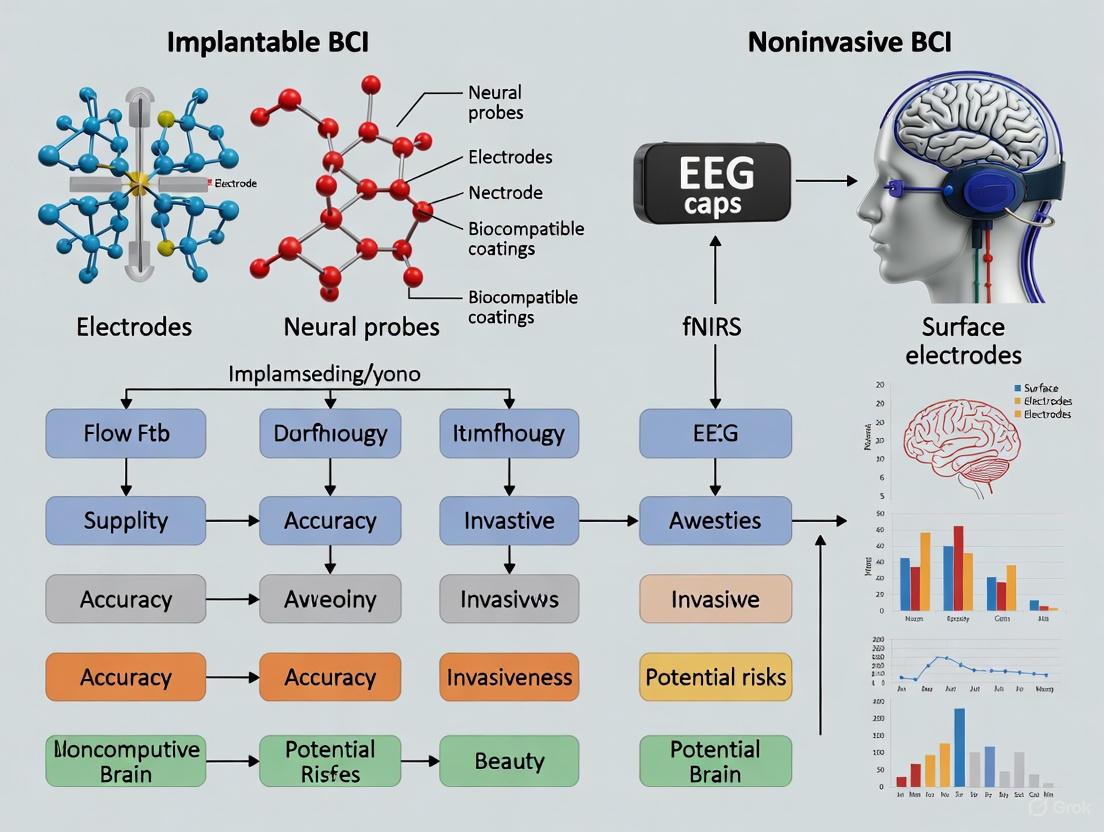
This article provides a comprehensive analysis of the distinct ethical landscapes surrounding implantable (iBCIs) and non-invasive Brain-Computer Interfaces for a research and drug development audience.
Implantable vs. Non-Invasive Brain-Computer Interfaces: A Comparative Ethical Framework for Biomedical Research
Abstract
This article provides a comprehensive analysis of the distinct ethical landscapes surrounding implantable (iBCIs) and non-invasive Brain-Computer Interfaces for a research and drug development audience. It explores the foundational ethical principles, including autonomy, personhood, and privacy, and contrasts the risk-benefit profiles of both BCI modalities. The content delves into methodological challenges in clinical trial design, informed consent, and long-term oversight, informed by current regulatory frameworks like the FDA's Investigational Device Exemption (IDE). It further offers a troubleshooting guide for mitigating risks such as cybersecurity threats, signal degradation, and physical adverse events. By presenting a direct, validated comparison of the ethical and performance trade-offs, this article aims to equip scientists and professionals with the knowledge to navigate the responsible development and application of these transformative neurotechnologies.
Foundational Ethical Principles and Neuroethical Dilemmas in BCI Technologies
Brain-Computer Interface (BCI) technology represents a transformative frontier in neuroscience and medicine, enabling direct communication between the brain and external devices [1]. These systems can be broadly categorized as implantable/invasive (iBCIs), which require surgical placement onto or into brain tissue, and non-invasive (e.g., EEG-based), which record neural activity from the scalp surface [1] [2]. While holding immense promise for restoring function in patients with neurological disabilities, these technologies raise profound ethical questions that challenge our fundamental understanding of human identity and rights [1] [2]. The ethical evaluation of neurotechnology, particularly the distinction between invasive and non-invasive approaches, necessitates a rigorous examination of three core principles: autonomy, personhood, and human dignity [2] [3]. This technical guide examines these concepts within the context of BCI research, providing a framework for researchers, scientists, and drug development professionals to navigate the complex ethical landscape of neurotechnological innovation.
Core Ethical Concepts: Definitions and Neurotechnological Implications
Autonomy
Concept Definition: Autonomy refers to the capacity for self-determination and the ability to make voluntary, informed decisions without controlling interference [2] [4]. In medical and research ethics, this is operationalized through the process of informed consent.
Impact of BCIs:
- Implantable BCIs: Invasive interfaces pose significant challenges to autonomy through multiple mechanisms. The surgical implantation procedure and subsequent electrical stimulation can potentially lead to alterations in personality, preferences, or decision-making capacities [2]. For instance, Deep Brain Stimulation (DBS) in Parkinson's patients has been associated with cases of disproportionate euphoria or impaired financial judgment, which can undermine the patient's ability to make autonomous decisions consistent with their pre-implant identity [2]. Furthermore, the bidirectional nature of next-generation iBCIs, which can both read and write neural signals, introduces the risk of external influence on thoughts and intentions, potentially compromising mental integrity [5].
Non-Invasive BCIs: While generally presenting lower physical risk, non-invasive systems still pose autonomy-related concerns. These often relate to the potential for misinterpretation of neural data to make inferences about a user's mental state without their full understanding or consent. The risk of undue influence or coercion is also present, particularly when these technologies are marketed directly to consumers for enhancement purposes with overstated claims [6].
Informed Consent Dynamics: The process of obtaining valid informed consent is particularly complex in iBCI research. Participants may have conditions, such as paralysis from spinal cord injury or amyotrophic lateral sclerosis (ALS), that impair their communication abilities, though not necessarily their decision-making capacity [4]. Researchers must implement augmentative and alternative communication (AAC) strategies and ensure participants can ask questions and express withdrawal of consent throughout the study. The therapeutic misconception—where participants conflate research with established treatment—is a significant risk that must be explicitly addressed during the consent process for both invasive and non-invasive BCI studies [4].
Personhood
Concept Definition: Personhood is a philosophical and ethical concept encompassing the essential attributes that constitute an individual's identity, such as self-consciousness, responsibility, and the capacity to plan for the future [2]. Integrity and dignity of a person are the most relevant criteria for the ethical evaluation of technological interventions [2].
Impact of BCIs:
- Implantable BCIs: Invasive interfaces prompt fundamental questions about the stability and boundaries of the self. Neurotechnological interventions can, in extreme cases, transiently or irreversibly alter a patient's personality and character [2]. This raises the question of whether an individual remains the "same person" following a significant neuromodulation. Such changes challenge traditional notions of legal responsibility, especially if an "intelligent neuroprosthesis" autonomously interprets or modifies brain activity [2]. The very concept of a hybrid brain-machine system blurs the line between the biological self and integrated technology, prompting what has been described as fundamental questions regarding the nature of conscious selfhood [1] [2].
Non-Invasive BCIs: These systems present a lower direct risk to the core of personal identity, as they do not physically penetrate the brain and their effects are typically more transient. However, they still engage with the extended mind hypothesis, which posits that cognitive abilities extend beyond the brain to include the body and parts of the external environment, including tools like notebooks and mobile phones [1]. A non-invasive BCI could thus become a functionally integrated component of a user's cognitive system. The ethical question becomes whether the alteration or removal of such a tightly integrated technology constitutes a violation of the person's cognitive continuity or mental integrity.
Philosophical and Practical Balance: From an ethical and regulatory standpoint, the concept of personhood serves as a critical benchmark. The current practice of neurotechnological interventions is, explicitly and implicitly, orientated toward the concept of personhood [2]. The guiding principle is that interventions are ethically unacceptable if the ability to remain a person is at risk. However, the situation is complicated by alterations in personality and character traits that may not reach the threshold of impairing personhood but still significantly impact the individual's lived experience and relationships [2].
Human Dignity
Concept Definition: Human dignity refers to the intrinsic and inalienable worth of every human being, which must be respected and protected regardless of their capacities or conditions [2]. It forms the foundation for human rights and is central to the governance of emerging technologies.
Impact of BCIs:
- Implantable BCIs: Invasive technologies risk commodifying human biology and mental life, potentially reducing individuals to objects that can be monitored, manipulated, and optimized [7]. The surgical integration of a machine component into the human brain can be viewed as an violation of bodily integrity, a key component of human dignity [2]. Furthermore, the potential for social stratification between those with and without cognitive enhancements could create a new form of inequality that undermines the fundamental equality of human dignity [1]. The long-term dependence on a corporate entity for device maintenance, support, and software updates also raises concerns about the instrumentalization of human beings [1].
Non-Invasive BCIs: While less physically intrusive, non-invasive BCIs still pose dignity risks, primarily related to privacy and data security. Neural data is deeply personal and may contain information about a person’s health, thoughts, intentions, or emotional states that the individual is not even consciously aware of [6]. The misuse or unauthorized access to this data represents a profound intrusion into the private sphere of the individual. The commercialization of consumer neurotechnology risks treating mental activity and emotional states as products to be mined and sold, a process often described as neural data commodification [7].
Regulatory Safeguards: Protecting human dignity in BCI research requires robust governance frameworks that prioritize participant welfare over commercial interests [7]. This includes ensuring transparency in research practices, maintaining long-term accountability for implanted devices, and enforcing strict data protection standards that treat neural data as a special category of sensitive information [8] [4]. Oversight bodies, such as Institutional Review Boards (IRBs), must have the specialized expertise necessary to evaluate the unique risks iBCI research poses to human dignity [4].
Comparative Ethical Analysis: Implantable vs. Non-Invasive BCIs
The ethical implications of BCI technologies vary significantly based on their level of invasiveness. The table below provides a structured comparison of the ethical considerations for implantable versus non-invasive BCIs.
Table 1: Ethical Considerations for Implantable vs. Non-Invasive BCIs
| Ethical Principle | Implantable/Invasive BCIs | Non-Invasive BCIs |
|---|---|---|
| Autonomy | High risk of compromised consent due to surgery; potential for personality changes affecting decision-making; challenges in long-term withdrawal from study [2] [4]. | Lower physical risk; concerns about understanding and coercion in consumer contexts; easier to discontinue use [6]. |
| Personhood | Direct risk of altering personality and identity; raises questions about the "self" and responsibility; blurs boundary between human and machine [2]. | Lower direct risk to core identity; engages with the "extended mind" concept; potential for functional integration into cognition [1]. |
| Human Dignity | High risk via bodily intrusion and commodification; potential for social inequality (enhancement divide); long-term user dependency on corporations [1] [7]. | Risks primarily from neural data privacy breaches and commercial exploitation; potential for discrimination based on neural analytics [7] [6]. |
| Informed Consent | Complex due to participant health status and communication impairments; requires rigorous, adaptive processes and ongoing consent verification [4]. | Generally more straightforward process; risk of misunderstanding technological capabilities due to commercial hype [6]. |
| Primary Regulatory Focus | Surgical safety, long-term biocompatibility, cybersecurity of bidirectional systems, post-market surveillance [7] [4]. | Data privacy, accuracy of claims (truth in advertising), validation of efficacy for intended use [7] [6]. |
Experimental Protocols and Methodologies for Ethical BCI Research
To ensure that research on both implantable and non-invasive BCIs adheres to ethical standards, specific methodological protocols must be implemented. These protocols are designed to safeguard participant autonomy, monitor impacts on personhood, and protect human dignity throughout the research lifecycle.
Protocol for Assessing and Supporting Informed Consent
This protocol is critical for ensuring autonomy, especially when recruiting participants with severe neurological disabilities who may have impaired communication abilities.
Workflow:
- Capacity Screening: Utilize standardized assessment tools, adapted for the participant's specific motor and communication limitations, to evaluate decision-making capacity.
- Information Disclosure: Present study information using augmentative and alternative communication (AAC) methods. This includes detailed discussion of the experimental nature of the device, all known risks (surgical, neurological, psychological, and social), the responsibility of the research team versus the participant, and the right to withdraw at any time without penalty.
- Comprehension Assessment: Employ a teach-back method or a customized questionnaire to verify the participant's understanding of key study elements, including risks, benefits, and alternatives.
- Documentation: Obtain signature or an established alternative method of affirmation (e.g., eye-gaze controlled digital signature) on the IRB-approved consent form.
- Ongoing Consent: Implement a process for continuous consent re-affirmation throughout the study duration, especially prior to major protocol changes or if new risks are identified.
Diagram 1: Informed Consent Assessment Workflow for BCI Research
Protocol for Longitudinal Monitoring of Psychosocial Well-being
This protocol is designed to detect potential alterations in personhood and other psychosocial factors during long-term BCI studies, particularly with iBCIs.
Workflow:
- Baseline Establishment: Conduct comprehensive pre-implant/use assessments using validated scales for personality, mood, quality of life, and sense of agency/self. Conduct semi-structured interviews with the participant and their close family/friends to establish a psychosocial baseline.
- Scheduled Monitoring: Perform repeated assessments at pre-defined intervals (e.g., 3, 6, 12 months post-implantation, and annually thereafter). For iBCIs, correlate these assessments with device programming and stimulation parameters.
- Data Review and Analysis: A multidisciplinary committee, including a neurologist, neurosurgeon, psychiatrist, and ethicist, should review the data to identify significant changes from baseline that may indicate negative impacts on psychosocial well-being or personal identity.
- Intervention and Support: If adverse changes are detected, the committee will recommend interventions, which may include psychological support, device parameter adjustments, or in extreme cases, discussion of device deactivation or explantation.
Protocol for Neural Data Governance and Security
This protocol is essential for protecting participant dignity and privacy by securing sensitive neural data against breaches and unauthorized use.
Workflow:
- Data Classification: Classify all raw and processed neural data as Highly Sensitive Personal Information.
- Technical Safeguards: Implement end-to-end encryption for data in transit and at rest. Use strong access controls (multi-factor authentication, principle of least privilege). For iBCIs, secure the bidirectional communication channel against unauthorized manipulation (hacking) [4].
- Policy and Governance: Develop clear data governance policies that define ownership, permissible uses, retention periods, and sharing agreements. These policies must be explicitly detailed in the informed consent document.
- Independent Auditing: Engage external cybersecurity experts to conduct regular penetration testing and security audits of the entire BCI system, from the implantable unit to the cloud storage infrastructure [4].
- Participant Transparency: Provide participants with a clear, understandable summary of how their neural data is protected, stored, and used.
The Scientist's Toolkit: Essential Research Reagents and Materials
The following table details key materials and methodological components frequently used in ethical BCI research, highlighting their function in both scientific and ethical contexts.
Table 2: Key Reagents and Materials in BCI Research with Ethical Considerations
| Item / Solution | Technical Function | Ethical Relevance & Considerations |
|---|---|---|
| High-Density Microelectrode Arrays (e.g., Utah Array, Neuralink's "Link") | Record and/or stimulate neural activity from hundreds to thousands of individual neurons [1] [9]. | Invasiveness & Safety: Core of iBCI risk. Requires rigorous evaluation of long-term biocompatibility, signal stability, and inflammatory response. Raises central ethical concerns regarding personality alteration and informed consent [1] [2]. |
| Electroencephalography (EEG) Caps/Headsets | Non-invasively record aggregate electrical brain activity from the scalp [1] [2]. | Privacy & Data Fidelity: While lower physical risk, data can infer mental states. Raises ethical issues of data privacy, interpretation accuracy, and potential for "mind reading" in consumer applications [6]. |
| Deep Brain Stimulation (DBS) Leads | Implanted electrodes that deliver electrical stimulation to deep brain structures to modulate neural circuitry [2]. | Personhood & Autonomy: Well-documented for therapeutic use (e.g., Parkinson's). Ethical focus is on unintended side-effects on mood, personality, and decision-making, which can impact autonomy and identity [2]. |
| Spike Sorting Algorithms | Software algorithms to classify action potentials from recorded extracellular signals, attributing them to specific neurons [1]. | Data Interpretation & Validity: Accuracy is critical for decoding intention. Inaccurate algorithms could lead to erroneous device outputs, posing safety risks and potentially causing user frustration or harm, undermining trust and autonomy. |
| Machine Learning (ML) Decoders | Translate recorded neural signals into commands for external devices (e.g., cursors, robotic limbs) [1]. | Agency & Responsibility: "Black box" nature of some ML models can make errors difficult to understand. Raises questions about user agency (who is in control?) and responsibility for actions taken by the system [2]. |
| Biocompatible Encapsulants (e.g., Parylene, Silicone) | Electrically insulate implanted electrodes and protect neural tissue from the immune response [1]. | Long-Term Safety & Welfare: Failure leads to inflammation, scarring, and signal degradation. Ethical imperative to maximize device longevity and safety to prevent harm and the need for risky explantation/revision surgeries. |
The ethical landscape of neurotechnology is as complex and nuanced as the neural circuits it engages. Implantable and non-invasive BCIs present distinct but overlapping ethical challenges related to the core principles of autonomy, personhood, and human dignity. iBCIs, with their greater potential for therapeutic benefit, also carry higher risks of physical harm, profound alterations to identity, and long-term dependencies. Non-invasive BCIs, while safer and more accessible, raise significant concerns regarding privacy, data commodification, and the potential for societal-level misuse. For researchers and developers, navigating this landscape requires a commitment to a multidisciplinary approach that integrates neuroscience, medicine, engineering, ethics, and law from the earliest stages of design and protocol development. Proactive and continuous ethical assessment, robust informed consent processes, stringent data governance, and anticipatory regulatory thinking are not impediments to innovation but essential components of responsible research that respects the fundamental humanity of its participants. The future of BCI technology depends not only on technical breakthroughs but also on our collective ability to establish and uphold ethical standards that protect and preserve what it means to be human.
Brain-Computer Interfaces (BCIs) represent a transformative neurotechnology with the potential to restore function for patients with neurological deficits. These systems are broadly categorized into implantable BCIs (iBCIs), which require surgical insertion, and non-invasive BCIs, which record neural signals from the scalp. This whitepaper provides a comparative risk-benefit analysis, examining the surgical risks of iBCIs against the limitations of non-invasive alternatives. The ethical imperative is to balance the potential for superior functionality against the fundamental principle of minimizing harm, guiding researchers and clinicians in their therapeutic and investigational choices. The analysis is framed within the broader ethical considerations essential to BCI research and development.
The core distinction between iBCIs and non-invasive BCIs lies in the proximity of the recording sensors to the neural tissue, which directly dictates signal quality and, consequently, the associated risks and benefits.
Implantable BCIs (iBCIs): These devices are surgically placed on the surface of the brain (e.g., Electrocorticography, ECoG) or within the brain parenchyma (e.g., intracortical microelectrode arrays). This proximity to neural sources allows for the recording of signals with high spatial resolution and bandwidth, enabling the decoding of intricate neural patterns for complex tasks like speech reconstruction and dexterous motor control [10]. However, this advantage comes with inherent surgical risks and long-term biocompatibility challenges.
Non-Invasive BCIs: Typically using technologies like electroencephalography (EEG), these systems record electrical activity from the scalp. They are safer and more convenient as they avoid surgery, but the signals are severely compromised by the skull, leading to low spatial resolution and susceptibility to physiological and environmental noise [11] [12]. This limits their application to simpler control paradigms, though they show promise in rehabilitation settings.
Table 1: Fundamental Characteristics of BCI Modalities
| Feature | Implantable BCIs (iBCIs) | Non-Invasive BCIs (e.g., EEG) |
|---|---|---|
| Signal Fidelity | High spatial resolution & bandwidth [10] | Low spatial resolution; blurred by skull [12] |
| Invasiveness | High (requires surgery) [13] | None |
| Typical Applications | Complex communication (speech decoding), motor control [10] | Basic rehabilitation, communication, and control [11] |
| Key Technical Limitation | Long-term signal stability, biocompatibility [14] | Low signal-to-noise ratio, sensitivity to artifacts [12] |
Comprehensive Risk Analysis
Risks of Implantable BCIs (iBCIs)
The risks associated with iBCIs are significant and multifaceted, extending from the immediate perioperative period to the long-term.
Surgical and Biological Risks: The implantation procedure carries inherent risks, including surgical complications, anesthesia risks, and postoperative infections [10]. Furthermore, the body's biological response to the implanted device is a major challenge. This includes immune reactions such as glial scarring, which can lead to the encapsulation of the device and a progressive degradation of signal quality over time [14].
Cybersecurity Risks: iBCIs are increasingly networked devices, making them vulnerable to cyberattacks. A breach could lead to unauthorized access to sensitive neural data or, even more critically, the malicious manipulation of the device's function. This could result in the impairment of cognitive or motor functions for the user, a threat that scales to a population level if standardized systems are compromised [15].
Long-Term Ethical and Psychological Risks: The long-term implantation of a device that interfaces directly with the brain raises profound ethical questions. These include the potential for changes in personality or personal identity, concerns about mental privacy, and the possibility of "coercive optimism," where vulnerable patients feel unduly pressured to accept risks due to the transformative promise of the technology [13] [14].
Risks and Limitations of Non-Invasive BCIs
While non-invasive BCIs avoid the severe risks of surgery, their limitations are primarily functional.
Functional Limitations due to Signal Quality: The poor spatial resolution of non-invasive signals limits their information transfer rate (bitrate). They are generally incapable of decoding complex intentions like continuous speech or fine motor commands. Furthermore, these systems are highly susceptible to interference from "neural noise" such as mind-wandering, emotional fluctuations, and environmental artifacts, which can degrade performance and require extensive user training to overcome [14] [12].
Practical and User Experience Limitations: For widespread use, factors such as set-up time, portability, and cosmesis are important. Current non-invasive systems often require gel application, precise electrode placement, and can be cumbersome, which may limit their adoption for everyday use outside of clinical or laboratory settings [12].
Table 2: Comparative Risk and Limitation Profile
| Risk Category | Implantable BCIs (iBCIs) | Non-Invasive BCIs |
|---|---|---|
| Procedural | Surgical risk, infection, anesthesia risk [10] | None |
| Biological | Chronic immune response, signal degradation over time [14] | None |
| Cybersecurity | High; potential for data theft & functional manipulation [15] | Lower; primarily a data privacy concern |
| Long-Term Function | Signal instability, device failure [14] | Stable but inherently limited |
| Primary Functional Limitation | Long-term biocompatibility & stability | Low signal fidelity and high noise [12] |
Benefit and Efficacy Analysis
Therapeutic Benefits of iBCIs
iBCIs have demonstrated groundbreaking successes in restoring function for individuals with severe neurological conditions. The primary benefit is the enablement of complex, high-bandwidth communication. Recent research has successfully decoded speech directly from cortical activity with high accuracy, allowing individuals with paralysis and anarthria to communicate through synthesized speech or text at a level that approaches natural conversation [10]. This represents a qualitative leap in restoring embodied communication, far surpassing the capabilities of current non-invasive systems.
Therapeutic Benefits of Non-Invasive BCIs
Non-invasive BCIs have shown significant promise as tools for neurorehabilitation. A 2025 meta-analysis of patients with spinal cord injury found that non-invasive BCI interventions had a statistically significant, positive impact on motor function, sensory function, and the ability to perform activities of daily living [11]. The therapeutic mechanism is thought to be the promotion of neuroplasticity through closed-loop neurofeedback training, potentially helping to reinforce residual neural pathways. Their safety profile makes them suitable for broader application across various patient populations and for use in long-term, repetitive training protocols.
Table 3: Comparative Clinical Evidence and Applications
| Application | Implantable BCIs (iBCIs) | Non-Invasive BCIs |
|---|---|---|
| Communication | High-accuracy speech decoding & synthesis [10] | Slow spelling (e.g., P300 speller) |
| Motor Restoration/Rehab | Control of external devices (e.g., robotic arms) | Improved motor/sensory function post-SCI [11] |
| Level of Evidence | Promising case reports & series; no large-scale RCTs [10] | Meta-analysis of RCTs and self-controlled trials [11] |
| Key Benefit | Replaces lost function for severe paralysis | Facilitates recovery and rehabilitation |
Ethical and Regulatory Considerations
The development and deployment of BCIs must be guided by robust ethical and regulatory frameworks to protect patient rights and welfare.
Informed Consent: This is a paramount challenge, especially for iBCI research involving participants who may have impaired consent capacity due to their underlying condition. The process must be meticulously managed to avoid "coercive optimism" and ensure participants or their legally authorized representatives truly understand the profound risks and unproven benefits [13] [14].
Regulatory Pathways: In the United States, iBCIs are regulated as Class III medical devices by the FDA, subjecting them to the most stringent pre-market approval (PMA) requirements. The regulatory process involves an Investigational Device Exemption (IDE) for clinical trials, which must be approved by the FDA and an Institutional Review Board (IRB) [13] [4]. A significant gap, however, is the current regulatory emphasis on pre-market safety and efficacy, with less developed frameworks for long-term post-market surveillance, which is critical for devices that may induce neural changes over many years [13].
Cybersecurity as an Ethical Imperative: The Yale Digital Ethics Center recommends specific measures to safeguard iBCIs, including: strong authentication schemes to prevent unauthorized access, non-surgical methods for software updates and recovery, and the encryption of data moving to and from the device [15]. Protecting the integrity and privacy of the brain-computer interface is not just a technical issue but a fundamental ethical requirement.
Experimental Protocols and Methodologies
Protocol for iBCI Speech Decoding
The groundbreaking work on speech neuroprostheses involves a detailed and multi-stage protocol.
- Pre-Surgical Planning: Utilizing fMRI or other neuroimaging to localize speech-related brain areas (e.g., sensorimotor cortex, Broca's area, Wernicke's area).
- Surgical Implantation: A craniotomy is performed to place a high-density multielectrode array or ECoG grid onto the targeted cortical surface [10].
- Data Acquisition: Participants are asked to attempt to speak, imagine speaking, or produce specific phonemes. Neural activity is recorded at high sampling rates.
- Feature Extraction & Model Training: Advanced machine learning models (e.g., deep neural networks) are trained to map specific neural activation patterns to intended speech outputs (text or audio) [10].
- Closed-Loop Testing: The decoded speech is provided as real-time feedback to the user, creating a closed-loop system for calibration and use.
Protocol for Non-Invasive BCI Rehabilitation
A typical protocol for rehabilitating motor function after spinal cord injury, as synthesized in meta-analyses, involves:
- Participant Selection: Patients with subacute or chronic SCI, often classified on the ASIA Impairment Scale [11].
- System Setup: Application of an EEG cap according to the international 10-20 system. Signals are amplified and digitized.
- Paradigm Selection: Use of a motor imagery paradigm (e.g., imagining hand or foot movement) or a stimulus-driven paradigm like Steady-State Visual Evoked Potential (SSVEP) [11] [14].
- Intervention: The BCI system is linked to an effector, such as functional electrical stimulation (FES) of a paralyzed limb or a virtual reality avatar. Successful motor imagery triggers the effector, providing contingent feedback.
- Outcome Measurement: Standardized scales are used pre- and post-intervention, such as the ASIA motor score, Berg Balance Scale (BBS), or Spinal Cord Independence Measure (SCIM) to quantify functional changes [11].
The Scientist's Toolkit: Research Reagent Solutions
Table 4: Essential Materials and Tools for BCI Research
| Item | Function in Research |
|---|---|
| Multielectrode Arrays (e.g., Utah Array) | Chronic intracortical recording for iBCIs; captures single-neuron or multi-unit activity [10]. |
| ECoG Grids | Subdural recording from the cortical surface; offers a balance of signal quality and reduced invasiveness compared to intracortical arrays. |
| High-Density EEG Systems | Non-invasive recording of brain activity from the scalp; essential for rehabilitation and cognitive studies [11] [12]. |
| Steady-State Visual Evoked Potential (SSVEP) | A robust paradigm for non-invasive BCIs that uses rhythmic visual stimuli to generate a clear, frequency-locked neural response for control [14]. |
| Common Terminology Criteria for Adverse Events (CTCAE) | Standardized grading scale for quantifying the severity of adverse reactions in clinical trials, crucial for risk assessment [16]. |
| Brain-Computer Interface Toolboxes (e.g., BCILAB, OpenBMI) | Software platforms that provide standardized signal processing and machine learning algorithms for decoding neural signals. |
Visual Synthesis of Risk-Benefit Decision Framework
The following diagram illustrates the core logical relationship and decision-making workflow for choosing between BCI modalities, based on the comparative analysis of risks, benefits, and patient-specific factors.
The choice between implantable and non-invasive BCIs is not a matter of superiority but of alignment with specific clinical goals, risk tolerance, and patient-specific factors. iBCIs offer unparalleled functionality for restoring complex communication in the most severely disabled individuals but demand a high-risk, high-reward calculus due to inherent surgical and long-term biocompatibility risks. Non-invasive BCIs present a much safer profile and have demonstrated efficacy in neurorehabilitation, though they are constrained by fundamental limits in signal fidelity. For researchers and clinicians, the ethical path forward requires a rigorous, transparent, and patient-centered benefit-risk assessment. Future work must focus on mitigating the risks of iBCIs through improved materials and robust cybersecurity, while enhancing the capabilities of non-invasive systems, ensuring that this powerful technology develops in a manner that is both responsible and maximally beneficial to patients.
The rapid advancement of brain-computer interfaces (BCIs) presents unprecedented ethical challenges, particularly concerning the privacy and security of neural data. This sensitive information can reveal thoughts, emotions, and decision-making patterns, constituting what many consider the final frontier of human privacy [17]. The ethical landscape differs significantly between implantable and non-invasive BCIs, each presenting distinct risk profiles, technical challenges, and security considerations that researchers must address [12] [1]. As BCIs transition from medical applications to potential cognitive enhancement tools, the scientific community faces pressing questions about how to safeguard the intimate window into human consciousness that these technologies provide [1]. Recent legislative developments, including the proposed MIND Act of 2025, highlight growing recognition of these challenges at the policy level and underscore the need for robust technical frameworks to protect neural data [17] [18].
The Unique Sensitivity of Neural Data
What Makes Neural Data Different?
Neural data encompasses information obtained by measuring the activity of an individual's central or peripheral nervous system through neurotechnology [17]. Unlike conventional personal data, neural information can provide direct insights into cognitive, emotional, and psychological states, including those the individual may not voluntarily disclose or even consciously access [1]. This data can reveal mental health conditions, political beliefs, susceptibility to addiction, and other deeply personal attributes that individuals might not want to share [17]. The proposed MIND Act recognizes this sensitivity, defining neural data broadly to include not only direct central nervous system measurements but also related data such as heart rate variability, eye tracking patterns, voice analysis, and facial expressions that can infer mental states [17].
Ethical Dimensions in BCI Research
The ethical considerations surrounding neural data protection extend beyond conventional data privacy due to the direct connection to personal identity and autonomy [1]. Neural data protection raises fundamental questions about human dignity, cognitive liberty, and the right to mental self-determination [18]. Researcher fiduciary obligations are particularly heightened in BCI studies involving vulnerable populations, such as individuals with locked-in syndrome, where issues of autonomy and consent present complex challenges that continue throughout the research lifecycle [19].
Table 1: Comparative Analysis of Neural Data Types and Their Sensitivity
| Data Category | Examples | Revealing Capacity | Research Context |
|---|---|---|---|
| Direct CNS Data | EEG, ECoG, intracortical recordings | Thoughts, emotions, decision-making patterns | High-risk; requires stringent protection |
| PNS Data | Heart rate variability, galvanic skin response | Cognitive load, emotional arousal | Medium-risk; inferential limitations |
| Behavioral Correlates | Eye tracking, facial expressions, voice analysis | Attention, cognitive states, emotional responses | Variable risk; context-dependent |
| Derived Metrics | Algorithmically processed neural data | Cognitive performance, neurological conditions | Depends on algorithm transparency |
Technical Landscape: Implantable vs. Non-Invasive BCIs
Distinct Data Security Challenges by BCI Type
The architectural differences between implantable and non-invasive BCIs create fundamentally different security and privacy considerations that researchers must address.
Implantable BCIs
Implantable systems, such as intracranial electrodes and electrocorticography (ECoG) grids, offer high-resolution neural data acquisition but present unique security vulnerabilities [1] [20]. These systems face significant biocompatibility challenges, where mechanical mismatch between rigid electrode materials and soft neural tissue can lead to foreign body reactions, scar tissue formation, and potential device failure [20]. The chronic implantation of these devices creates long-term attack surfaces for potential cybersecurity threats, including unauthorized access to neural data or malicious manipulation of brain stimulation parameters [18]. Recent research focuses on developing softer, more biocompatible materials and conformal ECoG grids to improve integration and reduce immune response, but these advances introduce new security considerations for wireless and power systems [20].
Non-Invasive BCIs
Non-invasive approaches, primarily electroencephalography (EEG), functional near-infrared spectroscopy (fNIRS), and emerging wearable magnetoencephalography (MEG), avoid surgical risks but face different limitations [12] [21]. These systems suffer from stronger signal degradation through hardware limitations and real-world artifacts, but their increasing portability and consumer adoption create broader data collection surfaces [12]. The signal-to-noise ratio challenges in non-invasive systems often require more sophisticated data processing, increasing the computational footprint and potential vulnerability points in the data pipeline [12] [21].
Table 2: Security and Privacy Considerations by BCI Modality
| Parameter | Implantable BCIs | Non-Invasive BCIs |
|---|---|---|
| Data Resolution | High (single neuron possible) | Low to medium (signal aggregates) |
| Primary Vulnerabilities | Device tampering, unauthorized stimulation | Eavesdropping, data interception |
| Attack Surface | Limited physical access but high impact | Broader access but lower resolution data |
| Data Volume | High-density recordings | Lower-density but more widely collected |
| Security Lifecycle | Long-term (years) implant management | Sh-term device cycling |
| Encryption Needs | Device-to-external processor communication | End-to-end in consumer applications |
| Regulatory Framework | FDA medical device regulations | Emerging FTC/state privacy regulations |
Experimental Protocols for Secure Neural Data Handling
Establishing standardized protocols for secure neural data handling is essential for responsible BCI research. The following methodology outlines a comprehensive approach:
Protocol 1: Secure Data Acquisition and Transmission
- Implement authenticated encryption for all neural data streams using AES-256-GCM or similar standards
- Utilize hardware security modules for key management in research settings
- Establish secure boot processes for BCI devices to prevent firmware tampering
- Implement continuous integrity monitoring for data during acquisition [18]
Protocol 2: Privacy-Preserving Data Processing
- Apply differential privacy techniques for dataset sharing
- Employ federated learning approaches to minimize raw data transfer
- Implement secure multi-party computation for collaborative analysis
- Develop synthetic data generation methods for algorithm validation [1]
Protocol 3: Access Control and Audit Frameworks
- Deploy role-based access control with principle of least privilege
- Maintain immutable audit logs for all neural data access
- Implement multi-factor authentication for sensitive data repositories
- Establish data governance policies specific to neural information [17] [18]
Regulatory Framework and Emerging Guidelines
Current Legislative Landscape
The regulatory environment for neural data is rapidly evolving, with several states enacting privacy protections and federal legislation under consideration. The proposed MIND Act of 2025 would direct the Federal Trade Commission to study neural data processing and identify regulatory gaps [17]. This act recognizes the need to balance innovation with consumer protection, specifically highlighting risks of manipulation, discrimination, exploitation, and surveillance [18]. Meanwhile, states including California, Colorado, Connecticut, and Montana have amended their privacy laws to include neural data protections, though with varying definitions and requirements that create a complex compliance landscape for multi-state research [17] [18].
Ethical Oversight in Research Settings
Beyond legal compliance, BCI researchers must implement rigorous ethical oversight mechanisms. This includes developing specialized institutional review board (IRB) protocols for neural data research, establishing data retention and deletion policies reflective of neural data sensitivity, creating incident response plans specifically for neural data breaches, and implementing ethical review processes for neural data sharing agreements [1] [19]. The ethical obligations extend throughout the research lifecycle, including study conclusion, where researchers have fiduciary obligations to participants, particularly in studies involving vulnerable populations [19].
Cybersecurity Protocols for BCI Research Infrastructure
Technical Safeguards for Neural Data Systems
Implementing robust cybersecurity measures is essential for protecting neural data throughout the research pipeline. The following technical safeguards represent current best practices:
Secure Software Update Framework
- Cryptographic verification of firmware integrity at download, transfer, and installation points
- Rollback capability to previous versions if updates cause instability
- Digital signing of all software components with certificate-based authentication [18]
Authentication and Access Controls
- Multi-factor authentication for all system access points
- User-configurable login resets and trusted device management
- Session timeouts and configurable wireless connectivity disablement features [18]
Data Protection Measures
- End-to-end encryption for data in transit and at rest
- Adversarial AI training to detect and resist manipulation attempts
- Network segmentation to isolate critical BCI control systems [18]
Diagram 1: Neural Data Security and Threat Mitigation Framework. This workflow illustrates the end-to-end security measures required for protecting neural data and potential failure points that could lead to breaches.
Research Reagent Solutions for Secure Neural Interfaces
Table 3: Essential Research Tools for Neural Data Security
| Reagent/Tool Category | Specific Examples | Research Function | Security Considerations |
|---|---|---|---|
| Biocompatible Electrode Materials | Flexible polymer-based electrodes, conformal ECoG grids | Reduce immune response and improve signal stability | Material integrity affects long-term device security |
| Secure Data Acquisition Systems | Hardware security modules, encrypted ADC platforms | Protect data at acquisition source | Prevent tampering during initial data capture |
| Neural Data Encryption Tools | AES-256-GCM implementations, homomorphic encryption libraries | Enable privacy-preserving data analysis | Balance computational overhead with security needs |
| Access Control Frameworks | Role-based access control systems, biometric authentication | Manage researcher access to sensitive neural datasets | Implement principle of least privilege |
| Adversarial Testing Tools | Model inversion attack detectors, membership inference frameworks | Identify potential vulnerabilities in neural algorithms | Proactive security assessment |
| Data Anonymization Toolkits | Differential privacy implementations, k-anonymity tools | Enable data sharing while protecting participant identity | Balance data utility with privacy protection |
Emerging Challenges and Opportunities
The field of neural data protection faces several emerging challenges that require ongoing research attention. The integration of artificial intelligence with BCI systems introduces new attack surfaces through adversarial machine learning, where inputs can be deliberately designed to mislead neural decoding algorithms [20]. The development of closed-loop BCIs that both record and stimulate neural activity creates potential vulnerabilities for malicious manipulation of brain function [18]. As BCIs expand from medical applications to cognitive enhancement, new ethical questions emerge about privacy standards for non-medical neural data [1]. The growing market for consumer neurotechnology, forecast to reach over $1.6 billion by 2045, increases the scale of neural data collection and corresponding privacy risks [21].
Protecting sensitive neural information requires a multidisciplinary approach integrating neuroscience, computer security, ethics, and policy. The unique sensitivity of neural data demands higher standards of protection than conventional health information, with rigorous security protocols tailored to the specific risks of different BCI modalities. As stated in the BRAIN Initiative guidelines, "BRAIN Initiative research should hew to the highest ethical standards for research with human subjects" [22]. Researchers have a fundamental responsibility to implement comprehensive privacy and security measures that protect not only the data but the cognitive liberty and mental integrity of research participants. The development of robust neural data protection frameworks is not merely a technical challenge but an ethical imperative essential for maintaining public trust and ensuring the responsible advancement of neurotechnologies.
Brain-Computer Interface (BCI) technology represents one of the most transformative advancements in modern neuroscience, establishing a direct communication pathway between the brain and external devices [12]. These systems can be broadly categorized into implantable BCI (iBCI) devices, which require surgical insertion into the brain, and non-invasive BCI devices, which use external sensors to detect neural signals [13] [12]. While initially developed for therapeutic applications to restore function for individuals with disabilities, rapid commercialization and technological progress are accelerating non-medical enhancement applications, creating a pressing need for ethical boundaries [14] [7]. The global BCI market, valued at approximately $2.83 billion in 2025 and projected to reach $8.73 billion by 2033, demonstrates the significant economic forces driving this expansion [23].
This growth is fueled by substantial private investments, such as the $205 million in Series C funding secured by Neuralink and $100 million raised by Precision Neuroscience, accelerating both medical and consumer-oriented development [24] [23]. The ethical significance of BCIs extends beyond conventional medical ethics, as they function as "infrastructures of moral inclusion" that restore communicative agency to individuals otherwise excluded from human interaction [25]. This paper examines the technical capabilities, ethical challenges, and regulatory frameworks necessary to distinguish between therapeutic and enhancement applications of BCI technology, with particular attention to the distinct considerations raised by implantable versus non-invasive approaches.
Technical Foundations: Comparative Capabilities of Implantable and Non-Invasive BCIs
Technical Specifications and Performance Metrics
The fundamental distinction between implantable and non-invasive BCIs lies in their signal acquisition methods, which directly determine their capabilities and applications. iBCIs utilize electrodes surgically implanted in the brain cortex, providing high-fidelity access to neural signals but introducing surgical risks, immune responses, and potential device degradation over time [14]. Non-invasive approaches, primarily using electroencephalography (EEG), capture neural signals through scalp sensors, avoiding surgical risks but struggling with signal resolution and robustness due to interference from skull tissue and external noise [14] [12].
Table 1: Performance Comparison of Major BCI Modalities
| Parameter | Implantable BCIs (iBCIs) | Non-Invasive BCIs (EEG-based) |
|---|---|---|
| Spatial Resolution | High (micron-scale) | Low (centimeter-scale) |
| Temporal Resolution | Excellent (milliseconds) | Excellent (milliseconds) |
| Signal Fidelity | High-quality neural spiking activity | Degraded by skull and tissue |
| Clinical Risk | Surgical risks, immune response, device degradation | Minimal physical risk |
| Primary Applications | Severe paralysis, ALS, spinal cord injuries, movement restoration | Basic communication, motor imagery, cognitive monitoring, entertainment |
| Key Limitations | Biocompatibility, long-term stability, requirement for surgery | Signal noise, limited complexity of decodable commands, user training requirements |
Signal Processing and Decoding Challenges
Both iBCIs and non-invasive systems face fundamental neuroscientific challenges in translating neural activity into actionable commands. The brain's dynamic, distributed networks resist reduction to simple linear models, creating a mismatch between neural reality and BCI design assumptions [14]. Current systems predominantly decode basic motor intentions through statistically correlating neural patterns with user-generated feedback, requiring continuous recalibration and adaptation to individual neural variability [14]. Even the most advanced iBCIs struggle to generalize beyond highly controlled experimental settings and simple, repetitive tasks, highlighting significant scientific and technical barriers to expanding BCI capabilities [14].
Non-invasive systems have demonstrated more success with robust, unambiguous neural signals like the Steady-State Visual Evoked Potential (SSVEP), where frequency-locked electrical responses in the visual cortex provide a direct, decodable signal for communication [14]. Recent refinements like Rapid Invisible Frequency Tagging (RIFT) utilize imperceptible flicker rates (>50 Hz) to maintain signal clarity while minimizing visual fatigue, representing a promising pathway for efficient next-generation interfaces [14]. However, both approaches must contend with the brain's inherent "noise" - spontaneous neural activity unrelated to user intent that includes subconscious processes, emotional fluctuations, and sensory distractions that interfere with detecting goal-directed signals [14].
Ethical Framework: Boundary Criteria Between Therapy and Enhancement
Foundational Ethical Principles
The ethical evaluation of BCI applications requires a multidimensional framework that extends beyond conventional medical ethics. While traditional risk-benefit analysis remains essential, BCIs introduce distinct ethical considerations stemming from their direct interface with neural tissue and cognitive processes [25]. The concept of "communicative reinstatement" reframes therapeutic BCIs as infrastructures of moral inclusion that restore personhood by enabling participation in ethical communities [25]. This perspective establishes a fundamental ethical obligation to provide and maintain technologies that restore communicative agency where reasonably possible.
Four primary ethical principles should guide the therapy-enhancement distinction:
Autonomy and Consent: Informed consent requires special consideration for BCI research, particularly for individuals with impaired consent capacity. The transition from communicative isolation to reinstatement is difficult to fully apprehend in advance, necessitating enhanced consent protocols that address this phenomenological shift [25] [13].
Beneficence and Risk Proportionality: Therapeutic applications must demonstrate risk-benefit proportionality, with higher procedural risks (such as brain surgery for iBCIs) justified by compelling medical needs. Enhancement applications, by definition, lack this medical necessity, creating different risk tolerance thresholds [14] [5].
Privacy and Integrity: The "neural commodification" - transforming uniquely sensitive neural data reflecting mental states and identity into economic goods - raises fundamental privacy concerns that are particularly acute for enhancement applications where medical benefit is absent [14].
Justice and Equity: With high costs (approximately $60,000 per unit) currently limiting access, prioritization of therapeutic applications serves distributive justice principles [23]. Enhancement applications risk exacerbating existing social inequalities if available only to affluent populations.
Procedural Vulnerabilities and Commercial Pressures
The rapid commercialization of BCIs introduces specific ethical vulnerabilities that complicate the therapy-enhancement distinction. "Coercive optimism" describes the phenomenon where intense commercial hype and overwhelming promise of transformative benefits unduly influences vulnerable populations (such as patients with severe paralysis) to accept procedural risks, undermining truly autonomous consent [14]. Additionally, "ethics shopping" occurs when companies exploit variation in regulatory standards across jurisdictions to minimize compliance burdens by conducting research in locations with the weakest oversight [14].
The case of Neuralink illustrates these tensions, as the company has presented its technology with commercial marketing aesthetics more typical of consumer products than medical devices, potentially blurring important distinctions between medical and enhancement applications [9] [5]. This commercial framing, coupled with initial lack of transparency including delayed trial registration, has raised concerns within the scientific community about adequately distinguishing between valid therapeutic applications and speculative enhancement capabilities [5].
Experimental Protocols and Research Methodologies
Standardized Testing Paradigms for BCI Applications
Research evaluating BCI applications employs standardized experimental protocols to assess both technical performance and functional outcomes. These methodologies provide the empirical foundation for distinguishing between therapeutic efficacy and enhancement capabilities.
Motor Imagery Paradigms account for approximately 27% of prefrontal tasks used in BCI research [24]. In this protocol, users imagine performing specific movements without actual physical execution, while the BCI system decodes associated neural patterns to control external devices. This approach has demonstrated particular utility for individuals with spinal cord injuries, enabling basic control of assistive devices [14] [23]. The University of Lausanne's "digital bridge" represents a notable advancement, where researchers created a connection between the brain of a paralyzed individual and the portion of his spinal cord below the lesion, allowing him to walk again by decoding walking intention signals and transmitting them to spinal cord electrodes [5].
Communication Restoration Protocols for individuals with complete locked-in syndrome (CLIS) utilize spelling applications that enable users to construct sentences through neural signal detection. One landmark study documented an ALS patient who, after entering CLIS, learned to use an implanted BCI speller to construct sentences at a rate of approximately one character per minute [25]. These protocols demonstrate the ethical significance of communicative reinstatement, transforming patients from passive care recipients to active participants in ethical dialogue [25].
SSVEP (Steady-State Visual Evoked Potential) Protocols utilize visual stimuli flickering at specific frequencies (typically 5-30 Hz) to elicit frequency-locked neural responses detectable in the visual cortex [14]. Users direct spatial attention to targets flickering at different rates, enabling selection from multiple options. This approach provides robust performance for basic control applications while minimizing training requirements [14]. Recent refinements like Rapid Invisible Frequency Tagging (RIFT) extend this paradigm using imperceptible flicker rates (>50 Hz) to reduce visual fatigue while maintaining classification accuracy [14].
The Scientist's Toolkit: Essential Research Reagents and Platforms
Table 2: Essential Research Platforms and Reagents in BCI Development
| Research Tool | Type/Platform | Primary Function | Research Application |
|---|---|---|---|
| BCI2000 | Software Platform | Data acquisition, brain signal processing, and research task management | Stores data in standard formats (BCI2000 native or GDF) with event markers; provides tools for easy data import/export and integration with external programs [24]. |
| BSanalyze | Analysis Software | Interactive platform for processing and analyzing multimodal biosignal data | Comprehensive investigation of invasive and non-invasive functions of the brain; includes sample biosignal datasets (SSVEP, P300, motor imagery) for research validation [24]. |
| BCILAB | MATLAB Toolbox | Brain-Computer Interface research and algorithm development | Simplifies conception and crafting of novel cognitive state estimation approaches; enables application in offline data analysis and real-time BCI systems [24]. |
| Stentrode | Implantable Device | Endovascular stent-electrode array | Minimally invasive motor neuroprosthesis implanted via blood vessels rather than open-brain surgery [5]. |
| Microelectrode Arrays | Implantable Hardware | Neural signal recording from cortical tissue | High-density electrode placement (Neuralink's N1 utilizes 64 threads detecting activity at 1,024 sites) for capturing neural signals [9] [5]. |
Regulatory Frameworks and Oversight Considerations
Current Regulatory Landscape
The United States Food and Drug Administration (FDA) regulates investigational medical devices under the Investigational Device Exemption (IDE) program, requiring thorough review of device safety, efficacy, design, materials, and clinical study protocols before clinical trials can commence [13]. In 2021, the FDA published formal guidance for iBCI devices specifically for patients with paralysis or amputation, emphasizing comprehensive risk management, cybersecurity assessments, and human factors engineering [13]. For market approval, iBCIs typically follow the Premarket Approval (PMA) pathway, the most comprehensive marketing submission reserved for high-risk (Class III) medical devices that support or sustain life or present potential unreasonable risk of illness or injury [13].
A significant regulatory challenge involves the current focus on premarket safety and efficacy, with less emphasis on long-term surveillance and post-market follow-up [13]. This creates particular concerns for iBCIs, which may induce neural changes that unfold over extended periods, requiring more persistent monitoring protocols than traditional medical devices [13]. The rapid commercialization of BCIs has further revealed regulatory gaps, as existing frameworks struggle to address vulnerabilities in consent, privacy, and long-term safety while balancing innovation with patient protection [14] [7].
Institutional Review Board (IRB) Considerations
Institutional Review Boards play a critical role in safeguarding participant rights and welfare in BCI research, facing distinct challenges when reviewing iBCI protocols [13]. IRBs must ensure that informed consent processes adequately address the unique phenomenology of BCI-mediated communication restoration, particularly for participants with impaired consent capacity who may rely on legally authorized representatives [13] [25]. The ethical review must carefully evaluate risk-benefit ratios, recognizing that while direct benefits may include improved mobility or communication, feasibility studies provide societal benefits through generalizable knowledge [13].
IRBs reviewing iBCI research require specialized expertise, including neurologists, neurosurgeons, and cybersecurity experts, to adequately evaluate complex technical and ethical considerations [13]. Cybersecurity represents a particularly critical consideration, as inadequate data protection could enable unauthorized access to neural data or even manipulation of brain activity [13]. These reviews are further complicated by the relatively small number of iBCI clinical trials, which limits institutional experience with these unique ethical challenges compared to more established therapeutic areas [13].
The ethical boundaries between therapeutic and enhancement applications of BCI technology require ongoing evaluation as technological capabilities advance. The distinction must balance recognition of BCIs as "infrastructures of moral inclusion" that restore fundamental human capacities [25] against legitimate concerns about premature translation into consumer markets [14] [7]. Responsible innovation demands proactive regulatory measures, robust public engagement, and ethical frameworks that prioritize communicative reinstatement and patient welfare over commercial interests [14] [25].
Future policy development should establish reliability standards for enabling nuanced expression, guarantees of long-term device continuity, and interoperability standards that prevent vendor lock-in [25]. Funding models must evolve beyond traditional reimbursement schemes to support sustained maintenance and upgrading necessary for BCI functionality, potentially including insurance categories recognizing "communicative benefit" [25]. Most fundamentally, the ethical evaluation of BCI applications must prioritize the restoration of communicative agency as a distinct ethical good, irreducible to conventional therapeutic aims but essential for moral personhood and inclusion [25].
Methodological Challenges and Regulatory Pathways in BCI Research and Development
Informed Consent Protocols for Participants with Impaired Capacity
Obtaining valid informed consent is a cornerstone of ethical clinical research. This process becomes profoundly complex when research involves participants with impaired decision-making capacity, a population that includes individuals with psychiatric disorders or neurological conditions such as those targeted by brain-computer interface (BCI) research. Impaired capacity can stem from various factors, including executive function impairment, memory dysfunction, and reduced processing speed, which are common in conditions like schizophrenia, mood disorders, and Alzheimer's disease [26]. In the context of BCI research, which often involves significant risk and technological complexity, establishing robust, ethical, and practical consent protocols is not merely a regulatory hurdle but a moral imperative to protect the autonomy and welfare of vulnerable individuals. This guide outlines the critical considerations and methodologies for developing and implementing informed consent protocols tailored for participants with impaired capacity within the specific ethical landscape of implantable and non-invasive BCI research.
Core Concepts and Challenges in BCI Research
Brain-computer interfaces are systems that create a direct communication pathway between the brain and an external device [26]. They are broadly categorized into two functional types, each presenting distinct ethical and consent-related challenges:
- Invasive BCIs (iBCIs): These require surgical implantation of electrodes into or onto the surface of the brain. They offer high-fidelity signals but carry risks such as surgical complications, infections, and long-term biocompatibility issues [4] [27]. They are typically considered Class III medical devices by the FDA, requiring the most stringent regulatory oversight [4].
- Non-Invasive BCIs: These use external devices (e.g., EEG) to record brain signals. While safer, they generally provide less precise signal resolution [1].
The enrollment of participants with impaired capacity in BCI research is fraught with unique challenges. Potential participants may have conditions that directly affect cognitive domains necessary for providing informed consent. Furthermore, the cutting-edge nature of BCI technology, coupled with uncertainties about long-term effects and the potential for neurodata privacy breaches, adds layers of complexity to the consent process [28] [7]. Investigators and Institutional Review Boards (IRBs) must be vigilant against therapeutic misconception, where participants might misunderstand the research purpose as therapeutic, a risk heightened by the involvement of patients with unmet medical needs [29].
Assessing Decision-Making Capacity
Decisional capacity is not a global, static trait but is decision-specific and can fluctuate over time [29]. A diagnosis alone does not determine capacity; it must be assessed individually for each potential participant. The classic model for decision-making capacity comprises four key elements [26] [29]:
- Understanding: The ability to comprehend the information about the nature of the research, its procedures, risks, and potential benefits.
- Appreciation: The ability to recognize how the research information applies to one's own situation and condition.
- Reasoning: The ability to logically process and weigh the alternatives (participation vs. non-participation) and their consequences.
- Choice: The ability to make a stable decision and communicate it clearly.
Several validated tools are available to aid in the assessment of capacity for research:
Table 1: Standardized Tools for Assessing Decisional Capacity in Research
| Assessment Tool | Description | Application |
|---|---|---|
| MacArthur Competence Assessment Tool for Clinical Research (MacCAT-CR) | A semi-structured interview that scores the four domains of understanding, appreciation, reasoning, and choice [29]. | Considered a gold standard; customizable to specific protocols but requires trained administrators [26] [29]. |
| University of California San Diego Brief Assessment of Capacity to Consent (UBACC) | A shorter, 10-item scale focusing on understanding and appreciation [29]. | Useful as a screening tool to identify individuals who may need a more comprehensive capacity assessment [29]. |
The following workflow outlines the recommended procedural steps for capacity assessment and subsequent consent processes in research involving participants with potential impairment:
Detailed Consent Protocols and Methodologies
Developing a consent protocol for a participant with impaired capacity requires a flexible, multi-faceted approach that prioritizes understanding and voluntariness.
Enhanced Consent Process
An enhanced process goes beyond simply presenting a form. It involves:
- Multi-Stage Disclosure: Information is provided over multiple sessions to prevent cognitive overload and allow for reflection [30].
- Simplified Language and Tools: Using consent forms written in plain language, supplemented with visual aids, videos, or interactive tools to improve comprehension [31].
- Witnessed Consent: Involving an independent observer or advocate to ensure the process is conducted thoroughly and without coercion [30].
Process Consent and Ongoing Assessment
For individuals with fluctuating or progressive conditions, a single assessment at the outset is insufficient. Process consent is an ethical model that involves seeking consent continuously and repeatedly throughout the research engagement [31]. This is coupled with ongoing monitoring of capacity, allowing participants to reaffirm their willingness to continue or to withdraw as their condition or the study evolves.
Surrogate Decision-Making and Assent
When a participant is found to lack capacity to consent, two mechanisms come into play:
- Surrogate Consent: A Legally Authorized Representative (LAR), as defined by state law, provides permission for participation. The LAR should make a "substituted judgment" based on what they believe the participant would have decided, if possible [29].
- Assent: Even when a LAR provides formal consent, the research team must still seek affirmative agreement from the participant themselves. Any sign of resistance or dissent from the participant must be respected, regardless of the LAR's consent [31].
Protocol for Populations with Severe Communication Impairments
For potential participants with locked-in syndrome or advanced ALS, who may be conscious but unable to communicate, obtaining consent is particularly challenging. One proposed methodology involves using functional MRI (fMRI) to assess task compliance as a proxy for willingness [30]. In this protocol, the individual is asked to perform simple mental tasks (e.g., reading words, counting backwards) while in the scanner. The ability to willfully modulate brain activity in response to these instructions is interpreted as an indication of capacity and a means to communicate choice. However, this remains a theoretical and ethically complex approach that is not yet standard practice [30].
Table 2: Disorder-Specific Informed Consent Competency (ICC) Challenges in BCI Research
| Psychiatric Disorder | Common ICC Challenges | Consent Protocol Considerations |
|---|---|---|
| Schizophrenia | Executive function impairment, working memory deficit, slower decision-making, processing speed deficit [26]. | Simplify information; check understanding repeatedly; conduct sessions during periods of relative stability. |
| Mood Disorders | Processing speed deficits, potential cognitive distortions during severe episodes [26]. | Assess during euthymic periods if possible; focus on appreciation of risks and benefits for their specific situation. |
| Alzheimer's Disease | Memory dysfunction (episodic, working), progressive decline in understanding and reasoning [26]. | Use process consent; involve LAR early; rely heavily on assent and ongoing monitoring of comfort and willingness. |
| Total Locked-In Syndrome | Inability to communicate choices through conventional means [30]. | Pre-emptive consent discussions before complete communication loss; research into novel communication-based consent (fMRI). |
Regulatory and Ethical Oversight
In the United States, BCI research is subject to a multi-layered regulatory framework designed to protect human subjects.
- FDA Oversight: Invasive BCIs are regulated as Class III medical devices through the Investigational Device Exemption (IDE) process, which requires demonstration of safety and scientific validity before clinical trials can begin [4].
- IRB Review: An Institutional Review Board must provide independent approval and ongoing oversight. For iBCI studies, the IRB must ensure it has the requisite expertise (e.g., consulting neurologists or neurosurgeons) to evaluate the unique risks [4]. The IRB's role is to ensure that risks are minimized and justified by potential benefits, and that informed consent is ethically sound and compliant with regulations.
- Risk-Benefit Analysis: The IRB must perform a careful risk-benefit analysis. For iBCI research, this includes weighing potential direct benefits (e.g., restored communication) against significant risks like brain surgery, cybersecurity threats, and long-term neuronal changes [4].
BCI-Specific Considerations: Implantable vs. Non-Invasive
The ethical considerations and consent protocols must be tailored to the type of BCI being studied.
Table 3: Differentiated Consent Considerations by BCI Type
| Consideration | Implantable BCI (iBCI) | Non-Invasive BCI |
|---|---|---|
| Primary Risks | Neurosurgical risks (hemorrhage, infection), long-term biocompatibility, device failure, explantation risks, identity alteration [4] [27]. | Privacy of neural data, psychological discomfort, minimal physical risk. |
| Long-Term Issues | Uncertainty about long-term neural effects; need for post-market surveillance; device dependency and support [4] [7]. | Fewer long-term physical concerns; data privacy remains a primary issue. |
| Key Consent Disclosures | Permanence of surgery; risk of explantation; potential for changes in personality or agency; cybersecurity risks to neural data [1] [4]. | Emphasis on data use, storage, and privacy; who can access the brain data and for what purposes [28]. |
| Vulnerability Context | High stakes due to irreversibility of surgery; potential for "desperation" to influence decision-making in severely ill patients [30]. | Lower physical risk may reduce perceived pressure, but privacy vulnerabilities are heightened. |
The Scientist's Toolkit: Essential Materials and Reagents
While BCI research is highly interdisciplinary, the core methodologies for assessing capacity and conducting ethical consent are behavioral and procedural. The following table details key resources for implementing these protocols.
Table 4: Research Reagent Solutions for Consent and Capacity Assessment
| Item / Tool | Function in Research Protocol |
|---|---|
| MacCAT-CR Manual & Protocol | Provides the standardized interview script and scoring guide for a comprehensive assessment of decision-making capacity domains (Understanding, Appreciation, Reasoning, Choice) [29]. |
| UBACC Questionnaire | A brief screening instrument to quickly identify potential incapacity, triggering the need for a more thorough evaluation [29]. |
| Simplified Consent Forms | Consent documents written at a lower reading level (e.g., 6th-grade), using plain language and short sentences to enhance participant comprehension. |
| Visual Aids and Flowcharts | Diagrams illustrating study procedures, risks, and alternatives; used to support understanding for participants with cognitive or educational limitations. |
| fMRI Paradigm Software | For studies involving completely locked-in populations, software to present cognitive tasks (e.g., word reading, mental arithmetic) to assess willful participation and task compliance as a proxy for consent capacity [30]. |
Navigating informed consent for participants with impaired capacity in BCI research demands a sophisticated, vigilant, and compassionate approach. There is no one-size-fits-all protocol. Instead, researchers must employ a dynamic strategy that integrates proactive capacity assessment, enhanced and ongoing consent processes, and robust surrogate decision-making frameworks, all under the careful supervision of a knowledgeable IRB. As BCI technology evolves, so too must our ethical frameworks and consent methodologies. Future efforts should focus on developing validated dynamic evaluation systems, establishing clearer guidelines for the use of advanced communication technologies in consent, and fostering inclusive dialogues that incorporate the perspectives of individuals with disabilities. By prioritizing ethical rigor alongside scientific innovation, the research community can ensure that the transformative potential of BCI is realized without compromising the fundamental rights and dignity of the vulnerable individuals it aims to serve.
The Role of Institutional Review Boards (IRBs) in Overseeing iBCI and Non-Invasive BCI Trials
Brain-Computer Interface (BCI) technology represents a revolutionary communication pathway between the brain and external devices, bypassing traditional neuromuscular channels [13]. These systems can be broadly categorized as implantable BCIs (iBCIs), which require surgical placement within the brain, and non-invasive BCIs, which measure neural activity from the scalp surface [32]. iBCIs offer higher signal fidelity but carry significant surgical risks and long-term implantation concerns, while non-invasive systems provide greater safety but face challenges with signal resolution and robustness [14] [32]. As this technology advances rapidly—with the global BCI market projected to grow from $3.21 billion in 2025 to $12.87 billion by 2034—the ethical and oversight challenges intensify accordingly [32].
Institutional Review Boards (IRBs) serve as federally mandated ethical gatekeepers in the United States, charged with protecting the rights and welfare of human research subjects [13] [33]. For BCI trials, IRBs face unique complexities when balancing the transformative potential of these technologies against substantial ethical considerations. Their oversight extends from initial protocol review through ongoing monitoring of approved studies, with particular attention to risk-benefit assessments, informed consent processes, and data privacy protections [13]. The rapid commercialization of BCI technologies risks outpacing both neuroscientific understanding and ethical frameworks, making robust IRB oversight increasingly critical [14].
Regulatory Framework for BCI Trials
United States Regulatory Landscape
In the U.S., BCI devices are regulated primarily as medical devices under the Food and Drug Administration's (FDA) oversight. The regulatory pathway depends significantly on the device's risk profile and intended use [13] [32]:
- Investigational Device Exemption (IDE): Clinical trials of investigational BCIs must secure an IDE from the FDA, which involves comprehensive review of device safety, design, materials, and clinical study protocols before human trials can commence [13].
- Premarket Approval (PMA): Following successful clinical trials, implantable BCIs typically follow the PMA pathway—the most rigorous marketing submission requiring independent demonstration of safety and effectiveness [13].
- Device Classification: Most iBCIs are designated as Class III medical devices (high-risk), requiring stringent controls because they support life, prevent impairment, or present significant risk of illness or injury [13]. The FDA has issued specific guidance for iBCIs targeting paralysis or amputation, emphasizing thorough risk management, cybersecurity assessments, and human factors engineering [13].
Table: FDA Regulatory Pathways for BCI Devices
| Regulatory Mechanism | Purpose | Applicability | Key Requirements |
|---|---|---|---|
| Investigational Device Exemption (IDE) | Authorizes clinical investigation of unapproved devices | Required before clinical trials can begin | Safety review, study protocol approval, risk minimization |
| Premarket Approval (PMA) | Marketing authorization for high-risk devices | Class III devices (most iBCIs) | Independent demonstration of safety and effectiveness |
| 510(k) Clearance | Marketing authorization for moderate-risk devices | Some non-invasive BCIs | Demonstration of substantial equivalence to predicate device |
International Regulatory Perspectives
Globally, prominent regulatory models have emerged from China, the European Union, and the United States, each with distinct approaches to BCI governance [32]:
- China's State-Led Model: China employs a risk-based classification model that distinguishes between invasive and non-invasive BCIs, with governance prioritizing safety under the "Regulations on the Supervision and Administration of Medical Devices" [32].
- EU's Empowerment Model: The European Union utilizes an empowerment model to strictly mitigate risks, primarily through the Medical Device Regulation (MDR) alongside comprehensive data protection under the General Data Protection Regulation (GDPR) [32].
- US Innovation-Driven Model: The United States maintains a flexible, innovation-driven approach that encourages development while ensuring safety through the FDA's regulatory framework [32].
A significant regulatory challenge across all jurisdictions is the current focus on premarket safety and efficacy, with less emphasis on long-term surveillance and post-market follow-up [13]. This is particularly problematic for iBCIs, which may induce neural changes that unfold over extended periods, necessitating more persistent monitoring protocols than currently required [13].
Ethical Considerations in BCI Research
Implantable BCIs: Unique Ethical Challenges
iBCI research presents several distinct ethical challenges that demand specialized IRB scrutiny:
- Informed Consent Capacity: Target populations for iBCIs often include individuals with conditions that may impair consent capacity, such as ALS, advanced Parkinson's disease, or traumatic brain injury [13]. IRBs must carefully evaluate protocols for assessing consent capacity and procedures for involving legally authorized representatives while respecting residual decision-making abilities [13].
- Long-Term Neural Implications: iBCIs may induce changes in personality, neuronal functionality, or identity that are difficult to predict during pre-trial assessments [13]. These potentially permanent alterations raise fundamental questions about authenticity and agency that IRBs must consider in risk-benefit analyses [14].
- Physical Risks: Surgical implantation carries significant risks including brain damage, immune responses, and device degradation over time [14] [32]. The biocompatibility of materials and long-term stability of signals present persistent challenges that IRBs must weigh against potential benefits [14].
- Coercive Optimism: Vulnerable populations facing severe neurological conditions may be unduly influenced by intense commercial hype and overwhelming promises of transformative benefits, potentially undermining truly autonomous consent [14]. IRBs must guard against what has been termed "coercive optimism" during participant recruitment.
Non-Invasive BCIs: Distinct Ethical Profiles
While non-invasive BCIs avoid surgical risks, they present their own ethical considerations:
- Privacy and Data Security: Although non-invasive systems don't penetrate the blood-brain barrier, they still collect sensitive neural data that could reveal intimate information about mental states, preferences, and health conditions [34] [35]. The potential for "brain spyware" to extract sensitive information like passwords or biographical details requires robust data protection protocols [32].
- Mental Privacy Debates: Experts debate whether BCI-based "mind reading" (BMR) poses unique threats to mental privacy. Some scholars advocate for new "neurorights," while others contend current BCI technology cannot truly decode inner thoughts and therefore doesn't justify distinct privacy rights [35]. Most experts believe current BCI technology cannot fully decode inner thoughts, though they acknowledge potential for future advancements [35].
- Commercialization Pressures: The direct-to-consumer neurodevice market raises concerns about premature translation into commercial applications before neuroscientific understanding and ethical frameworks have matured [14]. IRBs must scrutinize studies for potential "ethics shopping"—where companies exploit regulatory variations across jurisdictions to minimize compliance burdens [14].
Table: Comparative Ethical Considerations for iBCI vs. Non-Invasive BCI
| Ethical Dimension | Implantable BCI | Non-Invasive BCI |
|---|---|---|
| Informed Consent | Often complicated by patient impairment; requires enhanced safeguards | Typically less complex but still vulnerable to therapeutic misconception |
| Physical Risks | Significant (surgical risks, immune response, device failure) | Minimal to none |
| Privacy Concerns | High (direct brain access) | Moderate (indirect neural signal measurement) |
| Long-Term Effects | Potentially permanent neural changes; device durability concerns | Generally transient effects |
| Autonomy Issues | Potential for personality/identity changes; unauthorized manipulation | Primarily data privacy and interpretation accuracy |
IRB Evaluation Framework for BCI Protocols
Risk-Benefit Assessment Methodology
IRBs employ structured methodologies to evaluate the risk-benefit ratio of proposed BCI research:
- Direct vs. Societal Benefits: IRBs distinguish between direct benefits to participants (e.g., improved communication or mobility) and generalizable knowledge benefits to society [13]. While feasibility studies may not promise direct benefit, they must demonstrate sufficient societal value to justify risks [13].
- Multidimensional Risk Evaluation: Beyond physical risks, IRBs must consider psychological, social, and economic risks including stigma, discrimination, privacy breaches, and financial burdens [13] [14]. For iBCIs, this includes assessment of unknown long-term neural changes [13].
- Participant Vulnerability Considerations: IRBs apply additional safeguards for populations with limited consent capacity, ensuring appropriate assessment methods and legitimate involvement of legally authorized representatives [13].
Informed Consent Protocol Evaluation
IRBs meticulously evaluate informed consent processes for BCI trials, with particular attention to:
- Comprehension Assurance: Consent documents must clearly communicate complex concepts like device functionality, potential neural changes, and cybersecurity risks in accessible language [13]. IRBs often recommend simplified summaries, multimedia explanations, and comprehension assessments for potential participants.
- Voluntariness Protection: IRBs scrutinize recruitment materials and procedures to prevent undue influence, particularly given the "coercive optimism" that may affect desperate patient populations [14]. This includes evaluating financial incentives, the therapeutic misconception, and power dynamics between researchers and potential subjects.
- Capacity Assessment Integration: For studies involving participants with potentially impaired consent capacity, IRBs require explicit protocols for capacity assessment and documentation of consent from legally authorized representatives while respecting participant assent [13].
Cybersecurity and Data Protection Assessment
BCI systems present unique data security challenges that IRBs must address:
- Neural Data Sensitivity: Brain signals constitute intimate personal information that could reveal mental states, health conditions, and potentially even private thoughts [13] [32]. IRBs evaluate protocols for data encryption, access controls, and sharing limitations.
- Unauthorized Manipulation Risks: iBCIs carry the theoretical risk of unauthorized manipulation of brain activity, requiring robust cybersecurity measures to prevent external interference [13] [32].
- Long-Term Data Governance: IRBs must consider data retention policies and future use provisions, especially for neural data that may have unknown future sensitivities [13].
Specialized IRB Composition and Expertise
Effective review of BCI protocols requires IRBs to access specialized expertise beyond standard membership:
- Clinical Specialists: IRBs reviewing iBCI protocols typically require consultation with neurologists and/or neurosurgeons familiar with neural implants to properly evaluate surgical risks, device placement, and potential neurological consequences [13].
- Cybersecurity Experts: Given the vulnerabilities of connected neurodevices, IRBs benefit from external cybersecurity consultants to assess protection against data breaches and unauthorized manipulation [13].
- Neuroethics Consultation: Complex cases involving potential personality changes, identity alterations, or consciousness interventions may warrant neuroethics expertise to navigate novel ethical territory [14].
- Signal Processing Knowledge: Understanding the technical limitations of signal acquisition and interpretation helps IRBs assess protocol feasibility and avoid overpromising in consent documents [14].
The challenge for IRBs lies in the relative scarcity of these specialized experts, particularly those with specific BCI experience, which can delay review processes and necessitates advanced planning for protocol evaluation [13].
Documentation and Reporting Standards
BCI Research Documentation Framework
Standardized documentation practices enhance both IRB review efficiency and research quality:
- Device Specifications: Detailed documentation of BCI design, materials, components, and functionality must be provided to the IRB, including information about signal acquisition methods and decoding algorithms [13] [36].
- Signal Acquisition Protocols: Clear descriptions of signal capture methods—whether EEG, ECoG, or microelectrode arrays—including sampling rates, filtering parameters, and artifact handling procedures [36].
- Adverse Event Reporting Plans: Comprehensive protocols for identifying, documenting, and reporting adverse events, including unanticipated neural changes, device malfunctions, or privacy breaches [13].
Essential Research Reagents and Materials
Table: Essential Research Materials for BCI Trials
| Material/Reagent | Function | Technical Specifications |
|---|---|---|
| Microelectrode Arrays | Neural signal recording from brain tissue | Silicon, platinum, or iridium oxide; typically 64-421 electrodes; single-unit recording capability |
| Flexible Polymer Substrates | Biocompatible interface for cortical surface | Polyimide or parylene-C; ultra-thin conformal design |
| Signal Amplifiers | Boost weak neural signals for processing | 1,000-10,000x amplification; microvolts range detection |
| Analog-to-Digital Converters | Transform continuous signals to digital format | 250-10,000 Hz sampling rates; 12-24 bit resolution |
| Biocompatible Coatings | Improve tissue integration and reduce immune response | PEDOT:PSS, hydrogels; reduce electrode encapsulation |
| Wireless Transmitters | Enable untethered neural data transmission | Bluetooth or custom protocols; energy-efficient design |
| EEG Electrodes/Caps | Non-invasive scalp recording | Ag/AgCl electrodes; 10-20 international system placement |
Current Challenges and Future Directions
IRBs face several ongoing challenges in overseeing BCI research:
- Experience Limitations: The relatively small number of BCI trials compared to other therapeutic areas means IRBs have limited opportunities to develop specialized experience with these devices [13]. Each new protocol often requires extensive education about fundamental BCI concepts and unique ethical issues.
- Evolving Outcome Measures: There is ongoing debate about appropriate efficacy measures for BCI trials, with discussions focusing on information transfer rate (ITR), words per minute (WPM), and quality-of-life metrics [34]. IRBs must evaluate whether chosen endpoints adequately capture clinically meaningful benefits.
- Adaptive Regulatory Approaches: There is growing recognition that iBCIs may require more specialized regulatory approaches than currently exist, including potential lifecycle regulatory mechanisms and regulatory sandboxes for innovative designs [13] [32].
- Global Governance Harmonization: As BCI research becomes increasingly globalized, disparities in regulatory standards and ethical guidelines across jurisdictions present challenges for consistent participant protection [32].
The oversight of iBCI and non-invasive BCI trials presents Institutional Review Boards with complex challenges at the intersection of innovative neuroscience, evolving regulatory frameworks, and profound ethical considerations. As BCI technology advances toward broader clinical application, IRBs must balance their protective function with support for responsible innovation. This requires specialized expertise in neural engineering, cybersecurity, and neuroethics, along with adaptive review frameworks that can address both the immediate risks and long-term implications of brain-interfacing technologies. Through rigorous protocol evaluation, meticulous attention to informed consent processes, and ongoing monitoring of approved research, IRBs serve as essential guardians of participant welfare in this rapidly evolving field. The continued development of standardized review methodologies and international governance cooperation will be crucial for ensuring ethical BCI research practices that maximize benefits while minimizing risks to human subjects.
The development of Brain-Computer Interfaces (BCIs), particularly implantable devices (iBCIs), represents one of the most complex frontiers in medical technology, blending advanced neuroscience with sophisticated engineering [4]. These devices, which facilitate direct communication between the brain and external devices, offer transformative potential for patients with severe neurological conditions but also present unique regulatory challenges [37]. The U.S. Food and Drug Administration (FDA) regulates these technologies through a framework designed to balance innovation with patient safety, with key pathways including the Investigational Device Exemption (IDE), Premarket Approval (PMA), and the Breakthrough Devices Program [38] [4]. For researchers and developers, understanding these pathways is crucial not only for regulatory compliance but also for addressing the profound ethical considerations inherent in technologies that interface directly with the human brain [1] [4]. This guide provides a comprehensive technical overview of these regulatory processes within the context of ethical BCI development.
Core FDA Regulatory Pathways: Definitions and Procedures
Investigational Device Exemption (IDE)
An Investigational Device Exemption permits a device to be used in a clinical study to collect safety and effectiveness data required for marketing submissions [4]. The IDE process involves comprehensive FDA review of the device's design, materials, clinical study protocols, and risk-benefit profile before human trials can begin [4]. As of 2025, the FDA encourages the use of the electronic Submission Template (eSTAR) for IDE submissions, which provides a standardized format to ensure submissions contain all necessary elements for efficient review [39]. The IDE is mandatory for most significant risk studies involving iBCIs, which are typically classified as Class III devices due to their invasive nature and potential risks [4].
Premarket Approval (PMA)
Premarket Approval is the most rigorous FDA marketing application process, required for Class III medical devices that support or sustain human life or present potential unreasonable risk of illness or injury [4]. iBCIs nearly always follow this pathway due to the risks associated with brain implantation, including surgical risks, potential for neuronal damage, and cybersecurity vulnerabilities [4]. The PMA process requires applicants to provide valid scientific evidence demonstrating reasonable assurance of the device's safety and effectiveness, typically through data collected under an IDE [4]. This evidence often includes results from preclinical bench testing, animal studies, and human clinical trials specifically designed to address the unique aspects of neural interfaces [4].
Breakthrough Devices Program
The Breakthrough Devices Program is a voluntary program for certain medical devices that provide for more effective treatment or diagnosis of life-threatening or irreversibly debilitating diseases or conditions [38]. To be eligible, a device must meet two criteria: provide more effective treatment or diagnosis, and meet at least one secondary criterion such as representing breakthrough technology, having no approved alternatives, offering significant advantages over existing alternatives, or addressing patient best interests [38]. The program offers manufacturers enhanced interaction with FDA experts through various program options, including sprint discussions and clinical protocol agreements, along with prioritized review of regulatory submissions [38]. As of June 30, 2025, the FDA had granted 1,176 Breakthrough Device designations, with 160 devices ultimately receiving marketing authorization [38].
Table 1: Key FDA Regulatory Pathways for Medical Devices
| Pathway | Purpose | Device Classification | Key Features | Submission Format |
|---|---|---|---|---|
| Investigational Device Exemption (IDE) | Allows clinical investigation of device to collect safety & effectiveness data | Primarily Significant Risk Devices (typically Class III) | Required before clinical trials; comprehensive review of design, materials, protocols [4] | eSTAR (voluntary for IDEs as of 2025) [39] |
| Premarket Approval (PMA) | Marketing application for high-risk devices | Class III (high-risk) | Requires valid scientific evidence of safety & effectiveness; most stringent pathway [4] | eSTAR (voluntary for PMAs as of 2025) [39] |
| Breakthrough Device Designation | Expedited development and review for innovative devices | Devices meeting breakthrough criteria (can be 510(k), De Novo, or PMA) | Voluntary program; interactive FDA communication; prioritized review; within 60-day decision timeline [38] | Designation Request Q-Submission [38] |
Quantitative Analysis of Regulatory Programs
Statistical data reveals important patterns in regulatory outcomes, particularly for the Breakthrough Devices Program. As of September 2024, the FDA had granted 1,041 Breakthrough designations, with only 128 devices (approximately 12%) ultimately achieving clearance or approval [40]. This attrition rate highlights the significant development challenges that persist even after receiving breakthrough status. The acceleration in review timelines varies substantially by regulatory pathway, with PMA submissions typically experiencing 6-12 months faster review, while 510(k) submissions see minimal acceleration due to their already expedited timeline [40].
Table 2: Breakthrough Devices Program Statistics (2024-2025)
| Metric | Value | Time Period | Notes |
|---|---|---|---|
| Breakthrough Designations Granted | 1,176 | As of June 30, 2025 | Includes devices originally designated under Expedited Access Pathway [38] |
| Marketing Authorizations Granted | 160 | As of June 30, 2025 | 156 CDRH devices + 4 CBER devices [38] |
| Designation to Authorization Rate | ~12% | As of September 2024 | 128 approvals out of 1,041 designations [40] |
| Designation Request Review Timeline | 60 days | FDA performance commitment | From receipt of request to decision [38] |
| PMA Review Acceleration | 6-12 months | Compared to standard timeline | Based on FOIA study data [40] |
BCI-Specific Regulatory Considerations
Implantable vs. Non-Invasive BCI Classification
The regulatory pathway for BCIs differs significantly based on their degree of invasiveness. Implantable BCIs (iBCIs) involve surgical placement of electrodes directly into brain tissue or on the cortical surface, while non-invasive BCIs use external devices such as EEG caps to record brain activity from the scalp [37] [41]. This distinction carries profound implications for both regulatory strategy and ethical considerations. iBCIs consistently fall into the Class III device category due to the significant risks associated with brain surgery, potential for tissue damage, inflammation, and long-term biocompatibility concerns [4] [37]. These devices require the full IDE/PMA pathway with extensive preclinical testing and clinical data. Non-invasive BCIs may be classified as Class I or II, potentially qualifying for the less burdensome 510(k) pathway if substantial equivalence to a predicate device can be demonstrated [38].
Special Considerations for iBCI Applications
The FDA has recognized the unique challenges of iBCI devices through specialized guidance documents, including the 2021 formal guidance for iBCIs for patients with paralysis or amputation [4]. This guidance emphasizes comprehensive risk management, cybersecurity assessments, and human factors engineering to ensure device safety and user-friendliness [4]. iBCI sponsors should expect heightened scrutiny on several key areas: non-clinical testing including detailed bench testing and animal studies; clinical performance testing with careful patient selection criteria; and robust post-market surveillance plans to monitor long-term neural changes and device performance [4]. The FDA also places significant emphasis on cybersecurity for iBCIs, requiring thorough assessment and mitigation strategies to prevent unauthorized access or manipulation of brain activity [4].
BCI Regulatory Pathway: This diagram illustrates the key decision points and stages in the FDA regulatory process for implantable Brain-Computer Interfaces, highlighting where the Breakthrough Designation fits into the development timeline.
Ethical Considerations in BCI Research and Regulation
Ethical Distinctions: Implantable vs. Non-Invasive BCI
The ethical considerations for BCIs vary dramatically based on their invasiveness, which directly influences both regulatory strategy and research protocols. iBCIs raise profound ethical concerns regarding personhood, identity, autonomy, and long-term psychological effects [1] [42]. The surgical implantation process carries physical risks including infection, tissue damage, and inflammation, while the long-term presence of foreign materials in the brain creates potential for glial scarring and unknown neurological consequences [37] [42]. Perhaps most fundamentally, iBCIs create possibilities for unauthorized access to neural data, manipulation of brain activity, and potential changes to personality or cognitive patterns that challenge traditional conceptions of selfhood and autonomy [1]. Non-invasive BCIs, while avoiding surgical risks, still raise significant ethical concerns regarding privacy, data security, and potential misuse of neural information for purposes such as cognitive assessment or emotional monitoring without appropriate consent [42] [41].
Institutional Review Board (IRB) Considerations
IRBs face unique challenges when reviewing iBCI research protocols due to the technology's novelty and complexity [4]. Key considerations include ensuring truly informed consent, particularly when enrolling participants with impaired consent capacity; assessing risk-benefit ratios for first-in-human studies; and evaluating long-term monitoring plans for neural changes [4]. IRBs reviewing iBCI protocols should include neurological and neurosurgical expertise, either through membership or consultation, to properly evaluate the technical aspects and potential neurological impacts [4]. Additional considerations include comprehensive data management plans with robust cybersecurity measures, protocols for handling adverse device effects, and clear communication strategies for conveying complex risks to potential participants [4].
BCI Ethical Assessment Framework: This diagram outlines the key ethical considerations that Institutional Review Boards and researchers must evaluate when developing or reviewing BCI research protocols, highlighting the distinct concerns for implantable versus non-invasive technologies.
The Scientist's Toolkit: Essential Research Components
Research Reagent Solutions for BCI Development
Table 3: Essential Research Materials for BCI Development and Testing
| Material/Reagent | Function | Application in BCI Research |
|---|---|---|
| Microelectrode Arrays | Record neural signals with high spatial & temporal resolution | Neural signal acquisition from cortical surfaces or deep brain structures; available in various configurations (MEA, ECoG, sEEG) [37] |
| Neural Signal Processing Software | Decode & classify neural activity patterns | Translate recorded brain signals into executable commands using algorithms (Bayesian decoders, Kalman filters, machine learning) [37] |
| Biocompatible Coating Materials | Improve long-term tissue integration & reduce immune response | Coatings for implanted electrodes to minimize glial scarring and maintain signal quality over time [37] |
| Cyber-Physical System Testbeds | Simulate real-world BCI operation & cybersecurity threats | Bench testing platforms to evaluate system performance and vulnerability to unauthorized access before clinical use [4] |
| Human Factors Engineering Tools | Assess device usability & user interface design | Ensure iBCI systems are operable by target patient populations with potentially limited motor function [4] |
Experimental Protocols for BCI Regulatory Submissions
Successful regulatory submissions for BCIs require robust experimental data across multiple domains. For non-clinical testing, comprehensive bench testing protocols should evaluate electrode impedance, signal-to-noise ratio, accelerated lifespan testing, and mechanical stability under simulated physiological conditions [4]. Animal study protocols must demonstrate device safety and preliminary efficacy, typically including histological analysis of tissue response, chronic recording stability, and functional assessment of stimulation parameters [4]. For clinical studies, early feasibility study protocols should focus on safety endpoints with carefully defined stopping rules, while pivotal study protocols typically employ randomized controlled designs with clinically meaningful endpoints specific to the target condition [4] [43]. The FDA's 2021 guidance on iBCIs for paralysis and amputation provides specific recommendations for patient selection criteria, study design considerations, and endpoint selection that sponsors should incorporate into their clinical protocols [4].
Integrating Regulatory and Ethical Strategies
Successful navigation of the FDA regulatory landscape for BCIs requires integrated planning that addresses both regulatory requirements and ethical considerations from the earliest stages of device development. Sponsors should engage with the FDA through Pre-Submission meetings (Q-Subs) before finalizing clinical trial designs, particularly for innovative iBCI approaches [38] [4]. The Breakthrough Devices Program offers particularly valuable opportunities for early and frequent interaction with FDA experts, potentially shaping development pathways to maximize efficiency while maintaining rigorous safety standards [38] [40]. For devices targeting unmet needs in life-threatening or irreversibly debilitating conditions, Breakthrough designation should be pursued during development after proof-of-concept but before pivotal studies, when FDA guidance can still influence study design [40].
Emerging Trends and Future Directions
The regulatory landscape for BCIs continues to evolve, with several significant trends emerging. The FDA is increasingly emphasizing real-world evidence and post-market surveillance for iBCIs, recognizing that some effects may only manifest over extended periods of use [4]. The Transitional Coverage for Emerging Technologies (TCET) program from CMS leverages Breakthrough designation for expedited Medicare coverage decisions, potentially reducing the typical 5-year reimbursement process to just 6 months [40]. Additionally, the mandatory use of eSTAR for most submission types creates both challenges and opportunities for sponsors, requiring more structured data presentation but potentially reducing review cycles through more complete submissions [39]. As BCI technology advances toward enhancement applications in healthy individuals, regulatory and ethical frameworks will need to adapt to address questions of cognitive liberty, equitable access, and the fundamental boundaries of human-technology integration [1]. By understanding the current regulatory pathways and their ethical dimensions, researchers and developers can responsibly advance this transformative technology while maintaining appropriate safeguards for human subjects and society.
The design of clinical trials for Brain-Computer Interfaces (BCIs) demands careful consideration of unique ethical and technical challenges, particularly when comparing implantable (iBCIs) and non-invasive approaches. iBCIs are surgically placed into the brain and offer transformative potential for individuals with severe neurological conditions by restoring communicative agency and functional independence [4] [25]. These systems facilitate direct communication between the brain and external devices, bypassing traditional neuromuscular pathways [13]. However, this transformative potential comes with significant ethical considerations, including surgical risks, long-term device viability, privacy of neural data, and the profound responsibility of re-establishing communication for those who have lost it [4] [25].
Non-invasive BCIs, while generally posing lower physical risk, face their own design challenges, including lower signal resolution and robustness in real-world environments [14]. The ethical framework for BCI trials must therefore be tailored to the specific technology, its risk profile, and its potential impact on participant autonomy and personhood. This guide addresses the core considerations in designing rigorous, ethical clinical trials for both implantable and non-invasive BCIs, focusing on patient selection, endpoint determination, and long-term follow-up strategies.
Patient Selection: Balancing Scientific Rigor with Ethical Inclusion
Selecting appropriate participants for BCI research requires a multi-faceted approach that considers medical eligibility, scientific needs, and profound ethical responsibilities.
Medical and Scientific Eligibility Criteria
Clinical trials for iBCIs have primarily focused on patients with conditions such as amyotrophic lateral sclerosis (ALS), complete locked-in syndrome (CLIS), spinal cord injury, stroke, Parkinson's disease, and multiple sclerosis [4] [13]. These populations stand to benefit directly from technologies that restore communication or motor control. For non-invasive BCIs, research often includes participants with less severe disabilities or even healthy volunteers, particularly in early-stage feasibility studies [14].
Table 1: Key Considerations in BCI Patient Selection
| Consideration | Application in iBCI Trials | Application in Non-invasive BCI Trials |
|---|---|---|
| Target Population | Patients with severe communication or motor deficits (e.g., ALS, spinal cord injury) [4] | Broader range, including moderate disability and healthy volunteers [14] |
| Condition Stability | Chronic, stable conditions preferred to assess long-term device function [4] | Less critical; can accommodate fluctuating conditions |
| Comorbidities | Must be surgically fit; exclude uncontrolled psychiatric conditions [4] | Generally more inclusive; fewer exclusion criteria based on comorbidities |
| Technical Capacity | Ability to undergo implantation surgery and postoperative care [4] | Ability to use the interface with residual motor function if required |
| Ethical Vulnerability | High due to severity of disability and therapeutic misconception [4] | Moderate; requires careful consent but lower immediate risk |
Ethical Dimensions and Communicative Reinstatement
The most significant ethical consideration in iBCI research is the restoration of communicative capacity, a process termed "communicative reinstatement" [25]. For patients with complete locked-in syndrome, iBCIs can transform their moral status from passive recipients of care to active participants in ethical dialogue [25]. This imposes a profound ethical obligation on researchers to ensure that trial participation does not exploit vulnerable individuals' desperation for communication.
Informed consent processes must be exceptionally rigorous, especially when participants have impaired consent capacity [4]. This often involves:
- Legally Authorized Representatives (LARs): Engaging LARs in the consent process while respecting the participant's previously expressed wishes and values [4].
- Assent Monitoring: Continuously seeking affirmation from the participant throughout the trial, even after implantation, using the BCI itself when possible [25].
- Mitigating Coercive Optimism: Guard against the phenomenon where intense commercial hype and the promise of transformative benefits unduly influence vulnerable patients to accept risks [14].
Endpoint Selection: Measuring Efficacy, Safety, and Impact
Endpoint selection for BCI trials must capture both technical performance and meaningful functional improvements in participants' lives.
Primary Endpoints: Efficacy and Performance Metrics
Primary endpoints typically focus on the core functional outcome the BCI is designed to address. These vary significantly based on the device's intended use and the population being studied.
Table 2: Common Endpoints in BCI Clinical Trials
| Endpoint Category | Specific Metrics | Applicable BCI Type |
|---|---|---|
| Communication Efficacy | Characters per minute, selection accuracy, vocabulary use range [25] | iBCI for locked-in syndrome |
| Motor Control | Task completion rate, time to completion, range of motion, grip strength [4] | iBCI for paralysis, motor restoration |
| System Performance | Information Transfer Rate (ITR), Bit Rate, Signal-to-Noise Ratio, Decoding Accuracy [14] | All BCI types |
| Clinical Outcomes | Reduction in seizure frequency, improvement in Unified Parkinson's Disease Rating Scale (UPDRS) scores [15] | iBCI for neurological disorders |
| User Experience | System setup time, ease of use, independence in operation [4] | All BCI types |
For communication BCIs, performance is often measured in characters per minute. Landmark studies have documented patients achieving rates of approximately one character per minute, enabling everything from mundane requests to expressions of existential significance involving care preferences [25]. Motor control BCIs might measure success in task completion such as controlling a robotic arm to drink independently.
Safety and Adverse Event Monitoring
Safety endpoints are particularly critical for iBCIs due to their invasive nature. These must capture both immediate surgical risks and long-term biological responses:
- Surgical Complications: Infection, hemorrhage, and anesthetic risks associated with implantation [4].
- Device-Related Adverse Events: Biocompatibility issues, immune responses leading to glial scarring, and device degradation over time [14].
- Neurological and Psychological Effects: Changes in personality, neuronal function, or psychological well-being, which can be challenging to define and measure [4].
- Cybersecurity Incidents: Unauthorized access, data breaches, or manipulation of device function [15].
Long-Term Follow-Up: Ensuring Safety, Functionality, and Ethical Responsibility
Long-term follow-up is essential for iBCI trials, as many risks and benefits unfold over extended periods that exceed typical clinical trial durations.
Post-Trial Responsibilities and Device Maintenance
A critical ethical challenge in iBCI research involves obligations to participants after the trial concludes. Researchers and sponsors must address:
- Device Maintenance and Support: Communicative capacity depends on sustained technical support, software updates, and user training [25]. Historical cases of early BCI users abandoned by manufacturers exemplify the grave ethical costs of neglect [25].
- Post-Trial Access Plans: Protocols should explicitly address whether participants can continue using the investigational device after trial completion and who bears responsibility for ongoing costs [4].
- Device Explantation or Deactivation: Plans for safe device removal or deactivation if necessary, including psychological support for participants who may experience loss of regained functions [25].
The diagram below illustrates the key considerations and stakeholder responsibilities in long-term follow-up:
Cybersecurity and Neural Data Protection
As BCIs become more sophisticated with features like post-implantation software updates and real-time data transmission, they become more vulnerable to cyberattacks [15]. Long-term follow-up must include ongoing cybersecurity measures:
- Secure Software Updates: Implement integrity checks and automated recovery plans for non-surgical software updates to resolve vulnerabilities [15].
- Authentication and Authorization: Require strong login schemes to ensure only clinicians and patients can access BCIs and edit settings [15].
- Controlled Connectivity: Allow patients to enable or disable wireless connections to reduce attack surfaces [15].
- Data Encryption: Encrypt BCI data during transfer to and from the device to prevent theft and privacy breaches [15].
Experimental Protocols and Methodologies
Robust experimental design is crucial for generating meaningful, reproducible results in BCI research.
Signal Acquisition and Processing Workflow
The methodology for capturing and interpreting neural signals follows a standardized workflow, though specific implementations vary between invasive and non-invasive approaches.
The signal processing workflow involves:
- Signal Acquisition: Using EEG, ECoG, or microelectrode arrays to capture neural electrical activity [36].
- Amplification and Filtering: Raw brain signals are extremely weak (microvolts range) and must be amplified 1,000-10,000 times, then filtered to remove unwanted noise [36].
- Analog-to-Digital Conversion: Continuous signals are converted to discrete digital values at sampling rates between 250-10,000 Hz [36].
- Feature Extraction: Advanced algorithms extract meaningful features from the digitized signals, such as specific frequency bands or neural firing patterns [14].
- Translation: Machine learning algorithms convert features into commands for external devices [14].
Calibration and Training Protocols
BCI systems require extensive calibration and user training to achieve optimal performance. This process is iterative and feedback-driven, highlighting the brain's resistance to reductionist interpretations [14]. Protocols typically include:
- System Calibration: Initial calibration to map the user's unique neural patterns to intended commands, which can take several sessions [14].
- User Training: Participants learn to modulate their neural signals through neurofeedback, often requiring multiple sessions over weeks or months [14].
- Adaptive Retraining: Regular recalibration to account for neural plasticity and changes in signal characteristics over time [14].
The Researcher's Toolkit: Essential Materials and Reagents
Implementing BCI research requires specialized materials and technologies. The table below details key components and their functions in BCI systems.
Table 3: Essential Research Materials and Technologies for BCI Studies
| Category | Specific Materials/Technologies | Function in BCI Research |
|---|---|---|
| Signal Capture | Microelectrode arrays (silicon, platinum, iridium oxide), Flexible polymer substrates (polyimide, parylene-C), EEG electrodes (gold, silver/silver chloride) [36] | Detect neural electrical activity at various levels of invasiveness and resolution |
| Signal Processing | Amplifiers, Analog-to-digital converters, Bandpass filters (0.1-100 Hz), Notch filters (50/60 Hz) [36] | Condition, digitize, and clean raw neural signals for analysis |
| Data Transmission | Wireless transmitters, Bluetooth modules, Implantable telemetry systems [15] [36] | Transfer neural data and commands between the device and external equipment |
| Biocompatible Materials | PEDOT:PSS coatings, Hydrogel encapsulation, Titanium casings [36] | Promote integration with neural tissue and reduce immune response for implanted devices |
| Fabrication Technologies | Photolithography, Thin-film deposition, Laser micromachining, MEMS fabrication [36] | Create precise electrode patterns and miniaturized device components |
| Calibration & Testing | Visual stimulation systems (for SSVEP), Motion capture systems, Robotic arms/prosthetics, Standardized assessment software [14] | Calibrate BCI systems and quantify performance accuracy and latency |
Designing clinical trials for brain-computer interfaces requires interdisciplinary collaboration between clinicians, engineers, ethicists, and regulatory specialists. The profound potential of BCIs to restore communication and function for people with severe disabilities brings equally profound ethical responsibilities. By implementing rigorous patient selection criteria, meaningful endpoints, comprehensive long-term follow-up, and robust experimental protocols, researchers can advance this promising field while protecting participant rights and welfare. Future directions should include standardized outcome measures, regulatory frameworks that address long-term support obligations, and inclusive policies that ensure equitable access to these transformative technologies.
Troubleshooting Ethical and Technical Hurdles in BCI Implementation
Mitigating Cybersecurity Threats and Preventing Unauthorized Neural Data Access
The rapid advancement of brain-computer interface (BCI) technologies presents unprecedented cybersecurity challenges that intersect directly with core ethical considerations in neural research. BCIs, which facilitate direct communication between the brain and external devices, are classified into two primary categories: implantable BCIs (iBCIs), which are surgically placed inside the brain, and non-invasive BCIs, which use external sensors [44]. From a cybersecurity perspective, this distinction creates fundamentally different threat models and vulnerability landscapes. iBCIs offer higher fidelity neural signals but introduce surgical risks and permanent attack surfaces, while non-invasive systems, though safer for widespread adoption, face challenges with signal quality and user-controlled security practices [44]. Both approaches process neural data—information generated by measuring activity of the central or peripheral nervous systems that can reveal mental states, emotions, and even intentions [45] [46]. The intimate nature of this data, potentially revealing a person's innermost thoughts, makes it uniquely sensitive compared to other forms of personal information and creates urgent ethical imperatives for robust cybersecurity frameworks in research settings [46].
The evolving regulatory landscape reflects growing recognition of these risks. In the United States, the Food and Drug Administration (FDA) regulates iBCIs as Class III medical devices, subjecting them to the most stringent premarket approval requirements [4] [13]. Meanwhile, states including California, Colorado, Connecticut, Massachusetts, Minnesota, and Vermont have begun explicitly classifying neural data as sensitive personal information, imposing heightened consent and protection obligations on researchers [45] [47]. This technical guide examines current cybersecurity vulnerabilities in BCI systems, provides detailed mitigation methodologies, and establishes a framework for ethical security implementation across both implantable and non-invasive research platforms.
Cybersecurity Vulnerabilities in BCI Architectures
BCI systems possess multiple attack surfaces that malicious actors could exploit, with consequences ranging from privacy breaches to direct manipulation of neural function. Through threat modeling analysis, researchers have identified critical vulnerabilities across the BCI data pipeline.
Technical Vulnerabilities by BCI Type
Table: Comparative Vulnerability Analysis of Implantable vs. Non-Invasive BCI Systems
| Vulnerability Point | Implantable BCI (iBCI) Impact | Non-Invasive BCI Impact | Potential Consequences |
|---|---|---|---|
| Wireless Communication Channels | High-risk: Constant connectivity for data transmission and software updates [15] | Medium-risk: Typically intermittent connectivity [15] | Data interception, signal manipulation, unauthorized device control [15] [48] |
| Software Update Mechanisms | Critical-risk: Surgical implantation makes post-deployment patches challenging [15] | Medium-risk: User-accessible devices enable easier updates [44] | Malicious firmware installation, device malfunction [15] |
| Authentication Protocols | High-risk: Historical assumption that physical connection implies authorization [15] | Medium-risk: Often implements standard consumer authentication [48] | Unauthorized access to neural data or device controls [15] |
| Data Storage (Local/Cloud) | High-risk: Continuous neural data collection with limited local storage capacity [46] | Variable: Depends on implementation; consumer devices often use cloud storage [46] | Mass neural data breaches, privacy violations [45] [46] |
| Power Management Constraints | Critical-risk: Limited power budget inhibits strong encryption [15] | Low-to-Medium-risk: Typically has more available power [44] | Weakened cryptographic protection, forced tradeoffs between security and functionality [15] |
| Supply Chain Integrity | High-risk: Surgical implantation makes hardware tampering difficult to detect [48] | Medium-risk: Consumer distribution channels increase vulnerability [48] | Hardware backdoors, compromised device integrity [48] |
Emerging Threat Vectors
Beyond conventional cybersecurity concerns, BCI systems face novel threats emerging from advancing neurotechnology and artificial intelligence capabilities. Neuronal cyberattacks, including simulated neuronal flooding (FLO) and neuronal scanning (SCA) attacks, have demonstrated the potential to adversely affect neuronal activity in micron-scale BCI systems, with FLO being more effective immediately and SCA in the long term [46]. The integration of AI introduces adversarial machine learning threats, where malicious stimuli could be crafted to cause unwanted BCI actions or where algorithms could be manipulated to misinterpret neural signals [15]. Furthermore, researchers have demonstrated the theoretical feasibility of extracting specific PIN codes from EEG signals for some users, highlighting the potential for neural data-based authentication bypass [46]. These advanced threats necessitate specialized security protocols beyond conventional cybersecurity approaches.
Security Framework and Mitigation Strategies
Implementing comprehensive security for BCI systems requires a layered approach addressing technical vulnerabilities while maintaining ethical principles of user autonomy and privacy protection. The following framework provides a structured methodology for securing BCI research platforms.
Core Security Framework
Detailed Mitigation Protocols
Encryption and Data Protection Protocol
Objective: Implement end-to-end encryption for neural data that balances security with the power constraints of implanted devices.
Methodology:
- Encryption Scope: Apply strong encryption specifically to neural data during transmission to external devices, minimizing constant cryptographic overhead on implanted devices [15]. For non-invasive systems, implement full-disk encryption for local storage and transport layer security for data transmission.
- Algorithm Selection: Utilize AES-256-GCM for data in transit and at rest, providing authenticated encryption with associated data (AEAD) capabilities. For implantable devices with severe power constraints, consider AES-128 with efficient Galois/Counter Mode implementation.
- Key Management: Establish a secure public key infrastructure (PKI) for initial key exchange, followed by periodic symmetric key rotation. For implanted devices, implement physical proximity requirements for initial pairing to prevent remote exploitation.
- Validation Procedure: Verify encryption effectiveness through packet analysis during transmission testing and perform power consumption analysis to ensure cryptographic operations do not adversely affect device operation.
Authentication and Access Control Protocol
Objective: Prevent unauthorized access to BCI devices and neural data through robust authentication mechanisms.
Methodology:
- Multi-Factor Authentication: Implement three-factor authentication combining (1) physical token or clinician device, (2) biometric verification, and (3) knowledge-based credentials for accessing BCI configuration settings [15].
- Role-Based Access Control: Establish distinct permission levels for researchers, clinicians, patients, and maintenance personnel, limiting neural data access to authorized roles only.
- Session Management: Implement short-lived authentication tokens with automatic revocation upon session termination or detected anomalies.
- Validation Procedure: Conduct penetration testing simulating various attacker capabilities, from remote attacks to physical access scenarios, with specific focus on privilege escalation attempts.
Wireless Security Protocol
Objective: Minimize wireless attack surfaces while maintaining necessary functionality for data collection and device management.
Methodology:
- Connection Control: Implement user-controlled wireless disable functionality, allowing patients or researchers to enable wireless connections only during specific data transfer or update sessions [15].
- Secure Pairing: Use Bluetooth LE Secure Connections with passkey entry or Out-of-Band (OOB) pairing for initial device association, preventing man-in-the-middle attacks during pairing.
- Frequency Hopping: Implement adaptive frequency hopping spread spectrum with blacklisting of congested channels to resist jamming and interception attacks.
- Validation Procedure: Conduct wireless signal analysis to detect data leakage and implement regular security audits to identify potential vulnerabilities in wireless protocols.
Experimental Protocols for BCI Security Validation
Rigorous experimental validation is essential for verifying BCI security implementations. The following protocols provide methodologies for assessing system resilience against cyber threats.
Threat Modeling Experiment
Objective: Identify and prioritize potential security threats specific to the BCI architecture being evaluated.
Procedure:
- System Characterization: Document all BCI system components, including data flow paths, trust boundaries, and entry points. For iBCIs, this includes the implanted device, external controller, clinical programming software, and data storage systems.
- Threat Enumeration: Using the STRIDE methodology, systematically identify potential Spoofing, Tampering, Repudiation, Information Disclosure, Denial of Service, and Elevation of Privilege threats for each component [15].
- Risk Prioritization: Evaluate each threat based on (1) potential impact on patient safety and privacy and (2) likelihood of exploitation using the DREAD risk assessment model.
- Data Collection: Document all identified threats in a threat matrix, noting associated attack vectors, potential impact scores (1-10), and recommended mitigation strategies.
- Analysis: Calculate risk priority numbers (RPN) for each threat and prioritize mitigation efforts accordingly. Reassess quarterly or after significant system modifications.
Neural Signal Integrity Validation
Objective: Detect potential manipulation or corruption of neural signals through malicious interference or system compromise.
Procedure:
- Baseline Establishment: Record neural signal patterns during known cognitive tasks (e.g., motor imagery, visual stimulation) to establish individual-specific baselines.
- Signal Anomaly Detection: Implement machine learning algorithms (e.g., isolation forests, autoencoders) to detect statistical anomalies in real-time neural signals that may indicate manipulation attempts.
- Challenge Testing: Introduce controlled signal manipulations to validate detection sensitivity and specificity. Measure false positive and negative rates across different manipulation intensities.
- Response Protocol: Establish automated responses to detected anomalies, including alerting researchers/clinicians, initiating data integrity checks, and in critical cases, entering safe mode operation.
Update Integrity Verification Protocol
Objective: Ensure the authenticity and integrity of software and firmware updates for BCI systems.
Procedure:
- Cryptographic Signing: Require all software updates to be digitally signed using RSA-2048 or ECDSA P-256 signatures verified by a trusted certificate authority.
- Secure Boot Implementation: Implement verified boot processes that validate firmware and critical software components before execution using cryptographic hash comparisons.
- Rollback Protection: Include version checking to prevent downgrade attacks that could reintroduce patched vulnerabilities.
- Recovery Mechanism: Maintain secure backup firmware images to enable recovery from failed or malicious updates without requiring surgical intervention for iBCIs [15].
Research Reagent Solutions for BCI Security
Table: Essential Research Tools for BCI Cybersecurity Implementation
| Research Tool/Category | Function/Purpose | Implementation Considerations |
|---|---|---|
| Cryptographic Libraries | Provide encryption, digital signatures, and secure hash functions for data protection | Select libraries with NSA Suite B compliance; Lightweight crypto essential for implantable devices [15] |
| Hardware Security Modules (HSM) | Secure cryptographic key generation, storage, and operations | Use FIPS 140-2 Level 3 validated modules for key management in research infrastructure |
| Threat Modeling Software | Systematic identification and prioritization of security threats | Implement STRIDE methodology tailored to medical device constraints [15] |
| Static Application Security Testing (SAST) | Identify vulnerabilities in source code before deployment | Integrate into development pipeline with specialized rules for neural data handling |
| Dynamic Analysis Tools | Runtime security testing and vulnerability detection | Use medical device-specific testing frameworks with fuzzing capabilities |
| Network Security Monitoring | Detect and alert on suspicious network activity | Implement specialized monitoring for BCI data transmission channels |
| Intrusion Detection Systems | Identify potential security breaches through anomaly detection | Customize for neural signal patterns with AI-assisted analysis [48] |
| Secure Update Management | Verify authenticity and integrity of software updates | Implement cryptographically signed updates with rollback protection [15] |
Ethical Implementation and Regulatory Compliance
Implementing BCI cybersecurity requires careful attention to ethical principles and regulatory requirements that vary between implantable and non-invasive systems.
Ethical Considerations in Security Implementation
The cybersecurity measures implemented must balance protection with patient autonomy and therapeutic effectiveness. For iBCIs, informed consent processes must clearly explain potential cybersecurity risks alongside physical surgical risks, including the possibility of unauthorized neural data access or device manipulation [4] [13]. Security implementations should not unduly burden patients—for example, overzealous authentication protocols should not prevent legitimate emergency medical access. Additionally, equitable access to secure BCI technologies must be considered, ensuring that financial constraints do not limit availability of protected systems to privileged populations only [45].
The differential ethical obligations between implantable and non-invasive systems are significant. iBCIs necessitate more stringent security measures due to their permanent nature and higher-risk implantation procedures, while non-invasive systems require careful attention to user education and consent for data collection practices [44]. Both approaches must address the fundamental right to mental privacy, ensuring neural data receives protection beyond conventional health information [45] [46].
Regulatory Compliance Framework
BCI security implementations must navigate an evolving regulatory landscape that increasingly recognizes the sensitivity of neural data:
- FDA Premarket Approval: iBCIs require rigorous cybersecurity documentation as part of the Class III device approval process, including threat modeling, vulnerability testing, and security control verification [4] [13].
- State Neural Privacy Laws: Compliance with emerging state-specific regulations is essential. Colorado and California have established neural data as sensitive personal information, requiring explicit consent for collection and processing [45] [47]. Multiple additional states including Connecticut, Massachusetts, Minnesota, and Vermont have proposed similar legislation [47].
- International Standards: Researchers operating globally must consider international frameworks including the EU's GDPR (which may classify neural data as health or biometric data), Chile's constitutional neurorights protections, and upcoming UNESCO global standards on neurotechnology ethics [45] [46].
As BCI technologies advance toward broader adoption, implementing robust cybersecurity measures becomes increasingly critical for both patient safety and the preservation of fundamental cognitive liberties. The differential vulnerabilities between implantable and non-invasive systems necessitate tailored security approaches—iBCIs require surgical-level consideration of permanent risk factors, while non-invasive systems demand careful attention to user-controlled security practices. By adopting the layered security framework, experimental validation protocols, and ethical implementation guidelines presented in this technical guide, researchers can advance BCI technologies while maintaining rigorous protection against unauthorized neural data access and manipulation. Future work should focus on developing standardized security certification processes for BCI systems, establishing secure neural data sharing frameworks for research, and creating adaptive security measures that can evolve alongside both neurotechnology and cyber threats.
Addressing Signal Stability and Hardware Reliability in Long-Term Implants
For researchers and clinicians developing implantable Brain-Computer Interfaces (iBCIs), achieving long-term signal stability and hardware reliability represents a fundamental engineering challenge with direct ethical implications. The promise of iBCIs to restore communication, mobility, and independence for people with severe neurological conditions can only be realized if these devices demonstrate consistent performance over periods of years, not months [4]. Signal degradation or hardware failure not only diminishes functional utility but also exposes participants to repeated surgical risks and eroded trust in neurotechnology. This technical guide examines the core mechanisms, measurement methodologies, and material solutions for enhancing iBCI longevity, contextualized within the ethical framework required for responsible human subjects research.
The foreign body response and chronic inflammation at the neural tissue-electrode interface remain primary biological drivers of signal degradation, while material fatigue, corrosion, and encapsulation failure constitute key hardware failure modes [49] [50]. Understanding these interconnected challenges is essential for developing next-generation iBCIs that meet the stringent safety and efficacy requirements for chronic human implantation. This review synthesizes recent advances in both intracortical and less-invasive endovascular approaches, providing researchers with standardized methodologies for quantifying long-term performance.
Signal Stability: Metrics and Longitudinal Performance
Signal stability refers to the consistency of recorded neural signals over extended implantation periods, typically measured through electrophysiological features and decoding performance. Quantitative assessment requires standardized metrics and experimental protocols to enable cross-study comparisons.
Key Stability Metrics
Long-term signal evaluation focuses on both time-domain signal qualities and the preservation of information content for decoding applications.
Table 1: Key Metrics for Assessing Neural Signal Stability
| Metric Category | Specific Measures | Measurement Protocol | Interpretation |
|---|---|---|---|
| Signal Quality | Action potential amplitude (Vpp) | Peak-to-peak voltage of sorted units | Decrease indicates tissue response or electrode encapsulation |
| Electrode impedance | Electrochemical impedance spectroscopy at 1kHz | Increases may suggest protein fouling or encapsulation | |
| Signal-to-noise ratio (SNR) | RMS of signal band vs. noise band | Reductions suggest decreased recording fidelity | |
| Information Content | Threshold crossing rate | Count of events crossing set voltage threshold | Stable rates suggest preserved multi-unit activity |
| Decoder performance | Offline classification accuracy or bit rate | Most clinically relevant metric for BCI utility | |
| Band-specific power | Spectral power in gamma (30-200 Hz) bands | Maintained movement-related modulation indicates stability |
Comparative Long-Term Performance Across Platforms
Recent studies have demonstrated promising long-term signal stability across different implant platforms, though with varying performance characteristics and timelines.
Table 2: Longitudinal Signal Stability Across iBCI Platforms
| Implant Type | Study Duration | Key Stability Findings | Performance Maintenance |
|---|---|---|---|
| Endovascular Stentrode [51] [52] | 12 months | Motor-related modulation in high-frequency bands (30-200 Hz) sustained; impedance stable | Rest and movement states remained differentiable throughout |
| Utah Intracortical Array [53] | 9.4-31.7 months | Action potential amplitude declined 2.4% monthly; threshold crossings stable | Decoder performance maintained using threshold crossings rather than sorted units |
| Microwire Electrodes [50] | 3 months | Persistent inflammation and BBB permeability; non-progressive neuronal loss | Variable recording performance correlated with inflammatory markers |
A critical insight from longitudinal studies is that clinical performance can be maintained even when specific signal quality metrics degrade. Research with Utah arrays demonstrated that while action potential amplitude declined by an average of 2.4% per month over implantation periods up to 31.7 months, decoder performance remained stable when using threshold crossing events rather than relying on well-isolated single units [53]. This suggests that iBCI systems designed to leverage population-level neural activity rather than single-unit activity may offer more robust long-term performance.
Experimental Protocols for Stability Assessment
Standardized experimental protocols are essential for generating comparable data across research sites and implantation platforms. The following methodology has been successfully employed in recent clinical trials:
Protocol 1: Longitudinal Signal Characterization in iBCI Participants
- Participant Population: Five participants with paralysis enrolled in an early feasibility trial (NCT05035823) [52]
- Implantation: 16-channel stent-electrode array deployed in superior sagittal sinus
- Recording Schedule: Home-based sessions with standardized tasks at regular intervals
- Data Acquisition: Neural activity recorded during attempted movements and rest states
- Analysis Pipeline:
- Preprocessing: Common average referencing, bandpass filtering (0.3-7.5 kHz for spiking, 1-300 Hz for LFP)
- Feature Extraction: High-frequency band power (30-200 Hz), threshold crossing rates, impedance measurements
- Statistical Analysis: Linear mixed-effects models with random intercepts for participants and electrodes
This protocol demonstrated that motor-related neural modulation could be consistently recorded over 12 months, with no significant changes in impedance or resting state band power for most channels [51] [52].
Hardware Reliability: Material Solutions and Failure Prevention
Hardware reliability encompasses the physical integrity and consistent operation of implanted components in the challenging environment of the human body. Material selection, encapsulation strategies, and design approaches all contribute to long-term device survival.
Material Degradation and Protection Strategies
The body's environment is particularly corrosive to electronic components, with moisture, ions, and mechanical stresses creating multiple failure modes. Silicon integrated circuits (ICs), fundamental to modern iBCIs, are especially vulnerable without proper protection.
Accelerated Aging Studies for Chip Longevity
Recent research has evaluated the longevity of bare silicon ICs and protective coatings through accelerated in vitro and in vivo studies:
- Methodology: Chips from different foundries were soaked in hot salt water with electrical biasing to simulate years of implantation in accelerated timeframes [49]
- Coating Application: Polydimethylsiloxane (PDMS) elastomer coating applied to create body-fluid barriers
- Findings:
- Bare silicon regions showed significant degradation
- PDMS-coated regions maintained structural integrity and electrical functionality
- Properly coated chips demonstrated potential for years-long implantation
This research provides crucial guidelines for enhancing IC longevity, suggesting that PDMS encapsulation can effectively shield implantable chips from bodily fluids when applied comprehensively [49].
Alternative Form Factors for Reduced Tissue Trauma
Traditional intracortical electrodes penetrate brain tissue, initiating a characteristic foreign body response that includes:
- Persistent inflammation and enhanced blood-brain barrier permeability at the electrode-tissue interface [50]
- Activated microglia/macrophages adjacent to the implant track
- Variable astrogliosis that shows minimal progression after initial stabilization
In contrast, less invasive approaches aim to minimize this tissue response through innovative form factors:
Endovascular Stentrodes
- Deployed via blood vessels, residing within the superior sagittal sinus
- Record from adjacent cortical areas without direct brain tissue penetration
- Demonstrate stable impedance and band power over 12 months [52]
Circulatronics Approach
- Microscopic wireless devices that travel through bloodstream
- Self-implant in target brain regions without open surgery
- Fuse electronics with monocytes for immune evasion and blood-brain barrier passage [54]
Research Reagent Solutions for iBCI Development
The development of reliable long-term implants requires specialized materials and biological reagents optimized for neural interface applications.
Table 3: Essential Research Reagents for iBCI Development
| Reagent/Material | Function | Application Notes |
|---|---|---|
| PDMS Elastomers | Silicon-based encapsulation providing body-fluid barriers | Coating thickness and uniformity critical for long-term protection; biocompatibility requires validation [49] |
| Stainless Steel Microwires | Neural recording electrodes with Epoxylite insulation | 75μm diameter with 25μm exposed tip; require sterilization before implantation [50] |
| Monocyte Cell Line | Cellular camouflage for circulatronic devices | Enables immune evasion and targeted implantation through blood-brain barrier [54] |
| ED-1 Antibody | Marker for activated microglia/macrophages in tissue response | Quantitative immunohistochemistry to assess inflammatory response to implants [50] |
| Organic Semiconducting Polymers | Flexible electronic materials for biointegration | Sandwiched between metallic layers in heterostructures; enable miniaturization [54] |
Ethical Framework and Regulatory Considerations
The technical challenges of signal stability and hardware reliability exist within a crucial ethical context that directly impacts human subjects research. Institutional Review Boards (IRBs) face unique challenges when evaluating iBCI studies, particularly regarding long-term risks and participant protection.
Risk-Benefit Assessment in iBCI Research
IRBs must determine whether potential benefits outweigh risks for participants, considering:
- Direct benefits: Improved communication or mobility, even if only within the research context
- Risks: Surgical implantation, cybersecurity vulnerabilities, potential personality changes, and unknown long-term effects [4]
- Technical reliability concerns: How signal degradation or hardware failure impacts risk profile
- Alternative interventions: Comparison with existing assistive technologies like eye-tracking systems
The investigational nature of most iBCIs means they are typically classified as FDA Class III devices, requiring Investigational Device Exemption (IDE) and Premarket Approval (PMA) pathways [13]. This regulatory status reflects the significant risks involved and necessitates thorough long-term monitoring protocols often extending beyond current regulatory frameworks.
Informed Consent Challenges
Obtaining truly informed consent presents particular difficulties in iBCI research:
- Participants with impaired consent capacity: Many potential beneficiaries have conditions affecting decision-making capacity
- Communication limitations: Target populations may have difficulty expressing understanding or asking questions
- Uncertain long-term effects: Neural changes may unfold over extended periods, beyond initial study timelines
- Explanation of technical limitations: Participants must understand possibilities of signal degradation or device failure
These challenges necessitate specialized consent processes, potentially involving legally authorized representatives, multi-stage consent procedures, and ongoing assessment of participant understanding throughout the study [4].
Achieving signal stability and hardware reliability in long-term neural implants requires addressing interconnected biological and engineering challenges. The foreign body response remains a primary obstacle, prompting development of both improved material interfaces and less invasive form factors. Quantitative longitudinal studies demonstrate that current iBCI platforms can maintain clinically useful signals for periods exceeding one year, particularly when using population-level neural activity rather than single-unit recordings.
Future directions include advanced encapsulation materials like PDMS that provide robust protection against bodily fluids, miniaturized wireless devices that avoid open surgery, and hybrid bioelectronic approaches that leverage cellular mechanisms for improved integration. These technical advances must be coupled with enhanced regulatory frameworks and ethical oversight mechanisms specifically designed for the unique challenges of permanent brain implants. As the field progresses toward clinical translation, maintaining focus on both technical excellence and responsible innovation will be essential for realizing the transformative potential of iBCIs while ensuring participant safety and autonomy.
The development of implantable Brain-Computer Interfaces (BCIs) represents a frontier in neurotechnology with transformative potential for restoring function in patients with neurological disorders. However, their long-term stability and safety are critically dependent on effectively managing three interconnected physical adverse events: inflammatory responses, electrode detachment, and tissue damage. These issues collectively determine the functional longevity of implanted devices and carry significant ethical weight regarding patient risk-benefit ratios. The foreign body reaction triggered by implantation initiates a complex inflammatory cascade that ultimately leads to the formation of an insulating glial scar around the electrode, increasing interface impedance and causing rapid signal attenuation [55]. The mechanical mismatch between rigid electrodes and soft brain tissue—one of the softest and most fragile tissues in the human body—further exacerbates tissue damage and chronic inflammation [55] [56]. Understanding and mitigating these adverse events is thus not merely a technical challenge but an ethical imperative for the responsible translation of BCI technologies from research to clinical application.
Pathophysiology of BCI-Related Adverse Events
The Foreign Body Response and Inflammatory Cascade
The implantation of a BCI electrode initiates a precise, multicellular sequence of events that compromises the device's function and integrity. This process begins immediately upon blood-brain barrier disruption, allowing infiltration of blood cells and plasma proteins that trigger an inflammatory cascade [55].
The cellular response unfolds over time:
- Acute Phase (Minutes to Hours): Resting microglia activate, transforming into a "pro-inflammatory" phenotype as the primary effectors of the acute immune response [55]. Concurrently, oligodendrocytes activate and begin participating in neuronal repair [55].
- Subacute Phase (Days): Astrocytes activate in response to interleukin-1β, tumour necrosis factor-α, and complement component 1q released by microglia [55]. These activated astrocytes migrate toward the electrode interface.
- Chronic Phase (Weeks to Months): Activated astrocytes proliferate and secrete extracellular matrix components, forming a dense physical barrier that matures into a compact glial scar [55] [56]. This scar tissue creates an insulating sheath around the electrode, increasing the distance between neurons and electrode sites and causing rapid signal attenuation alongside a sharp rise in impedance [56].
Table 1: Cellular Contributors to the Foreign Body Response
| Cell Type | Time of Activation | Primary Role in Foreign Body Response | Impact on BCI Function |
|---|---|---|---|
| Microglia | Minutes to hours | Initiate pro-inflammatory response; release cytokines | Creates inflammatory microenvironment; damages nearby neurons |
| Astrocytes | Days to weeks | Migrate to interface; form glial scar | Creates insulating barrier; increases impedance; reduces signal quality |
| Oligodendrocytes | Hours to days | Participate in initial repair mechanisms | Limited role in chronic inflammation |
The following diagram illustrates this sequential inflammatory cascade:
Figure 1: The Inflammatory Cascade Following BCI Implantation
Electrode Detachment and Micromovements
Despite advances in flexible materials, mechanical mismatch persists between implanted electrodes and brain tissue. The brain's Young's modulus is approximately 1–10 kPa, while even flexible electrode materials typically have higher stiffness values [56]. This mismatch creates two challenges: initial penetration difficulty and chronic micromovements.
Micromovements occur due to physiological processes such as breathing, blood pulsation, and general body movement, causing ongoing friction between the implant and brain tissue [56]. This results in:
- Persistent re-injury at the tissue interface
- Sustained activation of microglia and release of inflammatory cytokines
- Exacerbation of the foreign body response
- Potential physical dislodgement of the electrode over time
The problem of detachment is particularly challenging for ultra-flexible electrodes designed to minimize mechanical mismatch. These devices often require rigid shuttles or temporary stiffeners for implantation, which are subsequently removed, creating potential for movement and displacement [56].
Tissue Damage from Implantation and Device Presence
Tissue damage occurs through multiple mechanisms throughout the device lifecycle. Acute damage happens during implantation, where mechanical forces cause tearing of neuronal tissue, damaging neurons and nerve fibers and leading to tissue displacement and deformation [56]. This initial injury releases inflammatory factors that attract immune cells to phagocytose cell debris [56].
The chronic phase of tissue damage results from the persistent mechanical presence of the device. Neural axons in brain tissue break at about 18% strain, and rigid implants inevitably exceed this threshold during implantation and through chronic micromovements [55]. The resulting neuronal loss and reduced fiber density directly undermine the intended function of the BCI, which depends on proximity to viable neurons for signal acquisition and stimulation.
Material and Design Strategies for Mitigation
Advanced Interface Materials
Novel material platforms aim to address the fundamental mechanical mismatch problem while maintaining electrical performance:
Table 2: Advanced Materials for Neural Interfaces
| Material Category | Specific Examples | Key Properties | Impact on Adverse Events |
|---|---|---|---|
| Flexible Polymers | Polyimide-based electrodes | Low bending stiffness, reduced Young's modulus | Minimizes mechanical mismatch; reduces chronic inflammation |
| Conductive Polymers | PEDOT, Polypyrrole [55] | Mixed ionic/electronic conduction, soft mechanical properties | Lowers impedance; improves signal-to-noise ratio |
| Carbon Nanomaterials | Carbon nanotubes, Graphene [55] | Excellent electrical properties, biocompatibility | Enhances signal quality; reduces foreign body response |
| Bioactive Materials | Polymer hydrogels, bio-based materials [55] | Tissue-like mechanical properties, bioactivity | Promotes integration; may release anti-inflammatory agents |
Conductive polymers like PEDOT and Polypyrrole represent a significant advancement because they enable mixed ionic and electronic conduction at the interface, effectively bridging the signal transduction gap between biological and electronic systems [55]. When deposited on electrode surfaces, these materials significantly reduce impedance and improve the signal-to-noise ratio for both recording and stimulation.
Carbon-based nanomaterials offer complementary benefits, with graphene and carbon nanotubes providing exceptional electrical properties alongside demonstrated biocompatibility [55]. Their tunable structural features enable customization of mechanical properties to better match neural tissue.
Geometric Optimization and Implantation Strategies
Electrode geometry directly influences both acute implantation damage and chronic inflammatory responses. The relationship between electrode geometry and implantation strategy can be visualized as follows:
Figure 2: Relationship Between Electrode Geometry and Tissue Response
Two primary implantation philosophies have emerged for flexible electrodes:
Unified Implantation utilizes a single guidance system to deploy multiple electrodes simultaneously, maintaining predefined spatial arrangements. This approach is particularly suitable for high-density detection in specific brain regions. For example, single-shank implants with 100 µm² cross-sectional areas and 64 detection channels have successfully recorded neural signals in macaque cortex for up to eight months [56]. The U-shaped neck design in some polyimide-based electrodes adds mechanical stability for deep brain applications, though at the cost of increased acute injury and subsequent glial sheath formation [56].
Distributed Implantation employs multiple independent guidance systems to deploy electrodes sequentially. This approach minimizes the cross-sectional area of each implantation event, promoting better wound healing with minimal scarring. Advanced implementations include filamentary electrodes as narrow as 7-10 μm in width, approaching subcellular dimensions that better match single-cell traction [56]. Robotic-assisted implantation technology further enhances the precision and efficiency of distributed approaches [56].
The bending stiffness of an electrode, which determines its penetration capability and tissue compatibility, is described by the equations:
- Circular cross-sections: ( Bending\,stiffness = E \times \frac{\pi r^{4}}{4} )
- Rectangular cross-sections: ( Bending\,stiffness = E \times \frac{b h^{3}}{12} )
where ( E ) represents Young's modulus, ( r ) is the cross-sectional radius, ( b ) is the width, and ( h ) is the height [56]. These equations guide the design of electrodes that balance implantation feasibility with long-term biocompatibility.
Experimental Models and Assessment Methodologies
Preclinical Models for Adverse Event Evaluation
Robust evaluation of BCI-related adverse events requires sophisticated animal models that replicate the human biological response. Rodent models provide accessible platforms for initial biocompatibility screening and accelerated timeline studies of the foreign body response. However, their lissencephalic brains and smaller size present limitations for translating electrode designs intended for human gyrencephalic brains.
Non-human primate models represent the gold standard for preclinical BCI evaluation, as their brain size, complexity, and inflammatory responses closely mirror humans. Research in macaques has demonstrated stable recording capabilities for up to eight months with appropriately designed electrodes [56]. These models enable realistic assessment of implantation techniques, chronic micromovement effects, and long-term signal stability.
Analytical Techniques for Interface Characterization
Comprehensive assessment of the electrode-tissue interface requires multimodal approaches:
- Electrochemical Impedance Spectroscopy (EIS): Monitors interface stability and fibrotic encapsulation through changes in impedance spectra.
- Histopathological Analysis: Quantifies glial scarring through immunohistochemical staining for GFAP (astrocytes) and Iba1 (microglia).
- Functional Recording Metrics: Tracks signal-to-noise ratio and single-unit yield as indicators of interface health.
- Mechanical Testing: Evaluates adhesion strength and potential for detachment through simulated micromovements.
The mean cumulative function (MCF) provides a nonparametric statistical approach for analyzing recurrent adverse event data in clinical trials, offering advantages over traditional crude incidence rates by better accounting for individual patient profiles of multiple events over time [57].
The Scientist's Toolkit: Research Reagent Solutions
Table 3: Essential Reagents for BCI Interface Research
| Reagent/Category | Specific Examples | Research Application | Function in Study Design |
|---|---|---|---|
| Conductive Polymers | PEDOT:PSS, Polypyrrole | Electrode surface coating | Lowers interface impedance; enhances charge injection capacity |
| Flexible Substrates | Polyimide, Parylene-C | Electrode structural material | Provides mechanical flexibility; reduces modulus mismatch |
| Biomaterial Coatings | Polyethylene glycol (PEG), Laminin | Temporary implantation aid; bioactive coating | Serves as sacrificial stiffener; promotes neuronal attachment |
| Immunohistochemical Markers | GFAP, Iba1, NeuN | Tissue response quantification | Identifies astrocytes, microglia, and neurons respectively |
| Anti-inflammatory Agents | Dexamethasone, Ibuprofen | Controlled release studies | Modulates inflammatory response; extends functional longevity |
The management of physical adverse events in implantable BCIs represents a critical intersection of materials science, neurobiology, and clinical medicine. The ethical imperative to minimize patient risk while maximizing therapeutic benefit demands continuous refinement of interface technologies. Current strategies focusing on material flexibility, geometric optimization, and bioactive modulation show promise in addressing the fundamental challenges of inflammation, detachment, and tissue damage.
Future progress will likely involve closed-loop systems that not only record or stimulate but also actively monitor the interface state and deliver targeted anti-inflammatory interventions. Such intelligent interfaces represent the next frontier in achieving stable, long-term integration of BCIs with the nervous system. As these technologies evolve, maintaining rigorous adverse event monitoring and transparent reporting will be essential for responsible translation from laboratory to clinical practice [58].
The ethical framework for BCI development must balance innovation with caution, ensuring that technological advancement does not outpace our understanding of neural interface biology or our capacity to manage the associated risks. Only through such a balanced approach can the full potential of BCIs be realized for patients with severe neurological disabilities.
Strategies for Ensuring Algorithmic Transparency and Addressing AI Bias in Neural Decoding
Neural decoding, a field at the intersection of artificial intelligence (AI) and neuroscience, focuses on translating brain activity into interpretable signals using complex computational models. As this technology advances, particularly in brain-computer interfaces (BCIs), ensuring algorithmic transparency and mitigating bias becomes paramount for ethical and effective application. This whitepaper provides a comprehensive technical guide for researchers and developers, outlining strategic frameworks for transparent model design and bias mitigation, with specific considerations for the distinct ethical landscapes of implantable and non-invasive BCIs. The methodologies and protocols detailed herein are designed to help build more equitable, trustworthy, and socially responsible neural decoding systems.
Neural decoding is a computational process that involves translating patterns of neural activity into meaningful outputs, such as intentions, sensory experiences, or commands for external devices [59]. This process relies on sophisticated AI and machine learning algorithms to analyze data captured from technologies like electroencephalography (EEG), functional magnetic resonance imaging (fMRI), or intracortical electrodes [1] [59]. The ultimate goal is to interpret brain function and facilitate direct communication between the brain and computers.
The ethical imperative for addressing transparency and bias stems from the technology's potential for profound societal impact. Neural decoding forms the core of BCIs, which can be broadly categorized into two groups:
- Implantable BCIs (iBCIs): Surgically placed into the brain, offering high-resolution data but carrying greater physical risk and ethical complexity regarding privacy and identity [1] [4].
- Non-invasive BCIs: Wearable technologies like EEG headsets, which are safer and more accessible but generally provide lower signal resolution [1].
The development of "enhancement BCIs (eBCIs)" for cognitive augmentation in healthy individuals raises ethical questions far more complex than those for therapeutic applications, including issues of inequality, autonomy, and the very nature of human agency [1]. Consequently, ensuring that the underlying algorithms are transparent and free from bias is not merely a technical challenge but a fundamental prerequisite for ethical research and deployment.
Algorithmic Transparency in Neural Decoding Systems
Algorithmic transparency refers to the ability to understand, audit, and explain the decision-making processes of an AI model. In neural decoding, this is critical for validating results, ensuring reproducibility, and building trust among researchers, clinicians, and users.
Technical Approaches for Enhancing Transparency
- Interpretable Model Architectures: Utilizing hybrid systems that integrate inherently interpretable models (e.g., linear models, decision trees) with complex deep learning components. This allows for complex data handling while providing explanations through more transparent sub-components [60].
- Explainable AI (XAI) Frameworks: Implementing post-hoc explanation techniques such as feature importance analysis and attention mechanisms. For instance, visual explanation tools like Gradient-weighted Class Activation Mapping (Grad-CAM) can highlight which features in the input neural data (e.g., specific signal frequencies or spatial patterns) most influenced the model's output [60].
- Structured Logging and Audit Trails: Maintaining comprehensive logs of the model's training process, including data provenance, hyperparameter choices, and performance metrics across different demographic subgroups. This creates a traceable path for auditing and accountability.
Visualization of a Transparent Neural Decoding Workflow
The diagram below illustrates a closed-loop workflow for developing a transparent neural decoding system, integrating data handling, model training, explanation generation, and human-in-the-loop validation.
Mitigating Algorithmic Bias in Neural Decoding Models
Algorithmic bias in neural decoding can arise from unrepresentative training data, flawed model assumptions, or systemic inequalities in data collection, leading to skewed performance across different demographic groups. Proactive mitigation is essential for equitable outcomes.
Comparative Analysis of Bias Mitigation Methods
Recent research has empirically evaluated several bias mitigation techniques. The table below summarizes the performance of three prominent methods tested on graph neural networks, which are often used to model complex brain connectivity data [61].
Table 1: Performance Comparison of Bias Mitigation Methods in Neural Networks
| Mitigation Method | Key Principle | Impact on Fairness Metrics | Impact on Model Performance | Suitability for BCI Data |
|---|---|---|---|---|
| Data Sparsification | Removes or down-samples correlations associated with protected attributes (e.g., age, gender). | Improves statistical parity and equality of opportunity [61]. | Can lead to a noticeable drop in overall accuracy if not carefully calibrated [61]. | Moderate; may reduce dataset size. |
| Stratified Sampling | Ensures balanced demographic representation in training datasets through strategic sampling. | Proves highly effective in balancing demographic representation and improving fairness [61]. | Generally maintains model performance better than data sparsification [61]. | High; directly addresses data bias at the source. |
| Synthetic Data Augmentation (e.g., GraphSAGE) | Generates synthetic data for underrepresented groups using models like GraphSAGE. | Highly effective in improving fairness metrics, including statistical parity and false positive rates [61]. | Effectively maintains model performance while enhancing fairness [61]. | High; enhances data diversity without sacrificing original data. |
Experimental Protocol for Bias Mitigation
The following detailed protocol is adapted from comparative studies on bias mitigation [61] and can be implemented to audit and reduce bias in neural decoding pipelines.
Objective: To evaluate and mitigate bias in a neural decoding model designed to classify cognitive states from neural data.
Materials & Dataset:
- Neural Dataset: A suitable benchmark dataset (e.g., the german credit dataset was used in foundational studies [61]) with neural recordings and associated subject demographics (e.g., age, gender, ethnicity).
- Computational Framework: Machine learning environment (e.g., Python with TensorFlow/PyTorch).
- Fairness Metrics Library: A library for computing fairness metrics (e.g.,
AIF360orFairlearn).
Procedure:
- Baseline Model Training:
- Randomly split the dataset into training (70%), validation (15%), and test (15%) sets, ensuring no subject overlap between sets.
- Train a baseline graph neural network (GNN) or other suitable model on the training set to perform the target classification task.
- Evaluate the model on the test set for both overall accuracy and fairness metrics, including Statistical Parity, Equality of Opportunity, and False Positive Rate across different demographic groups [61]. Record these as baseline performance.
Intervention - Mitigation Implementation:
- Implement the three mitigation strategies from Table 1 in parallel on the training set:
- Data Sparsification: Identify and remove edges or nodes in the graph data that are strongly correlated with protected attributes.
- Stratified Sampling: Restructure the training set so that all demographic subgroups are represented proportionally to their prevalence in the overall population or are equally weighted.
- Synthetic Data Augmentation: Using a framework like GraphSAGE, generate synthetic neural graph data for underrepresented groups to balance the training dataset [61].
- Retrain three separate instances of the baseline model architecture on each of the three modified training sets.
- Implement the three mitigation strategies from Table 1 in parallel on the training set:
Evaluation and Comparison:
- Evaluate each mitigated model on the same held-out test set from Step 1.
- Calculate the same suite of fairness metrics and overall accuracy.
- Compare the results against the baseline to quantify the trade-off between fairness and performance for each method.
The Scientist's Toolkit: Research Reagent Solutions
Successful and ethical neural decoding research relies on a suite of computational and methodological "reagents." The following table details essential components for building transparent and unbiased neural decoding systems.
Table 2: Essential Research Reagents for Transparent and Unbiased Neural Decoding
| Research Reagent | Function | Example Tools & Frameworks |
|---|---|---|
| Deep Learning Models | Non-linear function approximators used for building powerful encoding and decoding models of neural data [62]. | Artificial Neural Networks (ANNs), Convolutional Neural Networks (CNNs), Recurrent Neural Networks (RNNs) [62] [63]. |
| Explainability (XAI) Toolkits | Provide post-hoc explanations for model predictions, highlighting influential input features [60]. | Grad-CAM, LIME, SHAP. |
| Fairness Metric Libraries | Provide standardized metrics to quantify algorithmic bias and disparity across user subgroups [61]. | IBM AIF360, Fairlearn, Aequitas. |
| Data Augmentation Engines | Generate synthetic data to balance underrepresented classes in training datasets, mitigating data bias [61]. | GraphSAGE, Variational Autoencoders (VAEs), Generative Adversarial Networks (GANs). |
| Structured Logging Systems | Document the entire model lifecycle for auditability, reproducibility, and regulatory compliance. | MLflow, Weights & Biases, custom audit logs. |
Ethical Considerations: Implantable vs. Non-Invasive BCI Research
The strategies for transparency and bias mitigation must be applied with consideration for the distinct ethical contexts of different BCI modalities.
Ethical Risk Matrix for BCI Modalities
The inherent characteristics of implantable and non-invasive BCIs create different risk profiles, necessitating tailored ethical and technical approaches.
Regulatory and Oversight Frameworks
For iBCIs, which are typically classified as Class III medical devices by the U.S. Food and Drug Administration (FDA), the path to market involves a rigorous Investigational Device Exemption (IDE) and Premarket Approval (PMA) process [4]. This requires a thorough demonstration of safety and efficacy. Institutional Review Boards (IRBs) play a central role in safeguarding participants, but face challenges in reviewing iBCI research due to its novelty and complexity [4]. Ensuring algorithmic transparency and providing evidence of bias mitigation are becoming increasingly critical for successful regulatory review and ethical approval.
As neural decoding technologies evolve from assistive devices to potential cognitive enhancers, the ethical imperative to ensure their transparency and fairness becomes non-negotiable. This whitepaper has outlined a multi-faceted approach, combining technical strategies like hybrid models and synthetic data augmentation with a deep understanding of the distinct ethical landscapes for implantable and non-invasive BCIs. The provided experimental protocols, visualization workflows, and reagent toolkit offer a concrete foundation for researchers to build systems that are not only high-performing but also equitable, accountable, and trustworthy. By embedding these principles into the core of the research and development lifecycle, the scientific community can steer the development of neural decoding towards a future that responsibly unlocks human potential while rigorously protecting individual and societal values.
A Validated Comparative Analysis: Weighing the Ethical Trade-offs of Invasive vs. Non-Invasive BCIs
The evolution of Brain-Computer Interfaces (BCIs) presents researchers with a fundamental trade-off: the choice between the high fidelity of invasive systems and the accessibility of non-invasive approaches. This technical analysis examines the core distinctions in signal fidelity and performance between high-resolution implantable BCIs (iBCIs) and scalp-level Electroencephalography (EEG) systems. Understanding these technical characteristics is a prerequisite for navigating the subsequent ethical considerations in BCI research, as the capabilities and limitations of each technology directly influence risk-benefit assessments for human subjects [4]. iBCIs, which require surgical implantation, offer direct access to neural signals, while non-invasive scalp EEG measures brain activity from outside the skull [1]. This guide provides a detailed, quantitative comparison of these modalities, framed within the context of responsible research design.
Core Technical Comparison: Signal Acquisition and Performance
The performance divergence between iBCIs and scalp EEG stems from fundamental differences in their physical proximity to neural signal sources and the biological tissues that lie in between.
Physical and Physiological Basis of Signal Fidelity
Neuronal electrical activity is the source signal for both iBCIs and EEG. However, the path this signal travels drastically alters its quality:
- iBCI Signals: Invasive interfaces, such as microelectrode arrays (MEAs) and electrocorticography (ECoG) grids, are placed directly on or in the brain tissue. MEAs penetrate the cortex to record action potentials (APs, the rapid all-or-nothing signals from individual neurons, and local field potentials (LFPs), which represent the summed synaptic activity of local neuronal populations. ECoG grids sit on the cortical surface, measuring LFPs with high fidelity [64] [65]. By bypassing the skull and scalp, iBCIs avoid the significant signal attenuation and low-pass filtering effects of these tissues.
- Scalp EEG Signals: Scalp electrodes measure signals that have passed through the cerebrospinal fluid, skull, and scalp. These tissues act as a series of resistors and spatial low-pass filters, smearing and attenuating the electrical fields generated by the brain. Consequently, EEG primarily captures a blurred version of large, synchronous post-synaptic potentials from millions of pyramidal neurons [64]. The activity of small neuronal clusters is buried in noise or is undetectable at the scalp.
Quantitative Performance Metrics
The table below summarizes the key performance differentiators between these two modalities.
Table 1: Performance Comparison between iBCIs and Scalp EEG
| Performance Metric | High-Resolution iBCIs (MEA/ECoG) | Scalp-Level EEG |
|---|---|---|
| Spatial Resolution | Microns to millimeters (single neurons to cortical columns) [64] | Centimeters (limited by skull conductivity and electrode density) [64] |
| Temporal Resolution | Millisecond (capable of tracking individual action potentials) [64] | Millisecond (excellent, but signals are dominated by low-frequency components) [12] |
| Signal Bandwidth | Wideband (up to several kHz) [64] [65] | Narrowband (typically < 90 Hz, useful information often < 40 Hz) [64] |
| Signal-to-Noise Ratio (SNR) | Very High (direct neural contact minimizes environmental noise) | Low (signals are 1/1000th the amplitude of iBCIs and susceptible to motion, muscle, and environmental artifacts) [64] |
| Information Transfer Rate (ITR) | High (e.g., speech decoding at ~78 words per minute) [1] | Low to Moderate (sufficient for basic control paradigms) [64] |
| Typical Applications | Motor control prosthetics, speech decoding, closed-loop neuromodulation [66] [1] | Basic device control, neurofeedback, epilepsy monitoring, brain state monitoring [12] [67] |
A critical hardware-level finding reinforces this trade-off: analysis of BCI decoding circuits shows a negative correlation between power consumption per channel and the overall Information Transfer Rate (ITR). This indicates that increasing the number of recording channels (a key advantage of iBCIs) can simultaneously reduce normalised power consumption through hardware sharing and increase ITR by providing more neural data [65].
Experimental Protocols for Signal Characterization
To objectively characterize the performance of each BCI modality, researchers employ standardized experimental protocols. The workflows for invasive and non-invasive paradigms are structurally similar but differ critically in the signal acquisition stage and the resulting data quality.
Protocol for Invasive BCI Motor Decoding
This protocol is common in clinical trials with participants who have paralysis [66] [65].
Diagram 1: iBCI motor decoding workflow.
- Participant Preparation & Surgical Implantation: A participant, typically with tetraplegia, is implanted with a high-density microelectrode array (e.g., Utah Array) or an ECoG grid in the hand/arm area of the primary motor cortex. The surgery is performed by a skilled neurosurgeon [66] [4].
- Neural Signal Acquisition: The implanted device records extracellular potentials. MEAs capture single- and multi-unit activity (spikes) and local field potentials (LFPs), while ECoG records cortical surface potentials [64] [65]. Data is typically sampled at tens of thousands of Hertz.
- Signal Preprocessing & Feature Extraction: Raw signals are filtered (e.g., 300-5000 Hz for spikes, 1-300 Hz for LFP). For spike data, sorting algorithms isolate activity from individual neurons. Features for decoding can include spike rates, LFP band power, or population vectors [65].
- Decoder Training & Calibration: The participant is asked to imagine performing specific motor tasks (e.g., grasping, moving a cursor). Machine learning models (e.g., Kalman filters, neural networks) are trained to map the neural features to the intended kinematic parameters [64].
- Real-time Closed-loop Testing: The trained decoder operates in real time, allowing the participant to control an external device, such as a robotic arm or computer cursor, through thought alone. Performance is quantified by metrics like task completion time, path efficiency, and bit rate [66].
Protocol for Non-Invasive EEG Motor Decoding
This protocol uses scalp EEG and shares a similar structure but must contend with a noisier signal [68] [65].
Diagram 2: Scalp EEG motor decoding workflow.
- Participant Preparation & EEG Setup: Electrodes are placed on the scalp according to the international 10-20 system. This process can involve skin abrasion and conductive gel application to reduce impedance, though dry-electrode systems are becoming more common [67].
- EEG Signal Acquisition: Brain activity is recorded, typically at sampling rates of 256-512 Hz. The recorded signals are in the microvolt range—thousands of times smaller than iBCI signals—and are highly susceptible to artifacts from eye movements, muscle activity, and line noise [68].
- Advanced Signal Preprocessing: This is a critical step to mitigate the low SNR. Techniques include:
- Spatial Filtering: Common Spatial Patterns (CSP) to enhance discriminability between mental states.
- Artifact Removal: Independent Component Analysis (ICA) to identify and remove components corresponding to blinks and muscle noise [68].
- Temporal Filtering: Bandpass filtering to isolate relevant frequency bands (e.g., Mu rhythm: 8-13 Hz, Beta rhythm: 13-30 Hz) [68].
- Feature Extraction & Decoder Training: Features are often based on the power within specific frequency bands. The participant performs motor imagery, and a classifier (e.g., Linear Discriminant Analysis) is trained to distinguish between different imagined movements [65].
- Real-time BCI Control: The participant uses the system to perform a task, such as moving a cursor in two dimensions. Performance is generally slower and less accurate than with iBCIs, suitable for basic control tasks but not for dexterous manipulation [64].
The Scientist's Toolkit: Research Reagent Solutions
Selecting appropriate hardware and software is fundamental to BCI research. The table below details essential components for both iBCI and EEG research pipelines.
Table 2: Essential Tools and Reagents for BCI Research
| Item Category | Specific Examples / Techniques | Function & Rationale |
|---|---|---|
| Implantable Electrodes | Utah Array (Blackrock Neurotech) [66], Neuralink N1 Chip [66], Precision Neuroscience's Layer 7 [66] | Provides high-density, high-fidelity neural recording from the cortical surface or within the brain tissue. The core of any iBCI system. |
| Minimally Invasive Systems | Synchron Stentrode [66] [69] | An endovascular electrode array delivered via blood vessels, offering a compromise between signal quality and surgical risk. |
| Research-Grade EEG Systems | High-density wet EEG systems (e.g., 64-256 channels); Dry electrode headsets (e.g., REMI sensor) [70] [67] | Provides a non-invasive means of recording brain activity. Dry electrodes improve usability for long-term monitoring. |
| Signal Preprocessing Algorithms | Independent Component Analysis (ICA), Discrete Wavelet Transform (DWT), Butterworth Filtering [68] | Critical for cleaning noisy EEG data. ICA is optimal for signal clarity, while DWT offers a balance for feature preservation [68]. |
| Neural Signal Decoders | Kalman Filter, Linear Discriminant Analysis (LDA), Convolutional Neural Networks (CNNs) [65] | Translates preprocessed neural signals into control commands. Choice depends on signal type (spikes vs. EEG) and computational constraints. |
| Low-Power Circuit Platforms | Custom Application-Specific Integrated Circuits (ASICs) and System-on-Chip (SoC) designs [65] | Enables the development of portable, battery-powered, and fully implantable BCI systems by minimizing power consumption for on-chip decoding. |
Ethical Considerations Informed by Technical Capabilities
The technical performance gap between iBCIs and EEG directly shapes the ethical landscape of BCI research. Key considerations include:
- Risk-Benefit Analysis and Participant Safety: The superior performance of iBCIs must be weighed against the "higher risks and ethical concerns" of brain surgery, which include infection, tissue damage, and inflammatory responses [1] [4]. Scalp EEG presents minimal physical risk. Institutional Review Boards (IRBs) must rigorously evaluate this balance, ensuring that the potential direct benefit (e.g., restored communication) justifies the invasive procedure for the participant [4].
- Informed Consent and Vulnerability: The complex, novel nature of iBCIs poses challenges for obtaining truly informed consent. This is particularly acute for potential participants with conditions like ALS, who may have impaired consent capacity and are vulnerable to the "therapeutic misconception"—overestimating the potential benefit of an experimental trial [4]. Consent documents must clearly communicate the limitations, including the fact that current iBCIs sample only a "tiny fraction of the brain's neurons" and that performance is far from natural restoration [1].
- Privacy and Data Security: iBCIs generate high-resolution data that could theoretically reveal a person's intentions, emotions, or attempted speech. This raises profound privacy concerns. Robust cybersecurity is not just a technical issue but an ethical imperative, as unauthorized access could lead to manipulation of brain activity or theft of sensitive neural data [1] [4].
- Enhancement vs. Therapy: As iBCI technology evolves, a long-term ethical frontier is the potential for cognitive enhancement in healthy individuals [1]. The technical ability to read from and write to the brain with high fidelity could eventually be used to improve memory or attention. This prospect demands proactive public discourse and regulatory guidance to address issues of fairness, autonomy, and what it means to be human.
The choice between high-resolution iBCIs and scalp-level EEG is a fundamental one, defined by a direct trade-off between signal fidelity and invasiveness. iBCIs provide unrivalled spatial and temporal resolution for restoring complex functions like movement and speech, while scalp EEG offers a safe and accessible tool for basic brain monitoring and control. This technical distinction is the foundation upon which ethical research is built. A deep understanding of the capabilities, limitations, and experimental requirements of each modality is essential for designing valid studies, obtaining meaningful informed consent, and ensuring that the welfare of research participants remains the highest priority. As the field advances, the ethical framework must evolve in parallel with the technology, guiding its application toward morally responsible and socially beneficial outcomes.
Brain-Computer Interface (BCI) technology presents a paradigm shift in human-computer interaction, offering profound therapeutic potential alongside complex ethical challenges. This whitepaper provides a direct comparison of the ethical landscapes for implantable BCIs (iBCIs) and non-invasive BCIs (niBCIs), focusing on the core domains of user safety, agency, and identity impact. While iBCIs face significant physical risks and long-term safety uncertainties, they also raise acute concerns regarding identity alteration and data privacy due to the high resolution of neural data they acquire. Conversely, niBCIs, though safer, introduce unique challenges to user agency through their susceptibility to neural "noise" and potential for misinterpretation. A critical analysis of current regulatory frameworks reveals significant gaps, particularly in long-term oversight and cybersecurity for iBCIs. For researchers and developers, this analysis underscores the necessity of integrating ethical risk assessments from the earliest stages of experimental design and protocol development.
Quantitative Ethical Risk Comparison: iBCIs vs. niBCIs
The table below summarizes and quantifies the core ethical challenges, providing a structured comparison for risk assessment.
- Table 1: Comparative Analysis of Ethical Challenges in iBCIs and niBCIs
| Ethical Domain | Specific Challenge | Implantable BCIs (iBCIs) | Non-Invasive BCIs (niBCIs) |
|---|---|---|---|
| User Safety | Primary Safety Risks | Surgical risks (infection, hemorrhage, brain tissue damage) [66] [71]; Immune response and scar tissue formation leading to signal degradation [14] [71]; Device malfunction or failure requiring explantation [71]. | Minimal physical risk; potential for discomfort or skin irritation from external sensors [71]. |
| Signal Fidelity & Longevity | High-resolution signals from intracortical or epidural placement [66] [71]. Signal quality may degrade over years due to scarring [14]. | Low-resolution signals (e.g., EEG) due to skull attenuation; susceptible to electromagnetic interference and muscle artifacts [14] [35]. | |
| Agency & Autonomy | Threats to Volition | Potential for "write-in" BCIs to influence brain activity, raising concerns about subversion of free will [71]; Device failure constitutes a catastrophic loss of restored function [25]. | Agency is challenged by inherent "neural noise" (mind-wandering, fatigue) that interferes with decoding goal-directed signals, reducing control reliability [14]. |
| Informed Consent Complexity | High; often involves vulnerable populations (e.g., ALS patients). Risks include "coercive optimism" where hope for a cure undermines risk appreciation [14]. Consent for long-term, poorly understood psychological effects is challenging [13] [4]. | Lower physical risk simplifies consent, but commercial hype ("coercive optimism") for enhancement applications remains a concern [14]. | |
| Identity & Privacy | Data Sensitivity & Privacy | Highest risk; can infer specific intentions, behaviors, and perceptions [71]. Data is highly personal and could reveal subconscious information [35]. Cybersecurity breaches could lead to unauthorized manipulation of neural activity [13] [71]. | Lower-resolution data limits but does not eliminate privacy risks. Patterns can still be used to infer cognitive states, preferences, and emotions [35]. |
| Impact on Personal Identity | Potentially significant; chronic brain stimulation or a tightly integrated device may lead to changes in personality, mood, or sense of self [13] [71]. Users may report feeling a merger with the device. | Lower direct impact, as the interface is not permanently integrated. Identity concerns may arise from how the decoded data is used or interpreted by others. |
Experimental Protocols for Key Ethical Investigations
To empirically investigate the ethical challenges outlined, researchers can employ the following detailed methodologies.
Protocol 1: Assessing Long-Term Biocompatibility and Signal Stability in iBCIs
- Objective: To quantify the relationship between long-term iBCI implantation, the foreign body response (scar tissue formation), and the degradation of recorded signal-to-noise ratio (SNR).
- Background: The long-term viability of iBCIs is limited by the brain's immune response. Glial scarring around electrodes insulates them from neurons, attenuating signal amplitude and reducing the number of recordable units over time [14]. This protocol provides a standardized methodology for monitoring this critical failure mode.
- Materials: Animal model (e.g., non-human primate or rodent); Intracortical microelectrode arrays (e.g., Utah Array or flexible polymer-based arrays); Histological staining equipment; Neural signal acquisition system.
- Methodology:
- Implantation: Surgically implant microelectrode arrays into the targeted brain region (e.g., motor cortex).
- Chronic Recording: Over a 6-12 month period, regularly (e.g., weekly) record neural activity during standardized behavioral tasks to establish baseline SNR and single-unit yield.
- Terminal Histology: At the study endpoint, perfuse the subject and extract the brain. Section the tissue containing the implant site.
- Analysis:
- Signal Metrics: Plot single-unit yield and aggregate SNR against time.
- Histological Metrics: Stain tissue for neuronal nuclei (NeuN) and glial fibrillary acidic protein (GFAP). Quantify neuronal density within a 150µm radius of each electrode tip and the thickness of the glial scar.
- Correlation: Perform a linear regression analysis correlating glial scar thickness with the decline in SNR and unit count.
Experimental Workflow for iBCI Biocompatibility
Protocol 2: Quantifying Agency Loss from Neural Noise in niBCIs
- Objective: To measure the performance degradation of a motor imagery niBCI due to competing neural background processes unrelated to user intent.
- Background: niBCIs must contend with the brain's inherent "noise"—spontaneous neural activity from subconscious processes, emotional fluctuations, and sensory distractions [14]. This protocol aims to objectively quantify this interference.
- Materials: High-density EEG system (64+ channels); BCI control interface (e.g., cursor control task); Pre-task questionnaires to assess participant fatigue and anxiety levels.
- Methodology:
- Calibration & Task: Participants perform a standard motor imagery task (e.g., imagining left/right hand movement to control a cursor) in a controlled, quiet environment to establish a baseline performance score (e.g., information transfer rate).
- Induced Interference Trial: Participants repeat the task under controlled interference conditions:
- Cognitive Load: Simultaneously performing an auditory n-back task.
- Sensory Distraction: Introduction of unpredictable, low-volume ambient noise.
- Data Analysis:
- Performance Metric: Compare the success rate and task completion time between baseline and interference trials.
- Neural Metric: Analyze EEG power spectra and source-localized activity to identify the emergence of spectral power in frequency bands associated with the default mode network (e.g., theta waves), which is active during mind-wandering.
Quantifying Agency Loss in niBCIs
The Scientist's Toolkit: Essential Research Reagents and Materials
The following table details key materials and their functions for conducting BCI research, particularly with a focus on ethical safety and efficacy testing.
- Table 2: Key Research Reagent Solutions for BCI Development
| Item | Function in Research | Ethical Relevance |
|---|---|---|
| Utah Array / Flexible µECoG Arrays | Intracortical (Utah) or cortical surface (µECoG) recording. Provides high-fidelity neural signals for decoding algorithms. [66] | Enables study of high-risk iBCIs. Essential for investigating long-term biocompatibility, signal stability, and the foreign body response. |
| Endovascular Stentrode (Synchron) | A minimally invasive iBCI delivered via blood vessels. Records signals from within a cortical vein. [66] | A key comparator for assessing if surgical risk reduction translates to equivalent ethical risk reduction in safety and long-term viability. |
| High-Density EEG Systems | Non-invasive recording of brain activity from the scalp. The primary tool for niBCI development. [71] [35] | Critical for studying the limitations of niBCIs, including signal robustness, vulnerability to noise, and threats to user agency. |
| Steady-State Visually Evoked Potential (SSVEP) Paradigms | A robust niBCI paradigm that uses frequency-tagged visual stimuli to generate highly decodable brain signals. [14] | Provides a high-performance, low-agency-loss benchmark for comparing the ethical challenges (e.g., reliability) of other, more complex niBCI control strategies. |
| Biocompatible Polymer Substrates | Materials for creating flexible, thin-film neural interfaces designed to minimize the foreign body response. [66] [14] | A direct mitigation strategy for the core safety challenge of iBCIs. Their performance is a key variable in long-term safety studies. |
| Cybersecurity "Red Team" Testbed | A isolated network environment where white-hat hackers attempt to breach the BCI system's data security or manipulate its input/output. [13] [71] | Essential for proactively identifying and mitigating catastrophic privacy and autonomy risks, particularly for iBCIs, before human trials begin. |
Regulatory and Oversight Considerations
The current regulatory landscape is evolving to address the unique challenges of BCI technology.
- FDA Framework: In the U.S., iBCIs are regulated as Class III medical devices due to their significant risk, requiring an Investigational Device Exemption (IDE) for clinical trials and Premarket Approval (PMA) [13] [4]. The FDA has issued specific guidance for iBCIs, emphasizing risk management, cybersecurity, and human factors engineering [13].
- IRB Challenges: Institutional Review Boards face specific difficulties in reviewing iBCI research, including a lack of member expertise and the challenge of evaluating risks that are poorly understood, such as long-term personality changes [13] [4]. Ensuring truly informed consent from vulnerable populations is a paramount concern.
- International Landscape: There is a growing movement to establish "neurorights." Chile has constitutionally protected brain activity, while Spain and France have issued ethical charters [71]. The OECD and UNESCO are developing international frameworks to ensure responsible innovation [71]. A critical debate questions whether neural data requires entirely new rights ("neuroexceptionalism") or can be protected under adapted existing privacy laws [35].
The ethical topography of BCI research is fundamentally shaped by the trade-offs between the high-risk, high-reward profile of iBCIs and the more accessible but performance-limited nature of niBCIs. For iBCIs, the most pressing challenges are physical safety, long-term device viability, and protecting the highly sensitive neural data they generate. For niBCIs, the primary ethical hurdles lie in ensuring reliable agency for users and managing expectations in the face of inherent technical limitations. Future research must prioritize the development of more biocompatible materials, robust and adaptive decoding algorithms that account for neural noise, and proactive cybersecurity frameworks. Furthermore, regulatory science must keep pace with innovation, creating pathways that ensure safety and efficacy without stifling the transformative potential of a technology that can restore communicative agency and redefine human experience [25].
Evaluating Accessibility, Cost, and the Risk of Exacerbating Social Inequality
Brain-Computer Interfaces (BCIs) represent a transformative technological frontier with the potential to restore neurological function and redefine human-computer interaction. These systems facilitate direct communication between the brain and external devices, bypassing traditional neuromuscular pathways [4] [13]. BCIs are broadly categorized into implantable BCIs (iBCIs), which require surgical insertion into the brain tissue, and non-invasive BCIs, which interface with the brain through the scalp. Within the context of ethical research frameworks, this whitepaper provides a technical evaluation of how these two distinct approaches differ in their implications for accessibility, economic cost, and potential to exacerbate existing social inequalities. As BCI technologies transition from research laboratories to clinical and commercial applications [7], a systematic assessment of these factors becomes imperative for researchers, ethicists, and policy makers to ensure equitable development and deployment.
Technical Comparative Analysis: Implantable vs. Non-Invasive BCIs
The fundamental technological distinctions between implantable and non-invasive BCIs directly influence their performance characteristics, application scopes, and subsequent socio-economic impacts. Table 1 summarizes the core technical differentiators that form the basis for this analysis.
Table 1: Technical Performance and Application Comparison
| Feature | Implantable BCIs (iBCIs) | Non-Invasive BCIs |
|---|---|---|
| Signal Quality | High spatial and temporal resolution; records from individual neurons [72] | Lower spatial resolution due to signal attenuation by skull [73] [72] |
| Primary Applications | Restoration of motor/sensory function in paralysis, ALS, Parkinson's [4] [72] | Neurofeedback, basic communication, sleep monitoring, stroke rehabilitation [73] [74] |
| Key Advantages | Precision, ability for bidirectional (recording & stimulation) function [72] | Safety, minimal risk, greater initial accessibility for research and use |
| Invasiveness & Risk | Surgical risks (hemorrhage, infection), chronic inflammation, scar tissue formation [72] | Non-invasive; primarily risk-free from surgical complications |
| Long-term Stability | Challenged by biocompatibility issues and electrode degradation [72] | Generally stable, but susceptible to environmental noise and variable setup conditions |
A critical challenge for iBCIs is biocompatibility and the foreign body response. The mechanical mismatch between rigid implantable electrodes (e.g., silicon at ~102 GPa) and soft neural tissue (Young's modulus of 1–10 kPa) can induce micromotion-related damage, activate microglia, and promote astrocytic scar formation [72]. This scar tissue insulates the electrode, increasing electrical impedance and degrading signal quality over time, which can limit the device's functional lifespan and necessitate complex revisions or explanations.
Conversely, non-invasive BCIs, such as those using electroencephalography (EEG), face the fundamental physical constraint of the skull barrier. The skull's electrical conductivity (0.01–0.02 S/m) is an order of magnitude lower than that of the scalp (0.1–0.3 S/m), leading to significant signal dispersion and attenuation—up to 80–90% for low-frequency components like Delta and Theta waves [73]. This inherently limits the information bandwidth and application fidelity of non-invasive systems.
Quantitative Analysis of Socio-Economic Factors
The technical profiles of implantable and non-invasive BCIs directly translate into distinct economic and accessibility outcomes. The cost structure is multifaceted, extending beyond the initial device to include surgical implantation, long-term maintenance, and cybersecurity infrastructure. Table 2 synthesizes the key cost and accessibility drivers derived from current literature.
Table 2: Socio-Economic Factor Analysis
| Factor | Implantable BCIs (iBCIs) | Non-Invasive BCIs |
|---|---|---|
| Device & Procedure Cost | Very high (sophisticated device, neurosurgery, inpatient stay) [74] | Relatively low (consumer-grade to clinical-grade hardware) |
| Maintenance & Cybersecurity | Requires robust, long-term cybersecurity for neural data protection; risk of unauthorized manipulation [4] [15] | Lower cybersecurity burden; primarily data privacy concerns |
| Regulatory Pathway | Stringent FDA Class III requirements, IDE, and Premarket Approval (PMA) [4] [13] | Generally simpler regulatory pathways, depending on claimed intended use |
| Primary Funding Source | Predominantly research grants and specialized medical insurance [4] | Broader funding, including out-of-pocket consumer purchase and general healthcare budgets |
| Public Perception & Concern | High concern regarding surgical risks (98%) and cost (92%) [74] [75] | Higher public acceptance for non-medical use, but significant privacy concerns [74] |
Public perception data reveals significant ethical concerns that directly impact accessibility. A UK survey of 806 community-dwelling adults found that 98% of respondents had concerns about the risks of BCI implantation, and 92% were specifically worried about cost [74] [75]. This indicates that both perceived risk and actual cost are significant barriers to public acceptance and access. Furthermore, the same study identified significant associations between demographic variables and the belief that BCIs could worsen social inequalities, highlighting that the risk of inequitable access is not just theoretical but is already a public concern.
Experimental Protocols for Assessing Socio-Economic Impact
To systematically evaluate the ethical dimensions of BCI research, particularly concerning inequality, researchers can implement the following detailed experimental protocols. These methodologies are designed to generate quantitative and qualitative data on accessibility and societal impact.
Protocol 1: Public Perception and Inequality Risk Assessment
This protocol is based on a cross-sectional study design used to investigate community perspectives on BCIs [74] [75].
- Objective: To quantify public knowledge, attitudes, and perceptions regarding BCIs, and to determine the relationship between demographic factors and beliefs about BCI-induced inequalities.
- Methodology:
- Survey Design: Develop a structured questionnaire with ~30 items covering:
- Demographics (age, gender, ethnicity, income, education).
- Awareness and prior knowledge of BCIs.
- Willingness to use BCIs for medical and non-medical applications.
- Ethical concerns (e.g., privacy, safety, cost, inequality).
- Support for strict BCI regulations.
- Participant Recruitment: Utilize an online platform (e.g., Prolific Academic) and professional networks to recruit a demographically diverse sample. A sample size of ~800 participants provides a 5% margin of error at a 95% confidence level.
- Data Collection: Administer the survey via a secure online platform (e.g., Qualtrics). Implement digital fingerprinting to prevent duplicate responses.
- Data Analysis:
- Summarize responses using frequencies and percentages.
- Employ chi-squared tests to examine associations between demographic variables and outcomes of interest (e.g., belief that BCIs will increase inequality).
- Survey Design: Develop a structured questionnaire with ~30 items covering:
- Expected Outcome: Identification of key demographic correlates of inequality concerns and a ranked understanding of public ethical priorities to inform targeted public engagement and equitable policy design.
The workflow for this public perception study is outlined in the diagram below.
Protocol 2: Techno-Economic Accessibility Modeling
This protocol provides a framework for analyzing the cost structures and accessibility barriers of different BCI modalities.
- Objective: To model the total cost of ownership and identify primary cost drivers that create accessibility barriers for implantable versus non-invasive BCIs.
- Methodology:
- Cost Data Collection:
- Direct Costs: Device manufacturing, surgical fees (for iBCIs), hospitalization, long-term maintenance, software updates, and cybersecurity infrastructure.
- Indirect Costs: Training for clinicians and patients, ongoing technical support, and costs associated with device failure or explantation.
- Stakeholder Analysis: Conduct structured interviews with key stakeholders (patients, clinicians, device manufacturers, insurers, and regulatory officials) to identify perceived value, willingness-to-pay, and key barriers to access.
- Model Construction: Develop a comparative cost model that projects the total cost over a 5-year and 10-year horizon for both iBCIs and non-invasive BCIs.
- Scenario Testing: Use the model to test how factors like technological advancements (e.g., reduced sensor cost), regulatory changes, or new insurance reimbursement policies could impact final user cost and accessibility.
- Cost Data Collection:
- Expected Outcome: A validated techno-economic model that identifies the most significant financial barriers and evaluates the potential impact of interventions aimed at improving affordability and access.
The methodology for the techno-economic analysis is a multi-stage process, as visualized below.
Ethical Implications and Pathways to Inequality
The core ethical challenge in BCI research lies in mitigating the risk of creating a new form of social division—a "neuro-split" between those who can afford advanced cognitive and physical enhancements and those who cannot [7] [74]. The pathways through which BCI technologies can exacerbate social inequality are complex and interconnected, as illustrated in the following diagram.
The diagram shows how high costs create a technological divide, limiting access primarily to wealthy individuals and institutions. This is compounded by a data and privacy divide, where neural data from iBCI users could be vulnerable to breaches or unauthorized manipulation [4] [15], creating new power imbalances. Furthermore, the prioritization of iBCIs for high-profile, restorative applications may divert research attention and resources from less invasive, more scalable technologies that could benefit a larger population, thereby widening the accessibility gap.
The societal impact of inequality extends beyond access to technology. Research has linked societal inequality itself to structural changes in the brains of children, irrespective of family wealth, including reduced cortical surface area and altered brain connectivity, which are associated with poorer mental health outcomes [76] [77]. This suggests that the introduction of a new vector of inequality through BCI technology could have profound and long-lasting public health consequences.
The Scientist's Toolkit: Key Research Reagents and Materials
Research into the ethical and accessibility dimensions of BCI requires a multidisciplinary toolkit. Table 3 details essential materials and methodological tools for conducting rigorous studies in this field.
Table 3: Research Reagent Solutions for Socio-Ethical BCI Research
| Tool Category | Specific Example | Function & Application in Research |
|---|---|---|
| Public Engagement Tools | Qualtrics XM Platform [74] [75] | Hosts and distributes structured eSurveys for quantitative public perception data collection. |
| Participant Recruitment Platforms | Prolific Academic Panel [74] [75] | Online platform for recruiting demographically diverse participants for survey studies. |
| Data Analysis Software | R or Python with Statistical Libraries | For performing chi-squared tests, regression analysis, and other statistical evaluations of survey data. |
| Techno-Economic Modeling Tools | Excel, R, or Python with Monte Carlo simulation libraries | To build cost models, project long-term expenses, and run scenario analyses for policy impact. |
| Biocompatibility Materials (iBCI Focus) | Flexible conductive polymers (e.g., PEDOT:PSS) [72] | Coating for neural electrodes to improve signal-to-noise ratio and reduce foreign body response. |
| Signal Acquisition (Non-Invasive Focus) | Flexible Brain Electronic Sensors (FBES) [73] | Wearable, flexible sensors for improved comfort and signal acquisition in non-invasive BCI setups. |
| Cybersecurity Testbeds | Hypothetical Threat Models [15] | Framework for identifying and assessing cybersecurity vulnerabilities in BCI systems and software updates. |
The evaluation of accessibility, cost, and inequality risks reveals a critical divergence between the trajectories of implantable and non-invasive brain-computer interfaces. While iBCIs offer unparalleled performance for severe neurological conditions, their high cost, surgical risks, and complex regulatory pathway position them as a technology with inherent high barriers to access, potentially available only to a privileged few. Non-invasive BCIs, though currently limited by lower signal fidelity, present a more immediately scalable and accessible pathway for broader applications. The prevailing public concerns regarding cost, privacy, and inequality [74] [75] underscore that the responsibility for steering BCI development toward an equitable future lies squarely with the research community, regulators, and industry partners. This necessitates a conscious research agenda that prioritizes not only technological sophistication but also affordability, inclusive design, and robust ethical governance to prevent the emergence of a new, biologically-rooted social divide.
Brain-Computer Interfaces (BCIs) represent a revolutionary class of communication systems that enable direct interaction between the brain and external devices, bypassing conventional neuromuscular pathways [32]. As of 2025, the global BCI market is experiencing significant growth, with projections estimating its value to reach USD 2.40 billion in 2025 and potentially USD 6.16 billion by 2032, exhibiting a compound annual growth rate (CAGR) of 14.4% [78]. This rapid expansion is fueled by advancements in neuroscience, artificial intelligence, and neuroengineering, creating a competitive landscape between implantable and non-invasive approaches [79] [66].
The differentiation between these technologies is critical not only for performance and application but also for the ethical considerations inherent in their development and deployment. Implantable BCIs (iBCIs), such as Neuralink's device, require surgical implantation and offer high-fidelity neural signaling but introduce significant ethical concerns regarding safety, privacy, and bodily integrity [9] [13]. Non-invasive alternatives provide greater accessibility and safety but face limitations in signal resolution and breadth of application [80]. This technical analysis examines these competing paradigms through real-world case studies, focusing on their operational methodologies, performance characteristics, and the profound ethical implications for researchers and clinicians.
Technical Foundations of BCI Technologies
Core BCI Operational Principles
All BCI systems share a fundamental operational pipeline consisting of four critical stages: signal acquisition, preprocessing and signal enhancement, feature extraction, and classification leading to device control [32]. This process creates a closed-loop system where brain activity is acquired, decoded, and translated into commands for external devices, with visual or sensory feedback allowing users to refine their mental strategies [66].
The initial stage involves capturing neural signals using various interface technologies. Subsequent processing enhances the signal-to-noise ratio by filtering out artifacts from muscle movement, environmental interference, or other biological signals. Feature extraction algorithms then identify patterns in the neural data correlated with specific user intentions, while classification systems translate these patterns into executable commands for output devices such as computer cursors, robotic limbs, or speech synthesizers [66] [32].
Comparative Signal Acquisition Methodologies
The primary distinction between iBCIs and non-invasive systems lies in their signal acquisition methodologies, which fundamentally dictate their performance characteristics and application suitability.
Implantable BCI Systems like Neuralink's "Link" utilize microelectrode arrays implanted directly into the cerebral cortex. Neuralink's specific implementation consists of 64 thin threads containing 1,024 electrode sites that record neuronal electrical activity at high resolution [9]. This invasive approach provides direct access to neural firing patterns, bypassing the signal-attenuating properties of the skull and scalp. The surgical implantation is performed by a specialized robotic system that weaves these electrodes into the brain tissue [9] [66].
Non-Invasive BCI Systems employ external sensors positioned on the scalp to detect neural activity. The most established methodology is electroencephalography (EEG), which measures electrical potentials generated by brain activity through electrodes placed on the scalp surface [21]. Alternative non-invasive approaches include functional near-infrared spectroscopy (fNIRS), which measures hemodynamic responses correlated with neural activity, and magnetoencephalography (MEG), which detects magnetic fields induced by neuronal firing [21]. These technologies avoid surgical risks but contend with the fundamental biological barrier of the skull, which dissipates and blurs neural signals [80].
Table 1: Comparative Technical Specifications of Major BCI Platforms
| Parameter | Neuralink (iBCI) | Synchron (Endovascular) | Blackrock Neurotech (iBCI) | High-End EEG Systems |
|---|---|---|---|---|
| Signal Resolution | Ultra-high bandwidth; 1,024 recording sites [9] | High-fidelity through vessel wall [66] | High-resolution via Utah array [66] | Low spatial resolution (~1-3 cm) [80] |
| Invasiveness | Fully implantable (craniotomy) [9] | Minimally invasive (endovascular) [66] | Fully implantable (craniotomy) [66] | Non-invasive [80] |
| Surgical Requirement | Robotic-assisted brain surgery [9] | Catheter-based implantation [80] | Traditional neurosurgery [66] | None [21] |
| Signal-to-Noise Ratio | High (direct neural contact) [80] | Moderate-high [66] | High (direct neural contact) [66] | Low-moderate (skull attenuation) [80] |
| Primary Applications | Motor control, communication, eventual consumer use [9] | Texting, device control for paralysis [66] | Motor control, communication [66] | Research, wellness monitoring, basic control [21] |
Figure 1: Generalized BCI Signal Processing Workflow. All BCI systems follow this fundamental pipeline from signal acquisition to device control, with user feedback completing the closed-loop system [66] [32].
Case Study 1: Neuralink's Implantable BCI Platform
Technology and Implementation
Neuralink's iBCI platform represents the cutting edge of fully implantable neural interfaces. The core technology consists of a coin-sized device called "the Link" that is surgically implanted into the skull using a specialized robotic system [9]. The device contains 64 flexible polymer threads bearing 1,024 electrodes that are precisely inserted into the motor cortex to record neuronal activity [9]. This high channel count enables unprecedented access to neural signals, significantly surpassing previous generation devices.
The system operates through a fully wireless interface, transmitting decoded neural signals via Bluetooth to external devices and receiving power through inductive charging [9]. This represents a substantial advancement over earlier wired BCI systems that limited patient mobility and increased infection risk [9]. The company has received FDA approval for clinical trials and is currently conducting the "PRIME Study" (Precise Robotically Implanted Brain-Computer Interface) to evaluate the safety and functionality of the device in human subjects [9].
Experimental Protocols and Clinical Outcomes
Neuralink's clinical protocol involves recruiting patients with severe motor impairments, specifically those with "limited or no ability to use both hands due to cervical spinal cord injury or amyotrophic lateral sclerosis (ALS)" [9]. The first human recipient, Noland Arbaugh, underwent implantation in January 2024 and demonstrated the ability to control a computer cursor and play online chess through neural signals alone [9].
The surgical protocol involves a craniotomy procedure where a small fragment of skull is removed to allow the robotic insertion of electrode threads into the motor cortex regions controlling hand and arm movement [9]. Post-operative outcomes reported by Neuralink indicate rapid recovery, with Arbaugh reportedly discharged from the hospital within a day and experiencing no cognitive impairments [9]. The company stated that as of June 2025, five individuals with severe paralysis are using the Neuralink interface to control digital and physical devices with their thoughts [66].
Long-term safety data remains limited due to the novelty of the intervention. Potential complications include surgical risks (hemorrhage, infection), device failure, tissue response leading to scar formation around electrodes, and cybersecurity vulnerabilities [9] [13]. Neuralink's approach to mitigating these risks includes the development of sophisticated surgical robotics to minimize tissue damage and the use of biocompatible materials to reduce immune response [9].
Case Study 2: Non-Invasive Commercial Alternatives
Leading Non-Invasive Platforms and Methodologies
Non-invasive BCI platforms utilize various technological approaches to detect neural activity through the skull. EEG-based systems represent the most mature and widely adopted methodology, employing electrode arrays mounted on headcaps or headbands to measure electrical potentials on the scalp surface [21]. Companies like NeuroSky, Emotiv, and InteraXon (Muse) have commercialized consumer-grade EEG devices for applications ranging from meditation tracking to basic device control [78].
Advanced research platforms are addressing the inherent limitations of traditional EEG through technological innovations. For instance, researchers at Georgia Tech have developed a novel wearable BCI incorporating microneedle electrodes designed to fit seamlessly between hair follicles, improving signal quality while maintaining non-invasiveness [78]. Other approaches include functional near-infrared spectroscopy (fNIRS), which measures cerebral blood flow changes correlated with neural activity, and emerging wearable magnetoencephalography (MEG) systems that detect the magnetic fields generated by neuronal firing [21].
Performance Characteristics and Applications
Non-invasive systems fundamentally trade signal resolution for safety and accessibility. The skull acts as a significant barrier to neural signals, attenuating high-frequency components and spatially blurring the underlying neural activity [80]. This results in lower spatial resolution (approximately 1-3 cm for EEG compared to sub-millimeter precision for iBCIs) and limited capacity to decode complex motor intentions or speech [80].
Despite these limitations, non-invasive BCIs have demonstrated meaningful clinical utility. Research at UC Davis Health has produced a non-invasive BCI that translates brain signals into speech with up to 97% accuracy, offering communication solutions for individuals with severe speech impairments [78]. Similarly, companies like Neurable are developing commercial applications such as the MW75 Neuro LT headphones, which detect mental fatigue using non-invasive sensors [78].
The primary advantages of non-invasive systems include elimination of surgical risks, greater accessibility, lower cost, and user control over when to engage with the technology [80]. These characteristics make them suitable for applications where continuous monitoring is unnecessary or where medical contraindications preclude surgical intervention.
Table 2: Ethical Considerations Matrix for BCI Technologies
| Ethical Dimension | Implantable BCIs (e.g., Neuralink) | Non-Invasive BCIs |
|---|---|---|
| Physical Safety | Brain injury, surgical complications, infection, scar tissue formation [9] [13] | Minimal physical risk [80] |
| Privacy & Data Security | Direct access to neural data; potential extraction of sensitive information; hacking risks [13] [7] | Neural data susceptible to interception; privacy concerns but less direct access [7] |
| Informed Consent | Complex for patients with cognitive impairments; long-term risks uncertain [13] | More straightforward due to reversible nature; lower stakes [80] |
| Autonomy & Agency | Potential for unauthorized neural manipulation; identity concerns [13] [7] | User maintains control; can remove device [80] |
| Equity & Access | High cost limits accessibility; may exacerbate social stratification [81] [32] | Lower cost improves accessibility but still significant expense [78] |
| Regulatory Oversight | FDA Class III medical device; rigorous premarket approval required [13] | Variable regulatory classification; some may bypass medical device regulation [32] |
Ethical Framework Analysis
Risk-Benefit Assessment in Human Subjects Research
The ethical deployment of BCI technologies requires careful balancing of potential benefits against multifaceted risks. For iBCIs like Neuralink, the substantial benefits of restoring communication and motor function for severely disabled individuals must be weighed against the non-trivial risks of brain surgery and potential long-term complications [13]. The central ethical challenge lies in the fact that those most likely to benefit from these technologies—individuals with severe neurological conditions—may also have impaired capacity to provide fully informed consent [13].
Institutional Review Boards (IRBs) face particular challenges when evaluating iBCI research protocols. The scarcity of experts with specific knowledge of neural implants complicates thorough risk-benefit analysis [13]. Additionally, the rapid pace of commercial development risks outpacing traditional ethical oversight frameworks, potentially prioritizing market interests over patient welfare [7]. IRBs must consider not only physical risks but also potential psychological impacts, identity alterations, and privacy concerns that extend beyond conventional medical device evaluations [13].
Neural Privacy and Data Governance
The ability of BCIs to access and decode neural signals raises unprecedented privacy concerns. Both implantable and non-invasive systems generate neural data that can reveal intimate information about individuals' thoughts, emotions, and intentions [32]. Research demonstrates that "brain spyware" could potentially extract sensitive information including passwords, financial data, and personal memories from BCI signals [32].
The current regulatory landscape for neural data protection remains fragmented. The European Union's General Data Protection Regulation (GDPR) offers some protection, while the United States relies on a patchwork of laws including HIPAA for health information and state-level regulations like the California Consumer Privacy Act [32]. China has implemented the Personal Information Protection Law (PIPL), which extends some protections to neural data [32]. However, specialized governance frameworks specifically addressing the unique characteristics of neural information are still emerging across all jurisdictions [32].
Long-Term Societal Implications
The commercialization of BCI technologies introduces broader societal concerns regarding equity, autonomy, and human enhancement. The high cost of advanced iBCI systems (potentially thousands of dollars per device) creates disparities in access, potentially exacerbating social stratification if enhancing technologies become available only to affluent segments of society [81] [32].
There are also fundamental questions about human identity and agency as these technologies evolve. The potential for "neural manipulation" through unauthorized control of iBCIs represents a novel ethical challenge [13]. Some scholars have advocated for establishing specific "neurorights" to protect mental privacy, personal identity, and free will in the face of advancing neurotechnology [32]. The debate continues between those who believe existing human rights frameworks provide sufficient protection and those who argue for entirely new rights categories to address the unique challenges posed by direct brain-computer interaction [32].
Figure 2: Ethical Considerations Framework for BCI Technologies. This diagram illustrates the multifaceted ethical dimensions that must be addressed throughout BCI development and implementation, culminating in comprehensive governance frameworks [13] [32] [7].
Regulatory Landscape and Compliance Protocols
Comparative Global Regulatory Models
Significant jurisdictional differences exist in how BCI technologies are regulated, reflecting varying cultural values and risk tolerance. The United States employs an innovation-driven flexible model, classifying iBCIs as Class III medical devices requiring Premarket Approval (PMA) through the FDA's Investigational Device Exemption (IDE) pathway [13] [32]. The FDA has issued specific guidance for iBCIs targeting paralysis or amputation, emphasizing non-clinical testing, cybersecurity assessments, and human factors engineering [13].
China has implemented a state-led governance model that prioritizes safety through stringent control. China's National Medical Products Administration categorizes BCIs based on invasiveness, with invasive devices typically classified as Class III medical devices requiring extensive clinical validation [32]. The recently issued "Ethical Guidelines for Brain Computer Interface Research" (2024) provides additional oversight specifically tailored to neurotechnology [32].
The European Union utilizes a precautionary empowerment model, regulating BCIs primarily through the Medical Device Regulation (MDR) while addressing data protection through the General Data Protection Regulation (GDPR) [32]. The EU's Artificial Intelligence Act adds another layer of oversight for BCI systems incorporating machine learning algorithms [32].
Compliance Strategy for Research and Development
Navigating this complex regulatory environment requires proactive compliance strategies throughout the development lifecycle. For iBCIs, this includes:
- Early Engagement with Regulatory Bodies: Consulting with the FDA or equivalent agencies during the pre-submission phase to align on clinical trial design and endpoints [13].
- Comprehensive Risk Management: Implementing thorough risk assessment protocols addressing both physical risks (surgical complications, device failure) and digital risks (cybersecurity vulnerabilities, data breaches) [13].
- Human Factors Validation: Conducting rigorous usability testing to ensure the device can be safely operated by intended users, including those with disabilities [13].
- Long-term Safety Monitoring: Developing robust post-market surveillance plans to detect adverse events that may emerge during extended device use [13].
Regulatory experts emphasize that current frameworks primarily focus on premarket safety and efficacy, with less emphasis on long-term monitoring [13]. This creates particular challenges for iBCIs, which may induce neural changes that unfold over extended periods, necessitating adaptive regulatory approaches capable of addressing evolving risk profiles throughout the device lifecycle [13].
The Scientist's Toolkit: Essential Research Reagents and Materials
Table 3: Essential Research Materials for BCI Development and Evaluation
| Research Material | Function/Application | Technical Specifications |
|---|---|---|
| Microelectrode Arrays | Neural signal recording; electrical stimulation | Material biocompatibility; impedance characteristics; channel count; electrode density [66] |
| Neural Signal Processors | Real-time data acquisition and processing | Sampling rate (>30 kHz); input-referred noise; wireless data transmission capability [66] |
| Surgical Robotics | Precise electrode placement | Positioning accuracy (<10 µm); force feedback; sterile operation [9] |
| Biocompatible Encapsulants | Device protection from biological fluids | Long-term stability; hermetic sealing; minimal tissue response [66] |
| EEG Headsets | Non-invasive signal acquisition | Electrode type (wet/dry); montage density; amplifier specifications [21] |
| fNIRS Systems | Hemodynamic activity monitoring | Wavelength options; source-detector separation; sampling rate [21] |
| Decoding Algorithms | Neural signal translation to commands | Machine learning architecture; latency requirements; adaptive capabilities [66] |
| Phantom Brain Models | Device testing and calibration | Material conductivity matching brain tissue; anatomical accuracy [66] |
The comparative analysis of Neuralink's iBCI platform and non-invasive commercial alternatives reveals a field at a critical inflection point. Implantable systems offer unprecedented neural access and decoding capabilities for severe neurological conditions but introduce significant ethical challenges related to safety, privacy, and long-term implications. Non-invasive technologies provide more accessible and lower-risk alternatives but face fundamental limitations in signal fidelity and therapeutic potential.
Responsible advancement in this domain requires parallel progress in both technological innovation and ethical governance. Researchers and developers must prioritize transparent reporting of clinical outcomes, implement robust cybersecurity measures, and engage diverse stakeholders in establishing guidelines that protect participant welfare without stifling innovation. The creation of adaptive regulatory frameworks, international standards for neural data protection, and ongoing ethical discourse will be essential to ensure that these transformative technologies develop in alignment with societal values and human rights considerations.
As BCI technologies continue their rapid evolution from laboratory research to clinical application and potential consumer markets, maintaining this balance between innovation and ethical responsibility remains the paramount challenge for the field. The decisions made today regarding these technologies will establish precedents with far-reaching implications for the future of human-technology interaction and the very definition of human agency in an increasingly connected world.
Conclusion
The ethical deployment of BCI technology demands a nuanced, modality-specific approach. While implantable BCIs offer superior signal fidelity for restoring complex functions, they carry significant ethical burdens related to safety, privacy, and identity, necessitating robust, long-term regulatory oversight. Non-invasive BCIs, though safer and more accessible, present their own ethical challenges concerning data privacy and limited performance. The future of ethical BCI research lies in developing adaptive regulatory frameworks that can keep pace with technological innovation, fostering greater transparency from developers, and prioritizing post-market surveillance. For biomedical researchers, the path forward involves balancing the profound potential to restore human function with a steadfast commitment to safeguarding the core principles of bioethics, ensuring that these powerful tools are developed and applied to serve, rather than compromise, fundamental human values.
References
- 1. for the use of brain–computer interfaces for... Ethical considerations [https://pmc.ncbi.nlm.nih.gov/articles/PMC11542783/]
- 2. Neurotechnology: Current Developments and Ethical Issues [https://pmc.ncbi.nlm.nih.gov/articles/PMC5733340/]
- 3. A review of ethical for the medical applications of... considerations [https://link.springer.com/article/10.1007/s11571-024-10144-7]
- 4. Mind the gap: bridging ethical considerations and ... [https://www.frontiersin.org/journals/human-neuroscience/articles/10.3389/fnhum.2025.1633627/full]
- 5. Neuralink's brain-computer interfaces: medical innovations ... [https://www.frontiersin.org/journals/human-dynamics/articles/10.3389/fhumd.2025.1553905/full]
- 6. Challenges and advances in brain-computer interfaces | Penn Today [https://penntoday.upenn.edu/news/challenges-and-advances-brain-computer-interfaces]
- 7. Ethical imperatives in the commercialization of brain- ... [https://www.sciencedirect.com/science/article/pii/S2667242125001605]
- 8. Ethical governance of clinical research on the brain ... [https://pubmed.ncbi.nlm.nih.gov/40735361/]
- 9. The Advancements and Ethical Concerns of Neuralink [https://medreview.odus.princeton.edu/2025/06/23/the-advancements-and-ethical-concerns-of-neuralink/]
- 10. Invasive Brain–Computer Interface for Communication [https://pmc.ncbi.nlm.nih.gov/articles/PMC12026362/]
- 11. The impact of non-invasive brain-computer interface ... [https://pmc.ncbi.nlm.nih.gov/articles/PMC12642192/]
- 12. The history, current state and future possibilities of the non- ... [https://www.sciencedirect.com/science/article/pii/S2590093525000049]
- 13. Mind the gap: bridging ethical considerations and regulatory ... [https://pmc.ncbi.nlm.nih.gov/articles/PMC12325254/]
- 14. Ethical imperatives in the commercialization of brain- ... [https://pmc.ncbi.nlm.nih.gov/articles/PMC12553070/]
- 15. Study offers measures for safeguarding brain implants [https://news.yale.edu/2025/07/23/study-offers-measures-safeguarding-brain-implants]
- 16. An Approach to a Benefit-Risk Framework [https://acrpnet.org/2024/04/12/an-approach-to-a-benefit-risk-framework]
- 17. U.S. Senators Propose "MIND Act" to Study and ... [https://www.dwt.com/blogs/privacy--security-law-blog/2025/10/senate-mind-act-neural-data-ftc-regulation]
- 18. The MIND Act: Balancing Innovation and Privacy in ... [https://www.cooley.com/news/insight/2025/2025-09-25-the-mind-act-balancing-innovation-and-privacy-in-neurotechnology]
- 19. Ethical considerations in ending exploratory brain ... [https://rerc-aac.psu.edu/2019/04/02/ethical-considerations-in-ending-exploratory-brain-computer-interface-research-studies-in-locked-in-syndrome-klein-et-al-2018/]
- 20. Revolutionizing brain‒computer interfaces - PubMed Central [https://pmc.ncbi.nlm.nih.gov/articles/PMC12243264/]
- 21. Brain Computer Interfaces 2025-2045: Technologies, ... [https://www.idtechex.com/en/research-report/brain-computer-interfaces/1024]
- 22. BRAIN 2025: A Scientific Vision - BRAIN Initiative - NIH [http://braininitiative.nih.gov/vision/nih-brain-initiative-reports/brain-2025-scientific-vision]
- 23. Brain Computer Interfaces Market Size & Outlook, 2025-2033 [https://straitsresearch.com/report/brain-computer-interfaces-market]
- 24. Brain-Computer Interface Statistics and Facts (2025) [https://media.market.us/brain-computer-interface-statistics/]
- 25. The Ethical Significance of Brain-Computer Interfaces as ... [https://journals.library.columbia.edu/index.php/bioethics/article/view/14149]
- 26. Informed consent competency assessment for brain-computer ... [https://pmc.ncbi.nlm.nih.gov/articles/PMC12362645/]
- 27. The functional differentiation of brain–computer interfaces ... [https://www.nature.com/articles/s41599-023-02419-x]
- 28. The Need for Ethical Regulation of Brain-Machine Interface ... [https://www.insideprecisionmedicine.com/topics/the-need-for-ethical-regulation-of-brain-machine-interface-technologies/]
- 29. Capacity, Vulnerability, and Informed Consent for Research [https://pmc.ncbi.nlm.nih.gov/articles/PMC6035898/]
- 30. The tricky ethics of brain implants and informed consent [https://www.technologyreview.com/2023/08/25/1078413/ethics-brain-implants-informed-consent/]
- 31. Ethics and Consent in Research with Vulnerable Participants [https://researchmethodscommunity.sagepub.com/blog/ethics-and-consent-in-research-with-vulnerable-participants]
- 32. Paradigm Shift in Global Governance of Medical Brain ... [https://www.dovepress.com/paradigm-shift-in-global-governance-of-medical-brain-computer-interfac-peer-reviewed-fulltext-article-RMHP]
- 33. Understanding IRBs: Roles, Responsibilities & Ethics [https://ccrps.org/clinical-research-blog/understanding-institutional-review-boards-irbs-roles-amp-responsibilities]
- 34. Non-Invasive Brain-Computer Interface Trial Balances ... [https://www.clinicalleader.com/doc/non-invasive-brain-computer-interface-trial-balances-regulatory-requirements-with-patient-needs-0001]
- 35. Does brain-computer interface-based mind reading threaten ... [https://bmcmedethics.biomedcentral.com/articles/10.1186/s12910-025-01229-x]
- 36. BCI Research Documentation Standards for 2025 [https://editverse.com/bci-research-documentation-standards-for-2025/]
- 37. Modulating Brain Activity with Invasive Brain–Computer ... [https://pmc.ncbi.nlm.nih.gov/articles/PMC9856340/]
- 38. Breakthrough Devices Program [https://www.fda.gov/medical-devices/how-study-and-market-your-device/breakthrough-devices-program]
- 39. eSTAR Program [https://www.fda.gov/medical-devices/how-study-and-market-your-device/estar-program]
- 40. What Is FDA's Breakthrough Devices Program? Complete ... [https://www.complizen.ai/post/fda-breakthrough-devices-program-guide-2025]
- 41. How does invasive vs non-invasive BCI compare? [https://synapse.patsnap.com/article/how-does-invasive-vs-non-invasive-bci-compare]
- 42. Ethical aspects of brain computer interfaces: a scoping review [https://bmcmedethics.biomedcentral.com/articles/10.1186/s12910-017-0220-y]
- 43. Paradromics gets FDA green light for BCI study [https://www.massdevice.com/paradromics-fda-green-light-bci-study/]
- 44. The Past, Present And Future Of Brain-Computer Interfaces [https://www.forbes.com/sites/robtoews/2025/10/05/these-are-the-startups-merging-your-brain-with-ai/]
- 45. Unlocking Neural Privacy: The Legal and Ethical Frontiers ... [https://www.cooley.com/news/insight/2025/2025-03-13-unlocking-neural-privacy-the-legal-and-ethical-frontiers-of-neural-data]
- 46. Regulating neural data processing in the age of BCIs [https://pmc.ncbi.nlm.nih.gov/articles/PMC11951885/]
- 47. States Propose Privacy Laws Safeguarding Neural Data [https://www.mofo.com/resources/insights/250317-more-states-propose-privacy-laws-safeguarding-neural-data]
- 48. How Will Brain-Computer Interfaces Be Protected from ... [https://www.hackers4u.com/how-will-brain-computer-interfaces-be-protected-from-cyber-attacks]
- 49. Advancements in neural implant research enhance durability [https://www.sciencedaily.com/releases/2025/01/250107140908.htm]
- 50. Quantitative analysis of the tissue response to chronically ... [https://www.sciencedirect.com/science/article/abs/pii/S0142961209012770]
- 51. Signal properties and stability of a chronically implanted ... [https://pubmed.ncbi.nlm.nih.gov/41040697/]
- 52. Signal properties and stability of a chronically implanted ... [https://www.medrxiv.org/content/10.1101/2025.09.19.25335897v1]
- 53. Long-term stability of neural prosthetic control signals from ... [https://pmc.ncbi.nlm.nih.gov/articles/PMC3644617/]
- 54. New therapeutic brain implants could defy the need for ... [https://news.mit.edu/2025/new-therapeutic-brain-implants-defy-surgery-need-1105]
- 55. Advances in electrode interface materials and modification ... [https://pmc.ncbi.nlm.nih.gov/articles/PMC10817795/]
- 56. Long-term stability strategies of deep brain flexible neural ... [https://www.nature.com/articles/s41528-025-00410-x]
- 57. Statistical methods to analyze adverse events data of ... [https://pubmed.ncbi.nlm.nih.gov/20183450/]
- 58. Improving the analysis of adverse event data in ... [https://pubmed.ncbi.nlm.nih.gov/34954021/]
- 59. What is neural decoding in AI neuroscience? [https://synapse.patsnap.com/article/what-is-neural-decoding-in-ai-neuroscience]
- 60. Decoding Black Box AI: The Global Push for Explainability ... [https://trendsresearch.org/insight/decoding-black-box-ai-the-global-push-for-explainability-and-transparency/?srsltid=AfmBOorTYU_atgUFqWWjVQ_2C6Z0zNOT-SU-Hz_HGDc1XHhZa6Fetl_J]
- 61. Comparing Methods for Bias Mitigation in Graph Neural ... [https://arxiv.org/abs/2503.22569]
- 62. Decoding the brain: from neural representations to ... [https://pmc.ncbi.nlm.nih.gov/articles/PMC11637322/]
- 63. Resource-Efficient Decoding of Topological Color Codes ... [https://www.mdpi.com/2076-3417/15/16/8937]
- 64. Invasive vs. Non-Invasive Neuronal Signals for Brain- ... [https://www.frontiersin.org/journals/neuroscience/articles/10.3389/fnins.2016.00295/full]
- 65. Comparison metrics and power trade-offs for BCI motor ... [https://pmc.ncbi.nlm.nih.gov/articles/PMC11936894/]
- 66. BCIs in 2025: Trials, Progress, and Challenges [https://andersenlab.com/blueprint/bci-challenges-and-opportunities]
- 67. Why Brain Wearables Are Making Traditional EEG Labs ... [https://globalrph.com/2025/10/why-brain-wearables-are-making-traditional-eeg-labs-obsolete-in-2025/]
- 68. A comprehensive EEG dataset and performance assessment ... [https://pmc.ncbi.nlm.nih.gov/articles/PMC12504554/]
- 69. Top 10 Global Brain-Computer Interface (BCI) Companies ... [https://alltechmagazine.com/top-10-global-brain-computer-interface-bci-companies-in-2025/]
- 70. Comparative analysis of signal quality and usability for a ... [https://www.sciencedirect.com/science/article/pii/S2467981X25000289]
- 71. Ethical and Legal Challenges of Neurotech [https://www.dlapiper.com/en-us/insights/publications/2025/03/ethical-and-legal-challenges-of-neurotech]
- 72. Revolutionizing brain‒computer interfaces: overcoming ... [https://jnanobiotechnology.biomedcentral.com/articles/10.1186/s12951-025-03573-x]
- 73. Flexible brain electronic sensors advance wearable ... [https://www.nature.com/articles/s44385-025-00029-7]
- 74. Community perspectives regarding brain-computer interfaces [https://pmc.ncbi.nlm.nih.gov/articles/PMC11798465/]
- 75. Community perspectives regarding brain-computer interfaces [https://journals.plos.org/digitalhealth/article?id=10.1371/journal.pdig.0000524]
- 76. Study links greater inequality to structural changes in ... [https://www.theguardian.com/science/2025/sep/30/study-links-greater-inequality-to-structural-changes-in-childrens-brains]
- 77. Societal inequality linked to structural brain changes in ... [https://www.york.ac.uk/news-and-events/news/2025/research/societal-inequality-brain-changes-children/]
- 78. Brain Computer Interface Market Poised for Explosive ... [https://finance.yahoo.com/news/brain-computer-interface-market-poised-141800272.html]
- 79. Top Brain Computer Interface ( BCI ) Companies & How to Compare ... [https://www.linkedin.com/pulse/top-brain-computer-interface-bci-companies-how-p9aqe]
- 80. Inside the BCI Race: How a Global Push to Bridge Minds... - The Debrief [https://thedebrief.org/inside-the-bci-race-how-a-global-push-to-bridge-minds-and-machines-reveals-competing-paths-toward-bci-integration/]
- 81. The Pros And Cons Of Neuralink On Humans [https://www.presencesecure.com/the-pros-and-cons-of-neuralink-on-humans/]