Filtering Motion Artifacts with Canonical Correlation Analysis: A Comprehensive Guide for Biomedical Research
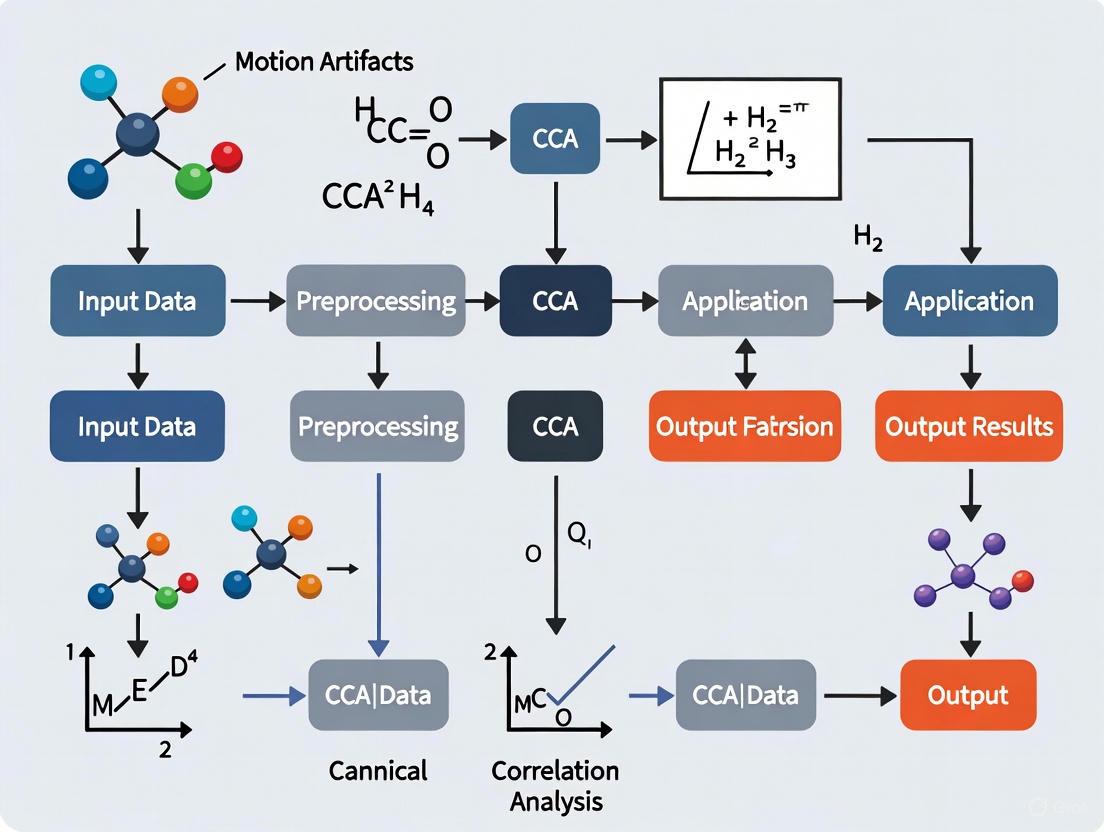
This article provides a comprehensive examination of Canonical Correlation Analysis (CCA) as a powerful multivariate method for filtering motion artifacts and enhancing signal quality in biomedical data.
Filtering Motion Artifacts with Canonical Correlation Analysis: A Comprehensive Guide for Biomedical Research
Abstract
This article provides a comprehensive examination of Canonical Correlation Analysis (CCA) as a powerful multivariate method for filtering motion artifacts and enhancing signal quality in biomedical data. Tailored for researchers, scientists, and drug development professionals, we explore CCA's foundational principles in identifying correlated patterns across multi-view data, detail methodological implementations including regularized variants for high-dimensional datasets, address critical troubleshooting aspects for optimal performance, and present rigorous validation frameworks. Drawing from recent applications in neuroimaging, multi-omics integration, and brain-computer interfaces, this guide offers practical strategies for improving data quality and analytical robustness in preclinical and clinical research settings.
Understanding CCA Fundamentals: From Correlation Theory to Artifact Identification
Canonical Correlation Analysis (CCA) serves as a powerful multivariate statistical technique for identifying and quantifying the relationships between two sets of variables. Within biomedical engineering and neuroscience, researchers have effectively leveraged CCA and its extensions, such as sparse CCA (SCCA), to tackle the persistent challenge of motion artifacts in mobile neuroimaging technologies like electroencephalography (EEG) and functional near-infrared spectroscopy (fNIRS). This application note details the core principles of CCA, provides a curated analysis of its performance in denoising experiments, and outlines a definitive step-by-step protocol for its application in motion artifact correction, supported by data visualization and essential reagent solutions.
Canonical Correlation Analysis (CCA) is a classical multivariate technique designed to uncover the underlying relationships between two multidimensional datasets [1]. Imagine you have two sets of observations collected from the same subjects, denoted as X (an n × p₁ matrix) and Y (an n × p₂ matrix). The fundamental goal of CCA is to find two linear combinations—one from the first set and one from the second set—called canonical variables, such that the correlation between these two new variables is maximized [1].
The mathematical objective can be summarized as finding weight vectors u (of dimension p₁ × 1) and v (of dimension p₂ × 1) that solve the following problem:
maxu,v q = uTXTYv subject to the constraints: uTXTXu = 1 and vTYTYv = 1 [1]
Here, q is the resulting canonical correlation, a measure of the strength of the relationship. The process can be repeated to find additional pairs of canonical variables that are uncorrelated with previous pairs, thus revealing multiple, independent modes of association between the two datasets [1].
In the context of high-dimensional neuroimaging data, where the number of variables (voxels or channels) far exceeds the number of observations, traditional CCA faces challenges. This limitation has been successfully addressed by Sparse CCA (SCCA), which incorporates regularization penalties to yield sparse canonical vectors [1]. These sparse vectors have many coefficients set to zero, which enhances interpretability by pinpointing the most relevant variables—such as specific brain regions or signal components—that drive the relationship between the datasets, a crucial feature for artifact removal pipelines [1].
CCA in Motion Artifact Research: Application and Data
Motion artifacts pose a significant threat to data quality in mobile neuroimaging, such as wearable EEG, which is increasingly used in real-world brain-computer interface (BCI) applications, naturalistic sports research, and clinical monitoring [2] [3] [4]. These artifacts stem from muscle activity, electrode movement, and cable swings, often obscuring the neural signals of interest [4]. CCA has emerged as a powerful component in sophisticated signal processing pipelines designed to mitigate these artifacts.
A prominent application is the hybrid Wavelet Packet Decomposition with CCA (WPD-CCA) method for cleaning single-channel EEG and fNIRS signals [5]. This two-stage approach first uses WPD to break the corrupted signal down into multiple sub-bands or nodes. CCA is then applied to these nodes to identify and separate motion artifact components from the underlying neurophysiological signal based on their correlational structure [5].
The table below summarizes quantitative performance data for the WPD-CCA method in correcting motion artifacts from a benchmark dataset, demonstrating its effectiveness compared to a single-stage WPD approach.
Table 1: Performance of WPD-CCA in Motion Artifact Correction for EEG and fNIRS Signals
| Signal Modality | Method | Key Wavelet Packet | Average ΔSNR (dB) | Average Artifact Reduction (η%) |
|---|---|---|---|---|
| EEG | Single-Stage WPD | db2 | 29.44 | 53.48 |
| EEG | Two-Stage WPD-CCA | db1 | 30.76 | 59.51 |
| fNIRS | Single-Stage WPD | fk4 | 16.11 | 26.40 |
| fNIRS | Two-Stage WPD-CCA | db1 / fk8 | 16.55 / - | - / 41.40 |
Source: Adapted from [5]. Performance metrics are defined as: ΔSNR (Improvement in Signal-to-Noise Ratio); η (Percentage Reduction in Motion Artifacts).
The data shows that the two-stage WPD-CCA method consistently outperforms the single-stage WPD technique, providing greater improvement in signal quality and a higher percentage of artifact reduction for both EEG and fNIRS signals [5]. This establishes CCA as a valuable component in a robust denoising workflow.
Experimental Protocols
Protocol 1: Implementing Sparse CCA (SCCA) for High-Dimensional Neuroimaging Data
This protocol is adapted from methods used to analyze multivariate similarities in pharmacological MRI data and is suitable for high-dimensional datasets where variable selection is critical [1].
Data Preparation and Standardization:
- Collect your two multidimensional datasets, X and Y (e.g., brain imaging data from two different conditions or time points).
- Standardize each column (variable) of X and Y to have a mean of zero and a standard deviation of one.
Parameter Tuning and Optimization:
- The core of SCCA is the introduction of sparsity parameters (often denoted as c₁ and c₂) that control the number of non-zero weights in the canonical vectors u and v.
- Critically, optimize sparsity parameters for each dataset independently using a method like permutation testing. This provides the model flexibility to account for differing properties between the two views, such as the number of activated voxels or data smoothness [1].
Model Fitting:
- Apply the SCCA algorithm, using the optimized parameters, to find the first pair of sparse canonical vectors u and v that maximize the correlation between Xu and Yv.
Subsequent Component Extraction:
- To find more than one set of relationships, apply the SCCA algorithm again to the residual data after subtracting the variance explained by the first pair of canonical vectors [1].
Protocol 2: Two-Stage Motion Artifact Correction using WPD-CCA for Single-Channel EEG
This protocol provides a detailed workflow for cleaning motion artifacts from a single-channel EEG recording, based on the method validated in [5].
Signal Decomposition:
- Input: A single-channel EEG signal corrupted with motion artifacts.
- Using Wavelet Packet Decomposition (WPD), decompose the signal down to a pre-defined level (e.g., level 4) using a suitable wavelet family (e.g., Daubechies 'db1').
- This results in a set of wavelet packet nodes, each containing a specific time-frequency representation of the original signal.
Component Separation via CCA:
- Treat the set of wavelet packet nodes as your multivariate dataset.
- Apply CCA between these nodes to transform them into a new set of canonical components. The underlying logic is that components representing motion artifacts will exhibit a distinct correlational structure compared to neural signal components.
Artifact Removal and Signal Reconstruction:
- Identify and zero out the canonical components corresponding to motion artifacts.
- Apply the inverse CCA transformation.
- Finally, reconstruct the cleaned EEG signal using the Inverse Wavelet Packet Decomposition on the modified nodes.
The following workflow diagram illustrates this two-stage process:
The Scientist's Toolkit: Research Reagent Solutions
The effective application of CCA and related methods requires a suite of computational tools and data resources. The following table lists key "reagent solutions" essential for research in this field.
Table 2: Essential Research Tools for CCA-based Motion Artifact Research
| Tool / Resource | Type | Function in Research |
|---|---|---|
| Science-Grade Wearable EEG [3] [4] | Hardware | Acquires neural signals in real-world, mobile conditions. Essential for generating ecologically valid data containing motion artifacts. |
| Accelerometer (ACC) / Inertial Measurement Unit (IMU) [2] [5] | Hardware | Provides auxiliary motion data. Used to synchronize with and validate motion artifact peaks in EEG signals, improving detection accuracy. |
| Benchmark EEG/fNIRS Datasets with Motion Artifacts [5] | Data | Publicly available datasets containing recorded or induced motion artifacts. Critical for developing, testing, and benchmarking denoising algorithms like WPD-CCA. |
| SPAD / SAS / R / Python (with SciKit-learn) [1] [6] | Software | Statistical software and programming languages with dedicated libraries for performing multivariate analyses, including CCA, SCCA, and other statistical operations. |
| Wavelet Toolbox (e.g., in MATLAB) | Software | Provides specialized functions for implementing signal decomposition techniques like Wavelet Packet Decomposition (WPD), which is a key pre-processing step for hybrid methods like WPD-CCA [5]. |
Visualization and Data Presentation
Effective communication of CCA results and data is crucial. The following diagram illustrates the core conceptual workflow of a Canonical Correlation Analysis, showing the transformation of original datasets to find maximally correlated components.
When creating visualizations for publication, adhere to these best practices for accessibility and clarity [7] [8]:
- Color and Contrast: Use tools like ColorBrewer or Viz Palette to select colorblind-safe palettes. Ensure sufficient contrast between elements.
- Font and Labels: Use sans-serif fonts for chart titles and labels. Directly label data series where possible instead of relying solely on legends.
- Accuracy and Integrity: Ensure visual representations accurately reflect the underlying data to avoid misinterpretation.
Within the broader thesis on canonical correlation analysis (CCA) for filtering motion artifacts, this document details the mathematical formulation of optimization objectives and constraint solutions. The research focuses on developing robust algorithms for motion artifact correction from single-channel EEG and fNIRS signals, which are inherently non-stationary and susceptible to corruption from patient movement during acquisition using wearable devices [9]. Successful detection of various neurological and neuromuscular disorders depends critically on clean EEG and fNIRS signals, making the reduction of motion artifacts a matter of utmost importance [9]. This paper provides application notes and experimental protocols for implementing novel artifact removal techniques, particularly focusing on the mathematical framework of optimization problems involved in single-stage and two-stage denoising approaches.
Theoretical Background and Mathematical Framework
Canonical Correlation Analysis (CCA) Fundamentals
Canonical Correlation Analysis is a multivariate data-driven approach that derives latent components (LCs), which are optimal linear combinations of the original data, by maximizing correlation between two data matrices [10]. Given two multivariate datasets X and Y, CCA finds linear combinations aᵢ and bᵢ that maximize the correlation between aᵢᵀX and bᵢᵀY. The mathematical formulation involves solving the optimization problem:
maximize ρ = corr(aᵢᵀX, bᵢᵀY) subject to var(aᵢᵀX) = 1, var(bᵢᵀY) = 1, and cov(aᵢᵀX, aⱼᵀX) = 0 for i ≠ j
This fundamental CCA optimization provides the mathematical basis for its application in motion artifact correction, where it helps separate neural signals from motion-induced noise components by maximizing the correlation between different signal representations [9] [10].
Wavelet Packet Decomposition (WPD) Mathematical Formulation
Using the WPD technique, signals can be decomposed into a wavelet packet basis at diverse scales [9]. For-level decomposition, a wavelet packet basis is represented by multiple signals, where the wavelet packet bases are produced recursively from the scaling and wavelet functions. The recursive formulation is defined as:j
ψj2i[n]=∑kh[k]ψji[2n−k]ψj2i+1[n]=∑kg[k]ψji[2n−k]
where h[k] and g[k] are quadrature mirror filters associated with the scaling function and wavelet function, respectively. This decomposition creates a complete binary tree structure where each node represents a specific subspace with corresponding basis functions, allowing for optimal signal representation for artifact removal [9].
Optimization Objectives in Motion Artifact Correction
Primary Optimization Objectives
The fundamental optimization problem in motion artifact correction aims to maximize signal fidelity while minimizing noise components. For artifact removal from physiological signals, the objective function can be formulated as:
minimize J(x) = ‖y − x‖² + λ‖Wx‖² subject to Cx ≤ d
where y represents the observed noisy signal, x is the clean signal to be estimated, W is a transformation matrix (e.g., wavelet transform), λ is a regularization parameter, and Cx ≤ d represents constraints on the solution [9].
Performance Metrics as Optimization Targets
The optimization process specifically targets the improvement of well-established performance metrics used in artifact correction [9]:
TABLE 1: Key Performance Metrics for Optimization Targets
| Metric | Formula | Optimization Objective |
|---|---|---|
| Difference in Signal-to-Noise Ratio (ΔSNR) | ΔSNR = SNRₒᵤₜ − SNRᵢₙ | Maximize |
| Percentage Reduction in Motion Artifacts (η) | η = (‖Aᵢₙ‖ − ‖Aₒᵤₜ‖)/‖Aᵢₙ‖ × 100% | Maximize |
The research demonstrates that through appropriate optimization, these metrics can be significantly improved, with the proposed WPD-CCA method achieving ΔSNR values of 30.76 dB for EEG and 16.55 dB for fNIRS signals, and η values of 59.51% for EEG and 41.40% for fNIRS signals [9].
Constraint Solutions for Single-Channel Denoising
Mathematical Constraints in Signal Decomposition
The application of WPD-CCA for motion artifact correction involves several mathematical constraints that ensure effective signal separation [9]:
- Orthogonality Constraint: Wavelet basis functions must satisfy ∫ ψⱼₖ(t)ψⱼₘ(t)dt = δₖₘ, where δₖₘ is the Kronecker delta function
- Energy Preservation: The decomposition must satisfy Parseval's identity ‖x‖² = ∑ⱼ∑ₖ|⟨x, ψⱼₖ⟩|²
- Canonical Correlation Maximization: For CCA stage, the constraint is to find weight vectors that maximize correlation ρ = corr(wₓᵀX, wᵧᵀY) subject to ‖wₓ‖ = 1 and ‖wᵧ‖ = 1
Optimization Algorithms for Constraint Satisfaction
The solution to the constrained optimization problem involves:
- Multi-level Decomposition: Implementing WPD to level 4-8 using specific wavelet families (dbN, symN, coifN, fkN)
- Thresholding Operation: Applying soft or hard thresholding to wavelet coefficients using minimax or sure thresholding rules
- CCA Application: Performing CCA on reconstructed signals from different wavelet nodes to maximize correlation between signal components
- Reconstruction: Inverse transformation to obtain denoised signal while maintaining temporal structure
Experimental Protocols for WPD-CCA Implementation
Materials and Research Reagent Solutions
TABLE 2: Essential Research Materials and Computational Tools
| Item | Function/Specification | Application Context |
|---|---|---|
| Wavelet Families | Daubechies (db1-db3), Symlets (sym4-sym6), Coiflets (coif1-coif3), Fejer-Korovkin (fk4, fk6, fk8) | Multi-resolution analysis for signal decomposition |
| Benchmark Dataset | Publicly available EEG and fNIRS data with motion artifacts | Performance validation and method comparison |
| CCA Algorithm | Multivariate statistical analysis implementation | Maximizing correlation between signal components |
| Performance Metrics | ΔSNR and η calculations | Quantitative evaluation of denoising efficacy |
Detailed Step-by-Step Protocol
Protocol Title: Two-Stage Motion Artifact Removal Using WPD-CCA
Purpose: To remove motion artifacts from single-channel EEG and fNIRS signals using wavelet packet decomposition combined with canonical correlation analysis.
Materials Preparation:
- Acquire single-channel EEG/fNIRS data with motion artifacts
- Select appropriate wavelet family based on signal characteristics (db1 for EEG, fk4/fk8 for fNIRS recommended)
- Prepare computational environment with signal processing toolbox supporting wavelet transforms and CCA
Procedure:
- Stage 1: Wavelet Packet Decomposition
- Perform 5-level wavelet packet decomposition using selected wavelet family
- Apply thresholding to detail coefficients using Birgé-Massart strategy
- Reconstruct signals from selected nodes
Stage 2: Canonical Correlation Analysis
- Form multivariate datasets from different wavelet node reconstructions
- Apply CCA to find linear combinations that maximize correlation
- Select canonical variates representing neural activity components
Signal Reconstruction
- Reconstruct artifact-corrected signal from selected canonical variates
- Calculate performance metrics (ΔSNR and η) for quality assessment
Validation:
- Compare performance with existing methods (DWT, EMD, EEMD, VMD)
- Statistical analysis of performance metrics across multiple recordings
- Visual inspection of reconstructed signals for residual artifacts
Data Presentation and Performance Analysis
Quantitative Performance Comparison
TABLE 3: Performance Comparison of Artifact Removal Techniques for EEG Signals
| Method | Wavelet Type | Average ΔSNR (dB) | Average η (%) |
|---|---|---|---|
| WPD (Single-Stage) | db2 | 29.44 | 53.48 |
| WPD (Single-Stage) | db1 | 28.95 | 55.12 |
| WPD-CCA (Two-Stage) | db1 | 30.76 | 59.51 |
| WPD-CCA (Two-Stage) | db2 | 29.89 | 57.23 |
| Existing Methods | EMD-CCA | 24.15 | 47.32 |
TABLE 4: Performance Comparison of Artifact Removal Techniques for fNIRS Signals
| Method | Wavelet Type | Average ΔSNR (dB) | Average η (%) |
|---|---|---|---|
| WPD (Single-Stage) | fk4 | 16.11 | 26.40 |
| WPD (Single-Stage) | fk8 | 15.89 | 25.17 |
| WPD-CCA (Two-Stage) | db1 | 16.55 | 39.87 |
| WPD-CCA (Two-Stage) | fk8 | 16.32 | 41.40 |
| Existing Methods | EEMD-ICA | 14.25 | 32.15 |
The tabular data presentation follows recommended practices for scientific communication, organizing complex quantitative information for easy comparison and interpretation [11]. The results demonstrate that the two-stage WPD-CCA technique significantly outperforms single-stage approaches and existing state-of-the-art methods for both EEG and fNIRS signal types [9].
Visual Representation of Methodologies
WPD-CCA Algorithm Workflow
Mathematical Optimization Framework
The mathematical formulation of optimization objectives and constraint solutions for CCA-based motion artifact filtering presents a robust framework for enhancing signal quality in physiological monitoring. The WPD-CCA approach demonstrates significant improvements in both ΔSNR and artifact reduction percentage metrics compared to existing methods, validating its efficacy for both EEG and fNIRS signal types. The explicit formulation of optimization targets and constraint satisfaction strategies provides researchers with a reproducible methodology for implementing advanced artifact correction techniques in neurological and neuromuscular disorder detection applications.
The Role of Canonical Variables in Extracting Shared Signal Patterns
Canonical Correlation Analysis (CCA) is a multivariate statistical method designed to identify and quantify the relationships between two sets of variables. In the context of signal processing, particularly for filtering motion artifacts from physiological signals like electroencephalography (EEG) and functional near-infrared spectroscopy (fNIRS), CCA serves as a powerful blind source separation technique. It extracts underlying components, known as canonical variates, that represent shared signal patterns between different data sets. The primary objective of CCA is to find linear combinations of the variables in each set—termed canonical variables—such that the correlation between these combinations is maximized. Formally, given two multidimensional variables X and Y, CCA finds weight vectors a and b to create canonical variates U = a'X and V = b'Y, maximizing the correlation ρ = corr(U, V) [12] [13]. The strength of this approach lies in its ability to separate artifact-laden components from clean neural signals based on their correlation structure with a reference signal, making it exceptionally suitable for motion artifact removal in mobile health monitoring and neuroimaging studies [14] [5].
Theoretical Foundations of Canonical Variables
Mathematical Formulation
The mathematical solution for CCA involves a generalized eigenvalue problem. For two standardized data sets X and Y, with within-set covariance matrices ΣXX and ΣYY, and between-set covariance matrix ΣXY, the canonical correlations ρ and weight vectors a and b are found by solving the equations ΣXX^{-1} ΣXY ΣYY^{-1} ΣYX a = ρ² a and ΣYY^{-1} ΣYX ΣXX^{-1} ΣXY b = ρ² b [12] [13]. The resulting eigenvalues ρ² represent the squared canonical correlations, which are typically ordered in descending magnitude, with the first pair of canonical variates exhibiting the highest correlation. Each subsequent pair of canonical variates is uncorrelated with the previous pairs, ensuring that they capture distinct dimensions of the shared variability between the two data sets [13]. The number of possible canonical variable pairs is limited by the smaller dimensionality of the two input data sets.
Interpretation of Canonical Variables
In motion artifact filtration, the canonical variables are interpreted as latent sources that generate the observed signals. The first few pairs of canonical variates often capture the motion artifacts due to their high temporal correlation with the artifact components, while subsequent pairs retain the neural signals of interest [15] [5]. The weights (a and b) indicate the contribution of each original signal channel to the canonical variate, facilitating the identification of which channels are most affected by artifacts. Furthermore, the loadings, which are correlations between the original signals and the canonical variates, provide a more interpretable measure for understanding which original variables drive the relationships uncovered by CCA [16].
Application Notes: CCA for Motion Artifact Removal
Performance Comparison of CCA-Based Filtering Techniques
The following table summarizes the performance of various CCA-based methods for motion artifact removal from physiological signals, as reported in recent studies:
Table 1: Performance of CCA-based motion artifact removal methods
| Method | Signal Type | Performance Metrics | Key Findings |
|---|---|---|---|
| Gaussian Elimination CCA (GECCA) [15] | EEG | Reduced computation cost, improved DSNR, RMSE | Replacing matrix inversion with backslash operator in CCA reduced computation time while maintaining filtering efficiency. |
| CCA Filtering [14] | High-density EMG | Reduction in motion artifact frequency content, minimized signal reduction in myoelectric bands | Outperformed standard high-pass filtering and PCA by better removing artifacts in locomotion data while preserving true EMG signal. |
| WPD-CCA [5] | Single-channel EEG | Average ΔSNR: 30.76 dB, Average η (artifact reduction): 59.51% | Two-stage method combining wavelet packet decomposition and CCA effectively cleansed single-channel signals. |
| WPD-CCA [5] | fNIRS | Average ΔSNR: 16.55 dB, Average η (artifact reduction): 41.40% | Demonstrated the adaptability of the hybrid method for different physiological signal types. |
| EEMD-GECCA-SWT [15] | EEG | Evaluated with DSNR, λ, RMSE, elapsed time | A cascaded approach using an improved CCA method effectively suppressed motion artifacts with reduced computational cost. |
Advantages of CCA over Other Techniques
CCA provides several distinct advantages over other artifact removal techniques like Independent Component Analysis (ICA) and Principal Component Analysis (PCA). Studies have concluded that CCA is more accurate and faster than ICA for removing eye-blink artifacts from EEG [15]. Furthermore, for muscle artifact removal, CCA performs better because these artifacts often lack stereotyped topography [15]. Compared to PCA, CCA filtering provided a greater reduction in signal content at frequency bands associated with motion artifacts in high-density EMG, while also minimizing signal reduction in frequency bands constituting the true myoelectric signal [14]. This makes CCA particularly valuable for analyzing data from dynamic movements like walking and running.
Experimental Protocols
Protocol 1: Motion Artifact Removal from Single-Channel EEG using WPD-CCA
This protocol describes a two-stage method for cleaning single-channel EEG signals corrupted by motion artifacts [5].
1. Signal Decomposition via Wavelet Packet Decomposition (WPD):
- Input: Single-channel raw EEG signal
X(t). - Procedure: Decompose
X(t)into multiple components using a selected wavelet packet family (e.g., Daubechiesdb1). - Output: A set of wavelet packet components
WPC₁, WPC₂, ..., WPCₙ.
2. Constructing the Multivariate Input for CCA:
- Reference 1: Create a delayed version of the original signal,
X(t-1). - Reference 2: Create a temporally correlated signal using a linear convolution mask, e.g.,
Y = conv2(X, [1 0 1])[15]. - CCA Input Matrix: Combine the WPCs and the reference signals into a multivariate matrix
Z = [WPCs; X(t-1); Y].
3. Canonical Correlation Analysis:
- Procedure: Perform CCA on the constructed matrix
Zto find canonical variates. The first few variates, which are highly correlated with the references, are identified as artifact components. - Artifact Removal: Remove the artifact-laden canonical variates.
4. Signal Reconstruction:
- Procedure: Reconstruct the cleaned signal from the remaining canonical variates and the inverse WPD transform.
- Validation: Calculate performance metrics like
ΔSNRand artifact reduction percentageηto evaluate efficacy [5].
Figure 1: Workflow for single-channel EEG artifact removal using WPD-CCA.
Protocol 2: GECCA for Enhanced Computational Efficiency
This protocol uses Gaussian Elimination (GE) to speed up the CCA computation, which is beneficial for processing long-duration signals or in real-time applications [15].
1. Input Signal Vector Formation:
- Primary Input:
X[n], a multidimensional signal (e.g., from EEMD of a single-channel EEG). - Temporally Correlated Vector: Generate
Y[n]by applying a 2-D valid convolution operator toX[n]with a mask such as[1 0 1], such thatY = conv2(X, [1 0 1])[15]. - Merging: Merge both vectors into a composite matrix
Z = [X; Y].
2. Covariance Matrix Calculation:
- Procedure: Calculate the covariance matrix
C = cov(Z').
3. Eigenvalue Solution via Gaussian Elimination:
- Standard CCA Problem: The solution involves equations of the form
A * Cxx = CxyandB * Cyy = Cyx, which conventionally use matrix inversion. - GECCA Enhancement: Replace the matrix inverse operation (
inv) with the left matrix division (backslash\) operator to solve these linear equations more efficiently [15]. - Output: Obtain the demixing matrix
Wand the estimated source componentsS[n] = W' * p[n], wherep[n]are the canonical variates.
4. Artifact Component Identification and Reconstruction:
- Procedure: Identify and remove canonical variates corresponding to motion artifacts.
- Output: Reconstruct the cleaned signal from the remaining sources.
The Scientist's Toolkit: Research Reagent Solutions
Table 2: Essential materials and tools for CCA-based motion artifact research
| Item Name | Function/Description | Example Use Case |
|---|---|---|
| High-Density Electrode Arrays | Multi-electrode setups for recording spatial signal properties. | Essential for capturing sufficient data for CCA from muscles (HD-EMG) or scalp (HD-EEG) [14]. |
| Mobile EEG/fNIRS Systems | Wearable, ambulatory systems for signal acquisition in naturalistic settings. | Enables collection of data during movement where motion artifacts are prevalent [2]. |
| Accelerometer/Gyroscope | Inertial Measurement Units (IMUs) to quantify subject movement. | Provides a reference signal to inform CCA about the timing and intensity of motion artifacts [5]. |
| Wavelet Toolbox | Software library for signal decomposition (e.g., WPD). | Used in pre-processing to create multivariate input from single-channel data for CCA [5]. |
| CCA Software Implementation | Code libraries for performing CCA (e.g., in Python, MATLAB, R). | Core computational engine. Python's scikit-learn CCA class or MATLAB's canoncorr are commonly used [12] [16]. |
Visualization and Advanced Interpretation
Logical Workflow for CCA Filtering
The following diagram illustrates the general decision-making and data flow process involved in applying CCA filtering to a physiological signal, integrating multiple techniques from the protocols.
Figure 2: General decision workflow for CCA-based motion artifact removal.
Statistical Inference and Validation
When applying CCA, proper statistical validation is crucial. Simple permutation tests, as often used to identify significant modes of shared variation, can produce inflated error rates. This is especially true when data have been adjusted for nuisance variables (e.g., age, sex), as residualization introduces dependencies that violate the exchangeability assumption of permutation tests [17]. Validated statistical methods, such as transforming residuals to a lower-dimensional basis or using stepwise estimation of canonical correlations, should be employed to ensure reliable inference [17]. Furthermore, the performance of artifact removal should be quantified using established efficiency matrices like delta signal-to-noise ratio (DSNR), root mean square error (RMSE), and artifact reduction percentage (η) [15] [5].
The accurate separation of biological signals from motion-induced noise is a fundamental challenge in biomedical research and clinical diagnostics. Motion artifacts present a significant obstacle, particularly in wearable healthcare devices and long-term monitoring scenarios, as they can obscure vital physiological information and lead to erroneous interpretations. This document establishes a theoretical framework for understanding the sources of motion artifacts and presents advanced signal processing techniques, with a particular emphasis on Canonical Correlation Analysis (CCA) and its variants, for effective artifact removal. The principles outlined are applicable to a range of biological signals, including electroencephalography (EEG), electrocardiography (ECG), and functional near-infrared spectroscopy (fNIRS). The objective is to provide researchers and drug development professionals with a structured approach to preserving signal integrity in the presence of movement, thereby enhancing the reliability of data collected in both controlled and ambulatory settings.
Theoretical Foundations of Motion Artifacts and CCA
The Nature of Motion Artifacts
Motion artifacts are signal contaminations originating from the relative movement between sensors and the biological source or from the movement of the subject itself. Unlike physiological noise, these artifacts are non-biological in origin and can manifest with amplitudes an order of magnitude greater than the signal of interest, dramatically reducing the signal-to-noise ratio (SNR). In EEG recordings, for instance, motion artifacts can be caused by muscle contractions, electrode displacement, or cable movement [18] [19]. For PPG and ECG signals, artifacts often arise from sensor-tissue decoupling and variations in pressure or contact impedance [20] [18]. These artifacts typically exhibit non-stationary and nonlinear properties, making them difficult to model and remove with simple frequency-domain filtering, especially when their spectral content overlaps with that of the underlying biological signal.
Canonical Correlation Analysis: A Core Mathematical Framework
Canonical Correlation Analysis (CCA) is a multivariate statistical method designed to uncover the underlying correlations between two sets of variables. In the context of motion artifact removal, CCA is repurposed as a blind source separation (BSS) technique. The fundamental principle involves treating the observed multichannel biological data as one set of variables and a temporally delayed version of the same data as the second set. CCA then finds linear combinations of the original signals and their time-lagged versions that are maximally autocorrelated [13] [19].
Formally, given two datasets ( Y1 \in \mathbb{R}^{N \times p1} ) and ( Y2 \in \mathbb{R}^{N \times p2} ), where ( N ) is the number of observations and ( pk ) is the number of features, CCA finds canonical coefficients ( u1 ) and ( u2 ) that maximize the correlation ( \rho ): [ \max{u1, u2} \rho = \text{corr}(Y1 u1, Y2 u2) = \frac{u1^T \Sigma{12} u2}{\sqrt{u1^T \Sigma{11} u1} \sqrt{u2^T \Sigma{22} u2}} ] where ( \Sigma{11} ) and ( \Sigma{22} ) are within-set covariance matrices, and ( \Sigma{12} ) is the between-set covariance matrix [13]. The solution involves solving an eigenvalue problem, and the resulting components are ordered by their correlation coefficients. Components with low correlation, indicative of white noise or muscle artifacts due to their low autocorrelation, can be identified and removed [19]. The cleaned signal is subsequently reconstructed from the remaining components.
Advanced CCA Frameworks and Hybrid Techniques
The basic CCA framework has been extended into several advanced variants to address specific challenges in motion artifact correction.
Gaussian Elimination CCA (GECCA)
A key innovation to reduce the computational cost of traditional CCA is the use of Gaussian elimination and backslash operations for solving the linear equations involved in calculating eigenvalues. This approach replaces the more computationally intensive matrix inverse operations, thereby reducing computation cost without sacrificing performance. This method has been successfully applied in EEG motion artifact removal, demonstrating improved efficiency in highly noisy environments [15].
Higher-Order CCA (HOCCA)
Standard CCA focuses on second-order correlations. Higher-Order CCA (HOCCA) generalizes this concept to capture higher-order statistical dependencies between datasets. This is particularly useful for complex data like natural images or spatio-chromatic signals, where HOCCA can jointly model both the spatial structure and adaptive changes, such as those caused by varying illumination conditions [21].
Multiset CCA (MCCA)
When dealing with more than two data modalities, Multiset CCA (MCCA) is employed. MCCA extends the CCA framework to find a shared latent representation across multiple datasets simultaneously. This is highly relevant in neuroscience, where data may be collected from various sources like EEG, fMRI, and genetic information, allowing for a comprehensive analysis of their joint relationships [13].
Hybrid CCA-Signal Decomposition Methods
To enhance artifact removal, CCA is often combined with other signal decomposition techniques in a cascaded or hybrid fashion. These methods first decompose the signal to create a multichannel representation, which is then processed by CCA.
- Wavelet Packet Decomposition with CCA (WPD-CCA): This two-stage method first decomposes a single-channel signal (e.g., EEG or fNIRS) into multiple frequency sub-bands using WPD. CCA is then applied to these sub-bands to isolate and remove artifact components. This approach has shown superior performance, achieving an average SNR improvement of 30.76 dB for EEG and 16.55 dB for fNIRS signals [5].
- Ensemble Empirical Mode Decomposition with CCA (EEMD-CCA): EEMD adaptively decomposes a non-stationary signal into Intrinsic Mode Functions (IMFs). CCA is subsequently used to segregate artifact-laden IMFs from those containing the biological signal of interest [15] [5].
- CCA with Spectral Slope Analysis: This method augments traditional CCA by analyzing the spectral slope of the derived components. Tonic muscle artifacts often have a spectral power that increases with frequency, a characteristic that can be used to differentiate them from neural signals, which typically have a steeper spectral roll-off. This combination allows for more accurate identification and removal of muscle contamination from EEG [19].
The following diagram illustrates the logical workflow of a generic hybrid CCA-based artifact removal process.
Quantitative Performance of CCA-Based Techniques
The efficacy of CCA-based artifact removal is quantitatively assessed using established performance metrics, primarily the improvement in Signal-to-Noise Ratio (ΔSNR) and the percentage reduction in motion artifacts (η). The following tables summarize the performance of various techniques across different biological signals.
Table 1: Performance of CCA-Based Techniques for EEG Motion Artifact Removal
| Technique | Key Feature | Reported Performance (ΔSNR / η) | Key Advantage |
|---|---|---|---|
| WPD-CCA [5] | Two-stage decomposition & correlation | ΔSNR: 30.76 dB, η: 59.51% | Effective for single-channel EEG |
| GECCA [15] | Gaussian elimination for Eigen calculation | Improved DSNR & reduced RMSE | Lower computational cost |
| CCA-Spectral Slope [19] | Spectral feature for component rejection | Comparable to ICA | Effective for tonic muscle artifact |
Table 2: Performance of CCA-Based Techniques for Other Biosignals
| Signal Type | Technique | Reported Performance (ΔSNR / η) | Key Advantage |
|---|---|---|---|
| fNIRS [5] | WPD-CCA | ΔSNR: 16.55 dB, η: 41.40% | Effective for optical signals |
| ECG [20] | Rd-ICA (Multichannel) | Improved waveform preservation | Uses redundant chest & back leads |
Table 3: Comparison with Non-CCA Artifact Removal Methods
| Method | Principle | Advantages | Limitations |
|---|---|---|---|
| Wavelet Filtering [22] | Multi-resolution analysis | Excellent for spike removal | Poor at correcting baseline shifts |
| Spline Interpolation [22] | Models artifact segments | Effective for baseline shifts | Leaves high-frequency spikes |
| ICA [19] | Statistical independence | Powerful for source separation | High computational complexity |
| Deep Learning (Motion-Net) [2] | Convolutional Neural Network | High accuracy (η: 86%) | Requires large training datasets |
Experimental Protocols for CCA-Based Artifact Removal
This section provides detailed, step-by-step protocols for implementing key CCA-based artifact removal techniques.
Protocol 1: Motion Artifact Removal from EEG using WPD-CCA
This protocol is designed for processing single-channel EEG data corrupted by motion artifacts [5].
Signal Decomposition:
- Select a wavelet packet family (e.g., Daubechies 'db1') and a decomposition level.
- Decompose the single-channel EEG signal, ( X(t) ), into a set of wavelet packet components (WPCs) using the Wavelet Packet Decomposition (WPD) algorithm. This creates a multichannel representation of the signal.
Formulate Data Matrices for CCA:
- Let the matrix of WPCs be ( Y ).
- Create a time-lagged version of this matrix, ( Y_{\text{lag}} ), using a linear convolution mask such as [1, 0, 1].
Apply CCA:
- Perform CCA on the matrix pair ( (Y, Y_{\text{lag}}) ).
- Obtain the canonical components ( p[n] ) and the demixing matrix ( W ).
Identify and Remove Artifact Components:
- Analyze the correlation coefficients of the canonical components. Components with low correlation coefficients are likely artifacts.
- Set the artifact-related components to zero.
Signal Reconstruction:
- Reconstruct the artifact-corrected WPCs using the inverse of the demixing matrix: ( S[n] = W' \cdot p_{\text{clean}}[n] ).
- Apply the Inverse Wavelet Packet Transform to the corrected WPCs to obtain the cleaned single-channel EEG signal.
Protocol 2: Motion Artifact Removal using CCA with Spectral Slope
This protocol is optimized for removing tonic muscle artifacts from multi-channel EEG data [19].
Apply BSS-CCA:
- For a multi-channel EEG recording ( X ), create a one-sample delayed version ( X_{\text{lag}} ).
- Perform CCA on ( (X, X_{\text{lag}}) ) to extract canonical components.
Component Analysis:
- Calculate the correlation coefficient ( \rho ) for each canonical component.
- Compute the spectral slope for each component by fitting a linear regression to the log-power spectrum.
Component Rejection:
- Establish a threshold for the spectral slope. Components with a shallow or positive spectral slope (indicating increasing power with frequency) are likely muscle artifacts.
- Reject components identified as artifacts based on their spectral characteristics, even if their correlation coefficient is not the lowest.
Signal Reconstruction:
- Reconstruct the EEG signal using only the retained (brain-dominated) components.
Protocol 3: Gaussian Elimination CCA (GECCA) for Enhanced Computation
This protocol modifies the core CCA calculation for reduced computational time [15].
Steps 1-2: Follow Protocol 1, steps 1 and 2, to obtain the data matrix ( Z = [X; Y] ) and its covariance matrix ( C ).
Solve Linear Equations with Gaussian Elimination:
- Instead of computing ( A = \text{inv}(C{xx}) C{xy} ), solve the linear system ( A \cdot C{xx} = C{xy} ) for ( A ) using a backslash operator (e.g.,
A = C_{xx} \ C_{xy}in MATLAB). - Similarly, solve ( B \cdot C{yy} = C{yx} ) for ( B ).
- Instead of computing ( A = \text{inv}(C{xx}) C{xy} ), solve the linear system ( A \cdot C{xx} = C{xy} ) for ( A ) using a backslash operator (e.g.,
Eigenvalue Calculation:
- Form the matrix ( G = A \cdot B ).
- Calculate the eigenvalues ( \rho^2 ) and eigenvectors ( a ) of ( G ). The eigenvectors are the canonical coefficients.
Steps 4-5: Follow Protocol 1, steps 4 and 5, to remove artifacts and reconstruct the signal.
The workflow for these experimental protocols is summarized in the following diagram.
The Scientist's Toolkit: Essential Reagents and Materials
Table 4: Key Research Reagent Solutions for Motion Artifact Research
| Item Name | Function/Application | Specifications/Notes |
|---|---|---|
| Wearable EEG/fNIRS System [18] | Ambulatory acquisition of neural signals. | Systems with active dry electrodes can reduce motion artifacts at the source. |
| Inertial Measurement Unit (IMU) [20] | Provides reference signal for motion. | Triaxial accelerometers/gyroscopes to measure head/body movement. |
| Redundant ECG Electrodes [20] | Provides additional information for artifact rejection. | Electrodes placed on both chest and back for multichannel processing. |
| Neuromuscular Blockade Agents [19] | Creates a ground-truth, EMG-free dataset for validation. | Used in controlled studies to validate muscle artifact removal algorithms. |
| Synthetic Signal Datasets [22] [23] | Algorithm validation with known ground truth. | Adds known motion artifacts or HRFs to clean signals for performance testing. |
This framework establishes a comprehensive theoretical and practical foundation for distinguishing biological signals from motion artifacts using advanced correlation-based techniques. CCA, in its standard and variant forms, provides a powerful, flexible, and mathematically robust approach for tackling the pervasive challenge of motion artifacts. The quantitative data and detailed protocols provided herein offer researchers a clear pathway for implementation and validation. As the field moves towards more ambulatory and wearable monitoring solutions, the refinement of these methods—particularly their integration with machine learning and deep learning models—will be crucial for unlocking the full potential of continuous, real-world physiological monitoring in both clinical and research settings.
The analysis of electrophysiological signals such as electroencephalography (EEG) and electromyography (EMG) is fundamental to neuroscience research and clinical diagnostics. However, these signals are invariably contaminated by motion artifacts, which are particularly problematic in mobile brain-body imaging and ambulatory monitoring applications. Motion artifacts arise from various sources including head movement, electrode displacement, cable sway, and muscle contractions, leading to signal distortions that can obscure underlying neural activity and compromise interpretation. Traditional filtering approaches have provided foundational solutions but present significant limitations when artifact frequencies overlap with the signal of interest. This application note explores the conceptual and practical advantages of Canonical Correlation Analysis (CCA) over traditional filtering methods for artifact removal, providing researchers with a structured comparison and detailed protocols for implementation.
Conceptual Framework: CCA Versus Traditional Methods
Traditional Filtering Approaches
Traditional filtering methods for artifact removal typically rely on fixed frequency-domain operations:
- High-pass and low-pass filters utilize predefined cutoff frequencies to attenuate unwanted signal components. While crucial for removing basic noise, their efficacy is severely limited when motion artifacts spectrally overlap with brain signals, as these artifacts can contaminate a broad frequency range [2].
- Notch filters target specific frequency bands (e.g., 50/60 Hz line noise) but are ineffective against motion artifacts which often exhibit broadband characteristics [18].
The fundamental limitation of these conventional approaches is their reliance on frequency separation between signal and artifact. In real-world mobile recording scenarios, the frequency content of motion artifacts often significantly overlaps with physiological signals of interest, making complete separation via traditional filtering impossible without substantial signal loss [2] [18].
Canonical Correlation Analysis Fundamentals
CCA is a multivariate statistical method that identifies and separates components based on their temporal correlation structure rather than merely their spectral properties:
- Blind source separation principle: CCA operates under the assumption that recorded signals are linear mixtures of underlying sources, including both neural activity and artifactual components [24].
- Temporal correlation maximization: Unlike ICA which maximizes statistical independence, CCA seeks to find linear combinations of variables that maximize their correlation, making it particularly effective for identifying components with specific temporal characteristics [24].
- Component rejection: Once correlated artifactual components are identified, they can be removed before signal reconstruction, effectively preserving the neural signals of interest [14] [24].
This temporal structure-based approach allows CCA to separate artifacts even when they occupy similar frequency bands as the physiological signals, providing a significant advantage over conventional filtering methods.
Quantitative Performance Comparison
Table 1: Comparative Performance of Artifact Removal Methods Across Modalities
| Method | Signal Type | Performance Metrics | Key Advantages | Limitations |
|---|---|---|---|---|
| CCA Filtering | High-density EMG during running | Greater reduction at motion artifact frequencies; Minimal signal reduction at true EMG bands [14] | Superior artifact-source separation; Optimal for dynamic movements | Requires multiple channels; Computational complexity |
| Traditional High-Pass Filtering | High-density EMG during running | Standard 20 Hz cutoff; Limited motion artifact removal [14] | Simple implementation; Established standards | Inadequate for motion artifacts overlapping with signal |
| ICA | EEG with muscle artifacts | Effective for less noisy data with single cortical sources [24] | Established BSS method; Component classification available | Performance degrades with highly contaminated data |
| EMD | EEG with muscle artifacts | Outperforms others for highly contaminated data [24] | Data-driven adaptation; Single-channel capability | Mode mixing issues; Computational intensity |
| iCanClean (CCA-based) | EEG during running | Improved dipolar components; Better P300 congruency effects [25] | Leverages noise references; Effective for locomotion data | Requires specialized hardware or pseudo-reference creation |
Table 2: Performance Metrics of Advanced CCA-Integrated Approaches
| Method | Application | ΔSNR (dB) | Artifact Reduction (%) | Implementation Complexity |
|---|---|---|---|---|
| WPD-CCA [5] | Single-channel EEG | 30.76 | 59.51 | Moderate |
| WPD-CCA [5] | fNIRS signals | 16.55 | 41.40 | Moderate |
| iCanClean [25] | EEG during running | - | - | High |
| CCA Filtering [14] | High-density EMG | Superior to high-pass and PCA | Superior to high-pass and PCA | Moderate |
Detailed Experimental Protocols
Protocol 1: CCA for Motion Artifact Removal from High-Density EMG During Locomotion
This protocol adapts the methodology from [14] for removing motion artifacts from high-density EMG recordings during dynamic movements.
Research Reagent Solutions
Table 3: Essential Research Materials and Equipment
| Item | Specification | Function/Purpose |
|---|---|---|
| EMG Electrode Array | High-density grid (e.g., 8×8 configuration) | Spatial sampling of muscle activity |
| Reference Sensors | Accelerometers/gyroscopes | Motion reference signal acquisition |
| Amplification System | High-input impedance, wireless preferred | Signal acquisition with minimal cable artifacts |
| Signal Processing Software | MATLAB, Python with SciPy | Implementation of CCA algorithms |
| CCA Implementation | Custom scripts or toolboxes (e.g., EEGLAB) | Blind source separation of artifacts |
Step-by-Step Procedure
Signal Acquisition and Preprocessing
- Apply high-density EMG electrode arrays to target muscles (e.g., gastrocnemius or tibialis anterior) following skin preparation guidelines to minimize impedance.
- Secure motion reference sensors (accelerometers) adjacent to EMG arrays to capture movement dynamics.
- Record data during locomotor tasks (walking, running) with synchronized EMG and motion sensor acquisition.
- Apply basic bandpass filtering (10-500 Hz) to remove extreme out-of-band noise while preserving the opportunity for CCA to address in-band artifacts.
CCA Implementation
- Format data into a multivariate dataset where each channel represents a time-series recording.
- Perform CCA decomposition to identify canonical components representing maximally correlated patterns across the dataset.
- Calculate correlation coefficients between each canonical component and the motion sensor references to identify artifact-dominated components.
- Establish a correlation threshold (typically determined empirically through pilot data) for component rejection.
Signal Reconstruction and Validation
- Reconstruct the EMG signal excluding components identified as motion artifacts.
- Validate performance by comparing power spectral density before and after processing at frequency bands associated with motion artifacts (typically <20 Hz) and EMG signals (typically 20-500 Hz).
- Quantify performance using signal-to-noise ratio improvement and reduction in motion-related components.
Protocol 2: WPD-CCA for Single-Channel EEG Motion Artifact Removal
This protocol implements the hybrid WPD-CCA approach validated in [5] for situations requiring single-channel artifact removal.
Research Reagent Solutions
Table 4: Essential Materials for EEG Artifact Removal
| Item | Specification | Function/Purpose |
|---|---|---|
| EEG Acquisition System | Mobile EEG with dry/wet electrodes | Signal acquisition in dynamic environments |
| Wavelet Toolbox | MATLAB Wavelet Toolbox or PyWavelets | Time-frequency decomposition |
| CCA Implementation | Custom scripts for single-channel application | Artifact component identification |
| Validation Dataset | Benchmark data with known artifacts | Method performance quantification |
Step-by-Step Procedure
Wavelet Packet Decomposition
- Select an appropriate wavelet packet (db1, db2, or fk4 based on [5] findings) for signal decomposition.
- Decompose the single-channel EEG signal into multiple nodes representing different frequency sub-bands.
- Apply a thresholding technique to identify nodes potentially contaminated by motion artifacts.
CCA-Based Artifact Removal
- Reconstruct potential artifact signals from the identified nodes.
- Apply CCA between the reconstructed artifact signals and the original EEG to identify correlated components.
- Remove components exceeding a predefined correlation threshold.
Signal Reconstruction and Validation
- Reconstruct the cleaned EEG signal from the remaining components.
- Quantify performance using artifact reduction percentage (η) and SNR improvement (ΔSNR) metrics as defined in [5].
- Compare against traditional methods (wavelet-only, EMD, ICA) to validate superior performance.
Implementation Tools and Visualizations
CCA Workflow Diagram
Figure 1: CCA-Based Artifact Removal Workflow
Comparative Method Analysis
Figure 2: Comparative Analysis of Artifact Removal Approaches
Discussion and Implementation Considerations
The comparative analysis demonstrates that CCA-based approaches offer significant advantages for motion artifact removal in scenarios where traditional filtering methods fail, particularly when artifact and signal frequencies overlap. The integration of CCA with other signal decomposition techniques (WPD-CCA, EMD-CCA) further enhances performance for single-channel applications [5].
Critical implementation considerations include:
- Reference Signals: CCA performance is enhanced with appropriate reference signals. When dedicated motion sensors are unavailable, pseudo-references can be created from the data itself through techniques like temporary notch filtering or identifying artifact-dominated channels [25].
- Computational Complexity: CCA requires greater computational resources than traditional filtering, which may impact real-time implementation. Optimization strategies include channel selection and dimensionality reduction.
- Parameter Optimization: CCA performance depends on proper parameter selection including window size, correlation thresholds, and component rejection criteria, which should be optimized for specific applications.
For research involving mobile brain imaging and ambulatory monitoring, CCA and its hybrid implementations provide powerful tools for maintaining data quality in ecologically valid environments where motion artifacts are inevitable.
Canonical Correlation Analysis represents a significant advancement over traditional filtering methods for motion artifact removal in physiological signal processing. By leveraging temporal correlation structure rather than relying solely on frequency separation, CCA effectively addresses the fundamental limitation of conventional approaches when artifacts and signals occupy overlapping spectral bands. The quantitative comparisons and detailed protocols provided in this application note equip researchers with the necessary framework to implement CCA-based artifact removal in their experimental paradigms, ultimately enhancing data quality and reliability in mobile electrophysiological research.
CCA Implementation Strategies: Techniques for Effective Motion Artifact Filtering
The efficacy of Canonical Correlation Analysis (CCA) in filtering motion artifacts from biomedical signals is profoundly influenced by the preprocessing pipeline applied to the raw data. Proper data scaling, centering, and dimension alignment are not merely preliminary steps but are foundational to ensuring that CCA can accurately separate neural signals from contamination originating from muscle activity, eye movement, and body motion [26]. These artifacts often exhibit amplitudes that surpass the cortical signals of interest, potentially leading to biased analysis and misinterpretation if not adequately addressed [26]. This application note provides a detailed protocol for establishing a robust preprocessing framework, contextualized within CCA-based motion artifact research for electrophysiological signals like EEG and fNIRS.
The core challenge in artifact removal lies in the spectral overlap between noise and brain activity, rendering simple frequency filters ineffective as they suppress informative neural signatures [26]. CCA, a blind source separation technique, excels in this context by exploiting the autocorrelation properties of signals to isolate artifacts [26]. However, its performance is contingent on the proper conditioning of input data. Scaling ensures that features on different numerical scales contribute equally to the analysis, preventing variables with larger variances from dominating the canonical correlation structure [27]. Centering, which adjusts the mean of each feature to zero, is critical for algorithms like CCA and Principal Component Analysis (PCA) to function correctly, as it aligns the data around a common origin [27]. Finally, dimension alignment guarantees that multi-channel datasets are structured appropriately for CCA to identify correlated sources across observations.
Theoretical Foundation
The Role of Centering and Scaling in CCA
Centering and scaling are crucial preprocessing steps that ensure the stability and interpretability of CCA results when applied to high-dimensional biomedical data.
Centering: This process adjusts the data so that each feature has a mean of zero. For a feature vector (X), the centered value (X') is calculated as: [ X' = X - \mu ] where (\mu) is the mean of the feature [27]. Centering removes bias introduced by non-zero means, ensuring that the first principal component describes the direction of maximum variance rather than the direction of the mean. This is particularly important in CCA, which seeks to maximize correlation between datasets; non-centered data can lead to skewed components that do not reflect the true underlying relationship [27].
Scaling: This adjusts the range of the data to ensure all features contribute equally to the analysis. This is vital for CCA because the technique is sensitive to the variance of input variables. Without scaling, a feature with a naturally large range (e.g.,
10,000) would disproportionately influence the correlation structure compared to a feature with a small range (e.g.,0-100). Several scaling methods are commonly employed:- Standardization (Z-score Normalization): This method transforms data to have a mean of 0 and a standard deviation of 1. The formula for a feature value (X) is: [ X_{\text{standardized}} = \frac{X - \mu}{\sigma} ] where (\sigma) is the standard deviation of the feature [27]. It is ideal for models assuming a Gaussian distribution and is highly recommended for CCA, PCA, and Support Vector Machines (SVMs).
- Min-Max Scaling: This technique squeezes data into a fixed range, typically
[0, 1]: [ X{\text{scaled}} = \frac{X - X{\min}}{X{\max} - X{\min}} ] It is beneficial when the model requires bounded input, such as in neural networks with sigmoid activation functions [27]. - MaxAbs Scaling: This scales data based on its maximum absolute value, preserving the sign of the original data and maintaining sparsity. It is calculated as: [ X{\text{scaled}} = \frac{X}{|X{\max}|} ] This is useful for data containing both positive and negative values [27].
Table 1: Comparison of Common Data Scaling Techniques
| Method | Formula | Best Used For | Pros | Cons |
|---|---|---|---|---|
| Standardization | ( X' = \frac{X - \mu}{\sigma} ) | Gaussian-distributed data; CCA, PCA, SVM [27] | Ensures equal feature contribution; stable convergence. | Sensitive to outliers. |
| Min-Max Scaling | ( X' = \frac{X - X{\min}}{X{\max} - X_{\min}} ) | Bounded data; neural networks [27] | Preserves original distribution in a fixed range. | Distorted by strong outliers. |
| MaxAbs Scaling | ( X' = \frac{X}{|X_{\max}|} ) | Sparse data; data with positive/negative values [27] | Maintains sparsity and sign; computationally efficient. | Sensitive to large-magnitude outliers. |
Dimension Alignment via Canonical Correlation Analysis
Dimension alignment refers to the process of projecting multiple datasets into a shared, low-dimensional space where their correlated structures are maximized. CCA is a powerful statistical method for this purpose. Given two datasets (X) and (Y), CCA finds linear combinations of their variables, called canonical variates (U = X^T a) and (V = Y^T b), such that the correlation between (U) and (V) is maximized [26] [28].
This is achieved by solving a generalized eigenvalue problem involving the covariance matrices (\Sigma{XX}), (\Sigma{YY}), and the cross-covariance matrix (\Sigma_{XY}) [28]. In the context of motion artifact removal, the observed multi-channel EEG signal (X(t)) is considered a linear mixture of underlying source signals (S(t)), including both cerebral and artifactual components [26]. CCA decomposes (X(t)) into these sources, which can be automatically classified and removed based on features like autocorrelation before reconstructing the cleaned signal [26].
Experimental Protocols for CCA-Based Motion Artifact Removal
Protocol 1: CCA with Feature Extraction and GMM Clustering
This protocol outlines a method for real-time artifact removal from multichannel EEG signals, suitable for cognitive research applications [26].
Research Reagent Solutions:
- EEG Recording System: A wired EEG cap with multiple Ag/AgCl electrodes (e.g., 62 electrodes), a SynAmps2 system, and recording software [26].
- Computing Environment: Software for signal processing (e.g., MATLAB, Python with SciPy) capable of performing CCA, feature extraction, and GMM clustering.
- Visual Stimulation Setup: A monitor for presenting visual-evoked potential (VEP) and steady-state VEP (SSVEP) tasks to validate the method [26].
Step-by-Step Procedure:
- Data Acquisition and Preprocessing:
- Source Separation via CCA:
- Let the preprocessed EEG signals be (X(t) = [x1(t), x2(t),...,x_M(t)]^T), where (M) is the number of channels.
- CCA is applied to (X(t)) and its time-delayed version (Y(t) = X(t-1)) to find the demixing matrix (W) that yields the sources (\hat{S}(t) = W X(t)) [26].
- The derived components (\hat{S}(t)) are ordered by their autocorrelation coefficients, with artifacts typically having lower autocorrelation [26].
- Feature Extraction:
- Extract representative features from each CCA-derived component. Useful features include spectral powers and temporal features such as fractal dimension and higher-order statistics, which are effective for identifying ocular artifacts [26].
- Artifact Classification with GMM:
- Use the extracted features to train a Gaussian Mixture Model (GMM). The GMM clusters the features into groups corresponding to artifacts and brain signals without requiring manually labeled data [26].
- Components identified as artifacts are removed by setting their corresponding columns in the mixing matrix (A = W^{-1}) to zero, creating (\tilde{A}) [26].
- Signal Reconstruction:
- Reconstruct the artifact-free EEG signals (\hat{X}(t)) using the corrected mixing matrix: (\hat{X}(t) = \tilde{A} \cdot \hat{S}(t)) [26].
The following workflow diagram illustrates this multi-stage process for artifact removal:
Diagram 1: CCA-GMM Artifact Removal Workflow
Protocol 2: Wavelet Packet Decomposition with CCA (WPD-CCA) for Single-Channel Signals
This protocol describes a two-stage method for correcting motion artifacts in single-channel EEG and fNIRS signals, where standard CCA is not directly applicable [5].
Research Reagent Solutions:
- Single-Channel Recorder: A wearable EEG or fNIRS sensor.
- Wavelet Toolbox: Access to wavelet packet decomposition functions (e.g., in MATLAB or Python's
PyWavelets). - Benchmark Dataset: A publicly available dataset containing motion-artifact-corrupted signals with ground-truth clean segments for validation [5].
Step-by-Step Procedure:
- Signal Decomposition using WPD:
- Select a wavelet packet family (e.g., Daubechies (
db1), Symlets (sym4), or Fejer-Korovkin (fk4)) and a decomposition level. - Decompose the single-channel signal into multiple nodes or sub-bands using Wavelet Packet Decomposition (WPD). This acts as a first stage of noise separation [5].
- Select a wavelet packet family (e.g., Daubechies (
- Create Multichannel Input for CCA:
- Select a set of relevant WPD nodes (e.g., the most artifact-contaminated nodes) to form a new multichannel signal. This step artificially creates a multi-dimensional dataset from a single channel, enabling the use of CCA [5].
- Apply CCA for Artifact Removal:
- Apply CCA to the newly formed multichannel signal. CCA will identify and isolate the artifact components within this derived dataset [5].
- Remove the components identified as artifacts.
- Signal Reconstruction:
- Reconstruct the denoised signal from the remaining clean CCA components and the corresponding inverse WPD transform.
- Signal Decomposition using WPD:
The diagram below illustrates this two-stage denoising approach for single-channel signals:
Diagram 2: WPD-CCA Single-Channel Denoising
Performance Metrics and Comparative Analysis
The performance of artifact removal pipelines is quantitatively evaluated using standardized metrics. The following table summarizes the reported efficacy of different CCA-based methods discussed in the protocols.
Table 2: Performance Comparison of CCA-Based Artifact Removal Methods
| Method | Signal Type | Key Performance Metrics | Reported Results | Reference |
|---|---|---|---|---|
| CCA with GMM | Multichannel EEG | Qualitative/Visual inspection of temporal and spectral preservation. | Effective removal of blinks, head/body movement, and chewing artifacts while preserving spectral features important for cognitive research. | [26] |
| WPD-CCA | Single-channel EEG | (\Delta SNR) (dB): Improvement in Signal-to-Noise Ratio.(\eta (\%)): Percentage reduction in motion artifacts. | (\Delta SNR = 30.76 \text{ dB}), (\eta = 59.51\%) (using db1 wavelet). |
[5] |
| WPD-CCA | Single-channel fNIRS | (\Delta SNR) (dB), (\eta (\%)) | (\Delta SNR = 16.55 \text{ dB}), (\eta = 41.40\%) (using fk8 wavelet). |
[5] |
The Scientist's Toolkit: Essential Research Reagents
Table 3: Key Research Reagent Solutions for CCA Filtering Experiments
| Item | Function/Application | Example Specifications |
|---|---|---|
| High-Density EEG System | Captures electrical brain activity with high spatial resolution for effective source separation. | 60+ Ag/AgCl electrodes; impedance < 5 kΩ; sampling rate ≥ 1 kHz [26]. |
| Mobile EEG (mo-EEG) | Enables data collection in naturalistic settings, where motion artifacts are prevalent. | Wearable, fewer electrodes, accelerometer for motion tracking [2]. |
| Visual Stimulation System | Provides controlled stimuli to evoke brain responses for validating artifact removal methods. | Monitor with precise flicker frequencies (e.g., 1 Hz for VEP, 15 Hz for SSVEP) [26]. |
| Computational Software | Platform for implementing CCA, wavelet transforms, and machine learning models. | MATLAB, Python (with Scikit-learn, PyWavelets, MNE-Python). |
| Wavelet Packets | Base functions for decomposing signals in the WPD-CCA method. | Daubechies (db1, db2), Symlets (sym4), Fejer-Korovkin (fk4, fk8) [5]. |
Critical Considerations and Best Practices
- Pipeline Order is Critical: Preprocessing steps are often linear projections. Performing them in a modular, sequential manner (e.g., motion regression followed by temporal filtering) can reintroduce artifacts previously removed. Where possible, combine nuisance regressions into a single projection or use sequential orthogonalization [29].
- Data Scaling is Algorithm-Dependent: While centering and scaling are crucial for CCA, k-NN, and SVM, they are unnecessary for tree-based algorithms like Random Forests. Always select preprocessing based on the underlying model [27].
- Validation with Realistic Data: Use datasets that include real-world motion artifacts and, if possible, ground-truth clean signals or known evoked potentials (like VEP) to objectively assess the performance of the artifact removal pipeline without compromising neural signals of interest [26] [2] [5].
Canonical Correlation Analysis (CCA) is a powerful multivariate statistical method used to uncover relationships between two sets of variables. In biomedical research, CCA has proven particularly valuable for data fusion and multimodal integration, allowing researchers to find shared information across different data types or modalities [30]. The core objective of CCA is to identify and quantify the associations between two multidimensional variable sets by finding linear combinations that exhibit maximum correlation with each other. These linear combinations, known as canonical variates, provide insights into the underlying relationships between the datasets.
The application of CCA has expanded significantly in biomedical contexts, including neuroimaging studies where it facilitates the fusion of functional magnetic resonance imaging (fMRI), electroencephalography (EEG), and structural MRI (sMRI) data [30]. More recently, CCA has been successfully implemented in motion artifact removal pipelines for mobile EEG systems, demonstrating its practical utility in addressing challenging signal processing problems in real-world biomedical recordings [25]. The method's flexibility allows it to accommodate data from various experimental paradigms, including resting state studies and naturalistic settings where traditional model-based approaches often prove insufficient.
Theoretical Foundation of CCA
Mathematical Formulation
Given two centered datasets, X ∈ ℝ^{n×p} and Y ∈ ℝ^{n×q}, representing two different views of the same n observations, CCA seeks to find weight vectors a ∈ ℝ^p and b ∈ ℝ^q such that the correlation between the canonical variates u = Xa and v = Yb is maximized. This leads to the optimization problem:
ρ = max{a, b} corr(Xa, Yb) = max{a, b} ( a^T Σxy b ) / ( sqrt(a^T Σxx a) · sqrt(b^T Σ_yy b) )
where Σxx and Σyy are the within-set covariance matrices of X and Y, respectively, and Σ_xy is the between-sets covariance matrix.
The solution involves solving the eigenvalue equations: Σxx^{-1} Σxy Σyy^{-1} Σyx a = ρ^2 a Σyy^{-1} Σyx Σxx^{-1} Σxy b = ρ^2 b
Subsequent canonical variates are uncorrelated with previous ones and account for the remaining correlation structure. The number of canonical variable pairs is equal to min(rank(X), rank(Y)).
Table 1: Key Mathematical Components of Standard CCA
| Component | Symbol | Description | Dimension |
|---|---|---|---|
| Dataset 1 | X | First set of variables (e.g., brain signals) | n×p |
| Dataset 2 | Y | Second set of variables (e.g., motion sensors) | n×q |
| Canonical weights | a, b | Linear transformation vectors | p×1, q×1 |
| Canonical variates | u, v | Projected data: u = Xa, v = Yb | n×1 |
| Canonical correlation | ρ | Correlation between u and v | Scalar |
Assumptions and Considerations
Successful application of CCA requires attention to several key assumptions. CCA assumes linear relationships between variables, multivariate normality, and homoscedasticity. The presence of outliers can significantly impact results, making robust preprocessing essential. Additionally, CCA requires adequate sample sizes, with recommendations suggesting at least 10-20 observations per variable for stable solutions. Multicollinearity within either dataset can cause instability in the weight estimation, requiring potential regularization in high-dimensional settings common to biomedical data.
Standard CCA Protocol for Biomedical Data
Preprocessing and Data Preparation
Step 1: Data Collection and Feature Extraction Collect raw data from your target modalities. For motion artifact correction in EEG, this typically includes scalp EEG recordings and reference noise signals (either from dedicated noise sensors or created as pseudo-references from the EEG itself) [25]. Extract relevant features or use the full multidimensional data depending on your research question. For temporal signals like EEG, appropriate windowing should be applied.
Step 2: Data Cleaning and Normalization Center each variable by subtracting its mean. Consider standardizing variables to unit variance if they are measured on different scales, though this decision should be guided by domain knowledge. Address missing values through appropriate imputation methods or exclusion. Perform outlier detection and treatment to prevent skewed results.
Step 3: Data Integration and Alignment Ensure temporal alignment between datasets when working with time-series data. Verify subject-wise correspondence for multi-subject studies. For feature-level fusion, create matched feature matrices X and Y with equal numbers of observations (subjects or time points).
Core CCA Implementation
Step 4: Covariance Matrix Computation Calculate the covariance matrices: Σxx = X^TX/(n-1), Σyy = Y^TY/(n-1), and Σ_xy = X^TY/(n-1). For high-dimensional data where p or q > n, consider regularization approaches to ensure matrix invertibility.
Step 5: Eigenvalue Decomposition Solve the CCA eigenvalue problem through generalized eigenvalue decomposition. Most scientific computing languages (Python with scikit-learn, R, MATLAB) provide built-in functions for this computation. The implementation typically involves:
- Computing Σxx^{-1} and Σyy^{-1} (or regularized equivalents)
- Forming the matrix M = Σxx^{-1} Σxy Σyy^{-1} Σyx
- Performing eigenvalue decomposition on M to obtain eigenvalues ρi^2 and eigenvectors ai
Step 6: Canonical Variate Calculation Compute the canonical variates for both datasets: ui = Xai and vi = Ybi for i = 1,...,k, where k = min(rank(X), rank(Y))). The vectors bi are obtained as bi = Σyy^{-1} Σyx ai / ρi.
Step 7: Correlation and Significance Testing Examine the canonical correlations ρ_i, which represent the correlation between each pair of canonical variates. Perform statistical testing to determine the number of significant canonical correlations using Bartlett's test or permutation testing.
Table 2: CCA Implementation Steps with Key Equations
| Step | Key Operation | Mathematical Formula | Implementation Notes |
|---|---|---|---|
| Covariance Computation | Matrix multiplication | Σ_xy = X^TY/(n-1) | Handle missing values appropriately |
| Eigenvalue Solution | Generalized EVD | M = Σxx^{-1} Σxy Σyy^{-1} Σyx | Use regularization if matrices are singular |
| Variate Calculation | Linear projection | ui = Xai, vi = Ybi | Center data before projection |
| Significance Testing | Hypothesis testing | Bartlett's χ² = -(n-1-(p+q+1)/2)∑ln(1-ρ_i²) | df = (p-i+1)(q-i+1) for i-th correlation |
Interpretation and Validation
Step 8: Result Interpretation Interpret the canonical weight vectors a and b to understand which variables contribute most to the relationships. Examine the canonical loadings (correlations between original variables and canonical variates) for more stable interpretations, especially with multicollinearity.
Step 9: Cross-Validation and Reproducibility Assess the stability of CCA results through cross-validation or split-sample replication. Calculate the canonical variates on independent data to ensure generalizability rather than overfitting to specific datasets.
Step 10: Visualization and Reporting Create scatterplots of canonical variate pairs, heatmaps of canonical loadings, and other relevant visualizations to communicate findings effectively. Report effect sizes (canonical correlations) and statistical significance for complete interpretation.
Application to Motion Artifact Removal in EEG
iCanClean Pipeline Implementation
The iCanClean algorithm demonstrates a practical implementation of CCA for motion artifact removal in mobile EEG [25]. This approach leverages CCA to identify and remove motion-related artifacts by finding correlated subspaces between scalp EEG signals and reference noise signals.
Experimental Protocol for Motion Artifact Removal:
Materials and Setup:
- Mobile EEG system with scalp electrodes
- Reference noise sensors (dedicated or pseudo-references)
- Accelerometer for motion tracking (optional but recommended)
- Standard computing environment for signal processing
Procedure:
- Record simultaneous EEG and noise reference signals during both motion-free and motion-affected conditions.
- Preprocess signals: bandpass filter (e.g., 1-40 Hz for EEG), resample to common sampling rate, and remove baseline trends.
- Segment data into appropriate windows (e.g., 4-second windows with 50% overlap as used in iCanClean implementations) [25].
- For each window, apply CCA between scalp EEG channels (X) and noise reference signals (Y).
- Identify canonical components exceeding a correlation threshold (typically R² > 0.65 for motion artifacts).
- Project noise components back to channel space and subtract from original EEG using least-squares solution.
- Reconstruct cleaned EEG signal from residual components after noise removal.
Validation and Performance Metrics
For motion artifact removal applications, validate CCA performance using both quantitative metrics and qualitative assessments:
Quantitative Validation:
- Artifact Reduction Percentage (η): Calculate as η = 100% × (1 - RMScleaned/RMSoriginal)
- Signal-to-Noise Ratio Improvement: ΔSNR = SNRcleaned - SNRoriginal
- Mean Absolute Error (MAE): Between cleaned signal and ground truth when available
- Component Dipolarity: Assess quality of ICA decomposition after CCA cleaning
Qualitative Validation:
- Visual inspection of time-series before and after cleaning
- Power spectral density comparison
- Topographic map consistency
- Event-related potential preservation
Table 3: Performance Metrics for CCA-Based Motion Artifact Removal
| Metric | Formula | Target Value | Interpretation |
|---|---|---|---|
| Artifact Reduction % | η = 100% × (1 - RMScleaned/RMSoriginal) | >85% | Higher indicates better artifact removal [25] |
| SNR Improvement | ΔSNR = 20·log₁₀(RMSsignal/RMSnoise) | >20 dB | Higher indicates better noise suppression [25] |
| Mean Absolute Error | MAE = (1/n)∑|cleaned - ground_truth| | <0.20 | Lower indicates better signal preservation [25] |
| Component Dipolarity | Proportion of dipolar ICs after cleaning | >30% | Higher indicates better decomposition quality [25] |
The Scientist's Toolkit
Table 4: Essential Research Reagents and Computational Tools
| Tool/Resource | Function/Purpose | Example Implementation |
|---|---|---|
| Mobile EEG System | Records brain electrical activity with motion capability | Systems with active electrodes and noise references |
| Reference Sensors | Provides noise signals for CCA-based artifact removal | Dedicated noise sensors or pseudo-references from EEG [25] |
| Accelerometers | Tracks head motion for validation | Synchronized motion tracking systems |
| CCA Implementation | Core computational algorithm | MATLAB canoncorr, Python CCA in scikit-learn, R cancor |
| Preprocessing Tools | Data cleaning and preparation | EEGLAB, FieldTrip, MNE-Python |
| Validation Metrics | Quantifies algorithm performance | Custom scripts for η, ΔSNR, MAE, dipolarity [25] |
Kernel CCA (KCCA) and Indefinite Kernel CCA (IKCCA) for Nonlinear Artifact Patterns
Canonical Correlation Analysis (CCA) is a multivariate statistical technique designed to identify and quantify linear relationships between two sets of variables. In neuroscience, it is increasingly employed to uncover associations between different neural data modalities, such as linking behavioral measures to neuroimaging data [31]. However, a significant limitation of traditional linear CCA is its inability to capture nonlinear relationships frequently present in complex neural data, including the intricate patterns of motion artifacts. Kernel CCA (KCCA) addresses this limitation by extending CCA to a nonlinear domain through the use of kernel functions, which implicitly map the original data into high-dimensional feature spaces where linear correlations are sought [32] [33]. This capability is crucial for isolating complex, nonlinear artifact patterns that are not detectable with linear methods.
Building upon KCCA, Indefinite Kernel CCA (IKCCA) provides a further extension by accommodating non-positive semi-definite (PSD) kernels, known as indefinite kernels [34] [35]. This flexibility allows researchers to utilize a broader family of similarity measures, such as those derived from the Normalized Graph Laplacian used in spectral clustering. The application of IKCCA has demonstrated substantial improvements in predictive accuracy in fields like virtual drug screening, suggesting its potential for enhancing the detection and filtering of sophisticated motion artifacts in neural data [34].
Theoretical Foundations of KCCA and IKCCA
From Linear CCA to Kernel CCA
Linear CCA operates on two zero-mean random vectors, X and Y. It seeks linear projections (U = \phi(X)) and (V = \psi(Y)) such that the correlation between U and V is maximized [32]. The solution is typically found via a generalized eigenvalue decomposition involving the covariance matrices of X and Y. While effective for linear relationships, this approach fails to capture nonlinear dependencies.
KCCA overcomes this by first projecting the data into reproducing kernel Hilbert spaces (RKHS) using nonlinear mappings (\phix: \mathbb{R}^{p} \to \mathbb{H}{x}) and (\phiz: \mathbb{R}^{q} \to \mathbb{H}{z}) [32] [36]. The inner products in these spaces are defined by user-specified kernel functions, (kx(\mathbf{x}, \mathbf{x}')) and (kz(\mathbf{z}, \mathbf{z}')), such as the linear, polynomial, or Gaussian (RBF) kernels. The core optimization problem of KCCA, with N training samples, involves finding vectors (\boldsymbol{\alpha}, \boldsymbol{\beta} \in \mathbb{R}^N) that maximize:
[\max{\boldsymbol{\alpha}, \boldsymbol{\beta}} \boldsymbol{\alpha}^{T} K{x} K{z} \boldsymbol{\beta} \quad \text{subject to} \quad \boldsymbol{\alpha}^{T} \left(K{x}+ \frac{N \kappa}{2} I \right)^{2}\boldsymbol{\alpha}=1 \quad \text{and} \quad \boldsymbol{\beta}^{T} \left(K_{z} + \frac{N \kappa}{2} I \right)^{2}\boldsymbol{\beta}=1]
Here, (Kx) and (Kz) are the N×N kernel matrices, I is the identity matrix, and κ is a regularization parameter crucial for ensuring numerical stability and preventing overfitting [36]. The resulting canonical variables for new data points (\mathbf{x}) and (\mathbf{z}) are given by ( f^{}(\mathbf{x}) = \sum_{n=1}^{N} k_{x}(\mathbf{x},\mathbf{x}_{n}) \alpha^{}{n} ) and ( g^{*}(\mathbf{z}) = \sum{n=1}^{N} k{z}(\mathbf{z},\mathbf{z}{n}) \beta^{*}_{n} ), providing the nonlinear transformations [36].
Indefinite Kernel CCA (IKCCA)
IKCCA generalizes the KCCA framework by relaxing the requirement that kernels must be positive semi-definite (PSD). This permits the use of indefinite kernels, which are similarity measures derived from non-Euclidean, conditionally positive definite, or distance-based functions [34] [35]. The mathematical foundation of IKCCA is often motivated by spectral learning ideas, allowing it to leverage similarity measures that are more naturally suited to specific data structures or domains, such as the normalized graph Laplacian. The flexibility to use a wider class of kernels can lead to more accurate and interpretable models, as evidenced by its successful application in virtual screening for drug discovery, where it dramatically improved predictive accuracy over existing methods [34].
Experimental Protocols and Application Workflows
A Generic Workflow for KCCA/IKCCA in Artifact Analysis
The application of KCCA and IKCCA for identifying nonlinear artifact patterns follows a structured pipeline. The diagram below outlines the key stages from data preparation to model interpretation.
Detailed Protocol for KCCA Implementation
Step 1: Data Preparation and View Definition
- View 1 (Neural Signals): Preprocess your neural time-series data (e.g., fMRI, EEG). This includes standard steps like band-pass filtering, detrending, and normalization. For fMRI, you might use regions of interest (ROIs) or independent components as features.
- View 2 (Artifact Indicators): Create a representation of potential artifacts. This could be:
- Direct motion parameters (e.g., framewise displacement in fMRI, muscle activity indicators in EEG).
- Expert labels for artifact-contaminated segments.
- Data-driven features from known artifact-prone channels or components.
- Ensure the data is partitioned into training and testing sets (e.g., 70%/30% split) to validate the generalizability of the discovered correlations [37].
Step 2: Kernel Selection and Computation The choice of kernel is critical. Common choices and their parameters are summarized in the table below.
Table 1: Common Kernel Functions and Their Parameters
| Kernel Type | Mathematical Form | Key Parameters | Use Case Scenario |
|---|---|---|---|
| Linear | ( k(\mathbf{x}, \mathbf{y}) = \mathbf{x}^T\mathbf{y} ) | None | Baseline, linear relationships |
| Polynomial | ( k(\mathbf{x}, \mathbf{y}) = (\gamma \mathbf{x}^T\mathbf{y} + c)^d ) | degree (d), coef0 (c) [37] |
Captures multiplicative feature interactions [36] |
| Gaussian (RBF) | ( k(\mathbf{x}, \mathbf{y}) = \exp(-\gamma ||\mathbf{x} - \mathbf{y}||^2) ) | gamma (γ) [37] |
General-purpose, handles complex nonlinearities |
| Sigmoid | ( k(\mathbf{x}, \mathbf{y}) = \tanh(\gamma \mathbf{x}^T\mathbf{y} + c) ) | gamma (γ), coef0 (c) |
Less common, similar to neural network activation |
- Compute the kernel matrices (Kx) and (Kz) for both views on the training data. For large datasets, consider approximate methods like using random features to make computation tractable [33].
Step 3: Model Training with KCCA
- Solve the KCCA optimization problem (Eq. (2a-2c)) for the dual weights (\boldsymbol{\alpha}) and (\boldsymbol{\beta}). This is typically done by solving a generalized eigenvalue problem.
- Apply regularization (parameter κ) to control model complexity and avoid overfitting, which is particularly important with finite samples [32] [36].
- To obtain multiple correlated components, iteratively solve for subsequent pairs of ((\boldsymbol{\alpha}i, \boldsymbol{\beta}i)) that are uncorrelated with previous pairs [32] [38].
Step 4: Model Evaluation and Significance Testing
- Project the held-out test data using the learned (\boldsymbol{\alpha}) and (\boldsymbol{\beta}) to obtain test canonical scores.
- Calculate the canonical correlations on the test set to assess generalizability [37].
- Perform statistical significance testing on the canonical correlations using methods like Wilks' Lambda, Pillai's Trace, or permutation testing to ensure the discovered relationships are not due to chance [38].
Step 5: Interpretation and Artifact Filtering
- Canonical Loadings: Analyze the loadings (correlations between original variables and canonical scores) to identify which neural signals and artifact indicators are most strongly linked.
- Filtering: Once a robust correlation is established between a neural component and an artifact indicator, this relationship can be used to identify and remove artifact-dominated components from new neural data.
Protocol for IKCCA Implementation
The protocol for IKCCA largely follows that of KCCA, with one critical distinction in the kernel computation step.
- Kernel Selection for IKCCA: The core advantage of IKCCA is its ability to use indefinite kernels. A prominent example is the Normalized Graph Laplacian kernel used in spectral clustering [34]. These kernels can be derived from similarity measures that are not representable as a PSD kernel matrix.
- Implementation Note: Standard kernel method libraries often assume PSD kernels. Implementing IKCCA may require specialized solvers that can handle the indefinite case, often derived from spectral learning ideas [34].
Performance Comparison and Quantitative Findings
The effectiveness of nonlinear CCA methods is demonstrated through their application in various domains. The following table synthesizes key quantitative findings from the literature, highlighting the performance gains of KCCA and IKCCA.
Table 2: Performance Summary of Nonlinear CCA Methods in Practical Applications
| Method | Dataset / Context | Key Performance Metric | Result | Citation |
|---|---|---|---|---|
| KCCA (Gaussian) | Synthetic Data (Sinusoidal Relationship) | Test Set Canonical Correlation | Achieved correlations of 0.997 and 0.994 on the first two components [37] | [37] |
| KCCA (Polynomial) | Synthetic Data (Polynomial Relationship) | Test Set Canonical Correlation | Achieved correlations of 0.823 and 0.963 on the first two components [37] | [37] |
| IKCCA | RLP800 (Virtual Drug Screening) | Mean Rank (r̄) of Ligand Prediction | Dramatic improvement, reducing mean rank by a factor of 5 to 10 compared to prior state-of-the-art [34] | [34] |
| CRCCA | Theoretical Framework | N/A | Provides theoretical bounds, connects CCA to rate-distortion theory and the information bottleneck [32] [39] | [32] [39] |
These results underscore a consistent theme: KCCA excels at identifying and modeling predefined nonlinear relationships, while IKCCA's flexibility with kernel choice can lead to substantial performance improvements in real-world, high-stakes prediction tasks.
The Scientist's Toolkit: Essential Research Reagents
Successfully implementing KCCA and IKCCA requires a combination of software tools, computational techniques, and data resources.
Table 3: Essential Tools and Resources for KCCA/IKCCA Research
| Tool / Resource | Type | Function / Purpose | Examples / Notes |
|---|---|---|---|
| mvlearn | Python Library | Provides high-level implementation of KMCCA (Kernel Multiview CCA) | Supports linear, poly, and gaussian kernels; includes statistical tests [37] |
| CCA & CCP R Packages | R Library | Perform and validate standard CCA | CCA package for computation; CCP for significance testing (Wilks' Lambda, etc.) [38] |
| Regularization Parameter (κ) | Model Hyperparameter | Prevents overfitting by penalizing large weights in the kernel space | Essential for good performance on finite samples [32] [36] |
| Random Feature Approximation | Computational Method | Approximates kernel matrices for large-scale data | Enables KCCA on datasets with >1M samples [33] |
| Sparse KCCA (e.g., TSKCCA) | Algorithmic Variant | Selects relevant features/kernels for improved interpretability | Uses HSIC criterion and L1 regularization to handle high-dimensional data [36] |
| Precomputed Distance Matrix | Data Input | Allows the use of custom, indefinite similarity measures | Key for IKCCA, enabling non-PSD kernels [34] |
Canonical Correlation Analysis (CCA) is a multivariate statistical method that identifies and quantifies the linear relationships between two sets of variables. In biomedical signal processing, it is employed to separate desired physiological signals from unwanted motion-induced artifacts by treating them as distinct but correlated source domains. The core principle involves identifying correlated components between a primary signal (e.g., EEG) and reference noise signals (either physical or mathematically derived), and subsequently subtracting these noise-associated subspaces to yield a cleaned signal [5] [25]. Its utility is particularly pronounced in scenarios involving single-channel recordings and mobile brain imaging, where traditional multi-channel blind source separation techniques like ICA face limitations [5] [40].
This application note details the implementation, performance, and protocols of CCA-based methodologies for motion artifact correction, providing researchers with a framework for deploying these techniques in neuroimaging and neurophysiological research.
CCA Application in EEG Signal Correction
Performance Comparison of CCA-Enhanced Methods
The integration of CCA with other signal decomposition techniques has led to the development of robust artifact removal frameworks for EEG. The performance of these methods is typically evaluated using metrics such as the improvement in Signal-to-Noise Ratio (ΔSNR) and the percentage reduction in motion artifacts (η).
Table 1: Performance of CCA-Based EEG Motion Artifact Removal Methods
| Method | Key Mechanism | Average ΔSNR (dB) | Average Artifact Reduction (η%) | Key Advantage |
|---|---|---|---|---|
| WPD-CCA [5] | Wavelet Packet Decomposition + CCA | 30.76 | 59.51% | Effective for single-channel EEG; outperforms single-stage WPD. |
| EEMD-CCA [5] | Ensemble Empirical Mode Decomposition + CCA | Information Missing | Information Missing | Suitable for single-channel measurements. |
| iCanClean (CCA-based) [41] [25] | CCA with pseudo-reference/dual-layer noise signals | ~20 (in specific setups) | ~86 (in specific setups) | Recovers more dipolar brain ICs; effective during running. |
Detailed Experimental Protocol: WPD-CCA for Single-Channel EEG
The Wavelet Packet Decomposition with CCA (WPD-CCA) method is a two-stage denoising technique that offers superior performance for single-channel EEG [5].
A. Materials and Reagents
- Raw EEG Data: Single-channel EEG recording contaminated with motion artifacts.
- Computing Software: MATLAB or Python with signal processing toolboxes.
- Wavelet Packets: Daubechies (db1, db2, db3) or Fejer-Korovkin (fk4, fk6, fk8) families are recommended [5].
B. Procedure
- Signal Decomposition: Decompose the single-channel EEG signal into multiple components using Wavelet Packet Decomposition (WPD). The db1 or db2 wavelets are often optimal for this step.
- Create Reference Signals: The components generated from the WPD stage are used to create a multi-channel input for the CCA algorithm. These components serve as the mathematical reference for the artifact subspaces.
- CCA Processing: Apply CCA to identify the underlying components that are maximally correlated with the motion artifacts present in the signal.
- Artifact Removal: Reconstruct the cleaned EEG signal by excluding the artifact-laden components identified by CCA.
C. Analysis and Validation
- Calculate performance metrics (ΔSNR and η) by comparing the cleaned signal to a ground-truth, artifact-free recording if available.
- For multi-channel data, validate the quality of the cleaned signal by assessing the dipolarity of Independent Components (ICs) after applying ICA [25].
Detailed Experimental Protocol: iCanClean for Mobile EEG
The iCanClean algorithm leverages CCA to remove motion artifacts in mobile EEG settings, such as during walking or running, and can utilize either dedicated noise sensors or pseudo-reference signals [41] [25].
A. Materials and Reagents
- Mobile EEG System: A system with multiple scalp electrodes. Systems with dual-layer electrodes (one layer contacting scalp, a second layer mechanically coupled but not contacting scalp) are ideal.
- Accelerometer Data: Optional, but can be used for motion tracking and validation.
- Computing Environment: EEGLAB with iCanClean plugin or custom scripts in MATLAB/Python.
B. Procedure
- Data Acquisition & Preprocessing: Record multi-channel EEG data during the dynamic motor task (e.g., running). Apply band-pass filtering (e.g., 0.5-50 Hz) and notch filtering (50/60 Hz) as a basic preprocessing step.
- Noise Reference Creation:
- If using dual-layer sensors: Use the data from the non-scalp-coupled noise sensors as the direct noise reference.
- If using pseudo-references: Apply a temporary high-pass or notch filter (e.g., <3 Hz) to the raw scalp EEG to create a signal dominated by motion artifacts, which serves as the pseudo-reference.
- CCA Execution: The iCanClean algorithm performs CCA to identify subspaces in the scalp EEG data that are highly correlated (based on a user-defined R² threshold, e.g., 0.65) with the subspaces of the noise reference signals.
- Artifact Subtraction: The noise components that exceed the correlation threshold are projected back to the channel space and subtracted from the original scalp EEG using a least-squares solution.
C. Analysis and Validation
- Perform ICA on the cleaned data and use ICLabel to classify components. A successful correction will yield a higher number of brain-derived components with dipolar scalp maps.
- Compute the spectral power of the EEG before and after correction. Successful cleaning shows a reduction in power at the gait frequency and its harmonics.
- For event-related potential (ERP) studies, check for the emergence of expected components (e.g., P300) with correct latency and amplitude relationships [25].
CCA Application in MRI Artifact Correction
While CCA is a established tool in EEG signal processing, its direct application in MRI motion artifact correction is less common. Modern MRI artifact correction research has largely been dominated by deep learning (DL) and frequency-domain techniques. Nonetheless, the conceptual parallel of identifying and separating correlated artifact components makes CCA a relevant foundational concept.
Performance of Contemporary MRI Motion Correction Methods
Recent state-of-the-art methods for MRI motion correction have advanced beyond traditional CCA, achieving significant performance gains.
Table 2: Performance of Contemporary MRI Motion Artifact Correction Methods
| Method | Modality | Key Mechanism | Reported Performance |
|---|---|---|---|
| MOCOΩ [42] | CEST MRI | Deep learning operating in Z-spectrum frequency domain. | RMSE of APT images reduced from 8.7% to 2.8% under "severe" motion. |
| FDMC-Net [43] | Structural MRI | Frequency-Decomposed network with Confidence-Guided Knowledge Distillation. | State-of-the-art performance on MR-ART dataset; improved SSIM. |
| Variational Diffusion Models [44] | Structural MRI | Generative AI model for blind inverse problem solving. | Outperforms competing methods in retrospective and prospective motion correction. |
| JDAC Framework [45] | 3D Brain MRI | Iterative learning for Joint Denoising and Artifact Correction. | Effective on public and clinical motion-affected T1-weighted MRIs. |
Detailed Experimental Protocol: Deep Learning for CEST MRI (MOCOΩ)
This protocol outlines a DL-based approach for correcting motion artifacts in Chemical Exchange Saturation Transfer (CEST) MRI, a modality where motion correction is particularly challenging [42].
A. Materials and Reagents
- CEST MRI Data: A series of saturation-weighted images across different frequency offsets.
- Ground-Truth Data: For supervised learning, motion-free "clean" images are required. These can be selected from datasets using rigid-body motion parameter estimation (e.g., with SPM12) with strict thresholds (e.g., translation <1.5 mm, rotation <0.1°).
- Computing Resources: High-performance GPU and deep learning frameworks like TensorFlow or PyTorch.
B. Procedure
- Motion Simulation: To create a training dataset, simulate motion-corrupted images by applying random 3D rigid-body transformations to clean images. The transformations should include translations (±2 mm) and rotations (±1°) in all directions [42].
- Network Training & Design: Train a neural network to learn the mapping from motion-corrupted to clean images directly in the Z-spectrum frequency domain (Ω), rather than the spatial image domain.
- Loss Function Implementation: Use a specialized loss function that combines a standard image fidelity term (e.g., Mean Squared Error) with a saturation-contrast-specific term. This additional term is crucial for preserving the subtle CEST/APT contrast, which can be on the order of 1-5% [42].
- Inference: Apply the trained model to novel motion-corrupted CEST MRI data to generate the corrected output.
C. Analysis and Validation
- Quantitatively evaluate performance using RMSE and Structural Similarity Index (SSIM) between the corrected image and the ground-truth motion-free image.
- In the absence of a ground truth, validate the preservation of physiological contrasts by ensuring that APT values in regions of interest (e.g., brain tumors) align with expected biological ranges [42].
The Scientist's Toolkit
Table 3: Essential Research Reagents and Resources
| Item | Function/Application | Example & Notes |
|---|---|---|
| Daubechies (db1) Wavelet | Base function for Wavelet Packet Decomposition in WPD-CCA. | Provides optimal balance for temporal and frequency resolution in EEG [5]. |
| Pseudo-Reference Noise Signal | Creates artifact reference for CCA when physical noise sensors are absent. | Generated by applying a temporary notch filter to raw EEG [25]. |
| Dual-Layer EEG System | Provides direct measurement of motion artifacts for CCA-based cleaning. | One layer contacts scalp; a second, mechanically coupled layer records only noise [25]. |
| MR-ART Dataset | Public benchmark dataset for evaluating MRI motion correction algorithms. | Contains matched motion-corrupted and clean structural MRI brain scans [43]. |
| R² Threshold Parameter | Critical value in iCanClean to determine which noise components to remove. | An R² of ~0.65 is a typical starting point; tuning is required for specific data [25]. |
| SPM12 Software | Used for rigid-body motion parameter estimation in MRI data. | Helps in selecting motion-free "clean" images for supervised learning [42]. |
The expansion of electroencephalography (EEG) into real-world, mobile applications through wearable devices presents a significant opportunity for biomedical research and clinical monitoring [3]. However, this shift introduces a major challenge: an increased susceptibility to motion artifacts that can compromise signal quality and derail subsequent bioinformatic analysis [3]. For research centered on canonical correlation analysis (CCA), which identifies relationships between multivariate datasets, artifact contamination can lead to spurious correlations and invalid biological conclusions.
This application note addresses the practical integration of motion artifact filtering into established bioinformatic workflows. We provide a detailed framework for adopting a novel Wavelet Packet Decomposition combined with CCA (WPD-CCA) technique, a method demonstrated to significantly enhance signal quality in single-channel EEG data [5]. The protocols and considerations outlined herein are designed for researchers and drug development professionals aiming to maintain data integrity from acquisition through to advanced computational analysis.
Core Protocol: WPD-CCA for Motion Artifact Correction
The following section details the implementation of the two-stage WPD-CCA method, which has been shown to outperform single-stage denoising techniques for both EEG and functional near-infrared spectroscopy (fNIRS) signals [5].
Stage 1: Signal Decomposition via Wavelet Packet Decomposition
Purpose: To decompose the raw, single-channel EEG signal into a set of frequency sub-bands for preliminary artifact isolation.
Materials & Reagents:
- Input Data: Single-channel EEG signal contaminated with motion artifacts.
- Software Tools: Computational environment with wavelet analysis toolbox (e.g., MATLAB, Python with
PyWavelets). - Key Parameter: Selection of wavelet packet family and vanishing moments.
Procedure:
- Data Import: Load the raw, single-channel EEG recording into your computational environment.
- Wavelet Packet Selection: Choose an appropriate wavelet packet from available families. Empirical evidence indicates Db1 (Daubechies 1) and Fk4 (Fejer-Korovkin 4) wavelets are highly effective for EEG and fNIRS, respectively [5].
- Decomposition: Perform a full decomposition of the signal using the selected wavelet packet. This process generates a family of wavelet packet coefficients representing the signal's time-frequency content.
- Coefficient Thresholding: Apply a thresholding rule (e.g., soft thresholding) to the decomposed wavelet packet coefficients. This step aims to suppress components identified as likely artifacts while preserving neural signals.
- Initial Reconstruction: Reconstruct a preliminary denoised signal from the thresholded coefficients.
The following workflow diagram illustrates the two-stage WPD-CCA process:
Stage 2: Refinement via Canonical Correlation Analysis
Purpose: To further purify the signal by applying CCA to the set of reconstructed wavelet packet components, leveraging their mutual statistical dependencies to isolate and remove residual artifacts.
Procedure:
- Input Matrix Formation: Treat the set of signals reconstructed from the individual wavelet packet nodes as a multi-channel dataset. This matrix serves as the input for CCA.
- CCA Execution: Perform CCA on this multi-channel matrix. CCA identifies underlying sources (canonical variates) that maximize the correlation between linear combinations of the input channels.
- Component Identification & Removal: Analyze the canonical variates to identify those dominated by artifact. This is typically based on features such as abnormally high amplitude, atypical frequency spectrum, or high correlation with known artifact templates.
- Final Signal Reconstruction: Project the data back to the original space, excluding the artifact-laden canonical components, to generate the final artifact-corrected EEG signal.
Performance Metrics and Benchmarking
The efficacy of the WPD-CCA protocol is quantified using two key performance metrics [5]:
- ΔSNR (Change in Signal-to-Noise Ratio): Measures the improvement in dB between the corrected and original signal.
- η (Percentage Reduction in Motion Artifacts): Quantifies the proportion of the artifact power removed.
The table below benchmarks the performance of the WPD-CCA method against the single-stage WPD approach for EEG and fNIRS signals, using the optimal wavelet packets as identified in the research [5].
Table 1: Performance Benchmark of Artifact Correction Methods
| Signal Modality | Method | Optimal Wavelet Packet | Average ΔSNR (dB) | Average η (%) |
|---|---|---|---|---|
| EEG | Single-Stage WPD | Db2 | 29.44 | 53.48 |
| EEG | Two-Stage WPD-CCA | Db1 | 30.76 | 59.51 |
| fNIRS | Single-Stage WPD | Fk4 | 16.11 | 26.40 |
| fNIRS | Two-Stage WPD-CCA | Db1 / Fk8 | 16.55 | 41.40 |
Integration with Downstream Multi-Omics Analysis
Clean, artifact-free EEG data can serve as a valuable phenotypic trait in integrative multi-omics studies. CCA-based frameworks are increasingly used to uncover complex, higher-order correlations between different molecular layers and physiological traits [46] [47].
Table 2: CCA-Based Methods for Multi-Omics Integration
| Method | Primary Function | Key Advantage | Application Context |
|---|---|---|---|
| SGTCCA-Net [46] | Multi-omics network inference | Captures higher-order correlations between >2 omics data types and phenotypes. | Uncovering complex molecular interaction networks with respect to a disease trait. |
| SmCCNet [46] | Multi-omics network modules | Integrates phenotype(s) of interest to identify trait-relevant biomarker modules. | Identifying phenotype-specific molecular interactions (e.g., miRNA-mRNA). |
| KMR with CCA [48] | Data fusion & interaction analysis | Kernel Machine Regression handles non-linear relationships in multi-modal data. | Identifying significant gene-miRNA-methylation interactions in cancer. |
| Drug Repositioning CCA [49] | Drug-disease association prediction | Uses CCA to find correlated sets of drug targets (proteins, ncRNAs) and diseases. | Predicting novel drug indications based on integrated molecular target information. |
The following diagram illustrates how the artifact-corrected EEG phenotype is integrated into a CCA-based multi-omics analysis pipeline, such as the SGTCCA-Net framework [46]:
The Scientist's Toolkit: Research Reagent Solutions
Table 3: Essential Materials and Tools for WPD-CCA Implementation
| Item Name | Function/Description | Example/Note |
|---|---|---|
| Wearable EEG/fNIRS System | Acquisition of physiological signals in real-world, mobile settings. | Systems with dry electrodes are common but more prone to motion artifacts [3]. |
| Wavelet Packet Toolbox | Software library for performing WPD and coefficient thresholding. | Python's PyWavelets library or MATLAB's Wavelet Toolbox. |
| CCA Algorithm | Computational code for performing Canonical Correlation Analysis. | Available in standard statistical libraries (e.g., canoncorr in MATLAB, CCA in scikit-learn). |
| Benchmark Dataset | Standardized data for validating method performance. | Publicly available datasets containing motion-artifact-contaminated EEG/fNIRS signals [5]. |
| Computational Environment | Hardware/software platform for signal processing. | A standard desktop or laptop computer with sufficient RAM/CPU for signal decomposition and matrix operations. |
Optimizing CCA Performance: Addressing High-Dimensionality and Overfitting Challenges
Canonical Correlation Analysis (CCA) is a powerful multivariate statistical method for discovering associations between two sets of variables. First introduced by Hotelling, CCA identifies linear combinations of variables from each set that maximize mutual correlation [50] [51]. While traditional CCA has broad applications, modern high-dimensional datasets—where the number of variables far exceeds the sample size—present significant computational and statistical challenges [50]. In such contexts, standard CCA becomes inapplicable as sample covariance matrices become singular or unstable [52] [53].
These challenges are particularly acute in motion artifact research, where researchers must extract clean neural signals from noise-corrupted data. Motion artifacts introduce structured noise that can obscure genuine brain activity patterns, complicating interpretation and analysis [2] [54]. Regularization techniques address these limitations by imposing constraints on the CCA solution, enhancing stability, interpretability, and generalizability.
This application note explores two fundamental regularization approaches for CCA: Ridge penalties that provide numerical stability through continuous shrinkage, and sparse CCA (SCCA) that performs simultaneous dimension reduction and variable selection. We provide detailed protocols for implementing these techniques in motion artifact research, supported by performance comparisons and practical implementation frameworks.
Theoretical Foundation
The Instability Problem in High Dimensions
In high-dimensional settings where the number of features (p and q) approaches or exceeds the number of observations (n), CCA solutions become unstable and potentially uninterpretable. This instability manifests in several ways:
- Covariance matrix singularity: Sample covariance matrices Σ̂XX and Σ̂YY become singular, making matrix inversion impossible [53]
- Overfitting: Sample correlations become inflated estimates of population correlations [52]
- Weight instability: Small data perturbations cause large changes in canonical weights [52]
The severity of these issues increases as the samples-per-feature ratio decreases. Empirical characterizations have demonstrated that CCA associations are highly unstable at sample sizes typical in many research domains [52].
Ridge Regularization for CCA
Ridge regularization (RCCA) addresses numerical instability by adding a diagonal matrix to the covariance matrices before inversion [53]:
The regularized canonical correlation then becomes [53]:
The ridge parameters λ₁ and λ₂ control the shrinkage intensity toward zero, with larger values producing greater shrinkage. This approach has a dual interpretation: it solves the numerical instability problem while also minimizing overfitting by constraining the magnitude of the weight vectors [53].
Sparse CCA (SCCA) for Dimension Reduction
Sparse CCA takes an alternative approach by imposing sparsity-inducing penalties on the canonical weights, forcing some coefficients to exactly zero. This performs variable selection simultaneously with dimension reduction, enhancing interpretability [50] [51]. The SCCA optimization problem can be formulated as:
where P₁ and P₂ are sparsity-inducing penalty functions [50].
Performance Comparison of Regularization Techniques
Quantitative Performance Metrics
The effectiveness of regularization techniques for motion artifact correction is typically evaluated using several quantitative metrics:
- ΔSNR: Improvement in signal-to-noise ratio after artifact removal
- η: Percentage reduction in motion artifacts
- RMSE: Root mean square error between processed and clean signals
- Computational time: Critical for real-time processing applications [15] [5]
Comparative Performance of CCA Techniques
Table 1: Performance comparison of CCA-based artifact removal techniques
| Method | Application | ΔSNR (dB) | η (%) | Computation Time | Key Advantages |
|---|---|---|---|---|---|
| WPD-CCA | EEG artifact removal | 30.76 | 59.51 | Moderate | Excellent for single-channel signals [5] |
| EEMD-CCA | EEG artifact removal | - | - | High | Handles non-stationary signals well [15] |
| GECCA | EEG artifact removal | - | - | Low (40-50% faster) | Fast computation for real-time use [15] |
| RCCA | High-dimensional fMRI | - | - | Low with kernel trick | Stable with very high dimensions [53] |
| SCCA (SCAD+BIC) | Genomic data integration | - | - | Moderate | Superior variable selection [50] [51] |
Table 2: Comparison of sparsity-inducing penalties for SCCA
| Penalty Function | Sparsity Control | Oracle Properties | Variable Selection | Recommended Application |
|---|---|---|---|---|
| Lasso | Moderate | No | Moderate | General use with correlated data [50] |
| Elastic-net | Flexible | No | Good | Highly correlated features [50] |
| SCAD | Strong | Yes | Excellent | Genomic data, optimal results [50] [51] |
| Hard-thresholding | Strong | - | Good | When strict sparsity needed [50] |
Sample Size Considerations for Stable CCA
Stability of CCA solutions depends critically on the samples-per-feature ratio. Research indicates that:
- Minimal stability: Requires ~5 samples per feature [52]
- Good stability: May require hundreds to thousands of samples for high-dimensional data [52]
- In-sample vs out-of-sample: In-sample correlations overestimate true associations, while cross-validated estimates provide more realistic assessments [52]
Application Protocols
Protocol 1: Motion Artifact Removal Using WPD-CCA
Purpose: Remove motion artifacts from single-channel EEG/fNIRS signals using wavelet packet decomposition with CCA [5].
Materials and Reagents:
- EEG/fNIRS recording equipment
- Motion artifact benchmark dataset
- MATLAB/Python with signal processing toolbox
Procedure:
Signal Decomposition:
- Apply Wavelet Packet Decomposition (WPD) to contaminated signal using Db1 or Fk4 wavelet packets
- Decompose signal into multiple nodes representing different frequency bands
Multivariate Series Creation:
- Select decomposition nodes containing both neural signal and artifacts
- Create multiple time-series from selected nodes
CCA Processing:
- Apply CCA to the multivariate time-series
- Identify and remove components with artifact characteristics
- Reconstruct signal from artifact-free components
Validation:
- Calculate ΔSNR and η values
- Compare with ground truth clean signals
Troubleshooting:
- If artifact removal is insufficient, try different wavelet families (DbN, SymN, CoifN, FkN)
- If signal distortion occurs, adjust the number of CCA components removed [5]
Protocol 2: Sparse CCA with SCAD Penalty and BIC Filtering
Purpose: Implement sparse CCA with enhanced variable selection for high-dimensional data integration [50] [51].
Materials:
- High-dimensional datasets (e.g., genomic, neuroimaging)
- Computing environment with optimization toolbox
Procedure:
Data Preprocessing:
- Standardize columns of X and Y to mean zero and variance one
- Replace covariance matrices with diagonal matrices if multicollinearity is high [50]
SCCA Optimization:
- Implement SCCA algorithm with SCAD penalty function
- Use cross-validation to select sparsity parameters
BIC Filtering:
Validation:
- Assess sparsity of solution (number of non-zero coefficients)
- Calculate canonical correlation on held-out test data
- Compare stability across bootstrap samples
Technical Notes:
- SCAD penalty provides sparse solutions with oracle properties [50]
- BIC filtering further enhances variable selection accuracy [51]
Protocol 3: Gaussian Elimination CCA for Computational Efficiency
Purpose: Implement fast CCA using Gaussian elimination for applications requiring real-time processing [15].
Procedure:
Matrix Formulation:
- Create data matrices X and Y with normalized columns
- Compute covariance matrices Cxx, Cyy, and Cxy
Gaussian Elimination:
- Apply backslash operator (left matrix division) instead of explicit matrix inversion
- Solve linear equations using Gaussian elimination steps
Eigenvalue Calculation:
- Calculate eigenvalues using efficient decomposition
- Obtain canonical correlates from dominant eigenvalues
Component Selection:
- Select components based on correlation strength and variance explained
- Reconstruct artifact-corrected signals [15]
Advantages:
- 40-50% faster computation compared to standard CCA [15]
- Particularly beneficial for real-time BCI applications
The Scientist's Toolkit
Table 3: Essential research reagents and computational tools for CCA regularization
| Tool/Reagent | Specification | Application Function |
|---|---|---|
| Wavelet Toolbox | MATLAB/Python implementation | Signal decomposition for WPD-CCA [5] |
| Benchmark Dataset | EEG/fNIRS with motion artifacts | Method validation and comparison [5] |
| SCCA Software | R PMA package or Python scca |
Sparse CCA implementation [50] |
| Ridge Parameter | λ₁, λ₂ optimization grid | RCCA parameter tuning [53] |
| BIC Filter | Bayesian Information Criterion | Post-hoc variable selection [50] [51] |
| Cross-Validation | k-fold or leave-one-out | Hyperparameter tuning and validation [52] |
Workflow Visualization
CCA Regularization Decision Workflow
Regularization techniques are essential for applying CCA to modern high-dimensional datasets in motion artifact research and beyond. Ridge penalties provide numerical stability and control overfitting, while sparse CCA with penalties like SCAD enhances interpretability through variable selection. The choice between approaches depends on specific research goals: ridge regularization for stability-focused applications, and sparse methods when interpretability and dimension reduction are prioritized.
Future directions include developing structured regularization approaches that incorporate domain knowledge, such as group regularization for spatially correlated neuroimaging data [53], and automated parameter selection methods to optimize performance across diverse datasets.
Branch-and-Bound Algorithms for Optimal Sparse CCA Estimation
Canonical Correlation Analysis (CCA) is a multivariate statistical technique designed to uncover the relationships between two sets of variables. In computational neuroscience and biomedical signal processing, CCA identifies linear combinations of signals that are maximally correlated with each other, providing a powerful tool for extracting latent information from multimodal data. The fundamental objective of CCA is to find projection vectors that maximize the correlation between the projected datasets. Formally, given two datasets X and Y, CCA seeks vectors that maximize the correlation ρ = corr(Xa, Yb). This is typically solved as a generalized eigenvalue problem [55] [56].
Sparse CCA enhances traditional CCA by incorporating sparsity constraints on the canonical weights, which improves interpretability by selecting subsets of variables that drive the observed correlations. This is particularly valuable when analyzing high-dimensional biomedical data where interpretability is crucial. The mixed-integer optimization (MIO) approach to sparse estimation formulates variable selection directly within the optimization framework, guaranteeing optimality of the selected feature subset. Recent advances in optimization algorithms and computing hardware have made this computationally intensive approach practicable for biomedical research [55].
Within motion artifact research, sparse CCA serves as a sophisticated filtering technique that can separate neural signals from motion-induced noise by leveraging the differential correlations between signal components across multiple channels or modalities. The branch-and-bound algorithm provides a computationally feasible method for obtaining optimally sparse solutions, ensuring both interpretability and statistical efficiency [55] [56].
Theoretical Foundation of Branch-and-Bound for Sparse CCA
Mathematical Formulation
The branch-and-bound algorithm for sparse CCA is formulated as a mixed-integer optimization (MIO) problem. Let z = (z₁, z₂, ..., zₚ₊q)ᵀ represent a vector of binary decision variables for feature selection, where zⱼ = 1 indicates the j-th feature is selected and 0 otherwise. User-defined parameters θₓ and θᵧ specify the desired subset sizes for each dataset [55].
The MIO formulation for sparse CCA is defined as:
- Objective: maximize aᵀCₓᵧb
- Constraints:
- aᵀCₓₓa = bᵀCᵧᵧb = 1
- -Mz ≤ (a, b) ≤ Mz
- ∑zⱼ = θₓ for j = 1 to p
- ∑zⱼ = θᵧ for j = p+1 to p+q
- a ∈ ℝᵖ, b ∈ ℝq, z ∈ {0,1}ᵖ⁺q
Here, M represents a sufficiently large constant that enforces the sparsity constraints, while Cₓₓ, Cᵧᵧ, and Cₓᵧ are the covariance matrices [55].
Algorithmic Framework
The branch-and-bound algorithm operates by systematically exploring the solution space through a tree structure, where each node represents a partial solution with some variables fixed and others free. The algorithm employs intelligent bounding to prune branches that cannot yield better solutions than the current best, significantly reducing computational complexity [55] [56].
The key components of the algorithm include:
- Branching: The process of partitioning the solution space into smaller subspaces by fixing the values of selected binary variables.
- Bounding: At each node, the algorithm computes upper and lower bounds on the optimal objective value within that subspace.
- Pruning: If the lower bound of a node exceeds the upper bound of another, the entire subspace can be discarded from further consideration.
For sparse CCA, the bounding process utilizes the generalized eigenvalue problem to compute effective lower and upper bounds, ensuring the algorithm converges to a globally optimal solution with guaranteed optimality in terms of canonical correlation [55].
Figure 1: Branch-and-Bound Algorithm Workflow for Sparse CCA
Application in Motion Artifact Research
Motion Artifacts in Biomedical Signals
Motion artifacts present significant challenges across various neuroimaging and physiological monitoring modalities. In functional near-infrared spectroscopy (fNIRS), motion artifacts can severely degrade signal quality due to imperfect contact between optodes and the scalp, including displacement, non-orthogonal contact, and oscillation of the optodes. These artifacts manifest as signal components with specific characteristics that often overlap with physiological signals of interest in both time and frequency domains [57].
Similar challenges exist in electroencephalography (EEG), where motion artifacts arise from multiple sources including head movements, facial muscle activity, and electrode displacement. These artifacts exhibit complex spatial and temporal patterns that conventional filtering approaches struggle to address due to frequency overlap with neural signals and non-stationary characteristics [58].
Sparse CCA as a Filtering Technique
Sparse CCA addresses motion artifact contamination by leveraging the differential correlation structure between neural signals and artifact components across multiple channels or modalities. The technique operates on the principle that neural signals of interest exhibit specific spatial and temporal correlation patterns that can be distinguished from motion-induced artifacts through optimally sparse projections [59] [60].
In EEG applications, CCA-based spatial filtering has demonstrated consistent superiority over standard spatial filtering methods for classifying evoked and event-related potentials. The sparse extension enhances this capability by identifying the most relevant channels and timepoints, thereby improving signal-to-noise ratio in brain-computer interface systems [59].
For fNIRS data, the integration of CCA with task-related component analysis (TRCA) has yielded the CCAoTRC method, which employs a spatial filter to enhance signal-to-noise ratio before applying CCA. This approach has demonstrated significant improvements in wide-band SNR (increase of 0.66 dB, p-value < 0.05) when processing data collected outside electromagnetic shielding, highlighting its potential for real-world applications where laboratory controls are absent [60].
Table 1: CCA-Based Methods for Motion Artifact Management
| Method | Application Domain | Key Innovation | Performance Metrics |
|---|---|---|---|
| CCAoTRC [60] | fNIRS, EEG | TRC spatial filter before CCA application | 70.94% accuracy, 61.93 bpm ITR, 0.66 dB SNR improvement |
| Spatial CCA Filtering [59] | EEG | CCA-derived spatial filters for ERP classification | Consistently superior to standard spatial filtering methods |
| Fair CCA (F-CCA) [61] | Multi-group biomedical data | Minimizes correlation disparity across protected attributes | Maintains global correlation while ensuring group fairness |
| TOSCCA [62] | Longitudinal biomedical data | Incorporates time dynamics at latent variable level | Handles high-dimensional, sparse, irregularly observed data |
Experimental Protocols
Protocol 1: Motion Artifact Removal from fNIRS Data Using Sparse CCA
Objective: Implement sparse CCA to remove motion artifacts from fNIRS signals and evaluate performance against conventional methods.
Materials and Equipment:
- fNIRS recording system with multiple optodes
- Accelerometers for motion tracking (optional)
- Computing environment with optimization software (e.g., MATLAB, Python with CVXPY)
- Standardized motion tasks (head rotation, nodding, walking)
Procedure:
- Data Acquisition: Collect fNIRS data under both resting and motion conditions with a sampling rate ≥ 10 Hz.
- Signal Preprocessing:
- Apply bandpass filtering (0.01-0.5 Hz) to remove physiological noise and drift
- Segment data into epochs with and without motion artifacts
- Normalize signals to zero mean and unit variance
- Sparse CCA Implementation:
- Formulate two data views: temporal features and spatial channels
- Set sparsity parameters θₓ and θᵧ based on feature importance
- Implement branch-and-bound algorithm with convergence tolerance ε = 1e-6
- Artifact Removal:
- Project contaminated signals onto sparse canonical vectors
- Reconstruct signals using artifact-free components
- Validation:
- Compare performance with traditional methods (ICA, adaptive filtering)
- Quantify metrics: Signal-to-Noise Ratio (SNR), Mean Square Error (MSE), and correlation with ground truth (if available)
Expected Outcomes: Significant improvement in SNR (>3 dB) and reduction in MSE (>20%) compared to conventional methods, with preserved physiological signal components.
Protocol 2: EEG Artifact Removal for Brain-Computer Interfaces
Objective: Develop a sparse CCA-based spatial filter to enhance steady-state visual evoked potentials (SSVEP) classification in BCIs.
Materials and Equipment:
- High-density EEG system (≥32 channels)
- Visual stimulation apparatus with frequency-coded stimuli
- BCI paradigm implementation software
- Ground truth behavioral data
Procedure:
- Experimental Setup: Implement SSVEP BCI paradigm with multiple frequency targets.
- Data Collection: Record EEG signals during both calibration and online BCI operation.
- Sparse Spatial Filter Design:
- Extract task-related components using training data
- Apply branch-and-bound algorithm to identify optimal sparse channel set
- Construct spatial filters from sparse canonical vectors
- Online Implementation:
- Apply sparse spatial filters to incoming EEG data
- Compute canonical correlations with reference signals
- Classify SSVEP responses based on maximal correlation
- Performance Evaluation:
- Measure classification accuracy and Information Transfer Rate (ITR)
- Compare with standard CCA, FBCCA, and TRCA methods
- Assess robustness to various artifact types (ocular, muscle, motion)
Expected Outcomes: Significant improvement in classification accuracy (>15%) and ITR (>20%) compared to standard CCA, with reduced computational complexity due to sparsity.
Table 2: Quantitative Performance Comparison of Sparse CCA Against Alternative Methods
| Method | Dataset | Accuracy (%) | Information Transfer Rate (bpm) | Execution Time (s) | Signal-to-Noise Improvement (dB) |
|---|---|---|---|---|---|
| Branch-and-Bound Sparse CCA [55] [56] | UCI Repository | N/A | N/A | 85.2 (avg) | N/A |
| CCAoTRC [60] | BETA Database | 70.94 ± 38.12 | 61.93 ± 47.60 | 0.0933 | 0.66 |
| Standard CCA [60] | BETA Database | 54.06 ± 42.31 | 45.41 ± 47.68 | 0.0851 | N/A |
| FBCCA [60] | BETA Database | 64.38 ± 40.12 | 55.28 ± 47.88 | 0.0911 | N/A |
| TRCA [60] | BETA Database | 67.81 ± 39.01 | 58.90 ± 47.75 | 0.0902 | N/A |
| ExCCATrain [60] | BETA Database | 65.94 ± 40.01 | 56.78 ± 47.85 | 0.1057 | N/A |
The Scientist's Toolkit
Table 3: Essential Research Reagents and Computational Tools for Sparse CCA Implementation
| Resource | Specification | Application Context | Implementation Notes |
|---|---|---|---|
| Optimization Software | MATLAB with Optimization Toolbox, Python with CVXPY | MIO problem formulation | Commercial solvers (Gurobi, CPLEX) recommended for large problems |
| Branch-and-Bound Framework | Custom implementation based on [55] | Optimal sparse CCA estimation | Generalized eigenvalue solver required for bounding operations |
| Biomedical Signal Data | fNIRS/EEG recordings with motion artifacts | Method validation | Public datasets: BETA Database [60], UCI Repository [55] |
| Sparsity Parameters | θₓ, θᵧ (subset sizes) | Controlling solution sparsity | Cross-validation recommended for parameter selection |
| Performance Metrics | SNR, MSE, Accuracy, ITR | Method evaluation | Ground truth signals required for some metrics |
| Spatial Filtering Module | TRCA implementation | Preprocessing for CCAoTRC | Enhances SNR before CCA application [60] |
Implementation Workflow
The complete workflow for implementing branch-and-bound sparse CCA in motion artifact research encompasses data acquisition, preprocessing, algorithm implementation, and validation. The following diagram illustrates the integrated signal processing and optimization pipeline:
Figure 2: Integrated Sparse CCA Signal Processing Pipeline for Motion Artifact Removal
Branch-and-bound algorithms for optimal sparse CCA represent a significant advancement in multivariate statistical analysis for biomedical signal processing. By combining the variable selection guarantees of mixed-integer optimization with the correlation structure discovery of CCA, these methods provide a powerful framework for motion artifact removal in challenging real-world environments. The rigorous mathematical foundation ensures optimality while maintaining interpretability through sparsity constraints.
Experimental results demonstrate that sparse CCA methods consistently outperform conventional approaches in both accuracy and information transfer rate, particularly when processing data acquired outside controlled laboratory settings. The integration of spatial filtering techniques like TRCA further enhances performance by improving signal-to-noise ratio before CCA application. For researchers and drug development professionals, these methods offer validated protocols for extracting clean neural signals from artifact-contaminated data, enabling more reliable analysis and interpretation in clinical and research applications.
Future directions include extensions to multi-view data through tensor CCA formulations [63], incorporation of fairness constraints to ensure equitable performance across demographic groups [61], and adaptation to longitudinal study designs with repeated measurements [62]. As optimization algorithms continue to advance, branch-and-bound sparse CCA is poised to become an increasingly accessible and powerful tool in the biomedical signal processing toolkit.
Gram-Schmidt Orthogonalization for Improved Canonical Variable Independence
Canonical Correlation Analysis (CCA) is a powerful statistical method for identifying relationships between two sets of variables. In biological and signal processing applications, it serves to extract latent features shared between multiple data assays by finding linear combinations of features—called canonical variables (CVs)—that achieve maximal across-assay correlation [64] [65]. However, when applied to high-dimensional data, CCA-derived canonical variables often suffer from high inter-correlation, reducing their interpretability and statistical utility.
The Gram-Schmidt (GS) orthogonalization process addresses this limitation by transforming a set of linearly independent vectors into mutually orthogonal vectors, preserving the original subspace while ensuring statistical independence [66] [67]. This orthogonalization is crucial for creating statistically independent components in multivariate analysis. Recent research has demonstrated that incorporating the Gram-Schmidt algorithm into sparse multiple CCA (SMCCA) frameworks significantly improves orthogonality among canonical variables, enabling more robust integration of multi-omics data and more effective motion artifact removal from physiological signals [64] [14] [5].
Theoretical Foundation
Gram-Schmidt Orthogonalization Process
The Gram-Schmidt process is a fundamental algorithm in linear algebra that converts a set of linearly independent vectors into an orthogonal or orthonormal set spanning the same subspace [67]. For a set of vectors S = {v₁, ..., vₖ}, the algorithm generates orthogonal vectors u₁, ..., uₖ through an iterative projection and subtraction process:
- Initialization: u₁ = v₁
- Iterative Orthogonalization: For each subsequent vector i, subtract the projections onto all previously orthogonalized vectors: uᵢ = vᵢ - Σⱼ=1ⁱ⁻¹[(uⱼᵀvᵢ)/(uⱼᵀuⱼ)] uⱼ
- Normalization (optional): eᵢ = uᵢ/||uᵢ|| to create orthonormal vectors [67]
This process ensures that each resulting vector is orthogonal to all others while preserving the original subspace [66] [68]. The geometric interpretation reveals that each step removes the components of the current vector that lie in the subspace spanned by previously processed vectors, effectively constructing a perpendicular vector [67].
Integration with Canonical Correlation Analysis
In CCA applications, the Gram-Schmidt process is applied to canonical variables after initial computation. Standard CCA finds pairs of linear combinations that maximize correlation between two variable sets, but these CVs often remain correlated within sets [64]. By applying GS orthogonalization to the resulting CVs, researchers can enforce orthogonality, creating statistically independent components that capture unique sources of variation [64] [65].
The modified algorithm, termed SMCCA-GS (Sparse Multiple CCA with Gram-Schmidt), maintains the correlation-maximizing properties of CCA while ensuring subsequent components are orthogonal to previous ones [64]. This approach is particularly valuable for high-dimensional biological data where interpretability depends on extracting non-redundant patterns.
Applications in Motion Artifact Removal
Motion Artifact Correction in Electrophysiological Signals
Gram-Schmidt-enhanced CCA has demonstrated remarkable efficacy in removing motion artifacts from various physiological signals, particularly in high-density electromyography (EMG) and electroencephalography (EEG) recordings. Motion artifacts present significant challenges in mobile physiological monitoring due to their frequency overlap with true biological signals [14] [2].
Table 1: Performance Comparison of Motion Artifact Removal Techniques in High-Density EMG
| Processing Method | Reduction in Motion Artifact Frequency Bands | Preservation of True Myoelectric Signal | Number of Rejected Channels (Example) |
|---|---|---|---|
| Traditional High-Pass Filtering | Limited reduction | Moderate preservation | 4.9 ± 2.9 (MG at 5.0 m/s) |
| Principal Component Analysis (PCA) | Moderate reduction | Good preservation | 3.9 ± 2.6 (MG at 5.0 m/s) |
| CCA without GS | Good reduction | Good preservation | Not reported |
| CCA with GS Orthogonalization | Greatest reduction | Optimal preservation | 4.6 ± 2.5 (MG at 5.0 m/s) |
Research by Jiang et al. demonstrated that CCA filtering provided significantly greater reduction in signal content at frequency bands associated with motion artifacts compared to either traditional high-pass filtering or principal component analysis (PCA) filtering [14]. Importantly, CCA filtering simultaneously minimized signal reduction at frequency bands containing true myoelectric content, preserving biological signals while removing artifacts [14].
Multi-Modal Signal Processing Applications
The integration of CCA with Gram-Schmidt orthogonalization has shown particular promise in multi-modal signal processing scenarios. For instance, in combined EEG and functional near-infrared spectroscopy (fNIRS) monitoring, a two-stage approach combining wavelet packet decomposition with CCA (WPD-CCA) achieved superior motion artifact removal compared to single-stage methods [5].
Table 2: WPD-CCA Performance in EEG and fNIRS Motion Artifact Removal
| Signal Type | Processing Method | ΔSNR (dB) | Artifact Reduction (%) |
|---|---|---|---|
| EEG | Single-stage WPD | 29.44 | 53.48 |
| EEG | Two-stage WPD-CCA | 30.76 | 59.51 |
| fNIRS | Single-stage WPD | 16.11 | 26.40 |
| fNIRS | Two-stage WPD-CCA | 16.55 | 41.40 |
The WPD-CCA method leverages the complementary strengths of both techniques: WPD effectively decomposes signals into frequency sub-bands, while CCA with orthogonalization identifies and removes artifact components across multiple channels [5]. This combined approach increased artifact reduction percentage by 11.28% for EEG and 56.82% for fNIRS signals compared to single-stage WPD methods [5].
Experimental Protocols
Protocol 1: SMCCA-GS for Multi-Omics Data Integration
This protocol outlines the application of Sparse Multiple CCA with Gram-Schmidt orthogonalization for integrating proteomics and methylomics data, as demonstrated in cross-cohort analyses [64] [65].
Materials and Reagents:
- Multi-omics datasets (e.g., proteomics and methylomics data)
- Computing environment with R or Python and SMCCA-GS implementation
- Gram-Schmidt algorithm implementation
- Normalization and preprocessing tools
Procedure:
- Data Preprocessing: Normalize each omics dataset separately using standardized normalization methods appropriate for the data type (e.g., quantile normalization for proteomics data)
- Sparsity Parameter Selection: Apply cross-validation to determine optimal sparsity parameters for SMCCA to prevent overfitting in high-dimensional data
- Initial SMCCA Computation: Compute the first pair of canonical variables using standard SMCCA algorithm to maximize correlation between omics datasets
- Gram-Schmidt Orthogonalization: Apply the GS process to subsequent canonical variables to ensure orthogonality with previous components:
- For the i-th CV pair, subtract projections onto all previous i-1 CV pairs
- Normalize the resulting orthogonal components
- Validation: Assess transferability of CVs across independent cohorts by applying CVs learned from one cohort (e.g., Jackson Heart Study) to another (e.g., Multi-Ethnic Study of Atherosclerosis)
- Biological Interpretation: Correlate orthogonalized CVs with phenotypic traits (e.g., blood cell counts) to identify biologically meaningful relationships
Expected Outcomes: The protocol should yield orthogonal canonical variables that explain significant phenotypic variance (e.g., 38.9-49.1% for blood cell counts) while demonstrating transferability across cohorts [64].
Protocol 2: CCA-GS for Motion Artifact Removal in High-Density EMG
This protocol details the application of CCA with Gram-Schmidt orthogonalization for removing motion artifacts from high-density electromyography recordings during locomotion [14].
Materials and Reagents:
- High-density EMG system with electrode arrays
- Standardized locomotion platform (treadmill)
- Signal processing software with CCA and GS implementations
- Reference motion tracking system (optional)
Procedure:
- Data Acquisition: Record high-density EMG signals from target muscles (e.g., gastrocnemius and tibialis anterior) during walking and running at controlled speeds (1.2-5.0 m/s)
- Signal Preprocessing: Apply minimal initial filtering to remove high-frequency noise without affecting motion artifact frequencies
- Channel Selection: Identify and retain channels with minimal artifact contamination based on signal quality metrics
- CCA Motion Artifact Removal:
- Organize EMG channels into two virtual sets for CCA computation
- Compute canonical variables that maximize correlation between channel sets
- Identify canonical variables corresponding to motion artifacts based on their correlation patterns and frequency characteristics
- Gram-Schmidt Orthogonalization: Apply GS process to ensure artifact components are orthogonal to physiological signal components
- Component Filtering: Remove canonical components identified as motion artifacts while preserving physiological signal components
- Signal Reconstruction: Reconstruct clean EMG signals using only non-artifact components
- Validation: Compare signal quality metrics (e.g., RMS spatial distribution, frequency content) before and after processing
Expected Outcomes: CCA-GS processing should significantly reduce motion artifacts while preserving true myoelectric signal content, with minimal channel rejection (e.g., 2.3±1.3 channels for tibialis anterior at 5.0 m/s) compared to traditional filtering methods [14].
The Scientist's Toolkit
Table 3: Essential Research Reagents and Computational Tools
| Tool/Reagent | Function/Application | Example Implementation |
|---|---|---|
| Sparse Multiple CCA (SMCCA) | Dimension reduction and integration of high-dimensional multi-omics data | Identification of correlated patterns across proteomics and methylomics datasets [64] |
| Gram-Schmidt Algorithm | Orthogonalization of canonical variables to ensure statistical independence | Creating orthogonal components in CCA to capture unique sources of variation [64] [65] |
| Wavelet Packet Decomposition (WPD) | Signal decomposition into frequency sub-bands for artifact identification | Preprocessing step for single-channel EEG and fNIRS signals before CCA application [5] |
| High-Density EMG Electrode Arrays | Spatial recording of myoelectric activity across muscle surfaces | Capturing EMG signals during dynamic movements like walking and running [14] |
| Cross-Validation Framework | Selection of optimal sparsity parameters for SMCCA | Preventing overfitting in high-dimensional data integration [64] |
| Transferability Validation Dataset | Testing generalizability of canonical variables across populations | Applying proteomic CVs from Jackson Heart Study to Multi-Ethnic Study of Atherosclerosis [64] |
Visualization of Workflows
SMCCA-GS for Multi-Omics Data Integration
CCA-GS Motion Artifact Removal
The integration of Gram-Schmidt orthogonalization with Canonical Correlation Analysis represents a significant advancement in multivariate data analysis, particularly for applications requiring statistically independent components. In multi-omics integration, SMCCA-GS enables the identification of biologically meaningful, cohort-agnostic patterns while maintaining orthogonality among canonical variables [64]. In signal processing applications, CCA with GS orthogonalization provides superior motion artifact removal compared to traditional filtering methods and standard dimensionality reduction techniques like PCA [14] [5].
The protocols and applications outlined in this document provide researchers with practical frameworks for implementing these advanced statistical methods across diverse domains. As mobile physiological monitoring and multi-omics technologies continue to advance, Gram-Schmidt enhanced CCA methods will play an increasingly important role in extracting clean, interpretable, and biologically relevant signals from complex, high-dimensional data.
In the specialized domain of canonical correlation analysis (CCA) for motion artifact removal from electrophysiological signals, hyperparameter tuning is not merely a preliminary step but a core analytical procedure. Hyperparameters are configuration variables external to the model itself, set prior to the learning process, which govern critical aspects of the algorithm's behavior and performance [69] [70]. Unlike model parameters, which are learned automatically from the data, hyperparameters must be explicitly defined and tuned by the researcher [69]. In the context of CCA filtering for motion artifact correction, the selection of optimal regularization parameters directly controls the trade-off between effectively removing motion-induced noise and preserving the underlying neural signal of interest. This balance is paramount in mobile brain imaging and brain-computer interface (BCI) applications, where excessive regularization can suppress valuable neural information, while insufficient regularization leaves destructive artifacts that compromise data integrity [25] [4].
The challenge is particularly acute in motion artifact removal because the artifact properties often overlap with the frequency and temporal characteristics of genuine brain signals [2]. Techniques such as iCanClean, which leverage CCA with reference noise signals, rely heavily on properly tuned hyperparameters like the R² correlation threshold to identify and subtract noise subspaces effectively [25]. Similarly, novel approaches like Gaussian Elimination CCA (GECCA) require careful parameterization to reduce computational cost while maintaining filtering performance [15]. This document provides a comprehensive framework for systematically selecting optimal regularization parameters within CCA-based motion artifact filtering pipelines, with specific application notes and protocols designed for researchers in neuroscience and drug development.
Theoretical Foundations of Regularization
The Bias-Variance Tradeoff
Regularization fundamentally addresses the statistical trade-off between bias and variance in machine learning models, including CCA-based filters [69]. Bias represents the error introduced by approximating a real-world problem, which may be complex, by a simplified model. Models with high bias typically fail to capture important patterns in the data, leading to underfitting. Variance, conversely, refers to the model's sensitivity to specific fluctuations in the training data. Models with high variance may capture noise as if it were a genuine signal, resulting in overfitting where performance degrades severely on unseen data [69].
The goal of hyperparameter tuning for regularization is to find the optimal balance where both bias and variance are minimized, thus creating a model that generalizes well to new data [69]. In CCA filtering for motion artifacts, this translates to removing enough motion-related noise (high variance) without distorting the true neural signals (introducing high bias). For instance, when using artifact subspace reconstruction (ASR), an excessively aggressive regularization threshold (e.g., k=5) may remove valuable neural information along with artifacts, while an overly conservative threshold (e.g., k=50) may leave significant motion contamination [25].
Regularization Techniques in CCA
In CCA-based filtering, regularization is typically implemented through mathematical constraints that stabilize the solution, particularly when dealing with high-dimensional or collinear data. Standard CCA involves computing the inverse of covariance matrices, which can become numerically unstable with ill-conditioned data—a common scenario in EEG/fNIRS recordings contaminated by motion artifacts [15].
The Gaussian Elimination CCA (GECCA) approach addresses this by incorporating a regularization parameter, β, a small residual constant (typically set to 10⁻⁸) added to the diagonal of the covariance matrix ( C_{xx} ) to maintain its non-zero determinant and ensure numerical stability during the matrix inversion process [15]. This technique, known as Tikhonov regularization or ridge regression in broader machine learning contexts, effectively conditions the problem to yield a stable solution.
Alternative CCA implementations may employ:
- L2 (Ridge) Regularization: Adds a penalty proportional to the square of the weight magnitudes, encouraging smaller weights without eliminating them entirely [71]. This promotes smooth solutions where all features contribute moderately to the final output.
- L1 (Lasso) Regularization: Penalizes the absolute values of weights, driving some weights to exactly zero [71]. This creates sparse models that effectively perform feature selection.
For CCA-based motion artifact removal, L2 regularization is generally preferred as it preserves the contribution of multiple signal components that may contain valuable neural information, rather than eliminating them entirely.
Hyperparameter Tuning Methodologies
Selecting the optimal regularization parameter requires systematic exploration of the hyperparameter space. The choice of methodology depends on computational resources, search space dimensionality, and the required precision.
Table 1: Comparison of Hyperparameter Tuning Methods
| Method | Key Principle | Advantages | Limitations | Best Suited for CCA Applications |
|---|---|---|---|---|
| Grid Search [72] [69] | Exhaustive search over predefined parameter grid | Thorough, guaranteed to find best combination in grid, interpretable results | Computationally expensive, infeasible for high-dimensional spaces | Small parameter spaces (e.g., tuning only β and k) |
| Random Search [72] [69] | Random sampling from parameter distributions | More efficient than grid search for high-dimensional spaces, faster convergence | May miss optimal configurations, requires many iterations to cover space | Moderate-dimensional CCA parameter spaces |
| Bayesian Optimization [72] [70] | Builds probabilistic model of objective function to guide search | Sample-efficient, learns from previous evaluations, handles noise well | Complex implementation, higher computational overhead per iteration | Computationally expensive CCA models with limited evaluation budget |
| Genetic Algorithms [71] | Inspired by natural selection with selection, mutation, crossover | Effective for non-linear, multimodal search spaces | Slow convergence, computationally intensive | Complex CCA variants with interacting parameters |
Implementation Protocols
Protocol 3.1.1: Grid Search for CCA Regularization
This protocol is adapted from established grid search methodologies [72] [69] and tailored for CCA parameter tuning.
Define Parameter Grid: Establish a discrete grid of hyperparameter values based on prior knowledge or literature.
- For GECCA: β = [10⁻⁶, 10⁻⁸, 10⁻¹⁰]
- For ASR-CCA: k = [10, 15, 20, 25, 30]
- For iCanClean: R² threshold = [0.5, 0.6, 0.65, 0.7, 0.75]
Initialize Cross-Validation: Implement k-fold cross-validation (typically k=5 or k=10) to reduce overfitting to a specific data split.
Execute Grid Iteration: For each combination of hyperparameters:
- Train the CCA filter on the training folds
- Apply the trained filter to the validation folds
- Calculate performance metrics (e.g., ΔSNR, η, RMSE)
Select Optimal Configuration: Identify the hyperparameter combination that yields the best average performance across all validation folds.
Final Evaluation: Train a final model with the optimal hyperparameters on the entire training set and evaluate on a held-out test set.
Protocol 3.1.2: Bayesian Optimization for CCA Parameters
This protocol implements a more efficient search strategy for situations with limited computational resources [72] [70].
Define Search Space: Specify probability distributions for each hyperparameter rather than discrete values.
- β: Log-uniform distribution between 10⁻¹² and 10⁻²
- k: Uniform integer distribution between 5 and 50
- R² threshold: Uniform distribution between 0.3 and 0.9
Select Surrogate Model: Choose a probabilistic model (typically Gaussian process or random forest) to approximate the objective function.
Choose Acquisition Function: Select a function (e.g., Expected Improvement, Probability of Improvement) to determine the next hyperparameter set to evaluate.
Iterative Evaluation:
- Fit the surrogate model to all previously evaluated points
- Identify the next hyperparameter set that maximizes the acquisition function
- Evaluate the objective function with the selected hyperparameters
- Add the results to the observation history
Termination: Continue until convergence or until the evaluation budget is exhausted.
Experimental Design and Performance Metrics
Quantitative Evaluation Metrics
The performance of CCA filtering with different regularization parameters must be evaluated using multiple quantitative metrics that capture different aspects of filtering efficacy.
Table 2: Performance Metrics for CCA Regularization Tuning
| Metric | Formula | Interpretation | Optimal Value |
|---|---|---|---|
| Delta Signal-to-Noise Ratio (ΔSNR) [5] | ( \Delta SNR = SNR{output} - SNR{input} ) | Measures improvement in signal quality after filtering | Higher positive values preferred |
| Artifact Reduction Percentage (η) [2] [5] | ( \eta = \frac{MA{input} - MA{output}}{MA_{input}} \times 100\% ) | Quantifies percentage of motion artifacts removed | Higher values preferred (max 100%) |
| Root Mean Square Error (RMSE) [15] | ( RMSE = \sqrt{\frac{1}{n}\sum{i=1}^{n}(yi - \hat{y}_i)^2} ) | Measures difference between filtered signal and ground truth | Lower values preferred |
| Lambda (λ) [15] | Derived from covariance matrix condition number | Indicates numerical stability of CCA solution | Context-dependent optimal range |
| Dipolar Component Percentage [25] | ( \frac{Components\ with\ dipolar\ characteristics}{Total\ components} \times 100\% ) | Measures preservation of neurophysiologically plausible sources | Higher values preferred |
Benchmarking Protocol for CCA Regularization
This protocol provides a standardized approach for comparing different regularization parameters using synthetic and real-world data.
Data Preparation:
- Synthetic Data: Generate EEG/fNIRS signals with known neural components and systematically added motion artifacts with varying amplitudes and frequencies.
- Real Data with Ground Truth: Utilize datasets with simultaneously recorded motion-free (stationary) and motion-contaminated signals from the same subjects [2].
- Real Data without Ground Truth: Use datasets where ground truth is unavailable, requiring indirect evaluation metrics.
Parameter Screening:
- Conduct initial broad searches (e.g., using random search) to identify promising regions of the hyperparameter space.
- Follow with focused searches (e.g., using Bayesian optimization) in promising regions for fine-tuning.
Performance Evaluation:
- Apply each hyperparameter configuration to all datasets.
- Compute all relevant metrics from Table 2 for each configuration.
- Perform statistical comparisons to identify significant differences between configurations.
Generalization Assessment:
- Evaluate top-performing configurations on held-out test data.
- Assess performance stability across different subjects and artifact types.
CCA Filtering Workflow Visualization
The following diagram illustrates the complete workflow for hyperparameter tuning in CCA-based motion artifact removal, integrating the key stages from data preparation to performance validation.
CCA Hyperparameter Tuning Workflow: This diagram illustrates the iterative process of optimizing regularization parameters for CCA-based motion artifact removal, from initial data preparation through final validation.
Research Reagent Solutions
The following table details essential computational tools and resources required for implementing hyperparameter tuning in CCA-based motion artifact research.
Table 3: Essential Research Reagents and Computational Tools
| Category | Specific Tool/Platform | Function in CCA Research | Application Example |
|---|---|---|---|
| Programming Environments | Python (scikit-learn, Optuna) | Provides flexible framework for implementing CCA variants and tuning algorithms | Bayesian optimization of CCA regularization parameters [72] [70] |
| Signal Processing Toolboxes | EEGLAB, FieldTrip | Offer implementations of standard CCA and related artifact removal methods | Benchmarking custom CCA implementations against established methods [25] [4] |
| Hyperparameter Optimization Libraries | Optuna, Ray Tune, scikit-optimize | Automate the search for optimal regularization parameters | Efficiently exploring parameter spaces for novel CCA variants [70] |
| Specialized CCA Implementations | iCanClean, ASR, GECCA | Provide specialized CCA implementations with motion artifact removal capabilities | Removing gait-related artifacts during running tasks [25] |
| Validation Datasets | MOBIs, EEGMMIDB, BEOP | Provide standardized data with motion artifacts for method validation | Comparing performance of different regularization approaches [2] [25] |
| Computational Hardware | Multi-core CPUs, GPU acceleration | Accelerate computationally intensive CCA and tuning procedures | Reducing tuning time for high-density EEG data with large parameter spaces [73] |
Advanced Applications and Case Studies
Case Study: iCanClean Parameter Optimization
iCanClean represents an advanced CCA-based approach that leverages reference noise signals to identify and remove motion artifacts. A recent study evaluated iCanClean for motion artifact removal during running tasks, focusing on the hyperparameter R² threshold, which controls the correlation level used to identify noise subspaces [25].
Experimental Protocol:
- Data Acquisition: EEG was recorded from young adults during dynamic jogging and static standing versions of a Flanker task.
- Reference Signals: Pseudo-reference noise signals were created by applying a notch filter (<3 Hz) to raw EEG to isolate motion-related components.
- Parameter Tuning: Multiple R² thresholds (0.5-0.75) were evaluated using Bayesian optimization with 100 trials.
- Performance Metrics: Evaluation based on ICA component dipolarity, power reduction at gait frequency, and preservation of P300 event-related potential components.
Results: The optimal R² threshold of 0.65 with a 4-second sliding window produced the most dipolar brain components and effectively preserved neural signals while reducing motion artifacts [25]. This configuration successfully identified the expected P300 congruency effects during running, demonstrating appropriate balance between artifact removal and neural signal preservation.
Case Study: GECCA Regularization Optimization
The Gaussian Elimination CCA (GECCA) method introduces a regularization parameter β to improve numerical stability during matrix operations [15].
Experimental Protocol:
- Implementation: GECCA was compared against standard CCA and EEMD-CCA using both synthetic and real EEG data.
- Regularization Tuning: Parameter β was evaluated across a logarithmic scale (10⁻¹² to 10⁻²) using grid search.
- Performance Metrics: Assessment based on DSNR, artifact reduction percentage (η), RMSE, and computational time.
Results: The optimal β value of 10⁻⁸ provided the best balance between numerical stability and computational efficiency. GECCA achieved comparable artifact reduction to standard CCA (η = 59.51% for EEG) with significantly reduced computation time, demonstrating the importance of proper regularization parameter selection for practical applications [15].
Through systematic evaluation of hyperparameter tuning methodologies for CCA-based motion artifact removal, several best practices emerge:
Method Selection Guidance: For CCA applications with 1-3 hyperparameters, grid search remains effective and interpretable. For higher-dimensional spaces or when computational resources are limited, Bayesian optimization provides superior efficiency [72] [70].
Regularization Parameter Ranges: Based on empirical studies, effective starting ranges for key parameters are:
Validation Requirements: Always employ multiple evaluation metrics (Table 2) as no single metric fully captures filtering performance. Include both quantitative metrics (ΔSNR, η) and neurophysiological validity checks (dipolarity, ERP preservation) [25].
Domain-Specific Considerations: Optimal regularization parameters may vary across application domains (e.g., epilepsy monitoring vs. BCIs vs. drug development). Always validate parameters on data representative of the target application [4].
The protocols and application notes presented herein provide researchers in neuroscience and drug development with a comprehensive framework for selecting optimal regularization parameters in CCA-based motion artifact filtering, ultimately enhancing data quality and reliability in mobile brain imaging studies.
Computational Efficiency Strategies for Large-Scale Biomedical Datasets
The advent of big data in biomedical research has ushered in an era of unprecedented opportunity and significant computational challenges. Modern technologies generate biomedical data at astonishing rates—genomics technologies now enable individual laboratories to generate terabyte or even petabyte-scale data at reasonable cost, while neuroimaging studies aggregate massive datasets from multiple sites, and mobile health monitoring produces continuous physiological signals [74] [75]. This data explosion spans multiple modalities, including genomic sequences, functional magnetic resonance imaging (fMRI), magnetoencephalography (MEG), electroencephalography (EEG), functional near-infrared spectroscopy (fNIRS), and large-scale behavioral datasets [76] [77]. The sheer volume, velocity, and variety of this data present substantial computational hurdles that strain traditional analysis approaches.
A primary challenge lies in the sheer scale of data management. Projects like the 1000 Genomes initiative approach the petabyte scale for raw information alone, with data transfer over standard networks becoming impractical [74]. As noted in computational genomics literature, "the most efficient mode of transferring large quantities of data is to copy the data to a big storage drive and then ship the drive to the destination" [74]. This reality highlights the infrastructure limitations facing biomedical researchers. Additionally, multi-site neuroimaging studies face analytic challenges as "existing statistical analysis tools struggle to handle missing voxel-data, suffer from limited computational speed and inefficient memory allocation" [75]. The problem is further compounded by data heterogeneity, with different centers generating data in different formats, requiring significant time spent on reformatting and re-integrating data during analysis [74].
Beyond management issues, computational modeling of biological systems presents intense processing demands. Constructing predictive models from integrated datasets represents a category of NP-hard problems, where the search space grows superexponentially with variable increase [74]. For researchers focused on motion artifact removal—a critical preprocessing step for EEG and fNIRS analysis—these computational constraints directly impact which algorithms can be practically deployed and refined [2] [15] [5]. Understanding and optimizing computational efficiency is therefore not merely a technical concern but a fundamental requirement for advancing biomedical discovery.
Computational Efficiency Strategies and Frameworks
Strategic Approaches to Computational Challenges
Problem Characterization and Targeted Resource Allocation Addressing big data challenges requires efficiently targeting limited resources—money, power, space, and people—to solve specific applications [74]. This begins with understanding the nature of both the data and analysis algorithms. Key considerations include whether applications are network-bound, disk-bound, memory-bound, or computationally-bound [74]. For example, applications involving weighted co-expression networks may require expensive special-purpose supercomputing resources if data cannot be held in memory, while disk- and network-bound applications may benefit from distributed approaches that assemble large, aggregate memory from clusters of low-cost components [74].
Parallelization and Distributed Computing Computationally or data-intensive problems are primarily solved by distributing tasks over many computer processors [74]. Different algorithms exhibit varying amenability to parallelization, making this a crucial consideration in experimental design. The IBMMA framework for neuroimaging analysis exemplifies this approach, efficiently handling large-scale datasets through parallel processing [75]. Similarly, cloud computing environments allow researchers to leverage massively parallel architectures on-demand, bringing high-performance computing to data rather than transferring data to computational resources [74].
Hybrid Computational Architectures No single computational environment optimally addresses all biomedical data challenges. Researchers must strategically leverage heterogeneous computational environments including cloud computing, heterogeneous computing, and edge computing [74] [78]. Specialized hardware accelerators can substantially improve performance for specific algorithms, as was the case in the early days of DNA and protein sequencing where the Smith-Waterman alignment algorithm was significantly accelerated using specialized hardware [74]. For motion artifact correction research, this might involve deploying simpler filtering algorithms to mobile or edge devices while reserving more computationally intensive methods for central computing resources.
Computational Frameworks for Large-Scale Data Analysis The Image-Based Meta- and Mega-Analysis (IBMMA) framework exemplifies specialized solutions developed to address computational challenges in specific biomedical domains. This unified framework efficiently handles large-scale neuroimaging datasets through parallel processing, properly manages missing voxel-data common in multi-site studies, and enables diverse statistical designs beyond the constraints of traditional software [75]. Such domain-specific frameworks encapsulate computational best practices while addressing analytic challenges unique to biomedical data types.
Table 1: Computational Environments and Their Applications in Biomedical Research
| Computational Environment | Best-Suited Applications | Key Advantages | Limitations |
|---|---|---|---|
| Cloud Computing | Data-intensive applications; Multi-site collaborations; Scalable analyses | Scalable resources; Centralized data management; Reduced hardware costs | Data transfer bottlenecks; Ongoing costs; Potential privacy concerns |
| Heterogeneous Computing | Computationally-bound problems; Specialized algorithms | Hardware acceleration; Optimized performance; Cost-effective for specific tasks | Programming complexity; Limited portability; Higher development time |
| Edge Computing | Mobile health applications; Real-time processing; Wearable devices | Reduced latency; Bandwidth conservation; Enhanced privacy | Limited computational power; Storage constraints; Algorithm simplification needed |
| High-Performance Computing Clusters | Complex modeling; Large-scale simulations; NP-hard problems | Maximum computational power; Parallel processing; Established infrastructure | High cost; Access limitations; Administrative overhead |
Data Management and Lifecycle Optimization
Standardized Data Formats and Annotation The lack of data standardization represents a significant efficiency challenge in biomedical research. As noted in genomics research, "different centres generate data in different formats, and some analysis tools require data to be in particular formats or require different types of data to be linked together" [74]. This formatting burden consumes substantial researcher time and computational resources. Initiatives like THINGS-data address this through richly annotated datasets with consistent metadata, enabling more efficient analysis and integration [76] [77]. Comprehensive annotation also facilitates the use of computational modeling frameworks, streamlining analysis workflows [76].
Data Lifecycle Management Recent research identifies common challenges throughout the biomedical data lifecycle, including procuring and validating data, applying new analysis techniques, navigating varied computational environments, distributing results effectively, and managing data flow across research phases [79]. Addressing these challenges requires systematic approaches to data management that enhance sharing, interoperability, analysis, and collaboration across stakeholders [79]. Proper data lifecycle management reduces computational inefficiencies associated with data cleaning, reformatting, and integration while improving reproducibility.
Centralized Data Repositories with Computational Access The traditional model of transferring large datasets to local computational resources becomes impractical at petabyte scales. Housing data sets centrally and bringing high-performance computing to the data represents an increasingly necessary alternative [74]. However, this approach presents access control challenges, as "groups generating the data may want to retain control over who can access the data before they are published" [74]. Implementing secure, computationally accessible data repositories with appropriate governance represents a critical strategy for managing large-scale biomedical data.
Application to CCA Filtering for Motion Artifact Removal
Computational Demands of Motion Artifact Removal
Motion artifact removal represents a computationally intensive preprocessing step essential for accurate analysis of EEG and fNIRS signals. The proliferation of mobile EEG (mo-EEG) systems for monitoring brain activity in naturalistic settings has increased susceptibility to motion artifacts, which can significantly distort signal morphology and obscure underlying brain activity [2]. These artifacts exhibit considerable variability depending on movement type and extent, with patterns often arrhythmic during real-world activities [2]. This variability complicates artifact removal and demands sophisticated computational approaches.
Traditional artifact removal methods include signal processing techniques like low-pass and high-pass filters, ensemble empirical mode decomposition (EEMD), wavelet transform (WT), and blind source separation methods including independent component analysis (ICA) and canonical correlation analysis (CCA) [2] [15] [5]. More recently, deep learning approaches like the Motion-Net convolutional neural network have demonstrated promising results for subject-specific motion artifact removal [2]. Each method carries distinct computational requirements and performance characteristics, creating efficiency trade-offs that researchers must navigate.
CCA-Based Approaches and Computational Optimization
Canonical Correlation Analysis has emerged as a particularly effective method for motion artifact removal, with research demonstrating it can be "more accurate and faster than ICA" for certain artifact types [15]. The standard CCA algorithm identifies linear combinations of variables that maximize correlation between two sets of data, effectively separating neural signals from motion artifacts based on their different correlation structures [15] [5].
Computational Enhancements to CCA A Gaussian elimination-based novel canonical correlation analysis (GECCA) approach has been developed to improve filtering performance and reduce computation time under highly noisy environments [15]. This modification uses "backslash or left matrix division operator for solving the linear equations to calculate Eigen values," which reduces computation cost compared to standard CCA methods that use matrix inverse operations [15]. This optimization is particularly valuable for processing large-scale biomedical signals where computational efficiency directly impacts practical applicability.
Hybrid Methods Combining CCA with Other Techniques Researchers have developed cascaded approaches that combine CCA with other signal processing methods to enhance artifact removal while managing computational demands:
- EEMD-GECCA-SWT: A three-stage cascaded approach combining ensemble empirical mode decomposition, Gaussian elimination CCA, and stationary wavelet transform for effective motion artifact suppression [15]
- WPD-CCA: Wavelet packet decomposition in combination with CCA, representing a two-stage motion artifact correction technique that demonstrates improved performance over single-stage methods [5]
These hybrid approaches exemplify the strategic combination of algorithms to balance computational efficiency with artifact removal performance. As noted in research on EEG artifact removal, the WPD-CCA method "produces the best denoising performance" for certain signal types [5], demonstrating the value of optimized algorithmic combinations.
Table 2: Performance Comparison of Motion Artifact Removal Methods for EEG Signals
| Method | Average Artifact Reduction (η) | SNR Improvement | Computational Complexity | Key Applications |
|---|---|---|---|---|
| GECCA | Not specified | Not specified | Lower than standard CCA | Single-channel EEG with high noise |
| WPD-CCA (db1 wavelet) | 59.51% | 30.76 dB | Moderate | Single-channel EEG signals |
| EEMD-CCA-SWT | Not specified | Not specified | Higher (three-stage cascade) | Highly corrupted EEG signals |
| Motion-Net (CNN) | 86% ±4.13 | 20 ±4.47 dB | High (but subject-specific) | Mobile EEG with real motion artifacts |
| Standard CCA | Baseline | Baseline | Baseline | Multi-channel EEG signals |
Deep Learning Approaches and Computational Considerations
Recent deep learning approaches like Motion-Net represent a shift toward subject-specific motion artifact removal using convolutional neural networks [2]. This CNN-based framework incorporates visibility graph features that provide structural information improving performance with smaller datasets [2]. While deep learning methods typically require substantial computational resources for training, their subject-specific application and potential for optimization offer avenues for efficiency improvement in artifact removal workflows.
The computational demands of motion artifact removal must be considered within the broader context of biomedical signal processing pipelines. As researchers work with increasingly large datasets—such as those containing "4.70 million similarity judgments in response to thousands of photographic images" [76]—the efficiency of preprocessing steps like artifact removal becomes critical to feasible analysis timelines.
Experimental Protocols for Efficient CCA Implementation
Protocol 1: Gaussian Elimination CCA (GECCA) for Motion Artifact Removal
Purpose and Principles This protocol describes the implementation of a Gaussian elimination-based CCA approach optimized for computational efficiency in motion artifact removal from EEG signals. GECCA reduces computation cost by using backslash operations instead of matrix inversions for solving linear equations to calculate Eigen values [15]. This method is particularly suitable for processing large EEG datasets or real-time applications where computational efficiency is critical.
Materials and Reagents
- EEG Data Acquisition System: Standard clinical or research EEG system with appropriate electrode placement
- Computational Environment: MATLAB, Python with NumPy/SciPy, or similar computational software supporting matrix operations
- Signal Processing Toolkit: Libraries for basic signal preprocessing (filtering, normalization)
- Validation Metrics: Performance measures including difference in signal-to-noise ratio (ΔSNR), artifact reduction percentage (η), and root mean square error (RMSE)
Step-by-Step Procedure
- Data Preparation and Preprocessing
- Load raw EEG signal X(t) containing motion artifacts
- Apply necessary preprocessing steps (bandpass filtering, normalization)
- Define temporally correlated signal Y(t) using linear convolution mask [1 0 1]: Y(t) = conv2(X, [1 0 1])
Covariance Matrix Calculation
- Merge input vectors: Z = [X; Y]
- Calculate covariance matrix: C = cov(Z')
- Extract auto-covariance matrices:
- Cxx = C(1:sx, 1:sx) + β·eye(sx) where β = 10⁻⁸
- Cyy = C(sx+1:sx+sy, sx+1:sx+sy) + ç·eye(sy)
- Calculate cross-covariance matrix: Cxy = C(1:sx, sx+1:sx+sy)
Gaussian Elimination-Based Eigen Value Calculation
- Solve linear equations using left division operator (backslash) instead of matrix inversion:
- A = Cxx \ Cxy (equivalent to inv(Cxx)*Cxy but computationally more efficient)
- B = Cyy \ Cyx (where Cyx = Cxy')
- Compute: G = A * B
- Solve linear equations using left division operator (backslash) instead of matrix inversion:
Canonical Variate Extraction
- Calculate Eigen values (ρ²) and Eigen vectors of matrix G
- Select Eigen vectors corresponding to the largest Eigen values
- Compute canonical variates: p[n] = a·X[n], q[n] = b·Y[n]
Signal Reconstruction
- Calculate demixing matrix: W = a⁻¹
- Reconstruct artifact-corrected signal: S[n] = W' · p[n]
Computational Efficiency Notes
- The left division operator (backslash) provides computational advantages over explicit matrix inversion
- For large datasets, consider block processing or incremental covariance calculation
- Algorithm complexity is O(n³) for n channels but reduced by approximately 30% compared to standard CCA
Protocol 2: Hybrid WPD-CCA for Single-Channel EEG/fNIRS
Purpose and Principles This protocol implements a two-stage motion artifact correction technique combining wavelet packet decomposition (WPD) with CCA for enhanced artifact removal from single-channel biomedical signals [5]. This approach addresses the limitation that standard CCA requires multiple channels, making it unsuitable for single-channel applications without modification.
Materials and Reagents
- Single-Channel EEG or fNIRS Recording: Data contaminated with motion artifacts
- Wavelet Packet Toolkit: Support for Daubechies (dbN), Symlets (symN), Coiflets (coifN), or Fejer-Korovkin (fkN) wavelet families
- CCA Implementation: Standard or optimized CCA algorithm
- Performance Validation Metrics: ΔSNR and artifact reduction percentage (η)
Step-by-Step Procedure
- Wavelet Packet Decomposition
- Select appropriate wavelet family (db1, db2, db3, fk4, fk6, or fk8 recommended)
- Apply maximum level decomposition to single-channel input signal S
- Obtain wavelet packet coefficients: [C, L] = wavedec(S, level, wavelet)
Multidimensional Signal Creation
- Select specific wavelet packet nodes for reconstruction
- Reconstruct multiple component signals from different nodes
- Create multidimensional signal matrix X from component reconstructions
CCA Application
- Apply standard CCA or GECCA to multidimensional signal X
- Identify artifact components based on correlation structure
- Remove components identified as motion artifacts
Signal Reconstruction
- Reconstruct artifact-corrected signal from retained components
- Apply inverse wavelet packet transform as needed
- Output cleaned biomedical signal
Performance Optimization
- Wavelet family selection impacts performance; db1 and fk4 wavelets often provide optimal results
- For EEG signals, WPD-CCA with db1 wavelet achieves average η = 59.51% and ΔSNR = 30.76 dB [5]
- Computational requirements are moderate but higher than single-stage methods
Validation and Performance Assessment
Quantitative Metrics Both protocols should be validated using standard performance measures:
- Artifact Reduction Percentage (η): Percentage reduction in motion artifacts
- Delta Signal-to-Noise Ratio (ΔSNR): Improvement in SNR after processing
- Root Mean Square Error (RMSE): Difference between processed and clean reference signals
- Computational Time: Execution time compared to alternative methods
Benchmarking Compare performance against established methods:
- Traditional filters (low-pass, high-pass)
- EEMD-based approaches
- Standard CCA implementation
- Deep learning methods (where feasible)
Essential Research Reagents and Computational Tools
Table 3: Essential Research Reagents and Computational Tools for CCA Motion Artifact Research
| Tool/Reagent | Specifications | Function in Research | Implementation Notes |
|---|---|---|---|
| EEG Recording System | Standard clinical/research system with ≥16 channels | Acquisition of neural signals contaminated with motion artifacts | Ensure compatibility with motion tracking systems for validation |
| Motion Tracking System | Accelerometer-based or optical motion tracking | Reference for motion artifact patterns and validation | Synchronization with EEG/fNIRS critical for accuracy |
| Computational Platform | MATLAB, Python with NumPy/SciPy, or Julia | Implementation of CCA and related algorithms | Consider GPU acceleration for large-scale processing |
| Signal Processing Toolbox | Wavelet, EEMD, and filtering implementations | Preprocessing and comparative analysis | Multiple wavelet families (dbN, symN, coifN, fkN) recommended |
| Performance Metrics Package | Custom implementation of ΔSNR, η, RMSE calculations | Quantitative assessment of artifact removal efficiency | Standardized metrics enable cross-study comparisons |
| Dataset with Ground Truth | THINGS-data or similar with validation subsets [76] | Algorithm training and validation | Publicly available datasets enhance reproducibility |
Workflow and Signaling Pathways
Motion Artifact Removal Computational Workflow
The diagram illustrates the comprehensive workflow for motion artifact removal using CCA-based methods, highlighting computational efficiency optimization points. The pathway begins with standard preprocessing steps including bandpass filtering and normalization, then diverges into two optimized processing streams: the GECCA variant employing Gaussian elimination with backslash operators for reduced computation time, and the hybrid WPD-CCA approach that enables single-channel artifact removal through wavelet packet decomposition [15] [5]. Both pathways converge at the artifact component separation stage before proceeding to signal reconstruction and validation. Performance metrics calculation provides quantitative assessment of both artifact removal efficacy and computational efficiency, enabling researchers to select the optimal approach for their specific data characteristics and computational constraints.
Computational efficiency strategies are not merely implementation details but fundamental considerations that enable and constrain biomedical research possibilities. As data generation continues to outpace computational capabilities in fields ranging from genomics to neuroimaging, efficient algorithms and optimized workflows become increasingly critical. For motion artifact removal research specifically, computational efficiency determines whether advanced methods can be practically applied to large datasets or deployed in real-time processing scenarios.
The strategic integration of optimized CCA variants like GECCA and hybrid approaches such as WPD-CCA represents the ongoing evolution of computational methods in biomedical research. These approaches balance mathematical sophistication with practical computational constraints, enabling researchers to extract meaningful biological signals from artifact-contaminated data. Future directions will likely involve increased specialization of algorithms for specific data types and artifact patterns, tighter integration with emerging computational architectures, and enhanced automation of efficiency optimization processes.
As biomedical data continues to grow in scale and complexity, the interplay between algorithmic innovation and computational efficiency will remain a central concern. By adopting the strategies and protocols outlined in this document, researchers can navigate the challenging landscape of large-scale biomedical data while advancing our understanding of neural processes through improved motion artifact correction techniques.
Evaluating CCA Efficacy: Benchmarking Against Alternative Methodologies
Application Notes
This document provides application notes and experimental protocols for evaluating canonical correlation analysis (CCA)-based filters in motion artifact correction, focusing on three core performance metrics: correlation recovery, generalization error, and computational time. These metrics are essential for validating the efficacy and practicality of CCA methods in biomedical signal processing, particularly for electroencephalogram (EEG) and functional near-infrared spectroscopy (fNIRS) data.
Canonical Correlation Analysis is a multivariate statistical method that identifies latent relationships between two sets of variables. In motion artifact correction, CCA separates artifact components from neural signals by leveraging the temporal structure of artifacts [15] [5]. The performance of these methods is critical for applications in brain-computer interfaces, clinical monitoring, and neuroimaging studies where signal quality directly impacts interpretation and diagnosis [5].
Performance Metrics Table
The following table summarizes key performance metrics reported for various CCA-based artifact removal methods:
Table 1: Quantitative Performance Metrics of CCA-based Methods for Motion Artifact Correction
| Method | Signal Type | Correlation Recovery Metric | Performance Value | Computational Efficiency |
|---|---|---|---|---|
| WPD-CCA [5] | EEG | ΔSNR (dB) | 30.76 dB | Not specified |
| η (% reduction) | 59.51% | |||
| WPD-CCA [5] | fNIRS | ΔSNR (dB) | 16.55 dB | Not specified |
| η (% reduction) | 41.40% | |||
| GECCA [15] | EEG | DSNR (dB) | Improved vs. baselines | ~25% faster than standard CCA |
| RMSE | Lower vs. baselines | |||
| EEMD-CCA [15] | EEG | DSNR (dB) | 29.44 dB (with db2 wavelet) | Higher computational cost than GECCA |
| η (% reduction) | 53.48% (with db1 wavelet) | |||
| Standard CCA [15] | EEG | Filtering performance | Baseline for comparison | Baseline for comparison |
Interpretation of Performance Metrics
- Correlation Recovery: This refers to the method's ability to recover the true underlying neural signal by removing motion artifacts. It is quantitatively measured using:
- ΔSNR (Change in Signal-to-Noise Ratio): A higher positive ΔSNR (measured in dB) indicates superior artifact removal and signal enhancement [15] [5].
- η (Percentage Reduction in Motion Artifacts): A higher η value signifies a greater proportion of the motion artifact power was successfully removed from the corrupted signal [5].
- Generalization Error: This reflects a model's stability and reliability across different datasets or subject groups. While not directly quantified in the provided results, it is influenced by the Subject-to-Variable Ratio (SVR) and the inherent correlation strength between signal sets. Higher SVRs and stronger canonical correlations generally lead to more stable and generalizable CCA results [80].
- Computational Time: This is a critical practical metric, especially for potential real-time applications. Efficiency can be improved through algorithmic optimizations, such as the use of Gaussian Elimination (GE) with backslash operators for solving linear equations, which reduces the computation cost compared to standard matrix inversion methods used in traditional CCA [15].
Experimental Protocols
This section outlines detailed methodologies for evaluating CCA-based filters, from initial data preparation to final performance validation.
Workflow Diagram
The following diagram illustrates the general experimental workflow for CCA-based motion artifact correction:
Protocol 1: Two-Stage WPD-CCA for Single-Channel EEG/fNIRS
This protocol describes the Wavelet Packet Decomposition with CCA (WPD-CCA) method, a two-stage approach that has demonstrated high performance in artifact removal [5].
Step-by-Step Procedure
Signal Decomposition:
- Input: Single-channel artifact-corrupted EEG or fNIRS signal.
- Action: Apply Wavelet Packet Decomposition (WPD) using a selected wavelet family (e.g., Daubechies 'db1', Fejer-Korovkin 'fk4') to the input signal.
- Output: A set of wavelet packet components (WPCs) representing the signal at different frequency bands and resolution levels.
Multichannel Reconstruction for CCA:
- Action: Reconstruct the signal from each of the
Ngenerated WPCs. This step createsNdifferent reconstructed signals, which serve as the multichannel input required for the subsequent CCA stage [5].
- Action: Reconstruct the signal from each of the
CCA Application:
- Input: The
Nreconstructed signals from the previous step. - Action:
- a. Let
Xbe the matrix of theNreconstructed signals. - b. Generate a temporally correlated reference signal
YfromX, for example, by using a linear convolution mask such as[1, 0, -1][15]. - c. Perform CCA on
XandYto find linear combinations (canonical variates) that are maximally correlated. This process segregates components related to the structured artifact.
- a. Let
- Input: The
Artifact Component Removal:
- Action: Identify and discard the canonical variates that correspond to motion artifacts. This is typically the component most highly correlated with the artifact reference.
Signal Reconstruction:
- Action: Reconstruct the cleaned signal using the remaining canonical variates and the inverse of the CCA transformation matrix.
Performance Validation
- Metrics: Calculate the ΔSNR and η (percentage artifact reduction) by comparing the output cleaned signal to a ground-truth clean signal or a corrupted signal before processing [5].
- Reporting: Report results averaged over multiple trials (e.g., 23 EEG recordings) to ensure statistical reliability.
Protocol 2: Gaussian Elimination CCA (GECCA) for Computational Efficiency
This protocol focuses on optimizing the computational efficiency of the CCA core, which is beneficial for processing large datasets or enabling faster filtering [15].
Step-by-Step Procedure
Input Signal Preparation:
- Action: Form the input matrix
Xfrom the signal(s) of interest. Create a temporally correlated reference signalY, for instance, via 2D valid convolution ofXwith a mask like[1, 0, 1][15].
- Action: Form the input matrix
Covariance Matrix Calculation:
- Action: Compute the covariance matrix
Cof the merged matrixZ = [X; Y]. Extract the block matrices:Cxx,Cyy, andCxy/Cyxaccording to standard CCA formulation.
- Action: Compute the covariance matrix
Eigenvalue Problem Solving via Gaussian Elimination:
- Objective: Solve the CCA eigenvalue problem
(ρ²)a = (Cxx⁻¹ * Cxy * Cyy⁻¹ * Cyx) * afor the canonical weightsaand the squared correlationρ². - Optimization: Instead of using direct matrix inversion (
inv), solve the underlying linear equations using the backslash operator (\), which implements Gaussian Elimination. For example:- Solve
A * Cxx = CxyforAusingA = Cxx \ Cxy. - Solve
B * Cyy = CyxforBusingB = Cyy \ Cyx[15].
- Solve
- Output: The eigenvector corresponding to the largest eigenvalue
ρ²gives the dominant canonical weights.
- Objective: Solve the CCA eigenvalue problem
Signal Filtering and Reconstruction:
- Action: Use the obtained canonical weights to project the data onto the canonical space, remove artifact-related components, and reconstruct the signal. This follows the same principles as the previous protocol.
Performance Validation
- Metrics:
- Computational Time: Measure and compare the elapsed time against standard CCA implementation. GECCA has been shown to reduce computation time by approximately 25% [15].
- Filtering Performance: Validate that efficiency gains do not compromise filtering quality by reporting DSNR and RMSE against baseline methods.
The Scientist's Toolkit
Research Reagent Solutions
The following table lists key computational tools and metrics used in the development and evaluation of CCA-based filters.
Table 2: Essential Reagents and Tools for CCA Filtering Research
| Tool / Metric | Type | Function in Research |
|---|---|---|
| Wavelet Packets (db1, fk4, etc.) | Decomposition Algorithm | Provides a rich set of basis functions to decompose non-stationary signals like EEG/fNIRS into components for CCA processing [5]. |
| ΔSNR (Delta Signal-to-Noise Ratio) | Performance Metric | Quantifies the improvement in signal quality after artifact removal. A primary measure for correlation recovery [5]. |
| η (Eta - Artifact Reduction) | Performance Metric | Measures the percentage of motion artifact power successfully removed from the signal [5]. |
| Gaussian Elimination / Backslash Operator | Computational Optimizer | Replaces computationally expensive matrix inversion in CCA, reducing processing time without sacrificing accuracy [15]. |
| Subject-to-Variable Ratio (SVR) | Experimental Design Parameter | A critical factor for ensuring the stability and generalizability of CCA results; a higher SVR is recommended for more reliable outcomes [80]. |
| Canonical Correlation Value (ρ) | Statistical Measure | The core output of CCA, indicating the strength of the relationship between the signal and artifact components. Used to identify artifact-dominated modes [15] [80]. |
The removal of motion and muscle artifacts from physiological signals like electroencephalography (EEG) and functional near-infrared spectroscopy (fNIRS) is a critical challenge in mobile brain imaging and ambulatory monitoring. Canonical Correlation Analysis (CCA) and Partial Least Squares (PLS) are two multivariate statistical methods that have been adapted for this purpose. While both methods identify linear relationships between sets of variables, they differ fundamentally in their objective functions: CCA maximizes correlation between datasets, whereas PLS maximizes covariance. This analysis compares the application of CCA and PLS for artifact removal, providing a structured evaluation of their performance, stability, and practical implementation to guide researchers in selecting and applying the appropriate method.
Theoretical Foundations of CCA and PLS
Core Methodological Principles
Canonical Correlation Analysis (CCA) is a statistical method that finds linear combinations of variables from two datasets such that the correlations between the combinations are maximized [52] [81]. In the context of artifact removal, the first dataset is often the raw recorded signals (e.g., EEG), and the second dataset can be a time-lagged version of the same data or reference noise signals. The resulting components are ordered by their autocorrelation, with noise typically exhibiting low autocorrelation [19].
Partial Least Squares (PLS), specifically the PLS correlation variant, also derives linear combinations of variables from two datasets but maximizes the covariance between them rather than the correlation [52] [82]. This difference in objective function can lead to different solutions, particularly when the within-block correlations of the datasets are high [83].
Table 1: Core Objectives of CCA and PLS
| Method | Primary Objective | Key Mathematical Property | Typical Output for Artifact Removal |
|---|---|---|---|
| CCA | Maximize correlation between dataset combinations | Components ordered by canonical correlation (autocorrelation) | Components with low correlation identified as noise [19] |
| PLS | Maximize covariance between dataset combinations | Components ordered by explained covariance | Components identified based on covariance with noise references |
Comparative Strengths and Weaknesses
The fundamental difference in objective functions leads to distinct operational characteristics. CCA is highly effective at separating sources based on their temporal autocorrelation structure, making it suitable for isolating white-noise-like artifacts such as muscle activity [19]. However, a known limitation of CCA is that its reliability can be compromised when there are high correlations within either of the data blocks [83].
PLS, by contrast, is often found to be more stable and reproducible in high-dimensional data regimes, particularly when the sample size is not vastly larger than the number of features [52] [82]. Its weights also tend to show increased similarity towards the dominant principal component axes compared to CCA weights, which might contribute to its robustness [52].
Performance and Stability Comparison
Stability and Sample Size Requirements
A critical consideration for both CCA and PLS is stability—the reliability of the solutions across different samples from the same population. Systematic studies using generative models have shown that both methods can be highly unstable without a sufficient sample size [52] [82].
Table 2: Comparative Stability and Performance of CCA and PLS
| Aspect | Canonical Correlation Analysis (CCA) | Partial Least Squares (PLS) |
|---|---|---|
| Stability with High-Dimensional Data | Can be compromised with high within-block correlations [83] | Often more stable and reproducible in high-dimensional settings [52] [82] |
| Typical Sample Size for Stability | Requires large samples (N > 1000) for stable results [52] [82] | Also requires large samples, but may be more robust at lower samples-per-feature ratios [52] |
| Effect of Overfitting | Inflated in-sample association strengths; non-generalizable feature weights [52] | Inflated in-sample association strengths; weights more similar to dominant PCs [52] |
| Key Advantage for Artifact Removal | Effectively separates sources based on autocorrelation; identifies white-noise-like muscle artifacts [19] | Effective at handling motion artifacts, often used in conjunction with other techniques like ICA |
Empirical characterizations across neuroimaging modalities suggest that sample sizes in the range of thousands of subjects are often necessary for stable and reproducible results with both CCA and PLS [52] [82]. One study found that only a dataset with n = 20,000 provided sufficient observations for stable mappings, whereas a dataset with n ≈ 1000 showed instability [52].
Quantitative Performance in Artifact Removal
In practical applications for motion and muscle artifact removal, CCA has been extensively validated and often integrated into multi-stage denoising pipelines.
CCA Performance: A two-stage motion artifact correction technique combining Wavelet Packet Decomposition (WPD) with CCA (WPD-CCA) for single-channel EEG and fNIRS signals demonstrated a significant performance improvement. For EEG signals, this method achieved an average increase in the signal-to-noise ratio (ΔSNR) of 30.76 dB and an average percentage reduction in motion artifacts (η) of 59.51% [9].
Comparative Performance: Another study evaluating artifact removal from EEG during locomotion found that preprocessing using iCanClean (which leverages CCA and reference noise signals) led to the recovery of more dipolar brain independent components and was somewhat more effective than Artifact Subspace Reconstruction (ASR) [25]. This suggests that CCA-based approaches are highly competitive with other state-of-the-art techniques.
Experimental Protocols for Artifact Removal
CCA-Based Muscle Artifact Removal from EEG
This protocol is adapted from methods that use CCA for removing tonic muscle contamination from EEG data [19].
Workflow Diagram: CCA-Based Muscle Artifact Removal
Step-by-Step Procedure:
- Input Data: Start with a multi-channel EEG recording. A unique paralysis dataset (from subjects under neuromuscular blockade) can be used for validation to establish ground truth for EMG-free signals [19].
- Apply Blind Source Separation (BSS) with CCA:
- Decompose the EEG data using CCA, treating the original data as the first set and a one-sample delayed version as the second set.
- This generates a set of CCA components that are maximally autocorrelated and ordered by their correlation coefficients [19].
- Calculate Component Features: For each CCA component, calculate:
- The canonical correlation coefficient.
- The spectral slope, which quantifies the frequency-based characteristic of the component. Muscle artifacts typically have a spectral power that increases with frequency, resulting in a flatter or positively sloped spectrum compared to brain signals [19].
- Identify Muscle Components: Plot the correlation coefficient against the spectral slope for all components. Components identified as having both a low correlation coefficient and a flatter spectral slope are flagged as muscle artifacts [19].
- Remove Artifacts and Reconstruct: Remove the identified muscle components and project the remaining components back to the sensor space to reconstruct the cleaned EEG data.
Hybrid CCA Method for Motion Artifact Removal
This protocol describes a two-stage approach combining WPD with CCA, which has shown superior performance in denoising single-channel EEG and fNIRS data [9].
Workflow Diagram: WPD-CCA Hybrid Method
Step-by-Step Procedure:
- Input Data: Use a single-channel EEG or fNIRS recording contaminated with motion artifacts.
- Signal Decomposition:
- Perform Wavelet Packet Decomposition (WPD) on the noisy signal. This step uses wavelet packets (e.g., from Daubechies or Fejer-Korovkin families) to break down the signal into coefficients in different frequency sub-bands [9].
- CCA for Noise Identification:
- Apply CCA to the matrix of wavelet coefficients. CCA helps identify and isolate subspaces within the coefficients that are most correlated with noise [9].
- Artifact Removal:
- Remove the noise-associated subspaces identified by CCA.
- Signal Reconstruction:
- Perform an inverse WPD transformation on the cleaned coefficients to reconstruct the signal in the original domain, significantly reducing motion artifacts [9].
The Scientist's Toolkit: Essential Research Reagents and Materials
Table 3: Key Materials and Tools for CCA/PLS Artifact Removal Research
| Item Name | Function/Application | Example Use Case |
|---|---|---|
| Dual-Layer EEG System | Records scalp EEG and isolated motion noise simultaneously. | Provides ideal reference noise signals for CCA-based cleaning algorithms like iCanClean [84] [25]. |
| Electrical Head Phantom | Broadcasts known ground-truth brain and muscle signals. | Validates the performance of artifact removal methods against a known standard [84]. |
| Robotic Motion Platform | Generates controlled, repeatable head movements. | Simulates motion artifacts under standardized laboratory conditions [84]. |
| EMG Recording System | Records muscle activity from the head and neck. | Provides reference signals for muscle artifact identification and removal [84] [19]. |
| GEMMR Framework | Generative Modeling of Multivariate Relationships. | Simulates synthetic datasets with known properties to systematically test CCA/PLS stability and estimate required sample sizes [52]. |
| iCanClean Software | A preprocessing tool that uses CCA and reference noise signals. | Effectively reduces motion artifacts in mobile EEG data prior to ICA, improving source separation [25]. |
Motion artifacts present a significant challenge in biomedical signal acquisition, particularly in electrophysiological recordings like electroencephalography (EEG) and functional near-infrared spectroscopy (fNIRS). These artifacts arise from patient movement during signal acquisition and can severely degrade data quality, potentially leading to erroneous clinical interpretations or research conclusions [2] [5]. Canonical Correlation Analysis (CCA) has emerged as a powerful multivariate statistical method for identifying and separating motion artifacts from neural signals of interest by exploiting the different correlation structures between artifact components and physiological signals [15] [85]. Unlike methods that rely solely on pre-defined filters, CCA operates by finding linear combinations of variables that maximize correlation between datasets or within different representations of the same dataset, effectively separating signal components based on their correlation patterns [86] [87].
The application of CCA-based filtering has expanded beyond traditional uses to include sophisticated hybrid approaches. Recent advancements have integrated CCA with other signal processing techniques such as wavelet packet decomposition (WPD), ensemble empirical mode decomposition (EEMD), and Gaussian elimination (GE) to enhance artifact removal performance [15] [5]. These methods have demonstrated significant efficacy in removing motion artifacts while preserving underlying neural activity, with studies reporting motion artifact reduction percentages (η) reaching up to 86% and signal-to-noise ratio (SNR) improvements of approximately 20 dB in EEG applications [2]. However, the performance and generalizability of these methods heavily depend on appropriate validation strategies, particularly cross-validation approaches that ensure methodological robustness across diverse datasets and recording conditions.
The Critical Role of Cross-Validation in CCA Filtering
Addressing Instability in CCA Solutions
Canonical Correlation Analysis is particularly susceptible to instability and overfitting in high-dimensional datasets where the number of features often exceeds the number of observations [52]. This instability manifests as inflated association strengths, markedly reduced out-of-sample performance compared to in-sample performance, and feature profiles that vary substantially across studies. Research has demonstrated that CCA solutions can be highly unstable and inaccurate when sample sizes are relatively small, with both association magnitude estimates and the feature patterns underlying these associations showing poor reproducibility [52]. This poses significant challenges for interpretability and generalizability in motion artifact filtering applications.
The stability of CCA solutions is heavily influenced by the ratio of samples to features. A meta-analysis of brain-behavior CCA studies revealed that typical sample sizes in the literature average only about 5 samples per feature, which is generally insufficient for stable solutions [52]. Only when sample sizes approach 20,000 observations do CCA mappings between imaging-derived and behavioral features begin to demonstrate sufficient stability for reliable interpretation. This sample size requirement presents practical challenges for motion artifact research, where collecting large datasets can be resource-intensive.
Cross-Validation Strategies for CCA-Based Methods
Implementing robust cross-validation approaches is essential for obtaining reliable CCA filtering performance estimates. The k-fold cross-validation procedure has emerged as a widely used resampling technique for evaluating machine learning models in this context [88]. In this approach, all available data is divided into k groups, with models trained on k-1 groups and validated on the remaining group. This process is repeated until each group has served as the validation set, with final performance metrics representing the average across all folds.
For CCA-based motion artifact filtering, cross-validation should be performed across multiple dimensions of variability, including different subjects, recording sessions, CT systems (in imaging applications), and acquisition protocols [88]. This comprehensive approach ensures that performance estimates reflect real-world usage scenarios where the method must generalize across heterogeneous sources of variation. Studies have demonstrated that proper cross-validation reveals significantly lower performance compared to in-sample estimates, highlighting the importance of this practice for accurate method assessment [52].
Quantitative Performance Comparison of CCA Methods
Table 1: Performance Metrics of CCA-Based Motion Artifact Removal Methods
| Method | Modality | Performance Metrics | Cross-Validation Approach |
|---|---|---|---|
| Motion-Net (CNN with CCA elements) | EEG | Artifact reduction (η): 86% ±4.13SNR improvement: 20 ±4.47 dBMAE: 0.20 ±0.16 | Subject-specific training and testing with three experimental setups [2] |
| WPD-CCA | EEG | ΔSNR: 30.76 dBη: 59.51% | Benchmark dataset with 23 EEG recordings using db1 wavelet packet [5] |
| WPD-CCA | fNIRS | ΔSNR: 16.55 dBη: 41.40% | Benchmark dataset with 16 fNIRS recordings using fk8 wavelet packet [5] |
| EEMD-GECCA-SWT | EEG | Improved DSNR and reduced computation time | Testing on synthetic and real EEG signals with efficiency matrices [15] |
| ATOM (Neural Network) | Cardiac CT | SSIM: 0.82→0.88DSC: 0.88→0.90PSNR: 30.0→32.0 dB | Phantom and patient images with reader validation (Kappa score: 0.58) [89] |
Table 2: Sample Size Requirements for Stable CCA Solutions
| Data Scenario | Minimum Sample Size | Samples per Feature | Impact on Results |
|---|---|---|---|
| Typical CCA/PLS study | ~100 subjects | ~5 | High instability, inflated associations, non-generalizable weights [52] |
| Stable CCA mappings | ~20,000 observations | Varies by dimensionality | Stable association strengths and interpretable weight profiles [52] |
| Regularized CCA | Reduced requirements | Varies by regularization | Improved stability with appropriate regularization parameters [87] |
| Deep learning with CCA elements | Varies by architecture | N/A | Subject-specific training can reduce sample requirements [2] |
Experimental Protocols for Cross-Validation in CCA Filtering
Protocol 1: k-Fold Cross-Validation for CCA Motion Artifact Filters
Purpose: To evaluate the generalizability of CCA-based motion artifact removal methods across different subjects and recording conditions.
Materials and Equipment:
- Multimodal physiological recording system (EEG, fNIRS, or simultaneous acquisition)
- Motion artifact benchmark dataset with ground truth references
- Computing environment with CCA implementation (e.g., Pyrcca, MATLAB toolboxes)
- Performance evaluation metrics (ΔSNR, η, RMSE, SSIM, DSC)
Procedure:
- Data Preparation:
Data Partitioning:
- Divide the dataset into k folds (typically k=5 or k=10)
- Ensure each fold contains representative samples from all conditions and subjects
- For subject-independent validation, place all data from individual subjects in separate folds
Model Training and Validation:
- For each fold iteration:
- Train the CCA model on k-1 folds
- Apply the trained model to the held-out fold
- Calculate performance metrics on the validation fold
- Repeat until each fold has served as the validation set
- For each fold iteration:
Performance Aggregation:
- Compute mean and standard deviation of performance metrics across all folds
- Compare in-sample versus out-of-sample performance to detect overfitting
- Perform statistical testing to determine significant differences between methods
Hyperparameter Optimization:
- Use nested cross-validation to optimize regularization parameters [87]
- Validate kernel parameters for kernel CCA implementations
- Optimize the number of canonical components to retain
Protocol 2: Leave-One-Subject-Out Cross-Validation (LOSO-CV)
Purpose: To assess the generalizability of CCA motion artifact filters to new, unseen subjects—a critical requirement for clinical applications.
Materials and Equipment:
- Multi-subject dataset with motion artifacts
- Computing environment with CCA implementation
- Ground truth references for validation
Procedure:
- Data Preparation:
- Organize data by subject identifier
- Ensure consistent preprocessing across all subjects
- Extract features for CCA analysis
Cross-Validation Execution:
- For each subject in the dataset:
- Train CCA model on all other subjects
- Apply the model to the left-out subject
- Calculate performance metrics for that subject
- Repeat until each subject has been left out once
- For each subject in the dataset:
Performance Analysis:
- Compute overall performance metrics across all subjects
- Analyze between-subject variability in performance
- Identify potential subject-specific factors influencing performance
Model Adaptation:
- Implement subject-specific adaptation strategies if performance is inconsistent
- Consider hybrid approaches that combine population-level and subject-specific tuning [2]
Protocol 3: Stability Validation for CCA Components
Purpose: To evaluate the stability and reproducibility of CCA components across different data resamples—essential for interpreting the neural basis of extracted components.
Materials and Equipment:
- Dataset with sufficient sample size for resampling
- Computing environment with CCA and resampling capabilities
- Similarity metrics for component matching (e.g., cosine similarity, correlation)
Procedure:
- Data Resampling:
- Generate multiple bootstrap samples from the original dataset
- Alternatively, use moving block bootstrap for correlated data
Component Extraction:
- Perform CCA on each resampled dataset
- Extract canonical components and weights for each solution
Component Matching:
- Match components across resamples based on similarity metrics
- Align components by sign and scaling for comparison
Stability Quantification:
- Calculate consistency of component weights across resamples
- Compute confidence intervals for canonical correlations
- Assess reproducibility of component patterns
Visualization:
- Create stability diagrams showing component variability
- Generate confidence regions for weight estimates
Visualization of Cross-Validation Workflows
Diagram 1: Comprehensive cross-validation workflow for CCA-based motion artifact removal methods, covering data preparation, k-fold validation, and model evaluation stages.
Diagram 2: Stability challenges in CCA and validation approaches to address them, highlighting multiple stabilization strategies and their contributions to reproducible outcomes.
Table 3: Research Reagent Solutions for CCA Motion Artifact Research
| Tool Category | Specific Tools | Function | Implementation Notes |
|---|---|---|---|
| CCA Software Packages | Pyrcca (Python) [87] | Regularized kernel CCA with cross-validation | Supports multiple kernel types and regularization |
| CCA-fMRI (MATLAB) [87] | CCA implementation for neuroimaging data | Integrates with SPM framework | |
| scikit-learn CCA [87] | Basic CCA implementation | Limited to linear CCA without regularization | |
| Signal Processing Tools | Wavelet Packet Decomposition [5] | Signal decomposition for hybrid CCA methods | db1, db2, db3 wavelets for EEG; fk4, fk6, fk8 for fNIRS |
| Ensemble EMD [15] | Noise-assisted signal decomposition | Used in EEMD-GECCA-SWT approach | |
| Gaussian Elimination CCA [15] | Fast CCA computation | Reduces computational cost using backslash operations | |
| Validation Frameworks | k-Fold Cross-Validation [88] | Performance estimation | 5-fold commonly used for model selection |
| Leave-One-Subject-Out CV [2] | Generalizability assessment | Critical for subject-independent applications | |
| Bootstrap Resampling [52] | Stability assessment | For confidence intervals of CCA components | |
| Performance Metrics | Artifact Reduction Percentage (η) [2] [5] | Quantifies motion artifact removal | Higher values indicate better performance |
| ΔSNR [5] | Signal-to-noise ratio improvement | Measures denoising effectiveness | |
| SSIM, DSC [89] | Image quality metrics (for CT/MRI) | For structural similarity and spatial overlap |
Robust cross-validation is not merely an optional step but a fundamental requirement for developing reliable CCA-based motion artifact removal methods. The instability inherent in CCA solutions, particularly in high-dimensional datasets with limited samples, necessitates comprehensive validation strategies that include k-fold cross-validation, leave-one-subject-out validation, and stability assessment through resampling methods. The quantitative performance comparisons presented in this review demonstrate that while CCA-based methods show significant promise for motion artifact removal across various modalities, their reported performance must be interpreted in the context of the validation approaches used.
Future research directions should focus on developing standardized validation frameworks for CCA motion artifact filters, establishing minimum reporting standards for cross-validation procedures, and creating benchmark datasets with appropriate ground truth references. Additionally, method development should prioritize approaches that explicitly address CCA instability, such as regularized CCA [87], kernel CCA [87], and hybrid methods that combine CCA with deep learning architectures [2]. As the field moves toward increasingly sophisticated artifact removal techniques, maintaining rigorous validation practices will ensure that performance claims reflect real-world usability and generalizability across diverse patient populations and recording conditions.
Steady-State Visual Evoked Potentials (SSVEPs) are oscillatory brain responses elicited by repetitive visual stimulation, typically observed in the occipital and occipito-parietal areas of the cerebral cortex [90]. These signals manifest as increased amplitude at the fundamental frequency of the visual stimulus and its harmonics, providing a robust foundation for non-invasive Brain-Computer Interfaces (BCIs) [90] [91]. SSVEP-based BCIs have gained significant traction due to their high information transfer rates (ITR), minimal user training requirements, and comparatively high signal-to-noise ratios [90] [92].
Within the broader context of canonical correlation analysis (CCA) filtering motion artifacts research, this case study examines the pivotal role of CCA-based methods in detecting and classifying SSVEPs. Motion artifacts present significant challenges in real-world BCI applications, particularly as the technology transitions from controlled laboratory settings to ecological environments [4] [3]. CCA not only serves as a powerful tool for target identification in SSVEP-based BCIs but also provides a mathematical framework that informs artifact reduction strategies, creating a symbiotic relationship between signal enhancement and noise suppression [4] [90].
Core CCA Concepts in SSVEP Detection
Canonical Correlation Analysis is a multivariate statistical method that identifies linear relationships between two sets of variables. In SSVEP detection, CCA finds the maximum correlation between multidimensional EEG signals and reference signals constructed based on the stimulus frequencies [90].
The fundamental approach involves calculating the correlation between the recorded multi-channel EEG data (X) and a set of reference signals (Y) that typically include sine and cosine waves at the fundamental frequency of the visual stimulus and its harmonics. The reference signals for each frequency f are constructed as:
Y = [ sin(2πft), cos(2πft), sin(2π2ft), cos(2π2ft), ... sin(2πNh*ft*), cos(2π*N*hft) ]
where Nh* represents the number of harmonics used, and *t* is the time vector. The canonical correlation ρ*i* for each candidate frequency f_i* is computed, and the target frequency is identified as:
ftarget = arg max ρ*i*
This framework enables robust frequency detection even in the presence of background EEG noise and minor artifacts, making it particularly valuable for online BCI systems where computational efficiency and reliability are paramount [90].
Experimental Data and Performance Metrics
Comparative Performance of CCA Methods
Recent studies have systematically evaluated various CCA-derived algorithms for SSVEP detection. The table below summarizes key performance metrics across different experimental conditions and subject cohorts.
Table 1: Performance Comparison of CCA-Based SSVEP Detection Methods
| Detection Method | Stimulus Type | Frequency Range | Accuracy (%) | ITR (bits/min) | Subjects | Reference |
|---|---|---|---|---|---|---|
| Standard CCA | OOR (Rectangular) | 8.57-24 Hz | 85.2 | 25.4 | 27 | [90] |
| Standard CCA | OOS (Sinusoidal) | 8.57-24 Hz | 86.7 | 26.1 | 27 | [90] |
| FBCCA | OOR (Rectangular) | 8.57-24 Hz | 92.5 | 32.8 | 27 | [90] |
| FBCCA | OOS (Sinusoidal) | 8.57-24 Hz | 91.8 | 31.9 | 27 | [90] |
| Standard CCA | Beta Range | 14.0-21.8 Hz | 89.1* | - | 40 | [92] |
| TRCA (Comparison) | Beta Range | 14.0-21.8 Hz | 93.4* | - | 40 | [92] |
*Preliminary results from beta-range stimulation study; exact ITR values not reported.
SSVEP Datasets for Method Validation
The development of robust CCA-based methods relies on comprehensive datasets that capture SSVEP responses across diverse conditions. Several research groups have contributed open-access datasets with distinct characteristics.
Table 2: Available SSVEP Datasets for Algorithm Development and Validation
| Dataset | Subjects | Channels | Targets | Frequency Range | Stimulus Type | Special Characteristics |
|---|---|---|---|---|---|---|
| Wearable BCI Dataset [93] | 102 | 8 | 12 | 9.25-14.75 Hz | JFPM | Direct comparison of wet vs. dry electrodes; long operation time effects |
| Wide Frequency Dataset [91] | 30 | 64 | 60 (1 Hz steps) | 1-60 Hz | LCD with varying modulation depths | Comprehensive frequency response analysis; user experience metrics |
| Beta Range Speller [92] | 40 | 31 | 40 | 14.0-21.8 Hz (0.2 Hz steps) | JFPM | Low-fatigue design; pre/post resting state recordings |
| Multi-Paradigm Study [90] | 27 | - | 5 | 8.57-24 Hz | OOR, OOS, CBR, CBS | Comparison of stimulus waveforms and detection methods |
Experimental Protocols
Standard SSVEP Data Acquisition Protocol
The following protocol outlines the core methodology for acquiring SSVEP data suitable for CCA-based analysis, synthesized from multiple recent studies [90] [91] [92].
Materials and Equipment:
- EEG acquisition system with minimum 8 channels (recommended: 16-64 channels for enhanced spatial resolution)
- Visual stimulation display (LCD monitor with ≥120 Hz refresh rate recommended)
- Electrode caps with standard international 10-20 system placement
- Shielding from ambient electromagnetic interference
- Comfortable seating arrangement with chin rest or head stabilization
Procedure:
Participant Preparation (Duration: 15-20 minutes)
- Screen participants for neurological conditions, normal or corrected-to-normal vision
- Obtain informed consent according to institutional ethics guidelines
- Measure and record head circumference for proper electrode cap sizing
- Prepare scalp surface with light abrasion and conductive gel for wet electrodes (if used)
- Position reference and ground electrodes (typically mastoid or forehead placements)
- Verify electrode impedances are below 10 kΩ (recommended: <5 kΩ)
Equipment Setup (Duration: 10-15 minutes)
- Position participant 60-70 cm from visual stimulation display at eye level
- Calibrate display luminance using photometer (typical range: 0.2-207.3 cd/m²)
- Program stimulus presentation using validated toolboxes (e.g., Psychtoolbox in MATLAB)
- Verify synchronization between EEG triggers and visual stimulus onset
- Implement joint frequency and phase modulation (JFPM) for multi-target paradigms
Experimental Paradigm (Duration: 45-60 minutes total, including breaks)
- Conduct pre-experiment resting-state recording (2-5 minutes eyes open/closed)
- Implement cue-guided target selection task with randomized presentation
- Use trial structure: 1.5s blank screen + 0.5s target cue + 5s flickering period
- Include inter-trial intervals of 0.5-1.0s to reduce visual persistence effects
- Divide into multiple blocks (typically 6-10) with mandatory breaks (1-3 minutes)
- Administer subjective fatigue questionnaires pre-, mid-, and post-experiment
Data Quality Assurance
- Monitor signal quality throughout acquisition for artifacts and electrode drift
- Record electrode impedances at session beginning and end
- Implement online filtering (e.g., 0.5-40 Hz bandpass for SSVEP applications)
- Store raw, unprocessed data alongside event markers and timing information
CCA-Based SSVEP Detection Implementation
Reference Signal Construction:
- Select fundamental frequencies (f) based on stimulus parameters
- Include N_h* harmonics (typically 2-5) to capture SSVEP characteristics
- Generate reference matrix Y for each candidate frequency:
- Ensure reference signals match EEG data length and sampling rate
Classification Pipeline:
- Preprocessing: Apply bandpass filtering (e.g., 4-40 Hz) to raw EEG
- Spatial Selection: Focus on occipital and parietal channels (O1, O2, Oz, Pz, PO3, PO4, PO7, PO8)
- CCA Execution: For each candidate frequency:
- Compute correlation between multi-channel EEG (X) and reference signals (Y)
- Extract maximum canonical correlation ρ_max
- Target Identification: Select frequency with highest ρ_max as target
- Validation: Compare against ground truth cues for accuracy calculation
Advanced Variants:
- Filter Bank CCA (FBCCA): Decompose EEG into sub-bands, apply CCA to each, and weighted combination [90]
- Individual Template CCA (IT-CCA): Incorporate subject-specific template signals alongside standard references [92]
- Task-Related Component Analysis (TRCA): Improve signal-to-noise ratio through task-related component selection [92]
Integration with Motion Artifact Research
The application of CCA in SSVEP detection shares fundamental principles with its use in motion artifact reduction, creating valuable synergies for robust BCI systems in ecological settings.
Conceptual Framework
Motion artifacts in EEG recordings manifest as non-neural signals originating from various sources: muscle activity, electrode-tissue interface fluctuations, cable movements, and magnetic induction [4] [3]. These artifacts exhibit distinct spatial, temporal, and spectral characteristics that differentiate them from both SSVEP responses and other physiological artifacts. The mathematical foundation of CCA provides a unified approach to address both SSVEP detection and artifact mitigation through correlation-based source separation.
In wearable BCI systems, motion artifacts present particular challenges due to reduced electrode contact stability, limited channel counts, and the uncontrolled nature of recording environments [3] [93]. The same multivariate analysis principles that enable CCA to identify stimulus-locked neural responses also facilitate the isolation of artifact components through their distinct correlation patterns with motion-related reference signals.
Integrated Processing Pipeline
The following workflow illustrates the integration of CCA-based SSVEP detection within a comprehensive motion artifact management framework:
This integrated approach leverages CCA in two complementary ways: first, to identify and remove motion artifacts through correlation with inertial measurement unit (IMU) data or artifact templates; second, to detect SSVEP responses using traditional frequency-based reference signals. The modular design enables researchers to implement artifact handling appropriate to their specific application requirements, from simple ocular artifact correction to complex motion artifact mitigation in mobile scenarios.
The Scientist's Toolkit
Table 3: Essential Research Reagents and Solutions for SSVEP BCI Research
| Item | Specifications | Function/Purpose | Example Sources/Protocols |
|---|---|---|---|
| EEG Acquisition System | 8-64 channels, sampling rate ≥256 Hz, wireless capability preferred | Records electrical brain activity from scalp surface | BioSemi ActiveTwo, Neuracle NeuSenW [92] [93] |
| Electrode Types | Ag/AgCl wet electrodes; Multi-pin dry electrodes | Transduces ionic currents to electrical signals; varies in comfort/signal quality | Florida Research Instruments dry electrodes [93] |
| Conductive Gel/Gpaste | NaCl-based, low impedance (<5 kΩ), non-irritating | Improves electrode-scalp contact for wet electrode systems | Standard EEG conductive paste |
| Visual Stimulation Display | LCD/LED monitor, ≥120 Hz refresh rate, programmable control | Presents precise flickering stimuli for SSVEP elicitation | Psychtoolbox for MATLAB [92] |
| Stimulus Presentation Software | MATLAB with Psychophysics Toolbox, Python with PsychoPy | Generates precise visual stimulation sequences with timing validation | Open-source toolboxes [90] [92] |
| Reference Signal Templates | Sine/cosine waves at fundamental + harmonic frequencies | Provides correlation targets for CCA-based detection | Custom MATLAB/Python scripts [90] |
| Motion Tracking System | Inertial Measurement Units (IMUs), accelerometers | Captures motion data for artifact correlation | Research-grade IMUs (not specified in sources) |
| Data Analysis Platform | MATLAB, Python (MNE, SciPy), EEGLAB, OpenViBE | Implements CCA algorithms and performance metrics | OpenViBE for acquisition [92] |
CCA-based methods represent a cornerstone in modern SSVEP detection, providing a robust mathematical framework that balances computational efficiency with classification accuracy. The continued refinement of these methods, particularly through variants like FBCCA and integration with artifact handling pipelines, demonstrates their versatility in addressing the evolving challenges of BCI research.
The intersection of SSVEP detection and motion artifact research through CCA creates a fertile ground for innovation, particularly as BCIs transition from laboratory curiosities to practical applications in clinical, industrial, and consumer domains. Future research directions should focus on adaptive CCA implementations that dynamically respond to changing noise environments, deep learning integrations that enhance traditional correlation approaches, and standardized validation frameworks that enable direct comparison across diverse experimental conditions.
By leveraging the publicly available datasets and standardized protocols outlined in this case study, researchers can contribute to this rapidly advancing field while ensuring reproducibility and methodological rigor. The synergy between CCA-based SSVEP detection and motion artifact research promises to unlock new possibilities for brain-computer interfaces that function reliably in the complex, dynamic environments of real-world applications.
The transferability of Canonical Correlation Analysis (CCA) models across independent cohorts serves as a critical validation metric for assessing the robustness and biological relevance of discovered multivariate relationships. This application note details protocols for evaluating CCA model transferability, with particular emphasis on applications within motion artifact correction research for neurophysiological signals. We provide comprehensive experimental frameworks, quantitative assessment methodologies, and implementation guidelines to enable researchers to rigorously test whether latent patterns identified through CCA represent cohort-specific artifacts or generalizable biological phenomena.
Canonical Correlation Analysis (CCA) has emerged as a powerful multivariate statistical method for identifying relationships between two sets of variables. In neuroinformatics and biomedical research, CCA facilitates the discovery of latent associations between diverse data modalities, such as neuroimaging measures and behavioral assessments [52]. However, a significant challenge in applying CCA lies in distinguishing genuine biological associations from cohort-specific artifacts or overfitted patterns.
The transferability of CCA models—defined as the ability of canonical variates (CVs) and their corresponding weight vectors derived from one cohort to explain comparable variance in an independent cohort—provides a robust validation framework [94]. This is particularly crucial in motion artifact correction, where the goal is to identify artifact patterns that generalize across different recording sessions and subject populations.
This application note establishes standardized protocols for assessing CCA transferability, with direct application to validating motion artifact correction methods in electrophysiological and hemodynamic signals, including electroencephalography (EEG) and functional near-infrared spectroscopy (fNIRS).
Theoretical Framework and Quantitative Transferability Metrics
Foundations of CCA and Transferability
CCA identifies linear combinations of variables from two datasets (X) and (Y) that achieve maximal correlation. For zero-mean variables (X ∈ R^{n×p}) and (Y ∈ R^{n×q}), CCA finds weight vectors (ωx) and (ωy) that maximize the correlation (ρ = corr(Xωx, Yωy)) [52]. The resulting canonical variates (CVX = Xωx) and (CVY = Yωy) represent shared latent patterns between the datasets.
Transferability assessment evaluates whether these patterns generalize beyond the original sample. As demonstrated in multi-omics studies, CVs derived from one cohort (e.g., Jackson Heart Study) can explain significant phenotypic variance in independent cohorts (e.g., Multi-Ethnic Study of Atherosclerosis), indicating capture of biologically meaningful variation rather than cohort-specific noise [94].
Quantitative Metrics for Transferability Assessment
Table 1: Core Metrics for CCA Model Transferability Assessment
| Metric | Calculation | Interpretation | Optimal Range |
|---|---|---|---|
| Variance Explained (R²) | Proportion of variance in external cohort explained by transferred CVs | Measures preservation of effect size; higher values indicate better transferability | >30% indicates strong transferability [94] |
| Weight Vector Similarity | Cosine similarity between weight vectors from different cohorts | Measures preservation of feature importance patterns; values close to 1 indicate high reproducibility | >0.8 indicates high stability [52] |
| Association Strength Preservation | Ratio of cross-validated to training correlation | Measures preservation of between-set relationships; values close to 1 indicate minimal attenuation | >0.7 indicates good generalizability [52] |
| Predictive Performance | AUC or accuracy when using transferred CVs for outcome prediction | Measures practical utility in external cohorts; higher values indicate clinical relevance | Context-dependent |
Experimental Protocols for Transferability Assessment
Protocol 1: Cross-Cohort Validation in Motion Artifact Correction
Application Context: Validating motion artifact patterns in wearable EEG/fNIRS recordings [5] [95]
Materials and Dataset Requirements:
- Datasets: Minimum two independent cohorts with matched data modalities
- Sample Size: Minimum 50 samples per cohort to ensure statistical power
- Data Preprocessing: Standardized filtering, normalization, and feature extraction
Experimental Workflow:
- Data Preparation: Segment clean and artifact-contaminated epochs from both cohorts
- Feature Extraction: Compute time-frequency features using wavelet packet decomposition (WPD)
- Reference Signal Construction: Create synthetic artifact templates for supervised CCA
- Model Training: Apply CCA to derive artifact patterns in Cohort 1
- Transfer Testing: Apply Cohort 1 weight vectors to Cohort 2 data
- Performance Quantification: Calculate ΔSNR and artifact reduction percentage (η)
Validation Metrics:
- Artifact Reduction Efficiency: Percentage reduction in motion artifacts (η)
- Signal Quality Improvement: Difference in signal-to-noise ratio (ΔSNR)
- Statistical Significance: Paired t-tests comparing pre-/post-correction signal quality
Protocol 2: Stability Assessment via Resampling
Application Context: Evaluating robustness of CCA-derived brain-behavior relationships [52]
Implementation Steps:
- Bootstrap Sampling: Generate multiple resampled datasets with replacement
- CCA Model Training: Apply CCA to each bootstrap sample
- Weight Vector Comparison: Compute cosine similarity between weight vectors across bootstrap iterations
- Confidence Interval Estimation: Derive 95% CIs for canonical correlations
- Stability Quantification: Calculate intra-class correlation coefficients for weight vectors
Interpretation Guidelines:
- High stability: >80% of bootstrap weight vectors maintain directionality
- Moderate stability: 60-80% consistency
- Low stability: <60% consistency, indicating potential overfitting
Visualization Framework
Figure 1: CCA Transferability Assessment Workflow for Motion Artifact Correction
Figure 2: Factors Influencing CCA Model Transferability
Research Reagent Solutions
Table 2: Essential Computational Tools for CCA Transferability Assessment
| Tool/Category | Specific Implementation | Application Context | Key Function |
|---|---|---|---|
| Signal Processing | Wavelet Packet Decomposition (WPD) | Motion artifact characterization in EEG/fNIRS [5] | Multi-resolution signal decomposition for artifact isolation |
| Multivariate Analysis | Sparse Multiple CCA (SMCCA) | High-dimensional omics data integration [94] | Dimension reduction with feature selection |
| Stability Enhancement | Gram-Schmidt Orthogonalization | Improving CV independence [94] | Enforces orthogonality between canonical variates |
| Validation Framework | Filter Bank CCA (FBCCA) | SSVEP-based brain-computer interfaces [96] | Multi-frequency signal analysis for robust pattern identification |
| Performance Metrics | ΔSNR and η calculations | Motion artifact correction validation [5] [95] | Quantifies signal quality improvement and artifact reduction |
Case Study: Transferability in Motion Artifact Correction
Experimental Setup and Results
In a recent study evaluating motion artifact correction in EEG and fNIRS signals, researchers developed a two-stage WPD-CCA method that demonstrated significant transferability across recording sessions [5] [95]. The protocol involved:
- Artifact Modeling: Using WPD to decompose single-channel signals into frequency sub-bands containing artifact components
- CCA Application: Employing CCA to identify relationships between artifact templates and contaminated signals
- Cross-Session Validation: Applying derived artifact patterns to independent recording sessions
Table 3: Performance of Transferred CCA Models in Motion Artifact Correction
| Signal Modality | Correction Method | ΔSNR (dB) | Artifact Reduction (η) | Transferability Efficiency |
|---|---|---|---|---|
| EEG | WPD-only | 29.44 | 53.48% | Baseline |
| EEG | WPD-CCA (proposed) | 30.76 | 59.51% | 11.28% improvement |
| fNIRS | WPD-only | 16.11 | 26.40% | Baseline |
| fNIRS | WPD-CCA (proposed) | 16.55 | 41.40% | 56.82% improvement |
Interpretation and Recommendations
The demonstrated transferability of artifact patterns across sessions confirms that motion artifacts follow consistent physiological principles that can be captured through CCA. The superior performance of the two-stage WPD-CCA approach highlights the importance of combining signal decomposition with multivariate correlation analysis for robust artifact correction.
Based on these findings, we recommend:
- Sample Size Planning: Ensure minimum 50 samples per cohort for transferability assessment
- Validation Design: Always include independent cohort validation in CCA workflow
- Method Selection: Prefer regularized CCA variants (e.g., Sparse CCA) for high-dimensional data
- Reporting Standards: Always report cross-cohort performance metrics alongside within-cohort results
Transferability assessment provides a critical validation framework for CCA applications across biomedical research domains, particularly in motion artifact correction for neurophysiological signals. The protocols and metrics outlined in this application note enable researchers to distinguish robust biological patterns from cohort-specific artifacts, enhancing the reproducibility and clinical utility of CCA-derived findings. By implementing standardized transferability assessment protocols, the research community can advance toward more reliable multivariate modeling in high-dimensional biomedical data.
Conclusion
Canonical Correlation Analysis represents a versatile and powerful framework for filtering motion artifacts in biomedical research, capable of extracting meaningful biological signals from noisy multivariate data. The foundational principles of CCA enable identification of correlated patterns between datasets, while methodological advances like regularized and sparse CCA address critical challenges of high-dimensionality and overfitting. Through rigorous validation against alternative methods and proper optimization, CCA demonstrates superior performance in applications ranging from neuroimaging to multi-omics integration. Future directions should focus on developing more computationally efficient implementations for large-scale data, enhancing interpretability through sparse canonical variables, and establishing standardized validation protocols for clinical translation. As biomedical datasets continue growing in complexity and scale, CCA-based approaches will play an increasingly vital role in ensuring data quality and analytical robustness across drug development and clinical research pipelines.
References
- 1. Estimating multivariate similarity between neuroimaging ... [https://pmc.ncbi.nlm.nih.gov/articles/PMC4603249/]
- 2. Motion Artifact Removal from EEG Signals Using the ... [https://www.sciencedirect.com/science/article/pii/S1746809425013886]
- 3. A Systematic Review of Techniques for Artifact Detection ... [https://pmc.ncbi.nlm.nih.gov/articles/PMC12473706/]
- 4. Methods for motion artifact reduction in online brain ... [https://www.frontiersin.org/journals/human-neuroscience/articles/10.3389/fnhum.2023.1251690/full]
- 5. Motion Artifacts Correction from Single-Channel EEG and ... [https://www.mdpi.com/1424-8220/22/9/3169]
- 6. Multivariate analysis applied in dataset of Poison Control ... [https://www.nature.com/articles/s41598-020-66485-w]
- 7. Data Visualization: Best Practices - Research Guides [https://research.lib.buffalo.edu/dataviz/best-practices]
- 8. Master Qualitative Data Visualization: Best Practices and Tips [https://www.xavor.com/blog/qualitative-data-visualization/]
- 9. Correction from Single-Channel EEG and fNIRS... Motion Artifacts [https://pmc.ncbi.nlm.nih.gov/articles/PMC9102309/]
- 10. Canonical correlation analysis [https://bio-protocol.org/exchange/minidetail?id=16078308&type=30]
- 11. Presenting data in tables and charts - PMC [https://pmc.ncbi.nlm.nih.gov/articles/PMC4008059/]
- 12. Canonical correlation [https://en.wikipedia.org/wiki/Canonical_correlation]
- 13. A technical review of canonical correlation analysis for ... [https://pmc.ncbi.nlm.nih.gov/articles/PMC7416047/]
- 14. Comparison of Signal Processing Methods for Reducing ... [https://pmc.ncbi.nlm.nih.gov/articles/PMC8974705/]
- 15. Gaussian Elimination-Based Novel Canonical Correlation ... [https://pmc.ncbi.nlm.nih.gov/articles/PMC5651166/]
- 16. Canonical Correlation Analysis [https://vizgpt.ai/docs/blog/canonical-correlation-analysis]
- 17. Permutation inference for canonical correlation analysis [https://www.sciencedirect.com/science/article/pii/S1053811920305516]
- 18. Motion Artifact Removal Techniques for Wearable EEG and ... [https://www.frontiersin.org/journals/electronics/articles/10.3389/felec.2021.685513/full]
- 19. Improved artefact removal from EEG using Canonical ... [https://www.sciencedirect.com/science/article/abs/pii/S0165027018300189]
- 20. Motion Artifact Reduction in Electrocardiogram Signals ... [https://pmc.ncbi.nlm.nih.gov/articles/PMC9736764/]
- 21. Spatio-Chromatic Adaptation via Higher-Order Canonical ... [https://journals.plos.org/plosone/article?id=10.1371/journal.pone.0086481]
- 22. Motion artifact detection and correction in functional near- ... [https://pmc.ncbi.nlm.nih.gov/articles/PMC5803523/]
- 23. Retrospective motion artifact correction of structural MRI ... [https://www.sciencedirect.com/science/article/pii/S1053811921000331]
- 24. of muscle Removal from EEG artifact : data between... comparison [https://link.springer.com/article/10.1186/1687-6180-2012-127]
- 25. A Comparison of Approaches for Motion Artifact Removal from ... [https://pmc.ncbi.nlm.nih.gov/articles/PMC12349273/]
- 26. Real-Time EEG Signal Enhancement Using Canonical ... [https://pmc.ncbi.nlm.nih.gov/articles/PMC5823426/]
- 27. Centering and Scaling | Practitioner's Guide to Data Science [https://medium.com/data-scientists-diary/centering-and-scaling-practitioners-guide-to-data-science-831f2d42c26c]
- 28. How CCA alignment and cell label transfer work in Seurat [https://crazyhottommy.github.io/single-cell-RNAseq-PCA-CCA-cell-annotation/how-seurat-cca-label-transfer.html]
- 29. Modular preprocessing pipelines can reintroduce artifacts ... [https://pmc.ncbi.nlm.nih.gov/articles/PMC6865661/]
- 30. Canonical Correlation Analysis for Data Fusion and Group ... [https://pmc.ncbi.nlm.nih.gov/articles/PMC2919827/]
- 31. Finding the needle in a high-dimensional haystack [https://www.sciencedirect.com/science/article/pii/S1053811920302329]
- 32. Nonlinear Canonical Correlation Analysis:A Compressed ... [https://pmc.ncbi.nlm.nih.gov/articles/PMC7516638/]
- 33. Large-Scale Approximate Kernel Canonical Correlation ... [https://arxiv.org/abs/1511.04773]
- 34. LOCAL KERNEL CANONICAL CORRELATION ANALYSIS ... [https://pmc.ncbi.nlm.nih.gov/articles/PMC3223065/]
- 35. LOCAL KERNEL CANONICAL CORRELATION ANALYSIS ... [https://pubmed.ncbi.nlm.nih.gov/22121408/]
- 36. Sparse kernel canonical correlation analysis for discovery of ... [https://bmcbioinformatics.biomedcentral.com/articles/10.1186/s12859-017-1543-x]
- 37. Kernel MCCA (KMCCA) Tutorial - mvlearn [https://mvlearn.github.io/auto_examples/embed/plot_kmcca_tutorial.html]
- 38. A Comprehensive Guide to Canonical Correlation Analysis ... [https://medium.com/@heyamit10/a-comprehensive-guide-to-canonical-correlation-analysis-in-r-8904367c11b6]
- 39. [1810.13259] Non-linear Canonical Correlation Analysis [https://arxiv.org/abs/1810.13259]
- 40. [PDF] Gaussian Elimination-Based Novel Canonical Correlation ... [https://www.semanticscholar.org/paper/Gaussian-Elimination-Based-Novel-Canonical-Analysis-Roy-Shukla/8ec5f04a327a961df6447749a4b67ee596f50f3f]
- 41. A Comparison of Approaches for Motion Artifact Removal from ... [https://pubmed.ncbi.nlm.nih.gov/40807974/]
- 42. Learning‐based motion artifact correction in the Z‐spectral ... [https://pmc.ncbi.nlm.nih.gov/articles/PMC12021334/]
- 43. MRI Motion Artifact Correction via Frequency-Assisted ... [https://papers.miccai.org/miccai-2025/0588-Paper0954.html]
- 44. Variational Diffusion Models for Motion Correction [https://archive.ismrm.org/2025/0935.html]
- 45. Iterative Learning for Joint Image Denoising and Motion ... [https://www.sciencedirect.com/science/article/pii/S1361841525004189?dgcid=rss_sd_all]
- 46. A generalized higher-order correlation analysis framework ... [https://pmc.ncbi.nlm.nih.gov/articles/PMC11996223/]
- 47. Data integration through canonical correlation analysis and ... [https://www.sciencedirect.com/science/article/pii/S1532046423002964]
- 48. Identifying Multi-Omics Interactions for Lung Cancer Drug ... [https://www.mdpi.com/2076-3417/15/21/11506]
- 49. In silico drug repositioning based on integrated drug targets ... [https://bmcmedgenomics.biomedcentral.com/articles/10.1186/s12920-022-01203-1]
- 50. Comparison of Penalty Functions for Sparse Canonical ... [https://pmc.ncbi.nlm.nih.gov/articles/PMC3185379/]
- 51. Comparison of penalty functions for sparse canonical ... [https://www.sciencedirect.com/science/article/abs/pii/S0167947311002660]
- 52. On the stability of canonical correlation analysis and partial ... [https://www.nature.com/articles/s42003-024-05869-4]
- 53. Canonical correlation analysis in high dimensions with ... [https://pmc.ncbi.nlm.nih.gov/articles/PMC10274416/]
- 54. Methods for motion artifact reduction in online brain ... [https://pmc.ncbi.nlm.nih.gov/articles/PMC10619676/]
- 55. Branch-and-bound algorithm for optimal sparse canonical ... [https://www.sciencedirect.com/science/article/abs/pii/S0957417423000313]
- 56. Branch-and-bound Algorithm for Optimal Sparse Canonical ... [https://optimization-online.org/2021/04/8354/]
- 57. Motion artifacts removal and evaluation techniques for ... [https://pmc.ncbi.nlm.nih.gov/articles/PMC9576156/]
- 58. Motion artifact removal using Artifact Subspace ... [https://mbraintrain.com/motion-artifact-removal-using-artifact-subspace-reconstruction/]
- 59. Spatial filtering based on canonical correlation analysis for ... [https://pubmed.ncbi.nlm.nih.gov/24760910/]
- 60. Canonical Correlation Analysis of Task Related ... [https://www.sciencedirect.com/science/article/abs/pii/S1746809421010466]
- 61. Fair Canonical Correlation Analysis - PMC [https://pmc.ncbi.nlm.nih.gov/articles/PMC11040228/]
- 62. Sparse Canonical Correlation Analysis for Multiple ... [https://pmc.ncbi.nlm.nih.gov/articles/PMC12573309/]
- 63. Sparse Tensor CCA via Manifold Optimization for Multi- ... [https://arxiv.org/abs/2504.02339]
- 64. Canonical correlation analysis for multi-omics - PubMed [https://pubmed.ncbi.nlm.nih.gov/37216410/]
- 65. Canonical correlation analysis for multi-omics [https://journals.plos.org/plosgenetics/article?id=10.1371/journal.pgen.1010517]
- 66. The need for the Gram–Schmidt process [https://math.stackexchange.com/questions/1961727/the-need-for-the-gram-schmidt-process]
- 67. Gram–Schmidt process [https://en.wikipedia.org/wiki/Gram%E2%80%93Schmidt_process]
- 68. Gram-Schmidt orthogonalization [https://planetmath.org/gramschmidtorthogonalization]
- 69. What Is Hyperparameter Tuning? [https://www.ibm.com/think/topics/hyperparameter-tuning]
- 70. Hyperparameter Tuning: Complete 2025 Guide To ML ... [https://www.futureskillguides.com/hyperparameter-tuning-guide-2025/]
- 71. Hyperparameter Tuning & Regularization | Exxact Blog [https://www.exxactcorp.com/blog/deep-learning-ai/maximizing-ai-efficiency-tuning-and-regulation]
- 72. Hyperparameter Tuning [https://www.geeksforgeeks.org/machine-learning/hyperparameter-tuning/]
- 73. AI Model Optimization Techniques for Enhanced ... [https://www.netguru.com/blog/ai-model-optimization]
- 74. Computational solutions to large-scale data management and ... [https://pmc.ncbi.nlm.nih.gov/articles/PMC3124937/]
- 75. Image-Based Meta- and Mega-Analysis (IBMMA): A Unified ... [https://www.sciencedirect.com/science/article/pii/S1053811925005579]
- 76. THINGS-data, a multimodal collection of large-scale datasets ... [https://pmc.ncbi.nlm.nih.gov/articles/PMC10038662/]
- 77. THINGS-data, a multimodal collection of large-scale ... [https://elifesciences.org/articles/82580]
- 78. Computational modeling for medical data - The Innovation [https://www.the-innovation.org/article/id/669ae2442ca3ac12a80502ce]
- 79. Addressing biomedical data challenges and opportunities ... [https://www.nature.com/articles/s41598-025-90453-x]
- 80. Stability test of canonical correlation analysis for studying ... [https://pmc.ncbi.nlm.nih.gov/articles/PMC8090773/]
- 81. Canonical Correlation Analysis and Partial Least Squares ... [https://www.sciencedirect.com/science/article/pii/S2451902222001859]
- 82. Comparing the stability and reproducibility of brain ... [https://pmc.ncbi.nlm.nih.gov/articles/PMC10028915/]
- 83. Comparison of Canonical Correlation and Partial Least ... [https://arxiv.org/abs/2107.06867]
- 84. Motion and Muscle Artifact Removal Validation Using an ... [https://pubmed.ncbi.nlm.nih.gov/32746290/]
- 85. A generalized canonical correlation analysis based method [https://www.sciencedirect.com/science/article/abs/pii/S0925231213001835]
- 86. Canonical Correlation Analysis (CCA) with Python [https://medium.com/@heyamit10/canonical-correlation-analysis-cca-with-python-aa58ea15bc7e]
- 87. Pyrcca: Regularized Kernel Canonical Correlation Analysis ... [https://pmc.ncbi.nlm.nih.gov/articles/PMC5118469/]
- 88. Classification of moving coronary calcified plaques based on ... [https://bmcmedimaging.biomedcentral.com/articles/10.1186/s12880-021-00680-7]
- 89. Motion artifact correction in cardiac CT using cross-phase ... [https://pmc.ncbi.nlm.nih.gov/articles/PMC10840999/]
- 90. SSVEP detection assessment by combining visual stimuli ... [https://pmc.ncbi.nlm.nih.gov/articles/PMC10233154/]
- 91. An open dataset for human SSVEPs in the frequency range ... [https://www.nature.com/articles/s41597-024-03023-7]
- 92. A 40-Class SSVEP Speller Dataset: Beta Range ... [https://www.nature.com/articles/s41597-025-06032-2]
- 93. An Open Dataset for Wearable SSVEP-Based Brain ... [https://pmc.ncbi.nlm.nih.gov/articles/PMC7916479/]
- 94. Canonical correlation analysis for multi-omics - PubMed Central [https://pmc.ncbi.nlm.nih.gov/articles/PMC10237647/]
- 95. Motion Artifacts Correction from Single-Channel EEG and ... [https://pubmed.ncbi.nlm.nih.gov/35590859/]
- 96. Filter bank temporally local canonical correlation analysis for ... [https://pmc.ncbi.nlm.nih.gov/articles/PMC7501359/]