Beyond the Algorithm: A Practical Framework for Validating AI Tools in Neuroradiology
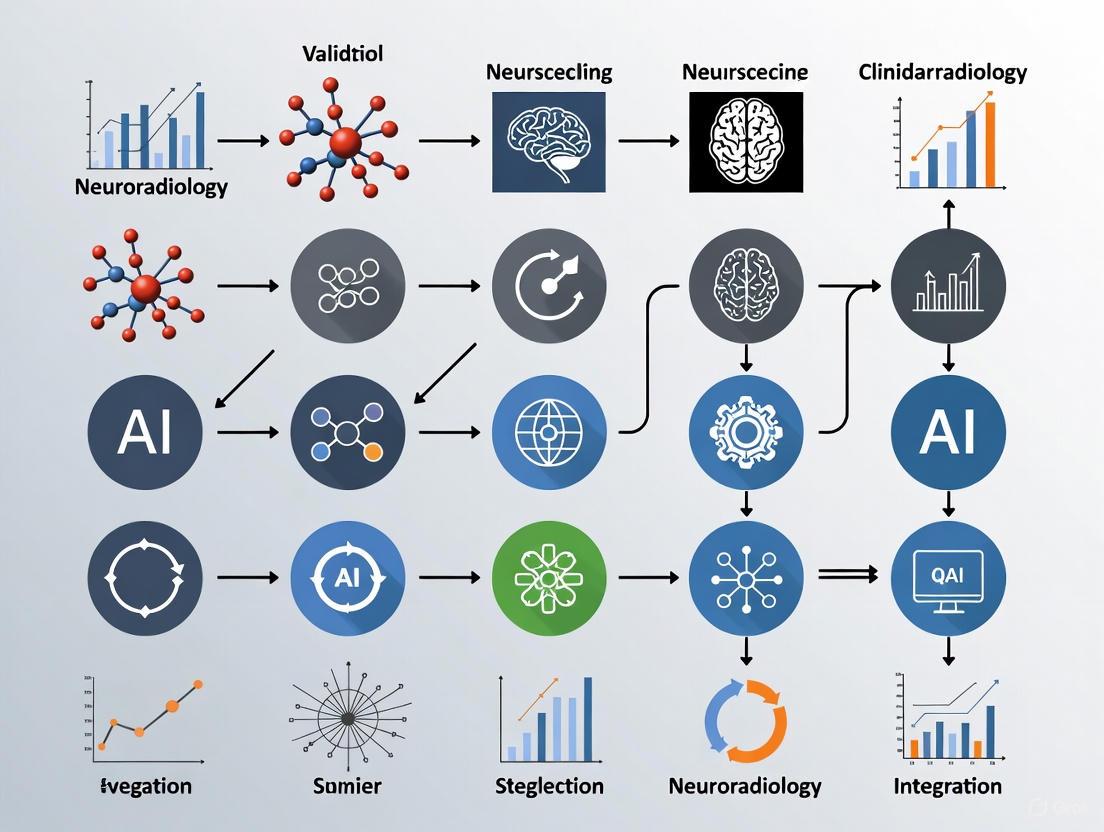
This article provides a comprehensive guide for researchers and drug development professionals on the critical process of validating AI tools for clinical neuroradiology integration.
Beyond the Algorithm: A Practical Framework for Validating AI Tools in Neuroradiology
Abstract
This article provides a comprehensive guide for researchers and drug development professionals on the critical process of validating AI tools for clinical neuroradiology integration. It moves from foundational concepts and regulatory requirements to detailed methodological approaches for performance assessment. The content addresses common troubleshooting scenarios, including algorithmic bias and workflow integration challenges, and establishes a framework for comparative analysis and real-world impact validation. By synthesizing current evidence and trends, this guide aims to equip stakeholders with the knowledge to ensure AI tools are not only accurate but also clinically effective, safe, and scalable.
The Neuroradiology AI Landscape: From Hype to Clinical Reality
The Current State of AI Adoption in Neuroradiology Practice
FAQs: Understanding AI Integration in Neuroradiology
What is the current adoption rate of AI in clinical neuroradiology practice? Despite radiology leading medical AI adoption, real-world clinical integration in neuroradiology remains limited. Only about 30% of radiologists have integrated AI into routine workflows, with usage largely confined to specific, narrow tasks rather than comprehensive diagnostic platforms [1]. While the U.S. had authorized nearly 777 AI-enabled radiology devices by 2025, only about 126 FDA-cleared products exist for neuroradiology, and few of these relate to specialized areas like brain tumor imaging [2] [3].
What are the primary clinical applications of AI in neuroradiology? AI in neuroradiology focuses on triage, detection, and workflow enhancement. Key applications include detecting intracranial hemorrhages, cerebral aneurysms, large vessel occlusions in stroke, and spinal fractures [2]. These algorithms demonstrate high sensitivity, with reported sensitivities for brain and spine triage algorithms ranging from 88% to 95% [2]. AI is also used for brain tumor volumetrics and automated measurement tasks [2].
What are the most significant barriers to widespread AI adoption? Key barriers include lack of standardized reimbursement pathways, regulatory challenges, limited generalizability across diverse populations, "black box" opacity, workflow integration difficulties, and data privacy concerns [3] [1] [4]. Financial barriers are particularly pronounced in Europe, where reimbursement remains fragmented compared to developing pathways in the U.S. [3].
How does AI impact radiologist workload and efficiency? AI has dual potential: it can automate repetitive tasks (like measurements and initial triage) to reduce workload, but may also increase it by requiring radiologists to double-check AI results [1]. Well-designed AI tools can enhance efficiency by accelerating image acquisition, automating report generation, and prioritizing critical cases [5]. Generative AI shows particular promise for reducing administrative burdens by turning dictated speech into structured reports [6].
Will AI replace neuroradiologists? Most experts agree AI will augment rather replace neuroradiologists. AI serves as a supportive tool that enhances diagnostic capabilities but cannot replicate clinical reasoning, interdisciplinary consultation, or patient communication [1] [4]. The evolving role emphasizes AI as an assistant that handles repetitive tasks, allowing radiologists to focus on complex decision-making [5].
Troubleshooting Guides: Addressing AI Implementation Challenges
Problem: Poor Generalizability Across Patient Populations
Symptoms
- AI model performance degrades when applied to new institutions or scanner types
- Decreased accuracy for demographic groups underrepresented in training data
- Inconsistent results across geographic regions or healthcare systems
Solution: Implement Robust Validation Protocols
- Conduct local validation studies before clinical deployment to assess model performance using your institution's data [2]
- Evaluate model generalizability using metrics like Dice coefficient and Hausdorff distance to quantify performance variations [2]
- Establish continuous monitoring to detect performance drift across patient subgroups [7]
- Utilize diverse test datasets that represent the full clinical population, including variations in age, ethnicity, and clinical presentation [4]
Validation Framework
Problem: Lack of Explainability and Trust in AI Outputs
Symptoms
- Radiologists hesitate to accept AI recommendations without understanding the reasoning
- Difficulty reconciling conflicting AI and human interpretations
- Inability to explain AI findings to referring physicians or patients
Solution: Integrate Explainable AI (XAI) Methods
- Implement saliency maps (Grad-CAM, Layer-wise Relevance Propagation) to visualize features influencing AI decisions [8]
- Develop context-aware explanations tailored to different users (radiologists, technologists, referring physicians) [8]
- Create contrastive explanations that clarify why the AI reached its conclusion and not alternative diagnoses [8]
- Establish human-AI dialogue systems that allow radiologists to query the AI about specific findings [8]
Verification Protocol When AI findings conflict with human interpretation:
- Review saliency maps to identify relevant features used by the AI
- Correlate with clinical context and patient history
- Consult additional imaging or advanced sequences if available
- Document the discrepancy and final resolution for quality assurance
- Use the case for continuous model improvement and training
Problem: Inefficient Workflow Integration
Symptoms
- AI tools require separate logins and interfaces outside primary PACS/RIS
- Increased time spent toggling between systems
- Disruption to established clinical workflows
- Resistance from staff due to added complexity
Solution: Optimize System Integration
- Select AI solutions with seamless PACS/RIS integration through DICOM standards [9]
- Implement unified worklists that incorporate AI findings and prioritization directly into existing workflows [5]
- Utilize middleware platforms that consolidate multiple AI applications through single sign-on [10]
- Design role-based interfaces tailored to specific users (radiologists, technologists, administrators) [5]
Integration Workflow
Quantitative Performance Data of AI in Neuroradiology
Table 1: Diagnostic Performance of AI Algorithms in Neuroradiology Applications
| Clinical Application | Modality | Reported Sensitivity | Reported Specificity | Key Metrics | FDA Clearance Status |
|---|---|---|---|---|---|
| Intracranial Hemorrhage Detection | CT | 88-95% [2] | 85-93% [2] | High accuracy for triage | 30+ cleared devices [3] |
| Large Vessel Occlusion Detection | CTA | 90-94% [2] | 88-92% [2] | Critical for stroke workflow | 20+ cleared devices [3] |
| Cerebral Aneurysm Detection | CTA/MRA | 87-93% [2] | 82-90% [2] | Reduced false positives | Limited clearance [2] |
| Cervical Spine Fracture | CT | 88-95% [2] | 90-96% [2] | RSNA challenge winner models | 15+ cleared devices [3] |
| Brain Tumor Segmentation | MRI | Variable by type [2] | Variable by type [2] | Dice coefficient 0.75-0.85 [2] | Limited clearance [2] |
Table 2: AI Impact on Operational Metrics in Radiology Departments
| Efficiency Metric | Traditional Workflow | AI-Enhanced Workflow | Improvement | Evidence Level |
|---|---|---|---|---|
| CT Exam Throughput | 20-25 patients/day [5] | 30+ patients/day [5] | 20-30% increase | Multi-site study [5] |
| MR Acquisition Time | Standard protocols | 30-50% reduction [2] | Significant time savings | Vendor data [2] |
| Report Turnaround Time for Critical Findings | 60-120 minutes [9] | 15-30 minutes [9] | 50-75% reduction | Clinical validation [9] |
| Time Spent on Structured Reporting | 3-5 minutes/case [6] | 1-2 minutes/case [6] | 60-70% reduction | User feedback [6] |
| Administrative Burden | High (43% report increased) [5] | Moderate reduction potential [6] | 25-40% estimated reduction | Physician survey [5] |
Experimental Protocols for AI Validation
Protocol 1: Model Generalizability Assessment
Purpose Evaluate AI algorithm performance across diverse clinical environments and patient populations to ensure robustness before deployment.
Materials
- Multi-institutional datasets representing variation in scanner manufacturers, protocols, and patient demographics [2]
- Reference standard annotations established by expert neuroradiologist consensus [7]
- Performance metrics toolkit including Dice coefficient, Hausdorff distance, sensitivity, specificity [2]
- Statistical analysis software for subgroup performance analysis [7]
Methodology
- Dataset Curation
- Collect retrospective imaging studies from ≥3 independent institutions
- Ensure representation of key demographic variables (age, sex, ethnicity)
- Include variety of scanner models and acquisition parameters
Performance Benchmarking
- Run AI algorithms on all datasets using standardized preprocessing
- Calculate performance metrics for overall population and subgroups
- Compare performance variation across sites using ANOVA testing
Failure Analysis
- Identify cases with discordant AI and reference standard readings
- Analyze common characteristics of failed cases
- Determine root causes (technical, clinical, demographic)
Validation Criteria
- Performance degradation <5% across institutions
- No statistically significant performance differences across demographic subgroups
- Dice coefficient >0.80 for segmentation tasks [2]
Protocol 2: Clinical Workflow Impact Assessment
Purpose Quantify the effect of AI integration on radiologist efficiency, report turnaround times, and diagnostic consistency.
Materials
- Integrated AI-PACS platform with automated worklist prioritization [5]
- Time-tracking software integrated into reading workflow
- Structured reporting system with AI-assisted dictation [6]
- Reader study framework with case mix reflecting clinical practice
Methodology
- Baseline Assessment
- Measure current key performance indicators (KPIs) without AI
- Establish baseline reading times, report turnaround, accuracy rates
- Document workflow pain points and bottlenecks
Controlled Implementation
- Deploy AI tools for specific use cases (e.g., hemorrhage detection)
- Train users on AI interaction and interpretation
- Implement parallel reading for initial validation period
Impact Measurement
- Track time from exam completion to final report
- Measure time saved on automated tasks (measurements, segmentation)
- Assess diagnostic consistency using inter-reader agreement statistics
- Survey user satisfaction and perceived workload
Success Metrics
- ≥20% reduction in critical finding report turnaround time [9]
- ≥15% increase in reading throughput without accuracy degradation
- ≥80% user satisfaction with AI integration [5]
Research Reagent Solutions for AI Validation
Table 3: Essential Components for Neuroradiology AI Validation
| Research Component | Function | Implementation Examples | Validation Role |
|---|---|---|---|
| Curated Reference Datasets | Ground truth for model training/validation | RSNA challenge datasets [2], Multi-institutional collections | Performance benchmarking and generalizability testing |
| Annotation Platforms | Expert lesion segmentation and labeling | 3D Slicer, ITK-SNAP, Commercial annotation tools | Creating gold standard for model training |
| Performance Metrics Toolkits | Quantitative algorithm assessment | Python libraries (Scikit-learn, MedPy), Custom validation frameworks | Objective performance measurement across sites |
| Explainability (XAI) Frameworks | Model decision transparency | Grad-CAM, LRP, SHAP, Attention visualization [8] | Building clinical trust and identifying failure modes |
| Workflow Integration Middleware | Connects AI to clinical systems | DICOM routers, HL7 interfaces, PACS integration tools [10] | Real-world performance assessment |
| Bias Detection Tools | Identify performance disparities across subgroups | Fairness metrics (demographic parity, equalized odds) | Ensuring equitable performance across patient populations |
Clinical validation is a critical process in the development of artificial intelligence (AI) tools for neuroradiology, ensuring these technologies are not only technically sound but also effective and safe in real-world clinical practice. While technical performance metrics are important, true validation requires demonstrating that an AI tool improves diagnostic accuracy, enhances workflow efficiency, and ultimately leads to better patient outcomes [11]. This technical support center provides researchers, scientists, and drug development professionals with essential guidance, troubleshooting, and experimental protocols for robust clinical validation of neuroradiology AI tools.
FAQs: Core Concepts in Clinical Validation
What is the difference between technical accuracy and clinical validation for AI tools in neuroradiology?
Technical accuracy refers to an algorithm's performance on a specific, narrow task, such as detecting a condition in a curated dataset, and is often measured by metrics like sensitivity, specificity, and area under the curve (AUC) [11]. Clinical validation, however, is a broader evaluation that assesses whether the AI tool provides a net benefit when used by clinicians in the intended clinical setting and patient population. It focuses on the tool's impact on the diagnostic thinking and therapeutic decisions of physicians, and ultimately, on patient outcomes [11] [12]. A tool can be technically excellent but fail clinical validation if it does not fit into the clinical workflow or improve patient management.
Why is generalizability a major challenge in the clinical validation of neuroradiology AI?
AI algorithms, particularly those based on deep learning, are prone to a phenomenon called "overfitting," where they perform exceptionally well on their training data but see a significant drop in performance on external data from different hospitals [11]. This limited generalizability stems from several factors, including the high heterogeneity of medical data. Variations in MRI or CT scanner models, imaging protocols, and patient populations across different clinical sites can drastically alter an algorithm's performance [11] [13]. For instance, a study evaluating an AI tool for multiple sclerosis lesion assessment was conducted on a cohort of 112 patients scanned on 8 different MRI scanner models with varying protocols, a design crucial for a meaningful real-world validation [13].
What study designs are best for establishing the clinical utility of an AI tool?
Demonstrating clinical utility, which proves that using the AI tool improves patient outcomes, requires the most rigorous study designs [11].
- Randomized Clinical Trials (RCTs): These are considered the ideal for establishing clinical utility. In an RCT, patients are randomly assigned to groups where clinicians either use or do not use the AI tool, allowing researchers to directly measure the tool's impact on patient outcomes [11].
- Diagnostic Cohort Studies: This design tests the clinical validity/accuracy of the AI in samples that represent the target patient population in real-world clinical scenarios. It is a robust method for showing the tool's performance in a realistic setting before undertaking a larger and more complex RCT [11].
How does the V3 framework (Verification, Analytical Validation, Clinical Validation) structure the evaluation of medical AI?
The V3 framework provides a structured, three-component foundation for determining if a Biometric Monitoring Technology (BioMeT), a category that includes many AI tools, is fit-for-purpose [12].
- Verification: A systematic evaluation by hardware manufacturers to ensure the system is built correctly. This involves assessing sample-level sensor outputs "at the bench" (in silico and in vitro) [12].
- Analytical Validation: This step occurs at the intersection of engineering and clinical expertise. It evaluates the data processing algorithms that convert sensor measurements into physiological or clinical metrics, ensuring the tool correctly measures what it claims to measure in a controlled setting [12].
- Clinical Validation: This is typically performed by a clinical trial sponsor to demonstrate that the AI tool acceptably identifies, measures, or predicts a clinical state in the intended context of use, which includes the specific patient population and clinical setting [12].
Troubleshooting Common Clinical Validation Challenges
Problem: High False Positive Rates in Real-World Use
- Potential Cause: The algorithm's threshold for flagging a finding may be too sensitive for general clinical practice, or it may have been trained on data that lacks the diversity and "noise" found in real-world imaging.
- Solution: Recalibrate the algorithm's operating threshold based on real-world validation data to better align with clinical priorities. Conduct additional training with more diverse, multi-institutional data that reflects a wider range of imaging protocols and patient anatomies [11] [13]. A prospective study of an MS lesion AI tool noted low positive predictive values (0.35–0.65) due to false positive tendencies, highlighting the importance of post-market monitoring and re-validation [13].
Problem: AI Tool Fails to Integrate into Clinical Workflow
- Potential Cause: The tool was designed without sufficient input from end-users (neuroradiologists) or without considering existing hospital IT infrastructure and radiology workflow systems like PACS [14].
- Solution: Involve neuroradiologists and IT staff early in the design process. Utilize established communication standards like DICOM and IHE profiles to ensure seamless integration. Choose platforms that offer unified infrastructures to manage multiple AI applications, reducing inefficiencies [15] [14]. Pilot testing in a live clinical environment before a full-scale validation study is crucial to identify and resolve workflow bottlenecks.
Problem: Algorithm Performance Deteriorates at External Validation Sites
- Potential Cause: The model has poor generalizability due to differences in patient demographics, disease prevalence, or imaging equipment/protocols at external sites [11].
- Solution: From the outset, design validation studies to be multi-center and multi-vendor. Employ techniques such as domain adaptation during training and use a hold-out external test set from a completely different institution to get a true measure of generalizability [11] [2]. As one expert noted, an AI model that works in three hospitals may not work across the entire U.S. [2].
Experimental Protocols for Clinical Validation
Protocol 1: Prospective Clinical Validation for a Triage AI Tool
This protocol is designed to validate an AI tool that triages urgent findings, such as intracranial hemorrhage or large vessel occlusion.
- Study Design: Prospective, multi-center, blinded study.
- Participant Recruitment: Consecutively enroll patients from the emergency department who undergo a non-contrast head CT for suspected stroke. Predefine inclusion and exclusion criteria.
- Ground Truth Definition: Establish a consensus ground truth for each case using a panel of at least three expert neuroradiologists, blinded to the AI results. The panel will review all imaging and available clinical data.
- AI Workflow Integration: The AI tool runs automatically on all eligible scans within the PACS. The results are logged in a separate system and are not initially visible to the interpreting radiologist.
- Data Collection: Record the AI's findings (presence/absence of hemorrhage) and the time from scan completion to AI result. The initial clinical report by the on-call radiologist (without AI assistance) is also recorded.
- Outcome Measures:
- Primary: Sensitivity and specificity of the AI tool compared to the expert panel ground truth.
- Secondary: Time from scan to AI notification; the false positive rate; the rate of "missed" findings by the initial radiologist that were correctly flagged by the AI.
Protocol 2: Measuring AI's Impact on Radiologist Workflow and Efficiency
This protocol assesses whether an AI tool improves efficiency in a time-consuming task, such as quantifying multiple sclerosis (MS) lesions.
- Study Design: Prospective, randomized, crossover study.
- Participant Recruitment: Recruit neuroradiologists of varying experience levels.
- Case Selection: Curate a set of MS patient MRI exams, each including current and prior scans for comparison.
- Study Procedure: In the first phase, radiologists are randomized to read half the cases with AI assistance and half without. After a washout period, they read the other half under the opposite condition. The AI tool provides automated lesion counts and highlights new/enlarging lesions.
- Data Collection:
- Time Tracking: Record the time taken for assessment per case for both conditions.
- Accuracy: Compare the radiologist's findings (with and without AI) to a manually curated ground truth.
- User Feedback: Administer a post-study questionnaire using a Likert scale to assess the radiologists' perception of the tool's helpfulness, confidence, and integration ease.
- Outcome Measures: Mean assessment time saved; change in sensitivity/specificity for detecting new lesions; qualitative user feedback [13]. A 2025 study using a similar design found a mean reduction of 27 seconds per case when using AI for MS follow-up, and radiologists found the AI helpful in 87% of cases [13].
Performance Metrics and Data Presentation
Table 1: Key Performance Metrics for AI Clinical Validation
| Metric | Formula / Definition | Interpretation in Clinical Context | ||||||||
|---|---|---|---|---|---|---|---|---|---|---|
| Sensitivity | True Positives / (True Positives + False Negatives) | The ability of the AI to correctly identify patients with the disease. A high value is critical for rule-out tests and triage of critical findings [11]. | ||||||||
| Specificity | True Negatives / (True Negatives + False Positives) | The ability of the AI to correctly identify patients without the disease. A high value is important to avoid unnecessary follow-up tests and anxiety [11]. | ||||||||
| Positive Predictive Value (PPV) | True Positives / (True Positives + False Positives) | The probability that a patient with a positive AI result actually has the disease. Highly dependent on disease prevalence [11] [13]. | ||||||||
| Negative Predictive Value (NPV) | True Negatives / (True Negatives + False Negatives) | The probability that a patient with a negative AI result truly does not have the disease. A high NPV is valuable for triaging cases that may not need immediate attention [13]. | ||||||||
| Area Under the ROC Curve (AUC/AUROC) | Plot of Sensitivity vs. (1 - Specificity) | The mean sensitivity over all possible specificities. A general measure of discriminative ability, but should be interpreted with caution as it may not reflect performance at a clinically chosen threshold [11]. | ||||||||
| Dice Similarity Coefficient | 2 * | True Positive | / (2 * | True Positive | + | False Positive | + | False Negative | ) | Measures the spatial overlap between an AI-generated segmentation (e.g., of a tumor) and a manually drawn ground truth. Common for segmentation tasks [11] [2]. |
| Measure | Radiologist Alone | Radiologist with AI | AI Alone |
|---|---|---|---|
| Mean Assessment Time | Baseline | -27 seconds (p=0.317) | N/A |
| Helpfulness to Radiologist | N/A | 87% of cases | N/A |
| Negative Predictive Value (NPV) for new lesions | N/A | 0.89 | N/A |
| Positive Predictive Value (PPV) for new lesions | N/A | 0.35 - 0.65 | N/A |
Workflow and Conceptual Diagrams
Diagram 1: The V3 Clinical Validation Workflow. This process, adapted from the V3 framework, outlines the foundational steps for establishing that an AI tool is fit-for-purpose, culminating in the demonstration of clinical utility [12].
Diagram 2: Relationship of Core Performance Metrics. This chart visualizes the relationship between the AI's predictions and the ground truth, defining the core components (TP, FP, TN, FN) used to calculate sensitivity, specificity, PPV, and NPV [11].
The Scientist's Toolkit: Essential Reagents & Materials
Table 3: Key Research Reagent Solutions for AI Validation
| Item | Function in Clinical Validation |
|---|---|
| Curated Datasets with Expert Ground Truth | Serves as the reference standard (gold standard) for training and initial testing. The quality of the ground truth (e.g., expert neuroradiologist annotations) is paramount [11] [12]. |
| External Test Sets (Multi-Center) | Independent datasets from different hospitals, used to evaluate the generalizability and real-world performance of the AI algorithm, testing for overfitting [11] [2]. |
| Performance Metric Calculators (e.g., Dice, AUC) | Software scripts or packages to calculate standardized performance metrics, ensuring consistent and comparable evaluation across different studies and tools [11]. |
| Clinical Data Integration Platform | A unified software infrastructure (e.g., an AI operating system) that allows for the seamless integration, deployment, and monitoring of multiple AI algorithms within a clinical workflow [15] [14]. |
| Structured Reporting Templates | Standardized templates, sometimes generated with the aid of large language models, that help convert free-text radiology reports into structured data for more consistent outcome measurement and data analysis [2]. |
This technical support center provides troubleshooting guides and FAQs for researchers and scientists conducting AI validation studies in neuroradiology. The content is framed within the context of validating AI tools for clinical integration research, focusing on key applications in stroke, hemorrhage, aneurysms, and spine imaging.
Troubleshooting Guides
Guide 1: Addressing AI Model Generalizability and Performance Gaps
Issue: AI model performance degrades when applied to external validation datasets or specific disease subtypes, threatening the validity of a clinical integration study.
Solution: Implement a rigorous, multi-faceted validation protocol.
Action 1: Subgroup Performance Analysis
- Procedure: Do not just calculate overall accuracy. Break down performance by clinically relevant subgroups, such as hemorrhage subtype, aneurysm location, or scanner manufacturer. This helps identify specific failure modes.
- Example: For an intracranial hemorrhage (ICH) detection AI, calculate sensitivity and specificity for each hemorrhage subtype (e.g., intraparenchymal, subdural, epidural). Research shows AI sensitivity for epidural hemorrhage can be as low as 75%, a critical detail masked by overall high performance [16].
Action 2: External Testing on Diverse Data
- Procedure: Validate the algorithm using retrospective data from multiple institutions not involved in model training. Ensure the data encompasses different geographic locations, patient demographics, and imaging equipment.
- Rationale: An algorithm developed at a single academic center may not perform well in community hospitals or across different populations. A model's generalizability cannot be assumed [2] [17].
Action 3: Implement a Real-Time Monitoring Framework
- Procedure: For deployed models, use frameworks like the Ensembled Monitoring Model (EMM) to estimate prediction confidence in real-time without needing ground-truth labels. The EMM uses an ensemble of sub-models; the agreement level between these sub-models and the primary AI indicates confidence [18].
- Output: Categorize AI predictions into "increased confidence," "similar confidence," or "decreased confidence" tiers. This allows researchers to flag unreliable predictions for further review during validation studies, reducing cognitive burden and potential misdiagnoses [18].
Guide 2: Integrating AI into Clinical Workflows for Pragmatic Trials
Issue: An AI tool with high diagnostic accuracy in a controlled, retrospective study fails to demonstrate practical impact when integrated into a live clinical workflow for a prospective trial.
Solution: Design the validation study around key clinical workflow metrics and seamless integration.
Action 1: Measure Operational Efficiency Metrics
- Procedure: In addition to diagnostic performance, track time-based and workflow metrics. Key Performance Indicators (KPIs) should include:
- Door-to-treatment decision time
- Critical case notification time
- Triage accuracy
- Expected Outcome: Successful AI integration has been shown to reduce door-to-treatment decision time by 26% and critical case notification time by 57% [16].
- Procedure: In addition to diagnostic performance, track time-based and workflow metrics. Key Performance Indicators (KPIs) should include:
Action 2: Ensure "Human-in-the-Loop" System Design
- Procedure: The AI should function as a decision-support tool, not an autonomous system. Design workflows that require radiologist confirmation for final diagnosis. This mitigates risks from AI "hallucinations" or over-reliance [17] [9].
- Analogy: "Think about AI like a toddler learning to ride a bike... Having an expert... to help support the bike while the child is learning is helpful" [17].
Action 3: Prioritize Seamless Technical Integration
- Procedure: Validate the AI tool within the existing clinical ecosystem (PACS, RIS). Tools that require radiologists to toggle between platforms create friction and reduce adoption. Seek solutions that embed results directly into the standard workflow via DICOM overlays or structured reports [9] [19].
Frequently Asked Questions (FAQs)
Q1: What are the realistic performance expectations for commercial AI in detecting intracranial hemorrhage? A: Based on a recent meta-analysis of 45 studies, commercial AI systems for ICH detection demonstrate high aggregate performance, but this varies significantly by hemorrhage subtype. You can expect pooled sensitivity of ~90% and specificity of ~95%. However, performance is not uniform; sensitivity for intraparenchymal hemorrhage is high (95%), but drops considerably for epidural hemorrhage (75%). This underscores the need for subtype-specific validation in your research [16].
Q2: Our validation study for a vertebral fracture AI shows high sensitivity but low PPV. How should this result be interpreted? A: This is a common finding. A study on the Nanox.AI HealthOST software revealed a similar pattern: at a >20% vertebral height reduction threshold, sensitivity was 92.0%, but PPV was only 16.5%. This indicates the AI is excellent at finding most true fractures (high sensitivity) but also generates a substantial number of false positives (low PPV). The clinical context should guide your response. For a screening tool where missing a fracture is unacceptable, this trade-off may be justified, provided a radiologist provides a secondary review of positive findings [20].
Q3: What methodologies exist for monitoring the performance of a "black-box" commercial AI model in real-time after deployment? A: The Ensembled Monitoring Model (EMM) framework is designed for this purpose. It operates without needing access to the internal workings of the commercial (black-box) AI. The EMM uses a ensemble of multiple sub-models trained for the same task. The agreement level between the EMM's sub-models and the primary AI's output serves as a proxy for confidence, allowing for real-time, case-by-case assessment without ground-truth labels [18].
Q4: How can AI be utilized to improve patient recruitment for stroke clinical trials? A: AI can significantly enhance trial recruitment in two key ways:
- Imaging-based Cohort Identification: Platforms like the AStrID (Acute Stroke Imaging Database) can automatically analyze MRI images to identify stroke type and precise location. Researchers can then query the database to find patients with very specific stroke attributes, enabling targeted recruitment for trials where a treatment may only be effective for a particular stroke profile [21].
- Automated Screening: AI can continuously analyze brain and vessel imaging in emergency settings to alert physicians about potential participants who meet the imaging criteria for a trial, thereby accelerating enrollment [17].
Quantitative Data Tables
Table 1: Diagnostic Performance of AI for Intracranial Hemorrhage Detection
| Model Category | Pooled Sensitivity (95% CI) | Pooled Specificity (95% CI) | Number of Studies (Patients) |
|---|---|---|---|
| Research Algorithms | 0.890 (0.839–0.942) | 0.926 (0.899–0.954) | 29 (n = 185,847) |
| Commercial AI Systems | 0.899 (0.858–0.940) | 0.951 (0.928–0.974) | 16 (n = 94,523) |
Source: Adapted from a meta-analysis in Brain and Spine [16].
Table 2: AI Performance by Intracranial Hemorrhage Subtype
| Hemorrhage Subtype | AI Sensitivity | Detection Challenge (Difficulty Score) |
|---|---|---|
| Intraparenchymal | 95% | Low |
| Subarachnoid | 90% | Medium |
| Subdural | 85% | Medium |
| Epidural | 75% | High (0.251) |
Source: Adapted from a meta-analysis in Brain and Spine [16].
Table 3: Clinical Impact of AI Integration on Workflow Efficiency
| Workflow Metric | Before AI Implementation | After AI Implementation | Relative Improvement |
|---|---|---|---|
| Door-to-Treatment Decision Time | 92 minutes | 68 minutes | -26% |
| Critical Case Notification Time | 75 minutes | 32 minutes | -57% |
| Triage Accuracy | 86% | 94% | +8% |
Source: Adapted from a meta-analysis in Brain and Spine [16].
Experimental Protocols
Protocol 1: Clinical Validation of a Vertebral Compression Fracture (VCF) AI Tool
This protocol is based on a real-world clinical validation study [20].
- Study Design: Retrospective analysis of outpatient chest and abdomen CT scans.
- Inclusion Criteria:
- Outpatients >50 years of age.
- CT scans performed for indications unrelated to vertebral fracture assessment.
- Exclusion Criteria:
- Patients with spinal hardware.
- Scans with excessive motion artifacts.
- Inadequate visualization of the thoracic/lumbar spine.
- Ground Truth Establishment:
- Two radiologists, including a senior musculoskeletal specialist, review all scans in consensus.
- Employ the Genant semiquantitative (GSQ) grading scheme.
- Resolve discrepancies through discussion or with a third expert in metabolic bone disease.
- AI Analysis:
- Process de-identified CT DICOM data through the AI software (e.g., Nanox.AI HealthOST).
- Test the AI's performance at different vertebral height reduction thresholds (e.g., >20% for mild, >25% for moderate fractures).
- Outcome Measures:
- Calculate sensitivity, specificity, PPV, and NPV of the AI against the radiologist-established ground truth.
- Compare original radiology reports with AI findings to determine the rate of previously missed fractures.
Protocol 2: Real-Time Monitoring of a Black-Box ICH Detection AI
This protocol outlines the implementation of the Ensembled Monitoring Model (EMM) framework [18].
- Model Setup:
- Primary Model: The commercial, black-box ICH detection AI to be monitored.
- EMM Construction: Develop an ensemble of five sub-models with diverse neural network architectures, all trained on the same task (ICH detection) but with different initializations and data augmentations.
- Inference and Monitoring:
- For each new head CT scan, the primary model and the five EMM sub-models process the image independently and in parallel.
- Record the binary output (ICH-positive or ICH-negative) from the primary model and each EMM sub-model.
- Confidence Scoring:
- Calculate the agreement level between the EMM sub-models and the primary model using unweighted vote counting.
- Agreement Level: 0%, 20%, 40%, 60%, 80%, 100%.
- Stratification and Action:
- Define confidence tiers based on agreement levels and baseline AI performance (see diagram below for logic).
- Increased Confidence: High agreement, AI prediction is highly reliable.
- Similar Confidence: Moderate agreement, use AI output as standard.
- Decreased Confidence: Low agreement, recommend disregarding AI output and conducting a conventional radiologist read.
Workflow and System Diagrams
AI Confidence Monitoring with EMM
Clinical Integration Pathway for Stroke AI
The Scientist's Toolkit: Research Reagent Solutions
| Tool / Resource | Function in AI Validation Research | Example / Note |
|---|---|---|
| Ensembled Monitoring Model (EMM) | Provides real-time confidence scores for black-box AI predictions without needing ground-truth labels or model internals. | Critical for ongoing performance assurance in clinical integration studies [18]. |
| Structured Datasets & Challenges | Provide curated, expert-annotated datasets for benchmarking AI algorithm performance in a standardized way. | The RSNA 2025 Intracranial Aneurysm Detection AI Challenge offers a dataset from 18 sites across 5 continents for developing and testing detection models [22]. |
| Acute Stroke Imaging Database (AStrID) | An AI-driven platform that automatically identifies stroke type and location from MRI, facilitating patient stratification and recruitment for clinical trials. | Enables researchers to find patients with specific stroke attributes for precision trial enrollment [21]. |
| FDA-Cleared Commercial AI Software | Commercially available tools that have passed regulatory scrutiny; used as interventions in pragmatic trials to assess real-world impact. | Examples include ICH detection tools and vertebral fracture detection software (e.g., Nanox.AI HealthOST) [20] [16]. |
| Genant Semiquantitative (GSQ) Grading | A standardized method for radiologists to establish ground truth for vertebral compression fractures, against which AI performance is measured. | Essential for consistent labeling in validation studies for spine AI [20]. |
The integration of Artificial Intelligence (AI) tools into clinical neuroradiology requires rigorous validation and compliance with regional regulatory frameworks. For researchers and developers, understanding these pathways is crucial for designing studies that meet regulatory standards and facilitate clinical adoption. The U.S. Food and Drug Administration (FDA) and the European Union's CE marking represent two primary, distinct regulatory approaches for AI-based medical devices, including those for neuroradiology applications such as intracranial hemorrhage detection, large vessel occlusion identification, and image segmentation [23].
Navigating these frameworks is a fundamental part of the research and development process. This guide addresses common questions and troubleshooting issues that arise during the experimental validation of AI tools intended for this field.
FAQ: Core Regulatory Concepts
Q1: What is the fundamental difference between FDA clearance and CE marking?
The fundamental difference lies in the governing authority, geographical applicability, and the underlying regulatory philosophy.
FDA Clearance/Approval is granted by the U.S. Food and Drug Administration and is mandatory for marketing medical devices in the United States [24] [25]. It involves a direct review and decision by the FDA agency itself.
CE Marking is a manufacturer's declaration that a product complies with the applicable European Union legislation, allowing it to be freely marketed within the European Economic Area [26]. While often involving third-party "Notified Bodies" for higher-risk devices, it is not issued by a central EU authority [26] [23].
Table: Key Differences Between FDA Clearance and CE Marking
| Feature | FDA Clearance/Approval | CE Marking |
|---|---|---|
| Governing Authority | U.S. Food and Drug Administration (FDA) | Manufacturer's declaration (with Notified Bodies for higher-risk classes) [26] [23] |
| Geographical Scope | United States | European Economic Area (EU, Iceland, Liechtenstein, Norway) and Northern Ireland [27] |
| Primary Legal Basis | Food, Drug and Cosmetic Act [24] | EU Medical Device Regulation (MDR) [23] |
| Key Database | FDA's AI-Enabled Medical Devices List [28] | NANDO database for Notified Bodies [26] |
Q2: What is a 510(k) clearance, and how does it relate to AI neuroradiology tools?
A 510(k) is a premarket notification submitted to the FDA to demonstrate that a new device is "substantially equivalent" to a legally marketed existing device [24] [25]. This is the most common pathway for AI medical devices.
For an AI tool in neuroradiology, this means the manufacturer must identify a "predicate" device—a previously cleared medical device—and provide evidence that their new AI tool is at least as safe and effective. Many AI tools for triage, such as those that prioritize CT scans with suspected strokes, have been cleared via the 510(k) pathway by referencing existing predicate devices [29] [30].
Q3: Is prospective clinical data always required for CE marking an AI medical device?
Not always. The need for prospective clinical data depends on the device's risk classification and intended purpose under the EU Medical Device Regulation (MDR) [31].
For some AI devices, particularly those with an indirect clinical benefit (e.g., an AI tool that provides accurate anatomical measurements to support a clinician's decision, rather than making a diagnosis itself), robust retrospective validation using existing datasets may be sufficient [31]. The manufacturer can justify that clinical data from prospective investigations is "not deemed appropriate" under Article 61(10) of the MDR, provided they can substantiate safety and performance through other means, such as performance evaluation and bench testing [31].
However, AI tools that make novel predictions or direct diagnoses will likely require clinical data from investigations involving human subjects to demonstrate safety and performance [31].
Q4: What are the common regulatory challenges when validating an AI tool for neuroradiology?
- Defining the "Intended Use": Precisely defining the tool's role in the diagnostic workflow is critical for regulatory submission and liability. Deviating from the approved "intended use" can increase medico-legal risk [23].
- The "Black-Box" Problem: Complex AI models can be difficult to interpret. Regulators and clinicians favor interpretable or explainable AI, especially when a wrong output could lead to patient harm [23].
- Post-Market Surveillance: Once a device is on the market, manufacturers must monitor its real-world performance. For AI devices, this is crucial to catch "model drift" or unexpected failures in new patient populations [23].
Troubleshooting Guide: Experimental Validation
Issue 1: Inconsistent Performance Across Datasets
Problem: Your AI model shows high accuracy on the internal validation set but performs poorly on external, multi-center data.
Solution:
- Action: Conduct rigorous external validation early in the development cycle.
- Protocol: Source retrospective imaging data from at least three independent clinical sites with different scanner models, protocols, and patient demographics. Ensure the dataset is representative of the intended use population.
- Documentation: Meticulously document all pre-processing steps, image acquisition parameters, and demographic information for all datasets. This demonstrates to regulators that you have understood and controlled for key sources of variability.
Issue 2: Establishing Clinical Utility for Indirect Benefits
Problem: How to prove the clinical benefit of an AI tool that provides measurements but does not directly output a diagnosis.
Solution:
- Action: Build a validation strategy that links the tool's output to downstream benefits for patient management or public health [31].
- Protocol: Design a study to show that the AI tool improves measurement precision and consistency compared to manual methods. Then, use established clinical literature to link these improved measurements to better treatment planning or monitoring. Combine this with summative usability testing to prove the tool works effectively in the hands of the intended users [31].
Issue 3: Navigating UKCA vs. CE Marking After Brexit
Problem: Determining the correct marking to sell a device in the United Kingdom (UK) and the European Union (EU).
Solution:
- Action: Understand that two different markings are now required for full market access to both regions.
- Guidance: The UKCA mark is required for Great Britain (England, Scotland, Wales). The CE mark is required for the EU, the European Economic Area, and Northern Ireland [27].
- Current Status: While the UK currently recognizes CE marking indefinitely for many products, medical devices may require separate approvals under UKCA and CE marking due to differing regulations [27]. For the highest assurance, plan for separate conformity assessments with a UK Approved Body for UKCA and an EU Notified Body for CE marking.
Experimental Protocols for Regulatory Validation
Protocol 1: Performance Evaluation Against the Standard of Care
This protocol is designed to generate evidence for a 510(k) submission or CE marking technical file.
1. Objective: To demonstrate that the AI-based neuroradiology tool is non-inferior or superior to the standard clinical practice (e.g., radiologist interpretation without AI assistance) for a specific task.
2. Methodology:
- Study Design: Retrospective, multi-reader, multi-case study.
- Data Set Curation:
- Collect a minimum of 300 de-identified neuroradiology cases (e.g., non-contrast head CTs) with a prevalence of the target finding (e.g., hemorrhage) that reflects clinical reality.
- Establish a ground truth through an adjudicated panel of at least three expert neuroradiologists, blinded to the AI output.
- Reader Study:
- Recruit a cohort of board-certified radiologists with varying experience levels.
- Each reader interprets the case set twice: once without AI assistance and once with AI assistance, with a sufficient washout period between sessions.
- Present cases in a randomized order to prevent recall bias.
3. Data Analysis:
- Compare the sensitivity, specificity, and area under the ROC curve (AUC) for the detection of the target finding between the unassisted and AI-assisted reads.
- Use statistical tests (e.g., McNemar's test for sensitivity/specificity, DeLong's test for AUC) to establish non-inferiority or superiority.
Protocol 2: Workflow Impact Analysis
This protocol quantifies the clinical utility of an AI tool in terms of efficiency, a key consideration for hospital adoption.
1. Objective: To measure the reduction in time-to-treatment and radiologist interpretation time using an AI triage tool.
2. Methodology:
- Study Design: Prospective, randomized controlled trial in a live clinical environment.
- Intervention:
- Control Arm: Standard workflow for processing and interpreting scans.
- Intervention Arm: AI tool automatically analyzes scans and alerts the radiologist for positive cases.
- Data Collection:
- Primary Endpoint: "Door-to-treatment" time for time-sensitive conditions like stroke [30].
- Secondary Endpoint: Time from scan completion to radiologist's final report.
- Capture cognitive burden metrics via standardized questionnaires.
3. Data Analysis:
- Use a time-to-event analysis (e.g., Kaplan-Meier curves and log-rank test) to compare door-to-treatment times between the two arms.
- Compare interpretation times using a paired t-test or Mann-Whitney U test, depending on data distribution.
Essential Research Reagent Solutions
This table outlines key components for building and validating an AI model for neuroradiology.
Table: Research Reagent Solutions for AI Neuroradiology Validation
| Item | Function in Validation |
|---|---|
| Curated, Multi-Center Image Dataset | Serves as the primary substrate for training and internal validation. Must be annotated by experts to establish reference standards. |
| External Validation Dataset | An independent dataset, ideally from different institutions and scanner types, used to test model generalizability and robustness [23]. |
| Adjudication Committee | A panel of expert neuroradiologists who establish the ground truth for complex cases, resolving discrepancies in annotations. |
| DICOM Conformance Tools | Software tools that verify the AI system correctly interfaces with Picture Archiving and Communication Systems (PACS) using standard DICOM protocols. |
| Performance Benchmarking Software | Tools to calculate standardized performance metrics (e.g., AUC, sensitivity, specificity) and compare them against pre-defined performance goals or predicate devices. |
Regulatory Workflow Visualization
The diagram below outlines the key stages and decision points in the regulatory pathway for an AI tool in neuroradiology.
Troubleshooting Guides
Guide 1: Addressing Algorithmic Bias in AI Models
Problem: AI model performance degrades or shows unfair outcomes across different patient demographics.
Solution: A comprehensive strategy involving bias detection, mitigation, and ongoing monitoring.
Step 1: Identify and Quantify Bias
- Action: Use open-source tools like IBM's AI Fairness 360 to run bias audits on your model [32].
- Methodology: Calculate fairness metrics such as demographic parity and equalized odds across subgroups defined by race, sex, age, etc. [33]. A 2023 review found that 50% of healthcare AI studies had a high risk of bias, often due to imbalanced datasets [33].
Step 2: Mitigate Bias in Training Data
- Action: Curate diverse and representative training datasets.
- Methodology: Leverage consortia models like the National Clinical Cohort Collaborative (N3C), which harmonizes data from over 75 institutions, to access more inclusive data [32]. Prioritize datasets that reflect the demographic diversity of your intended patient population.
Step 3: Ensure Model Generalizability
- Action: Perform rigorous external validation.
- Methodology: Test the algorithm on data from multiple external hospitals beyond your development site. Evaluate performance using metrics like the Dice coefficient and Hausdorff distance for image segmentation tasks to ensure accuracy holds [2].
Guide 2: Managing Data Privacy and Security
Problem: Ensuring patient data privacy during AI model training and deployment, in compliance with regulations.
Solution: Implement privacy-preserving technologies and robust data governance.
Step 1: Adopt Federated Learning
- Action: Train AI models across multiple institutions without moving or centralizing raw patient data [32].
- Methodology: Deploy the model to each institution's secure server. Only model parameter updates (not patient data) are shared and aggregated. The FeatureCloud project in Europe is a leading example of this approach [32].
Step 2: Implement Data Anonymization and Encryption
Step 3: Update Legal Agreements
Guide 3: Ensuring Effective Human Oversight
Problem: Radiologists experience "automation bias," over-relying on AI outputs, or the AI system fails without detection.
Solution: Establish clear human oversight protocols and monitoring systems as mandated by regulations like the EU AI Act [36].
Step 1: Define and Implement Human Oversight Workflows
- Action: Ensure clinicians have the authority and responsibility to override AI predictions when their clinical judgment contradicts the AI output [36].
- Methodology: Create clear standard operating procedures (SOPs) that define which AI findings require mandatory radiologist confirmation and which can be accepted without review based on the clinical context and the tool's validated performance.
Step 2: Establish Logging and Monitoring
- Action: Activate and maintain system logs that capture key events and AI outputs.
- Methodology: Logs must be retained for a minimum of six months and be accessible for internal audits and incident reporting. This allows for tracking how the AI system is used and identifying potential performance drift or bias over time [36].
Step 3: Conduct Ongoing Quality Monitoring
- Action: Implement a program for continuous clinical validation [35].
- Methodology: Incorporate a "human in the loop" review and regular audits of AI recommendations. Performance should be benchmarked against clinical consensus and monitored for accuracy across all patient populations to detect emerging bias [35].
Frequently Asked Questions (FAQs)
Q1: What are the most common types of bias we should test for in our neuroradiology AI models? The most common biases originate from data, development, and human interaction [37]. Key types include:
- Data Bias: Training data that lacks diversity in race, ethnicity, age, or socioeconomic status, leading to models that underperform on underrepresented groups [33].
- Representation Bias: Datasets that over-represent certain populations (e.g., from high-income regions) [33]. A study of neuroimaging AI models for psychiatric diagnosis found 97.5% included subjects only from high-income regions [33].
- Human Biases: These include implicit bias (subconscious stereotypes) and systemic bias (structural inequities in healthcare) that can be reflected in the data used to train models [33].
Q2: Our model performs well in our hospital but fails elsewhere. How can we improve generalizability? This is a classic problem of generalizability. Solutions include:
- External Validation: Test your model on data from several external hospitals that use different imaging equipment and have different patient demographics [2].
- Diverse Training Data: Build training datasets from multiple institutions to ensure the model learns robust, generalizable features rather than site-specific noise [32].
- Federated Learning: This technique allows you to train on diverse datasets from multiple institutions without transferring sensitive patient data, inherently improving generalizability [32].
Q3: What are our legal responsibilities if we use an FDA-cleared AI tool that fails to identify an abnormality? Legal liability for AI errors remains complex and somewhat ambiguous. However, the prevailing consensus is that the final responsibility for patient care and diagnosis rests with the clinical radiologist [38]. Relying on an FDA-cleared tool does not absolve the clinician of this responsibility. Healthcare organizations must ensure there is effective human oversight and that radiologists are trained to interpret and, when necessary, override AI outputs [36].
Q4: What specific obligations does the EU AI Act place on our research hospital using AI in neuroradiology? The EU AI Act classifies medical AI devices as "high-risk," placing specific obligations on users (deployers) [36]:
- Ensure AI Literacy: Provide training so staff understand the capabilities and limitations of the AI systems they use [36].
- Human Oversight: Implement measures to prevent automation bias and allow for the overriding of AI decisions [36].
- Data Quality Control: Verify that input data (e.g., medical images) meets the quality specifications set by the AI provider [36].
- Logging and Monitoring: Maintain logs of the AI system's operation for at least six months for auditing and monitoring purposes [36].
Q5: How can we transparently communicate the use of AI to our patients? Transparency is key to maintaining patient trust.
- Update Policies: Develop clear organizational policies on AI use and transparency [35].
- Revise Consent Forms: Inform patients when AI tools may be used in their care, even if the use is apparent to the clinician [35]. Laws like Texas's TRAIGA (effective 2026) are making this a legal requirement [35].
- Educate Staff: Prepare clinical staff to answer patient questions about how AI is used in their diagnosis and treatment [35].
Quantitative Data on AI in Radiology
The table below summarizes key quantitative data from recent studies and reports on AI adoption, performance, and bias in radiology.
| Metric | Value / Finding | Source / Context |
|---|---|---|
| AI Adoption in Radiology (2015-2020) | Grew from 0% to 30% | American College of Radiology data [9] |
| FDA-cleared AI Medical Devices | 882 total, with 76% in radiology (as of May 2024) | FDA update [33] |
| Studies with High Risk of Bias (ROB) | 50% of sampled AI studies showed high ROB | Kumar et al., 2023 systematic evaluation [33] |
| AI for Brain Tumor Classification | Diagnosis in under 150 seconds vs. 20-30 min for conventional methods | NIH/National Library of Medicine study [9] |
| Radiation Dose Reduction with AI (Pediatric) | 36% to 70% reduction, with some up to 95% | 2022 study of 16 peer-reviewed papers [9] |
| Sensitivity of Brain/Spine Triage AI | Reported range of 88% to 95% | Commercially available algorithms [2] |
Research Reagent Solutions
This table details key tools, frameworks, and resources essential for the ethical development and validation of AI in neuroradiology.
| Reagent / Resource | Function / Purpose | Application in Research |
|---|---|---|
| AI Fairness 360 (AIF360) | An open-source toolkit to check for and mitigate bias in machine learning models. | Used to calculate fairness metrics and run bias audits on developed models [32]. |
| Federated Learning Framework | A decentralized machine learning approach that trains algorithms across multiple institutions without sharing raw data. | Enables training on diverse datasets while preserving patient privacy and improving model generalizability [32]. |
| Dice Coefficient | A statistical metric (range 0-1) used to gauge the similarity between two sets of data. | A standard metric for evaluating the performance of image segmentation models (e.g., tumor contouring) [2]. |
| Assess-AI Registry | A registry developed by the American College of Radiology for blinded reporting of AI-related safety events. | Allows for confidential sharing of AI errors or near-misses to drive industry-wide learning and safety improvements [35]. |
| Structured Reporting with NLP | Use of Natural Language Processing (NLP) models like GPT-4 to convert free-text reports into structured data. | Helps structure vast amounts of radiology data for easier analysis, though requires caution regarding data privacy and "hallucinations" [2]. |
Experimental Validation Workflow for AI in Neuroradiology
The diagram below outlines a comprehensive workflow for the experimental validation of an AI tool in neuroradiology, integrating ethical imperatives at each stage.
Building a Robust Validation Protocol: Metrics and Integration Strategies
Frequently Asked Questions (FAQs)
Q1: What are realistic sensitivity and specificity values I should expect from an AI tool for detecting intracranial hemorrhage? Real-world performance can differ from developer-reported metrics. A large-scale study on an FDA-cleared AI tool for detecting intracranial hemorrhage (ICH) on non-contrast CT scans demonstrated a sensitivity of 75.6% and a specificity of 92.1% [39]. For other acute conditions, such as brain aneurysms, vessel occlusion in stroke, and cervical spine fractures on CT, reported sensitivities from commercially available triage algorithms often range from 88% to 95% [2]. It is critical to validate these metrics within your own clinical environment, as prevalence of disease and patient population characteristics can significantly impact performance.
Q2: How can an AI tool that is highly specific still slow down my overall workflow? A highly specific tool minimizes false alarms, but workflow impact is also determined by the positive predictive value (PPV). The PPV indicates the percentage of AI-positive cases that are true positives. In the ICH detection study, the tool had a PPV of only 21.1%, meaning nearly 79% of its alerts were false positives [39]. Each false alarm requires a radiologist to spend extra time to confirm it is not a real finding. This study found that interpreting these falsely flagged cases took over a minute longer than reading unremarkable scans, creating a net efficiency loss despite the tool's high specificity [39].
Q3: What key metrics should I use to evaluate an AI tool's impact on workflow speed? The primary quantitative metric is the change in average interpretation time, measured before and after AI integration [39]. However, a comprehensive evaluation should also consider qualitative factors. Evidence from systematic reviews is mixed, showing that AI does not always guarantee workflow efficiency gains [40]. Researchers should also assess the false positive rate's impact on radiologist cognitive load, system integration stability, and changes in report turnaround times for both AI-triaged and non-triaged studies.
Q4: Why is model generalizability a critical factor in multi-center trials? An AI model developed and validated at one hospital may not perform equally well across other institutions. This lack of generalizability can stem from differences in scanner manufacturers, imaging protocols, and patient population demographics [2]. For a multi-center trial, a drop in performance at a new site could introduce bias and invalidate key endpoints. It is essential to conduct site-specific validation of the AI tool prior to and during the trial to ensure consistent and reliable performance across all participating centers.
Q5: How do I assess the trustworthiness of an AI algorithm's output for a clinical trial? Establishing trust requires a multi-faceted approach. First, scrutinize the tool's regulatory status (FDA/CE clearance) and the clinical evidence from studies conducted in settings similar to your trial [41]. Second, inquire about the transparency and explainability of the AI's decisions. Some systems provide visual aids, like highlighting areas of concern, to help users understand the output [42]. Finally, evaluate the diversity and representativeness of the training data to ensure the algorithm is suitable for your trial's patient population and minimize the risk of biased performance [43] [44].
Performance Metrics for AI in Neuroradiology
The following tables summarize key quantitative metrics and methodological considerations for validating AI tools in neuroradiology, based on current literature and real-world implementations.
Table 1: Reported Performance Metrics for Selected AI Applications in Neuroradiology
| AI Application | Reported Sensitivity | Reported Specificity | Key Context / Notes |
|---|---|---|---|
| Intracranial Hemorrhage (ICH) Detection [39] | 75.6% | 92.1% | Real-world performance in a teleradiology setting; Positive Predictive Value (PPV) was 21.1%. |
| Brain & Spine Triage Algorithms [2] | 88% - 95% | Not Specified | Range includes detection of hemorrhage, stroke, aneurysms, and cervical spine fractures. |
| Cervical Spine Fracture Detection [2] | High Performance | High Performance | Winning algorithms from the RSNA 2022 Challenge demonstrated high detection and localization performance. |
Table 2: Experimental Protocol for Validating AI Workflow Impact
| Protocol Step | Description | Considerations for Researchers |
|---|---|---|
| 1. Study Design | Retrospective or prospective comparison of workflow metrics before and after AI integration. | A retrospective review of over 61,000 scans provides a robust model [39]. Prospective studies can capture real-time adaptations. |
| 2. Key Metrics | Measure average interpretation time (speed) and diagnostic accuracy (sensitivity/specificity). | Track time from opening the study to finalizing the report. Use expert panel consensus as a reference standard for accuracy [39]. |
| 3. Contextual Analysis | Analyze the impact of false positives and algorithm reliability on workflow efficiency. | Calculate the Positive Predictive Value (PPV). A low PPV can overwhelm radiologists with false alerts and slow down the net workflow [39]. |
| 4. Environment Assessment | Evaluate the tool's performance in the specific clinical environment where it will be used. | Disease prevalence and case-mix vary by site (e.g., emergency department vs. outpatient center) and can drastically alter a tool's practical value [39]. |
Experimental Workflow and Metric Relationships
The following diagram illustrates the logical pathway and key relationships for evaluating AI performance metrics in a validation study.
AI Validation Metric Relationships
The Scientist's Toolkit: Research Reagents & Essential Materials
Table 3: Key Resources for AI Validation in Neuroradiology Research
| Resource Category | Specific Examples / Functions | Role in Experimental Validation |
|---|---|---|
| Validated Datasets | Retrospective collections of imaging studies (e.g., >60,000 non-contrast head CTs [39]) with expert-annotated ground truth. | Serves as the benchmark for conducting robust, large-scale retrospective evaluations of AI algorithm performance before prospective deployment. |
| Annotation & Analysis Software | Platforms for segmenting lesions (e.g., hemorrhages, tumors) and performing volumetric analysis [2]. | Used to generate high-quality ground truth labels for training and to conduct specialized analyses (e.g., tumor volumetrics) that AI tools may automate. |
| Teleradiology/ PACS Platforms | Integrated clinical systems for managing and reading high volumes of studies, especially during off-hours [39]. | Provides a real-world, high-pressure environment to test AI's impact on workflow efficiency and diagnostic accuracy in a operational setting. |
| Performance Metric Tools | Software to calculate Dice coefficient, Hausdorff distance [2], sensitivity, specificity, and PPV [39]. | Provides quantitative, standardized measures for comparing AI performance against human experts and other algorithms. Essential for objective validation. |
| Computational Infrastructure | Powerful computing resources (GPUs) and advanced measurement techniques required for developing and running complex AI models [44]. | The foundational hardware and software required to train, test, and run deep learning models, particularly for image reconstruction and analysis tasks. |
Frequently Asked Questions
Q1: What is the fundamental difference between the Dice Coefficient and Hausdorff Distance? The Dice Coefficient (Dice-Sørensen Coefficient) measures the volume overlap or spatial agreement between two segmentations. In contrast, the Hausdorff Distance measures the largest distance between the boundaries of two shapes, capturing the worst-case scenario of mismatch [45] [46].
Q2: My Dice score is high, but my Hausdorff Distance is also large. What does this indicate? This is a common scenario. A high Dice score confirms good overall volumetric overlap between your AI output and the ground truth. However, a large Hausdorff Distance signifies that there is at least one localized, severe error where a part of the AI's segmentation is far from the corresponding part in the ground truth [46]. This combination warrants a visual inspection of the segmentation boundaries to identify these specific outliers.
Q3: When evaluating an AI model for brain tumor segmentation, which metric should I prioritize? For clinical applications in neuroradiology, it is crucial to use both metrics in conjunction [2]. The Dice Coefficient is excellent for assessing the overall accuracy of tumor volume segmentation, which is vital for treatment planning. The Hausdorff Distance is critical for ensuring that the segmentation boundaries are precise everywhere, as large boundary errors could be disastrous for surgical navigation or radiation therapy targeting [2].
Q4: How can I implement the calculation of these metrics in Python? Basic implementations for the Dice Coefficient and Hausdorff Distance can be achieved using common scientific computing libraries. The code snippets below demonstrate this.
Q5: What are the accepted interpretation guidelines for these metrics in medical imaging? While universal thresholds don't exist due to task-dependent variability, the following table offers general interpretation guidance for neuroradiology applications, based on common practices in the literature.
Table 1: Interpretation Guidelines for Segmentation Metrics in Neuroradiology
| Metric | Value Range | Common "Good" Threshold | Clinical Interpretation Guide |
|---|---|---|---|
| Dice Coefficient | 0 (No overlap) to 1 (Perfect overlap) | Often > 0.7 - 0.8 [47] | Indicates the overall volumetric agreement between AI segmentation and expert ground truth. |
| Hausdorff Distance | 0 to ∞ (smaller is better) | Task-dependent (e.g., < 5-10 mm) | Captures the largest boundary error, crucial for ensuring local accuracy in sensitive areas [46]. |
Troubleshooting Guides
Problem: Inconsistent or Unexpectedly Poor Dice Scores
- Potential Cause 1: Data Mismatch. The AI model was trained on data from one hospital or scanner type but is being evaluated on data from another, leading to a domain shift that reduces generalizability [2].
- Solution: Ensure your training and test datasets are representative of the clinical population and imaging protocols. Perform external validation on a dataset from a different source.
- Potential Cause 2: Incorrect Handling of Multiple Classes. When dealing with multi-class segmentation (e.g., tumor core, edema), calculating a single aggregate Dice score can mask poor performance in one class.
- Solution: Always calculate the Dice Coefficient separately for each class or structure of interest to get a precise performance breakdown [47].
Problem: Computationally Slow Calculation of Hausdorff Distance
- Potential Cause: Brute-Force Algorithm. A naive implementation that checks every point on one surface against every point on the other has a computational complexity of O(n*m), which is prohibitively slow for high-resolution medical images [46].
- Solution: For 3D surfaces, use optimized libraries like
scipy.spatial.distance.directed_hausdorfforopen3d, which utilize spatial data structures (e.g., KD-trees) to efficiently find nearest neighbors, drastically speeding up the calculation.
Problem: Hausdorff Distance is Overly Sensitive to a Single Outlier
- Potential Cause: The standard Hausdorff Distance (max distance) is, by definition, extremely sensitive to a single outlier point, which may not represent the overall boundary quality.
- Solution: Use a percentile-based variant, such as the 95% or 99% Hausdorff Distance. This metric sorts all the boundary point distances and takes the 95th percentile value, making it more robust to outliers while still capturing severe boundary errors.
Experimental Protocols for Metric Validation
Protocol 1: Benchmarking an AI Segmentation Model against Ground Truth This protocol outlines the steps for a standard performance evaluation of a neuroradiology AI tool.
Table 2: Research Reagent Solutions for Segmentation Validation
| Reagent / Tool | Function / Description |
|---|---|
| Expert-Annotated Ground Truth | Manually segmented medical images by clinical experts; serves as the reference standard for validation. |
| NumPy & SciPy (Python libraries) | Core libraries for numerical computations and implementing/sourcing metric calculations. |
| ITK-SNAP / 3D Slicer | Software for visualizing segmentations in 3D, overlaying results with ground truth, and inspecting Hausdorff Distance outliers. |
Workflow Overview: The following diagram illustrates the key stages in the validation workflow for an AI segmentation model in neuroradiology.
Protocol 2: Inter-Model Comparison Study This protocol is for comparing the performance of two or more different AI models.
Methodology:
- Dataset: Select a held-out test set with expert ground truth annotations.
- Execution: Run each AI model on the entire test set.
- Calculation: For each model and each image, compute both the Dice Coefficient and the Hausdorff Distance.
- Statistical Analysis: Perform appropriate statistical tests (e.g., paired t-test or Wilcoxon signed-rank test) on the results to determine if the performance differences between models are statistically significant.
- Visualization: Generate scatter plots or bar charts to visually compare the distribution of scores for each model.
Workflow Overview: The diagram below shows the comparative analysis process for evaluating multiple AI models.
The following table provides a consolidated overview of the two metrics for quick reference.
Table 3: Characteristics of Dice Coefficient and Hausdorff Distance
| Feature | Dice Coefficient | Hausdorff Distance |
|---|---|---|
| Primary Focus | Volumetric Overlap | Boundary Agreement / Maximum Error |
| Mathematical Range | 0 to 1 | 0 to ∞ |
| Interpretation | Higher is better | Lower is better |
| Sensitivity | Insensitive to small, localized errors | Highly sensitive to outliers |
| Best Used For | Assessing overall accuracy | Ensuring local precision and capturing worst-case errors |
| Clinical Relevance | Tumor volume measurement, treatment response assessment | Surgical planning, radiation therapy targeting [2] |
Designing Validation Studies for Real-World Generalizability
Frequently Asked Questions (FAQs)
FAQ 1: What constitutes a robust real-world dataset for validating an AI tool in neuroradiology? A robust real-world dataset should be representative of the intended clinical population and capture the full spectrum of clinical scenarios. Key considerations include:
- Data Diversity and Representativeness: The data must represent a broad socio-economic and ethnic population to minimize the risk of bias. It should capture data across various healthcare settings, scanner manufacturers, and protocols to ensure generalizability across different clinical environments [48] [2]. For instance, a dataset used for a multiple sclerosis monitoring tool included 397 scan pairs from three different scanner manufacturers (GE, Philips, Siemens) to test algorithm robustness [49].
- Longitudinal View: For chronic conditions like multiple sclerosis, data that covers a long period is essential for assessing disease progression and treatment response [48] [49].
- Fitness for Purpose: The data source must align with the research question. For example, administrative claims data is robust for financial metrics but may lack clinical details like vital signs [48]. Data should be routinely collected from varied sources, including electronic health records (EHRs), medical claims data, and disease registries [50].
FAQ 2: How can I assess the real-world clinical impact of an AI tool beyond diagnostic accuracy? Evaluating real-world impact requires looking beyond traditional performance metrics. Essential factors include:
- Workflow Integration: The tool must be integrated into existing clinical systems, such as the Radiology Information System (RIS) and Picture Archiving and Communications System (PACS), without adding burden to clinicians. Successful integration can enable features like automated worklist prioritization [51] [52].
- Interpretation Time: A tool that increases radiologist interpretation times can be a significant adoption barrier, especially in high-volume practices. Studies have shown that AI tools can sometimes increase reading times, which may offset diagnostic benefits [51].
- Value for Different Users: The tool's benefit may vary. For example, one study found that an AI algorithm for detecting steno-occlusive lesions provided a statistically significant diagnostic benefit for less-experienced resident trainees but not for expert neuroradiologists [51].
- Return on Investment (ROI) : From an administrative perspective, the marginal diagnostic benefit of a tool must be weighed against its cost, especially if it performs a task that an expert is already expected to do [51].
FAQ 3: What are the key regulatory considerations when designing a validation study? In the United States, understanding the U.S. Food and Drug Administration (FDA) framework is critical.
- FDA Classification: AI tools in radiology are typically not approved as autonomous devices. Many are classified as Computer Aided Triage and Notification (CADt) tools, while others may be Computer Aided Detection (CADe) or Computer Aided Diagnosis (CADx) devices. This classification reflects the extent of validation and determines the intended use [51].
- Real-World Evidence (RWE) : The FDA encourages the use of Real-World Data (RWD) to generate RWE for regulatory decisions. RWD is defined as "data relating to patient health status and/or the delivery of health care routinely collected from a variety of sources" [50]. The FDA has issued a framework for evaluating the use of RWE to support new drug indications or post-approval study requirements [50].
Troubleshooting Guides
Problem: AI tool performance decreases when deployed in a new hospital. This is typically a problem of generalizability, where the algorithm encounters data (e.g., from different scanner types or patient populations) not well-represented in its training set.
- Step 1: Analyze the Data Mismatch
- Step 2: Implement Data Augmentation and Diverse Training
- During algorithm development, use data augmentation techniques such as random cropping, rotation, and contrast adjustments. This encourages the network to focus on invariant features of the pathology rather than scanner-specific attributes [52].
- Ensure the training dataset is sourced from multiple locations and includes a wide array of scanner models and protocols [52].
- Step 3: Conduct a Rigorous Multi-Center Validation
- Before full deployment, validate the tool's performance on an independent, unselected dataset from the new hospital. This dataset should consecutively include all scans, including those with artifacts or post-operative changes, to provide a true real-world performance benchmark [52].
Problem: Clinicians are resistant to adopting the AI tool due to workflow disruptions. Resistance often stems from tools that are not seamlessly integrated into existing clinical workflows or that add time to the interpretation process.
- Step 1: Streamline Integration
- Deploy the tool using an informatics platform that operates silently in the background. The tool should automatically receive scans, process them, and return results directly into existing systems like the RIS and PACS without requiring any manual input from radiologists or clinicians [52].
- Step 2: Provide Actionable Outputs
- The tool should do more than just give a binary output. For positive cases, it can push annotated, pre-view images to the PACS, highlighting the region of interest (e.g., a potential hemorrhage) that informed the algorithm's decision. This provides immediate value to the radiologist [52].
- Step 3: Demonstrate Clear Clinical Workflow Benefits
Quantitative Performance Benchmarks
The following tables summarize real-world performance data from validated AI tools in neuroradiology, providing a benchmark for comparison.
Table 1: Performance of AI Tools in Detecting Specific Neurological Conditions
| Pathology | AI Tool | Sensitivity | Specificity | Comparator | Citation |
|---|---|---|---|---|---|
| Intracranial Hemorrhage | VeriScout | 0.92 (CI 0.84–0.96) | 0.96 (CI 0.94–0.98) | Ground Truth | [52] |
| Multiple Sclerosis Activity | iQ-Solutions | 93.3% | N/R | Standard Radiology Reports (58.3% sensitivity) | [49] |
| Steno-Occlusive Lesions | AI Algorithm (Lim et al.) | Modest increase | N/R | Expert Neuroradiologists (non-significant increase) | [51] |
| Cervical Spine Fracture | RSNA Challenge AI | High Performance (88-95% range) | N/R | Ground Truth | [2] |
Table 2: Impact of AI on Quantitative Imaging Biomarkers in Multiple Sclerosis
| Measurement Type | AI Tool (iQ-MS) | Core Lab | Standard Radiology Report | Citation |
|---|---|---|---|---|
| Percentage Brain Volume Change (PBVC) | -0.32% | -0.36% | Severe atrophy (>0.8% loss) not appreciated | [49] |
| Lesion Burden Quantification | Automated centile assignment | N/A | Inconsistent qualitative descriptors used | [49] |
N/R: Not Reported; N/A: Not Applicable
Experimental Protocols for Key Validations
Protocol 1: Real-World Clinical Validation for Disease Monitoring
This protocol is based on a validation study for an AI-based MRI monitoring tool in multiple sclerosis (MS) [49].
- Hypothesis: The AI tool will more sensitively detect MRI evidence of disease activity compared to conventional radiology reports and produce volumetric measurements comparable to a core imaging laboratory.
- Dataset Curation:
- Collect a large number of multi-center MRI scan pairs (e.g., 397 pairs) acquired during routine clinical practice.
- Include data from different scanner manufacturers (e.g., GE, Philips, Siemens) to ensure diversity.
- Apply strict quality checks (e.g., ensure 3D sequences with ≤3 mm slice thickness are available).
- Ground Truth Definition:
- Establish a consensus ground truth by having scans independently reviewed by expert radiologists and/or trained neuroimaging analysts from a core lab, blinding them to the AI results.
- Performance Comparison:
- Compare the case-level sensitivity and specificity of the AI tool against both the standard radiology reports and the core lab analyses.
- Statistically compare quantitative outputs, such as percentage brain volume change (PBVC), between the AI tool and the core lab using equivalence testing.
Protocol 2: Real-World Deployment and Workflow Integration Testing
This protocol is modeled on the validation of an AI-based CT hemorrhage detection tool [52].
- Objective: To retrospectively evaluate the performance of an AI triage tool in a real-world, unselected dataset and assess its integration into the clinical workflow.
- Dataset:
- Use a consecutive, unselected dataset of non-contrast head CT scans (e.g., 527 scans) from a hospital's emergency department, outpatients, and inpatients.
- Iteratively establish ground truth for the presence or absence of hemorrhage through review by a radiology trainee, followed by a blinded review by a subspecialty neuroradiologist. Resolve discrepancies with a third radiologist.
- Performance Analysis:
- Calculate the sensitivity and specificity of the AI tool against the ground truth for the global dataset.
- Sub-group analysis: Evaluate performance in scans containing artifacts or post-operative changes.
- Workflow Integration Assessment:
- Deploy the tool using an informatics platform that integrates with the hospital's RIS and PACS.
- Measure the time from scan completion to the appearance of the flag in the radiologist's worklist (e.g., within 10 minutes).
- Ensure the tool provides annotated preview images in PACS for positive cases without requiring manual intervention from clinical staff.
The Scientist's Toolkit: Research Reagent Solutions
Table 3: Essential Components for a Real-World AI Validation Study in Neuroradiology
| Item / Solution | Function / Explanation | Example from Literature |
|---|---|---|
| Multi-Center, Multi-Scanner Dataset | Provides a heterogeneous data source that tests the generalizability of an AI algorithm across different imaging hardware and protocols. | Validation of an MS tool using scans from GE, Philips, and Siemens scanners [49]. |
| Informatics Platform (e.g., Torana) | A software platform that enables seamless, silent integration of the AI tool into the hospital's existing clinical workflow (RIS/PACS) without disrupting radiologists [52]. | |
| Consensus Ground Truth | A rigorously established reference standard, often created by multiple sub-specialty experts, against which the AI tool's performance is measured. This is more reliable than single reads. | Iterative review by a neuroradiologist and a third radiologist to resolve discrepancies in ICH study [52]. |
| Longitudinal Data | Data collected from the same patients over multiple time points. Essential for validating tools that monitor disease progression or treatment response in chronic neurological conditions. | Used in MS study with scan pairs acquired with a mean interval of 12 months [49]. |
| Core Imaging Laboratory | A dedicated, highly standardized facility for processing and analyzing clinical trial images. Serves as a gold-standard comparator for quantitative AI tool outputs like brain volume measurements [49]. |
Workflow for Real-World AI Validation
The diagram below outlines a general workflow for designing and executing a real-world validation study for an AI tool in neuroradiology.
Clinical Deployment Workflow
This diagram illustrates the technical workflow for deploying an AI tool in a clinical setting, from image acquisition to radiologist notification.
The integration of Artificial Intelligence (AI) into neuroradiology represents a frontier in modern clinical research and practice. For researchers and drug development professionals, validating and deploying these tools requires their seamless connection to existing clinical infrastructure: the Picture Archiving and Communication System (PACS), Radiology Information System (RIS), and Electronic Health Record (EHR). These systems form the digital backbone of the radiology workflow, managing images, patient data, and reporting. Successful integration is not merely a technical exercise but a critical component of robust experimental design, ensuring that AI tools can function effectively in a real-world clinical environment, thereby producing generalizable and valid research outcomes for neuroradiology applications [2] [53].
Understanding the Integrated Ecosystem
A foundational understanding of the core systems and their interactions is essential for troubleshooting integration issues.
- PACS (Picture Archiving and Communication System): Manages the storage, retrieval, and distribution of medical images. It is the primary source of image data for AI algorithms [53].
- RIS (Radiology Information System): Manages patient scheduling, resource allocation, and radiologist reporting workflows. It is often the source of metadata for imaging studies [53].
- EHR (Electronic Health Record): The comprehensive repository of a patient's medical history, including laboratory results, clinical notes, and final radiology reports [54].
- AI Server/Platform: The environment where the AI model is hosted, which can be on-premises, in the cloud, or a hybrid of both [55] [15].
The goal of integration is to enable intelligent connections between these systems. In a typical workflow, a completed scan in PACS can automatically trigger an AI algorithm to analyze the images. The results—such as a flagged priority case or quantitative measurements—are then sent back to the PACS and/or RIS to be incorporated into the radiologist's workflow and ultimately included in a report that resides in the EHR [55] [15].
Troubleshooting Guides
Data Interoperability and Transmission Issues
Problem: AI model fails to receive studies or returns errors due to incompatible data formats.
- Step 1: Verify DICOM Conformance. Confirm that the AI server is fully DICOM-compliant. Use a DICOM validator tool to check that it supports the necessary Service-Object Pairs (SOP) Classes and Transfer Syntaxes (e.g., JPEG Lossless, JPEG 2000) used by your PACS [53].
- Step 2: Check Study-Series-Instance Hierarchy. Ensure the PACS is sending the complete study and that the AI model can correctly parse the DICOM structure. Incorrectly mapped DICOM tags (e.g., Study Instance UID, Series Instance UID) are a common point of failure.
- Step 3: Audit the DICOM Header. Manually inspect the DICOM headers of a failed study. Look for missing or non-standard tags that the AI model requires for processing (e.g., patient orientation, slice thickness). Develop a pre-processing script to standardize these headers if necessary.
Problem: AI results are not successfully returned to the PACS or EHR.
- Step 1: Validate HL7/FHIR Interfaces. If results are sent via HL7 or FHIR messages to the EHR, use an interface engine to monitor the traffic. Check for message parsing errors or schema non-conformance [54].
- Step 2: Confirm PACS Write Permissions. The AI server must have permission to "push" new data series (e.g., segmentation masks, heat maps) back to the PACS. Verify the AE Title, port, and permissions are correctly configured on the PACS side.
Network and Performance Issues
Problem: Significant latency in AI processing causes workflow delays.
- Step 1: Analyze Network Throughput. Use network monitoring tools to measure bandwidth between PACS and the AI server. For image-intensive tasks like brain perfusion analysis, latency can be caused by insufficient bandwidth, especially for large datasets like high-resolution MRI [55].
- Step 2: Evaluate Compute Resources. If the AI model runs on-premises, monitor GPU and CPU utilization during processing. Performance bottlenecks may require hardware upgrades or model optimization. For cloud-based solutions, review the provisioned computing instance specifications [55].
- Step 3: Implement Intelligent Pre-fetching. Configure the system to initiate AI processing during off-peak hours for non-urgent studies. For urgent triage, ensure the system is designed for real-time, high-priority processing [2].
Clinical Workflow Integration Issues
Problem: The AI tool disrupts the clinical or research workflow instead of enhancing it.
- Step 1: Map the Existing Workflow. Before integration, document the precise steps of the current neuroradiology workflow, from order entry to final report signature. Identify the optimal point for AI interaction (e.g., immediately after exam completion) [2] [15].
- Step 2: Design for "Human-in-the-Loop". The system should not operate as a black box. Ensure AI results are presented in an intuitive and interactive format within the radiologist's PACS workstation, allowing for easy review and correction. For example, a technologist or radiologist should be able to review and correct the model's results before finalizing a quantitative report [55].
- Step 3: User Acceptance Testing. Conduct structured testing with the radiologists and technologists who will use the system. Gather feedback on the presentation of AI results and refine the integration to minimize clicks and cognitive load.
Frequently Asked Questions (FAQs)
Q1: What are the key infrastructure choices for hosting an AI solution in a research setting? The choice depends on computational needs and data governance. On-premises servers (e.g., Dell servers with NVIDIA GPUs) offer full control and are ideal for computationally intensive tasks like brain perfusion analysis or model training with sensitive data [55]. Cloud platforms (e.g., AWS, Microsoft Azure, Google Cloud) offer scalability and are often used for deploying multiple AI triage tools, processing data in real-time, and then sending results back to the on-premises PACS [55]. A hybrid model is common in research, balancing control, scalability, and cost.
Q2: Our AI model performs well on our internal test set but fails in the integrated clinical environment. What could be wrong? This is often a problem of generalizability or data shift. The model may have been trained on data from a specific scanner type, protocol, or patient population that does not match the real-world data in the live PACS [2] [56]. To troubleshoot, create a new validation set directly from the live clinical feed. Analyze performance breakdowns by scanner manufacturer, model, and acquisition protocol to identify the source of the distributional shift [56].
Q3: How can we address potential bias in our AI models when integrating with hospital-wide data? Bias can be introduced at multiple stages. To mitigate it:
- Diverse Training Data: Use training datasets that are diverse in terms of ethnicity, age, sex, and clinical demographics [56] [57].
- Bias Auditing: Continuously monitor the model's performance across different patient subgroups after deployment to detect performance disparities [56].
- Explainable AI (XAI): Implement tools like saliency maps to understand which image features the model is using for its predictions, helping to identify spurious correlations [57].
Q4: What is the role of the FDA in AI integration, and how does it impact our research? For research aimed at clinical deployment in the U.S., the FDA provides clearance or approval for AI-based medical devices. The FDA has cleared over 100 AI/ML-enabled devices annually, with radiology being a leading specialty [58]. Research protocols should be designed with eventual regulatory requirements in mind, focusing on robust clinical validation, transparency, and real-world performance monitoring [58].
Experimental Protocols for Integration Validation
Validating the integration itself is as critical as validating the AI model's algorithm. The following protocols provide a framework for this process.
Protocol for Validating End-to-End Workflow Efficiency
Objective: To quantitatively assess the impact of AI integration on radiology report turnaround times for critical findings.
Methodology:
- Study Design: A randomized controlled trial or a pre-post intervention study.
- Cohort: Consecutive CT/MR neuroimaging studies from the emergency department. The pre-implementation cohort serves as the control.
- Integration Point: Configure the PACS to automatically send all relevant studies to a triage AI (e.g., for large vessel occlusion or intracranial hemorrhage) upon exam completion [55] [15].
- Primary Metric: Measure the time from exam completion to preliminary report finalization for positive cases. Compare the median times between the pre- and post-implementation cohorts using a Mann-Whitney U test.
- Secondary Metrics: Track the time from exam completion to AI result delivery and time from AI alert to radiologist review.
Table: Data Collection Sheet for Workflow Efficiency Validation
| Study ID | Exam Date/Time | AI Result Date/Time | Priority Alert Generated (Y/N) | Preliminary Report Date/Time | Final Report Date/Time | Radiologist ID |
|---|---|---|---|---|---|---|
| 001 | 2025-11-28 14:05:00 | 2025-11-28 14:07:22 | Y | 2025-11-28 14:15:10 | 2025-11-28 16:30:05 | RAD_03 |
| 002 | 2025-11-28 15:30:15 | 2025-11-28 15:32:01 | N | 2025-11-28 16:45:55 | 2025-11-28 17:20:30 | RAD_07 |
Protocol for Validating Data Fidelity and System Interoperability
Objective: To ensure the integrity and consistency of data transmitted between the PACS, AI server, and EHR.
Methodology:
- Test Data Set: Create a controlled set of neuroradiology DICOM studies with known findings and associated ground truth metadata.
- Process: Ingest the test studies into the clinical PACS, triggering the integrated AI pipeline.
- Validation Checks:
- Image Fidelity: Compare checksums of the DICOM images sent to the AI server with the originals to verify no data corruption.
- Metadata Mapping: Verify that critical DICOM tags (Patient ID, Study ID, Series Description) are correctly mapped and preserved throughout the workflow.
- Result Accuracy: Ensure the AI-generated result (e.g., a quantitative measurement of a brain lesion) is accurately represented in the structured report sent to the EHR.
- Tools: Use DICOM validation software and custom scripts to automate checks for a sample of studies daily.
Integration Architecture and Workflow Visualization
The following diagram illustrates the data flows and components in a typical integrated AI environment for neuroradiology.
AI-PACS-RIS-EHR Integration Data Flow
The Scientist's Toolkit: Research Reagent Solutions
This table outlines key technological components and their functions in an AI integration research project.
Table: Essential Components for AI Integration Research
| Component | Function in Research | Examples / Notes |
|---|---|---|
| DICOM Server | Handles communication with clinical PACS; receives and sends standardized medical images. | Open-source options (e.g., DCM4CHEE) are useful for research environments [53]. |
| HL7/FHIR Interface | Manages bidirectional communication with the EHR and RIS for non-image data. | Critical for incorporating clinical data (e.g., lab results) into AI models and sending structured reports out. |
| AI Model Server | The computational engine that hosts and executes the trained AI algorithms. | Can be on-premises (NVIDIA GPU cluster) or cloud-based (AWS, Azure, GCP) [55]. |
| Integration Engine | Middleware that routes data between different systems, translating protocols as needed. | Ensures seamless data flow between PACS, AI, and EHR, even if they use different communication standards. |
| Data Anonymization Tool | Removes protected health information (PHI) from DICOM headers for model training and testing. | Essential for research using retrospective data to maintain patient privacy and comply with regulations. |
| Benchmarking Datasets | Public or proprietary datasets with ground truth annotations for validating model performance. | Used to establish baseline performance and test generalizability before clinical integration [2]. |
Foundation: Core Concepts of ML Lifecycle Management
For researchers validating AI tools in neuroradiology, rigorous post-deployment monitoring is not an optional phase but a critical component of responsible clinical integration research. It ensures that a model's performance in a controlled development environment translates into reliable, safe operation in the dynamic and heterogeneous clinical setting.
- What is ML Model Lifecycle Management? This discipline oversees every stage of a machine learning model's existence, from initial development through deployment and ongoing monitoring. Its post-deployment focus is to ensure models remain compliant, performant, and aligned with evolving clinical and research objectives [59].
- The Necessity of Monitoring: Machine learning models have a lifespan and can decay. They are susceptible to "silent failures," where the model provides a prediction without any error message, but the output is unreliable, biased, or inaccurate [60]. Robust monitoring is the first line of defense to detect these issues.
- Key Challenges in Clinical Settings:
- The "AI Chasm": A performance gap often exists between a model's results in a controlled trial and its performance in real-world practice. This is driven by variations in imaging protocols, equipment, and patient populations across different medical institutions [57].
- Lack of Immediate Ground Truth: In a production environment, feedback on model performance (e.g., final diagnosis confirmation) is often delayed. Researchers cannot measure true accuracy in real time and must rely on proxy metrics [60].
- Generalizability and Fairness: Models trained on data from a single academic center may perform poorly on data from community hospitals or with underrepresented patient demographics, potentially exacerbating healthcare disparities [57].
The Researcher's Guide: FAQs and Troubleshooting
This section addresses specific, technical questions researchers may encounter when managing and validating AI models in a neuroradiology research context.
FAQ 1: Our model's performance is degrading in the hospital's live environment. What are the most likely causes?
Degradation is often traced to shifts in the model's operational environment. The table below summarizes common causes and their manifestations.
Table 1: Common Causes of Model Performance Degradation
| Cause | Description | Example in Neuroradiology |
|---|---|---|
| Concept Drift | The relationship between the input data and the target variable changes over time [60]. | A new, atypical pattern of hemorrhage emerges that was not present in the original training data. |
| Data Drift | The statistical properties of the input data itself change [60]. | A hospital upgrades its MRI scanner, changing the image noise characteristics and contrast properties. |
| Data Quality Issues | Problems with the accuracy, completeness, or reliability of input data [60]. | Incorrect DICOM header information, missing sequences in a perfusion study, or a new image compression algorithm introducing artifacts. |
| Upstream Model Failure | An error in a dependent model propagates downstream [60]. | An error in a prior image preprocessing model (e.g., for skull-stripping) provides corrupted inputs to your diagnostic model. |
FAQ 2: How can we detect these issues without immediate ground truth labels?
Without immediate labels, you must monitor proxy signals derived from the model's inputs and outputs [60]. The following experimental protocol provides a methodology for setting up this detection.
Experimental Protocol: Detecting Drift Without Ground Truth
- Objective: To establish a near-real-time monitoring system for detecting data and concept drift in a deployed neuroradiology AI model before labeled ground truth is available.
- Methodology:
- Establish a Baseline: Calculate the statistical distribution (e.g., mean, standard deviation, histogram) of key model input features and output scores from the original validation dataset used during model development. This is your reference distribution [60].
- Monitor Input Data Distribution: Continuously compute the same statistical distributions on incoming, live production data (e.g., from PACS). Use statistical tests (e.g., Population Stability Index (PSI), Kolmogorov-Smirnov test) to compare the production data distribution against the reference baseline. A significant divergence indicates data drift [60].
- Monitor Prediction Distribution: Track the distribution of the model's prediction confidence scores. A sudden shift, such as a cluster of low-confidence predictions or a change in the distribution of predicted classes, can be a leading indicator of concept drift [60].
- Set Alerting Thresholds: Define thresholds for the statistical tests that balance sensitivity with false alarms. An alert should trigger a deeper investigation by the research team.
- Required Metrics:
- For Data Drift: Population Stability Index (PSI), Wasserstein Distance, Jensen-Shannon divergence.
- For Prediction Monitoring: Shift in the mean/standard deviation of prediction scores, change in the entropy of prediction probabilities.
The logical workflow for implementing this monitoring strategy is outlined in the diagram below.
FAQ 3: What is a comprehensive set of metrics we should track for a brain hemorrhage detection model?
Tracking the right metrics is crucial for a holistic view of model health. The table below categorizes essential metrics for a classification model, such as one detecting brain hemorrhage.
Table 2: Model Performance and Monitoring Metrics for a Brain Hemorrhage Detection AI
| Category | Metric | Formula/Description | Target Value (Example) |
|---|---|---|---|
| Classification Performance | Sensitivity (Recall) | True Positives / (True Positives + False Negatives) | >95% [2] |
| Specificity | True Negatives / (True Negatives + False Positives) | >90% [2] | |
| Area Under the ROC Curve (AUROC) | Measures the model's ability to distinguish between classes. | >0.95 | |
| Data & Model Monitoring | Data Drift Score | e.g., Population Stability Index (PSI) | PSI < 0.1 (No Drift) |
| Prediction Drift | Shift in the distribution of output scores. | Monitor for significant change | |
| Data Quality | % of missing data, feature value ranges. | >99.9% data valid |
FAQ 4: Our model works well at our institution but fails at a partner hospital. How should we troubleshoot this?
This is a classic generalizability problem. The following troubleshooting guide provides a structured investigation path.
Troubleshooting Guide: Cross-Institution Model Failure
Step 1: Investigate Data Provenance and Quality
- Action: Compare the DICOM metadata and image statistics between the two institutions. Check for differences in scanner manufacturers, model, acquisition protocols (e.g., slice thickness, magnetic field strength), and reconstruction algorithms.
- Expected Outcome: Identify discrepancies in image resolution, signal-to-noise ratio, or contrast.
Step 2: Perform Domain Shift Analysis
- Action: Use the drift detection methods from the previous protocol to quantitatively compare the partner hospital's data distribution against your training data baseline.
- Expected Outcome: Confirm and quantify the presence of significant data drift.
Step 3: Analyze Subgroup Performance
- Action: Evaluate the model's performance on the partner hospital's data stratified by scanner type, patient age, or clinical indication. This can reveal specific failure modes.
- Expected Outcome: Discover that the model fails specifically on data from a particular scanner model or patient demographic.
Step 4: Mitigate with Data Augmentation or Retraining
- Action: If possible, incorporate a diverse, multi-institutional dataset that includes samples from the partner hospital's domain during the model's training or fine-tuning phase [57].
- Expected Outcome: Improved model robustness and performance across a wider range of clinical environments.
The systematic process for this investigation is visualized in the following diagram.
The Scientist's Toolkit: Essential Research Reagents and Solutions
For researchers building and validating neuroradiology AI models, the "reagents" are not just chemical compounds but also software tools, data resources, and evaluation frameworks.
Table 3: Key Research Reagent Solutions for AI in Neuroradiology
| Item | Function in Research |
|---|---|
| ML Monitoring Platform (e.g., Evidently, Fiddler) | Open-source or commercial libraries that automate the tracking of data quality, data drift, and model performance metrics, providing dashboards and alerts for researchers [60] [59]. |
| Structured Data Repository | A centralized system (e.g., a model registry) to log all model metadata, training parameters, versions, and results. This is critical for traceability, auditing, and reproducibility [59]. |
| DICOM Standardization Tools | Software to normalize and standardize medical images from different sources, helping to mitigate data drift caused by variations in imaging equipment and protocols. |
| Explainable AI (XAI) Tools | Techniques such as saliency maps that highlight which parts of an image influenced the AI's prediction. This is essential for clinical validation, building trust, and identifying model errors [57]. |
| Reference Test Datasets | Curated, multi-institutional datasets with expert-annotated ground truth. Used for robust external validation to test model generalizability beyond the development data [57]. |
| Continuous Integration/Continuous Delivery (CI/CD) for ML | Automated pipelines that test, validate, and deploy new model versions. This ensures reliable updates and integrates quality assurance checks into the lifecycle [59]. |
Navigating Real-World Hurdles: From Black Boxes to Workflow Friction
Frequently Asked Questions (FAQs) on AI Validation for Neuroradiology
FAQ 1: What are the most critical barriers to clinical adoption of AI in neuroradiology? The primary barriers extend beyond mere model accuracy. They include the "black box" nature of many complex AI models, which obscures the reasoning behind their decisions [61]. Furthermore, a significant challenge is the inability of many current AI systems to integrate clinical context and prior imaging studies, leading to potential diagnostic errors that a human radiologist would avoid [62]. Issues of model generalizability across different patient populations and hospital systems, as well as concerns about data privacy and ethical use, also critically hinder widespread adoption [44] [2].
FAQ 2: What kind of explainability do clinicians value most? Clinicians consistently prioritize clinically meaningful explanations over technical transparency. Most are not interested in the inner architecture of a model (e.g., number of layers) but need to understand what input data was used for training and how representative it is of their patient population [63]. They require explanations that connect the AI's output to clinically relevant outcomes and safety parameters, often favoring visual aids like feature importance maps that highlight regions relevant to a diagnosis [61] [63]. Ultimately, trust is built when the AI's recommendation aligns with their clinical reasoning or "gut feeling" [63].
FAQ 3: Why might an AI model that performed well in development fail in clinical practice? This failure, often due to domain shift, occurs when the training data is not representative of the real-world clinical environment [62]. Failure points can exist at any stage of the AI lifecycle, including inadequate technical infrastructure for deployment or a lack of coordination with human factors and existing clinical workflows [64]. For instance, an AI trained on high-quality, curated images may fail when faced with the noise and artifacts common in routine clinical scans [44] [62].
FAQ 4: How does AI assistance affect different radiologists? Research shows the impact is not uniform. AI can improve performance for some radiologists but worsen it for others, and these effects are not reliably predicted by factors like experience or specialty [65]. This underscores that radiologists cannot be treated as a uniform population. The accuracy of the AI tool itself is critical; poorly performing AI tools tend to diminish human diagnostic accuracy, while accurate tools can offer more consistent benefits [65].
Troubleshooting Guides
Guide 1: Addressing AI Model Performance Failures
- Problem: Model demonstrates high accuracy during testing but performs poorly upon clinical implementation.
- Investigation & Resolution Protocol:
- Check for Domain Shift: Compare the demographics, imaging protocols, and scanner manufacturers of your validation dataset with those of the target clinical environment. Use techniques like domain adaptation to retrain or adjust the model for the new data distribution [62].
- Audit Training Data for Biases: Evaluate your training dataset for class imbalance (e.g., rare diseases) or under-representation of specific demographic groups (e.g., gender, ethnicity). Mitigate fairness issues by sourcing more diverse data or applying algorithmic fairness techniques [66] [62].
- Validate with External Data: Always test the model's generalizability on a completely unseen, external dataset collected from a different institution [2] [66].
- Assess Data Quality: Ensure the model is not learning from artifacts or noise. Use XAI methods like saliency maps to verify the model is focusing on biologically plausible image features [44] [8].
Guide 2: Mitigating Lack of Clinical Trust in AI Output
- Problem: Clinicians are skeptical of the AI's recommendations and are reluctant to integrate it into their decision-making process.
- Investigation & Resolution Protocol:
- Implement Context-Sensitive XAI: Move beyond generic heatmaps. Provide explanations that are tailored to the clinical user and context, such as highlighting the features that most contributed to a "hemorrhage" classification and linking them to clinical knowledge [63] [8].
- Provide Operational Transparency: Clearly communicate the AI system's limitations, the representativeness of its training data, and its known failure modes. Clinicians need to understand the "operational envelope" within which the AI is reliable [63].
- Design for Human-AI Dialogue: Future systems should allow clinicians to interrogate the AI, asking "what-if" questions to understand how changes in input would affect the output, fostering a more collaborative interaction [8].
- Demonstrate Clinical Utility: Focus validation not just on technical metrics but on the AI's impact on clinical workflow efficiency and, most importantly, on patient outcomes [61] [2].
Guide 3: Resolving Integration and Workflow Inefficiencies
- Problem: The AI tool disrupts the clinical workflow, leading to delays or user frustration.
- Investigation & Resolution Protocol:
- Conduct Workflow Analysis: Before implementation, map the existing clinical workflow to identify potential integration points and bottlenecks. Design the AI system to minimize clicks and context-switching for the radiologist [64] [67].
- Ensure Seamless PACS/RIS Integration: The AI tool must integrate smoothly with Picture Archiving and Communication Systems (PACS) and Radiology Information Systems (RIS) to avoid the need for manual data transfer or the use of standalone applications [67].
- Enable Prior Study Comparison: To avoid errors like misclassifying a stable cavernoma as a new hemorrhage, the AI system should be designed, where possible, to incorporate prior imaging studies for comparison [62].
- Validate Processing Speed: The model's inference time must be fast enough to not delay reading times. Inefficient tools can paradoxically increase reporting times, negating their intended benefit [62].
Experimental Protocols for Key Validation Studies
Protocol 1: Validating Model Generalizability
- Objective: To assess an AI model's performance across multiple, independent clinical sites.
- Methodology:
- Dataset Curation: Secure retrospective imaging datasets from at least three different institutions, ensuring variation in scanner manufacturers, imaging protocols, and patient demographics.
- Statistical Analysis: Calculate performance metrics (see Table 1) for each site's data separately and for the aggregated data. Perform statistical tests (e.g., ANOVA) to determine if performance differences across sites are significant.
- Bias Assessment: Use XAI techniques (e.g., SHAP) to analyze if the model relies on different features for different demographic subgroups within the datasets [66].
Protocol 2: Evaluating Clinical Utility of XAI
- Objective: To determine if explainable AI outputs improve radiologist diagnostic accuracy and confidence.
- Methodology:
- Study Design: A controlled, reader study where a cohort of radiologists with varying expertise assesses a set of neuroradiology cases (e.g., brain tumor MRIs).
- Intervention: Each case is reviewed twice by each radiologist in a randomized order: once with the AI's diagnosis alone and once with the AI's diagnosis plus its explanation (e.g., a saliency heatmap and feature importance report).
- Outcome Measures: The primary outcome is the change in diagnostic accuracy (vs. ground truth). Secondary outcomes include radiologist confidence scores and time-to-diagnosis, measured with and without XAI [61] [63] [8].
Data Presentation
Table 1: Key Quantitative Metrics for AI Model Validation in Neuroradiology
| Metric Category | Specific Metric | Definition | Clinical Interpretation |
|---|---|---|---|
| Diagnostic Accuracy | Sensitivity (Recall) | Proportion of true positives correctly identified. | Ability to correctly find all diseased cases (e.g., hemorrhage). Critical for triage tools. |
| Specificity | Proportion of true negatives correctly identified. | Ability to correctly rule out disease in healthy cases. | |
| Area Under the ROC Curve (AUC) | Overall measure of model's ability to discriminate between classes. | A value of 1.0 is perfect; >0.9 is typically considered excellent. | |
| Segmentation Performance | Dice Coefficient (F1 Score) | Overlap between the AI-predicted segmentation and the ground truth mask. | Measures precision in outlining structures (e.g., tumors). Ranges from 0 (no overlap) to 1 (perfect overlap). |
| Hausdorff Distance | Maximum distance between the boundaries of the predicted and ground truth segmentations. | Measures the largest segmentation error, important for surgical planning [2]. | |
| Model Robustness & Fairness | Performance Variation Across Subgroups | Difference in metrics (e.g., sensitivity) across gender, age, or ethnicity. | Quantifies potential model bias. A significant drop indicates poor generalizability for that subgroup [66] [62]. |
Visualizing the AI Validation and Integration Workflow
AI Validation and Integration Workflow
The Scientist's Toolkit: Research Reagent Solutions
| Resource Category | Specific Tool / Reagent | Function / Purpose |
|---|---|---|
| Public Datasets | ADNI (Alzheimer's Disease Neuroimaging Initiative) [67] | Large, longitudinal dataset for developing/validating AI models for dementia and Alzheimer's disease. |
| ATLAS (Anatomical Tracings of Lesion After Stroke) [67] | Open-source dataset of stroke lesions on MRI, essential for training segmentation and outcome prediction models. | |
| The Cancer Imaging Archive (TCIA) [67] | Repository of medical images of cancer, including brain tumors, for oncology-focused AI research. | |
| XAI Software Libraries | Captum [8] | A PyTorch library providing state-of-the-art XAI algorithms like Integrated Gradients and SHAP for model interpretability. |
| SHAP (SHapley Additive exPlanations) [63] | A game theory-based approach to explain the output of any machine learning model, widely used in clinical research. | |
| Quantus [8] | A toolkit for evaluating and benchmarking XAI methods, ensuring the quality and robustness of explanations. | |
| Validation Frameworks | CLAIM (Checklist for Artificial Intelligence in Medical Imaging) [66] | A guideline to standardize the reporting of AI applications in medical imaging, improving research quality. |
| FUTURE-AI [66] | A framework offering guidelines for developing trustworthy AI in medicine based on six key principles (e.g., fairness, robustness). | |
| Data Anonymization | Defacing/Skull-stripping Software [44] | Tools used to remove facial features from neuroimages (e.g., MRI) to protect patient privacy while preserving brain data. |
Confronting Algorithmic Bias and Ensuring Dataset Diversity
This technical support center provides troubleshooting guides and FAQs to assist researchers in identifying and mitigating algorithmic bias, with a specific focus on validating AI tools for neuroradiology clinical integration.
Troubleshooting Guides
Guide 1: Diagnosing Bias in AI Model Performance
Problem: An AI model for neurological image analysis shows significantly different performance metrics across patient demographic groups.
Investigation & Resolution Steps:
- Audit Training Data Demographics: Check the representation of age, sex, race, and ethnicity in your dataset. Compare these distributions to your target clinical population [68]. Tools like the following table can help summarize this audit:
- Perform Subgroup Analysis: Calculate key performance metrics—such as sensitivity, specificity, and area under the curve (AUC)—separately for each demographic subgroup [68] [69].
Identify Performance Gaps: Use the results from the subgroup analysis to pinpoint where performance disparities are greatest. For instance:
Performance Metric Overall Subgroup A Subgroup B Sensitivity 92% 95% 82% Specificity 88% 90% 80% AUC 0.94 0.96 0.85 Table 2: Example results from a subgroup performance analysis, showing a performance gap for Subgroup B.
Mitigation Strategy: If gaps are identified, consider strategies like collecting more representative data, applying algorithmic fairness techniques, or implementing continuous monitoring with a "human-in-the-loop" for critical decisions [70] [71].
Guide 2: Addressing Poor Model Generalizability
Problem: A model validated on internal hospital data fails to perform accurately when deployed at a different institution.
Investigation & Resolution Steps:
- Benchmark Dataset Validation: Test the model on a well-curated, external benchmark dataset that reflects diverse populations, scanners, and imaging protocols [72].
- Analyze Failure Points: Examine cases where the model failed and identify common characteristics. These might be specific scanner manufacturers, image acquisition parameters, or rare neurological conditions not well-represented in the original training data.
- Mitigation Strategy: Develop and validate models using benchmark datasets that encompass a wide spectrum of cases, including data from multiple institutions and scanner types, to ensure robustness and generalizability [72].
Frequently Asked Questions (FAQs)
FAQ 1: What are the most common sources of bias in medical AI algorithms? Bias can be introduced at multiple stages of the AI lifecycle [70] [71] [69]:
- Problem Formulation: The clinical problem chosen may not be equally relevant across all patient groups [69].
- Data Collection: Using non-representative, historically biased, or incomplete datasets (sampling bias), or using faulty medical devices (measurement bias) [69].
- Data Preprocessing: Improper handling of missing data or aggregating diverse groups into a single category [69].
- Algorithm Design: Subjective decisions made by developers during model creation [70].
- Deployment: Applying a model in a clinical context different from its training environment without adequate testing [71].
FAQ 2: How can we quantitatively evaluate and measure algorithmic bias? Bias can be evaluated by comparing standard performance metrics across different demographic groups. The table below outlines common fairness metrics [68]:
| Metric | Formula | Clinical Interpretation |
|---|---|---|
| Equalized Odds | TPR~Group A~ = TPR~Group B~ and FPR~Group A~ = FPR~Group B~ | The model is equally accurate for all groups, regardless of prevalence. |
| Demographic Parity | PPR~Group A~ = PPR~Group B~ | The probability of a positive prediction is the same for all groups. |
| Predictive Parity | PPV~Group A~ = PPV~Group B~ | When the model predicts positive, it is equally likely to be correct for all groups. |
Table 3: Common statistical fairness metrics for evaluating AI bias. TPR: True Positive Rate; FPR: False Positive Rate; PPR: Positive Prediction Rate; PPV: Positive Predictive Value.
FAQ 3: Our dataset lacks certain demographic metadata. How should we proceed? The lack of metadata is a significant challenge. For future data collection, establish a protocol to collect and report a minimum set of demographic variables, including age, sex and/or gender, race, and ethnicity [68]. For existing datasets, be transparent about this limitation. Using such datasets for developing clinical AI tools is not recommended, as it prevents the evaluation of potential biases [68].
FAQ 4: What is a "benchmark dataset" and why is it critical for neuroradiology AI? A benchmark dataset is a well-curated, expert-labeled collection that reflects the full spectrum of diseases and the diversity of the target population [72]. It is essential for:
- External Validation: Testing an algorithm's performance on data not used in its development.
- Assessing Generalizability: Ensuring the model works across different clinical sites and patient demographics.
- Establishing Trustworthiness: Providing evidence of robust performance before clinical deployment [72].
The Scientist's Toolkit
Research Reagent Solutions for Bias Mitigation
| Item / Concept | Function & Explanation |
|---|---|
| Benchmark Datasets | Curated, diverse datasets used for external validation to test model generalizability and identify bias [72]. |
| Fairness Metrics | Statistical tools (e.g., equalized odds, demographic parity) to quantify performance differences between demographic groups [68]. |
| Algorithmic Auditing | A process of proactively testing an AI system for discriminatory outcomes, often involving subgroup analysis [70]. |
| Synthetic Data | Artificially generated data used to augment underrepresented groups in a dataset, helping to balance class distributions [72]. |
| Human-in-the-Loop (HITL) | A system design where AI recommendations are reviewed by human experts before a final decision is made, adding a layer of oversight [70]. |
| Bias Detection Software | Software tools and libraries that implement fairness metrics and statistical tests to help identify bias in models and datasets [71]. |
Experimental Protocols & Workflows
Protocol 1: A Methodology for Pre-Deployment AI Model Validation
This protocol, adapted from radiology best practices, provides a framework for evaluating AI tools before clinical integration [73].
Diagram: Pre-deployment AI Validation Workflow
Detailed Methodology:
- Define Clinical Use Case: Precisely specify the clinical task, disease, modality, and target population [72].
- Retrospective Data Collection: Gather a historical dataset that is representative of the intended clinical setting, ensuring diversity in demographics and equipment [72] [73].
- Run AI Model on Retrospective Data: Process the collected data through the AI model to generate predictions without influencing clinical care.
- Performance & Subgroup Analysis:
- Identify Wow Cases & Pitfalls: Document cases where the AI provided critical diagnostic assistance ("wow cases") and cases where it failed or was misleading ("pitfalls") [73].
- Calculate Gain-to-Pain Ratio: Synthesize the analysis to determine if the benefits (e.g., improved detection, workflow efficiency) outweigh the drawbacks (e.g., false positives, workflow disruption) [73].
- Decision & Iteration: Based on the overall evaluation, decide to deploy the model, reject it, or iterate on the model to address identified shortcomings.
Protocol 2: A Framework for Creating a Benchmark Dataset
This protocol outlines key steps for creating a robust benchmark dataset for external validation [72].
Diagram: Benchmark Dataset Creation
Detailed Methodology:
- Identify Specific Use Case: Define the clinical task, imaging modality, and target population with high precision [72].
- Ensure Case Representativeness: The dataset must reflect real-world clinical scenarios. This includes a full spectrum of disease severity, diversity in patient demographics (age, sex, race, ethnicity), and variation in scanner vendors and imaging protocols [72].
- Establish Proper Labeling: Use a consensus of domain experts (e.g., neuroradiologists) to establish high-quality ground truth labels. The years of experience of the experts and inter-observer agreement should be documented [72].
- Include Comprehensive Metadata: Collect and report de-identified patient demographics, clinical history, and key technical imaging parameters [68] [72].
- Document Creation Process: Maintain transparency by rigorously documenting all steps, including data sources, anonymization procedures, labeling instructions, and annotation formats [72].
Solving Workflow Integration Challenges and Avoiding Alert Fatigue
Troubleshooting AI Integration in Clinical Research Workflows
Why is my AI tool for neuroradiology not integrating smoothly with existing hospital systems?
Seamless integration of AI tools into established clinical workflows is a common challenge, often caused by rigid legacy systems and data interoperability issues [74].
- Check system compatibility and data formats: Ensure your AI tool's input/output formats match existing radiology information systems (RIS) and picture archiving and communication systems (PACS) [74].
- Validate data transfer protocols: Confirm that DICOM standards are properly implemented and test data transfer integrity between systems [75].
- Perform staged integration: Implement the AI tool in phases, starting with non-critical workflows to identify compatibility issues before full deployment [74].
Diagnostic Protocol:
- Trigger History Check: Review system logs to identify where the workflow fails [75]
- Run History Analysis: Examine inputs and outputs at each integration point [75]
- Runtime Debugging: Use diagnostic tools to inspect data transfers and API calls [75]
How can I validate my AI model's performance across different institutions?
Limited generalizability is a significant barrier to clinical adoption of AI tools in neuroradiology [74].
Multi-site Validation Protocol:
Table: Key Metrics for AI Model Generalizability Assessment
| Metric | Target Value | Assessment Purpose |
|---|---|---|
| Dice Coefficient | >0.8 | Measures spatial overlap accuracy [2] |
| Hausdorff Distance | <5mm | Quantifies boundary segmentation precision [2] |
| Sensitivity | 88-95% | Detection capability for conditions like hemorrhage [2] |
| Specificity | >90% | False positive reduction [2] |
Implementation Steps:
- Establish standardized imaging protocols across participating institutions to reduce data heterogeneity [74]
- Create centralized repositories with diverse, annotated datasets [74]
- Perform external validation on completely independent datasets not used during training [74]
- Incorporate longitudinal data to assess clinical impact over time [74]
Managing Alert Fatigue in AI Monitoring Systems
Why are clinical staff ignoring critical alerts from our AI triage system?
Alert fatigue occurs when excessive, irrelevant, or false-positive alerts diminish response to critical notifications [76]. In healthcare settings, this can have severe consequences, as evidenced by a case where medical staff ignored a 3800% medication overdose alert because the system generated alerts for 50% of prescriptions [76].
Alert Optimization Protocol:
Table: Alert Fatigue Identification and Resolution
| Alert Type | Identification Method | Resolution Strategy |
|---|---|---|
| Predictable Alerts | Consistent pattern recognition (e.g., Friday 5-6 PM) [77] | Schedule downtimes for predictable events [77] |
| Flappy Alerts | Frequent state switching (e.g., ALERT/OK multiple times hourly) [77] | Add recovery thresholds and extend evaluation windows [77] |
| Low-Value Alerts | Alerts that rarely require intervention [76] | Consolidate or eliminate non-essential notifications [77] |
Experimental Validation Methodology:
- Baseline Measurement: Record current alert volume and response rates over 30 days
- Categorization: Classify alerts by type, urgency, and response requirement
- Threshold Optimization: Adjust alert thresholds based on clinical relevance
- Structured Testing: Implement changes and measure impact on response times
What technical strategies effectively reduce false positive alerts in AI neuroradiology tools?
Advanced Alert Tuning Protocol:
- Extend Evaluation Windows: Increase from minutes to hours to distinguish transient anomalies from genuine issues [77]
- Implement Recovery Thresholds: Require sustained normal values before alert resolution [77]
- Apply Notification Grouping: Consolidate related alerts by service, device, or clinical priority [77]
- Utilize Conditional Variables: Route alerts to appropriate teams based on defined criteria [77]
Validation Experiment:
- Hypothesis: Modified alert parameters reduce false positives by >40% without compromising sensitivity
- Method: A/B testing with historical data comparing original vs. optimized alert configurations
- Metrics: False positive rate, clinician response time, alert acknowledgment rate
The Scientist's Toolkit: Research Reagent Solutions
Table: Essential Resources for AI Neuroradiology Research Validation
| Resource Type | Specific Examples | Research Function |
|---|---|---|
| Validation Metrics | Dice Coefficient, Hausdorff Distance [2] | Quantify segmentation and detection accuracy |
| FDA-Cleared Reference | 126 FDA-cleared AI products for neuroradiology [2] | Benchmark performance against approved tools |
| Structured Reporting | GPT-4 for standardized report generation [2] | Convert free-text reports into structured data |
| Image Reconstruction | Deep Learning Reconstruction (DLR) [2] | Enhance image quality while reducing scan time |
| Multi-institutional Data | Centralized imaging repositories [74] | Improve model generalizability across populations |
Frequently Asked Questions
How can we address the "black box" problem of AI algorithms in clinical validation?
The lack of interpretability in AI models creates skepticism among clinicians [74]. Effective strategies include:
- Implement explainability frameworks like attention mechanisms and feature importance mapping [74]
- Provide transparent, evidence-based explanations for AI predictions to build trust [74]
- Develop robust decision support systems that translate AI outputs into actionable clinical recommendations [74]
What workflow integration approach works best for AI triage of neuroradiology emergencies?
For time-sensitive conditions like stroke, hemorrhage, and spinal fractures:
- Start with high-sensitivity applications: AI algorithms for brain hemorrhage detection show 88-95% sensitivity [2]
- Integrate at the point of acquisition: Automate analysis immediately after image acquisition
- Maintain human oversight: Use AI for preliminary triage with radiologist confirmation
- Validate across diverse populations: Ensure performance consistency across patient demographics [2]
How do we balance alert sensitivity with specificity in clinical AI implementation?
Staged Optimization Protocol:
Implementation Framework:
- Clinical Impact Assessment: Prioritize alerts based on potential patient harm
- Staged Threshold Adjustment: Modify parameters incrementally with safety monitoring
- Cross-functional Review: Include clinicians, IT staff, and administrators in optimization
- Continuous Monitoring: Track performance metrics with regular review cycles [77]
Managing the Impact on Interpretation Times and Radiologist Burnout
Core Concepts and Quantitative Evidence
How is AI use quantitatively associated with radiologist burnout?
A large-scale 2023 cross-sectional study provides critical evidence on the AI-burnout relationship, revealing a complex interplay between technology and workplace well-being.
Table 1: Association Between AI Use and Radiologist Burnout (N=6726) [78]
| Metric | AI User Group | Non-AI User Group | Statistical Significance |
|---|---|---|---|
| Burnout Prevalence | 40.9% | 38.6% | P < .001 |
| Odds Ratio for Burnout | 1.20 (95% CI: 1.10-1.30) | Reference | Statistically Significant |
| Primary Driver | Emotional Exhaustion (OR: 1.21) | - | - |
| Dose-Response | Positive trend (P for trend < .001) | - | - |
| Key Moderating Factor | High AI acceptance reduced the negative association | - | - |
What performance metrics are relevant for AI tools in neuroradiology?
Validation experiments for AI integration must assess both diagnostic accuracy and workflow efficiency using standardized metrics.
Table 2: Key Performance Metrics for AI Tools in Neuroradiology [2] [79] [80]
| Metric Category | Specific Metric | Typical Performance Range (Reported) | Clinical Interpretation |
|---|---|---|---|
| Diagnostic Accuracy | Sensitivity | 88% - 95% for triage algorithms (e.g., hemorrhage, stroke) [2] | High sensitivity is critical for triage to minimize missed findings. |
| Specificity | High (Specific values context-dependent) [2] | Balances sensitivity to reduce false alarms and workflow disruption. | |
| AUC (Area Under Curve) | Up to 0.99 for specific tasks (e.g., fracture detection) [80] | Measures overall model discriminative ability. >0.9 is considered excellent. | |
| Workflow Efficiency | NPV (Negative Predictive Value) | 0.96 - 0.99 [80] | High NPV indicates a reliable "rule-out" tool, building radiologist confidence. |
| Time Savings | MRI scan time reduced by 30-50%; Reporting time saved >60 mins/shift [79] [81] | Directly impacts workload and interpretation times. | |
| Volumetric Analysis Time | 2 minutes vs. 30 minutes conventionally [82] | Automating repetitive, time-consuming tasks. |
Experimental Protocols for Validation
Protocol: Validating AI's Impact on Interpretation Times and Workflow
Objective: To quantitatively assess the impact of a specific AI tool on radiologist interpretation times, diagnostic confidence, and workload perception in a controlled, simulated environment.
Methodology:
- Study Design: A randomized, controlled crossover study. Participants interpret two matched sets of neuroradiology cases (e.g., brain MRIs for tumor follow-up) in two separate sessions: one with AI assistance and one without. The order of sessions is randomized to mitigate learning bias [82].
- Participants: Recruit radiologists or neuroradiology fellows, stratifying by experience level. A power analysis should determine the sample size.
- AI Intervention: The AI tool under investigation (e.g., for tumor volumetrics or hemorrhage detection) is integrated into the clinical PACS/RIS reading environment. The AI provides pre-processed results (e.g., segmentations, measurements, flags) to the radiologist [2] [80].
- Primary Outcome Measures:
- Interpretation Time: Measured automatically by the reading platform from case open to final report sign-off for each case.
- Diagnostic Accuracy: Compare the primary diagnosis and critical findings against a pre-established reference standard (ground truth) defined by an expert panel.
- Workload Perception: Administer the NASA-Task Load Index (NASA-TLX) after each reading session to measure mental demand, temporal demand, and frustration [78].
- Statistical Analysis: Use paired t-tests (or non-parametric equivalents) to compare interpretation times and NASA-TLX scores between the AI-assisted and unassisted arms. Diagnostic performance is compared using McNemar's test for sensitivity and specificity.
Protocol: Assessing the Impact of AI Triage on Radiologist Burnout
Objective: To evaluate the longitudinal effect of an AI-based triage system for urgent findings (e.g., ICH, large vessel occlusion) on radiologist burnout rates and workflow efficiency.
Methodology:
- Study Design: A prospective cohort study with a pre-post implementation design.
- Setting: Implement an FDA-cleared AI triage system (e.g., for intracranial hemorrhage) into the clinical workflow of an emergency radiology department. The system prioritizes positive studies at the top of the worklist [2] [83].
- Participants: All staff radiologists and residents in the department.
- Data Collection:
- Burnout Measurement: Administer the Maslach Burnout Inventory (MBI) - Human Services Survey, which measures Emotional Exhaustion (EE), Depersonalization (DP), and Personal Accomplishment (PA). This is conducted at baseline (pre-implementation) and at 6 and 12 months post-implementation [78].
- Workflow Metrics: Collect data on report turnaround times for critical findings, total number of studies read per shift, and time spent on the final interpretation of triaged vs. non-triaged cases.
- Qualitative Feedback: Conduct structured interviews or focus groups to understand user experience, perceived benefits, and new stressors (e.g., "alert fatigue") [84].
- Statistical Analysis: Use linear mixed models to analyze changes in MBI sub-scores over time, adjusting for covariates like workload and baseline burnout scores. Compare workflow metrics pre- and post-implementation using time series analysis.
Troubleshooting Common Research Challenges
FAQ: Our validation shows the AI model is accurate, but radiologists are resistant to using it. What are the key factors influencing acceptance?
Answer: Research indicates that clinical accuracy, while essential, is insufficient for acceptance. Resistance is often strongest against fully automated tasks central to radiologists' core competencies. Key factors identified in systematic reviews include [84]:
- Algorithmic Transparency & Explainability: Radiologists need to understand the "why" behind an AI's output. Black-box models are met with skepticism.
- Impact on Workflow & Efficiency: The tool must be seamlessly integrated. Poor integration that adds clicks or disrupts routine creates resistance. Tools that save significant time (e.g., >60 minutes/shift) are more readily accepted [81].
- Low Perceived Benefit vs. Risk: If the AI addresses a low-stakes or infrequent task, the perceived benefit may not outweigh the effort of using it. Acceptance is higher for tools that act as a "safety net" for high-risk findings [80].
- AI Literacy and Training: Lack of understanding of the tool's capabilities and limitations fosters distrust. Targeted education is crucial [84].
FAQ: How can we detect and mitigate bias in an AI model during our validation studies?
Answer: Bias can compromise generalizability and patient safety. A proactive approach is required across the AI lifecycle [56].
Table 3: Common AI Biases and Mitigation Strategies for Researchers [56] [79]
| Bias Type | Description | Detection Method | Mitigation Strategy |
|---|---|---|---|
| Dataset Bias | Training data is not representative of the target population (e.g., demographic, equipment, or protocol imbalances). | Stratify performance analysis by subgroups (age, sex, scanner model, hospital site). A performance drop >10-20% in a subgroup indicates bias [79]. | Use diverse, multi-institutional datasets for training and validation. Apply techniques like re-sampling or re-weighting. |
| Annotation Bias | Inconsistencies or errors in the reference standard labels provided by human experts. | Measure inter-rater variability among annotators. Audit a subset of labels with a panel of senior experts. | Use consensus panels for ground truth. Implement annotation guidelines with clear criteria. |
| Covariate Shift (Distributional Shift) | Differences in the data distribution between the development environment and the real-world deployment environment. | Perform external validation on data from new hospitals not seen during training. A drop in performance indicates a shift [79]. | Use domain adaptation techniques during model training. Continuously monitor performance post-deployment. |
| Automation Bias | The tendency for users to over-rely on automated outputs, disregarding contradictory information or personal judgment. | Designed into user studies by seeding cases with subtle AI errors. Monitor rates of false-positive AI suggestions being accepted. | User training emphasizing that AI is an assistive tool. Design interfaces that present AI output as a suggestion, not a final decision. |
The Researcher's Toolkit
Table 4: Essential Reagents and Resources for AI Validation Research
| Tool / Resource | Function in Research | Example / Note |
|---|---|---|
| Public Benchmark Datasets | Provides standardized data for initial model validation and benchmarking against state-of-the-art. | RSNA challenges datasets (e.g., Cervical Spine Fracture) [2]. |
| Multi-institutional Data Partnerships | Essential for assessing model generalizability and mitigating dataset bias. | Crucial for external validation studies [56]. |
| Maslach Burnout Inventory (MBI) | The gold-standard validated survey for quantitatively measuring burnout syndrome. | Measures 3 sub-scales: Emotional Exhaustion, Depersonalization, Personal Accomplishment [78]. |
| NASA-Task Load Index (NASA-TLX) | A validated, subjective tool for assessing perceived workload across multiple dimensions. | Measures mental, physical, and temporal demand, performance, effort, and frustration [78]. |
| Technology Acceptance Model (TAM) | A framework and survey instrument for evaluating user acceptance of a new technology. | Assesses perceived usefulness and perceived ease of use [78]. |
| Dice Coefficient / Hausdorff Distance | Quantitative image segmentation metrics to evaluate the spatial overlap between AI and expert manual segmentations. | Used for validating tasks like tumor volumetrics [2]. |
| Structured Reporting Platforms | Enables the collection of standardized data, which is easier for AI to learn from and analyze. | GPT-4 has shown feasibility in transforming free-text into structured reports [2]. |
Workflow and System Integration
Calculating and Demonstrating a Clear Return on Investment (ROI)
For researchers and clinicians working to integrate artificial intelligence (AI) into neuroradiology practice, demonstrating a clear and compelling Return on Investment (ROI) is a critical step in validating clinical utility and securing institutional support. This guide provides a structured approach to calculating and communicating the multifaceted value of AI tools, moving beyond pure financial metrics to include clinical, operational, and strategic benefits essential for comprehensive validation in a research context.
Quantitative ROI Frameworks and Data
A robust ROI calculation must account for both monetary and non-monetary benefits. The following table summarizes key quantitative metrics established in recent radiology AI studies.
Table 1: Key Quantitative Metrics for Radiology AI ROI
| Metric Category | Specific Metric | Demonstrated Value | Source / Context |
|---|---|---|---|
| Financial ROI | 5-Year ROI (including time savings) | 791% [85] [86] | Stroke management-accredited hospital [85] [87] |
| 5-Year ROI (labor time reductions) | 451% [85] [87] [86] | Stroke management-accredited hospital [85] [87] | |
| Radiologist Time Savings | Triage Time Savings | 78 days over 5 years [85] [87] | Based on specific AI platform integration [87] |
| Reporting Time Savings | 41 days over 5 years [85] [87] | Based on specific AI platform integration [87] | |
| Waiting Time Savings | >15 working days over 5 years [85] [87] | Based on specific AI platform integration [87] | |
| Reading Time Savings | 10 days over 5 years [85] [87] | Based on specific AI platform integration [87] | |
| Clinical Impact | Increase in Intracranial Hemorrhage (ICH) Diagnoses | 470 more cases over 5 years [87] | Use of triage and detection AI [87] |
| Increase in Large Vessel Occlusion (LVO) Detection | 196 more cases over 5 years [87] | Use of triage and detection AI [87] | |
| Reduction in Hospital Days for ICH Patients | 246 fewer days [87] | Due to earlier diagnosis and reprioritization [87] | |
| Operational Efficiency | Reduction in Report Turnaround Time (TAT) | Up to 83% (e.g., from 48h to 8.3h) [88] | AI-assisted fracture detection [88] |
| Time to Interpret Chest X-rays | 35.8% faster [88] | AI-based analysis software [88] |
Experimental Protocols for ROI Validation
Protocol 1: Comprehensive ROI Calculation for a Neuroradiology AI Tool
This methodology is adapted from a peer-reviewed model for evaluating an AI-powered diagnostic imaging platform [85] [86].
Define the Scope and Comparator:
- Establish a clear time horizon for the analysis (e.g., 1 year, 5 years) [85].
- The baseline comparator is the standard clinical workflow without the use of the AI tool.
Parameterize Costs:
- Direct Costs: Include licensing fees for the AI platform, any necessary hardware upgrades, and IT integration costs [85].
- Indirect Costs: Account for time spent on training radiologists and staff on the new system.
Quantify Monetary Benefits:
- Revenue Enhancement: Calculate revenue from additional treatments, hospitalizations, and follow-up scans generated by increased diagnosis rates (e.g., more LVO or ICH cases identified) [85] [87].
- Labor Cost Savings: Translate projected time savings (triage, reporting, etc.) into financial terms based on radiologist compensation.
Quantify Clinical and Operational Value:
Perform Sensitivity Analysis:
- Test how sensitive the ROI is to changes in key drivers, such as the volume of scans performed or the number of additional treatments generated. This identifies which parameters most influence ROI in your specific context [85].
Protocol 2: Technical Feasibility and Workflow Integration
This protocol outlines the process for deploying an AI model within a clinical PACS environment for real-time, point-of-care assessment, a critical step for validating integration feasibility [89].
Establish a Deployment Server:
- Set up a dedicated inference server within the institution's firewall. An example configuration is: Intel Xeon CPU, Linux/GNU OS, and NVIDIA T4 GPUs [89].
Containerize the AI Application:
- Use a framework like the MONAI Deploy App SDK to package the AI pipeline (e.g., for lesion segmentation) into a containerized application (MONAI Application Package) [89].
Integrate with Clinical PACS:
- Configure a DICOM Service Class Provider (SCP) on the server to receive studies pushed from the clinical PACS.
- Use MONAI Deploy Express to orchestrate the workflow. When a study is sent from PACS, the pipeline executes automatically [89].
Execute and Route Outputs:
- The pipeline processes the images (series selection, organ segmentation, lesion segmentation).
- The results, such as DICOM RTSTRUCT objects or lesion probability maps, are automatically routed back to PACS or a biopsy planning system for clinical use [89].
The diagram below illustrates this automated integration workflow.
The Scientist's Toolkit: Research Reagent Solutions
Table 2: Essential Components for AI Integration Research
| Item / Solution | Function in Research & Deployment |
|---|---|
| MONAI Deploy Express | An open-source platform used to orchestrate the packaging, deployment, and execution of containerized AI applications in a clinical environment [89]. |
| DICOM Service Class Provider (SCP) | A dedicated service that receives DICOM images pushed from the clinical PACS, enabling seamless data transfer to the AI inference server [89]. |
| MONAI Application Package (MAP) | A containerized application package that encapsulates the entire AI inference pipeline, ensuring consistent and reproducible execution [89]. |
| NVIDIA Clara Train SDK | An SDK used for training and developing specialized medical AI models, such as those for organ and lesion segmentation [89]. |
| Vendor-Neutral PACS/RIS Integration | An integration approach where the AI solution reads and writes standard DICOM data, allowing it to work with any standards-compliant PACS without forcing a change of viewer [88]. |
Frequently Asked Questions (FAQs) and Troubleshooting
Q1: Our ROI calculation seems low. What are the most common drivers of a high ROI for radiology AI? A: The most influential outcome is often the number of additional necessary treatments performed because of AI identification of patients [85]. This generates downstream revenue for the hospital. Furthermore, when radiologist time savings are monetized, ROI can increase significantly (e.g., from 451% to 791%) [85] [86]. Ensure your model accounts for these clinical and efficiency gains, not just the direct cost of the AI platform.
Q2: How can we validate the performance of an AI model before committing to a full deployment? A: Implement a rigorous, multi-step evaluation framework [90]:
- Test on Your Data: Run the model against your institution's own imaging data and patient demographics to assess real-world accuracy, as performance in controlled demos may not translate to your practice [90].
- Measure Detection Enhancement: The key question is whether the AI helps radiologists catch findings they might otherwise miss. Conduct a retrospective analysis to calculate a "detection enhancement rate" [90].
- Understand AI's Weaknesses: Systematically document the model's failure modes, false positives, and the patient populations or technical factors where accuracy decreases. This builds appropriate trust and informs safe usage [90].
Q3: What are the critical technical requirements for integrating an AI tool into our existing clinical PACS? A: Successful integration requires several key technical components [89] [88]:
- Seamless Integration Hub: The system must have bidirectional DICOM connectivity with your PACS and use standardized APIs. Vendor-neutral integration that presents results as DICOM secondary captures or overlays within the existing radiologist workflow is crucial for adoption [88].
- Intelligent Triage Engine: The AI should be able to flag critical findings and prioritize worklists, ensuring urgent cases are read first [90].
- Dedicated Inference Server: A server within the hospital's firewall, often with specialized GPUs, is typically needed to run containerized AI applications reliably and securely [89].
Q4: How can we address the "black box" problem and build clinical trust in AI recommendations among our radiologists? A: Seek out and prioritize AI solutions that offer explainability (XAI). For instance, models like NVIDIA Clara Reason provide a "chain-of-thought" output that mirrors a radiologist's reasoning, generating step-by-step diagnostic analysis, systematic anatomical review, and differential diagnosis consideration [91]. This transparency allows clinicians to validate the AI's reasoning pathway, building trust and facilitating integration into the diagnostic process.
Measuring True Clinical Impact: From Benchmarks to Patient Outcomes
Establishing Performance Benchmarks for Sub-Specialty Tasks
Troubleshooting Guides & FAQs
This technical support center addresses common challenges researchers face when establishing performance benchmarks for AI tools in neuroradiology.
Common Benchmarking Issues and Solutions
Q1: Why does my AI model perform well on internal validation but poorly on external, multi-institutional data?
- Symptoms: High AUC (>0.9) on internal test sets, but significant performance drop (AUC drop >0.2) on data from other hospitals or scanner vendors.
- Root Cause: Dataset Shift and Lack of Generalizability. Models trained on single-institution data learn site-specific features (scanner artifacts, protocol variations, population demographics) that do not transfer well [92] [93].
- Solution:
Diagram: Workflow for Creating a Representative Benchmark Dataset
Q2: How should I handle establishing a reliable ground truth for image labeling, especially when expert radiologists disagree?
- Symptoms: Low inter-observer agreement (e.g., Fleiss' Kappa <0.6) among labeling radiologists, leading to inconsistent training labels and unreliable performance metrics.
- Root Cause: Inherent Subjectivity in Image Interpretation. Some neuroradiology findings (e.g., subtle acute ischemic stroke) have natural diagnostic uncertainty [92].
- Solution:
- Implement a Consensus Protocol: As done in the ASFNR competition, use multiple board-certified neuroradiologists (e.g., 5) and define ground truth as the interpretation where a super-majority (e.g., 4 out of 5) agree [92].
- Tie-Breaker Mechanism: For cases without consensus, a senior, highly experienced neuradiologist (e.g., 25+ years) should review all interpretations and available follow-up imaging (like MRI) to make the final call [92].
- Standardized Training: Provide initial labeling training and feedback to radiologists to reduce inter-observer variability before the main labeling task begins [92].
Q3: What is the best way to structure a benchmark dataset to avoid bias and ensure it reflects the real clinical population?
- Symptoms: Algorithm performance differs significantly across patient subgroups (e.g., by age, ethnicity) or when presented with rare diseases.
- Root Cause: Non-Representative Data Sampling. The dataset lacks the diversity and disease spectrum encountered in actual clinical practice [93].
- Solution:
- Intentional Curation: Do not use convenience samples. Actively collect consecutive studies from multiple institutions to simulate daily practice [92] [93].
- Include Important Metadata: De-identified patient demographics, clinical history, scanner vendor, and model should be included to allow for subgroup analysis and testing for bias [93].
- Address Rare Diseases: For rare findings, consider data augmentation or generating synthetic data variants to ensure the model is exposed to a sufficient number of cases [93].
Experimental Protocols for Benchmark Validation
Protocol 1: Multi-Center External Validation (Based on ASFNR AI Competition)
- Objective: To evaluate the real-world generalizability of an AI model for identifying pathologies on Non-Contrast CT (NCCT) head scans [92].
- Methodology:
- Dataset Curation: Pool a large number (e.g., 1201) of consecutive, clinical NCCT scans from multiple institutions (e.g., 5). Inclusion criteria should mirror clinical workflow: adult patients, absence of severe motion artifacts, full-head coverage [92].
- Ground Truth Establishment: Employ the consensus protocol described in FAQ #2, involving multiple fellowship-trained neuroradiologists [92].
- Model Tasking: Test AI models on critical tasks relevant to clinical urgency:
- Task 1 (Pathology Detection): Identify acute ischemic stroke, intracranial hemorrhage, traumatic brain injury, and mass effect.
- Task 2 (Age-based Normality): Assess if findings are normal for the patient's age.
- Task 3 (Urgency Triage): Estimate the level of urgent medical intervention required [92].
- Statistical Analysis: Compare model outputs to ground truth using a Generalized Estimation Equation (GEE) logistic regression model to account for correlated data. Calculate AUC, accuracy, sensitivity, and specificity [92].
Protocol 2: Creating a Benchmark Dataset for a Specific Use Case
- Objective: To create a standardized benchmark dataset for validating AI performance on a specific task, such as detecting lung nodules on CT [93].
- Methodology:
- Use Case Identification: Precisely define the clinical task (detection, classification, segmentation), disease(s) of interest, imaging modality, and target population and setting [93].
- Data Collection for Representativeness: Ensure the dataset reflects the full spectrum of disease severity and includes diversity in demographics, scanner vendors, and healthcare settings [93].
- Proper Labeling and Annotation: Use expert consensus or histologic proof as the reference standard. Choose appropriate annotation formats (e.g., DICOM-SEG) and involve domain experts with documented experience [93].
- Metadata Inclusion: Collect relevant de-identified metadata (demographics, clinical history) that would be available to the AI in a clinical context [93].
Performance Metrics and Data Presentation
The following table summarizes key quantitative findings from the ASFNR AI Competition, highlighting the performance gap that can exist between expectation and reality in external validation [92].
| Task Description | Performance Metric (Area Under the ROC Curve - AUC) | Implication for AI Validation |
|---|---|---|
| Task 1: Pathology Detection | AUC ranged from 0.49 to 0.59 [92] | Models performed no better than random chance (AUC=0.5) in identifying critical pathologies on external data. |
| Task 2: Age-based Normality | AUC of 0.57 and 0.52 (two teams) [92] | Significant failure in a fundamental clinical assessment task. |
| Task 3: Urgency Triage | Little-to-no agreement with ground truth [92] | Models were unable to reliably triage patients for urgent care, a critical function for clinical integration. |
The Scientist's Toolkit: Research Reagent Solutions
| Item / Concept | Function in Benchmarking Experiments |
|---|---|
| Multi-Institutional Data Pool | Serves as the foundational "reagent" to create representative benchmark datasets, capturing real-world variance in scanners and populations [92] [93]. |
| Expert Consensus Ground Truth | Acts as the reference standard or "control" against which AI model predictions are quantitatively measured [92]. |
| Generalized Estimation Equation (GEE) | A statistical method used to analyze correlated data (e.g., multiple readings from the same patient), ensuring robust performance estimates [92]. |
| Work Relative Value Units (wRVUs) | A surrogate metric used in some healthcare systems (including the VHA) to quantify physician work output; used with caution as it may not capture all cognitive labor [94]. |
| Area Under the ROC Curve (AUC) | A core metric for evaluating the diagnostic performance of a model across all classification thresholds; essential for reporting benchmark results [92]. |
Comparative Analysis of AI Algorithms in Peer-Reviewed Studies
Frequently Asked Questions (FAQs) & Troubleshooting
FAQ 1: Why does my AI algorithm perform well on internal test data but fails in a real-world, multi-center clinical setting? This is often a problem of generalizability. An AI model trained on data from a single hospital may not perform well on images from different scanners or patient populations.
- Troubleshooting Guide:
- Action: Evaluate model generalizability using metrics like the Dice coefficient and Hausdorff distance to quantify performance drops [2].
- Action: Incorporate data from multiple centers and scanner manufacturers during the training and validation phases to improve robustness [49].
- Prevention: During development, use federated learning or heavily augmented data to simulate multi-center variability.
FAQ 2: How can I handle "hallucinations" or factually incorrect outputs from generative AI models used for report generation? Generative AI can produce confident but incorrect statements or fabricate references, a known issue with models like GPT-4 [95] [2].
- Troubleshooting Guide:
- Action: Implement a human-in-the-loop protocol where a domain expert (e.g., a neuroradiologist) must verify and sign off on all AI-generated content.
- Action: For report generation, use AI to create a preliminary draft based on structured templates rather than fully autonomous narrative generation [2].
- Prevention: Fine-tune base models on high-quality, domain-specific corpora to reduce nonsensical outputs.
FAQ 3: My AI model struggles with simple calculations despite correct problem-solving logic. How can I address this? Studies have shown that even advanced models like ChatGPT-4 can struggle with accurate numerical calculations, which is critical in quantitative imaging [95].
- Troubleshooting Guide:
- Action: Offload computational tasks to dedicated, validated calculation engines or software libraries, using the AI model only for logical reasoning and structuring the problem.
- Action: Implement a redundant calculation check, where the system recalculates outputs using a different method.
- Prevention: During validation, include a specific suite of calculation-heavy test cases to benchmark performance.
FAQ 4: What is the best way to validate an AI tool for detecting longitudinal changes, such as new lesions in Multiple Sclerosis? Validating longitudinal change detection requires a robust ground truth and comparison to current clinical standards.
- Troubleshooting Guide:
- Action: Establish a consensus ground truth by having multiple expert readers (e.g., neuroradiologists and a core imaging lab) independently review the scans [49].
- Action: Compare the AI tool's sensitivity and specificity not just against a ground truth, but also against standard qualitative radiology reports to demonstrate added value [49].
- Prevention: Ensure the AI tool includes automatic quality checks for image consistency (e.g., slice thickness, protocol stability) between timepoints to avoid false positives from technical variations [49].
FAQ 5: How do I prevent over-reliance on AI assistance, which could erode clinical diagnostic skills? Over-reliance can lead to automation bias, where clinicians may overlook correct diagnoses [96].
- Troubleshooting Guide:
- Action: Design the AI interface to provide information after the clinician's initial review (delayed cueing) rather than immediately, to help maintain diagnostic reasoning skills [96].
- Action: Ensure the AI system provides explainable outputs, highlighting the features it used to arrive at a decision, which allows the clinician to critically evaluate the result [96].
- Prevention: Integrate AI interpretation training into continuing medical education to reinforce complementary (not replacement) use.
Experimental Protocols from Cited Studies
The table below summarizes key experimental methodologies from recent peer-reviewed studies for validation and benchmarking.
Table 1: Summary of Experimental Protocols from AI Validation Studies
| Study Focus | Data Set & Annotation | AI Models / Tools Compared | Evaluation Methodology & Metrics |
|---|---|---|---|
| General AI Performance (Education/Health) [95] | 180 questions (40 MCQs, 40 T/F, 40 short answer, 40 calculations, 10 matching, 10 essays) from engineering and health sciences. Designed by experts with face validity. | ChatGPT 3.5, ChatGPT 4, Google Bard | Blind evaluation by two domain-specific experts. Metrics: Accuracy (%), clarity, comprehensiveness. |
| Chronic Pain Detection from Text [97] | 1,008 annotated Italian clinical notes. | XGBoost (with TF-IDF), Gradient Boosting (GBM), BERT-based models (BioBit, bert-base-italian-xxl). | Training: 30 trials of Bayesian optimization for hyperparameter tuning. Validation: Stratified cross-validation. Metrics: F1-score, Precision, Sensitivity, Specificity. |
| MS MRI Monitoring [49] | 397 multi-center MRI scan pairs from routine practice. Ground truth from consensus of expert readers and a core imaging lab. | iQ-Solutions (AI tool) vs. Standard Radiology Reports vs. Core Imaging Lab. | Analysis: Case-level and voxel-level comparison. Metrics: Sensitivity, Specificity, Percentage Brain Volume Change (PBVC), Dice score. |
The Scientist's Toolkit: Research Reagent Solutions
Table 2: Essential Materials and Tools for AI Validation in Neuroradiology
| Item / Tool | Function / Application | Explanation / Rationale |
|---|---|---|
| Structured, Multi-Center Datasets | Training and external validation of AI models. | Data from different institutions and scanner types is crucial for testing model generalizability and preventing performance drops in real-world use [2] [49]. |
| DICOM Format Images | Standard input format for medical imaging AI tools. | AI tools for clinical integration, like iQ-MS, are built to process brain MRI scans in the universal DICOM format to ensure compatibility with hospital PACS [49]. |
| Annotation & Analysis Core Lab | Providing a high-quality "ground truth" for validation. | An independent lab using standardized operating procedures (SOPs) provides a benchmark for comparing the performance of a new AI tool, especially in regulatory-style trials [49]. |
| 3D U-Net Architecture | Core network for volumetric medical image segmentation. | A standard deep learning model used for tasks like segmenting brain structures and MS lesions from 3D MRI sequences like FLAIR and T1 [49]. |
| XGBoost with TF-IDF | A powerful combination for text classification tasks on clinical notes. | This traditional ML approach can outperform more complex transformers (like BERT) on fragmentary, keyword-rich clinical text, achieving high F1-scores [97]. |
| Dice Coefficient / Hausdorff Distance | Quantitative metrics for segmentation accuracy. | These metrics are essential for evaluating how well an AI model's segmentation (e.g., of a tumor or lesion) overlaps with and is shaped like a manual expert segmentation [2]. |
Experimental Workflow Visualization
The following diagram illustrates a generalized validation workflow for integrating an AI tool into a neuroradiology research pipeline, synthesizing protocols from the cited studies.
AI Validation Workflow
Evaluating Impact on Diagnostic Confidence and Interobserver Concordance
Troubleshooting Guides and FAQs
FAQ 1: What are the most relevant clinical tasks in neuroradiology for studying AI's impact on diagnostic confidence? The most relevant tasks for studying AI's impact are those involving time-sensitive diagnoses and quantitative measurements where AI tools are already integrated into clinical workflows. Key areas include:
- Acute Neurological Event Triage: AI algorithms for detecting intracranial hemorrhage, large vessel occlusion in stroke, and acute infarction on non-contrast head CT are prevalent. Studying these tools allows researchers to measure how AI-prioritized worklists reduce time-to-diagnosis and increase radiologists' confidence in flagging critical cases [2] [67] [98].
- Chronic Disease Quantification: AI applications that automate the volume measurement of brain structures for neurodegenerative diseases like Alzheimer's or lesion load in multiple sclerosis are highly relevant. These tools reduce manual, time-consuming tasks and inter-observer variability, providing a clear metric for concordance studies [2] [98].
- Oncological Assessment: AI tools for brain tumor segmentation and characterization, including the assessment of treatment response (e.g., differentiating true progression from pseudo-progression), are emerging areas. Evaluating these can show AI's impact on confidence in treatment planning and monitoring [98].
FAQ 2: Our study found low interobserver concordance despite using an FDA-cleared AI tool. What are potential causes? Low concordance can stem from issues with the AI tool itself or its integration into the clinical workflow. Key factors to investigate include:
- Algorithm Generalizability: The AI model may have been trained on a population or scanner type that is not fully representative of your study's cohort. Performance can drop significantly when applied to external datasets from different institutions [2].
- Workflow Integration and Explainability: If the AI tool functions as a "black box" without highlighting the regions of interest or providing a clear rationale for its findings, radiologists may be hesitant to trust its output, leading to discordant interpretations. Tools that lack seamless integration with PACS can also disrupt the diagnostic process [9] [67].
- Case Mix and Clinical Context: Not all positive findings carry the same urgency. For example, a small petechial hemorrhage may be managed conservatively, while a large hemorrhage requires immediate action. If your case mix includes many of these "expected" or ambiguous findings, concordance can be lower as radiologists incorporate clinical knowledge that the AI lacks [67].
FAQ 3: What methodologies are recommended for a rigorous validation study of a neuroradiology AI tool? A robust validation study should go beyond simple metric reporting.
- Retrospective vs. Prospective Design: Start with a retrospective study using a well-characterized, multi-institutional dataset to assess the AI's standalone performance and generalizability. This should be followed by a prospective, controlled trial integrating the tool into the live clinical workflow to measure its real-world impact on report turnaround times, diagnostic confidence, and patient outcomes [98].
- Statistical Endpoints: While sensitivity and specificity are fundamental, also include interobserver concordance statistics (e.g., Fleiss' Kappa for multiple readers) and time-based metrics (e.g., door-to-needle time for stroke AI). For tools providing quantitative output (e.g., volumetrics), report the Dice coefficient or Hausdorff distance against a ground truth segmentation [2].
- Reader Study Design: Implement a multi-reader, multi-case (MRMC) study where a group of radiologists with varying experience levels interprets cases both with and without AI assistance. This design directly measures the tool's effect on diagnostic performance and interobserver variance [67].
FAQ 4: Which quantitative metrics are essential for evaluating AI performance in our experiments? Essential metrics can be categorized as follows:
| Metric Category | Specific Metrics | Brief Explanation and Relevance |
|---|---|---|
| Diagnostic Accuracy | Sensitivity, Specificity, AUC (Area Under the Curve) | Measures the fundamental ability of the AI to correctly identify the presence or absence of a condition [2]. |
| Segmentation/Quantification Performance | Dice Coefficient, Hausdorff Distance | Evaluates how well an AI's segmentation (e.g., of a tumor or hemorrhage) matches a expert-drawn ground truth. A higher Dice score (closer to 1) indicates better overlap [2]. |
| Impact on Clinical Workflow | Report Turnaround Time, Door-to-Needle Time | Tracks the time saved by using AI for triage or automated measurements, which is critical in acute settings like stroke [98]. |
| Observer Variability | Interobserver Concordance (e.g., Cohen's Kappa) | Quantifies the level of agreement between different radiologists when using the AI tool. An increase in Kappa indicates the tool improves consistency [67]. |
Experimental Protocols for Key Studies
Protocol 1: Evaluating an AI Triage Tool for Intracranial Hemorrhage on Head CT
- Objective: To determine the impact of an AI triage tool on radiologists' diagnostic confidence, interpretation time, and interobserver concordance for intracranial hemorrhage on non-contrast head CT.
- Materials:
- A dataset of 300 non-contrast head CT scans (150 with ICH, 150 normal), with ground truth established by an expert panel.
- An FDA-cleared/CE-marked AI triage application for ICH detection.
- A PACS-integrated viewing platform capable of displaying AI results.
- Five board-certified neuroradiologists of varying experience levels.
- Methodology:
- Study Design: A crossover, multi-reader, multi-case (MRMC) study.
- Phase 1 (Unaided): Readers interpret all cases in a randomized order without AI assistance, providing a binary diagnosis (ICH present/absent), a confidence level on a 5-point Likert scale, and the time taken for each interpretation.
- Washout Period: A minimum 4-week interval to reduce recall bias.
- Phase 2 (AI-Aided): Readers re-interpret the same cases in a new randomized order with AI results (e.g., a "priority" flag and a heatmap overlay of the suspected bleed) available.
- Data Analysis:
- Compare sensitivity, specificity, and AUC between the two phases.
- Calculate Cohen's/Fleiss' Kappa for interobserver concordance in both phases.
- Use a paired t-test to compare mean interpretation times and confidence scores.
- Analyze the false-positive and false-negative rates of the AI tool itself [2] [67] [98].
Protocol 2: Validating an Automated Brain Volumetric Tool for Neurodegenerative Disease
- Objective: To assess the concordance and time-efficiency of an AI-based volumetric tool compared to manual segmentation by experts for tracking hippocampal volume in Alzheimer's disease.
- Materials:
- A longitudinal dataset of 100 T1-weighted MRI brain scans from patients with Alzheimer's disease and mild cognitive impairment.
- An AI-powered volumetric analysis software.
- Two experts for manual segmentation using established software (e.g., FreeSurfer, FSL).
- Methodology:
- Ground Truth and AI Output: Experts perform manual segmentation of the hippocampi on all scans to establish a ground truth. The AI tool processes the same scans to generate its segmentations and volume measurements.
- Performance Comparison:
- Spatial Overlap: Calculate the Dice coefficient between the AI segmentation and the manual ground truth for each case.
- Quantitative Correlation: Perform an intraclass correlation coefficient (ICC) analysis between the volume measurements from the AI and the experts.
- Time Efficiency: Record the time taken for the AI to process the entire batch and compare it to the average time taken for manual segmentation of a single case.
- Clinical Concordance: Assess whether the AI-calculated rate of hippocampal volume loss over time leads to the same clinical conclusion (e.g., "significant progression" vs. "stable") as the experts' measurements [2] [98].
Research Reagent Solutions
The following table details key computational and data resources essential for conducting validation research in AI for neuroradiology.
| Item Name | Function/Explanation |
|---|---|
| Validated AI Platform (e.g., Blackford Platform) | A central platform to manage, deploy, and run multiple AI applications from different vendors. This simplifies the process of trialing and validating algorithms against your own institutional data [98]. |
| Public Neuroimaging Datasets (e.g., ADNI, ATLAS, TCIA) | Large, well-annotated datasets used for training new AI models and, crucially, for external validation and benchmarking of existing tools to test their generalizability [67]. |
| PACS/RIS Test Environment | A mirrored, non-clinical copy of the Picture Archiving and Communication System (PACS) and Radiology Information System (RIS). It is essential for testing the integration and workflow impact of AI tools without disrupting live clinical operations [9] [67]. |
| DICOM Standardized Reporting Tools | Software that uses AI and natural language processing (e.g., GPT-4) to transform free-text radiology reports into structured data. This is vital for retrospectively mining data to create labeled datasets for research [2]. |
| Statistical Analysis Software (e.g., R, Python with sci-kit learn) | Environments equipped with libraries for calculating advanced statistics like Dice coefficients, Hausdorff distance, and interobserver agreement metrics (Kappa), which are central to validation studies [2]. |
Experimental Workflow and Signaling Pathway Diagrams
AI Validation Study Workflow: This diagram outlines the key phases in a comprehensive AI validation study, from initial data preparation through to final analysis.
AI Impact on Diagnostic Confidence Pathway: This diagram illustrates the logical pathway through which an AI tool's output influences a radiologist's final diagnostic confidence.
Assessing Differential Value for General Radiologists vs. Sub-Specialists
Frequently Asked Questions
FAQ 1: In a setting where all scans are pre-read by sub-specialists, how significant is their additional input during multidisciplinary team meetings (MDTMs)? In a tertiary care center where all imaging examinations are interpreted by sub-specialized radiologists before the MDTM, their live input changes patient management in a minority of cases. One study found a management change ratio (MCratio) of 8.4% across 1,138 cases [99]. The median time investment for the radiologist was 9 minutes per patient for preparation and meeting attendance [99]. The clinical value varies by specialty; for instance, MCratios were significantly higher for head and neck oncology (median 22.5%) and hepatobiliary (median 14%) MDTMs compared to thoracic oncology (median 0%) [99].
FAQ 2: What are the primary barriers to trust and adoption of AI tools among referring physicians? A survey of 169 referring physicians identified three primary barriers [100]:
- Model Transparency ("Black Box" Issue): The most influential trust factor, rated significantly higher than others (56.3%) [100].
- Legal Clarity on Liability: Unclear accountability was a major concern for 25.0% of respondents [100].
- Data Privacy and Security: Strong data protection was a key factor for 11.7% of physicians [100].
FAQ 3: In which specific neuroradiology tasks has AI demonstrated high performance for clinical triage? AI is making strides in triaging cases for critical and time-sensitive conditions. Reported sensitivities for commercially available triage algorithms are high [2]:
- Brain Hemorrhage Detection: "Pretty high sensitivity and specificity" [2].
- Stroke and Aneurysm: Detection of vessel occlusion in stroke and brain aneurysms on CT angiography [2].
- Cervical Spine Fracture: Sensitivities reported between 88% to 95% for detection on CT scans [2].
FAQ 4: Does AI enhance the workflow and reporting efficiency of radiologists? Yes, AI can significantly enhance efficiency. Applications include [2] [9]:
- Structured Report Generation: Use of large language models like GPT-4 to post hoc convert free-text reports into structured templates [2].
- Workflow Prioritization: AI triage flags urgent cases, such as pneumothorax or fractures, helping radiologists prioritize their worklist [9].
- Automated Measurements: AI tools automate time-consuming tasks like tumor volumetry or orthopedic angle measurements, freeing up radiologist time [2] [9].
Table 1: Radiologist Impact in Multidisciplinary Team Meetings (MDTMs) This table summarizes data from a study on the time investment and impact of sub-specialized radiologists in MDTMs at a tertiary care center [99].
| Metric | Value | Context |
|---|---|---|
| Total Cases Analyzed | 1,138 cases | Across 68 MDTMs |
| Management Change Ratio (MCratio) | 8.4% (113 cases) | Change in management beyond pre-MDTM report |
| Median MCratio per MDTM | 6% | IQR 0-17% |
| Total Radiologist Time | 11,000 minutes | For 68 MDTMs |
| Median Time per MDTM | 172 minutes | IQR 113-200 minutes |
| Median Time per Patient | 9 minutes | IQR 8-13 minutes |
| Head & Neck Oncology MCratio | 22.5% (median) | Significantly higher than other specialties |
| Thoracic Oncology MCratio | 0% (median) | Significantly lower than other specialties |
Table 2: Physician-Perceived Barriers to AI Adoption in Radiology This table outlines the key factors influencing trust in AI, as identified by referring physicians (n=169) [100].
| Trust Factor | Percentage of Physicians Ranking as Most Influential | Brief Explanation |
|---|---|---|
| Model Transparency | 56.3% | Need to understand AI decision-making ("black box" problem) |
| Legal Clarity on Liability | 25.0% | Unclear accountability for AI-driven diagnostics |
| Strong Data Protection | 11.7% | Concerns about patient data privacy and security |
Experimental Protocols
Protocol 1: Measuring Sub-Specialist Radiologist Impact in MDTMs
Objective: To quantify how often a subspecialized radiologist's input in a Multidisciplinary Team Meeting (MDTM) changes patient management in a setting where all imaging has already been interpreted by a subspecialist [99].
Methodology:
- Design: Prospective data collection over a defined period (e.g., 2 years).
- Radiologists: Involve subspecialty radiologists (e.g., neuroradiology, musculoskeletal, abdominal) and have them document their MDTM activities.
- Data Recording: For each MDTM, the participating radiologist records:
- Number of cases prepared.
- Time required for preparation (excluding initial report generation).
- Time spent attending the MDTM.
- Number of questions asked by clinicians during the meeting.
- Number of cases where their input changed patient management.
- Defining Management Change (MC): A case is counted if the radiologist's live input leads to a change in additional imaging, biopsy, treatment, or follow-up plans, beyond what was in the original formal report. No differentiation between "major" and "minor" changes is made.
- Key Metric Calculation: Calculate the Management Change Ratio (MCratio) for each MDTM and overall: (Number of cases with management change / Total number of cases prepared) * 100 [99].
Protocol 2: Assessing Referring Physicians' Trust in AI Radiology Tools
Objective: To identify key facilitators and barriers to the clinical integration of AI in radiology from the perspective of referring physicians [100].
Methodology:
- Participant Selection:
- Population: Licensed physicians who frequently refer patients to radiology (e.g., surgeons, internists, general practitioners).
- Recruitment: Use stratified random sampling from publicly available sources to ensure representation across specialties and geographic locations.
- Exclusion Criteria: Retired physicians or those who rarely request radiological evaluations.
- Survey Instrument: A structured, time-efficient online questionnaire.
- Perceptions: Use Likert-scale items (1=strongly negative to 5=strongly positive) to gauge overall perception of AI in radiology.
- Trust Factors: Use single-choice and ranking questions to assess the importance of factors like model transparency, legal liability, and data protection.
- Barriers and Applications: Include multiple-choice questions on perceived adoption barriers and preferred AI applications.
- Data Analysis:
- Use statistical software (e.g., R, Python) for analysis.
- Employ descriptive statistics (mean, median, standard deviation) and tests (t-tests, Mann-Whitney U, Chi-square) to analyze group differences between specialties and practice settings. A p-value of < 0.05 is considered significant [100].
The Scientist's Toolkit
Table 3: Key Research Reagents and Materials for AI Validation Studies
| Item | Function in Research |
|---|---|
| Structured Physician Questionnaire | A validated survey instrument to quantitatively assess perceptions, trust factors, and identified barriers to AI adoption among clinician stakeholders [100]. |
| Annotated Multi-Specialty MDTM Dataset | A dataset comprising case details, preparation/attendance times, and recorded management outcomes, essential for calculating metrics like the Management Change Ratio (MCratio) [99]. |
| Validated AI Triage Algorithms | Commercially available or research AI tools with known performance metrics (e.g., sensitivity, specificity) for conditions like stroke, hemorrhage, or fracture, used as an intervention in workflow studies [2] [9]. |
| Deep Learning Image Reconstruction (DLR) | AI-based software for CT or MR that enhances image quality or reduces scan time, used in experiments to assess impact on diagnostic confidence and workflow efficiency [2]. |
Experimental Workflow Visualizations
Physician Trust Factor Analysis Workflow
MDTM Impact Assessment Workflow
Frequently Asked Questions (FAQs)
FAQ 1: What are the primary challenges when validating the real-world performance of an AI triage tool for neuroradiology?
The primary challenges involve ensuring the AI model generalizes across diverse clinical environments and integrates into existing workflows. A key concern is performance degradation on external data; one multi-institutional study found that AI models showed areas under the ROC curve as low as 0.49 to 0.59 when identifying critical pathologies like stroke and hemorrhage on non-contrast CT heads, highlighting a significant gap between expectation and clinical reality [92]. Other challenges include addressing potential bias in training data, ensuring the model provides explainable outputs for clinician trust, and navigating patient data privacy concerns during both development and deployment [2] [9].
FAQ 2: How can we quantitatively measure the impact of an AI tool on triage efficiency?
Triage efficiency is quantitatively measured by tracking specific operational metrics before and after AI implementation. Key metrics include the rate of correct triage categorization, the rate of over- and under-triaging, and compliance with time targets for physician review [101].
Table 1: Key Metrics for Triage Efficiency
| Metric | Definition | Data Source |
|---|---|---|
| Correct Triage Allocation | Percentage of cases where the AI-assisted nurse categorization matches the required urgency level [101]. | Audit of electronic health records against established triage policy. |
| Over-Triage Rate | Percentage of cases assigned a higher urgency category than necessary [101]. | Audit of electronic health records. |
| Under-Triage Rate | Percentage of cases assigned a lower urgency category than required, a critical safety metric [101]. | Audit of electronic health records. |
| Time to Physician Review | Time elapsed from triage categorization to physician assessment, measured against target times (e.g., 5 minutes for emergency cases) [101]. | Timestamp data from hospital information systems. |
FAQ 3: What does "care coordination" mean in the context of AI-integrated neuroradiology?
Care coordination is the deliberate organization of patient care activities and sharing of information among all participants concerned with a patient's care to achieve safer and more effective care [102]. In AI-integrated neuroradiology, this means the AI tool's findings must be effectively communicated and integrated into the patient's journey. This involves establishing clear accountability, seamlessly communicating AI findings to referring clinicians and the care team, and supporting transitions of care, for example, by flagging a large vessel occlusion in stroke to rapidly activate the thrombectomy team [2] [102]. The goal is to ensure the AI's output leads to an informed action.
FAQ 4: What is a comprehensive framework for validating an AI tool's value from conception to clinical implementation?
The Radiology AI Deployment and Assessment Rubric (RADAR) is a hierarchical framework designed for comprehensive value assessment [103]. It guides validation through seven critical levels, from technical efficacy to local impact.
Diagram 1: The RADAR Framework for AI Validation
Troubleshooting Guides
Problem: AI tool shows high performance in development but fails in clinical use.
Investigation & Diagnosis: This is a common problem often stemming from lack of generalizability.
- Action: Conduct an external validation on a multi-institutional dataset.
- Methodology: Use a dataset comprising retrospective, anonymized scans from at least 3-5 independent institutions not involved in the tool's training. The dataset should include a representative mix of scanner vendors, models, and imaging protocols [92].
- Ground Truth: Establish a robust ground truth, such as consensus readings from a panel of at least 3-4 board-certified neuroradiologists [92].
- Metrics: Compare the AI's outputs against the ground truth. Calculate not just accuracy, but also sensitivity, specificity, and area under the ROC curve. A significant drop in these metrics on external data indicates a generalizability failure [92].
- Action: Audit the integration into the clinical workflow.
- Methodology: Perform process mapping. Outline each step from image acquisition to the presentation of the AI result to the radiologist. Identify bottlenecks, manual uploads, or compatibility issues with PACS/RIS that could hinder performance [101].
Solution: Retrain the AI model on a more diverse, multi-institutional dataset. If the issue is workflow-related, re-engineer the integration for a seamless "hands-off" operation where AI results are embedded directly into the radiologist's standard viewing platform [2] [9].
Problem: The AI tool is adopted, but care coordination does not improve.
Investigation & Diagnosis: The problem likely lies in communication and process, not the AI's technical performance.
- Action: Evaluate information sharing protocols.
- Methodology: Conduct an audit of referral and reporting patterns. Check if the structured reports generated by the AI (e.g., using GPT-4) are being received by the referring physicians and if the format is actionable for them [2] [102]. Look for instances where critical findings were not communicated in a timely manner.
- Action: Assess accountability structures.
- Methodology: Through interviews and workflow analysis, determine if it is clearly defined who is responsible for acting on the AI-prioritized findings. Is there a protocol for the radiologist to override an incorrect AI suggestion, and is this feedback loop closed with the triage nurses? [101]
Solution: Implement problem-based training for all staff involved (nurses, radiologists, referring physicians) on the new AI-assisted workflow [101]. Develop and disseminate clear protocols that define roles and responsibilities for communicating urgent AI findings, ensuring the right person receives the information at the right time [102].
The Scientist's Toolkit
Table 2: Essential Reagents & Resources for AI Validation Experiments
| Item / Solution | Function in Validation |
|---|---|
| Multi-Institutional NCCT Dataset | A curated, diverse dataset of Non-Contrast CT scans from multiple hospitals, used for external validation to stress-test model generalizability [92]. |
| Expert Consensus Ground Truth | The reference standard for model performance, established by a panel of specialized neuroradiologists to minimize inter-reader variability and provide a robust benchmark [92]. |
| Structured Reporting Template | A standardized format (potentially generated using LLMs like GPT-4) for AI outputs, ensuring consistent, clear communication of findings to enhance care coordination [2]. |
| RADAR Framework | A comprehensive rubric that provides a structured, hierarchical approach to assessing AI value from technical efficacy (Level 1) to local impact (Level 7) [103]. |
| Process Mapping Tool | A visual representation of the clinical workflow from image acquisition to treatment, used to identify integration bottlenecks and optimize care coordination pathways [101]. |
Conclusion
The successful integration of AI into neuroradiology hinges on a rigorous, multi-faceted validation strategy that transcends mere algorithmic performance. True clinical readiness is demonstrated when a tool proves its value in enhancing diagnostic accuracy, streamlining workflows, and ultimately improving patient outcomes in diverse, real-world settings. Future efforts must focus on enhancing model generalizability, advancing explainable AI (XAI) to build trust, and conducting longitudinal studies that link AI use to long-term health economic benefits. For researchers and drug developers, this underscores a paradigm shift towards creating AI solutions that are not just scientifically sound but are also clinically indispensable, scalable, and ethically grounded partners in the future of precision medicine.
References
- 1. Navigating the AI revolution: will radiology sink or soar? - PMC [https://pmc.ncbi.nlm.nih.gov/articles/PMC12479635/]
- 2. How Is AI Being Used in Daily Neuroradiology Practice? [https://www.rsna.org/news/2025/july/ai-in-daily-neuroradiology-practice]
- 3. Artificial Intelligence in Radiology: A Comparative Analysis ... [https://www.sciencedirect.com/science/article/pii/S3050577125000544]
- 4. AI in Radiology: Use Cases in 2025, Benefits, Challenges ... [https://www.keragon.com/blog/ai-in-radiology]
- 5. AI in radiology: three keys to real-world impact [https://www.philips.com/a-w/about/news/archive/features/2025/ai-in-radiology-three-keys-to-real-world-impact.html]
- 6. The Next Era of Healthcare AI Adoption: Unlocking a ... [https://www.radai.com/blogs/the-next-era-of-healthcare-ai-adoption-unlocking-a-sustainable-future]
- 7. Artificial Intelligence in Clinical Medicine: Challenges ... [https://pmc.ncbi.nlm.nih.gov/articles/PMC12468291/]
- 8. Explainable AI in medicine: challenges of integrating XAI ... [https://www.frontiersin.org/journals/radiology/articles/10.3389/fradi.2025.1627169/full]
- 9. The 2025 guide to clinical-ready tools [Using AI for X-ray] [https://www.azmed.co/news-post/ai-in-radiology-the-2025-guide-to-clinical-ready-tools-using-ai-for-x-ray]
- 10. RSNA 2025 Best Of Guide [https://www.rapidai.com/rsna2025]
- 11. Key Principles of Clinical Validation, Device Approval, and ... [https://pmc.ncbi.nlm.nih.gov/articles/PMC7909857/]
- 12. Verification, analytical validation, and clinical validation (V3) [https://www.nature.com/articles/s41746-020-0260-4]
- 13. Prospective clinical evaluation of automatic lesion assessment in patients with multiple sclerosis | Neuroradiology [https://link.springer.com/article/10.1007/s00234-025-03834-4]
- 14. Challenges and solutions for introducing artificial ... [https://pmc.ncbi.nlm.nih.gov/articles/PMC7755626/]
- 15. ASNR 2025 - Aidoc is Scaling AI for Impact in Neuroradiology [https://www.aidoc.com/learn/blog/asnr-2025-aidoc-is-scaling-ai-for-impact-in-neuroradiology/]
- 16. Diagnostic performance and clinical applications of ... [https://www.sciencedirect.com/science/article/pii/S2772529425016856]
- 17. Stroke experts discuss current and future use of AI tools in ... [https://www.uc.edu/news/articles/2025/10/stroke-experts-discuss-current-and-future-use-of-ai-tools-in-research-and-treatment.html]
- 18. Automated real-time assessment of intracranial ... [https://www.nature.com/articles/s41746-025-02007-0]
- 19. RSNA 2025: Five Trends Shaping Radiology's Next Chapter [https://www.radai.com/blogs/rsna-2025-five-trends-shaping-radiologys-next-chapter]
- 20. Clinical Validation of Commercial AI Software for the Detection ... [https://pmc.ncbi.nlm.nih.gov/articles/PMC12192034/]
- 21. Artificial Intelligence-Driven Imaging Tool for Assessing ... [https://meded.georgetown.edu/news-releases/artificial-intelligence-driven-imaging-tool-for-assessing-strokes-is-launched/]
- 22. RSNA Intracranial Aneurysm Detection AI Challenge (2025) [https://www.rsna.org/artificial-intelligence/ai-image-challenge/intracranial-aneurysm-detection-ai-challenge]
- 23. Artificial intelligence tools in clinical neuroradiology [https://pmc.ncbi.nlm.nih.gov/articles/PMC10272241/]
- 24. 510(k) Clearances [https://www.fda.gov/medical-devices/device-approvals-and-clearances/510k-clearances]
- 25. Device Approvals and Clearances [https://www.fda.gov/medical-devices/products-and-medical-procedures/device-approvals-and-clearances]
- 26. CE marking – obtaining the certificate, EU requirements [https://europa.eu/youreurope/business/product-requirements/labels-markings/ce-marking/index_en.htm]
- 27. UKCA vs. CE Marking: Key Differences & Compliance ... [https://omcmedical.com/ukca-vs-ce-marking/]
- 28. Artificial Intelligence-Enabled Medical Devices [https://www.fda.gov/medical-devices/software-medical-device-samd/artificial-intelligence-enabled-medical-devices]
- 29. How FDA-Approved AI Tools are Revolutionizing Imaging ... [https://www.bccresearch.com/industry-trends/how-ai-tools-are-revolutionizing-imaging-practices-across-the-globe?srsltid=AfmBOopUsoyz80zkfqVNHYLcaLEi6VYiGF3gzgIuMn2pwyMDmm09D-2N]
- 30. RapidAI gains US FDA clearances for five new imaging ... [https://neuronewsinternational.com/rapidai-gains-us-fda-clearances-for-five-new-imaging-modules/]
- 31. Do AI Medical Devices Need Clinical Data for CE Mark? [https://www.hardianhealth.com/insights/ai-device-ce-mark-clinical-data]
- 32. Regulating medical AI before midnight strikes - PubMed Central [https://pmc.ncbi.nlm.nih.gov/articles/PMC12360511/]
- 33. Bias recognition and mitigation strategies in artificial ... [https://www.nature.com/articles/s41746-025-01503-7]
- 34. Healthcare Data Privacy in the Age of AI: Innovation with ... [https://ctomagazine.com/healthcare-data-privacy-ai-age/]
- 35. New National Guidance Lays Out 'Responsible Use of AI ... [https://www.parkerpoe.com/news/2025/11/new-national-guidance-lays-out-responsible-use-of]
- 36. The AI Act: responsibilities and obligations for healthcare ... [https://dirjournal.org/articles/the-ai-act-responsibilities-and-obligations-for-healthcare-professionals-and-organizations/dir.2025.252851]
- 37. Ethical and Bias Considerations in Artificial Intelligence ... [https://www.sciencedirect.com/science/article/pii/S0893395224002667]
- 38. Governing Artificial Intelligence in Radiology: A Systematic ... [https://pmc.ncbi.nlm.nih.gov/articles/PMC12468518/]
- 39. Enhancing Radiology Efficiency with AI: Insights from New ... [https://www.radai.com/blogs/enhancing-radiology-efficiency-with-ai-insights-from-a-study-on-intracranial-hemorrhage-detection]
- 40. Artificial intelligence for diagnostics in radiology practice [https://www.sciencedirect.com/science/article/pii/S2589537025001609]
- 41. Will AI replace radiologists? What AI radiology can and ... [https://www.azmed.co/news-post/will-ai-replace-radiologists-what-ai-radiology-can-and-cannot-do]
- 42. From the Inside: FAQ with Engineering [https://www.radai.com/blogs/from-the-inside-faq-with-engineering]
- 43. Common Questions Asked when Adopting AI in Radiology [https://www.icadmed.com/breast-cancer-blog/common-questions-asked-when-adopting-ai-in-radiology/]
- 44. Artificial intelligence in neuroradiology: a scoping review of ... [https://pmc.ncbi.nlm.nih.gov/articles/PMC10365008/]
- 45. Dice-Sørensen coefficient [https://en.wikipedia.org/wiki/Dice-S%C3%B8rensen_coefficient]
- 46. Hausdorff distance - Computational Geometry Lab at McGill [https://cgm.cs.mcgill.ca/~godfried/teaching/cg-projects/98/normand/main.html]
- 47. How to calculate dice coefficient for measuring accuracy of ... [https://stackoverflow.com/questions/31273652/how-to-calculate-dice-coefficient-for-measuring-accuracy-of-image-segmentation-i]
- 48. Five questions to ask before choosing a real-world data ... [https://www.merative.com/blog/five-questions-before-choosing-a-real-world-data-provider]
- 49. A real-world clinical validation for AI-based MRI monitoring ... [https://www.nature.com/articles/s41746-023-00940-6]
- 50. Real-World Evidence [https://www.fda.gov/science-research/science-and-research-special-topics/real-world-evidence]
- 51. Real-World Adoption of Artificial Intelligence in Radiology [https://pmc.ncbi.nlm.nih.gov/articles/PMC11392376/]
- 52. Real world validation of an AI-based CT hemorrhage ... [https://www.frontiersin.org/journals/neurology/articles/10.3389/fneur.2023.1177723/full]
- 53. A narrative review of the benefits of RIS/PACS and its ... [https://www.sciencedirect.com/science/article/abs/pii/S1078817425003293]
- 54. Role Of AI In Medical Imaging [https://www.rsna.org/news/2025/january/role-of-ai-in-medical-imaging]
- 55. How Can AI Help Transform Radiology? [https://healthtechmagazine.net/article/2025/05/how-can-ai-help-transform-radiology]
- 56. Bias in artificial intelligence for medical imaging [https://dirjournal.org/articles/bias-in-artificial-intelligence-for-medical-imaging-fundamentals-detection-avoidance-mitigation-challenges-ethics-and-prospects/dir.2024.242854]
- 57. Artificial intelligence in radiology: promising tool or ... [https://pmc.ncbi.nlm.nih.gov/articles/PMC12577799/]
- 58. AI Medical Devices: 2025 Status, Regulation & Challenges [https://intuitionlabs.ai/articles/ai-medical-devices-regulation-2025]
- 59. Guide to Machine Learning Model Lifecycle Management [https://www.fiddler.ai/articles/machine-learning-model-lifecycle-management]
- 60. Model monitoring for ML in production: a comprehensive ... [https://www.evidentlyai.com/ml-in-production/model-monitoring]
- 61. Explainable AI in Diagnostic Radiology for Neurological ... [https://pubmed.ncbi.nlm.nih.gov/39857052/]
- 62. AI in radiology: From promise to practice − A guide ... [https://www.sciencedirect.com/science/article/abs/pii/S0720048X2400514X]
- 63. Clinician perspectives on explainability in AI-driven closed ... [https://www.nature.com/articles/s41598-025-19510-9]
- 64. Recognising errors in AI implementation in radiology [https://www.sciencedirect.com/science/article/pii/S0720048X25003973]
- 65. Does AI Help or Hurt Human Radiologists' Performance? It ... [https://hms.harvard.edu/news/does-ai-help-or-hurt-human-radiologists-performance-depends-doctor]
- 66. Differences in technical and clinical perspectives on AI ... [https://eurradiolexp.springeropen.com/articles/10.1186/s41747-024-00543-0]
- 67. Artificial Intelligence in Neuroradiology: Current Status and ... [https://pmc.ncbi.nlm.nih.gov/articles/PMC7658873/]
- 68. Radiologists Share Tips to Prevent AI Bias [https://www.rsna.org/media/press/i/2577]
- 69. Bias in artificial intelligence algorithms and ... [https://pmc.ncbi.nlm.nih.gov/articles/PMC10287014/]
- 70. What Is Algorithmic Bias? [https://www.ibm.com/think/topics/algorithmic-bias]
- 71. Bias in AI [https://www.chapman.edu/ai/bias-in-ai.aspx]
- 72. Recommendations for the creation of benchmark datasets for ... [https://pmc.ncbi.nlm.nih.gov/articles/PMC11473745/]
- 73. 5 steps for evaluating radiology AI applications [https://radiologybusiness.com/topics/artificial-intelligence/5-steps-evaluating-radiology-ai-applications]
- 74. Addressing the current challenges in the clinical application of ... [https://pmc.ncbi.nlm.nih.gov/articles/PMC12515897/]
- 75. Troubleshoot and Diagnose Workflow Failures - Azure ... [https://learn.microsoft.com/en-us/azure/logic-apps/logic-apps-diagnosing-failures]
- 76. Understanding and fighting alert fatigue [https://www.atlassian.com/incident-management/on-call/alert-fatigue]
- 77. Alert Fatigue: What It Is and How to Prevent It [https://www.datadoghq.com/blog/best-practices-to-prevent-alert-fatigue/]
- 78. Artificial Intelligence and Radiologist Burnout - PMC [https://pmc.ncbi.nlm.nih.gov/articles/PMC11584928/]
- 79. Understanding the Accuracy of AI in Diagnostic Imaging [https://www.ramsoft.com/blog/accuracy-of-ai-diagnostics]
- 80. AZmed l How AI in radiology helps reduce radiologist burnout [https://www.azmed.co/news-post/can-ai-radiology-reduce-radiologist-burnout-a-comprehensive-analysis]
- 81. Rad AI | Save Time and Decrease Burnout with Radiology AI ... [https://www.radai.com/]
- 82. The role of AI in mitigating the impact of radiologist shortages [https://pmc.ncbi.nlm.nih.gov/articles/PMC12085355/]
- 83. Combating Radiology Burnout - How AI is Reshaping ... [https://www.aidoc.com/learn/blog/ai-combatting-radiology-burnout/]
- 84. Factors influencing AI acceptance in radiology [https://pubmed.ncbi.nlm.nih.gov/41269301/]
- 85. Unlocking the Value: Quantifying the Return on Investment ... [https://www.sciencedirect.com/science/article/pii/S1546144024002928]
- 86. Quantifying the Return on Investment of Hospital Artificial ... [https://pubmed.ncbi.nlm.nih.gov/38499053/]
- 87. AI Radiology ROI Calculator Study Projects 451 Percent ROI ... [https://www.diagnosticimaging.com/view/ai-radiology-roi-calculator-study-projects-451-percent-roi-over-five-years]
- 88. Clinically proven benefits of AI in radiology in 2025 [https://www.azmed.co/news-post/what-are-the-benefits-of-ai-in-radiology-5-clinically-proven-benefits-in-2025]
- 89. Research-based clinical deployment of artificial ... [https://pmc.ncbi.nlm.nih.gov/articles/PMC12602619/]
- 90. Build an AI Powered Radiology Platform [https://topflightapps.com/ideas/build-ai-powered-radiology-platform/]
- 91. Advancing Explainable AI in Radiology Research with ... [https://developer.nvidia.com/blog/advancing-explainable-ai-in-radiology-research-with-nvidia-clara-reason/]
- 92. Assessing the Performance of Artificial Intelligence Models [https://pmc.ncbi.nlm.nih.gov/articles/PMC11392353/]
- 93. Recommendations for the creation of benchmark datasets for ... [https://insightsimaging.springeropen.com/articles/10.1186/s13244-024-01833-2]
- 94. Physician Productivity in Specialty Care: A Scoping Review [https://www.ncbi.nlm.nih.gov/books/NBK616680/]
- 95. Comparative analysis of artificial intelligence-driven ... [https://www.frontiersin.org/journals/education/articles/10.3389/feduc.2024.1429324/full]
- 96. Researchers pose five guiding questions to improve the ... [https://www.uclahealth.org/news/release/researchers-pose-five-guiding-questions-improve-use]
- 97. Comparative analysis of AI algorithms on real medical data ... [https://pubmed.ncbi.nlm.nih.gov/40505249/]
- 98. Get your head around AI in neuroradiology [https://blackfordanalysis.com/resources/get-your-head-around-ai-in-neuroradiology]
- 99. What is the added value of specialist radiology review ... [https://pmc.ncbi.nlm.nih.gov/articles/PMC11399279/]
- 100. Implementation of AI in radiology [https://pmc.ncbi.nlm.nih.gov/articles/PMC12579084/]
- 101. Evaluation and Enhancement of Triaging Services Through ... [https://pmc.ncbi.nlm.nih.gov/articles/PMC10576912/]
- 102. Care Coordination | Agency for Healthcare Research and ... [https://www.ahrq.gov/ncepcr/care/coordination.html]
- 103. Radiology AI Deployment and Assessment Rubric (RADAR) to ... [https://insightsimaging.springeropen.com/articles/10.1186/s13244-023-01599-z]