Adaptive Filtering Algorithms for EEG Artifact Removal: A Comprehensive Guide for Biomedical Research
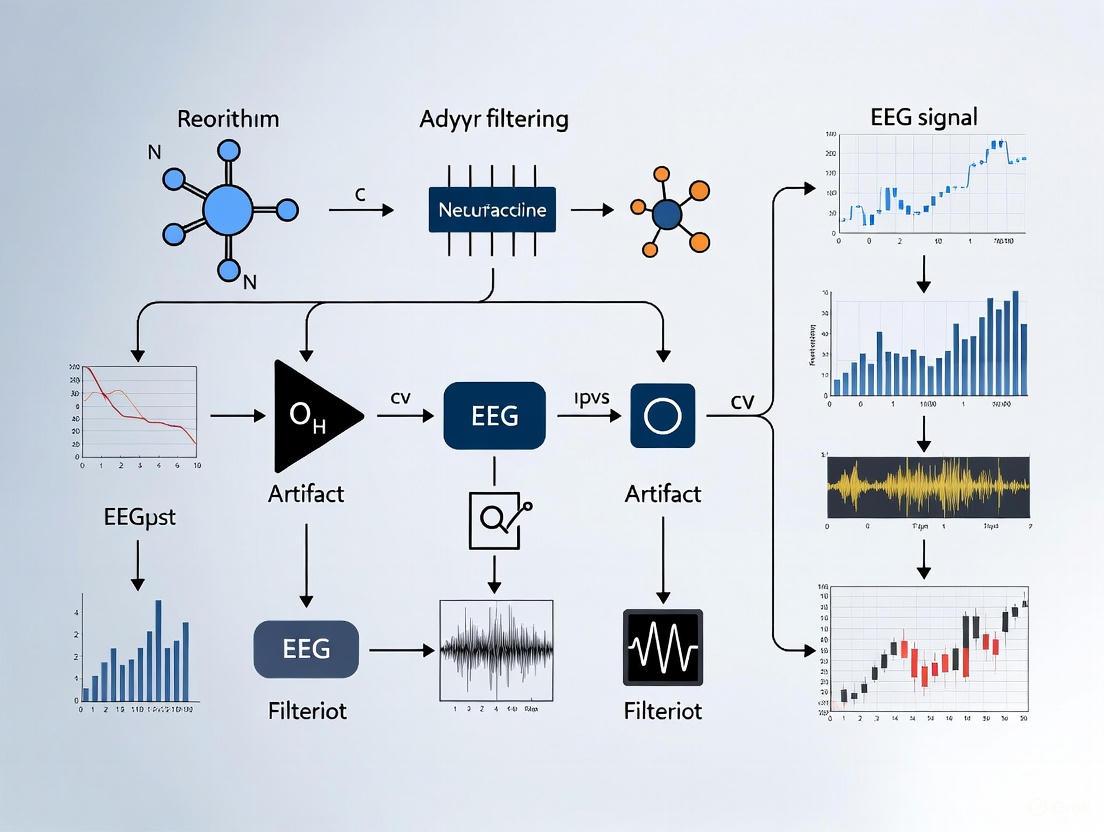
This article provides a comprehensive overview of adaptive filtering algorithms for electroencephalogram (EEG) artifact removal, tailored for researchers, scientists, and drug development professionals.
Adaptive Filtering Algorithms for EEG Artifact Removal: A Comprehensive Guide for Biomedical Research
Abstract
This article provides a comprehensive overview of adaptive filtering algorithms for electroencephalogram (EEG) artifact removal, tailored for researchers, scientists, and drug development professionals. It covers the foundational principles of EEG artifacts and adaptive filter theory, explores a range of methodological implementations from classic algorithms to modern deep learning hybrids, addresses critical troubleshooting and optimization challenges for real-world applications, and offers a comparative analysis of algorithm performance. The content synthesizes current literature to guide the selection, implementation, and validation of these techniques in both clinical and research settings, with a focus on improving data integrity for neurological and pharmacological studies.
Understanding EEG Artifacts and Adaptive Filtering Fundamentals
FAQ: A Researcher's Guide to EEG Artifacts
Q1: What is an EEG artifact and why is its removal critical for research? An EEG artifact is any recorded signal that does not originate from neural activity within the brain [1]. These unwanted signals contaminate the EEG recording, obscuring the underlying brain signals and reducing the signal-to-noise ratio (SNR) [1] [2]. Their presence can introduce uncontrolled variability into data, confounding experimental observations, reducing statistical power, and potentially leading to incorrect data interpretation or clinical misdiagnosis [1] [3]. Effective artifact removal is therefore a crucial preprocessing step for ensuring the validity of subsequent EEG analysis [4].
Q2: What are the most common physiological artifacts encountered in EEG experiments? The most frequent physiological artifacts arise from the researcher's own body [5] [1]:
- Ocular Artifacts (EOG): Caused by eye blinks and movements. Blinks create high-amplitude, low-frequency deflections maximal in frontal electrodes (Fp1, Fp2), while lateral movements show opposing polarities in electrodes like F7 and F8 [5] [2].
- Muscle Artifacts (EMG): Generated by the contraction of head, jaw, or neck muscles (e.g., clenching, chewing, frowning). EMG appears as high-frequency, broadband "buzz" of fast activity that can overlap with and mask beta and gamma EEG rhythms [5] [1] [6].
- Cardiac Artifacts (ECG): Caused by the electrical activity of the heart. It appears as rhythmic waveforms time-locked to the heartbeat, often more prominent on the left side of the scalp, and can be mistaken for cerebral rhythms [5] [2].
- Pulse Artifacts: A mechanical artifact occurring when an electrode is placed over a pulsating blood vessel, causing a slow, rhythmic movement of the electrode [5] [2].
- Sweat Artifacts: Result from changes in skin conductivity due to perspiration, producing very slow, large-amplitude drifts in the signal, typically below 0.5 Hz [5] [1].
Q3: What technical or non-physiological artifacts can compromise EEG data quality? These artifacts originate from the equipment or environment [1] [2]:
- Power Line Interference: A persistent 50 Hz or 60 Hz oscillation (depending on the regional power grid) caused by electromagnetic interference from nearby electrical wiring and devices [1] [2].
- Electrode "Pop": A sudden, high-amplitude transient with a very steep upslope, caused by a temporary disruption in the electrode-skin contact, often due to a loose electrode or drying gel [5] [1].
- Cable Movement: Movement of electrode cables can cause electromagnetic interference and impedance changes, leading to transient signal alterations or drifts [1] [2].
- Loose Electrode Contact: Results in an unstable signal characterized by slow drifts and sudden shifts in the baseline [2].
Q4: How do artifacts impact the development of adaptive filtering algorithms? Artifacts present a significant challenge for adaptive filtering algorithms due to their heterogeneous and overlapping properties. Different artifacts have distinct temporal, spectral, and spatial characteristics [4]. For instance, ocular (EOG) artifacts are primarily concentrated in the low-frequency spectrum, while muscle (EMG) artifacts are broadly distributed across mid-to-high frequencies [4]. A major research focus is developing unified models that can effectively remove multiple types of interleaved artifacts without requiring prior knowledge of the specific artifact type contaminating the signal [7] [4]. Furthermore, the irregular and non-stationary nature of artifacts like EMG requires algorithms that are robust and can adapt in real-time [8].
Table 1: Physiological Artifacts and Their Impact on the EEG Signal
| Artifact Type | Origin | Time-Domain Signature | Frequency-Domain Signature | Spatial Distribution on Scalp |
|---|---|---|---|---|
| Ocular (EOG) | Eye blinks and movements [1] | High-amplitude, slow deflections [2] | Delta/Theta bands (0.5-8 Hz) [2] | Maximal at frontal sites (Fp1, Fp2) [5] |
| Muscle (EMG) | Head, face, neck muscle contraction [1] | High-frequency, low-amplitude "buzz" [6] | Broadband, dominant in Beta/Gamma (>20 Hz) [1] | Frontal (frowning) & Temporal (jaw) regions [5] |
| Cardiac (ECG) | Electrical activity of the heart [1] | Rhythmic, spike-like waveforms [2] | Overlaps multiple EEG bands [1] | Often left-sided or central [5] |
| Pulse | Arterial pulsation under electrode [5] | Slow, rhythmic waves [5] | Delta frequency range [5] | Focal, over a blood vessel [2] |
| Sweat | Changes in skin impedance [1] | Very slow, large-scale drifts [2] | Very low frequencies (<0.5 Hz) [5] | Often frontal, but can be widespread [6] |
Table 2: Non-Physiological (Technical) Artifacts
| Artifact Type | Origin | Time-Domain Signature | Frequency-Domain Signature | Common Causes |
|---|---|---|---|---|
| Power Line | AC power interference [1] | Persistent high-frequency oscillation [2] | Sharp peak at 50/60 Hz [1] | Unshielded cables, nearby electrical devices [1] |
| Electrode Pop | Sudden change in electrode-skin contact [1] | Sudden, steep upslope with no field [5] | Broadband, non-stationary [1] | Loose electrode, drying gel [5] |
| Cable Movement | Physical movement of electrode cables [1] | Sudden deflections or rhythmic drift [2] | Can introduce artificial spectral peaks [1] | Cable swinging, participant movement [2] |
| Loose Electrode | Poor or unstable electrode contact [2] | Slow baseline drifts and instability [2] | Increased power across all frequencies [1] | Loose-fitting cap, hair pushing electrode away [2] |
Experimental Protocol: Benchmarking a Novel Deep Learning Artifact Removal Model
Objective: To train and evaluate the performance of a novel deep learning model (e.g., CLEnet) in removing multiple types of artifacts from EEG signals, comparing its efficacy against established benchmark models [7].
Detailed Methodology:
Dataset Preparation:
- Utilize a benchmark dataset such as EEGdenoiseNet [7] [4] or a custom-collected multi-channel dataset containing both clean EEG and known artifacts [7].
- For a comprehensive evaluation, use at least three distinct datasets:
- Dataset I: Semi-synthetic data created by mixing clean single-channel EEG with recorded EMG and EOG artifacts [7].
- Dataset II: Semi-synthetic data created by mixing clean EEG with Electrocardiogram (ECG) artifacts [7].
- Dataset III: Real 32-channel EEG data collected from participants performing tasks that induce unknown or mixed artifacts (e.g., a 2-back task) [7].
Model Architecture - CLEnet:
- Stage 1: Morphological & Temporal Feature Enhancement: Use a dual-branch CNN with convolutional kernels of different scales to extract morphological features at different resolutions. Embed a 1D Efficient Multi-Scale Attention (EMA-1D) module to enhance temporal features during this stage [7].
- Stage 2: Temporal Feature Extraction: Pass the enhanced features through fully connected layers for dimensionality reduction, then into a Long Short-Term Memory (LSTM) network to capture and preserve the temporal dependencies of genuine EEG [7].
- Stage 3: EEG Reconstruction: Flatten the fused features and use fully connected layers to reconstruct the artifact-free EEG signal [7].
- Training: Train the model in a supervised manner using Mean Squared Error (MSE) between the model's output and the known clean EEG as the loss function [7].
Performance Metrics:
- Signal-to-Noise Ratio (SNR): Measures the power ratio between the clean signal and the removed noise. Higher is better [7].
- Correlation Coefficient (CC): Measures the linear correlation between the cleaned signal and the true clean EEG. Closer to 1 is better [7].
- Relative Root Mean Square Error (RRMSE): Calculated in both the temporal (RRMSEt) and frequency (RRMSEf) domains. Lower values indicate better performance [7].
Benchmarking and Ablation:
The Scientist's Toolkit: Key Reagents & Computational Solutions
Table 3: Essential Tools for EEG Artifact Removal Research
| Item / Solution Name | Type | Primary Function in Research |
|---|---|---|
| EEGdenoiseNet [7] [4] | Benchmark Dataset | Provides a semi-synthetic benchmark dataset with clean EEG and recorded artifacts (EMG, EOG) for standardized training and evaluation of artifact removal algorithms. |
| Custom Multi-channel Dataset [7] | Proprietary Data | Enables testing of algorithms on real, complex artifacts (including "unknown" types) in multi-channel scenarios, moving beyond semi-synthetic data. |
| Independent Component Analysis (ICA) [7] [3] | Classical Algorithm | A blind source separation technique used to decompose multi-channel EEG into independent components, allowing for manual or automated identification and removal of artifact-related components. |
| Artifact Subspace Reconstruction (ASR) [9] | Classical Algorithm | An automated method for removing large-amplitude, transient artifacts from multi-channel EEG data by reconstructing corrupted segments based on clean baseline data. |
| CNN-LSTM Hybrid Network [7] [3] | Deep Learning Architecture | Combines Convolutional Neural Networks (CNN) to extract spatial/morphological features and Long Short-Term Memory (LSTM) networks to model temporal dependencies, effective for end-to-end artifact removal. |
| NARX Network [8] | Neural Network Model | A nonlinear autoregressive network with exogenous inputs, suitable for time-series prediction and modeling, can be used with adaptive filtering for artifact removal. |
| Adaptive Filter with FLM Optimization [8] | Optimization Algorithm | A hybrid Firefly + Levenberg-Marquardt algorithm used to find optimal weights for a neural network-based adaptive filter, enhancing its noise cancellation capabilities. |
Core Principles of Adaptive Filters
An adaptive filter is a digital system with a linear filter whose transfer function is controlled by variable parameters. These parameters are continuously adjusted by an optimization algorithm to minimize an error signal, which is the difference between the filter's output and a desired signal [10]. This self-adjusting capability is the core of its operation, allowing it to perform optimally even when the signal characteristics or noise properties are unknown or changing over time [11] [10].
The most common optimization algorithm used is the Least Mean Squares (LMS) algorithm, which aims to minimize the mean square of this error signal [10]. The filter coefficients are updated iteratively, with the magnitude and direction of the change being proportional to the error and the input signal [12].
Troubleshooting Guides and FAQs
Frequently Asked Questions
- Q1: Why is my adaptive filter unstable or failing to converge?
- A: The most likely cause is an improper step size (μ). If μ is too large, the algorithm becomes unstable and cannot converge. If it is too small, convergence is extremely slow [11] [10]. Ensure your step size is within a stable range, often related to the signal power. The LMS algorithm, for instance, requires
0 < μ < 1 / (σ^2), where σ² is the input signal power [10].
- A: The most likely cause is an improper step size (μ). If μ is too large, the algorithm becomes unstable and cannot converge. If it is too small, convergence is extremely slow [11] [10]. Ensure your step size is within a stable range, often related to the signal power. The LMS algorithm, for instance, requires
- Q2: My filter converges, but the output signal is distorted. What is happening?
- A: Signal distortion often occurs if the filter is not properly tuned and removes parts of the desired signal along with the noise [11]. In EEG contexts, this can mean erasing neural information while removing artifacts. Verify that your reference signal is strongly correlated with the noise and weakly correlated with the signal of interest [10].
- Q3: Can I implement an LMS adaptive filter on any digital signal processor (DSP)?
- A: No. While powerful, adaptive filters are computationally complex. Some processors, like the ADAU1701, lack the power for adaptive FIR filters, whereas others like the ADAU1761, ADAU1452, or SHARC processors are better suited [13]. Always check your hardware's computational capabilities before implementation.
Common Experimental Issues and Solutions
| Problem | Possible Cause | Suggested Solution |
|---|---|---|
| Slow Convergence | Step size (μ) too small; Non-stationary signal [11] [10] | Increase μ within stable limits; Use a more advanced algorithm like RLS [11]. |
| Algorithm Instability | Step size (μ) too large; High-power input signal [10] | Reduce the step size parameter; Normalize the input signal (use NLMS) [14]. |
| Poor Noise Removal | Reference signal contains desired signal components [10] | Improve the isolation of the reference noise source. |
| High Computational Load | Filter order too high; Complex algorithm [11] | Reduce the number of filter taps; Consider a simpler algorithm or more powerful hardware [13]. |
Quantitative Data Comparison
The following table summarizes key performance metrics from recent research on adaptive filtering techniques used in EEG artifact removal.
Table 1: Performance Metrics of Adaptive Filtering Methods in EEG Research
| Method / Study | Key Performance Metrics | Application Context |
|---|---|---|
| FF-EWT + GMETV Filter [15] | Lower RRMSE, Higher CC, Improved SAR and MAE on real EEG. | Single-channel EOG (eyeblink) artifact removal. |
| FLM (Firefly + LM) Optimization [8] | Achieved high SNR of 42.042 dB. | Removal of various artifacts (EOG, EMG, ECG) from multi-channel EEG. |
| EWT + Adaptive Filtering [14] | Average SNR improvement of 9.21 dB, CC of 0.837. | Ocular artifact removal from EEG signals. |
| LMS Algorithm [10] | Convergence dependent on 0 < μ < 1 / σ². |
General-purpose adaptive noise cancellation. |
Experimental Protocols
1. Protocol for EEG Artifact Removal using Hybrid EWT and Adaptive Filtering
This methodology is based on a 2025 study that demonstrated high effectiveness in removing ocular artifacts [15] [14].
- Aim: To remove EOG (electrooculogram) artifacts from a single-channel EEG signal while preserving the underlying neural information.
- Procedure:
- Decomposition: Use Fixed Frequency Empirical Wavelet Transform (FF-EWT) to decompose the contaminated single-channel EEG signal into six Intrinsic Mode Functions (IMFs) or sub-band components [15].
- Identification: Identify the IMFs contaminated with EOG artifacts using statistical metrics like kurtosis (KS), dispersion entropy (DisEn), and power spectral density (PSD) [15].
- Filtering: Apply a finely tuned Generalized Moreau Envelope Total Variation (GMETV) filter or a Normalized LMS (NLMS) adaptive filter to the identified artifact components to suppress the EOG signal [15] [14].
- Reconstruction: Reconstruct the clean EEG signal from the processed IMFs and the remaining unaltered IMFs.
- Validation: Performance is validated on synthetic and real EEG datasets using metrics like Signal-to-Artifact Ratio (SAR), Correlation Coefficient (CC), and Mean Absolute Error (MAE) [15].
2. Protocol for Artifact Removal using an FLM-Optimized Neural Network
This protocol uses a hybrid optimization approach to train a neural network for enhanced adaptive filtering [8].
- Aim: To remove multiple types of artifacts (EOG, EMG, ECG) from multi-channel EEG data using an optimized neural adaptive filter.
- Procedure:
- Network Selection: Employ a NARX (Nonlinear AutoRegressive with eXogenous inputs) neural network model, which is suitable for modeling nonlinear systems and time series analysis [8].
- Hybrid Optimization: Use a hybrid FLM (Firefly + Levenberg-Marquardt) algorithm to find the optimal weights for the neural network. This combination aims to overcome the individual shortcomings of each algorithm [8].
- Training and Filtering: The neural network, with its optimized weights, functions as an adaptive filter. The contaminated EEG signal is fed into this system, which is trained to output the clean EEG signal.
- Performance Analysis: Compare the results against traditional methods like ICA and wavelet-based techniques using Signal-to-Noise Ratio (SNR), Mean Square Error (MSE), and computation time [8].
Workflow and System Diagrams
EEG Artifact Removal Workflow
Core Adaptive Filter Structure
The Scientist's Toolkit
Table 2: Essential Research Reagents and Materials
| Item | Function in Research |
|---|---|
| Single-Channel EEG Data | The primary contaminated signal serving as the input for single-channel artifact removal algorithms [15]. |
| Reference EOG/EMG/ECG Signal | A correlated noise reference signal crucial for adaptive noise cancellation setups [8] [10]. |
| Empirical Wavelet Transform (EWT) | A signal decomposition technique used to adaptively break down the EEG signal into components for artifact identification [15] [14]. |
| NARX Neural Network | A recurrent neural network structure used for modeling nonlinear systems and time-series prediction in advanced filtering [8]. |
| LMS/RLS Algorithm | Core optimization algorithms for updating filter coefficients; LMS is simple, RLS converges faster but is more complex [11]. |
| High-Performance DSP (e.g., SHARC) | Digital Signal Processor hardware with sufficient power to run complex adaptive filter algorithms in real-time [13]. |
| Validation Metrics (SNR, MSE, CC) | Quantitative measures (Signal-to-Noise Ratio, Mean Square Error, Correlation Coefficient) to objectively evaluate filter performance [15] [8]. |
In electroencephalogram (EEG) artifact removal research, selecting and implementing the appropriate adaptive filtering algorithm is fundamental to achieving a clean neural signal. These algorithms are crucial for isolating brain activity from contaminants such as ocular movements, muscle activity, and cardiac rhythms. This guide provides a structured comparison, detailed experimental protocols, and troubleshooting advice to help you navigate the challenges of implementing these algorithms effectively in your research.
Algorithm Comparison and Selection Guide
The choice of algorithm involves a direct trade-off between convergence speed, computational complexity, and stability. The following table summarizes the core characteristics of the primary algorithm families to guide your selection.
Table 1: Key Algorithm Families for Adaptive Filtering in EEG Research
| Algorithm Family | Key Principle | Typical Convergence Speed | Computational Complexity | Key Artifacts Addressed | Stability & Notes |
|---|---|---|---|---|---|
| LMS (Least-Mean-Squares) | Stochastic gradient descent; uses instantaneous error for step-wise updates [16] [17]. | Slow | Low (O(n)) | All types, but with less precision [16] [8]. | Robust and stable, but sensitive to step-size parameter [16]. |
| NLMS (Normalized LMS) | Normalizes the step-size based on input signal power for more stable updates. | Moderate | Low (O(n)) | All types, better performance than LMS. | Improved stability over LMS; less sensitive to input power [17]. |
| RLS (Recursive Least Squares) | Recursively minimizes a least-squares cost function, leveraging all past data [16] [18]. | Fast | High (O(n²)) | Effective for various physiological artifacts [16] [8]. | Fast convergence but can face instability with ill-conditioned data [16] [18]. |
| RLS with Rank-Two Updates (RLSR2) | Enhances RLS by simultaneously adding new data and removing old data within a moving window [18]. | Very Fast | High (O(n²)) | Suitable for non-stationary signals with rapid changes. | Improved performance in ill-conditioned scenarios; incorporates both exponential and instantaneous forgetting [18]. |
| Deep Learning (e.g., CLEnet) | Uses neural networks (CNN, LSTM) in an end-to-end model to learn and separate artifacts from clean EEG [7]. | (Requires training) | Very High (GPU recommended) | Multiple and unknown artifacts simultaneously [7]. | Requires large datasets for training; high performance on multi-channel data [7]. |
Experimental Protocols for EEG Artifact Removal
Protocol 1: Baseline Implementation of LMS and RLS
This protocol provides a foundational methodology for comparing classic adaptive filters, using an EOG artifact as a reference.
Objective: To remove ocular artifacts (EOG) from a contaminated EEG signal using a reference EOG channel and compare the performance of LMS and RLS algorithms.
Materials and Setup:
- EEG Data: A recorded single-channel or multi-channel EEG signal contaminated with EOG artifacts.
- Reference Signal: A concurrently recorded EOG channel capturing the blink activity.
- Software: Computational environment like MATLAB or Python with NumPy/SciPy.
Procedure:
- Data Preprocessing: Load the contaminated EEG signal (primary input) and the reference EOG signal. Apply a basic bandpass filter (e.g., 0.5-40 Hz) to both signals to remove extreme noise.
- Algorithm Initialization:
- LMS: Initialize the weight vector to zeros. Set the step-size parameter (μ). A small μ (e.g., 0.01) ensures stability but slow convergence [16].
- RLS: Initialize the weight vector and the inverse correlation matrix (P). Set the forgetting factor (λ), typically close to 1 (e.g., 0.99), to assign more weight to recent samples [16] [18].
- Iterative Filtering: For each time step k:
- Compute the filter output: ( y(k) = w^T(k) * x(k) ), where ( x(k) ) is the reference EOG input vector.
- Calculate the error signal: ( e(k) = d(k) - y(k) ), where ( d(k) ) is the contaminated EEG signal.
- Update the filter weights according to the LMS or RLS algorithm.
- Output: The error signal ( e(k) ) is the cleaned EEG output.
- Performance Evaluation: Calculate the Signal-to-Noise Ratio (SNR), Mean Square Error (MSE), and Correlation Coefficient (CC) between the cleaned signal and a ground-truth clean EEG, if available [16] [8].
Protocol 2: Advanced Deep Learning-Based Removal
For complex scenarios involving multiple or unknown artifacts, deep learning models offer a powerful, data-driven alternative.
Objective: To remove multiple, unknown artifacts from multi-channel EEG data using a hybrid deep learning model.
Materials and Setup:
- EEG Data: Multi-channel EEG data (e.g., from a 32-channel system) with unknown or mixed artifacts [7].
- Computing Environment: Python with deep learning frameworks like TensorFlow or PyTorch, and a GPU for accelerated training.
Procedure:
- Data Preparation: Use a benchmark dataset like EEGdenoiseNet [7] or a custom dataset of real EEG. Split the data into training, validation, and test sets.
- Model Construction: Build a hybrid neural network, such as CLEnet, which integrates:
- Model Training: Train the model in a supervised manner. Use mean squared error (MSE) between the model's output and the clean target EEG as the loss function. Use an optimizer like Adam.
- Artifact Removal: Feed the artifact-contaminated EEG into the trained model. The model will output the cleaned EEG signal in an end-to-end fashion.
- Validation: Evaluate performance using RRMSE (Relative Root Mean Square Error) in both time and frequency domains (RRMSEt, RRMSEf), SNR, and CC on the held-out test set [7].
The following diagram illustrates the core workflow of a deep learning-based approach like CLEnet, which processes raw EEG to output a cleaned signal.
Deep Learning EEG Cleaning Workflow
The Scientist's Toolkit
Table 2: Essential Research Reagents and Computational Tools
| Tool / Resource | Function / Description | Application in Research |
|---|---|---|
| EEGdenoiseNet | A benchmark dataset containing semi-synthetic EEG signals contaminated with EMG and EOG artifacts [7]. | Provides standardized data for training and evaluating new artifact removal algorithms. |
| MNE-Python | An open-source Python package for exploring, visualizing, and analyzing human neurophysiological data [19]. | Used for data ingestion, preprocessing, filtering, and implementation of various artifact removal methods. |
| Independent Component Analysis (ICA) | A blind source separation technique that separates statistically independent components from multi-channel EEG [19] [1]. | Used to identify and remove components corresponding to ocular, muscular, and cardiac artifacts. |
| Hybrid FLM Optimization | A hybrid Firefly and Levenberg-Marquardt algorithm used to find optimal weights for a neural network-based adaptive filter [8]. | Applied to neural network models like NARX to enhance the filter's performance in artifact removal. |
Frequently Asked Questions (FAQs)
Q1: In theory, LMS and stochastic gradient descent seem identical. What is the practical distinction in adaptive filtering?
While both operate on the principle of gradient descent, the key difference lies in how the gradient is estimated. The true gradient requires knowledge of the expected value ( E(\mathbf{x}[n]e^[n]) ), which is typically unknown. The LMS algorithm approximates this gradient instantaneously using ( \mathbf{x}[n]e^[n] ) [17]. Therefore, LMS is a specific implementation of a stochastic gradient descent method that uses this particular, efficient approximation suited for real-time filtering.
Q2: My RLS algorithm is becoming unstable, especially with a short window size. What could be the cause and how can I mitigate it?
This is a classic problem associated with RLS. A short window size can lead to an ill-conditioned information matrix, making its inversion numerically unstable and causing error accumulation [18]. Mitigation strategies include:
- Initialization: Initialize the inverse of the information matrix to a positive definite matrix (e.g., ( P(0) = \delta I ), where ( \delta ) is a large positive number) [18].
- Advanced Algorithms: Consider using RLS with Rank-Two Updates (RLSR2), which is designed to handle the movement of data in and out of a window more robustly and has shown better convergence properties in ill-conditioned cases [18].
- Forgetting Factor Tuning: Carefully tune the forgetting factor to balance the influence of old and new data.
Q3: For removing unknown artifacts from multi-channel EEG data, are traditional algorithms like RLS still sufficient?
For complex, unknown artifacts in multi-channel data, traditional algorithms like RLS may struggle due to their linear assumptions and lack of context from other channels. Recent research indicates a shift towards deep learning models for such tasks. Architectures like CLEnet, which combine CNNs for spatial/morphological feature extraction and LSTMs for temporal modeling, are specifically designed to handle multi-channel inputs and can learn to separate a wider variety of artifacts, including unknown ones, directly from data [7]. These models have demonstrated superior performance in terms of SNR and correlation coefficient on tasks involving unknown artifacts [7].
Q4: What is the role of the "forgetting factor" in the RLS algorithm, and how should I choose its value?
The forgetting factor (( \lambda )), which is between 0 and 1, exponentially weights past data. A value of ( \lambda = 1 ) considers all past data equally, while a value less than 1 discounts older observations, allowing the filter to track changes in a non-stationary signal like EEG [18] [20]. The choice is a trade-off:
- ( \lambda ) close to 1: Provides accurate estimation in stable conditions but reacts slowly to changes.
- ( \lambda ) less than 1: Allows faster tracking of signal changes but can lead to noisier estimates. For EEG, a value between 0.99 and 0.999 is often a good starting point. There are also advanced methods, like OFFRLS, that optimize the forgetting factor in real-time using heuristic optimization to improve performance [20].
The Role of Reference Signals in Adaptive Noise Cancellation
Frequently Asked Questions
What is the fundamental principle behind adaptive noise cancellation? Adaptive noise cancellation is a signal processing technique that uses a primary input (containing the desired signal plus correlated noise) and a reference input (containing only noise correlated with the primary input's noise). An adaptive filter processes the reference signal to create an optimal estimate of the noise corrupting the primary signal, then subtracts this estimate to cancel the interference while preserving the desired signal [21] [22].
Why is a reference signal critical for this process? The reference signal provides a "clean" version of the interfering noise that is uncorrelated with the target signal but correlated with the noise in the primary input. This enables the adaptive filter to model the specific noise characteristics and generate an effective cancelling signal. Without a proper reference, the system cannot distinguish between desired signal and noise [21] [23].
What are the key requirements for an effective reference signal? The reference signal must meet two essential requirements: (1) It should be highly correlated with the noise corrupting the primary signal, and (2) It should be uncorrelated with the desired target signal. If these conditions aren't met, the noise cancellation will be ineffective and may even degrade the target signal [21].
What types of reference signals are used in EEG artifact removal? In EEG research, common reference signals include:
- Separate physiological recordings: EOG (electrooculogram) for eye movement artifacts, EMG (electromyogram) for muscle artifacts, or ECG (electrocardiogram) for heart-related interference [7].
- Accelerometer data: For motion artifacts during ambulatory EEG recordings [23].
- Synthetic or simulated signals: In semi-synthetic experimental setups where artifacts are artificially added to clean EEG data [7].
Why might my adaptive noise cancellation system be performing poorly? Common issues include:
- Insufficient correlation between the reference signal and the actual noise in the primary input
- Signal leakage where the desired signal contaminates the reference input
- Inappropriate filter length or step-size parameter selection
- Non-stationary noise characteristics that change faster than the adaptive algorithm can track [21] [22]
- Physical sensor issues such as blocked microphones or poor electrode contact in EEG systems [24]
Troubleshooting Guide
Problem: Inadequate Noise Reduction
Symptoms:
- Minimal reduction in target noise levels
- High residual error after convergence
- Poor signal-to-noise ratio improvement
Diagnostic Steps:
- Check reference signal quality: Verify the reference contains a correlated version of the target noise with minimal desired signal contamination [21].
- Measure correlation: Calculate the correlation coefficient between the primary and reference inputs - it should be significant for the noise components [21].
- Verify signal paths: Ensure the physical placement of reference sensors appropriately captures the interference source [23].
Solutions:
- Reposition reference sensors closer to the noise source
- Implement pre-filtering to enhance noise components in the reference
- Consider multi-channel reference inputs for complex noise environments [22]
Problem: Target Signal Distortion
Symptoms:
- Desired signal components appear attenuated or modified
- Introduction of artifacts not present in the original signal
- Unnatural characteristics in the output signal
Diagnostic Steps:
- Test for signal leakage: Check if the desired signal appears in the reference input [21].
- Analyze cross-correlation: Measure correlation between the reference input and desired signal - it should be minimal [21].
- Verify signal decorrelation: Confirm the target signal and interference are statistically independent [21].
Solutions:
- Improve isolation between desired signal sources and reference sensors
- Add adaptive delays to compensate for propagation differences
- Implement coherence-based filtering to preserve desired signal components [22]
Problem: Slow Convergence or Instability
Symptoms:
- Extended time to reach effective cancellation
- Oscillatory behavior in filter coefficients
- System divergence or excessive output variation
Diagnostic Steps:
- Analyze step size parameters: Check if the adaptation rate is appropriate for the signal characteristics [22].
- Evaluate signal power variations: Assess if non-stationary signals require normalized algorithms [22].
- Check secondary path modeling: Verify the accuracy of the estimated transfer function between actuator and error sensor [25].
Solutions:
- Switch from LMS to NLMS algorithm for non-stationary environments [22]
- Implement variable step-size techniques
- Improve secondary path modeling accuracy
- Consider RLS algorithm for faster convergence (if computational resources allow) [22]
Performance Comparison of Adaptive Filter Algorithms
Table 1: Algorithm selection guide for EEG artifact removal applications
| Algorithm | Computational Complexity | Convergence Speed | Stability | Best For EEG Applications |
|---|---|---|---|---|
| LMS | Low | Slow | Moderate | Stationary noise environments, computational resource constraints [22] |
| NLMS | Low to Moderate | Moderate | Good | Non-stationary artifacts, changing signal conditions [22] |
| RLS | High | Fast | Good | Rapidly changing artifacts, quality-critical applications [22] |
| FxLMS | Moderate | Slow to Moderate | Moderate | Systems with secondary path effects, active noise control [26] [25] |
Table 2: Typical performance metrics for EEG artifact removal
| Artifact Type | Best Method | Typical SNR Improvement | Correlation Coefficient | Key Challenges |
|---|---|---|---|---|
| Ocular (EOG) | RLS/Adaptive Filtering | 8-12 dB | 0.90-0.95 | Avoiding neural signal removal, especially frontal lobe activity [7] [27] |
| Muscle (EMG) | Hybrid Methods | 10-15 dB | 0.85-0.92 | Overlapping frequency spectra with neural signals [7] |
| Motion Artifacts | Accelerometer Reference | 5-10 dB | 0.80-0.90 | Complex transfer function between motion and electrical interference [23] |
| Cardiac (ECG) | Adaptive Cancellation | 12-18 dB | 0.92-0.98 | Periodic nature requires precise synchronization [21] [7] |
Experimental Protocols
Protocol 1: Motion Artifact Removal Using Accelerometer Reference
Objective: Remove motion artifacts from ambulatory EEG recordings using accelerometer data as a reference signal [23].
Materials Needed:
- Mobile EEG system with dry electrodes
- Tri-axial accelerometer
- Data synchronization unit
- Signal processing software (MATLAB, Python, or similar)
Methodology:
- Setup: Mount accelerometer on subject's torso or head. Place EEG electrodes according to international 10-20 system [23].
- Calibration: Record 2-minute baseline with no movement followed by 2-minute period with typical movements but no cognitive task [23].
- Data Collection: Simultaneously record EEG and accelerometer data during experimental tasks with varying movement levels [23].
- Synchronization: Precisely align EEG and accelerometer data streams using synchronization pulses.
- Implementation:
- Use accelerometer signal as reference input to adaptive filter
- Apply NLMS algorithm with normalized step size for non-stationary characteristics
- Set filter length based on delay between motion and artifact manifestation
- Process each EEG channel separately with shared accelerometer reference [23]
Validation:
- Compare power spectral density before and after processing
- Calculate correlation between residual signal and accelerometer reference (should approach zero)
- Verify preservation of known neural responses (e.g., event-related potentials)
Protocol 2: Hybrid Broadband/Narrowband ANC for Mixed Artifacts
Objective: Address EEG recordings contaminated by both broadband (EMG) and narrowband (line noise) artifacts using reference signal decomposition [26].
Materials Needed:
- Multi-channel EEG system
- Reference sensors for target artifacts
- Signal decomposition tools
Methodology:
- Reference Signal Acquisition: Obtain reference signals for both broadband and narrowband interference sources [26].
- Signal Decomposition: Separate reference signal into broadband and narrowband components using linear prediction [26].
- Parallel Processing:
- Process broadband component with standard adaptive filter
- Process narrowband component with specialized harmonic canceller
- Recombine outputs for comprehensive artifact removal [26]
- Coefficient Weighting: Apply balancing method to manage convergence speed differences between subsystems [26].
Validation Metrics:
- Calculate relative root mean square error in temporal (RRMSEt) and frequency (RRMSEf) domains [7]
- Measure signal-to-noise ratio improvement across frequency bands
- Verify absence of artifact residual in output signal
Reference Signal Selection Guide
Table 3: Reference signal options for common EEG artifacts
| Artifact Type | Optimal Reference Signal | Alternative Options | Implementation Considerations |
|---|---|---|---|
| Ocular Artifacts | EOG electrodes | Frontal EEG channels | Risk of capturing neural signals from frontal lobes [7] |
| Muscle Artifacts | EMG from jaw/neck muscles | Temporal EEG channels | Significant spectral overlap with neural gamma activity [7] |
| Motion Artifacts | Accelerometer data | Gyroscopic sensors | Complex, non-linear relationship to electrical artifacts [23] |
| Line Noise | Synthetic 50/60 Hz reference | Empty channel reference | Requires precise frequency tracking [28] |
| Cardiac Artifacts | ECG recording | Pulse oximeter | Periodic nature requires adaptive phase tracking [21] |
The Scientist's Toolkit
Table 4: Essential research reagents and solutions for adaptive filtering experiments
| Item | Function | Example Implementation |
|---|---|---|
| Semi-Synthetic EEG Datasets | Algorithm validation with ground truth | EEGdenoiseNet: Provides clean EEG with controlled artifact addition [7] |
| Adaptive Filter Algorithms | Core processing engine | LMS, NLMS, RLS implementations for different artifact characteristics [22] |
| Reference Sensors | Capture noise sources | EOG/EMG electrodes, accelerometers, separate reference channels [23] |
| Performance Metrics | Algorithm evaluation | SNR, correlation coefficient, RRMSEt, RRMSEf calculations [7] |
| Hybrid Processing Frameworks | Complex artifact handling | Combined CNN-LSTM networks (e.g., CLEnet) for unknown artifacts [7] |
Diagram: Adaptive Noise Canceller Configuration
Diagram: Hybrid EEG Processing Workflow
Implementing Adaptive Filters: From Classic Algorithms to Advanced Architectures
Frequently Asked Questions (FAQs)
Q1: What are the key advantages of using adaptive filters like LMS, NLMS, and RLS for EEG artifact removal over other methods?
Adaptive filters are highly effective for EEG artifact removal because they can track and remove non-stationary noise, which is common in physiological signals, without requiring prior knowledge of the signal or noise statistics. Specifically, LMS (Least Mean Squares) is simple and computationally efficient, making it suitable for real-time applications. NLMS (Normalized LMS) improves upon LMS by normalizing the step size, leading to greater stability with varying signal power, which is ideal for handling amplitude variations in artifacts like eye blinks [29] [30]. RLS (Recursive Least Squares) offers faster convergence and better performance at the cost of increased computational complexity, making it suitable for applications where convergence speed is critical, though it is less common in resource-constrained real-time systems [30] [31].
Q2: When should I choose NLMS over standard LMS for ocular artifact removal?
You should choose NLMS when dealing with ocular artifacts (EOG) because these artifacts can have high and variable amplitude, causing instability in the standard LMS filter. NLMS uses a normalized step-size, which makes the filter more stable and provides consistent performance even when the input signal power changes significantly, such as during large eye blinks [29] [30]. Research has demonstrated that an NLMS-based adaptive filtering technique can achieve an average improvement in signal-to-noise ratio (SNR) of over 9 dB when removing ocular artifacts [29].
Q3: Can these classic algorithms handle multi-channel EEG data for artifact removal?
Classic adaptive filtering algorithms like LMS, NLMS, and RLS are primarily designed for single-channel applications where a separate reference noise signal (e.g., from an EOG or ECG channel) is available [30] [31]. For multi-channel data without explicit reference channels, other techniques like Independent Component Analysis (ICA) are typically employed to separate neural activity from artifacts [29] [32] [31]. However, adaptive filters can be part of a hybrid approach, used to further clean components identified by source separation methods [29].
Q4: What is a common implementation challenge with the RLS algorithm?
A primary challenge with the RLS algorithm is its high computational complexity compared to LMS and NLMS. RLS involves updating a covariance matrix and calculating its inverse, which requires more computations per time step. This can be a limiting factor for real-time applications on devices with limited processing power or battery life [30] [31].
Troubleshooting Guides
Problem 1: Poor Convergence or Slow Adaptation (LMS/NLMS)
- Symptoms: The artifact is not effectively removed; the error signal remains large.
- Potential Causes & Solutions:
- Cause: Step-size parameter (μ) is too small.
- Solution: Gradually increase the step-size until performance improves, but ensure it remains within the stability bound (0 < μ < 2 for LMS).
- Cause: The reference signal is poorly correlated with the actual artifact in the EEG.
- Solution: Verify the quality and placement of the reference electrode (e.g., for EOG, ensure VEOG and HEOG channels are properly recorded) [30].
- Cause: The filter length is too short to model the artifact's impact.
- Solution: Increase the filter order (number of taps) and re-evaluate performance.
Problem 2: Filter Instability (LMS/NLMS)
- Symptoms: The output signal diverges or shows large, unrealistic oscillations.
- Potential Causes & Solutions:
- Cause: Step-size parameter (μ) is too large.
- Solution: Reduce the step-size value. For NLMS, the step-size is automatically normalized, but the initial μ should still be set carefully, typically between 0 and 1 [30].
- Cause: Abrupt changes in signal power or electrode impedance.
- Solution: Use NLMS instead of standard LMS, as it is inherently more robust to input power variations [30].
Problem 3: High Computational Load Leading to Real-Time Processing Delays
- Symptoms: The system cannot process data samples as fast as they are acquired.
- Potential Causes & Solutions:
- Cause: Using the RLS algorithm on a low-power processor.
- Solution: Switch to the simpler LMS or NLMS algorithm. If performance is insufficient, consider optimizing the RLS code or using a processor with higher computational power [30] [31].
- Cause: The filter order is set excessively high.
- Solution: Perform a design trade-off analysis to find the minimum filter order that provides acceptable artifact removal.
Performance Comparison Table
The following table summarizes the key characteristics and application scenarios for LMS, NLMS, and RLS algorithms in EEG artifact removal.
| Algorithm | Computational Complexity | Convergence Speed | Stability | Ideal Application Scenario in EEG |
|---|---|---|---|---|
| LMS | Low | Slow | Conditionally stable [30] | Real-time systems with limited processing power; well-defined, stationary noise. |
| NLMS | Low to Moderate | Moderate (faster than LMS) | More stable than LMS [29] [30] | Removing ocular artifacts (EOG) where signal amplitude varies; general-purpose artifact removal. |
| RLS | High | Fast | Stable [30] | Scenarios requiring rapid convergence where computational resources are not a primary constraint. |
Experimental Protocol: Ocular Artifact Removal using NLMS
This protocol outlines a standard methodology for removing ocular artifacts from a single EEG channel using the NLMS adaptive filter, based on established research practices [29] [30].
1. Objective To remove ocular artifacts (eye blinks and movements) from a contaminated frontal EEG channel (e.g., Fp1) using a recorded EOG reference and the NLMS adaptive filtering technique.
2. Materials and Data Acquisition
- EEG System: A multi-channel EEG acquisition system (e.g., according to the 10-20 international standard).
- Reference Signals: Two additional electrodes to record the Vertical EOG (VEOG) and Horizontal EOG (HEOG).
- Data: The raw EEG signal
s(n)from the frontal channel is modeled ass(n) = x(n) + d(n), wherex(n)is the true EEG andd(n)is the ocular artifact. The recorded VEOG and HEOG signals form the reference inputr(n)for the adaptive filter [30].
3. Algorithm Setup and Workflow The following diagram illustrates the NLMS adaptive noise cancellation setup.
- Step 1: Filter Initialization. Initialize the NLMS adaptive filter weights
w(n)to zero. Set the filter length (L) and the step-size parameter (μ). A typical μ for NLMS is less than 1 [30]. - Step 2: Filtering and Error Calculation. For each new sample
n:- The reference input vector
r(n) = [r_veog(n), r_heog(n)]^Tis processed by the adaptive filter to produce an artifact estimatey(n). - The error signal
e(n) = s(n) - y(n)is computed, which represents the clean EEG output.
- The reference input vector
- Step 3: Weight Update. The filter weights are updated using the NLMS rule:
w(n+1) = w(n) + (μ / (||r(n)||² + ψ)) * e(n) * r(n)whereψis a small constant to prevent division by zero [30]. - Step 4: Iteration. Repeat Steps 2 and 3 for the entire duration of the signal.
4. Performance Validation
- Quantitative Metrics: Calculate performance metrics to assess the quality of the cleaned signal [29] [33].
- Signal-to-Noise Ratio (SNR): Measures the power ratio between the signal and residual artifact. An increase in SNR indicates better performance.
- Correlation Coefficient (CC): Measures the linear similarity between the cleaned signal and a ground-truth clean EEG (if available). A value closer to 1 is better.
- Root Mean Square Error (RMSE): Measures the difference between the cleaned signal and the ground truth. A lower value is better.
Research Reagent Solutions
The table below lists key computational tools and data resources essential for experimenting with adaptive filtering in EEG research.
| Resource | Type | Function in Research |
|---|---|---|
| EEGdenoiseNet [29] [34] | Benchmark Dataset | Provides clean EEG and artifact signals (EOG, EMG) to create semi-synthetic data for standardized algorithm testing and validation. |
| MATLAB with Signal Processing Toolbox | Software Environment | Offers built-in functions for implementing and simulating LMS, NLMS, and RLS algorithms, along with visualization tools for analyzing results. |
| BCI Competition IV Dataset 2b [33] | Real-world EEG Data | Supplies real EEG data contaminated with artifacts, allowing researchers to test algorithm performance under realistic conditions. |
| Python (SciPy, NumPy, MNE) | Software Environment | Provides open-source libraries for numerical computation, signal processing, and EEG-specific analysis, enabling flexible implementation of adaptive filters. |
Accelerometer Troubleshooting and FAQs
FAQ: Why is my accelerometer reading +1g at rest instead of 0g?
Accelerometers measure proper acceleration, which is the acceleration it experiences relative to freefall. When at rest on the Earth's surface, the device is accelerating upwards relative to a local inertial frame (the frame of a freely falling object). To counteract gravity and keep the sensor stationary, it experiences an upward acceleration of approximately +1g [35].
FAQ: What does it mean if the accelerometer's bias voltage is 0 VDC?
A measured Bias Output Voltage (BOV) of 0 volts typically indicates a system short or a power failure [36].
- Primary Checks:
FAQ: What does an erratic or shifting bias voltage indicate?
An unstable bias voltage suggests a very low-frequency signal is being interpreted as a change in the DC level. This is often visible in the time waveform as erratic jumping or spiking [36].
- Common Causes & Solutions:
- Poor Connections: Check for corroded, dirty, or loose connections. Repair or replace as necessary, and apply non-conducting silicone grease to reduce future contamination [36].
- Ground Loops: These occur when the cable shield is grounded at two points with differing electrical potential. Solution: Ensure the cable shield is grounded at one end only [36].
- Thermal Transients: Uneven thermal expansion of the sensor housing can be sensed as a low-frequency signal [36].
- Signal Overload: High-amplitude vibration can overload the sensor [36].
Troubleshooting Guide: Analyzing Bias Output Voltage (BOV)
The BOV is a key diagnostic tool for most accelerometer systems. The table below summarizes common issues and their resolutions [36].
| BOV Measurement | Indicated Problem | Recommended Troubleshooting Actions |
|---|---|---|
| Equals supply voltage (e.g., 18-30 VDC) | Open circuit (sensor disconnected or reverse powered) [36] | 1. Check cable connections at junction boxes and the sensor itself [36].2. Inspect the entire cable length for damage [36].3. Test cable continuity [36]. |
| 0 VDC | System short or power failure [36] | 1. Confirm power is on and connected [36].2. Check for shorts in junction box terminations and cable shields [36].3. Test for infinite resistance (>50 MΩ) between signal leads and shield [36]. |
| Low or High (out of specification) | Damaged sensor [36] | Common damage sources include excessive temperature, shock impacts, incorrect power, or electrostatic discharge. Sensor failure from long-term temperature exposure is common [36]. |
EOG Artifact Removal Troubleshooting and FAQs
FAQ: Why is my EOG signal contaminated with high-frequency noise?
High-frequency noise in EOG signals is often environmental interference.
- Electrode Placement: Ensure you are using a true bipolar configuration for each channel (differential measurement between the red and green wires on the same channel) rather than a common reference. Place the electrodes as far apart as the measurement allows to increase signal amplitude [37].
- Grounding (BIAS): Always use the BIAS (ground) electrode, typically placed on the center of the forehead or earlobe. This centers the differential amplifiers and can help cancel mains noise [37].
- Filtering: Apply a bandpass filter (e.g., 0.1 Hz to 30 Hz) and enable a notch filter at your local mains frequency (50/60 Hz) to remove line interference [37].
- Cabling & Enclosure: Bundling cables in a sleeve or using a non-grounded enclosure can act as an antenna. Try wrapping cables in a conductive material before sheathing and ensure the enclosure is properly grounded [37].
FAQ: My EOG signal is weak. How can I improve the signal-to-noise ratio?
Weak signals are a common challenge, especially with non-standard electrode placements or dry electrodes.
- Electrode Type: For the best signal quality, use pre-gelled adhesive Ag/AgCl electrodes. Dry electrodes have much higher skin impedance, which couples more environmental noise and results in weaker signals [37].
- Placement: Follow standard EOG placements for the strongest signal. For horizontal EOG, place electrodes to the left of the left eye and to the right of the right eye. For vertical EOG, place electrodes above and below one eye [37].
- Skin Preparation: Reduce skin impedance by cleaning the skin area with alcohol before applying electrodes [37].
Advanced EOG Artifact Removal Protocol
For researchers integrating EOG reference signals into EEG artifact removal algorithms, the following methodology based on Fixed Frequency Empirical Wavelet Transform (FF-EWT) and a Generalized Moreau Envelope Total Variation (GMETV) filter provides a robust framework [15].
Aim: To automatically remove EOG artifacts from single-channel EEG signals.
Procedure:
- Decomposition: Use FF-EWT to decompose the artifact-contaminated EEG signal into six Intrinsic Mode Functions (IMFs) with compact frequency support [15].
- Identification: Identify EOG-related IMFs from the set of decomposed IMFs. This is done automatically using feature thresholding based on kurtosis (KS), dispersion entropy (DisEn), and power spectral density (PSD) metrics [15].
- Filtering: Apply a finely-tuned GMETV filter to the identified artifact components to suppress the EOG content [15].
- Reconstruction: Reconstruct the clean EEG signal from the processed IMFs [15].
Performance Metrics: This method can be validated using Relative Root Mean Square Error (RRMSE), Correlation Coefficient (CC), Signal-to-Artifact Ratio (SAR), and Mean Absolute Error (MAE) on both synthetic and real EEG datasets [15].
The Scientist's Toolkit: Research Reagent Solutions
| Item | Function / Specification | Application Note |
|---|---|---|
| Piezoelectric Accelerometer | Range: ±245 m/s² (±25g); Frequency Response: 0-100 Hz [38]. | Inherent high-pass filter provides AC response; ideal for vibration. Can saturate from high-frequency resonances or shocks [35]. |
| Piezoresistive Accelerometer | DC-coupled accelerometer [35]. | Best for shock testing; contains internal gas damping to prevent resonance issues and does not experience saturation decay like piezoelectric sensors [35]. |
| Ag/AgCl Electrodes (Wet) | Pre-gelled adhesive electrodes [37]. | Gold standard for EOG/EEG; provide low skin impedance and high signal quality, minimizing environmental noise [37]. |
| Dry Electrodes | Electrodes used without gel [37]. | User-friendly but yield higher skin impedance and much weaker signals, making them more susceptible to noise [37]. |
| Twisted Pair Shielded Cable | Cable with internal twisting and external shield [36]. | Minimizes magnetically coupled noise. Shield should be grounded at one end only to prevent ground loops [36]. |
| Notch Filter | Software or hardware filter [37]. | Critical for removing power line interference (50/60 Hz) from physiological signals like EOG and EEG [37]. |
Integrated Experimental Protocol: EOG Reference-Based EEG Cleaning
This protocol outlines a methodology for using an EOG reference channel to clean a contaminated EEG signal, suitable for validating adaptive filtering algorithms [34] [15].
Objective: To evaluate the performance of a deep learning model (CLEnet) in removing mixed EOG and EMG artifacts from multi-channel EEG data.
Setup:
- Data Acquisition: Use a 32-channel EEG system. For the EOG reference, place electrodes in a bipolar configuration at the outer canthi of both eyes (horizontal EOG) and above and below one eye (vertical EOG). Ensure the BIAS (ground) electrode is properly placed [37].
- Dataset Creation:
- Semi-synthetic Data: Artificially mix clean, artifact-free EEG segments with recorded EOG and EMG signals at known Signal-to-Noise Ratios (SNRs) to create a ground-truth dataset [34].
- Real Task Data: Collect EEG data from subjects performing a task known to induce artifacts, such as a 2-back working memory task, which can involve eye movements and muscle activity [34].
Procedure:
- Preprocessing: Apply a bandpass filter (e.g., 0.5 - 45 Hz) and a 50/60 Hz notch filter to all data (EEG and EOG channels) [37].
- Model Training: Train the CLEnet model on the semi-synthetic dataset in a supervised manner. The model uses a dual-branch architecture combining Convolutional Neural Networks (CNN) and Long Short-Term Memory (LSTM) networks to extract morphological and temporal features, respectively [34].
- Validation: Evaluate the model's performance on both the semi-synthetic dataset and the real 32-channel task data. Use the clean EEG from the semi-synthetic data and artifact-manually-identified-clean segments from the real data for validation [34].
Performance Evaluation: Calculate the following metrics by comparing the model's output to the ground-truth clean signal [34]:
- Signal-to-Noise Ratio (SNR) - Higher is better.
- Correlation Coefficient (CC) - Higher is better (closer to 1).
- Relative Root Mean Square Error (RRMSE) - Lower is better.
Troubleshooting Guides & FAQs
Frequently Asked Questions
Q1: My hybrid adaptive filter model converges slowly when removing EOG artifacts from single-channel EEG. What could be the issue? A: Slow convergence often stems from an improperly tuned step size parameter (μ) in the Least Mean Squares (LMS) component of your algorithm [11]. For EOG artifacts, which are low-frequency and high-amplitude, ensure your reference signal is well-correlated with the artifact. Consider integrating a Fixed Frequency Empirical Wavelet Transform (FF-EWT) for initial artifact isolation, which can provide a cleaner reference for the adaptive filter, thereby improving convergence speed [15].
Q2: After applying a WPTEMD hybrid approach, I notice residual high-frequency muscle artifacts in my pervasive EEG data. How can I address this? A: The Wavelet Packet Transform followed by Empirical Mode Decomposition (WPTEMD) is particularly effective for various motion artifacts, but may require parameter tuning for specific EMG noise [39]. You can:
- Reassess the thresholding criteria for the Wavelet Packet Transform to target higher-frequency components.
- Incorporate a subsequent adaptive filtering stage, like a Normalized LMS filter, which is more stable and can further reduce the uncorrelated high-frequency residuals [40] [11].
Q3: When using a hybrid deep learning model like CLEnet for multi-channel EEG, the model struggles with "unknown" artifacts not seen during training. What strategies can help? A: Generalizing to unseen artifacts is a known challenge. You can improve model robustness by:
- Data Augmentation: Artificially corrupt clean EEG segments with a wide variety of synthetic artifacts (e.g., EMG, EOG, motion) during training to expose the model to more noise types [7].
- Hybrid Preprocessing: Use a front-end adaptive filter or a blind source separation method like ICA to pre-clean the data, reducing the burden on the deep learning model to handle all artifact types from raw data [41] [39].
Q4: In a real-time BCI application, my adaptive filter causes distortion in the cleaned EEG signal. How can I minimize this? A: Signal distortion typically occurs if the adaptive filter is over-fitting or the step size is too large [11].
- Algorithm Choice: Switch from the simpler LMS algorithm to a Recursive Least Squares (RLS) algorithm, which provides faster convergence and better stability for a slightly higher computational cost [40] [11].
- Parameter Tuning: Carefully reduce the step size (μ) and monitor the Mean Square Error (MSE). A smaller step size reduces misadjustment and distortion but may slow convergence, requiring a careful balance [11].
Troubleshooting Common Experimental Issues
Issue 1: Poor Performance of ICA in Low-Density, Pervasive EEG Systems
- Problem: Independent Component Analysis (ICA) performance degrades significantly when the number of EEG channels is low (e.g., < 20), as is common in wireless systems, because it lacks sufficient channels to separate sources effectively [39].
- Solution: Implement a hybrid approach where another technique performs initial artifact suppression.
- Protocol: First, apply a Wavelet Packet Transform (WPT) to decompose the signal from each channel. Identify and remove components correlating with known artifact signatures (e.g., high power in high-frequency bands for EMG). Reconstruct the signal and then apply ICA. This pre-processing provides a cleaner input for ICA, improving its ability to isolate remaining artifacts [39].
Issue 2: Ineffective Removal of Ocular Blink Artifacts with Fixed Filters
- Problem: Traditional band-pass filters fail to remove ocular blink artifacts effectively because the artifact's frequency band (3–15 Hz) overlaps with crucial neural signals in the theta and alpha bands [41].
- Solution: Use a hybrid regression-adaptive filtering method.
- Protocol:
- Reference Signal: Obtain an EOG channel or use a frontal EEG channel as a reference for the ocular blink artifact [41].
- Regression: Use a time-domain regression (e.g., Gratton and Cole algorithm) to estimate the artifact's contribution to each EEG channel and subtract it [41].
- Adaptive Refinement: Apply an adaptive filter (e.g., LMS) with the same reference signal to further clean any residual, non-stationary artifact components that the linear regression missed [41].
Experimental Protocols & Performance Data
Detailed Methodology: The WPTEMD Hybrid Approach
This protocol is designed for removing motion artifacts from pervasive EEG data without prior knowledge of artifact characteristics [39].
- Signal Decomposition: Apply a Wavelet Packet Transform (WPT) to each EEG channel. This decomposes the signal into a complete tree of frequency sub-bands, providing a fine-grained time-frequency representation.
- Artifact Component Identification: For each node in the WPT tree, calculate a statistical metric (e.g., kurtosis or entropy). Artifact-contaminated components often exhibit statistically abnormal values. Set a threshold to automatically identify these components.
- Initial Reconstruction: Set the coefficients of the identified artifact components to zero, or attenuate them, and reconstruct a preliminary "cleaned" signal using the inverse WPT.
- Further Decomposition: Subject this preliminarily cleaned signal to Empirical Mode Decomposition (EMD). EMD adaptively decomposes the signal into Intrinsic Mode Functions (IMFs).
- Final Artifact Removal: Analyze the IMFs using similar statistical criteria as in Step 2. Identify and remove any residual artifact-dominant IMFs.
- Signal Reconstruction: Reconstruct the final artifact-free EEG signal from the remaining clean IMFs.
Detailed Methodology: The FF-EWT with Adaptive Filtering
This protocol is optimized for automated removal of EOG artifacts from single-channel EEG [15].
- Fixed Frequency Decomposition: Use Fixed Frequency Empirical Wavelet Transform (FF-EWT) to decompose the single-channel EEG signal into six Intrinsic Mode Functions (IMFs). The FF-EWT adaptively creates wavelets based on the signal's Fourier spectrum, focusing on fixed frequency ranges associated with EOG artifacts.
- Automated Identification: Calculate features like kurtosis (KS), dispersion entropy (DisEn), and power spectral density (PSD) for each IMF. Use a pre-defined feature threshold to automatically identify the IMFs that are correlated with EOG artifacts.
- Filtering: Pass the identified EOG-related IMFs through a finely-tuned Generalized Moreau Envelope Total Variation (GMETV) filter. This filter is highly effective at suppressing the artifact while preserving the sharpness of the underlying neural signal.
- Adaptive Enhancement (Extension): To handle non-stationary residuals, the cleaned IMFs can be further processed by an adaptive filter (e.g., a sign-error LMS filter) configured for noise cancellation. The original contaminated signal can serve as the reference input to remove any remaining correlated noise.
- Final Reconstruction: Reconstruct the artifact-free EEG signal from the processed IMFs and the untouched, clean IMFs.
Quantitative Performance Comparison of Hybrid Methods
Table 1: Performance of Hybrid Methods on Semi-Synthetic EEG Data
| Hybrid Method | Artifact Type | Key Performance Metrics | Reported Results |
|---|---|---|---|
| WPTEMD [39] | General Motion Artifacts | Root Mean Square Error (RMSE) | Outperformed other methods by 51.88% in signal recovery accuracy. |
| FF-EWT + GMETV [15] | EOG | Correlation Coefficient (CC)Relative RMSE (RRMSE) | Higher CC and lower RRMSE on synthetic data compared to other single-channel methods. |
| CLEnet (CNN + LSTM + EMA-1D) [7] | Mixed (EMG + EOG) | Signal-to-Noise Ratio (SNR)Correlation Coefficient (CC) | SNR: 11.498 dBCC: 0.925 |
Table 2: Comparison of Underlying Adaptive Filter Algorithms
| Algorithm | Convergence Speed | Computational Complexity | Stability | Best Use Case in Hybrid Models |
|---|---|---|---|---|
| LMS [40] [11] | Slow | Low | Sensitive to step size and input statistics | Pre-processing stage where low complexity is critical. |
| Normalized LMS [40] | Faster than LMS | Moderate | More stable than LMS | Real-time systems with varying input signal power. |
| RLS [40] [11] | Fast | High | Highly stable | Final denoising stages where convergence speed and accuracy are paramount. |
The Scientist's Toolkit
Table 3: Essential Research Reagents & Computational Tools
| Item Name | Function / Explanation | Example Application / Note |
|---|---|---|
| EEGdenoiseNet [7] | A benchmark dataset containing semi-synthetic EEG signals contaminated with EMG and EOG artifacts. | Used for training and fair comparison of artifact removal algorithms [7]. |
| Fixed Frequency EWT (FF-EWT) [15] | A signal decomposition technique that creates adaptive wavelets to isolate components in fixed frequency bands. | Highly effective for initial separation of EOG artifacts in single-channel EEG [15]. |
| Generalized Moreau Envelope TV (GMETV) Filter [15] | A filtering technique optimized to suppress artifacts while preserving signal sharpness and edges. | Used post-decomposition to clean artifact-laden components without distorting neural data [15]. |
| Wavelet Packet Transform (WPT) [39] | A generalization of DWT that decomposes both the approximation and detail coefficients, providing a rich time-frequency dictionary. | Serves as the first stage in hybrid models to identify artifact components across a full range of frequencies [39]. |
| Efficient Multi-Scale Attention (EMA-1D) [7] | A 1D attention mechanism that captures cross-dimensional interactions and multi-scale features. | Integrated into deep learning models (e.g., CLEnet) to enhance feature extraction without disrupting temporal information [7]. |
Workflow Visualization
Hybrid Artifact Removal Workflow
Adaptive Filter Core Algorithm
Frequently Asked Questions (FAQs)
FAQ 1: What are the main advantages of using a hybrid CNN-LSTM model over traditional methods for EEG artifact removal?
Hybrid CNN-LSTM models overcome key limitations of traditional methods like Independent Component Analysis (ICA) and regression. Unlike these methods, which often require manual intervention, reference channels, or struggle with unknown artifacts, deep learning approaches provide automated, end-to-end artifact removal. The CNN layers excel at extracting spatial and morphological features from the EEG signal, while the LSTM layers are adept at capturing long-term temporal dependencies, which are crucial for reconstructing clean brain activity patterns [7] [3]. This combination allows the model to adaptively remove various artifacts without the need for pre-defined reference signals.
FAQ 2: Can a single CNN-LSTM model effectively remove different types of artifacts, such as EMG and EOG?
Yes, this is a key area of advancement. Earlier deep learning models were often tailored to a specific artifact type, but newer architectures are designed to handle multiple artifacts simultaneously. For instance, the CLEnet model has demonstrated effectiveness in removing mixed artifacts (EMG + EOG) from multi-channel EEG data. Furthermore, frameworks like A²DM incorporate an "artifact-aware module" that first identifies the type of artifact present and then applies a targeted denoising strategy, enabling a unified model to handle the heterogeneous distributions of different artifacts in the time-frequency domain [7] [4].
FAQ 3: How is the performance of a deep learning-based artifact removal model quantitatively evaluated?
Performance is typically measured using a suite of metrics that compare the denoised signal to a ground-truth, clean EEG signal. Common metrics include:
- SNR (Signal-to-Noise Ratio) and CC (Correlation Coefficient): Higher values indicate better performance [7] [33].
- RRMSE (Relative Root Mean Square Error): Measured in both temporal (RRMSEt) and frequency (RRMSEf) domains, with lower values being desirable [7]. These metrics assess the model's success in removing noise while preserving the underlying neural information.
Troubleshooting Guide
Problem 1: Model performance is poor on real-world, multi-channel EEG data with unknown artifacts.
- Potential Cause: The model was trained only on semi-synthetic datasets containing specific, known artifacts (like pure EMG or EOG) and has not learned the features of other contaminations or the inter-channel correlations present in multi-channel data.
- Solution:
- Utilize or create a multi-channel dataset with real artifacts for training and validation, similar to the 32-channel dataset collected for CLEnet [7].
- Incorporate an attention mechanism, such as the improved EMA-1D used in CLEnet, which helps the model focus on relevant features across different scales and channels, enhancing its ability to handle complex, real-world data [7].
- Consider data augmentation strategies for EEG and artifact signals to expand the diversity of your training data, making the model more robust [3].
Problem 2: The denoising process inadvertently removes or damages genuine neural signals.
- Potential Cause: Overly aggressive filtering or a model architecture that is not sufficiently tuned to preserve the temporal dynamics of EEG signals.
- Solution:
- Implement a time-domain compensation module (TCM), as seen in the A²DM framework, to recover potential losses of global neural information after frequency-domain filtering [4].
- Adopt a targeted cleaning approach. Instead of subtracting entire components, focus removal on the specific time periods or frequency bands where the artifact is dominant. This method has been shown to reduce artificial inflation of effect sizes and minimize biases in source localization [27].
- Use a loss function during training that specifically penalizes the distortion of clean EEG components, ensuring the generator network learns to preserve neural information [33].
Problem 3: Training is unstable, or the model fails to converge when using a GAN-based framework.
- Potential Cause: GANs are known for training instability due to the adversarial competition between the generator and discriminator networks.
- Solution:
- Use advanced loss functions. Incorporate temporal-spatial-frequency constraints or Wasserstein distance to stabilize training and improve reconstruction quality [33].
- Design a robust discriminator. A common approach is to use a 1D convolutional neural network (CNN) as the discriminator to effectively judge the quality of the generated (denoised) EEG signal [33].
Experimental Protocols & Quantitative Performance
The following table summarizes the experimental protocols and key quantitative results from recent seminal studies in deep learning-based EEG artifact removal.
Table 1: Performance Comparison of Deep Learning Models for EEG Artifact Removal
| Model Name | Architecture | Key Innovation | Artifact Types | Reported Performance (Best) |
|---|---|---|---|---|
| CLEnet [7] | Dual-scale CNN + LSTM + improved EMA-1D attention | Fuses morphological and temporal feature extraction; handles multi-channel EEG. | EMG, EOG, Mixed (EMG+EOG), ECG | Mixed Artifact Removal: SNR: 11.498 dB, CC: 0.925, RRMSEt: 0.300 [7] |
| A²DM [4] | CNN-based with Artifact-Aware Module (AAM) & Frequency Enhancement Module (FEM) | Uses artifact representation as prior knowledge for targeted, type-specific removal. | EOG, EMG | Unified Denoising: 12% improvement in CC over a benchmark NovelCNN model [4] |
| Hybrid CNN-LSTM with EMG [3] | CNN-LSTM using additional EMG reference signals | Leverages simultaneous EMG recording as a precise noise reference for cleaning SSVEP-based EEG. | Muscle Artifacts (from jaw clenching) | Effective removal while preserving SSVEP responses; quality assessed via SNR increase [3] |
| ART [42] | Transformer | Captures transient, millisecond-scale dynamics of EEG; end-to-end multichannel denoising. | Multiple artifacts | Outperformed other deep learning models in restoring multichannel EEG and improving BCI performance [42] |
| AnEEG [33] | LSTM-based GAN | Adversarial training to generate artifact-free EEG signals. | Various artifacts | Achieved lower NMSE/RMSE and higher CC, SNR, and SAR compared to wavelet-based techniques [33] |
Detailed Experimental Protocol: CLEnet
A typical state-of-the-art protocol, as used by CLEnet, involves a three-stage, supervised learning process [7]:
- Morphological Feature Extraction & Temporal Feature Enhancement: The contaminated EEG input is processed through two convolutional kernels of different scales to extract features at different resolutions. An improved EMA-1D (One-Dimensional Efficient Multi-Scale Attention) mechanism is embedded within the CNN to enhance the extraction of genuine EEG morphological features while preserving temporal information.
- Temporal Feature Extraction: The features from the first stage are passed through fully connected layers for dimensionality reduction. The refined features are then fed into an LSTM network to model the long-term temporal dependencies of the brain's electrical activity.
- EEG Reconstruction: The enhanced features from the LSTM are flattened and processed by fully connected layers to reconstruct the final, artifact-free EEG signal. The model is trained in an end-to-end manner using Mean Squared Error (MSE) as the loss function.
Signaling Pathway & Model Architecture
The following diagram illustrates the core dataflow and logical structure of a hybrid CNN-LSTM model for EEG artifact removal, synthesizing elements from the cited architectures.
CNN-LSTM EEG Denoising
The Scientist's Toolkit: Research Reagent Solutions
Table 2: Essential Materials and Computational Tools for EEG Artifact Removal Research
| Item / Resource | Function / Description | Example from Literature |
|---|---|---|
| EEGdenoiseNet Dataset [7] | A semi-synthetic benchmark dataset containing clean EEG segments and recorded EOG/EMG artifacts, allowing for controlled model training and evaluation. | Used for training and benchmarking models like CLEnet and A²DM [7] [4]. |
| Custom Multi-channel EEG Dataset | A dataset of real EEG recordings with genuine artifacts, essential for validating model performance on complex, real-world data beyond semi-synthetic benchmarks. | CLEnet researchers collected a 32-channel EEG dataset from subjects performing a 2-back task for this purpose [7]. |
| Independent Component Analysis (ICA) | A blind source separation method used not for direct cleaning, but for generating pseudo clean-noisy data pairs to facilitate supervised training of deep learning models. | Used in the training pipeline for the ART (Artifact Removal Transformer) model [42]. |
| Improved EMA-1D Module | A one-dimensional efficient multi-scale attention mechanism that helps the model focus on relevant features across different scales, improving feature extraction without disrupting temporal information. | A core component integrated into the CNN branch of the CLEnet architecture [7]. |
| Artifact-Aware Module (AAM) | A sub-network that identifies the type of artifact present in the signal (e.g., EOG vs. EMG) and provides this "artifact representation" as prior knowledge to guide the denoising process. | A key innovation of the A²DM framework that enables unified removal of multiple artifact types [4]. |
Optimizing Performance and Overcoming Practical Implementation Hurdles
Frequently Asked Questions
FAQ 1: My adaptive filter is unstable—the output error increases dramatically. What is the most likely cause and how can I fix it?
A primary cause of instability in adaptive filters like LMS is a step size that is too large. The step size parameter (μ) controls the convergence rate and stability. If μ exceeds a certain bound, the filter diverges. To fix this, reduce the step size value. As a rule of thumb, for the LMS algorithm, ensure the step size is within the range 0 < μ < 2 / (total input power) for stability in the mean square [11] [43]. You can also switch to the Normalized LMS (NLMS) algorithm, which automatically normalizes the step size based on the input signal power, making it more robust [44].
FAQ 2: When removing motion artifacts from EEG, my filter converges too slowly. How can I improve the convergence speed without causing instability? This is a classic trade-off in adaptive filtering. To improve convergence speed:
- Adjust the Step Size: Increase the step size (μ) cautiously, as a larger value speeds up convergence but risks instability [43].
- Use a Different Algorithm: Consider using the Recursive Least Squares (RLS) algorithm. RLS typically offers much faster convergence than LMS but at the cost of higher computational complexity [11] [45]. For applications with impulsive noise, robust variants like FxlogRLS or M-estimator-based algorithms can be more effective [46].
- Algorithm-Specific Parameters: In RLS, adjusting the forgetting factor (λ) is crucial. A value closer to 1 (e.g., 0.995) places more weight on past data, which can improve stability but slow adaptation to new conditions [43].
FAQ 3: How do I choose the right filter order for my specific EEG artifact type? The filter order determines the number of filter coefficients and the model's complexity [11].
- Low Order (e.g., 10-50 taps): Suitable for removing simple, narrowband artifacts like powerline interference. A low order is computationally efficient but may not model complex artifacts well.
- High Order (e.g., 100+ taps): Necessary for modeling complex, broadband artifacts like motion artifacts or EMG noise, which have a wide frequency range and require a longer filter impulse response to capture [46]. Start with a moderate order and perform a sensitivity analysis. If increasing the order no longer significantly improves performance (e.g., reduction in Mean Square Error), you have likely found a sufficient value [11].
FAQ 4: For a multi-channel EEG headset, should I process each channel independently or use a multi-channel adaptive filter? While single-channel processing is simpler, the future lies in multi-channel and deep learning approaches. Recent research emphasizes that inter-channel correlations in EEG data contain valuable information [7]. Newer deep learning models like CLEnet are specifically designed for multi-channel EEG input and show superior performance in removing a mixture of unknown artifacts compared to single-channel models [7]. For traditional adaptive filters, a multi-channel approach can better exploit the spatial properties of both the brain signal and the artifacts.
Troubleshooting Guides
Problem: Poor Artifact Removal Performance on Real-World EEG Data
- Symptoms: Low Signal-to-Noise Ratio (SNR) improvement, high Mean Absolute Error (MAE) after filtering, preserved artifacts in the output signal.
- Investigation & Solutions:
| Step | Investigation Area | Action & Solution |
|---|---|---|
| 1 | Reference Signal Quality | Verify the quality of the reference signal used for artifact estimation. In adaptive noise cancellation, a clean reference is vital. If using an auxiliary sensor (e.g., EOG for eye blinks), ensure it is properly placed and recorded [43]. |
| 2 | Algorithm Mismatch | Re-assess the artifact type. Motion artifacts are often non-stationary and impulsive [47] [46]. Standard LMS may perform poorly; consider robust algorithms like RLS or those designed for impulsive noise [46]. |
| 3 | Parameter Fine-Tuning | Systematically re-tune parameters. Use the table below for initial guidance and validate on a small, representative data segment. |
Problem: High Computational Load, Unsuitable for Real-Time Processing
- Symptoms: Algorithm cannot keep up with the EEG data sampling rate, causing lags or data loss.
- Investigation & Solutions:
- Analyze Algorithm Complexity: The RLS algorithm, while fast-converging, has a complexity that grows quadratically with filter order, making it heavier than LMS [45].
- Reduce Filter Order: If possible, lower the filter order. This directly reduces the number of computations per iteration [11].
- Choose a Simpler Algorithm: Switch to the standard LMS or NLMS algorithm, which have linear complexity and are very efficient [44].
- Explore Efficient Variants: Investigate low-complexity variants of complex algorithms. For example, the FxRLM-NKP-DCD algorithm was developed specifically to reduce the computational cost of impulsive noise control [46].
Data Presentation: Algorithm Comparison and Parameter Ranges
The following table summarizes key adaptive filtering algorithms and their typical parameter considerations for EEG artifact removal.
Table 1: Adaptive Filtering Algorithms for EEG Artifact Removal
| Algorithm | Key Parameters | Typical Value Ranges / Considerations | Pros | Cons |
|---|---|---|---|---|
| LMS [11] [44] | Step Size (μ), Filter Order (N) | μ: 0.001 - 0.1; N: Application-dependent | Low complexity, robust, simple to implement [11] [44] | Slow convergence, sensitive to input signal power [45] [43] |
| NLMS [44] | Step Size (μ), Filter Order (N) | μ: 0.001 - 1.0; Normalized step size improves stability [44] | Faster & more stable than LMS for speech-like signals [44] | Performance can degrade for non-stationary signals [43] |
| RLS [11] [43] | Forgetting Factor (λ), Filter Order (N) | λ: 0.99 - 1.0; closer to 1 for more stationary signals [43] | Very fast convergence [11] [45] | High computational complexity, potential stability issues [45] [43] |
| Deep Learning (e.g., Motion-Net, CLEnet) [47] [7] | Learning Rate, Network Depth, Batch Size | LR: 1e-4 - 1e-3; highly architecture-dependent [47] [7] | High accuracy, can model complex artifacts, subject-specific tuning possible [47] | Requires large datasets, high computational cost for training, "black box" nature [7] [43] |
Experimental Protocols for Parameter Tuning
Protocol 1: Systematic Tuning of Step Size (μ) for LMS/NLMS This protocol provides a method to find the optimal step size that balances convergence speed and stability [43].
- Objective: To determine the maximum stable step size that provides the fastest convergence for a given EEG artifact removal task.
- Materials: A segment of artifact-contaminated EEG data with a known ground-truth clean segment or a semi-synthetic dataset where clean EEG is mixed with a known artifact [47] [7].
- Procedure: a. Set the filter order to a fixed, moderate value (e.g., N=32). b. Initialize the step size to a small value (e.g., μ=0.001). c. Run the adaptive filter and calculate the performance metrics (e.g., SNR improvement, MSE) over time. d. Gradually increase the step size (e.g., to 0.01, 0.1) and repeat the process. e. Plot the convergence curve (MSE vs. Time/Iterations) for each step size.
- Analysis: Select the step size that provides the fastest convergence to the lowest steady-state error without causing the MSE to diverge or show large oscillations.
Protocol 2: Determining an Appropriate Filter Order This protocol helps identify a sufficient filter order to model the artifact without overfitting.
- Objective: To find the filter order beyond which there are no significant performance gains.
- Materials: Same as in Protocol 1.
- Procedure: a. Set the step size to a stable value determined from Protocol 1. b. Run the adaptive filter while systematically increasing the filter order (N) (e.g., 16, 32, 64, 128). c. For each order, record the final steady-state MSE or the artifact reduction percentage [47].
- Analysis: Plot the steady-state performance metric against the filter order. The optimal order is often at the "knee" of the curve, where performance gains diminish.
Workflow and Algorithm Selection Diagrams
The Scientist's Toolkit: Research Reagent Solutions
Table 2: Essential Components for Adaptive Filtering Experiments in EEG Research
| Item | Function in Research |
|---|---|
| Semi-Synthetic Datasets [7] | Benchmarking tool created by adding known artifacts (EOG, EMG) to clean EEG. Enables controlled evaluation and comparison of different algorithms because the ground-truth clean signal is known [48] [7]. |
| Real-World Motion Artifact Datasets [47] | EEG recordings with synchronized accelerometer data from subjects performing actual movements. Critical for validating algorithms on realistic, non-simulated motion artifacts [47]. |
| Independent Component Analysis (ICA) [32] | A blind source separation method used as a pre-processing step to isolate and remove obvious artifact components before adaptive filtering, improving final results [32]. |
| Artifact-Specific Deep Learning Models [4] | Pre-trained models (e.g., for ocular or muscle artifacts) that can be used for transfer learning or as a benchmark for performance comparison against traditional adaptive filters [7] [4]. |
| Performance Metric Suite | A standard set of metrics to quantitatively evaluate success, including SNR Improvement (dB), Correlation Coefficient (CC), Mean Absolute Error (MAE), and Artifact Reduction Percentage (η) [47] [48]. |
FAQs on Computational Trade-offs in EEG Research
FAQ 1: Why is my artifact removal algorithm performing well on my small test dataset but failing when I scale up to full, multi-channel EEG data?
This is a classic symptom of unfavorable computational complexity. Algorithms that are tractable for small n (input size) may become prohibitively slow or memory-intensive at scale. The core issue is how an algorithm's resource consumption grows with input size [49].
- Root Cause: The computational complexity of your algorithm. For instance, an algorithm with quadratic time complexity (
O(n²)) will see its runtime increase fourfold each time the input size doubles. When moving from a single channel to multi-channel data, the effectivenincreases significantly, exposing this scaling problem [49]. - Solution: Analyze the asymptotic complexity of your methods. Consider switching to algorithms with more favorable growth rates (e.g., from
O(n²)toO(n log n)). For massive datasets, approximate or streaming algorithms that make a controlled trade-off between exactness and resource use can be effective [50] [49].
FAQ 2: I need higher accuracy from my adaptive filter, but it's already too slow for practical use. What are my options?
You are facing the direct trade-off between accuracy and computational efficiency [51].
- Root Cause: Achieving top-tier accuracy often requires complex models (e.g., deeper neural networks), extensive hyperparameter tuning, and large amounts of data, all of which increase computational demands [51].
- Solution Strategies:
- Algorithm Substitution: Replace a general-purpose optimization algorithm with one designed for efficiency. For example, the Firefly + Levenberg-Marquardt (FLM) hybrid was developed specifically to find optimal weights for a NARX neural network filter more efficiently than its individual components [8].
- Model Compression: If you have a large, accurate model, apply techniques like pruning (removing insignificant weights) or quantization (reducing numerical precision) to create a smaller, faster model with minimal performance loss [51].
- Architecture Choice: Select efficient neural network architectures. For example, the CLEnet model for EEG artifact removal was designed with dual-scale CNNs and LSTMs to efficiently extract both morphological and temporal features, balancing performance and cost [7].
FAQ 3: My deep learning model for artifact removal has high accuracy but is too large to run on our standard lab hardware. How can I make it feasible?
This problem centers on the trade-off between model size and inference speed, particularly for resource-constrained environments [51].
- Root Cause: Large models capture complex patterns but require more memory and computational power, leading to slower inference (prediction) times [51].
- Solution:
- Investigate Efficient Architectures: Prioritize models designed for edge or mobile deployment. While not mentioned in the results for EEG, architectures like MobileNet (for vision) or DistilBERT (for NLP) exemplify this principle. The CLEnet model incorporates an "Efficient Multi-Scale Attention" mechanism to improve performance without a proportional increase in complexity [7].
- Knowledge Distillation: Train a small, efficient "student" model to mimic a large, accurate "teacher" model, transferring knowledge into a more deployable package [51].
- Hardware and Deployment Optimization: Use optimized inference engines (e.g., TensorFlow Lite, ONNX Runtime) and consider hybrid cloud-edge approaches where complex computations are offloaded to the cloud [51].
FAQ 4: How do I choose between a simpler, interpretable model like ICA and a complex deep learning model like a CNN-LSTM hybrid?
This dilemma involves the trade-off between model complexity and interpretability [51].
- Root Cause: Simple models (e.g., linear regression, ICA) are easier to understand and explain but may lack the capacity to capture complex, non-linear patterns. Complex models (e.g., deep neural networks) can achieve high accuracy but act as "black boxes" [51].
- Solution:
- Regulatory and Ethical Needs: In clinical or diagnostic settings, interpretability may be paramount. A method like ICA allows researchers to inspect components and justify the removal of specific artifacts [51].
- Performance Needs: For end-use applications like brain-computer interfaces where highest accuracy is critical, a deep learning model may be preferable despite its opacity [7].
- Hybrid Approach: Use a complex model for its predictions and employ post-hoc interpretability techniques (e.g., SHAP, LIME) to generate explanations for its decisions [51].
Troubleshooting Guides
Problem: Slow Training Times for Deep Learning Models on Large EEG Datasets
A slow model iteration cycle hampers research progress. This guide outlines a systematic approach to identification and resolution.
Diagnosis Chart:
Experimental Protocol for Diagnosis:
- Profile System Resources: Use tools like
nvidia-smifor GPU orhtopfor CPU. Identify if the bottleneck is the GPU (ideal), CPU (often data-related), or memory. - Benchmark Data Loading: Time your data loading and augmentation pipeline separately from model training. If this step is slow, it indicates an I/O or preprocessing bottleneck.
- Analyze Model Complexity: Calculate the number of parameters in your model. Use a profiling tool (e.g., PyTorch Profiler) to identify the most time-consuming operations within the model (e.g., specific layers or functions).
Resolution Steps:
- For Data Bottlenecks:
- Optimize I/O: Convert data to a faster-read format (e.g., from individual files to a HDF5 database).
- Preprocess Offline: Perform expensive preprocessing (filtering, normalization) once and save the results, rather than doing it on-the-fly during training [52].
- For Model Bottlenecks:
- Simplify the Model: Reduce the number of layers or parameters. Start with a smaller model and increase complexity only if needed.
- Use Transfer Learning: Initialize your network with weights from a model pre-trained on a similar task or a public EEG dataset. This can significantly reduce the number of epochs required for convergence [51].
- For Hardware Bottlenecks:
- Increase Batch Size: If memory allows, a larger batch size can improve GPU utilization and training speed.
- Use Mixed Precision: Train using 16-bit floating-point numbers where possible, which can double training speed on modern GPUs.
Problem: Ineffective Artifact Removal Compromising Data Integrity
When your algorithm fails to clean EEG data adequately, follow this guide to diagnose and fix the issue.
Diagnosis Chart:
Experimental Protocol for Validation:
- Use a Benchmark Dataset: Employ a semi-synthetic dataset, like EEGdenoiseNet [7], where clean EEG is artificially contaminated with known artifacts. This provides a ground truth for quantitative evaluation.
- Quantitative Metrics Calculation:
- Signal-to-Noise Ratio (SNR): Measures the level of desired signal relative to noise. Higher is better. The FLM optimization-based filter achieved an SNR of 42.042 dB [8], while CLEnet achieved 11.498 dB on a mixed artifact task [7].
- Root Mean Square Error (RMSE): Measures the difference between the cleaned signal and the ground-truth clean signal. Lower is better.
- Correlation Coefficient (CC): Measures the similarity between the cleaned and clean signals. Closer to 1 is better. CLEnet achieved a CC of 0.925 [7].
- Visual Validation: Plot the raw, cleaned, and ground-truth signals in the time and frequency domains to identify what aspects of the signal are being incorrectly modified or left behind.
Resolution Steps:
- For Under-Removal: The model is not powerful enough to identify and remove the artifact.
- Increase Model Complexity: Use a more sophisticated model. For example, switch from a simple filter to a dual-branch network like CLEnet, which uses CNNs and LSTMs to capture both spatial and temporal features of artifacts [7].
- Hybrid Optimization: Use an advanced optimization algorithm to better train your model. The hybrid Firefly + Levenberg-Marquardt (FLM) algorithm was designed to find more optimal weights for a neural network filter than standard backpropagation [8].
- For Over-Removal: The model is too aggressive and is removing neural signal along with the artifact.
- Regularization: Introduce or strengthen regularization (e.g., L1/L2) to prevent the model from overfitting to the artifacts.
- Loss Function Modification: Adjust the loss function to penalize the distortion of clean EEG segments more heavily.
Table 1: Performance Comparison of EEG Artifact Removal Algorithms
| Algorithm | Reported SNR (dB) | Reported RMSE | Key Computational Trade-off |
|---|---|---|---|
| FLM-based NN Filter [8] | 42.042 | Low (MSE) | High accuracy achieved via a hybrid optimization algorithm, which increases computational complexity during training. |
| CLEnet (for mixed artifacts) [7] | 11.498 | RRMSEt: 0.300 | Balances performance and cost using a dual-scale CNN and LSTM architecture. More complex than a simple filter but more effective. |
| 1D-ResCNN [7] | Lower than CLEnet | RRMSEt: Higher than CLEnet | A simpler CNN architecture, leading to faster training/inference but lower reported performance on complex tasks. |
| DuoCL [7] | Lower than CLEnet | RRMSEt: Higher than CLEnet | CNN-LSTM model; its design may disrupt temporal features, making it less efficient than CLEnet for the same task. |
Table 2: Key Computational Trade-offs and Mitigation Strategies
| Trade-off | Impact on EEG Research | Mitigation Strategies |
|---|---|---|
| Accuracy vs. Computational Efficiency [51] | Pursuing highest SNR/RMSE can lead to models that are too slow for real-time application or require prohibitive hardware. | Model compression (pruning, quantization) [51]; Hybrid optimization (FLM) [8]; Efficient architectures (CLEnet) [7]. |
| Model Complexity vs. Interpretability [51] | Deep learning models (CLEnet) are high-performing but "black box," while simpler models (ICA) are interpretable but may be less accurate. | Use interpretable models for diagnostic work; Use complex models for end-use applications; Apply post-hoc explanation tools [51]. |
| Statistical vs. Computational [50] | The information-theoretically best possible model may be computationally intractable, forcing a choice of a less optimal but feasible model. | Accept a statistical "price" (e.g., higher sample complexity) for computational feasibility; Use convex relaxations of intractable problems [50]. |
| Training Time vs. Model Performance [51] | Extended training can yield better performance but slows down research iteration cycles. | Use transfer learning [51]; Apply learning rate scheduling; Perform early stopping. |
The Scientist's Toolkit: Research Reagent Solutions
Table 3: Essential Computational "Reagents" for EEG Artifact Removal Research
| Item / Tool | Function / Purpose | Application Note |
|---|---|---|
| Semi-Synthetic Datasets (e.g., EEGdenoiseNet) | Provides ground-truth data for quantitative evaluation and benchmarking of new algorithms by mixing clean EEG with known artifacts [7]. | Essential for the initial validation and comparison phase before moving to real, fully contaminated data. |
| Computational Budget Tracker | A log (e.g., paper notebook or digital file) to record compute time, memory usage, and energy consumption for different experiments [52]. | Critical for making informed trade-offs. Helps identify when an algorithm is becoming too costly to scale. |
| Version Control System (e.g., Git) | Manages and backs up every version of code, data preprocessing scripts, and model configurations [52]. | Prevents loss of work and allows exact replication of results, which is a cornerstone of the scientific method. |
| Profiling Tools | Software (e.g., PyTorch Profiler, nvidia-smi) that identifies bottlenecks in code and hardware utilization during training and inference [49]. |
Moves optimization efforts from guesswork to a data-driven process, saving significant time and resources. |
| Modular Code Architecture | Code written in reusable functions and modules, making it easy to swap out different algorithm components (e.g., filters, network layers) [52]. | Dramatically speeds up experimentation by allowing researchers to test new ideas without rewriting entire codebases. |
Troubleshooting Guides
Motion Artifact Troubleshooting Guide
Problem: My EEG data, collected from a participant during a walking task, shows large, irregular amplitude shifts and bursts that obscure the neural signals of interest.
Analysis: Motion artifacts are prevalent in mobile EEG (mo-EEG) setups and are caused by factors such as head movements, muscle twitches, and electrode displacement during activities like walking. These artifacts manifest as high-amplitude, non-stationary noise that can mimic epileptiform activity or other neural patterns, making them particularly challenging to separate from brain signals [47].
Solution: For a subject-specific, data-driven solution, consider implementing a deep learning model like Motion-Net. This is a 1D CNN-based framework specifically designed for motion artifact removal and can be effective even with relatively small datasets [47].
- Experimental Protocol for Motion-Net:
- Data Preparation: Synchronize your motion-corrupted EEG data with a ground-truth reference. This can be clean EEG recorded during a resting state or data from an accelerometer to precisely track motion events [47].
- Feature Enhancement: To improve model performance with smaller datasets, extract Visibility Graph (VG) features from the EEG signals. These features convert time-series signals into graph structures, providing the model with additional structural information about the signal [47].
- Model Training: Train the Motion-Net model separately for each subject (subject-specific training) using the corrupted EEG and ground-truth pairs. The model learns to map the contaminated signals to their clean versions [47].
- Validation: Evaluate the model's performance using metrics such as Artifact Reduction Percentage (η), Signal-to-Noise Ratio (SNR) improvement, and Mean Absolute Error (MAE). Reported results show an average η of 86% and an SNR improvement of 20 dB [47].
Ocular Artifact (EOG) Troubleshooting Guide
Problem: My single-channel EEG recording is contaminated with low-frequency, high-amplitude deflections caused by eye blinks, which dominate the frontal channels and distort the underlying brain activity.
Analysis: Ocular artifacts arise from the corneo-retinal potential dipole of the eye. During blinks or movements, this dipole shifts, creating a strong electrical field that is easily picked up by scalp electrodes, particularly frontal ones (e.g., Fp1, Fp2). These artifacts are typically in the 0.5–12 Hz range, overlapping with key EEG rhythms like delta and theta [1].
Solution: For single-channel EEG setups where traditional multi-channel methods like ICA are not feasible, an automated decomposition and filtering approach is highly effective.
- Experimental Protocol for FF-EWT with GMETV Filter:
- Signal Decomposition: Apply Fixed-Frequency Empirical Wavelet Transform (FF-EWT) to the contaminated single-channel EEG signal. This adaptively decomposes the signal into six Intrinsic Mode Functions (IMFs) based on its specific spectral characteristics [15].
- Artifact Identification: Automatically identify the IMFs containing EOG artifacts by calculating feature thresholds. Use a combination of Kurtosis (KS), Dispersion Entropy (DisEn), and Power Spectral Density (PSD) metrics to distinguish artifact-laden components from neural signals [15].
- Artifact Removal: Process the identified artifact components using a finely-tuned Generalized Moreau Envelope Total Variation (GMETV) filter. This filter effectively suppresses the artifact while preserving the integrity of the underlying EEG [15].
- Signal Reconstruction: Reconstruct the clean EEG signal from the processed IMFs and the remaining, unaffected IMFs [15].
Cardiac Artifact (ECG) Troubleshooting Guide
Problem: I observe rhythmic, spike-like artifacts in my EEG recording that occur at a regular interval matching the heart rate, most prominent in electrodes close to the neck and ears.
Analysis: Cardiac artifacts, or electrocardiogram (ECG) artifacts, occur when the electrical activity of the heart is recorded by EEG electrodes. This is more common depending on the individual's physiology and electrode placement. These artifacts can be mistaken for epileptic spikes due to their sharp morphology and can overlap with various EEG frequency bands [1].
Solution: A robust deep learning model capable of handling various artifact types, including cardiac artifacts, is suitable for this scenario, especially with multi-channel data.
- Experimental Protocol for CLEnet:
- Model Selection: Use the CLEnet architecture, which integrates dual-scale CNNs and LSTM networks with an improved attention mechanism (EMA-1D). This design allows it to extract both morphological and temporal features from the EEG, which is crucial for separating structured artifacts like ECG from brain activity [7].
- Training: Train the model in a supervised manner. Use a loss function such as Mean Squared Error (MSE) to minimize the difference between the model's output and the ground-truth clean EEG. The model should be trained on data containing various artifacts, including ECG [7].
- Application: Process the multi-channel EEG data through the trained CLEnet model. Its ability to handle multi-channel input allows it to leverage spatial information across channels for more effective artifact removal [7].
- Validation: Assess performance using SNR, Correlation Coefficient (CC), and Relative Root Mean Square Error in both temporal and frequency domains (RRMSEt/RRMSEf). CLEnet has demonstrated superiority in removing mixed and unknown artifacts compared to other mainstream models [7].
Frequently Asked Questions (FAQs)
Q: What is the fundamental difference between regression, BSS, and deep learning methods for artifact removal?
A: Regression methods (like AFFiNE) use a reference signal (e.g., EOG) to estimate and subtract artifact components from the EEG, but performance can degrade without a clean reference [53]. Blind Source Separation (BSS) methods, such as ICA, separate mixed signals into statistically independent sources (components), which are then manually or automatically inspected, and artifactual components are removed before signal reconstruction. However, ICA requires multiple channels and sufficient data length for reliable separation [1] [53]. Deep learning methods (like Motion-Net or CLEnet) learn a direct mapping from artifact-contaminated EEG to clean EEG in an end-to-end manner, often achieving higher automation and performance, especially with complex artifacts like motion [47] [7].
Q: Why are traditional low-pass and high-pass filters often insufficient for removing physiological artifacts?
A: Filters operate by attenuating specific frequency bands. The key challenge is that the frequency spectra of physiological artifacts (like EMG and EOG) significantly overlap with the frequencies of genuine brain signals. For example, eye-blink artifacts occupy the low-frequency delta/theta bands, while muscle artifacts pollute the high-frequency beta/gamma bands. Applying a filter to remove the artifact would also remove the overlapping neural information, degrading the signal of interest [47] [1].
Q: My research involves real-time brain-computer interfaces (BCIs). Which artifact removal methods are most suitable?
A: For real-time BCI applications, methods that can operate with minimal latency and on few channels are essential. Adaptive filtering approaches, such as the AFFiNE method, are designed for this purpose. AFFiNE uses a recursive-least-squares (RLS) adaptive filter with a fitted noise estimate, which can correct artifacts point-by-point with a minimal delay (e.g., 0.75 seconds in its implementation), making it suitable for online analysis [53]. Similarly, trained deep learning models can also be deployed for fast, real-time inference once their development is complete [32].
Q: A common issue after ICA-based cleaning is the unintentional removal of neural signals. How can this be mitigated?
A: You are describing a known limitation of ICA. A promising approach is targeted artifact reduction, as implemented in the RELAX pipeline. Instead of completely removing entire components identified as artifactual, this method targets cleaning only to the specific time periods (for eye movements) or frequency bands (for muscle artifacts) within those components. This precise targeting has been shown to effectively clean artifacts while better preserving neural signals and reducing biases in subsequent analysis like source localization [27].
The following tables summarize quantitative performance metrics for various artifact removal algorithms as reported in the research literature.
Table 1: Performance of Deep Learning Models for General Artifact Removal
| Model Name | Architecture | Key Metrics and Performance | Best For |
|---|---|---|---|
| Motion-Net [47] | 1D CNN with Visibility Graph features | Artifact Reduction (η): 86% ±4.13; SNR Improvement: 20 ±4.47 dB; MAE: 0.20 ±0.16 | Subject-specific motion artifact removal |
| CLEnet [7] | Dual-scale CNN + LSTM with EMA-1D attention | SNR: 11.50 dB; CC: 0.925; RRMSEt: 0.300; RRMSEf: 0.319 (on mixed artifact data) | Multi-channel EEG with mixed/unknown artifacts |
| AnEEG [33] | LSTM-based GAN | Improved SNR and SAR; Lower NMSE and RMSE compared to wavelet techniques | Generative, adversarial training for clean EEG synthesis |
Table 2: Performance of Specialized and Traditional Methods
| Method Name | Type | Key Metrics and Performance | Best For |
|---|---|---|---|
| FF-EWT + GMETV [15] | Wavelet Transform & Filtering | Lower RRMSE, higher CC on synthetic data; Improved SAR and MAE on real data | Automated EOG removal from single-channel EEG |
| AFFiNE [53] | Adaptive Filtering (RLS with BARS) | Successful P300 preservation; Comparable performance to ICA; suitable for online use | Ocular artifact correction when ICA is impractical |
| Targeted RELAX [27] | Enhanced ICA | Reduces effect size inflation and source localization bias from non-targeted ICA | Preserving neural signals during artifact removal |
Experimental Workflow & Algorithm Diagrams
Workflow for a Targeted Artifact Removal Pipeline
CLEnet Architecture for Multi-Artifact Removal
The Scientist's Toolkit: Key Research Reagents & Materials
Table 3: Essential Resources for EEG Artifact Removal Research
| Resource Type | Name / Example | Function / Application |
|---|---|---|
| Public Datasets | EEGdenoiseNet [7] | Provides semi-synthetic datasets with clean EEG and artifact (EOG, EMG) recordings for training and benchmarking models. |
| Public Datasets | Motor Imagery Datasets (e.g., from BCI Competition) [33] | Offer real-world multi-channel EEG data for validating artifact removal in applied settings. |
| Software & Pipelines | RELAX [27] | An EEGLAB plugin that implements targeted artifact reduction to minimize neural signal loss during cleaning. |
| Software & Pipelines | AFFiNE [53] | An adaptive filtering implementation suitable for real-time ocular artifact correction. |
| Reference Signals | Accelerometer Data [47] | Provides a ground-truth motion reference to synchronize with and inform motion artifact removal algorithms. |
| Reference Signals | EOG/ECG Channels [53] | Provide dedicated recordings of ocular and cardiac activity for use as reference signals in regression or adaptive filtering methods. |
| Feature Extraction Tool | Visibility Graph (VG) Transformation [47] | Converts time-series EEG into graph structures, providing additional features to improve deep learning model accuracy on small datasets. |
| Decomposition Method | Fixed-Frequency EWT (FF-EWT) [15] | A signal processing technique used to adaptively decompose a single-channel signal into components for targeted artifact identification and removal. |
Real-time Processing Constraints and Stability Considerations
Frequently Asked Questions
| Question | Answer |
|---|---|
| What are the most significant bottlenecks for real-time EEG processing? | The primary constraints are processing time and maintaining high accuracy amidst artifacts like eye blinks (EOG) and muscle noise (EMG). Balancing thorough artifact removal with the computational speed required for real-time operation is a key challenge [54]. |
| Why are my cleaned EEG signals still unstable or noisy? | Instability often arises from inadequate artifact removal or insufficient feature smoothing. Techniques like moving average windows or Savitzky-Golay filters can stabilize features like band power for more reliable analysis [54] [55]. |
| My deep learning model for artifact removal performs poorly on new data. What is wrong? | This is often a problem of generalization. Models trained on specific artifacts (e.g., EOG) may fail on "unknown" artifacts not seen during training. Using a model architecture designed for multiple artifact types and diverse training data can improve adaptability [7]. |
| How can I handle motion artifacts in mobile EEG setups? | Conventional algorithms are not optimal for movement artifacts. A recommended solution is an adaptive filter that uses a reference signal from an accelerometer placed on the user's body to effectively remove motion-related noise [23]. |
| What is the best artifact removal method for a single-channel EEG system? | Blind source separation methods like ICA are less effective for single-channel data. Advanced techniques like Fixed Frequency Empirical Wavelet Transform (FF-EWT) combined with a specialized filter (GMETV) have been validated for automatically identifying and removing EOG artifacts from single-channel recordings [15]. |
Troubleshooting Guides
Issue 1: Unstable Band Power or Feature Values in Real-Time Stream
Problem: Calculated EEG band powers (e.g., Alpha, Beta) show abrupt, erratic fluctuations, making it difficult to track cognitive states reliably [55].
Solution: Implement a feature smoothing stage in your processing pipeline.
- Apply a Moving Average Filter: Stabilize the signal by computing the average of the most recent values. A root mean square (RMS) moving average can be particularly effective for power values [55].
python def apply_moving_average(band, new_value): """Uses RMS averaging for a more stable result.""" smoothing_buffers[band].append(new_value) return np.sqrt(np.mean(np.square(smoothing_buffers[band]))) - Utilize Savitzky-Golay (SG) Filter: This digital filter can smooth data while preserving important trends and is effective for smoothing the feature space before classification [54].
Issue 2: Excessive Processing Latency Breaking Real-Time Constraints
Problem: The complete cycle of artifact removal, feature extraction, and classification takes too long, causing a noticeable delay that makes the system unusable for real-time interaction [54].
Solution: Optimize each stage of your methodology for speed.
- Optimize Artifact Removal: Test and compare different real-time artifact removal techniques. For EOG artifacts, lightweight methods based on ICA combined with wavelet analysis may offer a good balance of speed and efficacy [54].
- Strategic Electrode Selection: Rather than using all available electrodes, select a minimal set proven effective for your target (e.g., emotion estimation). Studies have shown that a focused set of six temporal and two prefrontal electrodes can maintain high accuracy while reducing data processing load [54].
- Efficient Feature Selection: Use filter-based feature selection methods, which are computationally less expensive than wrapper or embedded methods, to reduce dimensionality without getting bogged down in an NP-hard search space [54].
Issue 3: Persistent Ocular (EOG) Artifacts in Multi-Channel Data
Problem: Eye blinks and movements continue to contaminate frontal and prefrontal electrodes after processing, obscuring neural signals.
Solution: For high-density EEG systems (e.g., >40 channels), Independent Component Analysis (ICA) is highly effective.
- Decompose Signal: Use ICA to break down the multi-channel EEG signal into statistically independent components [41].
- Identify Artifact Components: Manually or automatically identify components that represent ocular artifacts based on their topography (frontally dominant) and timing [41] [1].
- Reconstruct Signal: Remove the artifact-related components and reconstruct the EEG signal without them [41].
Issue 4: Movement Artifacts in Ambulatory EEG Recordings
Problem: Data collected from walking or moving subjects is contaminated with large, low-frequency noise that standard algorithms fail to remove, degrading assessment performance [23].
Solution: Implement an accelerometer-based adaptive filter.
- Gather Reference Signal: Record body movement using an accelerometer placed on the participant's torso [23].
- Apply Adaptive Filtering: Use the accelerometer signal as a noise reference for an adaptive filter (e.g., LMS or RLS filter) to clean the EEG data. This technique has been shown to significantly improve mental workload assessment accuracy, even during physical activity [23].
Experimental Protocols & Performance Data
Table 1: Quantitative Performance of Featured Artifact Removal Algorithms
| Algorithm | Primary Application | Key Performance Metrics |
|---|---|---|
| ICA + Wavelet Analysis [54] | Real-time EOG removal | Compared in terms of loss of information and processing time for real-time constraints. |
| Accelerometer-based Adaptive Filter [23] | Motion artifact removal in ambulant users | Achieved mental workload classification accuracy of up to 95% with a random forest classifier in walking/jogging users. |
| FF-EWT + GMETV Filter [15] | EOG removal from single-channel EEG | On real EEG data: Improved Signal-to-Artifact Ratio (SAR) and reduced Mean Absolute Error (MAE). |
| CLEnet (Deep Learning) [7] | Multi-artifact removal (EOG, EMG, ECG) | On mixed artifact data: Achieved SNR of 11.50 dB, CC of 0.925, and RRMSEt of 0.300. Outperformed other models on multi-channel data with unknown artifacts. |
| ART (Transformer) [42] | End-to-end multichannel EEG denoising | Surpassed other deep-learning models in restoring multichannel EEG, improving BCI performance. |
Protocol: Removing Motion Artifacts for Ambulant Mental Workload Assessment
This protocol is adapted from a study that successfully achieved high-accuracy MW assessment in walking subjects [23].
Objective: To remove motion artifacts from EEG data collected during physical activity for reliable mental workload assessment.
Materials:
- Portable EEG system with dry electrodes (e.g., 8-channel headset).
- Accelerometer wearable (e.g., Zephyr BioHarness) to be placed on the participant's chest.
- MATB-II software task for modulating mental workload.
Procedure:
- Setup: Place the EEG headset and accelerometer on the participant. Ensure the accelerometer sampling rate is synchronized with the EEG data (e.g., by upsampling accelerometer data to match EEG sampling rate) [23].
- Data Collection: Have participants perform tasks (e.g., MATB-II) under different mental workload levels (Low/High) while engaging in different physical activities (e.g., sitting, walking on a treadmill). Record simultaneous EEG and accelerometer data [23].
- Apply Adaptive Filtering: For each EEG channel, process the signal using an adaptive filter (e.g., LMS filter) with the L2-normalized accelerometer signal as the noise reference. This will subtract the motion-related components from the EEG [23].
- Feature Extraction & Classification: Extract relevant spectral features (e.g., power in theta, alpha bands) from the cleaned EEG and train a classifier (e.g., Random Forest) to distinguish between levels of mental workload [23].
The Scientist's Toolkit: Research Reagent Solutions
Table 2: Essential Materials and Algorithms for EEG Artifact Removal Research
| Item | Function in Research |
|---|---|
| Portable EEG Headset (e.g., with 8+ dry electrodes) | Enables data collection in ecological, real-world settings and for real-time HRI applications [54] [23]. |
| Accelerometer | Provides a reference signal of body movement, which is crucial for adaptive filtering to remove motion artifacts in ambulant studies [23]. |
| Independent Component Analysis (ICA) | A blind source separation technique used to decompose multi-channel EEG and isolate components related to ocular, cardiac, and muscle artifacts for removal [54] [41] [1]. |
| Fixed Frequency EWT (FF-EWT) | A wavelet-based decomposition method ideal for single-channel EEG; automatically identifies and separates components contaminated with EOG artifacts in a specific frequency range [15]. |
| Artifact Subspace Reconstruction (ASR) | An advanced, automated technique that detects and reconstructs portions of the EEG signal contaminated by large-amplitude artifacts, suitable for real-time processing [41]. |
| Deep Learning Models (e.g., CLEnet, ART) | End-to-end neural networks (CNNs, LSTMs, Transformers) that learn to separate clean EEG from various artifacts without requiring manual component selection [7] [42]. |
Workflow Diagrams
Real-Time EEG Processing Pipeline
Adaptive Filtering for Motion Artifacts
Evaluating Algorithm Efficacy: Metrics, Benchmarks, and Selection Guidelines
Metric Definitions and Calculations
This section defines the key performance metrics used to evaluate adaptive filtering algorithms for EEG artifact removal, providing their formulas and core concepts.
Table 1: Core Performance Metrics for Signal Processing
| Metric | Full Name | Core Concept | Key Formula(s) |
|---|---|---|---|
| SNR | Signal-to-Noise Ratio | Measures the level of a desired signal relative to the level of background noise. [56] | ( \text{SNR} = \frac{P{\text{signal}}}{P{\text{noise}}} );( \text{SNR}{\text{dB}} = 10 \log{10}\left(\frac{P{\text{signal}}}{P{\text{noise}}}\right) ) or ( 20 \log{10}\left(\frac{A{\text{signal}}}{A_{\text{noise}}}\right) ) [56] [57] |
| MSE | Mean Squared Error | Measures the average squared difference between the original (true) signals and the processed (estimated) signals. [58] [59] | ( \text{MSE} = \frac{1}{n}\sum{i=1}^{n}(Yi - \hat{Y}_i)^2 ) [58] [60] |
| PRD | Percentage Root-mean-square Difference | Quantifies the error or distortion between the original and reconstructed signals, commonly used in biomedical signal compression. [61] | ( \text{PRD} = \sqrt{\frac{\sum{n=1}^{N}(x[n] - \hat{x}[n])^2}{\sum{n=1}^{N}(x[n])^2}} \times 100 ) [61] |
| Correlation Coefficient (r) | Pearson Correlation Coefficient | Measures the strength and direction of a linear relationship between two variables or signals. [62] [63] | ( r = \frac{\sum{i=1}^{n}(xi - \bar{x})(yi - \bar{y})}{\sqrt{\sum{i=1}^{n}(xi - \bar{x})^2 \sum{i=1}^{n}(y_i - \bar{y})^2}} ) [62] |
Troubleshooting Guides and FAQs
Frequently Asked Questions
FAQ 1: What does a negative SNR value indicate? A negative SNR in decibels (dB) means the noise power is greater than the signal power (( \text{SNR} < 1 )). In EEG artifact removal, this indicates that the noise (e.g., muscle activity, eye blinks) is dominating the signal of interest (neural activity), making it difficult to distinguish neural patterns. A higher SNR is always desirable. [56] [57]
FAQ 2: My MSE is low, but my processed EEG signal still looks poor. Why? A low MSE indicates small average error, but it does not reveal the nature of the error. A few large, localized artifacts can significantly distort the signal's appearance while contributing little to the overall average. Always visualize your signals and consider supplementing MSE with other metrics like PRD or SNR that may be more sensitive to perceptual quality. [58] [59]
FAQ 3: Why is the PRD metric considered problematic for ECG/EEG analysis? The standard PRD formula is highly dependent on the signal's DC baseline. A change in the mean value of the signal can inflate the PRD without any change in the actual signal morphology. For accurate assessment, the signal baseline must be removed before calculating PRD. [61]
FAQ 4: A high correlation coefficient between original and processed EEG signals suggests excellent performance. Is this always true? Not necessarily. The Pearson correlation coefficient (r) only captures linear relationships. Your filter could be introducing a constant delay (a phase shift), which would result in a high correlation but a misaligned signal. It is crucial to use correlation in conjunction with other metrics like MSE that are sensitive to such shifts. [62] [63]
Common Problems and Solutions
Problem: Inconsistent or Unreliable SNR Measurements
- Symptoms: Large variations in SNR values between trials; SNR values do not match qualitative assessment of signal quality.
- Possible Causes and Solutions:
- Cause 1: Inconsistent noise floor estimation. The noise must be measured within the same system bandwidth as the signal. [56]
- Solution: Standardize the protocol for noise measurement. For EEG, define a specific "quiet" segment (e.g., a period with no visible artifacts) from which to calculate noise power consistently across all trials.
- Cause 2: Using amplitude measurements incorrectly in power calculations.
- Solution: Remember that for voltage signals (like EEG), ( \text{SNR}{\text{dB}} = 20 \log{10}(A{\text{signal}} / A{\text{noise}}) ). Using a factor of 10 instead of 20 is a common error. [56] [57]
Problem: High Reconstruction Error (High PRD/MSE) After Filtering
- Symptoms: PRD or MSE values are above acceptable thresholds; the reconstructed signal appears over-smoothed or distorted.
- Possible Causes and Solutions:
- Cause 1: Overly aggressive filtering. The filter is removing important neural signal along with the artifacts.
- Solution: Adjust filter parameters (e.g., widen the stopband for a bandpass filter, reduce the cutoff frequency for a high-pass filter). Use an adaptive filtering approach that more selectively targets artifact components. [61]
- Cause 2: The PRD calculation is skewed by a non-zero baseline.
- Solution: Always remove the DC component from the original signal ( x[n] ) before computing PRD. Use the corrected formula: ( \text{PRD} = \sqrt{ \frac{\sum (x[n] - \hat{x}[n])^2}{ \sum (x[n] - \bar{x})^2 } } \times 100 ), where ( \bar{x} ) is the mean of the original signal. [61]
Experimental Protocols and Methodologies
Standard Protocol for Evaluating an Adaptive Filter
This protocol outlines the steps to quantitatively assess the performance of an adaptive filter for EEG artifact removal.
Data Preparation:
- Acquire raw EEG data with known artifacts (e.g., EOG for eye blinks, EMG for muscle noise).
- Define a "ground truth" segment. This can be a segment of EEG with minimal artifacts, or a semi-synthetic signal created by adding a known, clean artifact to a clean EEG baseline.
- Split your data into training and validation sets if tuning filter parameters.
Baseline Measurement:
- For synthetic tests: Calculate the initial SNR, MSE, and PRD between the clean EEG and the contaminated EEG (before filtering).
- For real data: Identify a clean segment to measure the noise floor and a contaminated segment for processing.
Filter Application:
- Process the contaminated EEG signal through your adaptive filter.
- Ensure the reference signal (e.g., EOG channel) is properly synchronized with the EEG channel.
Post-Processing Metric Calculation:
- SNR Calculation: Measure the power of the processed signal (considered the "signal") and the power of the removed component or the residual noise (considered the "noise"). Compute SNR in dB. [56] [64]
- MSE Calculation: Compute the MSE between the processed signal and the ground truth (clean) signal. [58] [59] [60]
- PRD Calculation: Compute the PRD between the original contaminated signal and the processed signal. Crucially, ensure the DC bias has been removed from the original signal first. [61]
- Correlation Calculation: Calculate the Pearson correlation coefficient (r) between the processed signal and the ground truth signal to assess linear fidelity. [62] [63]
Interpretation and Comparison:
- Compare the pre- and post-filtering metrics.
- A successful filter will show a significant increase in SNR and correlation, and a decrease in MSE and PRD.
Workflow Diagram
The following diagram visualizes the standard experimental protocol for evaluating an adaptive filter.
Metric Interpretation Guidelines
Table 2: Interpreting Metric Values in EEG Research
| Metric | What a High Value Indicates | What a Low Value Indicates | Desired Trend for a Good Filter |
|---|---|---|---|
| SNR (dB) | The signal of interest is strong compared to noise. A high SNR (>20-25 dB for many applications) is "good" to "excellent". [57] | Noise is dominant over the signal. An SNR below 10-15 dB is generally "poor" or "unacceptable". [57] | Increase |
| MSE | Large average error between the processed and target signals. Poor performance. | Small average error. The processed signal is close to the target. Good performance. [58] [59] | Decrease |
| PRD (%) | High distortion between original and processed signals. Poor reconstruction quality. [61] | Low distortion. High fidelity in the reconstructed signal. [61] | Decrease |
| Correlation (r) | Strong linear relationship between processed and target signals. Values near ±1 are ideal. [62] [63] | Weak linear relationship. Values near 0 indicate poor linear fidelity. [62] [63] | Increase (towards +1) |
The Scientist's Toolkit
Table 3: Essential Research Reagents and Computational Tools
| Item | Function in EEG Artifact Removal Research |
|---|---|
| MATLAB (with Signal Processing Toolbox) | A high-level programming platform used for algorithm development, signal simulation, and calculating metrics (e.g., using the snr(), mse() functions). [64] |
| EEG Datasets with Artifacts | Publicly available datasets (e.g., from PhysioNet) that provide real EEG recordings contaminated with well-characterized artifacts like EOG and EMG. Essential for algorithm validation. |
| Semi-Synthetic EEG Data | A "ground truth" created by adding a known artifact signal to a clean EEG recording. Allows for precise, quantitative performance evaluation. |
| Statistical Software (R, Python with SciPy) | Used for advanced statistical analysis of results, calculating correlation coefficients, and generating publication-quality plots. [62] [65] |
| Visualization Tools | Software libraries (e.g., matplotlib in Python, plotting in MATLAB) crucial for inspecting signal quality before and after processing, which complements quantitative metrics. |
Conceptual Relationships Diagram
The following diagram illustrates the logical relationships between the original signal, the filtering process, and the resulting performance metrics.
Frequently Asked Questions (FAQs)
Q1: What is the fundamental trade-off between computational complexity and convergence speed when choosing an adaptive filter for EEG artifact removal?
The fundamental trade-off is that algorithms with faster convergence speeds and superior performance in non-stationary environments typically require a higher number of mathematical operations per second, increasing computational complexity. In practice, you must choose between rapid adaptation (which is computationally expensive) and resource efficiency (which leads to slower adaptation). For instance, the RLS algorithm converges faster than the LMS algorithm but has computational complexity that grows quadratically with filter length, making it challenging for real-time applications on devices with limited processing power [66].
Q2: For a real-time, mobile EEG application with limited processing power, which adaptive filter algorithm offers a good balance?
The Normalized Least Mean Square (NLMS) algorithm is often recommended for a balanced approach [66]. It builds upon the standard LMS by using a normalized step size, which provides more stable and faster convergence compared to LMS, especially for speech-like inputs or colored noise [67] [66]. While its computational complexity of (3N+1) multiplications and one division per iteration is slightly higher than the LMS's (2N+1), this is often a worthwhile trade-off for its improved robustness and convergence properties in practical mobile EEG scenarios [66].
Q3: My EEG data is contaminated with impulsive noise. Which cost function-based algorithms are more robust?
Traditional algorithms based on the Mean Square Error (MSE) cost function, like LMS and NLMS, perform poorly under impulsive noise [68]. For such environments, robust algorithms based on different cost functions are preferable. These include:
- Sign Algorithm (SA): Based on the Mean Absolute Error (MAE), it uses only the sign of the error signal, providing good outlier suppression [68].
- Half-Quadratic Criterion (HQC): A novel algorithm based on a convex cost function that provides significant improvements in convergence speed and robustness against impulsive noise [68].
- Information-Theoretic Learning (ITL) algorithms: Such as those based on Generalized Maximum Correntropy Criteria (GMCC) and Kernel Risk-Sensitive Loss (KRSL), which measure similarity using a kernel method and are inherently robust to impulsive disturbances [68].
Q4: How can I effectively remove motion artifacts from EEG signals recorded during physical activity like walking or running?
A highly effective method is to use an adaptive filter with a reference signal from an accelerometer [23] [69]. Motion artifacts caused by gait and body movement have a strong correlation with the accelerometer data. The adaptive filter, such as an NLMS filter, uses this accelerometer signal as a reference input to model and subtract the motion artifact from the contaminated EEG signal, significantly improving signal quality for subsequent mental workload assessment or other analyses [23].
Troubleshooting Guides
Issue: Slow Convergence Speed
Problem: The adaptive filter takes too long to converge, making it unsuitable for tracking rapid changes in the EEG signal or artifact characteristics.
Possible Causes and Solutions:
- Cause 1: Incorrect Step Size (μ). A step size that is too small is a primary cause of slow convergence [67] [66].
- Cause 2: Highly Correlated Input Signal. The convergence of simple LMS slows down with correlated input signals [67].
- Cause 3: Non-Stationary Environment with Impulsive Noise.
- Solution: Switch to robust algorithms like the Half-Quadratic Criterion (HQC) or Variable Step-Size HQC (VSS-HQC), which are specifically designed for fast convergence in non-Gaussian noise environments [68].
Issue: High Computational Load
Problem: The filter algorithm consumes too much CPU or power, making it infeasible for long-term or battery-operated mobile EEG systems.
Possible Causes and Solutions:
- Cause 1: Use of a Computationally Complex Algorithm.
- Solution: Downgrade to a simpler algorithm. For example, replace RLS (complexity of O(N²)) or Kalman (complexity of O(N³)) with NLMS (complexity of O(N)) [66].
- Cause 2: Excessively Long Filter Length.
- Solution: Re-evaluate the required filter length (N). Using the minimum filter length necessary to model the artifact effectively can drastically reduce the number of operations [66].
- Cause 3: Use of a High-Order APA.
- Solution: Reduce the projection order (M) in the APA. A projection order of 2 or 3 is often sufficient for many EEG applications and keeps complexity manageable at O(2MN) [66].
Issue: Instability or Divergence
Problem: The filter coefficients become unstable, leading to an unbounded, large output instead of canceling the artifact.
Possible Causes and Solutions:
- Cause 1: Step Size Too Large. This is the most common cause of instability [67] [10].
- Solution: Drastically reduce the step size parameter (μ). Ensure it is within the stable range. The NLMS algorithm is inherently more stable than LMS because its step size is normalized by the input power [66].
- Cause 2: Numerical Precision Issues.
- Solution: This is more common in RLS-type algorithms. Implement the algorithm with higher precision arithmetic if possible [67].
- Cause 3: Incorrect Reference Signal.
- Solution: Ensure the reference signal (e.g., accelerometer data) is correlated with the artifact in the primary EEG signal. An uncorrelated reference can cause the filter to diverge as it tries to model an non-existent relationship [10].
Comparative Performance Data
Table 1: Algorithm Comparison for Computational Complexity and Convergence
| Algorithm | Computational Complexity (per iteration) | Convergence Speed | Key Characteristics | Best-Suited EEG Application |
|---|---|---|---|---|
| LMS | O(N) - (2N+1) multiplications [66] | Slow [66] | Simple, robust, sensitive to input signal statistics [67] [66] | Basic system identification; scenarios with minimal processing power [66] |
| NLMS | O(N) - (3N+1) multiplications [66] | Moderate / Faster than LMS [66] | Normalized step-size; more stable and robust than LMS [67] [66] | General-purpose artifact removal (e.g., using accelerometer reference) [23] [66] |
| VSS-LMS | O(N) - (4N+1) multiplications [66] | Fast [66] | Variable step-size balances fast convergence & low steady-state error [66] | Non-stationary environments where artifact properties change over time [66] |
| APA | O(2MN) (M=projection order) [66] | Fast [66] | Good for correlated input signals; complexity increases with M [67] [66] | Artifact removal with highly correlated noise sources [66] |
| RLS | O(N²) [66] | Very Fast [66] | Fast convergence but potential instability issues [67] [66] | High-fidelity, non-real-time analysis where accuracy is critical [66] |
| Kalman | O(N³) [66] | Very Fast [66] | Treated as a state estimation problem; optimal but highly complex [66] | Complex state estimation in EEG processing; often too complex for simple artifact removal [66] |
Table 2: Advanced & Deep Learning-Based Approaches
| Method / Algorithm | Key Principle | Performance Advantages | Considerations |
|---|---|---|---|
| Half-Quadratic Criterion (HQC) [68] | Minimizes a novel convex cost function [68] | Robust against impulsive noise; improved convergence speed & steady-state error [68] | More complex than standard LMS/NLMS; requires parameter tuning [68] |
| Motion-Net [47] | 1D CNN (U-Net) using Visibility Graph features [47] | High artifact reduction (86%) & SNR improvement (20 dB); subject-specific [47] | Deep learning model; requires training data and significant computational resources [47] |
| CLEnet [34] | Dual-scale CNN + LSTM with attention mechanism [34] | Effective at removing mixed/unknown artifacts from multi-channel EEG; high SNR & correlation [34] | Complex deep learning architecture; suited for offline or high-power mobile processing [34] |
Experimental Protocols
Protocol 1: Accelerometer-Based Motion Artifact Removal using Adaptive Filtering
This protocol is adapted from studies on mental workload assessment during physical activity [23] [69].
Objective: To remove motion artifacts from EEG signals recorded during walking or jogging using an adaptive filter with an accelerometer reference.
Materials:
- Mobile EEG headset (e.g., 8-channel dry electrode system).
- Tri-axial accelerometer worn on the torso.
- Data synchronization software or hardware.
Methodology:
- Data Collection: Simultaneously record multi-channel EEG and tri-axial accelerometer data while the subject performs tasks under different physical activity (e.g., rest, walking, running) and mental workload conditions.
- Preprocessing:
- Downsample/upsample signals to a common sampling rate (e.g., 250 Hz).
- Synchronize the EEG and accelerometer data streams temporally.
- For the accelerometer, compute the L2-norm (magnitude) of the x, y, and z axes to create a single reference signal representing overall body movement [23].
- Filter Setup: Configure an NLMS adaptive filter.
- Primary Input (d[k]): The motion-contaminated EEG signal.
- Reference Input (x[k]): The accelerometer norm signal.
- The filter will adapt its weights to model the relationship between the accelerometer signal and the motion artifact in the EEG.
- Filtering: The filter output
y[k]is the estimated motion artifact. This is subtracted from the primary input to produce the error signalϵ[k], which is the cleaned EEG. - Validation: Compare the power spectral density of the EEG before and after filtering, particularly in the low-frequency bands (<10 Hz) where motion artifacts are prominent [23].
Protocol 2: System Identification for Algorithm Performance Benchmarking
This protocol is a standard method for evaluating adaptive filter performance, as used in robust algorithm studies [68].
Objective: To quantitatively compare the convergence speed and steady-state error of different adaptive filter algorithms.
Materials:
- Software for signal generation and processing (e.g., MATLAB, Python with NumPy/SciPy).
Methodology:
- Setup: Model an unknown system (e.g., a finite impulse response filter) that represents the artifact pathway.
- Signal Generation:
- Generate an input signal
u[i](e.g., white noise or colored noise). - Pass
u[i]through the unknown system to produce the desired outputd[i]. - Add noise
n[i]tod[i]to simulate a noisy environment. For robustness testing, use both Gaussian and non-Gaussian/impulsive noise.
- Generate an input signal
- Algorithm Testing: For each algorithm under test (LMS, NLMS, HQC, RLS, etc.):
- Initialize the adaptive filter weights to zero.
- For each iteration
i, feed the inputu[i]to the adaptive filter. - Calculate the error
ϵ[i] = d[i] - y[i]. - Update the filter weights according to the algorithm's rule.
- Data Collection & Analysis:
- Record the Mean Square Error (MSE)
ϵ²[i]over iterations. - Plot the learning curve (MSE vs. iterations).
- Compare algorithms based on:
- Convergence Speed: The number of iterations to reach the steady-state.
- Steady-State Error/Misadjustment: The average MSE after convergence.
- Tracking Performance: If the unknown system changes, the ability to re-converge.
- Record the Mean Square Error (MSE)
Visual Workflows
Adaptive Filter Setup for EEG
Algorithm Selection Logic
The Scientist's Toolkit: Research Reagent Solutions
Table 3: Essential Materials and Algorithms for Adaptive Filtering Research
| Item / Solution | Function / Purpose | Example Use-Case in EEG Research |
|---|---|---|
| NLMS Algorithm | A robust, general-purpose adaptive filter providing a good balance of complexity and performance [66]. | Baseline method for removing motion artifacts using an accelerometer reference [23]. |
| VSS-HQC Algorithm | A robust algorithm with variable step-size for fast convergence and low error in impulsive noise environments [68]. | Removing artifacts in environments with unpredictable, burst-like noise contaminations [68]. |
| Tri-axial Accelerometer | Provides a reference signal correlated with body motion, essential for motion artifact modeling [23] [69]. | Used as the reference input for adaptive noise cancellation during walking, running, or other physical activities [23]. |
| Semi-Synthetic Dataset | A dataset created by adding known artifacts to clean EEG, enabling quantitative performance validation [34]. | Benchmarking and comparing the performance of new artifact removal algorithms against a ground truth [34]. |
| Deep Learning Models (e.g., CNN-LSTM) | Advanced models that can learn complex, non-linear artifact patterns from data in an end-to-end manner [47] [34]. | Removing unknown or mixed artifacts from multi-channel EEG data where traditional methods fail [34]. |
Frequently Asked Questions (FAQs) on EEG Artifacts
Q: What is an EEG artifact and why is its removal critical for research? An EEG artifact is any recorded signal that does not originate from neural activity. These unwanted signals can obscure the underlying brain activity and severely compromise data quality. Artifact removal is essential because artifacts can distort or mask genuine neural signals, leading to misinterpretation of data, biased experimental results, and in clinical settings, potential misdiagnosis [1]. For instance, artifacts can mimic true epileptiform abnormalities or seizures [1].
Q: What are the most common types of EEG artifacts? EEG artifacts are typically categorized by their origin [1]:
- Physiological Artifacts: Originate from the subject's own body.
- Ocular Artifacts: From eye blinks and movements, causing sharp, high-amplitude deflections over frontal electrodes.
- Muscle Artifacts (EMG): From facial, jaw, or neck muscle contractions, producing high-frequency noise.
- Cardiac Artifacts (ECG): Rhythmic waveforms from heartbeats.
- Non-Physiological (Technical) Artifacts: Originate from external sources.
- Electrode Pop: Sudden, high-amplitude transients from changes in electrode-skin impedance.
- Power Line Interference: A persistent 50/60 Hz noise from ambient AC power.
- Cable Movement: Noise induced by movement of electrode cables.
Q: My artifact removal method is not performing well on real-time data. What are some advanced adaptive techniques? Traditional artifact removal methods may struggle with the non-stationary nature of real-world EEG data. Adaptive spatial filtering techniques are designed for this challenge. One advanced method is BSS-REG (Blind Source Separation and Regression), which combines blind source separation with a linear regression technique. It is initialized with a short calibration dataset and then dynamically adjusts the spatial filter during the actual experiment, making it suitable for online, real-time artifact removal in applications like Brain-Computer Interfaces (BCIs) [70].
Troubleshooting Guides for Common Experimental Issues
Issue 1: Persistent Ocular and Muscle Artifacts in Recordings
| Symptom | Possible Cause | Solution |
|---|---|---|
| Slow, large deflections in frontal channels | Eye blinks and movements (Ocular artifact) [1] | Apply adaptive spatial filtering (e.g., BSS-REG) [70] or use techniques like Independent Component Analysis (ICA) to isolate and remove components correlated with EOG signals [1]. |
| High-frequency noise across many channels | Muscle activity from jaw clenching, talking, or frowning (EMG artifact) [1] | Use a regression-based method to subtract the artifact contribution or employ a source separation method like BSS-REG that can attenuate muscular noise while preserving neural data [70]. |
| Mixed artifacts (both ocular and muscular) | Multiple sources of contamination in real-world settings | Implement a hybrid method like BSS-REG, which is capable of attenuating different kinds of artifacts simultaneously [70]. |
Issue 2: Poor Performance in Seizure Detection or Mental Workload Classification
| Symptom | Possible Cause | Solution |
|---|---|---|
| High false positive rate in seizure detection | Artifacts being misclassified as epileptiform activity [1] | Integrate a robust artifact removal step as a preprocessing stage in your machine learning pipeline. Ensure the artifact removal method is validated on data similar to your target application [71]. |
| Model performs well on one dataset but poorly on another (lack of generalizability) | Overfitting to specific data characteristics; insufficient features | Use models that learn directly from raw EEG to automatically extract relevant features [72]. Consider models with attention mechanisms that focus on the most diagnostically valuable information across space and time [72]. |
| Inability to perform real-time classification | Model is too computationally heavy | Explore efficient adaptive filtering methods like BSS-REG for online artifact removal [70] and leverage deep learning models designed for raw EEG that eliminate extensive preprocessing and feature extraction steps [72]. |
Detailed Experimental Protocols
Protocol 1: Online Artifact Removal Using Adaptive Spatial Filtering (BSS-REG)
This protocol is based on the method described by Guarnieri et al. for online EEG artifact removal in BCI applications [70].
Objective: To remove artifacts in real-time during an EEG experiment, minimizing the need for offline processing.
Methodology:
- Calibration Phase:
- Collect a short segment of EEG data from the subject at the beginning of the experiment.
- Use a Blind Source Separation (BSS) algorithm (e.g., ICA) on this calibration dataset to initialize a spatial filter that can separate neural signals from artifacts.
- Online Processing Phase:
- During the main experiment, apply the initial spatial filter to incoming EEG data chunks.
- Dynamically adjust the spatial filter using a linear regression (REG) technique. This update is based on the statistical properties of the ongoing EEG signal, allowing the filter to adapt to changes in artifact characteristics.
- Output:
- The output is a cleaned EEG signal in real-time, with artifacts such as ocular and muscular activity attenuated.
This method is noted for its low computational requirements, making it suitable for both low-density and high-density EEG systems [70].
Protocol 2: Epileptic Seizure Detection Using a Spatiotemporal Feature Fusion Model (MASF)
This protocol outlines the methodology for the MASF model, which uses multiple attention mechanisms for seizure detection without extensive preprocessing [72].
Objective: To automatically detect epileptic seizures directly from raw EEG signals.
Methodology:
- Data Input: Feed raw EEG signals directly into the model.
- Parallel Feature Extraction:
- Path A (Spatial Features): The data passes through a hybrid attention mechanism module. This module learns the local features of each EEG channel and assesses the importance of different channels, highlighting spatially critical regions for detection.
- Path B (Temporal Features): Simultaneously, the data is processed by a Transformer Encoder Layer. The self-attention mechanism in this layer captures long-range temporal dependencies in the EEG signal.
- Feature Fusion and Classification:
- The spatial and temporal features from the two paths are concatenated.
- The combined feature set is processed by a dot-product attention mechanism, which dynamically weights the spatiotemporal features to focus on the most relevant information.
- The weighted features are finally fed into fully connected layers to output the seizure prediction.
This end-to-end model achieved an accuracy of 94.19% on the CHB-MIT dataset, demonstrating its effectiveness without manual feature engineering [72].
Signaling Pathways and Workflow Visualizations
Diagram 1: Adaptive Filtering for Artifact Removal.
Diagram 2: MASF Model for Seizure Detection.
The Scientist's Toolkit: Key Research Reagents and Materials
Table 1: Essential Components for an EEG-Based Research Pipeline.
| Item/Technique | Function/Benefit |
|---|---|
| High-Density EEG System | Enables recording with high spatial resolution, crucial for source-based analysis and advanced spatial filtering techniques [70]. |
| Blind Source Separation (BSS) | A foundational signal processing technique used to separate mixed signals into their underlying source components, vital for isolating artifacts from brain activity [70]. |
| Adaptive Spatial Filtering (BSS-REG) | An online artifact removal method that dynamically adjusts to changing signal statistics, ideal for real-time applications like BCIs and neurofeedback [70]. |
| Independent Component Analysis (ICA) | A specific BSS algorithm widely used to separate EEG data into statistically independent components, many of which correspond to artifacts [1]. |
| Hybrid Attention Models (MASF) | Deep learning models that automatically extract and weight important spatial and temporal features from raw EEG, eliminating manual feature extraction and improving detection accuracy [72]. |
| Explainable AI (XAI) | Techniques used to interpret the decisions of complex machine learning models, increasing trust and transparency, which is critical for clinical adoption [73]. |
Algorithm Selection Guidelines for Specific Research and Clinical Scenarios
Frequently Asked Questions
FAQ 1: What is the most suitable artifact removal method for a study with a low channel count and no reference recordings?
For studies with a low number of EEG channels and no separate EOG/EMG recordings, traditional methods like regression are not feasible, as they rely on reference signals [74] [34]. In this scenario, automated methods that do not require reference channels are recommended.
- Blind Source Separation (BSS) methods, such as Independent Component Analysis (ICA), can be a good option as they separate EEG signals into independent components, allowing for the manual or semi-automatic identification and removal of artifact-related components [74].
- Deep Learning (DL) methods are particularly suitable. Modern neural networks like CLEnet are designed for end-to-end artifact removal without needing reference channels and can effectively handle various artifact types, including unknown ones, even with limited input data [34].
FAQ 2: How should I handle artifact removal for real-time applications like brain-computer interfaces (BCIs) or neurofeedback?
Real-time applications demand low-latency processing. Therefore, the computational efficiency of the algorithm is a critical factor.
- Adaptive Filters are an excellent choice for real-time systems. The Least Mean Squares (LMS) algorithm is widely used due to its low computational cost and ability to continuously adapt to changing noise conditions, as demonstrated in removing motion artifacts using accelerometer references [23] [75].
- Simple filtering may be sufficient for artifacts with frequency bands outside the neural signal of interest, such as some motion artifacts [74] [23].
- Complex methods like ICA or deep learning models with large parameter sets are often unsuitable for real-time use due to their high computational demands and processing delays [75] [34].
FAQ 3: My research involves ambulant users or movement. What is the best approach for removing motion artifacts?
Motion artifacts caused by walking, running, or head movements are a major challenge for mobile EEG [23]. Classical algorithms designed for ocular or muscle artifacts are often suboptimal for movement artifacts [23].
- Adaptive Filtering with an Accelerometer Reference is a highly effective technique. An adaptive filter, such as an LMS filter, can use the accelerometer signal as a noise reference to specifically cancel out motion-induced artifacts from the EEG data [23].
- Hybrid Methods that combine this adaptive filtering with classical artifact removal algorithms have been shown to achieve high accuracy in mental workload assessment during physical activities like walking and jogging [23].
FAQ 4: When should I consider using deep learning methods over traditional algorithms?
Deep learning (DL) represents a paradigm shift in EEG artifact removal and is suitable in several specific scenarios [34].
- Presence of Unknown or Multiple Artifact Types: DL models like CLEnet can learn to remove a wide variety of artifacts without requiring prior knowledge of their specific characteristics [34].
- Need for Full Automation: DL enables complete automation of the artifact removal process, eliminating the need for manual inspection or component selection that is required in methods like ICA [34].
- Multi-channel EEG Processing: Advanced DL networks are capable of performing artifact removal on the overall input of multi-channel EEG data, taking into account the inter-channel correlations that simpler, single-channel models ignore [34].
Troubleshooting Guides
Problem 1: Poor EEG Signal Quality After Artifact Removal Algorithm
Issue: After applying an artifact removal algorithm, the EEG signal appears overly smoothed, neural information seems lost, or strange new artifacts are introduced.
Solution Checklist:
- Verify Algorithm Assumptions: Ensure the chosen algorithm is appropriate for your data. For example, using a method designed for single-channel data on multi-channel recordings will yield poor results [34]. Confirm that the artifact's frequency characteristics match the algorithm's strengths.
- Check Input Data Quality: The principle of "garbage in, garbage out" applies. Before sophisticated processing, ensure basic signal quality by checking that electrode impedances are within an acceptable range (e.g., 5-10 kOhms) [76].
- Adjust Algorithm Parameters: Many algorithms have key parameters that need tuning. For adaptive filters, this includes the step size (µ) and filter length (L) [75]. For ICA, the number of components and rejection threshold may need adjustment. Start with default or literature values and iterate.
- Try a Simpler Method: If a complex model like a deep network is performing poorly, it may be overfitting or unsuitable for your data volume. Consider starting with a validated traditional method like ICA to establish a baseline [74].
Problem 2: Algorithm Fails to Remove a Specific, Persistent Artifact
Issue: A particular artifact, such as ECG (heartbeat) or persistent muscle noise, remains in the signal after processing.
Solution Checklist:
- Use a Targeted Reference Signal: For persistent and periodic artifacts like ECG, using a reference-based method can be highly effective. Adaptive filtering can be applied with an ECG reference channel to specifically cancel out the cardiac artifact [74] [75].
- Explore Hybrid Methods: No single algorithm is perfect for all artifacts. Consider using a combination of methods. A common approach is to first use ICA to remove ocular and muscle artifacts, followed by an adaptive filter to remove any remaining cardiac artifacts [74].
- Inspect the Data Domain: Look at the data in different domains (e.g., time-frequency) to better identify the characteristics of the persistent artifact. This can inform the selection of a more appropriate filter or method [74].
Problem 3: Inconsistent Artifact Removal Performance Across Participants
Issue: The artifact removal algorithm works well for some participants but poorly for others, leading to inconsistent group results.
Solution Checklist:
- Individualize Parameters: Algorithm parameters may need to be optimized for each individual rather than using a one-size-fits-all approach. This is particularly true for adaptive filters, where the noise characteristics can vary between subjects [75].
- Check for Data Conformity: Ensure all data files are in a compatible format for the processing pipeline. Incompatible file formats (e.g., proprietary .eeg files) can lead to import errors and failed processing. Convert data to standard formats like EDF+ before analysis [77].
- Validate with Ground Truth Where Possible: If using semi-synthetic data (where clean EEG is artificially contaminated with noise), you can quantitatively validate the algorithm's performance for each subject or condition to identify where it fails [34]. For real data, use multiple expert reviewers to assess output quality.
Comparative Analysis of Artifact Removal Techniques
Table 1: Comparison of key artifact removal algorithms and their suitability for different scenarios.
| Algorithm | Best For Artifact Type | Key Requirements | Computational Load | Key Advantages | Major Limitations |
|---|---|---|---|---|---|
| Regression [74] | Ocular artifacts | Reference channels (EOG) | Low | Simple, intuitive | Bidirectional contamination; requires reference signals |
| ICA [74] | Ocular, Muscle, Cardiac | Multiple channels (>5); manual inspection | Medium-High | Does not need reference signals; handles multiple sources | Requires manual component selection; not for low-channel counts |
| Adaptive Filtering (e.g., LMS) [23] [75] | Motion, Gradient, Periodic (ECG) | Reference noise signal (e.g., accelerometer, ECG) | Low | Real-time capability; adapts to changing noise | Requires a well-correlated reference signal |
| Wavelet Transform [74] | Ocular, Muscle, non-stationary | Single or multiple channels | Medium | Good for non-stationary signals | Parameter selection (wavelet type, thresholds) can be complex |
| Deep Learning (e.g., CLEnet) [34] | Multiple/Unknown artifacts | Pre-trained model; training data | Very High (for training) | Fully automatic; high performance on mixed artifacts | "Black box"; requires large datasets for training |
Table 2: Summary of experimental protocols from key cited studies.
| Study Context | Primary Artifact Targeted | Core Methodology | Validation Approach |
|---|---|---|---|
| Ambulant EEG [23] | Motion artifacts from walking/jogging | Adaptive LMS filter using a chest-worn accelerometer as a noise reference. | Mental workload classification accuracy during physical activity. |
| MRI-compatible ECG [75] | MRI gradient and RF artifacts | Combination of analog low-pass filters and digital LMS adaptive filtering using scanner gradient signals as reference. | Identification of cardiac arrhythmias during real-time MRI. |
| Deep Learning (CLEnet) [34] | Mixed and unknown physiological artifacts | Dual-branch CNN-LSTM network with an attention mechanism (EMA-1D) for end-to-end signal reconstruction. | Performance metrics (SNR, CC) on semi-synthetic and real 32-channel EEG datasets. |
Experimental Workflows and Signaling Pathways
The Scientist's Toolkit: Essential Research Reagents and Materials
Table 3: Key materials and equipment for implementing EEG artifact removal protocols.
| Item Name | Function / Purpose | Example Use-Case |
|---|---|---|
| Portable EEG System with Dry Electrodes | Acquires neural signals in mobile, ecological settings. Essential for capturing motion artifacts. | Studying mental workload in ambulant users (e.g., first responders) [23]. |
| Tri-axial Accelerometer | Provides a reference signal correlated with motion artifacts. Serves as the noise input for adaptive filters. | Placed on the torso to capture gait-related motion for adaptive filtering of EEG [23]. |
| Reference Electrodes (EOG, ECG) | Records specific physiological artifacts (eye movements, heartbeats) for use in reference-based methods. | Used as a required input for regression methods or as a reference for adaptive filtering of ECG artifacts [74] [75]. |
| Semi-Synthetic Benchmark Datasets | Provides ground truth data (clean EEG + known artifacts) for quantitative validation of new algorithms. | Training and testing deep learning models like CLEnet; comparing algorithm performance [34]. |
| MRI-Compatible ECG System with Fiber Optics | Allows ECG recording inside the MRI scanner while mitigating RF interference. | Monitoring for arrhythmias during MRI-guided interventions; source of gradient artifacts for cancellation [75]. |
| High-impedance Checker / Bioamplifier | Ensures proper electrode-skin contact before recording. High impedance is a primary source of noise. | Standard pre-recording procedure to minimize extrinsic artifacts and improve initial signal quality [76]. |
Conclusion
Adaptive filtering algorithms represent a powerful and evolving toolkit for enhancing EEG signal quality, crucial for both basic neuroscience research and applied drug development. This synthesis demonstrates that while classic algorithms like LMS and RLS provide robust foundations, newer hybrid and deep learning approaches offer promising avenues for handling complex, unknown artifacts in multi-channel data. The future of EEG artifact removal lies in developing more automated, computationally efficient systems that can adapt to individual subject characteristics and operate reliably in real-world, ambulatory settings. For biomedical researchers, mastering these techniques is paramount for ensuring data integrity in neurological disorder monitoring, cognitive state assessment, and evaluating pharmacological interventions, ultimately accelerating the translation of EEG research into clinical practice.
References
- 1. EEG Artifacts: Types, Detection, and Removal Techniques ... [https://www.bitbrain.com/blog/eeg-artifacts]
- 2. Getting to know EEG artifacts and how to handle them in ... [https://pressrelease.brainproducts.com/eeg-artifacts-handling-in-analyzer/]
- 3. A Hybrid CNN-LSTM Approach for Muscle Artifact Removal ... [https://www.mdpi.com/2076-3417/15/9/4953]
- 4. $$A^{2}$$ DM: Enhancing EEG Artifact Removal by Fusing ... [https://link.springer.com/article/10.1007/s12559-025-10442-0]
- 5. Artifacts [https://www.learningeeg.com/artifacts]
- 6. Strategies to Reduce EEG/QEEG Artifacts [https://www.biosourcesoftware.com/post/strategies-to-reduce-eeg-qeeg-artifacts]
- 7. A novel EEG artifact removal algorithm based on an ... [https://www.nature.com/articles/s41598-025-98653-1]
- 8. Artifacts removal from EEG signal: FLM optimization-based ... [https://www.sciencedirect.com/science/article/abs/pii/S020852161630287X]
- 9. A Systematic Review of Techniques for Artifact Detection ... [https://www.mdpi.com/1424-8220/25/18/5770]
- 10. Adaptive filter [https://en.wikipedia.org/wiki/Adaptive_filter]
- 11. Adaptive Filtering Techniques for Biosignal Noise Reduction [https://fiveable.me/bioengineering-signals-systems/unit-15/adaptive-filtering-techniques/study-guide/YSoYZWCRVqIVCDWE]
- 12. L9: Adaptive Filters — Real Time Digital Signal Processing ... [https://schaumont.dyn.wpi.edu/ece4703b20/lecture9.html]
- 13. LMS adaptive filtering - Q&A - EngineerZone - Analog Devices [https://ez.analog.com/dsp/sigmadsp/f/q-a/586925/lms-adaptive-filtering]
- 14. A comparative analysis of advanced source decomposition ... [https://ui.adsabs.harvard.edu/abs/2025ERExp...7c5354A/abstract]
- 15. Single-channel EOG artifact removal using fixed frequency ... [https://www.nature.com/articles/s41598-025-10276-8]
- 16. Performance Comparison of LMS and RLS Algorithms for ... [https://www.ijecer.org/ijecer/article/view/383]
- 17. What's the Difference Between LMS and Gradient Descent ... [https://dsp.stackexchange.com/questions/30605/whats-the-difference-between-lms-and-gradient-descent-adaptation]
- 18. Performance Enhancement of the Recursive Least ... [https://arxiv.org/html/2507.11095v1]
- 19. Artifact Removal Methods for EEG Signal Preprocessing [https://link.springer.com/chapter/10.1007/978-3-031-95582-2_9]
- 20. Optimized forgetting factor recursive least square method ... [https://www.sciencedirect.com/science/article/pii/S2352152X25010114]
- 21. Adaptive noise cancelling [https://en.wikipedia.org/wiki/Adaptive_noise_cancelling]
- 22. Adaptive noise cancellation - Advanced Signal Processing [https://fiveable.me/advanced-signal-processing/unit-4/adaptive-noise-cancellation/study-guide/fEerEe2ZMi4G7Cul]
- 23. Adaptive Filtering for Improved EEG-Based Mental ... [https://www.frontiersin.org/journals/neuroscience/articles/10.3389/fnins.2021.611962/full]
- 24. If Active Noise Cancellation isn't working as expected on ... [https://support.apple.com/en-us/111108]
- 25. Active Noise Cancelling Algorithms implementation [https://github.com/iancraz/ANC-Implementation]
- 26. An active noise control system based on reference signal ... [https://www.sciencedirect.com/science/article/abs/pii/S1051200422002937]
- 27. EEG is better when cleaning effectively targets artifacts [https://pubmed.ncbi.nlm.nih.gov/41092567/]
- 28. Adaptive filtering and analysis of EEG signals in the time ... [https://asp-eurasipjournals.springeropen.com/articles/10.1186/s13634-020-00667-6]
- 29. A comparative analysis of advanced source decomposition ... [https://iopscience.iop.org/article/10.1088/2631-8695/adfe37]
- 30. Least Mean Square/Fourth Adaptive algorithm for excision ... [https://www.sciencedirect.com/science/article/abs/pii/S0003682X24001609]
- 31. Removal of Artifacts from EEG Signals: A Review [https://www.mdpi.com/1424-8220/19/5/987]
- 32. A Systematic Review of Techniques for Artifact Detection ... [https://pmc.ncbi.nlm.nih.gov/articles/PMC12473706/]
- 33. AnEEG: leveraging deep learning for effective artifact ... [https://www.nature.com/articles/s41598-024-75091-z]
- 34. A novel EEG artifact removal algorithm based on an advanced ... [https://pmc.ncbi.nlm.nih.gov/articles/PMC12134218/]
- 35. Troubleshooting & FAQs [https://support.endaq.com/article/125-troubleshooting]
- 36. Accelerometer Troubleshooting [https://skftechnicalsupport.zendesk.com/hc/en-us/articles/1500001563501-Accelerometer-Troubleshooting]
- 37. sources of crosstalk and interference in EOG signals ... [https://openbci.com/forum/index.php?p=/discussion/3279/sources-of-crosstalk-and-interference-in-eog-signals-resolved]
- 38. 25-g Accelerometer Troubleshooting and FAQs [https://www.vernier.com/til/1411?srsltid=AfmBOoq1U_d2JDpblKfTpJ5ying9vEOuzlU8seDfgTuFywq7kUJLKYpa]
- 39. Hybrid wavelet and EMD/ICA approach for artifact ... [https://www.sciencedirect.com/science/article/abs/pii/S0165027016300437]
- 40. Overview of Adaptive Filters and Applications - MATLAB & ... [https://www.mathworks.com/help/dsp/ug/overview-of-adaptive-filters-and-applications.html]
- 41. Optimizing EEG Signal Integrity: A Comprehensive Guide ... [https://pmc.ncbi.nlm.nih.gov/articles/PMC11505294/]
- 42. Augmenting brain-computer interfaces with ART: An artifact ... [https://www.sciencedirect.com/science/article/pii/S1053811925001259]
- 43. Adaptive Filter Design - an overview [https://www.sciencedirect.com/topics/computer-science/adaptive-filter-design]
- 44. Adaptive filters for signal processing: a comparative study [https://community.nasscom.in/communities/it-services/adaptive-filters-signal-processing-comparative-study]
- 45. Adaptive Filtering: Issues, Challenges, and Best-Fit ... [https://www.mdpi.com/1424-8220/23/18/7710]
- 46. A family of robust low-complexity adaptive filtering ... [https://www.sciencedirect.com/science/article/abs/pii/S0888327025004807]
- 47. Motion Artifact Removal from EEG Signals Using the ... [https://www.sciencedirect.com/science/article/pii/S1746809425013886]
- 48. A deep learning approach to artifact removal in ... [https://www.sciencedirect.com/science/article/pii/S030645222500990X]
- 49. Computational Complexity Theory [https://www.shadecoder.com/hi/topics/computational-complexity-theory-a-comprehensive-guide-for-2025]
- 50. Statistical-Computational Tradeoffs [https://www.emergentmind.com/topics/statistical-computational-tradeoffs]
- 51. 10 Essential Machine Learning Trade-offs: Balancing Act ... [https://medium.com/@mustaphaliaichi/10-essential-machine-learning-trade-offs-balancing-act-for-ai-success-d381d595348a]
- 52. Ten Simple Rules for Effective Computational Research - PMC [https://pmc.ncbi.nlm.nih.gov/articles/PMC3967918/]
- 53. Adaptive Filtering with Fitted Noise Estimate (AFFiNE) [https://pmc.ncbi.nlm.nih.gov/articles/PMC11273512/]
- 54. Optimization of Real-Time EEG Artifact Removal and ... [https://pmc.ncbi.nlm.nih.gov/articles/PMC6889828/]
- 55. NeuroCoach: The Science of Inner Peace and how we... | Medium [https://medium.com/@neurocoach/neurocoach-the-science-of-inner-peace-and-how-we-managed-to-find-it-5e1e5d7bcc53]
- 56. Signal-to-noise ratio [https://en.wikipedia.org/wiki/Signal-to-noise_ratio]
- 57. What is Signal to Noise Ratio and How to calculate it? [https://resources.pcb.cadence.com/blog/2020-what-is-signal-to-noise-ratio-and-how-to-calculate-it]
- 58. Mean squared error [https://en.wikipedia.org/wiki/Mean_squared_error]
- 59. Mean Squared Error (MSE) [https://statisticsbyjim.com/regression/mean-squared-error-mse/]
- 60. Mean Squared Error [https://www.geeksforgeeks.org/maths/mean-squared-error/]
- 61. On the use of PRD and CR parameters for ECG compression [https://www.sciencedirect.com/science/article/abs/pii/S1350453305000512]
- 62. Pearson correlation coefficient [https://en.wikipedia.org/wiki/Pearson_correlation_coefficient]
- 63. 1.6 - (Pearson) Correlation Coefficient, \(r\) | STAT 501 [https://online.stat.psu.edu/stat501/lesson/1/1.6]
- 64. snr - Signal-to-noise ratio - MATLAB [https://www.mathworks.com/help/signal/ref/snr.html]
- 65. Correlation Coefficients for a Study with Repeated Measures [https://pmc.ncbi.nlm.nih.gov/articles/PMC7136761/]
- 66. Adaptive filters for signal processing: a comparative study [https://ignitarium.com/adaptive-filters-for-signal-processing-a-comparative-study/]
- 67. 4.1 Adaptive filter structures - Advanced Signal Processing [https://fiveable.me/advanced-signal-processing/unit-4/adaptive-filter-structures/study-guide/AprnnpcNJU4WG6dl]
- 68. Robust adaptive filtering algorithms based on the half‐ ... [https://www.sciencedirect.com/science/article/abs/pii/S0165168422003140]
- 69. Adaptive Filtering for Improved EEG-Based Mental ... [https://pmc.ncbi.nlm.nih.gov/articles/PMC8058356/]
- 70. Online EEG artifact removal for BCI applications by adaptive spatial filtering - PubMed [https://pubmed.ncbi.nlm.nih.gov/29952752/]
- 71. Epileptic Seizure Detection Using Machine Learning [https://pmc.ncbi.nlm.nih.gov/articles/PMC12190198/]
- 72. A model for epileptic EEG detection and recognition based ... [https://www.nature.com/articles/s41598-025-17256-y]
- 73. Enhancing detection of epileptic seizures using transfer ... [https://www.sciencedirect.com/science/article/pii/S2001037025004581]
- 74. Removal of Artifacts from EEG Signals: A Review - PMC [https://pmc.ncbi.nlm.nih.gov/articles/PMC6427454/]
- 75. Adaptive Noise Cancellation to Suppress ... [https://pmc.ncbi.nlm.nih.gov/articles/PMC3080760/]
- 76. Avoiding EEG Recording Failures During a Clinical Trial [https://lifelinesneuro.com/eeg-recording-failures/]
- 77. Problems with importing my eeg file - Bugs - Brainstorm [https://neuroimage.usc.edu/forums/t/problems-with-importing-my-eeg-file/3309]