A Modular Workflow for Performance Benchmarking of Neuronal Network Simulations
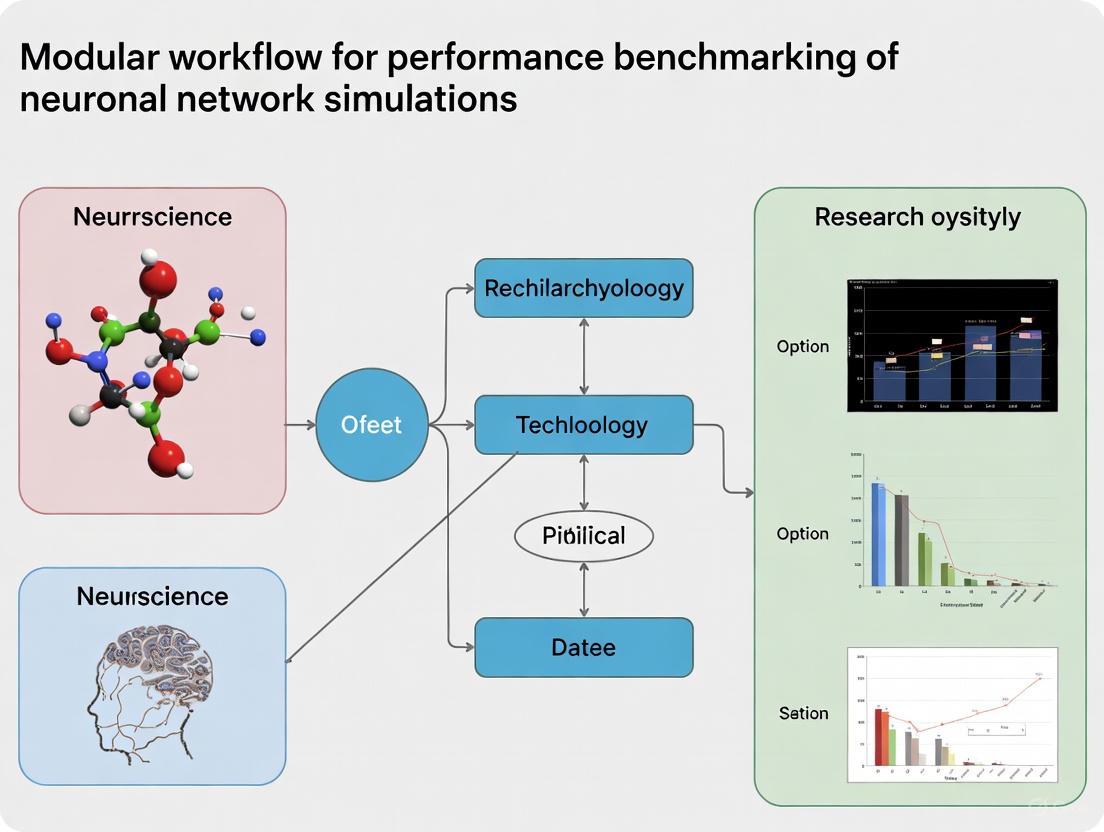
This article explores the critical role of standardized, modular benchmarking workflows in advancing computational neuroscience and drug discovery.
A Modular Workflow for Performance Benchmarking of Neuronal Network Simulations
Abstract
This article explores the critical role of standardized, modular benchmarking workflows in advancing computational neuroscience and drug discovery. It addresses the challenges of comparing simulator performance across diverse hardware, software, and model configurations. The content provides a foundational understanding of benchmarking principles, details the implementation of a modular workflow, offers strategies for troubleshooting and optimization, and establishes a framework for validation and comparative analysis. Aimed at researchers and drug development professionals, this guide serves as a comprehensive resource for improving the efficiency, reproducibility, and scalability of neuronal network simulations to accelerate therapeutic development.
The Critical Need for Standardized Benchmarking in Neuroscience
Performance benchmarking of neuronal networks has emerged as a critical methodology in computational neuroscience, enabling rigorous comparison of simulation technologies and guiding their development toward greater efficiency and capability. As the field progresses toward simulating brain-scale networks with increasing biological detail, the challenges of achieving accurate, reproducible, and comparable benchmark results have necessitated more structured approaches [1]. The complexity of modern neuronal network simulations spans multiple dimensions, including hardware configurations, software versions, simulator implementations, network models with their specific parameters, and researcher communication practices [1]. This landscape has motivated the development of standardized benchmarking workflows that can systematically address these dimensions while maintaining scientific relevance and practical utility. Performance benchmarking serves not only to validate simulation technologies but also to identify performance bottlenecks, guide optimization efforts, and ensure that computational resources are utilized effectively in the pursuit of neuroscientific discovery [1].
Conceptual Framework for Benchmarking
A systematic approach to neuronal network benchmarking employs a modular workflow that decomposes the process into distinct, interoperable segments. This conceptual framework encompasses several core components that work in concert to produce reliable, reproducible benchmark results. The hardware configuration module specifies the computing infrastructure, including processor architectures, memory hierarchies, interconnect technologies, and specialized neuromorphic systems where applicable [1]. The software configuration module encompasses operating systems, compiler versions, numerical libraries, and simulator-specific compilation options that significantly impact performance [1]. The simulator selection module encompasses the diverse range of simulation technologies available, from CPU-based simulators like NEST and Brian to GPU-accelerated platforms like GeNN and NeuronGPU, along with neuromorphic systems such as SpiNNaker and BrainScaleS [1] [2].
The model specification module defines the neuronal networks used for benchmarking, including their anatomical structure, neuronal and synaptic models, and the dynamics they exhibit. Finally, the data collection and analysis module standardizes how performance metrics are measured, recorded, and interpreted, ensuring comparability across different benchmark executions [1]. This modular decomposition enables researchers to systematically vary parameters within each component while maintaining consistency in others, facilitating precise identification of performance factors and their interactions. The framework's flexibility allows it to accommodate both functional models (validated by their ability to perform specific tasks) and non-functional models (validated through analysis of network structure and dynamics) [1].
Experimental Models for Benchmarking
Model Specifications and Characteristics
Performance benchmarking relies on well-characterized neuronal network models that represent scientifically relevant challenges while being sufficiently standardized to enable fair comparisons across simulators and hardware. These models vary in complexity, dynamics, and computational demands, providing a spectrum of benchmark scenarios that test different aspects of simulation technology.
Table 1: Benchmark Neuronal Network Models
| Model Name | Network Structure | Neuron Model | Synapse Model | Key Characteristics | Primary Applications |
|---|---|---|---|---|---|
| Balanced Random Network | Two-population (80% excitatory, 20% inhibitory) | Leaky Integrate-and-Fire (LIF) | Alpha-shaped postsynaptic currents, STDP | Excitation-inhibition balance, asynchronous irregular activity | Strong and weak scaling studies, simulator performance evaluation [1] |
| Brunel-type Network | Multiple populations with random connectivity | Leaky Integrate-and-Fire | Current-based or conductance-based | Configurable dynamics (synchronous/asynchronous states) | Simulation technology validation, performance analysis [1] |
| Multi-area Model | Hierarchical connectivity between brain areas | Various point neuron models | Short-term plasticity, NMDA synapses | Biological connectivity data, metastable dynamics | Memory consumption analysis, communication patterns [1] |
| Morphologically Detailed Networks | Sparse connectivity with spatial constraints | Multi-compartment neurons | conductance-based synapses | Complex dendritic processing, structural realism | Memory bandwidth tests, load balancing evaluation [1] |
| Synthetic Feature Selection Datasets | Custom connectivity for specific patterns | Simplified binary units | Deterministic connections | Ground truth knowledge, nonlinear relationships | Feature selection method validation, interpretability analysis [3] |
The balanced random network, particularly the "HPC-benchmark model" used in NEST development, represents a cornerstone benchmark in the field. This model typically employs leaky integrate-and-fire neurons with alpha-shaped post-synaptic currents and spike-timing-dependent plasticity (STDP) between excitatory neurons [1]. Its popularity stems from the approximately balanced excitation and inhibition observed in cortical networks, generating asynchronous irregular spiking activity that presents a computationally challenging scenario, particularly for distributed simulations requiring extensive communication.
For specialized benchmarking scenarios, synthetic datasets with precisely controlled properties provide valuable ground truth for evaluating specific capabilities. The RING dataset presents circular, non-linear decision boundaries that are impossible for linear additive models to capture, challenging simulators to accurately reproduce these dynamics [3]. The XOR dataset implements the archetypal non-linearly separable problem, requiring models to capture synergistic relationships between input features since individual features are uninformative [3]. Combined datasets such as RING+XOR merge these challenges, increasing the number of relevant features and preventing unfair advantage to methods that consider only small feature sets [3].
Spiking Neural Network Learning Methods
For spiking neural networks (SNNs), benchmarking extends beyond simulation performance to include learning capabilities and robustness. SNNs process information through discrete spikes, operating at significantly lower energy levels than traditional computing architectures, but training them presents unique challenges due to the non-differentiable nature of spiking mechanisms [4].
Table 2: Spiking Neural Network Learning Methods
| Method | Locality | Biological Plausibility | Computational Efficiency | Key Characteristics | Performance Considerations |
|---|---|---|---|---|---|
| Backpropagation Through Time (BPTT) | Global | Low | Memory-intensive, computationally expensive | Unrolls neural dynamics over time, symmetric weights | High accuracy but biologically implausible [4] |
| Feedback Alignment | Global | Medium | Moderate efficiency | Random matrices for backward passes, no symmetric weights | Reduced need for symmetric weights during learning [4] |
| E-prop | Semi-global | Medium-high | Improved efficiency | Direct feedback alignment, error propagated directly to each layer | Higher biological plausibility while maintaining performance [4] |
| DECOLLE | Local | High | High efficiency | Local error propagation at each layer, random mapping to pseudo-targets | Fully local learning, highest biological plausibility [4] |
The benchmarking of SNN learning methods must consider the trade-off between biological plausibility and performance. Global methods like BPTT typically achieve higher accuracy but at the cost of biological realism and computational efficiency, while local methods like DECOLLE offer greater biological plausibility and efficiency but may sacrifice some performance [4]. Additionally, the inherently recurrent nature of SNNs presents opportunities for enhancing robustness through explicit recurrent connections, which has been shown to improve resistance to adversarial attacks [4].
Performance Metrics and Evaluation
Core Benchmarking Metrics
Comprehensive benchmarking of neuronal networks requires multiple metrics that capture different aspects of performance, from raw speed to energy efficiency and simulation accuracy. These metrics provide complementary insights into simulator capabilities and limitations.
Time-to-solution measures the wall-clock time required to complete a simulation, typically distinguishing between network construction (setup phase) and state propagation (simulation phase) [1]. For performance analysis, it's crucial to specify whether benchmarks employ strong scaling (fixed model size with increasing resources) or weak scaling (model size grows proportionally with resources) approaches, as each reveals different performance characteristics [1].
Energy-to-solution quantifies the total energy consumption required to complete a simulation, an increasingly important metric as computational neuroscience addresses larger and more complex models [1]. Measurements may include only compute node consumption or encompass interconnects and support hardware, requiring clear specification for proper interpretation [1].
Memory consumption tracks peak memory usage during simulation execution, which can become a limiting factor for large-scale models with detailed neuronal morphologies or complex synaptic plasticity rules [1].
Simulation accuracy evaluates how closely simulated activity matches expected results, typically assessed through statistical comparisons of firing rates, distributions of membrane potentials, or correlation measures rather than exact spike timing due to the chaotic nature of neuronal network dynamics [1].
Scalability measures how simulation performance changes with increasing computational resources or model size, typically presented as speedup curves or efficiency plots that reveal performance bottlenecks and optimal resource configurations [1].
Quantitative Benchmark Results
Rigorous benchmarking studies have revealed significant performance differences across simulation technologies and configurations. Recent evaluations of deep learning-based feature selection methods on synthetic datasets demonstrate that even simple datasets can challenge many DL-based approaches, while traditional methods like Random Forests, TreeShap, mRMR, and LassoNet often show superior performance in identifying non-linear relationships [3].
For spiking neural network simulations, benchmarks comparing learning methods with varying locality reveal important trade-offs. BPTT generally achieves higher accuracy on classification tasks but with substantial computational and memory costs, while local learning methods like DECOLLE offer greater biological plausibility and efficiency but may exhibit accuracy degradation on complex tasks [4]. The addition of explicit recurrent weights in SNNs has been shown to enhance robustness against both gradient-based and non-gradient adversarial attacks, with Centered Kernel Alignment (CKA) metrics demonstrating greater representational stability in recurrent architectures under attack scenarios [4].
Experimental Protocols
Protocol for Balanced Random Network Benchmark
Purpose: To measure simulation performance for a canonical cortical network model with balanced excitation and inhibition, generating asynchronous irregular spiking activity.
Materials:
- Simulator installation (NEST, NEURON, Brian, GeNN, or Arbor)
- High-performance computing resources with appropriate core counts
- Performance monitoring tools (e.g., custom timing scripts, profiling utilities)
Procedure:
- Network Construction:
- Implement a two-population network with 80% excitatory and 20% inhibitory neurons [1]
- Set membrane parameters: Cm = 250 pF, taum = 20 ms for excitatory neurons; Cm = 250 pF, taum = 10 ms for inhibitory neurons [1]
- Configure synaptic weights: wexc = 0.1 mV (excitatory), winh = -0.5 mV (inhibitory) [1]
- Implement connectivity with 10% connection probability between neurons [1]
Simulation Configuration:
- Set simulation duration to 10,000 biological seconds with a timestep of 0.1 ms
- Configure recording of spike times from 1% of randomly selected neurons
- Implement Poisson background input with rate of 10 Hz per neuron
Performance Measurement:
- Execute strong scaling tests with fixed network size (e.g., 100,000 neurons) while varying core counts (1, 2, 4, 8, 16, 32, 64 cores)
- Execute weak scaling tests with network size proportional to core count
- Record separate timings for network construction and simulation phases
- Measure peak memory usage throughout simulation
Data Analysis:
- Calculate firing rates and coefficient of variation for interspike intervals to verify network state
- Compute speedup and parallel efficiency from timing data
- Generate performance plots comparing time-to-solution across configurations
Validation: Verify balanced state with mean firing rates of approximately 5-10 Hz and coefficient of variation of interspike intervals greater than 1 [1].
Protocol for Feature Selection Benchmarking
Purpose: To evaluate the performance of feature selection methods on non-linearly separable synthetic datasets with known ground truth.
Materials:
- Synthetic dataset generation code (RING, XOR, RING+XOR+SUM, DAG)
- Feature selection implementations (Random Forests, TreeShap, mRMR, LassoNet, DL-based methods)
- Computing environment with sufficient memory for high-dimensional data
Procedure:
- Dataset Generation:
- Generate RING dataset with n=1000 observations, m=p+k features (p=2 predictive, k variable decoys)
- Implement classification rule: Y=1 when |√((X₀-0.5)² + (X₁-0.5)²) - 0.35| ≤ 0.1151 [3]
- Generate XOR dataset with division of 2D space into 4 quadrants, positives in upper left and lower right
- Create combined datasets (RING+OR, RING+XOR+SUM) with increased predictive feature counts [3]
Method Evaluation:
- Apply each feature selection method to all dataset variants
- Systematically vary the number of decoy features (k) to assess robustness
- For DL-based methods, implement standard architectures with appropriate regularization
- For gradient-based attribution methods, compute Saliency Maps, Integrated Gradients, and SmoothGrad
Performance Assessment:
- Calculate precision and recall for identification of truly predictive features
- Measure computation time for each method
- Assess stability of selected features across multiple dataset instances
Validation: Compare results to known ground truth, with optimal methods correctly identifying predictive features despite non-linear relationships and increasing decoy dimensions [3].
Protocol for SNN Learning Method Benchmarking
Purpose: To compare the performance, efficiency, and robustness of spiking neural network learning methods with varying degrees of locality.
Materials:
- SNN simulator with support for multiple learning rules (BPTT, e-prop, DECOLLE)
- Neuromorphic datasets (N-MNIST, DVS Gesture) and traditional datasets (MNIST, CIFAR-10)
- Computational resources for training and evaluation
Procedure:
- Network Configuration:
- Implement Leaky Integrate-and-Fire (LIF) neurons with membrane and synaptic time constants [4]
- Configure network architecture with 800 excitatory and 200 inhibitory neurons
- For explicit recurrence, add recurrent connections with 20% probability
Training Protocol:
- Implement BPTT with surrogate gradient functions to handle non-differentiable spiking
- Configure e-prop with direct feedback alignment and symmetric weights
- Set up DECOLLE with local errors and random feedback matrices
- Train on classification tasks with matched hyperparameters where possible
Evaluation:
- Measure test accuracy on held-out datasets
- Record training time and memory consumption
- Assess robustness against gradient-based (FGSM, PGD) and non-gradient poisoning attacks
- Compute Centered Kernel Alignment (CKA) to analyze representational similarity
Validation: Verify that each learning method produces stable network activity and reasonable accuracy, with global methods typically outperforming local methods on accuracy but requiring more computational resources [4].
The Scientist's Toolkit
Research Reagent Solutions
Successful benchmarking of neuronal networks requires a comprehensive set of software tools, hardware platforms, and methodological approaches. The following table details essential components of the benchmarking toolkit.
Table 3: Essential Research Reagents for Neuronal Network Benchmarking
| Category | Tool/Platform | Primary Function | Key Features | Application Context |
|---|---|---|---|---|
| Simulation Engines | NEST | Simulate spiking neural network models | Focus on neural system dynamics and structure, ideal for networks of any size | Information processing models, network activity dynamics, learning and plasticity [2] |
| NEURON | Simulate morphologically detailed neurons | Multi-compartment models, complex electrophysiology | Detailed neuronal modeling, biophysically realistic simulations [1] | |
| Brian | Simulate spiking neural networks | Flexible model specification, clear code structure | Prototyping, teaching, research with custom neuron models [1] | |
| GeNN | GPU-accelerated neural network simulations | Code generation for GPU acceleration, support for various neuron models | Large-scale simulations requiring GPU acceleration [1] | |
| Benchmarking Frameworks | beNNch | Configuration, execution, and analysis of benchmarks | Records benchmarking data and metadata uniformly, supports reproducibility | Standardized benchmarking across simulators and hardware [1] |
| QuantBench | Evaluation of AI methods in quantitative investment | Industrial-grade standardization, full-pipeline coverage | Financial applications, standardized evaluation [5] | |
| Model Specification | PyNN | Simulator-independent network description | Write once, run on multiple simulators, high-level abstraction | Multi-simulator studies, model sharing, reproducible research [2] |
| NESTML | Domain-specific language for neuron models | Precise and concise syntax, automatic code generation | Defining custom neuron models, maintaining model consistency [2] | |
| Hardware Platforms | SpiNNaker | Neuromorphic computing platform | Massively parallel architecture, low power consumption | Real-time simulation, neuromorphic applications [2] |
| BrainScaleS | Neuromorphic system with analog neurons | Physical emulation of neural dynamics, high speed | Fast simulation, analog neuromorphic computing [2] | |
| Analysis & Visualization | NEST Desktop | Web-based GUI for NEST Simulator | Visual network construction, parametrization, result visualization | Education, prototyping, visual analysis of networks [2] |
Integrated Benchmarking Workflow
A modular workflow for performance benchmarking integrates these components into a systematic process that ensures reproducibility and meaningful comparisons. The reference implementation beNNch demonstrates this approach by decomposing benchmarking into distinct modules for configuration, execution, and analysis [1]. The workflow begins with precise specification of the benchmarking objectives, which determines the appropriate selection of network models, performance metrics, and experimental conditions. The model configuration module then instantiates the chosen network models with all relevant parameters, ensuring consistency across different simulator platforms through standardized descriptions, potentially using PyNN for simulator-independent definitions [2].
The execution environment module configures the hardware and software stack, capturing essential metadata such as compiler versions, library dependencies, and system architecture that might influence performance [1]. During benchmark execution, the workflow employs standardized timing and measurement procedures, clearly distinguishing between network construction time and simulation time to identify potential bottlenecks [1]. The data collection module records both performance metrics and simulation outputs, enabling subsequent verification that the models produced scientifically valid results in addition to performance measurements [1].
Finally, the analysis module processes the raw data to generate comparative performance metrics, scaling plots, and efficiency analyses, while the reporting module formats results in standardized formats suitable for publication and archival [1]. Throughout this process, version control for both model specifications and benchmarking code ensures reproducibility, while containerization technologies can capture the complete software environment to enable replication of results across different systems [1]. This integrated approach addresses the critical challenge of maintaining comparability in a rapidly evolving field with diverse simulation technologies, hardware platforms, and model complexities.
Reproducibility and comparability form the cornerstone of the scientific method, yet they present significant challenges in the field of simulation science, particularly in computational neuroscience. The inability to replicate or reproduce published research results has emerged as one of the most pressing issues across scientific disciplines [6]. In computational neuroscience specifically, where thousands of models are available, it is rarely possible to reimplement models based on information in original publications, primarily because model implementations are not made publicly available [6]. This challenge impedes scientific progress and undermines the reliability of computational models intended to explain brain dynamics in health and disease.
The development of complex neuronal network models proceeds alongside advancements in network theory and increasing availability of detailed anatomical data on brain connectivity [7]. As models grow in scale and complexity to study interactions between multiple brain areas and long-time scale phenomena such as system-level learning, ensuring reproducibility and comparability becomes both more critical and more challenging. This article examines these challenges within the context of developing modular workflows for performance benchmarking of neuronal network simulations, providing researchers with frameworks and protocols to enhance the reliability of their computational studies.
Defining the Landscape: Reproducibility and Replicability
Terminology and Conceptual Framework
The terminology surrounding reproducibility varies across disciplines, but several key definitions provide a conceptual framework for discussion:
Replicability refers to rerunning the publicly available code developed by the authors of a study and replicating the original results, achieving fully identical results including spike times and all state variables in neuronal network simulations [6] [8].
Reproducibility means reimplementing a model using knowledge from the original study, often in a different simulation tool or programming language, and simulating it to verify the study's results, focusing on key findings rather than identical outputs [6] [8].
Comparability involves comparing simulation results of different tools when the same model has been implemented in them, or comparing results of different models addressing similar research questions [6].
Robustness to analytical variability refers to the ability to identify a finding consistently across variations in methods, using the same data but different analytical approaches [9].
Table 1: Types of Reproducibility Based on Variable Experimental Components
| Type | Data Source | Method | Team/Lab | Objective |
|---|---|---|---|---|
| Type A (Analytical) | Same data | Same methods | Any | Confirm original analysis [10] |
| Type B (Robustness) | Same data | Different methods | Any | Assess sensitivity to analytical choices [10] |
| Type C (Intra-lab) | New data | Same methods | Same team | Verify internal consistency [10] |
| Type D (Inter-lab) | New data | Same methods | Different team | Confirm external validity [10] |
| Type E (Generalizability) | New data | Different methods | Different team | Establish broad applicability [10] |
The Inverse Relationship Between Reproducibility and Replicability
In computational neuroscience, a fundamental tension exists between replicability and reproducibility. A turnkey system provided on dedicated hardware or a virtual machine will run identically every time (high replicability) but may not be reproducible by outsiders who cannot access or modify the system [8]. Conversely, representations using equations provide the greatest degree of reproducibility across research groups but make obtaining identical results less likely [8]. This inverse relationship necessitates careful consideration of research goals when evaluating computational studies.
Fundamental Challenges in Simulation Science
Documentation and Implementation Gaps
The most fundamental challenge is the unavailability of original model implementations, with published articles often providing incomplete information due to accidental mistakes or limited publication space [6]. When implementations are shared, insufficient documentation regarding parameters, initial conditions, or computational environment creates significant barriers to replication.
Tool and Format Diversity
Computational neuroscience employs a diverse ecosystem of simulation tools, each with specialized capabilities:
- Brian and NEST for spiking neuronal networks using CPUs [6] [1]
- GeNN and NeuronGPU for GPU-accelerated simulations [1]
- NEURON and Arbor for morphologically detailed neuronal networks [1]
- COPASI and STEPS for biochemical reactions and signaling pathways [6] [11]
This tool diversity, while beneficial for addressing different research questions, creates interoperability challenges as each tool may use different model definition formats (SBML, NeuroML, custom formats), algorithms, number resolutions, or random number generators [11].
Systemic and Cultural Barriers
Cultural practices in scientific publishing often prioritize novelty over replication studies, with few journals explicitly accepting reproducibility studies [6]. Additionally, the lack of standardized specifications for measuring scaling performance on high-performance computing (HPC) systems complicates comparison across studies [7]. Research assessments that prioritize novel findings over replication efforts further disincentivize the substantial effort required for reproducibility studies.
The Modular Workflow Solution: beNNch Framework
Conceptual Framework for Benchmarking
Addressing the challenges of reproducibility and comparability in neuronal network simulations requires systematic approaches. The beNNch framework implements a modular workflow that decomposes the benchmarking process into distinct segments, providing a standardized methodology for performance assessment [7] [12]. This framework addresses five key dimensions of benchmarking complexity:
- Hardware configuration: Computing architectures and machine specifications
- Software configuration: General software environments and instructions
- Simulators: Specific simulation technologies
- Models and parameters: Different models and their configurations
- Researcher communication: Knowledge exchange on running benchmarks [7]
Figure 1: Modular workflow for benchmarking neuronal network simulations, ensuring reproducible performance assessments [7].
Workflow Implementation
The beNNch framework operationalizes the benchmarking process through five interconnected modules:
- Configuration Module: Defines benchmark experiments, including model parameters, simulator settings, and hardware resources
- Execution Module: Runs simulations across specified hardware and software configurations
- Analysis Module: Processes simulation output to extract performance metrics
- Storage Module: Records benchmarking data and metadata in a unified format
- Comparison Module: Enables cross-platform and cross-version performance analysis [7]
This modular approach ensures that benchmarking studies capture all necessary information to foster reproducibility, including detailed records of hardware and software configurations that are often omitted in conventional publications.
Experimental Protocols for Benchmarking
Strong and Weak Scaling Experiments
Performance benchmarking of simulation engines typically employs two complementary approaches:
Weak-scaling experiments proportionally increase the size of the simulated network model with computational resources, maintaining a fixed workload per compute node in perfectly scaling systems [1]. However, scaling neuronal networks inevitably changes network dynamics, complicating interpretation of results [1].
Strong-scaling experiments maintain a constant model size while increasing computational resources, which is more relevant for finding the limiting time-to-solution for network models of natural size [1]. When measuring time-to-solution, studies distinguish between setup phase (network construction) and simulation phase (state propagation) [1].
Table 2: Key Parameters for Balanced Random Network Benchmark Model
| Parameter Category | Specific Parameters | Typical Values | Function in Benchmarking |
|---|---|---|---|
| Network Architecture | Population ratio (E/I) | 80%/20% | Mimics cortical microcircuitry [1] |
| Neuron Model | Leaky integrate-and-fire (LIF) | Membrane time constant: 20ms | Computational efficiency for large networks [1] |
| Synapse Model | Alpha-shaped postsynaptic currents | Rise/decay time constants | Biologically plausible temporal dynamics [1] |
| Plasticity | Spike-timing-dependent plasticity (STDP) | Timing-dependent weight changes | Introduces computational complexity [1] |
| Connectivity | Balanced random connectivity | Specific synaptic weights | Maintains excitation-inhibition balance [1] |
Verification and Validation Protocols
To ensure credible simulations, particularly for biomedical applications, rigorous verification and validation protocols are essential:
Verification confirms that the implementation returns correct results with sufficient accuracy for suitable applications, evidenced by flawless implementation of components confirmed by unit tests [1].
Validation provides evidence that results are computed efficiently and address the intended research questions, comparing new technologies to previous studies based on relevant performance measures [1].
For clinical applications, establishing credibility is paramount. As computational neuroscience moves toward clinical applications, validation must demonstrate not just technical correctness but also clinical relevance and predictive power [8].
The Scientist's Toolkit: Essential Research Reagents
Table 3: Research Reagent Solutions for Reproducible Simulation Science
| Tool/Category | Specific Examples | Primary Function | Interoperability Considerations |
|---|---|---|---|
| Simulation Engines | NEST, Brian, NEURON, Arbor, GeNN | Simulate neuronal networks at different scales | Different model description formats; partial SBML/NeuroML support [1] [11] |
| Model Description Formats | SBML, NeuroML, CellML, SBtab | Standardized model representation | Conversion tools needed (SBFC, VFGEN) [11] |
| Parameter Estimation | MCMCSTAT (MATLAB), pyABC/pyPESTO (Python) | Estimate model parameters from data | Different algorithmic implementations and file formats [11] |
| Sensitivity Analysis | Uncertainpy (Python) | Global sensitivity analysis | Dependency on specific programming languages [11] |
| Benchmarking Frameworks | beNNch | Standardized performance assessment | Records data and metadata for reproducibility [7] |
| Version Control | Git, GitHub | Track changes and collaborate | Universal format, but requires discipline in usage [9] |
Figure 2: Interoperability workflow for biochemical models using format conversion to enable multi-simulator validation [11].
Protocols for Enhanced Reproducibility
Model Documentation and Sharing Protocol
Comprehensive model documentation should include:
- Mathematical specifications: Complete equations, parameters, and initial conditions in tabular format [6]
- Implementation code: Well-commented, version-controlled code with dependency specifications
- Simulation protocols: Step-by-step procedures for reproducing simulations
- Data sharing: Original data and scripts for analysis in standardized formats
The use of human-readable formats like SBtab facilitates manual editing and inspection while enabling automated conversion to machine-readable formats like SBML [11].
Metadata Recording for Benchmarking Studies
Consistent recording of metadata is essential for reproducing benchmarking results:
- Hardware specifications: Compute nodes, processors, memory, interconnect details
- Software environment: Operating system, compiler versions, library dependencies
- Simulator configuration: All settings and flags used during simulation
- Performance metrics: Time-to-solution, memory consumption, energy usage where possible
Frameworks like beNNch provide structured formats for capturing this metadata systematically [7].
Reproducibility and comparability challenges in simulation science require multifaceted solutions addressing technical, methodological, and cultural dimensions. Modular workflows for benchmarking, such as the beNNch framework, provide structured approaches to assess simulation performance while capturing essential metadata for reproducibility. Standardized protocols for model documentation, format conversion, and performance measurement enable more reliable building upon existing work in computational neuroscience.
As the field progresses toward more complex multiscale models and clinical applications, the adoption of these practices and tools will be essential for constructing a solid foundation of reproducible, replicable, and robust computational research. The development and widespread adoption of community standards, coupled with cultural shifts that value reproducibility as much as novelty, will drive future advances in simulation science.
In computational neuroscience, the development of complex neuronal network models to explain brain dynamics in health and disease necessitates advancements in simulation technology. Progress in simulation speed enables larger models that study interactions between multiple brain areas and investigate long-term phenomena like system-level learning [7]. The development of state-of-the-art simulation engines relies critically on benchmark simulations that assess performance metrics across various combinations of hardware and software configurations [7] [1]. This application note details the core dimensions of benchmarking—hardware, software, simulators, and models—within the context of a modular workflow for performance benchmarking of neuronal network simulations, providing researchers with structured protocols and reference data.
Core Dimensions of Benchmarking
Benchmarking experiments in neuronal network simulations are complex and multidimensional. The complexity can be decomposed into five main dimensions: "Hardware configuration," "Software configuration," "Simulators," "Models and parameters," and "Researcher communication" [7] [1]. This document focuses on the first four technical dimensions, which form the foundation of reproducible performance evaluation.
Table 1: Core Dimensions of Neuronal Network Simulation Benchmarking
| Dimension | Components | Considerations for Benchmarking |
|---|---|---|
| Hardware Configuration | Conventional HPC (CPU clusters), GPUs, Neuromorphic systems (e.g., SpiNNaker, BrainScaleS) [7] [1] [13] | Architecture, memory hierarchy, interconnect performance, power consumption [7] [13]. |
| Software Configuration | Operating system, compilers, numerical libraries, simulator version, Python/other interpreter versions [7] [1] | Software versions, compiler flags, environment variables, dependencies that impact performance [7]. |
| Simulators | NEST, Brian, GeNN, NEURON, Arbor, CARLsim [7] [1] [14] | Underlying algorithms (clock-driven vs. event-driven), support for neuron models, parallelism, and scalability [7] [14]. |
| Models and Parameters | Point neurons (e.g., LIF, Izhikevich) vs. morphologically detailed models; network scale and connectivity; synapse models [7] [1] [14] | Model complexity, network dynamics (balanced, chaotic), stationarity of activity, and numerical precision [7] [1]. |
Hardware Configuration
The choice of hardware platform significantly influences simulation performance and is a primary variable in benchmarking.
- Conventional HPC Systems: High-performance CPU clusters are widely used for large-scale network simulations. Benchmarks are often performed on contemporary supercomputers, and performance is assessed through strong-scaling (fixed model size, increasing resources) and weak-scaling (model size grows proportionally to resources) experiments [7]. Weak-scaling of neuronal networks can alter network dynamics, making strong-scaling more relevant for finding the limiting time-to-solution for a fixed model [7] [1].
- GPU Accelerators: GPU-based simulators like GeNN and NeuronGPU leverage massive parallelism for substantial speedups, with performance evaluated across different GPU tiers [7] [1].
- Neuromorphic Systems: Dedicated hardware like SpiNNaker (digital) and BrainScaleS (analog-mixed-signal) emulates neural networks with high energy efficiency, often targeting real-time operation [7] [13]. Benchmarking these requires consideration of physical acceleration factors and unique constraints [13].
Software Configuration
The software environment must be meticulously documented to ensure reproducibility, as performance can be sensitive to versions and configurations [7]. Key components include the operating system, compiler (e.g., GCC, NVCC) and its flags, MPI and CUDA versions, and numerical libraries (e.g., BLAS, LAPACK). The specific version of the simulator and its installation configuration are also critical [7] [15].
Simulators
Simulators are the core software engines for neuronal network simulations, each with distinct design goals, strengths, and performance characteristics.
Table 2: Selected Neuronal Network Simulators and Key Attributes
| Simulator | Primary Hardware Target | Simulation Strategy | Notable Features |
|---|---|---|---|
| NEST [7] [14] | CPU-based HPC clusters | Clock-driven, synchronous | Optimized for large-scale networks of point neurons; supports precise spike times. |
| Brian 2 [1] [16] | CPU, GPU (via code generation) | Clock-driven, synchronous | Intuitive, equation-oriented definition of models; high flexibility via runtime code generation. |
| GeNN [7] [1] [13] | GPU, CPU | Clock-driven, synchronous | Generics-based code generation for GPUs for accelerated simulation. |
| NEURON [7] [14] | CPU | Clock-driven, synchronous | Specializes in models with detailed morphology (multi-compartment neurons). |
| Arbor [7] | HPC systems (CPU/GPU) | Clock-driven, synchronous | A modern, performance-portable simulator for detailed neuron models on HPC systems. |
| SpiNNaker [7] [13] | Neuromorphic Hardware (SpiNNaker) | Asynchronous, event-based | Massively parallel, low-power system designed for real-time simulation. |
Two primary simulation strategies exist: synchronous (clock-driven) algorithms, where all neurons are updated simultaneously at discrete time steps, and asynchronous (event-driven) algorithms, where neurons are updated only when spikes are received or emitted [14]. Most large-scale simulators use clock-driven approaches for their simplicity and efficiency in handling large numbers of connections [14].
Models and Parameters
The choice of network model directly determines the computational load and is therefore a fundamental benchmark dimension.
- Neuron Models: Range from computationally simple Leaky Integrate-and-Fire (LIF) models, suitable for large-scale network simulations, to complex, biophysical Hodgkin-Huxley (HH) type models that simulate action potential generation in detail [7] [1] [14].
- Canonical Benchmark Networks: The most frequently used model for performance tests is the balanced random network [1]. A common variant is the HPC-benchmark model, which employs LIF neurons with alpha-shaped post-synaptic currents and spike-timing-dependent plasticity (STDP) to represent a scientifically relevant and computationally demanding workload [7] [1].
- Network Dynamics and Scaling: Model dynamics (e.g., balanced, chaotic) affect computational load, as non-stationary activity with transients can cause performance fluctuations [7]. When scaling a network model for benchmarking, it is crucial to note that simply increasing the size can change its dynamics, complicating the interpretation of weak-scaling results [7] [1].
Figure 1: The core dimensions of benchmarking neuronal network simulations, showing the hierarchy of key components within each dimension.
Experimental Protocols for Benchmarking
This section provides detailed methodologies for setting up and executing performance benchmarks.
Protocol: Strong and Weak Scaling Experiments
Objective: To measure the parallel scaling efficiency of a simulator on a given hardware platform. Background: Strong-scaling measures time-to-solution for a fixed network model while increasing computational resources. Weak-scaling increases the model size proportionally with resources, aiming to keep the workload per compute node constant [7].
- Model Selection: Choose a benchmark model, typically a balanced random network of LIF neurons with plastic synapses [7] [1].
- Baseline Setup:
- For strong-scaling, define the fixed model size (e.g., 100,000 neurons).
- For weak-scaling, define the model size per compute core/node (e.g., 10,000 neurons per node).
- Resource Scaling: Run the simulation across a range of compute nodes/cores (e.g., 1, 2, 4, 8, ..., 128 nodes).
- Execution:
- Use a batch system (e.g., Slurm) to schedule jobs.
- Execute the simulation for a defined biological time (e.g., 10 seconds of model time).
- Ensure the simulator is configured to output precise timing information for both the network construction (setup) and the state propagation (simulation) phases [7].
- Data Collection: Record for each run: number of nodes/cores, wall-clock time for setup and simulation, total simulated biological time, and any spike data for verification.
Protocol: Cross-Platform Performance and Energy Efficiency
Objective: To compare simulation performance and energy-to-solution across different hardware platforms and simulators. Background: Different simulators are optimized for different hardware, and energy efficiency is a key metric, especially for neuromorphic systems [13].
- Standardized Model: Implement the same network model (e.g., the HPC-benchmark model or a cortical microcircuit model [13]) on all target platforms using their respective interfaces (e.g., PyNN, native scripts).
- Fixed Workload: Run the simulation with identical parameters (simulated time, network size, etc.).
- Performance Measurement: Record the total wall-clock time-to-solution.
- Energy Measurement:
- If possible, use integrated power meters (e.g., via the HPC system's monitoring or hardware like a power meter for smaller systems).
- Record the total energy consumed in Joules. Specify whether the measurement includes only compute nodes or also interconnects and support hardware [7].
- Analysis: Calculate and compare the time-to-solution and energy-to-solution across the different platforms.
The Scientist's Toolkit
This section details essential tools and "research reagents" required for conducting rigorous benchmarking experiments.
Table 3: Essential Tools and Reagents for Benchmarking
| Category | Item | Function / Relevance |
|---|---|---|
| Benchmarking Frameworks | beNNch [12] [15] | A software framework for configuring, executing, and analyzing benchmarks in a unified, reproducible way. |
| SNABSuite [13] | A cross-platform benchmark suite for neuromorphic hardware and simulators. | |
| NeuroBench [17] | A community-developed benchmark framework for neuromorphic computing algorithms and systems. | |
| Reference Models | HPC-Benchmark Model [7] [1] | A balanced random network of LIF neurons with STDP; a standard for simulator performance tests. |
| Cortical Microcircuit Model [13] | A full-scale model used as a de-facto standard workload for comparing large-scale implementations. | |
| Rallpacks [18] | Early benchmarks for evaluating the speed and accuracy of simulators, particularly for single neuron models. | |
| Simulation Engines | NEST, Brian 2, GeNN, etc. (See Table 2) | Core simulation technology to be evaluated. |
| Analysis & Metrics | Wall-clock time | The primary measure for time-to-solution [7]. |
| Energy-to-solution | A critical measure for evaluating efficiency, especially on neuromorphic and edge devices [13]. | |
| Scaling efficiency | The ratio of ideal to observed performance in strong- and weak-scaling experiments. |
Robust benchmarking of neuronal network simulations is a multi-faceted endeavor that requires careful consideration of hardware, software, simulators, and models. Standardized protocols and frameworks like beNNch and SNABSuite are vital for ensuring reproducibility and meaningful comparisons. By adhering to structured workflows and documenting all dimensions of the benchmarking process, researchers can effectively guide the development of more efficient simulation technology, ultimately enabling more complex and scientifically ambitious brain models.
Within the context of a broader thesis on modular workflows for performance benchmarking in neuronal network simulations research, the precise definition and measurement of core performance metrics is paramount. The development of complex network models to explain brain function in health and disease relies on advancements in simulation technology, which in turn depends on rigorous benchmarking [7] [1]. Time-to-solution, energy-to-solution, and memory consumption represent the triad of key resources whose efficient use enables the construction of larger network models with extended explanatory scope and facilitates the study of long-term effects such as system-level learning [7]. This document provides detailed application notes and experimental protocols for the consistent measurement and reporting of these metrics, fostering comparability and reproducibility in computational neuroscience.
Metric Definitions and Significance
Efficiency in neuronal network simulations is measured by the resources required to achieve a scientific result [1]. The table below defines the core metrics and their scientific relevance for researchers and drug development professionals.
Table 1: Core Performance Metrics in Neuronal Network Simulations
| Metric | Formal Definition | Primary Significance | Secondary Significance |
|---|---|---|---|
| Time-to-Solution | Total wall-clock time required to complete a simulation, from network setup to the end of state propagation [7] [1]. | Determines the feasibility of simulating long-time-scale processes like learning and brain development [7]. | Enables real-time performance for robotics and closed-loop simulations; sub-real-time performance accelerates research cycles [7]. |
| Energy-to-Solution | Total energy consumed (often in Joules) by the hardware to complete a simulation [7] [1]. | Critical for developing sustainable HPC workflows and neuromorphic systems with hardware constraints [7] [19]. | Reveals trade-offs between computational speed and power consumption, impacting operational costs and hardware design [19]. |
| Memory Consumption | Peak physical memory (RAM) allocated during a simulation, including both model data and execution overhead [7]. | Dictates the maximum size and complexity of a network model that can be simulated on a given hardware system [7]. | Influences performance via memory bandwidth constraints and is a key design factor for in-memory compute architectures [7]. |
These metrics are not independent; optimizing one can directly impact the others. For instance, reducing time-to-solution often lowers energy-to-solution, while strategies to reduce memory footprint might increase computational time. Furthermore, the precise interpretation of these metrics depends on the specific simulation context. For time-to-solution, studies must distinguish between the setup phase (network construction) and the simulation phase (state propagation) [7]. For energy-to-solution, it is crucial to specify the measurement scope—whether it includes only compute nodes or also interconnects and support hardware [7].
Experimental Protocols for Metric Measurement
Protocol for Time-to-Solution Measurement
Objective: To reproducibly measure the wall-clock time required for the setup and execution of a neuronal network simulation. Materials: beNNch framework [7], HPC system or workstation, target simulator (e.g., NEST, NEURON, Brian, GeNN) [7] [1]. Methodology:
- Instrument the Simulation Code: Use high-resolution timers (e.g.,
std::chronoin C++ ortime.perf_counterin Python) to record timestamps.- Setup Phase: Start timer before network creation; stop after all neurons and synapses are instantiated.
- Simulation Phase: Start timer after setup; stop after the final simulation time step is complete.
- Execute Benchmarks: Run the simulation multiple times (minimum n=3) to account for system noise.
- Data Recording: Record the timing data and all relevant metadata, including simulator version, hardware specification, and network model parameters, using a standardized framework like beNNch [7]. Data Analysis: Calculate the mean and standard deviation of the total time-to-solution (setup + simulation) across runs. Report both the total and the phase-specific times.
Protocol for Energy-to-Solution Measurement
Objective: To quantify the total energy consumed by the hardware during a simulation. Materials: HPC system with integrated power meters (e.g., via IPMI or dedicated sensors), external power meter (for smaller systems), energy monitoring software (e.g., JURECA's power measurement infrastructure) [7]. Methodology:
- Select Measurement Scope: Define whether energy measurement includes compute nodes only or the entire supporting infrastructure [7].
- Establish Baseline: Measure the system's idle power consumption before launching the simulation.
- Monitor During Execution: Use the chosen measurement tool to sample power (in Watts) at a high frequency (e.g., 1 Hz) throughout the simulation's duration.
- Data Recording: Log power samples alongside simulation start and end timestamps.
Data Analysis: Integrate the power-over-time data to calculate total energy consumed in Joules (J):
Energy = Σ (Power_measured - Power_idle) * Time_sample_interval. Report the total energy and the average power.
Protocol for Memory Consumption Measurement
Objective: To measure the peak physical memory usage during a simulation.
Materials: HPC system, system monitoring tools (e.g., /proc/self/status on Linux, getrusage system call, or HPC cluster monitoring tools).
Methodology:
- Select Measurement Method: Instrument the simulator to periodically check memory usage or use an external tool to monitor the entire process.
- Sample Memory Usage: Track the resident set size (RSS) or equivalent metric at regular intervals (e.g., every second or every simulation time step).
- Data Recording: Log the memory usage samples. Data Analysis: Identify the peak memory usage value from all samples. Report this value in Gigabytes (GB).
A Modular Workflow for Integrated Benchmarking
A modular workflow is essential for managing the complexity of benchmarking studies, which involve multiple dimensions: hardware configuration, software configuration, simulators, and models [7]. The following workflow, implemented in tools like beNNch, decomposes the benchmarking process into standardized, reproducible segments [7].
Figure 1: Modular benchmarking workflow for neuronal network simulations.
Workflow Description:
- Module 1: Hardware Configuration: Document the precise HPC system, compute node specifications (CPU/GPU type, cores per node, memory), interconnect, and any power measurement capabilities [7].
- Module 2: Software Configuration: Record the operating system, compiler version, libraries, and the specific version of the simulator software being tested [7] [1].
- Module 3: Model & Parameters: Define the neuronal network model in a machine-readable format. This includes neuron and synapse models, connectivity rules, and all parameters. Using standardized models (e.g., the HPC-benchmark model [1]) facilitates comparison.
- Module 4: Simulator Execution: Run the simulation according to the protocols in Section 3, controlling for scaling type (strong-scaling vs. weak-scaling) [7].
- Module 5: Data & Metadata Collection: Systematically record all performance metrics (time, energy, memory) alongside the complete hardware, software, and model metadata. The beNNch framework is designed for this unified recording [7].
- Module 6: Analysis & Visualization: Analyze the collected data to generate performance profiles, scaling plots, and identify performance bottlenecks.
The Scientist's Toolkit: Research Reagent Solutions
The following table details essential "research reagents"—software, models, and hardware—required for conducting performance benchmarking in neuronal network simulations.
Table 2: Essential Research Reagents for Performance Benchmarking
| Item Name | Type | Function in Benchmarking | Example Tools / Models |
|---|---|---|---|
| Simulation Engines | Software | Core technology for executing neuronal network models; different engines are optimized for different hardware and model types. | NEST [7], NEURON [1], Brian [7], GeNN [7], Arbor [1] |
| Benchmarking Framework | Software | Configures, executes, and analyzes benchmarks in a standardized way; ensures reproducible collection of data and metadata. | beNNch [7] |
| Standardized Network Models | Model | Provides a consistent, scientifically relevant workload for comparing simulator performance across studies and hardware. | "HPC-benchmark" model [1], balanced random networks [1], multi-area models [7] |
| HPC & Neuromorphic Hardware | Hardware | The physical platform for execution; performance is highly dependent on the architecture (CPU, GPU, neuromorphic). | HPC clusters (JUQUEEN, JURECA) [7], GPU nodes [7], SpiNNaker [7] |
| Performance Analysis Tools | Software | Measures low-level hardware counters, power consumption, and memory usage during simulation. | IPMI tools, Linux perf, getrusage, custom power monitoring software [7] |
| Visualization Tools | Software | Aids in the analysis and comparative evaluation of different Spiking Neural Network (SNN) models and their performance. | RAVSim v2.0 [20] |
The rigorous and standardized application of the metrics and protocols outlined in this document is critical for the advancement of simulation technology in computational neuroscience. By adopting a modular workflow that meticulously records data and metadata, researchers can ensure their benchmark results are reproducible, comparable, and meaningful. This disciplined approach directly supports the broader thesis of modular benchmarking by providing a concrete methodology for assessing performance, ultimately guiding the development of more efficient simulation technology and enabling ever more detailed and predictive models of brain function.
In the field of computational neuroscience, the development of large-scale neuronal network models is essential for understanding brain function and dysfunction. The pursuit of this goal is tightly coupled with advancements in high-performance computing (HPC). As researchers strive to simulate ever-larger networks—from models representing specific brain regions to entire brains—the efficiency of the simulation software becomes paramount [7] [1]. Performance benchmarking is therefore a critical practice, providing the data needed to optimize simulation engines, guide resource allocation, and ultimately enable novel scientific research that would otherwise be computationally intractable [7]. Within this benchmarking process, scaling analysis forms the cornerstone, quantifying how a simulation's performance changes as computational resources are varied. This document details the core paradigms of scaling analysis—strong scaling and weak scaling—within the context of a modular workflow for benchmarking neuronal network simulations, providing application notes and experimental protocols for researchers.
Conceptual Foundations: Strong and Weak Scaling
Scalability, in the context of HPC, refers to the ability of hardware and software to deliver greater computational power when the amount of resources is increased [21] [22]. For software, this is often measured as parallelization efficiency. The fundamental metric for both scaling types is speedup, defined as:
Speedup = t(1) / t(N)
where t(1) is the computational time using one processor, and t(N) is the time using N processors [21] [22]. The two scaling paradigms differ in how the problem size is treated during this measurement.
Strong Scaling and Amdahl's Law
Strong scaling measures how the solution time varies with the number of processors for a fixed total problem size [21] [23]. The objective is to reduce the execution time of a fixed workload by adding more computational resources [22].
This paradigm is governed by Amdahl's Law, which posits that the maximum speedup is limited by the serial (non-parallelizable) fraction of the code. Amdahl's Law is formulated as:
Speedup = 1 / (s + p / N)
Here, s is the proportion of time spent on the serial part, p is the proportion of time spent on the parallelizable part (s + p = 1), and N is the number of processors [21] [22]. As N approaches infinity, the maximum possible speedup converges to 1/s, creating a hard ceiling on performance improvements for a fixed problem [21]. Strong scaling is particularly relevant for finding the "sweet spot" that allows a computation to complete in a reasonable amount of time without wasting too many cycles to parallel overhead [22]. It is most often applied to long-running, CPU-bound applications [22].
Weak Scaling and Gustafson's Law
Weak scaling assesses how the solution time changes when both the problem size and the number of processors are increased proportionally [21] [23]. The goal is to maintain a constant execution time per unit of work while handling a larger overall problem [23].
This paradigm is described by Gustafson's Law, which provides a formula for scaled speedup:
Scaled Speedup = s + p × N
The variables s, p, and N have the same meanings as in Amdahl's Law [21]. In contrast to Amdahl's Law, Gustafson's Law suggests that if the serial fraction does not increase with the problem size, the scaled speedup can increase linearly with the number of processors, with no theoretical upper limit [21]. Weak scaling is ideally suited for large, memory-bound applications where the required memory cannot be satisfied by a single node, allowing researchers to solve progressively larger problems [22].
Conceptual Workflow for Scaling Analysis
The following diagram illustrates the core logical relationship and decision process between the strong and weak scaling paradigms.
Application in Neuronal Network Simulation
For neuronal network simulations, the choice between strong and weak scaling depends on the scientific goal. Strong-scaling experiments are highly relevant for finding the limiting time-to-solution for a network model of a given, natural size [7] [1]. This is crucial when seeking to reduce the wall-clock time for long-running simulations, such as those studying learning or development. In contrast, weak-scaling experiments are employed when the aim is to scale up the network model itself—for instance, from a model of a single cortical column to a multi-area model of the entire cortex—in proportion to the available computational resources [7] [1].
A significant challenge in weak scaling for neuroscience is that scaling neuronal networks inevitably leads to changes in network dynamics, making comparisons of results obtained at different scales problematic [7] [1]. Therefore, strong scaling is often the preferred method for benchmarking the pure computational efficiency of a simulator on a scientifically relevant model size [7].
Table: Comparison of Scaling Paradigms for Neuronal Network Simulations
| Aspect | Strong Scaling | Weak Scaling |
|---|---|---|
| Problem Size | Fixed total problem (e.g., fixed number of neurons and synapses) [23] | Increases proportionally with processors (e.g., neurons per core is fixed) [23] |
| Primary Objective | Reduce time-to-solution for a specific model [22] [23] | Solve larger, more complex network models [22] |
| Governing Law | Amdahl's Law [21] | Gustafson's Law [21] |
| Performance Metric | Speedup for a fixed workload [23] | Efficiency in maintaining constant time per unit work [22] |
| Ideal Outcome | Linear reduction in time with added resources | Constant execution time with scaled-up problem size |
| Key Limitation | Serial fraction imposes a hard speedup limit [21] | Changing network dynamics with scale complicates scientific comparison [7] |
Experimental Protocols for Scaling Experiments
This section outlines a standardized, modular protocol for executing and analyzing scaling experiments, aligning with a reproducible benchmarking workflow [7].
General Benchmarking Workflow
A modular workflow decomposes the benchmarking endeavor into distinct segments to manage its complexity and foster reproducibility [7]. The diagram below outlines the key stages, from initial configuration to final analysis.
Protocol for Strong Scaling Experiments
Objective: To determine the reduction in time-to-solution for a fixed neuronal network model as the number of processing elements (cores/threads/MPI processes) is increased.
Model Configuration:
- Select a scientifically relevant neuronal network model. A common choice is a balanced random network of leaky integrate-and-fire (LIF) neurons with spike-timing-dependent plasticity (STDP) [1].
- Fix all model parameters, including the number of neurons, synaptic connectivity rules, and simulation duration. The total problem size must remain constant.
Resource Scaling:
- Start the experiment with a single processing element (or the minimum number required to run the model).
- Increase the number of processing elements in steps. It is advisable to use power-of-2 increments (e.g., 1, 2, 4, 8, 16, ...) up to the maximum available on the system [22].
- For each resource count, execute the simulation and record the wall-clock time for the simulation phase (excluding setup time, if measured separately) [7].
Data Collection and Analysis:
- Perform multiple independent runs (e.g., 3-5) for each resource count to account for system noise and variability. Average the results and remove outliers [22].
- For each run, calculate the strong speedup: Speedup(N) = t(1) / t(N).
- Plot the measured speedup and the ideal linear speedup against the number of processing elements.
- Fit the data to Amdahl's Law to estimate the serial fraction s of the code [21].
Table: Example Strong Scaling Results for a Julia Set Generator (Fixed Problem Size)
| Height (pixels) | Width (pixels) | Number of Threads | Time (sec) [21] |
|---|---|---|---|
| 10000 | 2000 | 1 | 3.932 |
| 10000 | 2000 | 2 | 2.006 |
| 10000 | 2000 | 4 | 1.088 |
| 10000 | 2000 | 8 | 0.613 |
| 10000 | 2000 | 12 | 0.441 |
| 10000 | 2000 | 16 | 0.352 |
| 10000 | 2000 | 24 | 0.262 |
Protocol for Weak Scaling Experiments
Objective: To assess the ability to maintain a constant execution time per unit of work when the network model size and computational resources are scaled up proportionally.
Model Configuration:
- Select a baseline neuronal network model.
- Define the "unit of work." In neuronal network simulations, this is often the number of neurons simulated per processing element (e.g., 10,000 neurons per core) [24].
Problem and Resource Scaling:
- Start with the baseline model size on a single processing element (or a small base number).
- Increase the number of processing elements (e.g., 1, 2, 4, 8, ...).
- For each increase in resources, scale the total network size proportionally. For example, if the baseline is 10,000 neurons on 1 core, then 20,000 neurons on 2 cores, 40,000 neurons on 4 cores, and so on [21].
- Ensure other parameters, such as synaptic density (connections per neuron), remain constant.
Data Collection and Analysis:
- Perform multiple independent runs for each (problem size, resource count) configuration [22].
- For each run, record the wall-clock time.
- Calculate the weak scaling efficiency: Efficiency(N) = t(1) / t(N). Perfect weak scaling is indicated by an efficiency close to 1.0 (or 100%), meaning the time remained constant as the problem scaled [22].
- Plot the execution time and efficiency against the number of processing elements.
- Fit the data to Gustafson's Law to derive the scaled speedup [21].
Table: Example Weak Scaling Results for a Julia Set Generator (Scaled Problem Size)
| Height (pixels) | Width (pixels) | Number of Threads | Time (sec) [21] |
|---|---|---|---|
| 10000 | 2000 | 1 | 3.940 |
| 20000 | 2000 | 2 | 3.874 |
| 40000 | 2000 | 4 | 3.977 |
| 80000 | 2000 | 8 | 4.258 |
| 120000 | 2000 | 12 | 4.335 |
| 160000 | 2000 | 16 | 4.324 |
| 240000 | 2000 | 24 | 4.378 |
Benchmarking neuronal network simulations requires a combination of specialized software, hardware, and model specifications. The following table details key "research reagents" for this field.
Table: Essential Materials for Neuronal Network Performance Benchmarking
| Category | Item | Function / Relevance |
|---|---|---|
| Simulation Software | NEST [7] [1] | A primary simulator for large-scale networks of point neurons; commonly used in scaling studies. |
| NEURON, Arbor [7] [1] | Simulators focused on networks of morphologically detailed neurons. | |
| GeNN, NeuronGPU [7] [1] | GPU-accelerated simulators for spiking neural networks. | |
| Benchmarking Framework | beNNch [7] [1] | An open-source framework for configuration, execution, and analysis of benchmarks; promotes reproducibility. |
| Reference Network Models | HPC-benchmark Model [1] | A standard model based on balanced random networks with LIF neurons and STDP, used for upscaling demonstrations. |
| Brunel-type Models [1] | A class of balanced random network models with defined asynchronous and synchronous states. | |
| Computational Resources | HPC Clusters [7] [1] | Provide the distributed computational power necessary for large-scale strong and weak scaling experiments. |
| Data Collection & Analysis | Wall-clock Time [22] | The primary performance metric, measured as time-to-solution. |
| Performance Counters | Tools to measure hardware-specific metrics (e.g., FLOPs, memory bandwidth) for deep performance analysis. |
Implementing a Modular Benchmarking Workflow: From Theory to Practice
Modern computational neuroscience strives to develop complex network models to explain brain dynamics in health and disease. The development of state-of-the-art simulation engines relies critically on benchmark simulations that assess time-to-solution for scientifically relevant network models across various hardware and software configurations [7] [1]. However, maintaining comparability of these benchmark results is notoriously difficult due to a lack of standardized specifications for measuring simulator performance on high-performance computing (HPC) systems [7]. The benchmarking endeavor is inherently complex, encompassing five main dimensions: "Hardware configuration," "Software configuration," "Simulators," "Models and parameters," and "Researcher communication" [7]. Motivated by this challenge, a generic modular workflow was defined to decompose the process into unique segments, leading to the development of the open-source framework beNNch [7]. This framework records benchmarking data and metadata in a unified way to foster reproducibility, guiding development toward more efficient simulation technology. This Application Note details the conceptual framework and provides explicit protocols for its implementation.
The Modular Workflow Architecture
The modular workflow conceptualizes the benchmarking process as a series of discrete, interconnected stages. This decomposition standardizes the procedure, enhances reproducibility, and allows individual components to be developed or updated independently. The entire process, from defining the experiment to analyzing the results, is encapsulated within a structured pathway.
The following diagram illustrates the logical flow and dependencies between the core modules of the benchmarking workflow:
Core Modules and Experimental Protocols
This section provides a detailed breakdown of each module in the conceptual workflow, including the specific experimental protocols for implementing performance benchmarks.
Module 1: Configuration
The configuration module establishes the foundation of the benchmark, defining the "what" and "where" of the experiment.
Protocol 1.1: Model Selection and Parameterization
- Objective: To select a scientifically relevant network model that tests specific simulator capabilities.
- Procedure:
- Choose a Benchmark Model: Frequently used models include the HPC-benchmark model with leaky integrate-and-fire (LIF) neurons and spike-timing-dependent plasticity (STDP) [7] [1], or balanced random networks [7] [1] inspired by cortical dynamics.
- Define Network Scale: Determine the network size (number of neurons and synapses). For weak-scaling experiments, plan to scale the network size proportionally with computational resources. For strong-scaling experiments, keep the model size fixed while increasing resources [7] [1].
- Parameterize the Model: Specify all neuron model parameters, synapse model parameters, and connectivity rules. Using standardized model descriptions, like those provided in supplementary materials of existing studies [7], is critical for comparability.
Protocol 1.2: Hardware and Software Environment Setup
- Objective: To configure the hardware and software environment for reproducible benchmark execution.
- Procedure:
- Hardware Specification: Document the HPC system, compute node architecture, number of cores per node, amount of memory, and interconnect type [7].
- Software Environment: Define the simulator version (e.g., NEST, NEURON, GeNN) [7] [2] [25], compiler version, MPI library, and operating system. Using container technologies (e.g., Docker, Singularity) is recommended to ensure a consistent environment.
Module 2: Execution
This module involves the automated running of the benchmark simulations based on the configurations defined in Module 1.
- Protocol 2.1: Running Scaling Experiments
- Objective: To measure simulator performance as a function of computational resources.
- Procedure:
- Job Submission: Launch simulation jobs on the HPC system using a workload manager (e.g., SLURM). The beNNch framework can automate this process [7].
- Scaling Sweep: For a strong-scaling experiment, run the same model on 1, 2, 4, 8, ..., up to a maximum number of cores or nodes. For a weak-scaling experiment, increase the model size in proportion to the number of cores [7].
- Replication: Execute each configuration multiple times to account for performance variability inherent in HPC systems.
Module 3: Data Collection
This module focuses on the systematic recording of performance data and all associated metadata.
- Protocol 3.1: Performance and Metadata Recording
- Objective: To collect all data necessary for analyzing performance and reproducing the benchmark.
- Procedure:
- Record Performance Metrics: For each simulation run, log the time-to-solution, broken down into network setup time and simulation time [7]. Optionally, measure memory consumption and energy-to-solution [7] [1].
- Capture Metadata: Automatically record all metadata, including the complete software environment, hardware specifications, model parameters, and benchmark launch parameters [7]. This is essential for reproducibility.
Module 4: Analysis
The final module transforms the raw collected data into interpretable results and insights.
- Protocol 4.1: Performance Analysis and Visualization
- Objective: To evaluate the efficiency and scaling performance of the simulator.
- Procedure:
- Calculate Speedup and Efficiency: For strong-scaling experiments, calculate the parallel speedup and efficiency. For weak-scaling, calculate the efficiency relative to the baseline run [7].
- Identify Bottlenecks: Analyze the breakdown of simulation time to identify performance bottlenecks, such as communication overhead or load imbalance [7].
- Generate Figures: Create standard plots, such as execution time vs. number of cores and scaling efficiency plots.
Quantitative Benchmarking Data
The following tables summarize key metrics and model parameters relevant to benchmarking neuronal network simulators.
Table 1: Key Performance Metrics for Neuronal Network Simulation Benchmarks [7] [1]
| Metric | Description | Measurement Goal |
|---|---|---|
| Time-to-Solution | Total wall-clock time to complete a simulation. | Measure raw simulation speed. |
| Setup Time | Time spent constructing the network and creating connections. | Identify I/O and network creation bottlenecks. |
| Simulation Time | Time spent propagating the model state and processing spikes. | Assess core simulation engine performance. |
| Energy-to-Solution | Total energy consumed (Joules) to complete a simulation. | Evaluate power efficiency, crucial for neuromorphic systems [1]. |
| Memory Consumption | Peak memory used during simulation. | Determine hardware requirements for large-scale models. |
| Scaling Efficiency | Parallel efficiency (strong-scaling) or scaled speedup (weak-scaling). | Quantify how well the simulator utilizes parallel resources. |
Table 2: Example Parameters for a Benchmark Network Model (based on the HPC-benchmark model) [7] [1]
| Parameter | Value / Type | Description |
|---|---|---|
| Neuron Model | Leaky Integrate-and-Fire (LIF) | A simple, computationally efficient point neuron model. |
| Synapse Model | Alpha-shaped postsynaptic currents, STDP | Models synaptic dynamics and plasticity. |
| Network Size | Scalable (e.g., 10^4 - 10^8 neurons) | Determines computational load. |
| Excitatory:Inhibitory Ratio | 4:1 (e.g., 80% excitatory, 20% inhibitory) | Mimics the balance found in cortical networks. |
| Connectivity | Random, sparse (e.g., 10^3 - 10^4 connections per neuron) | Defines the network structure and memory footprint. |
The Scientist's Toolkit: Essential Research Reagents
Successful implementation of the modular benchmarking workflow requires a suite of software tools and resources.
Table 3: Key Research Reagent Solutions for Neuronal Network Benchmarking
| Item | Function in Benchmarking | Reference |
|---|---|---|
| beNNch Framework | Open-source software for configuring, executing, and analyzing benchmarks in a unified and reproducible way. | [7] |
| NEST Simulator | A primary simulator for large-scale spiking network models; often used as a reference in benchmark studies. | [7] [2] [25] |
| PyNN | A simulator-independent Python API for building neuronal network models; allows the same model to be run on multiple simulators (NEST, NEURON, Brian). | [2] |
| GeNN | A GPU-enhanced simulator for spiking neural networks; used for benchmarking performance on GPU-based systems. | [7] |
| Continuous Benchmarking | An extension of the core workflow using principles of continuous integration to automatically detect performance regressions. | [26] |
| NeuroBench | A complementary, community-built framework for benchmarking neuromorphic computing algorithms and systems. | [17] |
The modular workflow for performance benchmarking provides a vital conceptual and practical framework for the systematic evaluation of neuronal network simulators. By decomposing the complex benchmarking process into standardized, reproducible modules, it directly addresses the critical challenges of comparability and reproducibility in computational neuroscience. The implementation of this framework through tools like beNNch, and its evolution into continuous benchmarking paradigms [26], empowers researchers to quantitatively guide the development of more efficient simulation technology. This, in turn, accelerates progress toward simulating larger, more complex models to unravel the dynamics of brain function and dysfunction.
The pursuit of complex neuronal network models in computational neuroscience necessitates advancements in simulation technology, where performance benchmarking is crucial for guiding development toward greater efficiency. The beNNch framework serves as a standardized, open-source reference implementation of a modular workflow designed to configure, execute, and analyze benchmarks for neuronal network simulations on high-performance computing (HPC) systems [27] [7]. By unifying the recording of benchmarking data and metadata, beNNch addresses the significant challenge of maintaining comparability across diverse hardware configurations, software environments, network models, and research laboratories, thereby fostering reproducibility and reliable performance assessment in the field [7] [1].
Computational neuroscience relies on ever-more complex network models to elucidate brain dynamics in health and disease. Simulating these large-scale models, particularly those studying interactions across multiple brain areas or long-term phenomena like system-level learning, requires continuous progress in simulation speed [7]. The development of state-of-the-art simulation engines depends critically on benchmark simulations that assess time-to-solution and scaling performance for scientifically relevant network models using various combinations of hardware and software [12].
However, the benchmarking process is inherently complex, encompassing five main dimensions: Hardware Configuration, Software Configuration, Simulators, Models and Parameters, and Researcher Communication [7]. This complexity makes it difficult to reproduce results and compare performance across different studies, simulators, and HPC systems [7] [1]. The beNNch framework was conceived to tackle this challenge by decomposing the benchmarking process into a structured, modular workflow, ensuring that performance data is annotated, stored, and presented in a consistent and reproducible manner [27].
beNNch is an open-source software framework that builds around the JUBE (Jülich Benchmarking Environment) platform [27]. Its core purpose is to provide a unified, modular workflow for performance benchmarking of neuronal network simulations. The framework is designed to install simulation software, provide an interface to benchmark models, automate data and metadata annotation, and manage the storage and presentation of results [27].
A key conceptual contribution of beNNch is its decomposition of the benchmarking process into distinct, manageable modules. This modularity allows researchers to systematically investigate performance across different simulators (e.g., NEST, Brian, GeNN, NEURON, Arbor), hardware configurations, and network models [7] [1]. The framework is particularly valuable for conducting strong-scaling experiments, where the model size remains constant while computational resources are increased, as this is highly relevant for determining the limiting time-to-solution for networks of natural size [7].
System Architecture and Workflow
The architecture of beNNch is designed to standardize the benchmarking lifecycle. The following diagram illustrates the core modular workflow implemented by the framework.
Figure 1: beNNch Modular Workflow Architecture. The diagram illustrates the sequential modules of the benchmarking process and the key input dimensions that configure each run.
Configuration Module
This initial module handles the setup of the benchmarking experiment. Users specify the simulation software (e.g., nest-simulator), its version, and a variant (allowing installation with different dependencies) in a model configuration file [27]. The framework uses Builder to install the specified software; if a plan file for new software or a variant does not exist, users must configure Builder by adding a common file that explicates the necessary installation steps [27].
Execution Module
The execution of benchmarks is managed by JUBE benchmarking scripts located in the benchmarks/ directory [27]. A benchmark is initiated with the command jube run benchmarks/<model>.yaml [27]. The framework includes a template.yaml file that provides a starting point for adding new benchmark models, requiring adaptations only in the marked sections [27].
Analysis Module
After benchmark execution, this module processes the results. The user first creates an analysis configuration instance, specifying parameters like the scaling type (across threads or nodes) and the path to the JUBE output [27]. The analysis is then executed via python ../analysis/analysis.py <id>, where <id> is the job id of the benchmark [27]. beNNch provides default plotting functions for timers across nodes and threads, which can be extended in analysis/plot_helpers.py [27].
Storage and Presentation Module
This final module ensures the unified and reproducible storage of benchmarking data and metadata. Results can be uploaded to a central repository with git annex add <file> and git annex sync [27]. A key feature is the ability to create hierarchical views of the results based on differing metadata keys (e.g., simulator version, number of processes) using git annex vfilter and to generate a "flip-book" of all plots for comparative analysis [27].
Key Experimental Protocols
Protocol 1: Initialization and Setup of beNNch
- Obtain the framework: Clone the beNNch repository from GitHub.
- Initialize submodules: Execute
git submodule initto download required submodules [27]. - Optional - Configure results repository: Change the URL of the results git submodule if a private repository is desired [27].
- Configure the benchmark: In the model configuration file, specify the
software,version,variant, and an optionalsuffix[27].
Protocol 2: Executing a Strong-Scaling Benchmark
- Select a benchmark model: Choose an existing model (e.g.,
microcircuit.yaml) or create a new one based ontemplate.yaml[27]. - Configure parameters: Ensure the model script can receive input parameters from JUBE (e.g., number of processes, virtual processes, simulation time) via a configuration file [27].
- Run the benchmark: Execute
jube run benchmarks/<model>.yaml. JUBE will display a table with submitted job information and a job id [27]. - Model requirements: The network model must output performance measurements in a beNNch-compliant format, ideally by using the logging function defined in
bm_helpers.pyto capture both C++ level timers and optional Python-level timers and memory information [27].
Protocol 3: Analysis and Visualization of Benchmark Results
- Navigate to results directory: Execute
cd results[27]. - Initialize results repository (first time): Run
git annex initandgit annex sync[27]. - Perform analysis: Execute
python ../analysis/analysis.py <id>, where<id>is the job id from the execution step [27]. This generates plots showing metrics like wall-clock time and real-time factor. - Filter and organize results: Use
git annex vfilterto create hierarchical views of results based on metadata (e.g.,num_nodes,software_version) [27]. - Generate flip-book: Create a comparative presentation of all plots with
python ../analysis/flipbook.py <scaling_type> <metadata_keys>[27].
Data Presentation and Analysis
beNNch captures comprehensive performance data, enabling detailed analysis. The following tables summarize key quantitative metrics and model specifications from a typical benchmarking study.
Table 1: Example Performance Metrics from a NEST Simulator Benchmark (Strong-Scaling) [7]
| Number of Compute Nodes | Wall-Clock Time (s) | Real-Time Factor | State Propagation Time (s) | Network Construction Time (s) |
|---|---|---|---|---|
| 4 | ~950 | ~0.11 | ~850 | ~100 |
| 8 | ~500 | ~0.21 | ~440 | ~60 |
| 16 | ~280 | ~0.37 | ~240 | ~40 |
| 32 | ~180 | ~0.58 | ~150 | ~30 |
Note: Values are approximate, extracted from graphical data in the original publication [7]. The real-time factor is calculated as simulation time divided by wall-clock time.
Table 2: Specifications of Common Benchmark Network Models [7] [1]
| Model Name | Neuron Type | Synapse Model | Key Features | Scale (Number of Neurons) |
|---|---|---|---|---|
| HPC-Benchmark Model | Leaky Integrate-and-Fire (LIF) | Alpha-shaped postsynaptic currents, STDP | Balanced random network, traditional for NEST | Scalable (e.g., 10^5 - 10^7) |
| Balanced Random Network | Leaky Integrate-and-Fire (LIF) | Current-based, static | 80% excitatory / 20% inhibitory, Brunel (2000) inspired | Scalable |
| Multi-Area Model | Various point-neuron models | Complex inter-area connectivity | Models macroscopic brain organization, non-stationary dynamics | Large-scale (~10^8) |
The Scientist's Toolkit: Essential Research Reagents and Materials
Table 3: Key Components of the beNNch Benchmarking Framework
| Component / "Reagent" | Function / Role in Benchmarking |
|---|---|
| JUBE Benchmarking Environment | The core platform that manages the execution of benchmarking scripts on HPC systems, handling parameter sweeps and job submission [27]. |
| Builder | Manages the installation of simulation software and its dependencies according to specified versions and variants, ensuring a consistent software environment [27]. |
| Model Configuration File | A YAML file that defines the specific parameters of a benchmarking run, including the simulator, network model, and computational resources [27]. |
| C++ Detailed Timers | Built-in simulator timers (enabled via -Dwith-detailed-timers=ON in NEST) that provide high-resolution measurements of different simulation phases (update, collocation, communication, delivery) [27] [7]. |
Python-level Timers & Helpers (bm_helpers.py) |
A provided interface for models to output performance data in a beNNch-compliant format, capturing both timing and memory information [27]. |
Analysis & Plotting Scripts (analysis.py) |
The module responsible for processing raw benchmark output, generating standardized plots (e.g., strong-scaling curves), and calculating derived metrics [27]. |
| Git-Annex Storage | A data management tool integrated into beNNch to version, store, and synchronize large benchmarking data files and their associated metadata across repositories [27]. |
Visualization of Benchmarking Metrics
The analysis phase of beNNch produces visualizations that are critical for identifying performance bottlenecks. The primary output includes a composite figure, as described below.
Figure 2: Structure of a Composite beNNch Output Figure. The main graph shows strong-scaling performance, while inset graphs detail the real-time factor and a breakdown of the state propagation time [27] [7].
The beNNch framework provides an indispensable, community-driven tool for standardizing performance assessment in computational neuroscience. By implementing a modular workflow that rigorously captures data and metadata, it directly addresses the critical challenges of reproducibility and comparability in HPC benchmarking [7]. The framework's ability to systematically identify performance bottlenecks across different simulators, hardware, and models guides the development of more efficient simulation technology [12] [1]. This, in turn, accelerates progress in neuroscience by enabling the simulation of larger, more complex network models essential for understanding brain function and dysfunction.
Performance benchmarking is a critical methodology in the field of computational neuroscience, enabling researchers to quantitatively evaluate the efficiency and scalability of neuronal network simulation technologies. The primary challenge lies in maintaining comparability of benchmark results across different hardware systems, software environments, network models, and research laboratories [7]. A modular workflow approach effectively decomposes this complex endeavor into distinct, manageable segments consisting of separate modules for configuration, execution, and analysis [7]. This structured methodology ensures that benchmarking experiments can be systematically reproduced and objectively compared, ultimately guiding the development of more efficient simulation technology capable of simulating larger network models over extended time scales to study long-term effects such as system-level learning [7].
The dimensions of high-performance computing (HPC) benchmarking experiments in neuronal network simulations encompass five critical aspects: hardware configuration (computing architectures and machine specifications), software configuration (general software environments and instructions), simulators (specific simulation technologies), models and parameters (different models and their configurations), and researcher communication (knowledge exchange on running benchmarks) [7]. Each dimension contributes significantly to the overall benchmarking outcome and must be carefully controlled and documented to ensure meaningful results.
The Scientist's Toolkit: Essential Research Reagents and Solutions
Table 1: Essential Research Reagents and Tools for Neuronal Network Benchmarking
| Category | Item | Function | Examples/Specifications |
|---|---|---|---|
| Simulation Software | NEST Simulator [7] [2] | Simulates spiking neural network models focusing on dynamics, size and structure rather than exact morphology | Ideal for networks of any size; supports models of information processing, network activity dynamics, and learning |
| GeNN (GPU-enhanced Neural Network) [7] [28] | Code generation framework for SNNs using GPU-based parallel architecture | Harnesses GPU simulation speed; suitable for computational neuroscience and machine learning applications | |
| PyNN [2] | Simulator-independent language for building neuronal network models | Write code once using Python API, run on multiple simulators (NEURON, NEST, Brian 2) without modification | |
| NEURON [7] | Simulates morphologically detailed neuronal networks | Focuses on complex neuron models with extended geometry and detailed biophysics | |
| Benchmarking Framework | beNNch [7] [27] | Modular performance benchmarking framework for neural network simulations | Configures, executes, and analyzes benchmarks; ensures unified data and metadata annotation |
| Hardware Systems | HPC Clusters [7] | Provide substantial computational resources for large-scale simulations | Multiple CPU cores; examples include JURECA-DC, systems at RIKEN Advanced Institute |
| GPU Systems [28] | Offer highly parallel architecture for accelerated simulation | Range from low-cost GPUs (GTX 970) to high-end GPUs; enable real-time simulation | |
| Network Models | Cortical Microcircuit [27] | Represents a biologically realistic model of cortical tissue | Used as a standard benchmark for comparing simulator performance |
| Spiking Attractor Network [28] | Models network metastability with E/I clusters | Features complex activity patterns; useful for benchmarking simulation costs |
Neuronal Network Simulators: Capabilities and Applications
The landscape of neuronal network simulators includes both established and emerging technologies, each with distinct capabilities and target applications. NEST (NEural Simulation Tool) represents a mature, widely-adopted simulator specifically designed for parallelized simulation of large and densely connected recurrent networks of point neurons [28] [2]. It has been under continuous development for decades and enjoys a stable developer and large user community, making it particularly suitable for network models that prioritize dynamics and architecture over detailed morphological realism [2].
GeNN (GPU-enhanced Neural Network) exemplifies the newer generation of simulators that leverage GPU-based parallel architecture to achieve significant simulation speed improvements [28]. As a code generation framework rather than a standalone simulator, GeNN translates model descriptions into optimized C++ code that can exploit the parallel processing capabilities of modern graphics cards [28]. This approach enables simulations of networks with up to 3.5 million neurons on high-end GPUs and real-time simulation for networks with 100,000 neurons even on low-cost GPU hardware [28].
Specialized tools complement these core simulators: PyNN provides a simulator-independent abstraction layer, allowing researchers to describe models once and run them across multiple simulation environments without modification [2]. NESTML offers a domain-specific language for concise specification of neuron models, which are then automatically translated into optimized code [2]. For researchers requiring morphological detail, NEURON and Arbor provide capabilities for simulating detailed neuronal anatomy [7]. Neuromorphic systems like SpiNNaker and BrainScaleS represent an alternative approach, implementing neural network models directly in specialized hardware for extreme energy efficiency [2].
Standardized Network Models for Benchmarking
Benchmarking experiments require carefully selected network models that represent scientifically relevant scenarios while allowing for controlled performance evaluation. The cortical microcircuit model based on Potjans and Diesmann (2014) has emerged as a standard benchmark, representing a biologically realistic model of cortical tissue with layered architecture and specific neuron density and connectivity patterns [27]. This model provides a balanced test case that challenges both memory and computational capabilities of simulators, especially when scaled to larger sizes.
The spiking cortical attractor network presents a more complex benchmark case, featuring a topology of densely connected excitatory and inhibitory neuron clusters with specialized connectivity patterns [28]. This network exhibits metastable dynamics where clusters dynamically switch between states of low and high activity, creating complex activation patterns that more closely resemble natural neural processing [28]. This model is particularly valuable for benchmarking because its compartmentalized architecture resembles whole-system or multi-area modeling in large-scale brain simulations.
For connectivity, the random balanced network (RBN) topology with random recurrent connections between excitatory and inhibitory neurons provides a baseline model with well-understood theoretical properties [28]. The pairwise Bernoulli connectivity scheme with connection probability p between any pair of neurons creates scaling characteristics where the number of synapses M scales quadratically with the number of neurons N (M = pN²) [28]. This relationship becomes crucial when designing scaling experiments and interpreting their results.
Table 2: Standard Network Models for Benchmarking Experiments
| Model Type | Key Characteristics | Benchmarking Purpose | Scalability Considerations |
|---|---|---|---|
| Cortical Microcircuit [27] | Layered cortical architecture, biologically realistic neuron densities and connectivity | Tests simulator performance on biologically relevant networks with complex connectivity | Network size increased by enlarging cortical surface area while maintaining density |
| Spiking Attractor Network [28] | Structured E/I clusters, metastable dynamics, stronger intra-cluster connectivity | Evaluates simulator handling of structured connectivity and complex activity patterns | Fixed number of clusters (e.g., NQ=20) with increasing neurons per cluster |
| Random Balanced Network [28] | Random connectivity, balanced excitation/inhibition, asynchronous irregular activity | Provides baseline performance measurement with well-understood theoretical properties | Quadratic scaling of synapses with neuron number (M = pN²) |
Hardware and Software Configuration Parameters
The hardware configuration for benchmarking experiments spans multiple tiers of computational resources, from individual workstations to high-performance computing clusters. CPU-based systems with multiple cores represent the conventional infrastructure for neuronal network simulations, with performance scaling dependent on both core count and architecture [28]. Benchmark studies with NEST have been conducted on diverse systems including those at Research Center Jülich in Germany and the RIKEN Advanced Institute for Computational Science in Japan [7]. GPU-based systems offer an alternative architecture that can provide significant speed improvements for certain classes of network models, with performance varying substantially between low-cost consumer GPUs and high-end computational GPUs [28].
Critical to reproducible benchmarking is the careful documentation of software environment details, including operating system versions, compiler toolchains, dependency libraries, and simulator-specific compilation options [7] [27]. For NEST, important configuration options include the activation of detailed timers (-Dwith-detailed-timers=ON) which enable fine-grained performance analysis across different simulation phases [27]. Connectivity matrix storage format represents another crucial configuration parameter, particularly for GPU-based simulators like GeNN where choices between SPARSE connectivity format (storing the matrix in sparse representation) and PROCEDURAL connectivity (regenerating connectivity on demand) can significantly impact memory usage and performance [28].
Table 3: Hardware Configurations for Benchmarking Studies
| Component Type | Specification | Performance Characteristics | Use Cases |
|---|---|---|---|
| High-End CPU Server [28] | Dual Intel Xeon E5-2630 v4 (2×10 cores, 2.2 GHz), 192 GB RAM | Optimized for parallel simulation across multiple cores | Large-scale network simulations using NEST |
| Consumer GPU [28] | GeForce GTX 970, 1,664 CUDA cores, 4 GB memory | 3.5 TFLOPS performance; suitable for medium-scale networks | Educational use; networks up to 250,000 neurons |
| High-End GPU [28] | State-of-the-art GPU architecture with substantial memory | Enables simulation of very large networks (up to 3.5 million neurons) | Research requiring maximum network size or real-time performance |
Experimental Protocols for Benchmarking Experiments
Performance Metric Quantification Protocol
The foundation of reliable benchmarking lies in the consistent measurement and reporting of performance metrics. Time-to-solution represents the most fundamental metric, typically measured as wall-clock time and distinguished between fixed costs (Tfix, independent of biological model time) and variable costs (Tvar, determined by simulation speed after model generation) [28]. The protocol requires:
- Measurement Instrumentation: Implement both Python-level timers for overall workflow assessment and built-in C++ level timers for detailed phase analysis [27]. For NEST, compile with
-Dwith-detailed-timers=ONto enable fine-grained timing of update, collocation, communication, and delivery phases [27]. - Statistical Robustness: Execute each benchmark configuration with multiple random seeds (minimum of three repeats) to account for performance variability, reporting both mean values and error bars indicating variability across repeats [7].
- Real-Time Factor Calculation: Compute the real-time factor as wall-clock time normalized by the simulated biological model time, with values greater than 1.0 indicating slower than real-time performance and values less than 1.0 indicating faster than real-time performance [7].
- Memory Usage Tracking: Monitor memory consumption throughout simulation execution, with particular attention to peak memory usage which may determine feasible network sizes on given hardware [7].
Scaling Experiment Methodology
Scaling experiments systematically evaluate how simulator performance changes with increasing computational resources or problem size, following two principal methodologies:
- Strong-Scaling Experiments: Maintain a fixed network model size while progressively increasing computational resources (cores, nodes) [7]. This approach identifies the limiting time-to-solution for a specific model and reveals communication overheads in parallel simulations. The protocol specifies: (i) selecting a scientifically relevant network model size; (ii) incrementally increasing computational resources from minimal to maximum available; (iii) measuring time-to-solution at each resource level; (iv) calculating parallel efficiency relative to baseline performance.
- Weak-Scaling Experiments: Increase network model size proportionally to computational resources, maintaining constant workload per compute unit [7]. This approach assesses scalability for increasingly large problems. The protocol requires: (i) establishing a baseline resource-to-network-size ratio; (ii) scaling both model size and resources according to this ratio; (iii) measuring time-to-solution at each scale; (iv) acknowledging that network dynamics may change with scaling, complicating direct comparisons [7].
Modular Workflow Implementation via beNNch
The beNNch framework implements a standardized, modular workflow for configuring, executing, and analyzing benchmarking experiments [7] [27]. The experimental protocol comprises:
- Initialization Phase: Download and initialize beNNch framework with
git submodule init; optionally configure custom results repository; verify software dependencies and access to benchmarking resources [27]. - Software Installation: Specify target software (simulator), version, and variant in the model configuration file; utilize Builder component to automatically install software with specified dependencies; verify successful installation and functionality [27].
- Benchmark Execution: Execute benchmarking scripts using JUBE environment with
jube run benchmarks/<model>.yaml; monitor job submission and progress; record job identification numbers for result tracking [27]. - Result Analysis: Configure analysis parameters including scaling type (across threads or nodes) and path to JUBE output; execute analysis script with
python ../analysis/analysis.py <job_id>; generate standardized performance visualizations [27]. - Result Management and Sharing: Upload results to central repository; annotate with comprehensive metadata; enable comparative analysis across different benchmarks through metadata-based filtering and hierarchical organization of results [27].
Data Presentation and Analysis Standards
Effective presentation of benchmarking data enables clear comparison across different simulators, hardware configurations, and network models. Structured tables and standardized visualizations facilitate immediate comprehension of key results and relationships. The beNNch framework generates comprehensive visualizations that typically include three complementary representations: (1) absolute wall-clock time measurements for both network construction and state propagation phases; (2) real-time factor analysis normalized by model time; and (3) relative contribution analysis of different state propagation phases (update, collocation, communication, delivery) [27].
Table 4: Comparative Performance of Simulator Technologies [28]
| Simulator | Hardware Architecture | Network Size Capacity | Real-Time Performance | Optimal Use Cases |
|---|---|---|---|---|
| NEST | Multi-core CPU clusters | Memory-bound by synapse count | Achievable for specific network sizes and configurations | Large-scale networks requiring precise reproducibility |
| GeNN (SPARSE) | GPU with sparse connectivity | ~3.5 million neurons on high-end GPU | Demonstrated for 100,000 neuron networks | Networks with sparse connectivity patterns |
| GeNN (PROCEDURAL) | GPU with on-demand connectivity | Limited by computation rather than memory | Superior for certain network architectures | Networks where memory limits connectivity storage |
| SpiNNaker | Neuromorphic hardware | Architecture-specific constraints | Native real-time operation | Closed-loop robotic applications and embedded systems |
Performance analysis should clearly distinguish between fixed costs (Tfix), which are independent of simulated biological time and include network construction and initialization overhead, and variable costs (Tvar), which scale with simulated biological time and reflect the core simulation efficiency [28]. For large networks, simulation time typically scales linearly with biological model time and approximately linearly with model size as dominated by the number of synaptic connections [28]. The critical distinction between simulator technologies often manifests in how fixed costs scale with model size: with GeNN, fixed costs remain almost independent of model size, while with NEST, fixed costs increase linearly with model size [28].
Comparative analysis between CPU-based and GPU-based simulation approaches reveals their complementary strengths. CPU-based simulators like NEST benefit from extensive optimization over decades of development and excel at simulating large-scale networks with complex connectivity patterns across distributed memory systems [28]. GPU-based simulators like GeNN leverage massive parallelism to achieve significantly higher simulation speeds for networks that fit within GPU memory constraints, with performance highly dependent on the efficient utilization of thousands of parallel processing units [28]. The choice between these approaches depends on specific research requirements including network size, connectivity pattern, required simulation speed, and available hardware resources.
Computational neuroscience relies on high-performance computing (HPC) to simulate complex, large-scale neuronal network models that can explain brain function in health and disease [1]. The development of state-of-the-art simulation engines depends critically on benchmark simulations that assess time-to-solution for scientifically relevant network models across various hardware and software configurations [1] [7]. However, maintaining comparability of benchmark results remains challenging due to a lack of standardized specifications for measuring simulator scaling performance on HPC systems [1]. The intricate complexity of benchmarking introduces reproducibility challenges, as studies may differ across multiple dimensions: hardware and software configurations, simulation technologies, model parameters, and analysis methodologies [7].
This application note provides a detailed, practical protocol for executing benchmarking experiments on HPC systems within the context of neuronal network simulations. We present a modular workflow that decomposes the benchmarking process into standardized segments, enabling reproducible performance evaluation that can guide development toward more efficient simulation technology [1] [12]. The methodology described aligns with the conceptual framework established in Albers et al. (2022) and implements the beNNch framework as a reference implementation for configuring, executing, and analyzing benchmarks while systematically recording data and metadata [1] [29].
Background and Principles
Benchmarking Objectives in Computational Neuroscience
Benchmarking neuronal network simulations serves distinct scientific objectives that dictate experimental design. Efficiency measurements typically focus on time-to-solution, energy-to-solution, and memory consumption, each requiring specific measurement approaches [1]. For neuromorphic computing systems, low power consumption and fast execution are explicit design goals, with real-time performance (where simulated model time equals wall-clock time) being essential for applications like robotics [1]. Even faster, sub-real-time simulations enable studies of slow neurobiological processes such as brain development and learning [1].
HPC benchmarking typically assesses scaling performance through two primary approaches. In weak-scaling experiments, the size of the simulated network model increases proportionally with computational resources, maintaining a fixed workload per compute node under perfect scaling [1]. However, scaling neuronal networks inevitably alters network dynamics, making comparisons between different scales problematic [1]. For network models of natural size, strong-scaling experiments (where model size remains unchanged while resources increase) are more relevant for identifying the limiting time-to-solution [1].
Dimensions of Benchmarking Complexity
Benchmarking experiments in simulation science encompass five main dimensions that must be systematically controlled [7]:
- Hardware configuration: Computing architectures and machine specifications
- Software configuration: General software environments and instructions for using the hardware
- Simulators: Specific simulation technologies (e.g., NEST, NEURON, Brian, GeNN, Arbor)
- Models and parameters: Different models and their configurations
- Researcher communication: Knowledge exchange on running benchmarks
The diversity across these dimensions complicates both comparison between studies and reproducibility of results [7]. For example, simulators employ different algorithms, number resolutions, and random number generators, while neuronal network dynamics themselves are often chaotic, rapidly amplifying minimal deviations and resulting in activity data that can only be compared statistically [7].
Modular Workflow Implementation
The benchmarking workflow is implemented through beNNch, an open-source software framework that builds around the JUBE Benchmarking Environment [29]. This framework installs simulation software, provides an interface to benchmark models, automates data and metadata annotation, and manages storage and presentation of results [29].
The complete benchmarking process follows a structured pathway from initial configuration through final analysis, with systematic recording of metadata at each stage to ensure reproducibility.
Key Research Reagents and Solutions
Table 1: Essential Research Reagents and Solutions for Neuronal Network Benchmarking
| Item | Function | Examples/Specifications |
|---|---|---|
| HPC Infrastructure | Provides computational resources for large-scale simulations | Compute clusters, Supercomputers, Cloud HPC services [7] |
| Simulation Software | Executes neuronal network models | NEST, NEURON, Brian, GeNN, Arbor [7] |
| Benchmarking Framework | Standardizes benchmark configuration, execution, and analysis | beNNch (built on JUBE environment) [29] |
| Network Models | Provides standardized test cases for performance evaluation | Brunel-type balanced random networks, HPC-benchmark model with LIF neurons [1] [7] |
| Performance Metrics | Quantifies simulation efficiency | Time-to-solution, energy-to-solution, memory consumption [1] |
| Profiling Tools | Identifies performance bottlenecks and resource utilization | Hardware performance counters, specialized profilers [1] |
Configuration Module
The configuration module establishes the foundation for reproducible benchmarking experiments. Three primary components must be systematically defined:
Hardware Configuration: Document all relevant hardware specifications, including compute node architecture, CPU/GPU types and counts, memory configuration (capacity, hierarchy, bandwidth), and interconnect technology (InfiniBand, Omni-Path, etc.) [7]. Different laboratories may not have access to the same machines, so benchmarking across multiple systems provides valuable comparative data and prevents unwanted optimization toward a single machine type [7].
Software Configuration: Record simulator version and build options, compiler versions and flags, MPI implementation, and all critical dependency versions [1] [29]. When compiling NEST for benchmarking, specific CMake options can improve performance and energy saving [29]. Environment variables that affect performance should be documented, such as those controlling thread affinity, memory allocation, or I/O behavior.
Model Configuration: Select network models with relevance to the field. Commonly used models for benchmarking include balanced random networks similar to Brunel (2000), with 80% excitatory and 20% inhibitory neurons [7]. The "HPC-benchmark model" employs leaky integrate-and-fire (LIF) neurons, alpha-shaped post-synaptic currents, and spike-timing-dependent plasticity (STDP) between excitatory neurons [7]. Model parameters should be explicitly documented, including network size, neuron and synapse model details, and simulation duration [1].
Experimental Protocols
Strong-Scaling Experiment Protocol
Strong-scaling experiments measure performance while keeping the problem size constant and increasing computational resources. This approach identifies the minimum time-to-solution for a given network model [1].
Model Selection: Choose a network model of fixed size that represents a scientifically relevant use case. For neuronal networks, this should be of sufficient complexity to stress memory and computational resources [1].
Resource Allocation: Select a range of compute node counts, typically starting from the minimum required to run the simulation and increasing by factors of 2 until performance plateaus or degrades [1].
Execution Parameters:
- Simulation duration: Sufficiently long to capture stable network dynamics (typically several seconds of simulated time) [1]
- Repeated trials: Minimum of 3 repetitions per configuration to account for system variability
- Measurement intervals: Record performance metrics throughout simulation to identify transients
Data Collection:
Analysis:
- Calculate speedup relative to baseline node count
- Identify ideal and parallel efficiency
- Determine the strong-scaling limit where additional resources provide diminishing returns
Table 2: Strong-Scaling Experiment Metrics and Measurements
| Metric | Measurement Method | Optimal Outcome | Typical Units |
|---|---|---|---|
| Time-to-Solution | Wall-clock time from simulation start to completion | Decreases proportionally with added resources | Seconds |
| Speedup | Tbase / TN where Tbase is baseline time and TN is time on N nodes | Linear increase with resource count | Factor (dimensionless) |
| Parallel Efficiency | Speedup / N × 100% | Remains close to 100% | Percent |
| Memory Usage | Peak memory consumption across processes | Consistent per-node usage | Gigabytes |
| Setup vs. Simulation Time | Separate timing for network construction and state propagation | Simulation phase dominates for long runs | Seconds |
Weak-Scaling Experiment Protocol
Weak-scaling experiments measure performance while increasing problem size proportionally with computational resources. This approach assesses scalability for growing model complexity [1].
Scaling Strategy: Define the relationship between model size and node count. For neuronal networks, this typically involves increasing the number of neurons and synapses proportionally to resources [1].
Baseline Establishment: Determine the maximum problem size that fits on a single node, then scale this baseline with node count [1].
Execution Parameters:
- Maintain constant simulation duration across scales
- Ensure consistent network dynamics despite changing size [1]
- Minimum of 3 repetitions per configuration
Data Collection:
- Record time-to-solution for each scale
- Monitor load balancing across processes
- Track communication-to-computation ratios
- Verify statistical similarity of network activity across scales [7]
Analysis:
- Calculate time-to-solution relative to ideal constant time
- Identify communication bottlenecks at larger scales
- Analyze how network dynamics change with scale [1]
Table 3: Weak-Scaling Experiment Metrics and Measurements
| Metric | Measurement Method | Optimal Outcome | Typical Units |
|---|---|---|---|
| Time-to-Solution | Wall-clock time for complete simulation | Remains constant as problem size and resources scale | Seconds |
| Per-Node Workload | Computational load per compute node | Consistent across scales | Neurons/node, Synapses/node |
| Network Activity Statistics | Firing rates, correlation measures, population dynamics | Consistent statistical properties across scales [7] | Hz, dimensionless |
| Communication Overhead | Time spent in MPI operations or data exchange | Minimal increase with scale | Seconds, Percent |
| Load Balance | Distribution of work across processes | Balanced across all processes | Coefficient of variation |
Data Analysis and Interpretation
Performance Metrics Analysis
Benchmarking data should be analyzed to identify performance bottlenecks and guide simulator development. Key analysis steps include:
Scaling Behavior Analysis: Plot time-to-solution against node count for both strong-scaling and weak-scaling experiments. Identify points where performance deviates from ideal scaling [1].
Component Breakdown: Analyze the contribution of different simulation phases (setup, connection building, simulation) to overall time-to-solution. This helps target optimization efforts [1].
Statistical Analysis: Account for variability across repetitions using appropriate statistical measures. Compute means, standard deviations, and confidence intervals for all performance metrics [1].
Comparative Analysis: When comparing multiple simulators or versions, ensure comparisons use consistent metrics and account for differences in implementation approaches [7].
Reproducibility and Metadata Management
Reproducibility requires systematic recording of benchmarking metadata across all dimensions of the experiment [1] [7]:
- Hardware Metadata: Exact system specifications, architecture details, BIOS settings, and firmware versions
- Software Metadata: Operating system version, compiler versions and flags, library dependencies, environment variables
- Model Metadata: Complete model specification, including all parameters, initial conditions, and random number generator seeds
- Execution Metadata: Job scheduling parameters, node allocation details, performance counter configurations
The beNNch framework automatically captures much of this metadata, promoting reproducible benchmarking practices [29].
Troubleshooting and Optimization
Common Performance Issues
- Poor Scaling: May indicate communication bottlenecks or load imbalance. Profile communication patterns and computational load distribution.
- Memory Exhaustion: Can occur with large network models. Monitor memory usage and optimize data structures.
- I/O Bottlenecks: Excessive time spent saving results. Consider asynchronous I/O or in-memory processing.
- System Noise: Variability in execution times due to shared system resources. Use dedicated nodes when possible and run multiple repetitions.
Optimization Strategies
- Compiler Optimization: Experiment with different compiler flags for optimal performance on specific hardware [29].
- Memory Layout: Optimize data structures for cache efficiency and memory access patterns.
- Communication Patterns: Implement overlapping computation and communication where possible.
- Load Balancing: Adjust workload distribution across processes for better balance.
This application note has presented a comprehensive, modular workflow for executing benchmarks on HPC systems within the context of neuronal network simulation research. By implementing the structured protocols for both strong-scaling and weak-scaling experiments, researchers can obtain reproducible performance measurements that guide the development of more efficient simulation technology [1]. The systematic approach to configuration, execution, and analysis, coupled with thorough metadata collection, addresses the critical challenges of comparability and reproducibility in HPC benchmarking [1] [7].
As computational neuroscience continues to advance toward more complex network models and longer time-scale simulations, robust benchmarking methodologies will remain essential for driving progress in simulation technology. The beNNch framework provides a concrete implementation of these principles, enabling researchers to identify performance bottlenecks and make informed decisions about simulator development and utilization [29].
Within the framework of a modular workflow for performance benchmarking of neuronal network simulations, the systematic recording of data and metadata is a critical pillar for ensuring reproducibility and enabling unified analysis across studies. Modern computational neuroscience relies on complex simulations whose results are sensitive to a vast array of parameters, spanning hardware, software, and model configurations [7]. A modular benchmarking workflow, which decomposes the process into distinct, well-defined segments, inherently generates structured data and metadata [7]. This document provides detailed application notes and protocols for capturing this information, thereby transforming individual benchmarking experiments into reliable, comparable, and collectively analyzable scientific assets.
Data and Metadata Standards for Benchmarking
A modular workflow necessitates that each module—be it for model configuration, simulation execution, or results analysis—records not only its output but also the precise context of its operation. The following metadata categories must be documented to provide a complete provenance trail.
Core Metadata Tables for Neuronal Network Simulation Benchmarks
Table 1: Essential metadata for reproducible benchmarking experiments. This table summarizes the key dimensions of information that must be recorded to contextualize any performance benchmark.
| Metadata Category | Description | Example Data |
|---|---|---|
| Simulator Identification | The specific simulation technology used and its version. | NEST 3.4, GeNN 4.4.0 [7] |
| Hardware Configuration | Specifications of the computing architecture used. | CPU: x86_64, GPU: NVIDIA A100, # of compute nodes: 16 [7] |
| Software Environment | Details of the software stack, including operating system and critical libraries. | OS: Linux 5.4, Compiler: GCC 11.2, Python 3.10 [7] |
| Model & Parameters | A unique identifier for the network model and all parameters defining its structure and dynamics. | Model: "Multi-area model of macaque visual cortex" [7], N_neurons: 1e6, simulation_time: 10 s |
| Benchmark Type | The type of scaling experiment performed. | Strong Scaling, Weak Scaling [7] |
| Performance Metrics | The specific quantities measured to assess performance. | Time-to-solution (s), Energy-to-solution (J), Memory consumption (GB) [7] |
Table 2: Quantitative data to be recorded from benchmark executions. This standardized data structure allows for direct comparison across different experimental conditions.
| Simulator Version | Hardware | Network Model | # Nodes | Time-to-Solution (s) | Memory (GB) | Firing Rate (Hz) |
|---|---|---|---|---|---|---|
| NEST 3.3 [7] | JUQUEEN (Blue Gene/Q) | Balanced Random Network | 1 | 450.1 | 12.5 | 5.2 |
| NEST 3.4 [7] | JURECA (Cluster) | Balanced Random Network | 1 | 380.5 | 11.8 | 5.3 |
| GeNN 4.4.0 [7] | NVIDIA V100 GPU | Multi-area Model | 1 | 155.2 | 9.1 | 3.8 |
Experimental Protocols
Protocol: Executing a Strong-Scaling Benchmark
Application: This protocol details the steps for performing a strong-scaling performance benchmark, where the network model size is held constant while the number of compute nodes is increased. This is essential for identifying the limiting time-to-solution for a given model [7].
Materials:
- High-Performance Computing (HPC) cluster with scheduling system.
- Installed and configured neuronal network simulator (e.g., NEST, GeNN, NEURON, Arbor) [7].
- A defined neuronal network model specification.
Procedure:
- Workflow Initialization: Launch the modular benchmarking framework (e.g., beNNch) [7].
- Model Definition: In the model configuration module, specify the complete set of fixed parameters for the network model (see Table 1 for required parameters).
- Resource Specification: In the execution module, define the sequence of compute resources to be tested (e.g., 1, 2, 4, 8, 16 nodes).
- Job Submission: The workflow automatically generates and submits the requisite job scripts to the HPC scheduler for each resource configuration.
- Data Collection: For each run, the framework records the performance metrics (Table 2) alongside the full set of metadata (Table 1).
- Data Aggregation: The analysis module compiles results from all runs into a unified dataset for subsequent visualization and analysis.
Protocol: Cross-Simulator Model Validation
Application: Before comparing performance, it is crucial to validate that different simulators produce statistically equivalent results for the same model, as precise spike-time comparisons may be infeasible due to chaotic network dynamics [7].
Materials:
- Two or more simulators (e.g., NEST, Brian, GeNN).
- Standardized model description.
Procedure:
- Model Translation: Implement the same network model definition on each target simulator.
- Execution: Run the simulation on each simulator for an identical simulated time, ensuring all other parameters (e.g., random seeds, numerical integration methods) are as consistent as possible.
- Data Extraction: Record population-level activity statistics, specifically the distribution of firing rates and, if applicable, cross-correlation coefficients.
- Statistical Comparison: Use inferential statistical methods, such as T-Tests or ANOVA [30], to determine if there are significant differences in the recorded distributions (e.g., mean firing rate) between simulators. A lack of significant difference supports functional model equivalence [7].
Visualization of Workflows and Relationships
The following diagrams, generated with Graphviz, illustrate the core logical relationships and data flows within the modular benchmarking framework.
Modular Benchmarking Workflow
Metadata Provenance Graph
The Scientist's Toolkit: Research Reagent Solutions
Table 3: Essential software and hardware "reagents" for performance benchmarking of neuronal network simulations.
| Item Name | Function / Application | Specifications / Notes |
|---|---|---|
| beNNch Framework [7] | Open-source software for configuration, execution, and analysis of benchmarks. | Standardizes the benchmarking process; records data and metadata uniformly to foster reproducibility [7]. |
| NEST Simulator [7] | A simulator for large networks of spiking point-neurons on HPC systems. | Runs on CPUs; widely used for brain-scale network simulations [7]. |
| GeNN [7] | A code generation framework for GPU-accelerated neuronal network simulations. | Translates model descriptions into optimized CUDA/C++ code for NVIDIA GPUs [7]. |
| High-Performance Computing (HPC) Cluster | The primary hardware platform for large-scale simulation benchmarks. | Comprises many compute nodes connected by a high-speed interconnect; allows for strong- and weak-scaling experiments [7]. |
| Standardized Network Models | Scientifically relevant network models used for consistent performance testing. | Examples: "Multi-area model of macaque visual cortex" [7]; should exhibit dynamics representative of the research domain. |
Identifying Bottlenecks and Optimizing Simulation Performance
Common Performance Bottlenecks in Neuronal Network Simulations
Computational neuroscience relies on increasingly complex neuronal network simulations to study brain function and dysfunction. As models grow in scale and complexity, ensuring simulation efficiency becomes critical for scientific progress. The development of state-of-the-art simulation engines depends fundamentally on systematic benchmarking that identifies performance-limiting factors across diverse hardware and software environments [7] [31].
Understanding common performance bottlenecks is essential for researchers aiming to optimize their simulation workflows, particularly within the context of developing modular benchmarking frameworks. This application note details these bottlenecks, provides experimental protocols for their identification, and presents a structured approach to performance analysis that aligns with modern benchmarking methodologies [7].
Categories of Performance Bottlenecks
Performance bottlenecks in neuronal network simulations manifest across several computational domains. The table below categorizes these primary bottlenecks, their characteristics, and impacted simulation phases.
Table 1: Common Performance Bottlenecks in Neuronal Network Simulations
| Bottleneck Category | Manifestation | Primary Simulation Phase Affected | Typical Impact |
|---|---|---|---|
| Load Imbalance [7] [32] | Uneven distribution of neurons or synapses across processes/cores | State propagation (simulation phase) | Reduced parallel efficiency, longer time-to-solution |
| Memory Access [32] | High latency in retrieving synaptic weights and neuronal state variables | Synaptic updates, State integration | Increased memory-bound time, cache inefficiencies |
| Communication Overhead [7] [32] | Excessive time spent on spike exchange and synchronization between nodes/cores | Spike communication, Barrier synchronization | Poor scaling with increasing node count |
| Inefficient Synapse Updates [33] | Suboptimal implementation of synaptic connectivity and event handling | Synaptic updates | Superlinear increase in simulation time with connectivity |
| Input/Output (I/O) | Time spent writing large volumes of spike and state data to disk | Data output phase | Significant slowdown in long-running simulations |
The relationships between these bottlenecks and their typical points of occurrence in a simulation workflow can be visualized as a directed graph, illustrating how different constraints interact and propagate through the system.
Experimental Protocols for Bottleneck Identification
A systematic approach to identifying performance bottlenecks requires carefully designed experiments that isolate different aspects of simulation performance. The following protocols provide detailed methodologies for characterizing simulation bottlenecks.
Protocol for Strong and Weak Scaling Experiments
Purpose: To determine how simulation performance scales with increasing computational resources, distinguishing between communication and computation bottlenecks.
Background: Strong-scaling experiments (fixed model size) reveal the limiting time-to-solution for a given network, while weak-scaling experiments (fixed workload per node) test how efficiently larger networks can be simulated [7].
Materials:
- High-performance computing (HPC) cluster with at least 16 nodes
- Benchmarking framework (e.g., beNNch [7] [12] [31])
- Standardized network models (e.g., balanced random network [7] [1])
Procedure:
- Select Network Models: Choose at least two standardized network models with different levels of complexity (e.g., a simple balanced random network and a multi-area model with intricate connectivity) [7].
- Configure Strong Scaling: For each model, configure simulations with fixed total network size while progressively increasing compute nodes (e.g., 1, 2, 4, 8, 16, 32 nodes).
- Configure Weak Scaling: For each model, configure simulations where network size increases proportionally with compute nodes, maintaining constant workload per node.
- Execute Benchmarks: Run each configuration with multiple trials (minimum n=3) to account for system performance variability.
- Measure Performance Metrics: Record detailed timing metrics for each simulation phase: setup time, state propagation time, spike exchange time, and data output time [7].
- Calculate Parallel Efficiency: For strong scaling, compute parallel efficiency as T₁/(N×T_N)×100%, where T_N is runtime on N nodes.
Interpretation:
- Rapid performance degradation in strong scaling indicates communication overhead
- Poor weak scaling efficiency suggests load imbalance or memory access issues
- Disproportionate increase in spike exchange time reveals communication bottlenecks
Protocol for Memory Access Pattern Analysis
Purpose: To identify memory subsystem bottlenecks in neuronal network simulations.
Background: Memory access patterns significantly impact performance, particularly for synapse updates which involve irregular access to synaptic weights and state variables [32].
Materials:
- Profiling tools (e.g., Intel VTune, NVIDIA Nsight)
- Memory bandwidth benchmarking utilities
- Simulators with different backend implementations (e.g., NumPy, PyTorch) [33]
Procedure:
- Instrument Simulation Code: Add fine-grained timing markers around critical operations: synaptic weight retrieval, state variable updates, and spike propagation.
- Run Memory-Intensive Benchmarks: Execute simulations with high synaptic density and complex connectivity patterns.
- Profile Memory Access: Use hardware performance counters to track cache miss rates, memory bandwidth utilization, and translation lookaside buffer (TLB) performance.
- Compare Backend Implementations: Execute identical network models on different computational backends (e.g., CPU vs. GPU, NumPy vs. PyTorch) [33].
- Vary Network Sparsity: Test performance across a range of network sparsities to identify optimal connectivity patterns for different hardware.
Interpretation:
- High cache miss rates indicate poor memory access patterns
- Significant performance differences between backends reveal architecture-specific bottlenecks
- Performance cliffs at specific sparsity levels highlight architectural constraints
Protocol for Load Imbalance Assessment
Purpose: To identify and quantify uneven computational workload distribution across processes, cores, or neurocores.
Background: In spatially expanded neuromorphic architectures, the slowest neurocore determines each timestep's duration, making load balancing critical for performance [32].
Materials:
- Parallel simulation environment with process-level timing capabilities
- Neuromorphic hardware or simulator with neurocore-level profiling [32]
- Networks with heterogeneous subpopulations
Procedure:
- Enable Fine-Grained Timing: Configure the simulation environment to record timing statistics for each parallel process or neurocore.
- Design Heterogeneous Networks: Create benchmark networks with intentionally unbalanced subpopulations (varying numbers of neurons, synaptic density, or complexity of neuronal models).
- Execute and Profile: Run simulations while collecting per-process/per-core timing data throughout the entire simulation cycle.
- Calculate Imbalance Metrics: Compute load imbalance factor as T_max/T_avg across processes/cores, where T_max is the maximum time and T_avg is the average time.
- Analyze Temporal Patterns: Examine whether imbalance patterns persist throughout simulation or vary with network activity.
Interpretation:
- Consistent imbalance patterns indicate structural workload distribution issues
- Temporal variations in imbalance correlate with dynamic network activity
- Higher imbalance factors in larger networks suggest non-optimal partitioning schemes
The Scientist's Toolkit: Research Reagent Solutions
Table 2: Essential Tools and Frameworks for Benchmarking Neuronal Network Simulations
| Tool Category | Specific Examples | Primary Function | Application Context |
|---|---|---|---|
| Benchmarking Frameworks | beNNch [7] [31] | Standardized configuration, execution, and analysis of benchmarks | Modular workflow for reproducible performance assessment |
| Simulation Engines | NEST [7], Brian 2 [33], ANNarchy [33], PyMoNNto(rch) [33], GeNN [7], NeuronGPU [7] | Simulate spiking neuronal network models | Large-scale network simulations on HPC systems |
| Performance Profilers | Intel VTune, NVIDIA Nsight, built-in simulator timers [7] | Fine-grained measurement of computational performance | Identifying specific code bottlenecks and resource utilization |
| Neuromorphic Hardware | Intel Loihi 2 [32] [34], BrainChip AKD1000 [32], SynSense Speck [32] | Event-based neural network acceleration | Ultra-low-power inference and real-time processing |
| Optimization Tools | NEURON's Multiple Run Fitter [35], BluePyOpt [35] | Parameter tuning and model optimization | Fitting models to experimental data, optimizing performance |
Integrated Bottleneck Analysis Workflow
A systematic approach to performance optimization requires integrating the experimental protocols into a cohesive workflow. The following diagram illustrates the logical sequence for identifying and addressing simulation bottlenecks.
Identifying and addressing performance bottlenecks in neuronal network simulations requires a systematic, multifaceted approach grounded in empirical benchmarking. The protocols and analyses presented here provide a structured methodology for researchers to diagnose and optimize simulation performance within a modular workflow framework.
The most effective bottleneck mitigation strategies emerge from iterative application of strong and weak scaling experiments, memory access pattern analysis, and load imbalance assessment. By adopting these standardized protocols and leveraging the appropriate tools from the research toolkit, computational neuroscientists can significantly enhance simulation efficiency, enabling larger-scale and more complex models that advance our understanding of neural computation.
As the field moves toward increasingly complex multi-scale modeling and real-time applications, systematic performance benchmarking will remain essential for guiding the development of next-generation simulation technology and maximizing the scientific return on computational investment.
Analyzing Benchmark Results to Pinpoint Inefficiencies
In the field of computational neuroscience, the development of complex network models to explain brain dynamics in health and disease requires continuous advancement in simulation speed and efficiency [7]. Benchmarking serves as a critical methodology for assessing the performance of simulation technologies, providing essential data to guide development toward more efficient solutions. For researchers engaged in a modular workflow for performance benchmarking of neuronal network simulations, the analysis of benchmark results transcends simple performance measurement; it involves a systematic process of pinpointing specific inefficiencies that hinder optimal performance. This application note provides a detailed framework for analyzing benchmark results to identify these performance bottlenecks, supported by structured data presentation, experimental protocols, and visualization tools essential for researchers and scientists working in this specialized field.
The challenges in benchmarking are multifaceted, involving complex interactions between hardware configurations, software environments, simulator technologies, and model parameters [7]. Without standardized methodologies, comparing results across different studies becomes problematic, potentially leading to incorrect conclusions about simulator efficiency. This document addresses these challenges by providing a systematic approach to benchmark analysis that aligns with modular workflow principles, enabling researchers to not only measure performance but also understand the underlying causes of inefficiencies in neuronal network simulations.
Foundational Concepts in Performance Benchmarking
Key Performance Metrics and Dimensions
Performance benchmarking for neuronal network simulations operates across multiple dimensions, each contributing to the overall assessment of efficiency. The primary dimensions include hardware configuration, software environment, simulator technologies, and model parameters [7]. Within these dimensions, researchers must track specific metrics that quantitatively capture performance characteristics. Time-to-solution represents the wall-clock time required to complete a simulation, while energy-to-solution measures the total energy consumed during execution [7]. For neuromorphic computing systems, which are specifically designed for energy-efficient neural network implementation, additional metrics such as energy consumption per spike become critically important [36].
The distinction between strong-scaling and weak-scaling experiments is fundamental to proper benchmark interpretation. In strong-scaling experiments, the model size remains constant while computational resources increase, measuring how effectively a simulator can utilize additional resources for a fixed problem [7]. Conversely, weak-scaling experiments increase both model size and resources proportionally, testing how efficiently a simulator can handle larger problems with correspondingly more resources. Each approach reveals different types of inefficiencies: strong-scaling highlights communication overhead and parallelization limitations, while weak-scaling exposes fundamental algorithmic bottlenecks and memory management issues.
Performance Bottlenecks in Neuromorphic Systems
Modern neuromorphic accelerators present unique performance dynamics that differ fundamentally from conventional computing architectures. These event-driven, spatially-expanded architectures co-locate memory with processing units (neurocores) and exploit unstructured sparsity through their design [32]. Through comprehensive performance bound and bottleneck analysis, researchers have identified three distinct bottleneck states in neuromorphic systems: memory-bound, compute-bound, and traffic-bound states [32].
In the memory-bound state, performance is limited by memory accesses during synaptic operations (synops), where fetching weights and accessing neuron states dominate execution time. The compute-bound state occurs when neuronal activation computations become the limiting factor, while the traffic-bound state emerges when message passing between neurocores via the network-on-chip (NoC) constrains performance [32]. Understanding which bottleneck state applies to a particular workload is essential for targeted optimization, as each state requires different optimization strategies. The presence of these bottlenecks is particularly evident in large-scale spiking neural network (SNN) implementations, where efficient mapping of neural computations to hardware resources determines overall performance [37].
Table 1: Key Performance Metrics for Neuronal Network Simulations
| Metric Category | Specific Metric | Description | Measurement Method |
|---|---|---|---|
| Execution Time | Time-to-solution | Total wall-clock time for simulation completion | Direct measurement of simulation phase |
| Real-time performance | Ratio of simulated time to wall-clock time | Comparison of model time to execution time | |
| Energy Efficiency | Energy-to-solution | Total energy consumed during simulation | Power measurement during execution |
| Energy per spike | Energy consumed per spike event | Power measurement divided by spike count | |
| Hardware Utilization | Memory consumption | Peak memory usage during simulation | Memory profiling tools |
| Computational throughput | Operations per second | Performance counters and timing measurements | |
| Network Dynamics | Firing rate | Spikes per neuron per second | Analysis of spike output |
| Spike duration | Temporal width of spike events | Waveform analysis |
Modular Workflow for Benchmark Analysis
The beNNch Framework Implementation
The beNNch framework provides a reference implementation for a conceptual benchmarking workflow, decomposing the complex endeavor into distinct, manageable segments [7] [31]. This open-source software framework facilitates the configuration, execution, and analysis of benchmarks for neuronal network simulations while recording benchmarking data and metadata in a unified way to foster reproducibility [7]. The modular nature of beNNch allows researchers to systematically address each dimension of benchmarking complexity, from hardware variations to model-specific parameters.
Within the beNNch framework, benchmark analysis follows a structured workflow that begins with experimental configuration and proceeds through data collection, metric calculation, bottleneck identification, and optimization planning. This workflow ensures that all relevant factors are considered when interpreting benchmark results, including transient network dynamics that may affect computational load [7]. For example, non-stationary network activity, such as the meta-stable states described in multi-area models, can significantly impact performance measurements and must be accounted for during analysis [7].
Workflow Visualization and Process
The following diagram illustrates the systematic workflow for analyzing benchmark results to pinpoint inefficiencies:
Diagram 1: Benchmark Analysis Workflow (76 characters)
This workflow begins with comprehensive data collection, where performance metrics are gathered across multiple dimensions. The subsequent metric calculation phase transforms raw data into standardized performance indicators, enabling systematic comparison across different simulator configurations, hardware platforms, and model parameters. The bottleneck analysis phase represents the core of inefficiency identification, where patterns in the calculated metrics reveal specific limitations in the simulation pipeline. The final stages focus on developing and implementing targeted optimizations based on these insights.
Analytical Framework for Identifying Inefficiencies
Performance Bottleneck Identification Protocol
Objective: To systematically identify and categorize performance bottlenecks in neuronal network simulations through structured analysis of benchmark results.
Materials and Equipment:
- Benchmark results database (e.g., beNNch output)
- Performance analysis toolkit (profiling tools, visualization software)
- Statistical analysis software (R, Python with pandas/scipy)
- Hardware performance counters (where available)
Procedure:
Data Preparation and Validation
- Collect benchmark results from multiple runs with varying parameters
- Verify result consistency across replicates
- Normalize performance metrics against baseline measurements
- Annotate results with relevant metadata (hardware specs, software versions)
Strong and Weak Scaling Analysis
- Execute strong-scaling tests: fixed model size with increasing cores/nodes
- Execute weak-scaling tests: model size proportional to resource increase
- Calculate parallel efficiency: ( Ep = \frac{T1}{p \times Tp} \times 100\% ) where ( T1 ) is time on one core, ( T_p ) is time on p cores
- Identify scaling breakdown points where efficiency drops below acceptable thresholds
Component-Level Timing Analysis
- Partition simulation into major phases: network setup, connection creation, state propagation
- Measure time distribution across phases
- Identify phases with disproportionate time consumption
- Correlate phase timing with model characteristics (network size, connection density)
Resource Utilization Assessment
- Monitor memory usage patterns throughout simulation
- Track CPU/GPU utilization rates
- Measure communication overhead in distributed simulations
- Profile cache performance and memory access patterns
Bottleneck Classification
- Classify bottlenecks using the three-state model: memory-bound, compute-bound, or traffic-bound [32]
- For memory-bound systems: Identify specific memory operations causing constraints
- For compute-bound systems: Analyze arithmetic intensity and computational patterns
- For traffic-bound systems: Evaluate network utilization and message passing efficiency
Analysis and Interpretation:
- Create visualizations of scaling behavior and resource utilization
- Perform statistical analysis to identify significant performance differences
- Correlate performance metrics with model complexity parameters
- Generate bottleneck classification report with supporting evidence
Advanced Bottleneck Visualization
For neuromorphic architectures, the relationship between different bottleneck states can be visualized using the floorline model, an analog to the roofline model for conventional architectures [32]. This model helps researchers understand the performance bounds of a neural network and informs optimization strategies based on the current bottleneck state.
Diagram 2: Bottleneck State Relationships (77 characters)
The diagram illustrates how different bottleneck states in neuromorphic systems interact and transition between each other. Understanding these relationships enables researchers to develop targeted optimization strategies that address the specific constraints limiting their simulation performance. For example, transitioning from a memory-bound to compute-bound state might involve increasing computational intensity through algorithmic changes, while moving from a traffic-bound to compute-bound state could require reducing message frequency through improved load balancing.
Comparative Analysis of Benchmarking Results
Structured Performance Comparison Framework
Objective: To enable meaningful comparison of benchmarking results across different simulators, hardware platforms, and model parameters through standardized analysis protocols.
Experimental Protocol:
Cross-Platform Benchmark Execution
- Select a standardized set of network models with varying complexity
- Execute identical models across different simulator engines (NEST, Brian, GeNN, NeuronGPU) [7]
- Maintain consistent measurement methodologies across platforms
- Document all environmental factors and configuration parameters
Metric Normalization and Standardization
- Normalize performance metrics to account for hardware differences
- Establish baseline measurements for cross-platform comparison
- Calculate relative performance indices for comparative analysis
- Apply statistical normalization to account for measurement variability
Multi-dimensional Performance Profiling
- Evaluate performance across different network sizes and connection densities
- Assess scalability with increasing model complexity
- Measure resource utilization efficiency patterns
- Profile memory access patterns and computational intensity
Statistical Analysis of Results
- Perform ANOVA to identify significant performance differences
- Calculate confidence intervals for performance metrics
- Apply correlation analysis to identify performance predictors
- Use cluster analysis to group similar performance profiles
Data Interpretation Guidelines:
- Focus on performance trends rather than absolute values
- Consider hardware-specific optimizations that may affect results
- Account for simulator-specific features and limitations
- Evaluate trade-offs between different performance metrics (e.g., speed vs. memory usage)
Quantitative Comparison Tables
Table 2: Comparative Analysis of LIF Neuron Circuit Implementations [36]
| Implementation Technology | Supply Voltage | Firing Rate | Energy per Spike | Membrane Capacitance | Refractory Mechanism |
|---|---|---|---|---|---|
| Frequency Adaptable CMOS | Varies (CMOS-specific) | Up to 2 kHz | ~1.2 fJ/spike | External capacitor | Present |
| Resistor-Capacitor (RC) LIF | Behavioral modeling | Elevated performance | Not specified | Behavioral | Implemented |
| Volatile Memristor-based | Memristor-specific | Adaptive firing | Not specified | Not required | Not required |
Table 3: Performance Bottleneck Characteristics in Neuromorphic Accelerators [32]
| Bottleneck State | Primary Constraint | Workload Characteristics | Optimization Strategies |
|---|---|---|---|
| Memory-Bound | Memory accesses during synaptic operations | High synaptic density, limited weight reuse | Weight compression, memory layout optimization |
| Compute-Bound | Neuron activation computations | Complex neuron models, high firing rates | Computational simplification, model reduction |
| Traffic-Bound | Message passing between neurocores | High activation sparsity, poor load balancing | Load redistribution, message aggregation |
Table 4: Research Reagent Solutions for Benchmarking Experiments
| Tool/Resource | Function | Application Context |
|---|---|---|
| beNNch Framework | Configuration, execution, and analysis of benchmarks | Standardized benchmarking workflow implementation [7] |
| NeuroBench | Benchmark framework for neuromorphic algorithms and systems | Hardware-independent and hardware-dependent benchmark measurement [17] |
| NEST Simulator | Simulation of large-scale neuronal networks | Reference implementation for network model simulation [7] |
| CARLsim | GPU-accelerated SNN simulation | Large-scale biologically detailed neural network simulation [37] |
| Viz Palette Tool | Color accessibility testing for visualizations | Ensuring accessibility of data visualizations for diverse audiences [38] |
| APCA Contrast Calculator | Advanced perceptual contrast assessment | Evaluating color contrast for data visualization components [39] |
| SNN Tool Box (SNN-TB) | Conversion of ANNs to SNNs | Automated transformation of neural network architectures [37] |
Optimization Strategies Based on Benchmark Analysis
Targeted Optimization Methodology
Objective: To develop and implement specific optimization strategies based on identified performance bottlenecks in neuronal network simulations.
Experimental Protocol:
Bottleneck-Specific Optimization Formulation
- For memory-bound systems: Implement memory access pattern optimization, data layout transformation, and weight compression techniques
- For compute-bound systems: Apply computational simplification, model reduction, and arithmetic intensity optimization
- For traffic-bound systems: Develop load balancing algorithms, message aggregation strategies, and communication scheduling optimizations
Sparsity-Aware Optimization
- Leverage unstructured sparsity through event-driven execution paradigms
- Implement neurocore-aware optimization to address load imbalance issues
- Apply spatial partitioning to minimize inter-core communication
- Utilize activation sparsity to reduce synaptic operations and message traffic [32]
Architecture-Aware Mapping
- Optimize neuron-to-core mapping based on connectivity patterns
- Balance computational load across neurocores to minimize synchronization overhead
- Partition networks to minimize inter-core communication while maintaining load balance
- Implement topology-aware mapping for structured networks
Iterative Optimization Validation
- Apply optimization strategies incrementally
- Measure performance impact after each optimization step
- Verify functional correctness after optimizations
- Validate optimization effectiveness across different network models
Case Study Implementation: A recent study demonstrated the effectiveness of a two-stage optimization methodology that combines sparsity-aware training with floorline-informed partitioning. This approach achieved substantial performance improvements at iso-accuracy: up to 3.86× runtime improvement and 3.38× energy reduction compared to prior manually-tuned configurations [32]. The first stage co-optimized network accuracy and sparsity during training to leverage the fundamental sparsity benefits in neuromorphic architectures, while the second stage used architecture-aware performance modeling to iteratively optimize neurocore partitioning and mapping.
Optimization Efficacy Assessment
Objective: To quantitatively evaluate the effectiveness of optimization strategies in addressing identified performance bottlenecks.
Assessment Protocol:
Pre-optimization Baseline Establishment
- Execute standardized benchmark suite before optimization
- Document current performance metrics across all relevant dimensions
- Identify and quantify specific bottleneck manifestations
Post-optimization Performance Measurement
- Execute identical benchmark suite after optimization implementation
- Measure performance changes across all metrics
- Quantify improvement in bottleneck-specific metrics
Trade-off Analysis
- Evaluate any performance trade-offs introduced by optimizations
- Assess potential accuracy impacts in functional models
- Measure resource utilization changes
Generalization Assessment
- Test optimization effectiveness across different network models
- Evaluate performance on varying hardware platforms
- Assess scalability of optimizations with model size
Documentation and Reporting:
- Create optimization implementation guidelines
- Document any limitations or constraints introduced by optimizations
- Provide performance prediction models for optimized configurations
- Share optimization libraries and tools with research community
The systematic approach to benchmark analysis described in this application note enables researchers to move beyond simple performance measurement to meaningful identification and resolution of inefficiencies in neuronal network simulations. By implementing the structured protocols, analytical frameworks, and optimization strategies outlined here, researchers can significantly enhance the efficiency and capability of their simulation workflows, ultimately advancing the field of computational neuroscience through more sophisticated and scalable modeling approaches.
Strategies for Optimizing Network Construction and State Propagation
Optimizing the construction of neuronal networks and the propagation of states within them is a fundamental challenge in computational neuroscience. With the growing complexity of neuronal simulations and the emergence of novel neuromorphic hardware, establishing efficient, scalable, and accurate methodologies is crucial for advancing research, including in silico drug development. This document outlines application notes and experimental protocols for a modular workflow, contextualized within a performance benchmarking framework for neuronal network simulations. We focus on providing researchers and scientists with practical strategies, supported by quantitative data and detailed methodologies, to enhance the construction of network models and the fidelity of state propagation, which directly impacts the reliability of simulation outcomes in therapeutic discovery.
Application Notes: Core Optimization Strategies
Network Simulation Strategies
The selection of a simulation strategy is the cornerstone of performing efficient and biologically plausible neuronal network simulations. The two primary families of algorithms offer distinct trade-offs between computational efficiency, biological realism, and precision [14].
Synchronous (Clock-Driven) Algorithms update the state variables of all neurons and synapses simultaneously at every time step (dt) of a simulation clock. This approach is versatile and can be applied to any model, including complex, non-linear neuron models like Hodgkin-Huxley types. However, because spike times are constrained to a discrete time grid, the temporal precision of events is limited by the chosen time step, which can artificially synchronize spike events and impact the dynamics of networks with spike-timing-dependent plasticity (STDP) [14].
Asynchronous (Event-Driven) Algorithms update the state of a neuron only when it receives or emits a spike. This strategy allows for continuous-time simulation, providing high temporal precision for spike events without the discretization artifacts of clock-driven methods. It is particularly well-suited for simple models like integrate-and-fire neurons where the state updates can be computed exactly between spikes. Its application to complex, non-linear models is challenging, as it is difficult to compute the exact timing of future spikes without numerical integration [14].
Table 1: Comparison of Network Simulation Strategies
| Feature | Synchronous (Clock-Driven) | Asynchronous (Event-Driven) |
|---|---|---|
| Update Principle | All components updated at every time step dt [14] |
Components updated only upon spike events [14] |
| Temporal Precision | Limited by time step dt, spikes are aligned to a grid [14] |
Continuous-time, high precision for spike times [14] |
| Optimal Use Case | Complex neuron models (e.g., Hodgkin-Huxley), any network topology [14] | Simple neuron models (e.g., Integrate-and-Fire), networks requiring exact timing [14] |
| Computational Load | Predictable, scales with number of neurons and time steps [14] | Variable, scales with the total number of spike transmissions [14] |
| Implementation Complexity | Generally lower, easier to parallelize [14] | Higher, requires efficient event scheduling and handling [14] |
State Propagation and Multi-State Problem Optimization
Accurately propagating the state of a system is critical, especially when dealing with multi-state optimization problems, such as mapping complex network configurations. Traditional one-hot encoding methods, often used in Ising machines for problems like graph coloring, are inefficient as they require a large number of physical neurons and introduce invalid states that the solver must explore [40].
The Vectorized Mapping approach offers a superior alternative. It represents a state (e.g., a neuron type or a functional mode) using a compact binary vector of length n = ⌈log2q⌉, where q is the number of possible states [40]. This method eliminates invalid state spaces from the exploration process, significantly improving solution quality and computational efficiency. The interactions between these vector states can be modeled using truth-table-based functions, which are well-suited for implementation in digital neuromorphic hardware [40].
Furthermore, for multi-stage processes—such as a sequential neuronal pipeline—Multi-Task Learning (MTL) with physics-informed state propagation can forecast system variable trajectories over extended horizons. This method uses individual autoregressive models for each stage, connected via a causality graph and jointly trained in an end-to-end architecture. Propagating states between these sub-models based on physical dependencies enforces causal relationships and improves the robustness and accuracy of forecasts, mitigating the effect of spurious correlations [41].
Benchmarking and Performance Evaluation
The NeuroBench framework provides a community-developed, standardized methodology for benchmarking neuromorphic algorithms and systems [17]. It offers a common set of tools for objective evaluation in both hardware-independent (e.g., algorithm efficiency) and hardware-dependent (e.g., energy consumption, latency) contexts. Integrating such a framework into a modular workflow is essential for quantifying the advancements offered by new optimization strategies and ensuring results are comparable across research efforts [17].
Experimental Protocols
Protocol 1: Implementing a Synchronous Simulation for a Hodgkin-Huxley Network
This protocol details the steps for constructing and simulating a network of biophysically detailed neurons using a synchronous, clock-driven strategy.
1. Problem Definition and Tool Selection:
- Objective: Simulate the dynamics of a network of 1,000 Hodgkin-Huxley type neurons with current-based synapses.
- Simulator Selection: Choose a simulator that supports synchronous integration and detailed neuron models (e.g., NEURON, NEST).
- Benchmarking Tool: Integrate relevant metrics from the NeuroBench framework for performance tracking [17].
2. Network Construction:
- Neuron Model Instantiation: Create 1,000 instances of the Hodgkin-Huxley neuron model. Set the initial membrane potential for each neuron to a random value near the resting potential.
- Synapse Model Definition: Define a current-based exponential synapse model. The post-synaptic current is defined as ( I_{syn}(t) = w * exp(-t/\tau) ), where
wis the synaptic weight andτis the decay time constant. - Network Connectivity: Use a probabilistic rule (e.g., Erdős–Rényi) to connect neurons with a 10% connection probability. Assign synaptic weights from a Gaussian distribution. Configure a delay for spike transmission between neurons.
3. Simulation Execution:
- Parameter Configuration:
- Integration time step (
dt): 0.1 ms - Simulation duration: 1,000 ms
- Solver: Fourth-order Runge-Kutta (RK4)
- Integration time step (
- Run Simulation: Execute the simulation in the chosen environment. Record membrane potentials of a subset of neurons and the spike times of all neurons.
4. Data Analysis and Validation:
- Functional Validation: Plot the membrane potential of representative neurons to ensure they generate action potentials. Generate a raster plot of network spikes to visualize population activity.
- Performance Benchmarking: Using NeuroBench tools, record the simulation's wall-clock time, memory usage, and energy consumption (if running on dedicated hardware) [17].
Protocol 2: Solving a Multi-State Problem with Vectorized Mapping
This protocol applies the vectorized mapping strategy to solve a network configuration problem, such as optimally assigning neuron types, framed as a graph coloring challenge.
1. Problem Definition:
- Objective: Color a network graph of N=256 nodes with q=16 colors such that no two connected nodes share the same color.
- Mapping: Each node represents a neuron, and each color represents a distinct neuron type or parameter set.
2. Model Preparation and Mapping:
- Vectorized Representation: Instead of one-hot encoding, represent each node's color using a binary vector. For q=16 colors, this requires
n = ⌈log2(16)⌉ = 4physical neurons per node. - Hamiltonian Formulation: Formulate the problem's cost function (Hamiltonian, H). The goal is to minimize H, where a value of zero corresponds to a valid coloring. For two connected nodes ( Si ) and ( Sj ), the cost function
Fis 1 if their binary vectors are identical (same color) or represent an invalid color, and 0 otherwise [40]: ( H = \sum{(Si,Sj) \in E} W{SiSj} F(s{i0}, s{i1}, ..., s{i(n-1)}, s{j0}, s{j1}, ..., s{j(n-1)}) )
3. Optimization Execution:
- Solver Selection: Employ a probabilistic Ising machine solver, configured to use the vectorized mapping and the defined Hamiltonian.
- Parameter Configuration:
- Number of neurons:
N * n = 256 * 4 = 1024 - Annealing steps: 10,000
- Temperature schedule: Geometric cooling from T=10 to T=0.1
- Number of neurons:
- Execution: Run the optimization process on the Ising accelerator.
4. Results Analysis:
- Solution Validation: Decode the binary vectors of all nodes to obtain their colors. Check that no connected nodes share the same color.
- Performance Metrics: Record the time-to-solution and the success rate. Compare against the traditional one-hot encoding method, which would require
N * q = 256 * 16 = 4096physical neurons and demonstrate lower solution quality due to exploration of invalid states [40].
The Scientist's Toolkit: Research Reagent Solutions
Table 2: Essential Tools and Resources for Optimized Network Simulation
| Item Name | Function / Application |
|---|---|
| NeuroBench Framework | A standardized benchmark suite for evaluating the performance and efficiency of neuromorphic algorithms and systems, enabling fair comparison [17]. |
| Synchronous Simulator (e.g., NEURON) | Software environment ideal for simulating networks of complex, biophysical neuron models using clock-driven integration strategies [14]. |
| Asynchronous Simulator (e.g., NEST with event-driven processing) | Software environment optimized for simulating large-scale networks of simple neuron models where exact spike timing is critical [14]. |
| Probabilistic Ising Machine Accelerator | Specialized hardware (e.g., FPGA-based) designed to efficiently solve combinatorial optimization problems, such as network configuration, using stochastic algorithms [40]. |
| Vectorized Mapping Algorithm | A mathematical approach for encoding multi-state problems compactly, drastically reducing the computational resources required for finding optimal solutions [40]. |
| Multi-Task Learning (MTL) with State Propagation | A machine learning framework for modeling multi-stage dynamic systems, enabling accurate forecasting of variable trajectories over long time horizons [41]. |
Workflow and Strategy Visualization
Simulation Strategy Selection Workflow
The following diagram outlines a decision-making workflow for selecting the appropriate network simulation strategy based on the research objective.
Vectorized Mapping for Multi-State Optimization
This diagram illustrates the conceptual architecture of the vectorized mapping approach for solving a graph coloring problem on an Ising accelerator, contrasting it with the traditional one-hot method.
Leveraging Hardware-Specific Optimizations for CPUs and GPUs
The pursuit of biologically realistic large-scale neuronal network simulations presents one of the most computationally intensive challenges in modern neuroscience. The computational demands of these simulations require a sophisticated understanding of how to leverage modern hardware architectures effectively. This document provides detailed application notes and experimental protocols for optimizing neuronal network simulations on CPU and GPU platforms, framed within a modular benchmarking workflow [7]. The primary audience includes researchers, scientists, and drug development professionals who require robust, efficient, and reproducible simulation methodologies.
The shift from general-purpose to specialized computing is fundamental to advancing simulation capabilities. Traditional CPU-centric architectures are often insufficient for the massive parallel computations required by modern neural networks, leading to the adoption of GPUs and other accelerators [42]. A modular workflow for benchmarking, which decomposes the process into distinct, reproducible segments, is essential for fair performance evaluation and for guiding hardware-specific optimizations [7]. This document outlines the specific optimizations for each architecture and provides a standardized framework for their assessment.
Hardware Architecture and Neuroscience Workloads
Key Architectural Differences
Neuronal network simulations involve computations that are inherently parallel, such as solving differential equations for neuronal dynamics and processing spike events across large networks. The architectural differences between CPUs and GPUs directly impact their efficiency for these tasks.
- CPU Architecture: Central Processing Units are designed for sequential processing and low-latency operations. They typically feature a limited number of powerful cores (4-64 in modern processors) with large cache hierarchies (L1, L2, L3) to minimize latency for complex, branch-heavy code [42]. This makes them well-suited for the serial portions of a simulation, such as network setup, connection management, and handling inherently sequential tasks or complex branching logic [42] [43].
- GPU Architecture: Graphics Processing Units are designed for high-throughput, parallel processing. They contain thousands of smaller cores optimized for executing the same instruction across multiple data streams (SIMD). This architecture excels at the compute-intensive, data-parallel kernels found in neuronal simulations, such as updating the state of thousands of neurons simultaneously or applying synaptic plasticity rules across millions of connections [42].
Performance Metrics for Simulation Benchmarking
Evaluating the performance of simulations on different hardware requires monitoring specific metrics. The table below summarizes the key performance indicators relevant to neuronal network simulations.
Table 1: Key Performance Metrics for Neuronal Network Simulations
| Metric | Description | Importance in Neuroscience |
|---|---|---|
| Time-to-Solution | Total wall-clock time to complete a simulation [7]. | Directly impacts research throughput; enables studies of long-term processes like learning and development [7]. |
| Performance-per-Watt | Computational work completed per unit of energy consumed [42]. | Crucial for datacenter economics and for deployment on neuromorphic or edge-computing systems with limited power budgets [42] [7]. |
| Memory Bandwidth | Rate at which data can be read from or stored to memory. | Often a bottleneck for large-scale network simulations that exceed cache capacity, leading to the "Von Neumann bottleneck" [42]. |
| Strong Scaling | Speedup achieved when solving a fixed-size problem on an increasing number of processors [7]. | Determines the limiting time-to-solution for a given network model [7]. |
| Weak Scaling | Ability to efficiently solve progressively larger problems by proportionally increasing computational resources [7]. | Allows simulation of larger or more detailed network models. |
Hardware-Specific Optimization Techniques
CPU Optimization Strategies
Optimizing neuronal simulations for CPU architectures involves leveraging their strengths in sequential execution and sophisticated cache systems.
- Vectorization with SIMD Instructions: Modern CPUs include Single Instruction, Multiple Data (SIMD) instruction sets (e.g., AVX-512 on Intel, NEON on ARM). These allow a single CPU core to process multiple data points—such as multiple neuronal state variables—simultaneously [42]. Properly vectorized code can achieve 10-16× speedups over scalar implementations. This can be achieved by using optimized libraries like Intel Math Kernel Library (MKL) or Eigen, or by ensuring the compiler's auto-vectorizer can effectively process the code.
- Multi-threading and Parallelization: Utilizing all available CPU cores is critical. Frameworks like OpenMP can be used to distribute independent work—such as updating different groups of neurons or processing spikes for different synaptic targets—across multiple cores [42]. For network models, different inputs in a batch can be processed independently on different cores, achieving near-linear speedup.
- Cache Awareness: Designing data structures and access patterns to maximize spatial and temporal locality can significantly reduce memory latency. This involves structuring neuron and synapse data to be contiguous in memory (array-of-structures vs. structure-of-arrays) to ensure that data needed for computations is already in the CPU's high-speed cache [42].
GPU Optimization Strategies
GPU optimization focuses on maximizing parallelism and efficiently managing memory transfer between the host (CPU) and device (GPU).
- Massive Parallelism: The core strategy is to formulate computational tasks into kernels that can be executed in parallel by thousands of threads. In a neuronal network simulation, each thread can be responsible for updating the state of one or a small number of neurons or synapses [7]. The high thread count allows GPUs to hide memory latency by switching to other threads that are ready to execute while waiting for data.
- Memory Hierarchy Management: GPUs have a complex memory hierarchy including global, shared, and local memory. Efficient use of faster, on-chip shared memory for data that is reused (e.g., synaptic weights for a localized microcircuit) can drastically reduce access times to slower global memory. Minimizing costly data transfers between the host and device memory is also paramount; this involves performing as much computation as possible on the GPU and only transferring essential results back to the CPU.
- Coalesced Memory Access: When threads in a warp (a group of 32 threads on NVIDIA GPUs) access contiguous segments of global memory, the accesses can be coalesced into a single transaction. Organizing data structures and thread indexing to facilitate coalesced access is a fundamental optimization for achieving high memory bandwidth on GPUs.
Table 2: Summary of Optimization Techniques for CPU and GPU Architectures
| Hardware | Core Optimization | Specific Techniques | Best Suited for Simulation Components |
|---|---|---|---|
| CPU | Low-Latency Sequential Control [42] | Branch prediction, out-of-order execution, large cache hierarchies. | Network construction, topology generation, spike routing, and I/O orchestration [42]. |
| CPU | Data-Level Parallelism (SIMD) [42] | Using AVX-512, NEON instructions; compiler auto-vectorization. | Vector operations in neuronal state updates (e.g., solving ODEs for ion channels). |
| CPU | Thread-Level Parallelism [42] | Using OpenMP, Intel TBB for multi-core processing. | Batch simulation of multiple network instances, parallel processing of neuron groups. |
| GPU | Massive Data Parallelism [7] | Launching thousands of threads; one thread per neuron/synapse. | Simultaneous state update for large populations of neurons and synapses. |
| GPU | Memory Throughput | Using shared memory for reusable data; ensuring coalesced global memory access. | Handling synaptic connectivity and weight matrices. |
| GPU | Overlapping Compute & Transfer | Using CUDA streams or similar to concurrently execute kernels and data transfers. | Pipelines where spike data is processed while the next simulation timestep is being computed. |
A Modular Benchmarking Workflow
To systematically evaluate the effectiveness of hardware optimizations, a modular benchmarking workflow is essential for ensuring reproducibility and fair comparison. The workflow can be decomposed into distinct modules [7].
Diagram 1: Modular Benchmarking Workflow
Workflow Module Specifications
- Module 1: Hardware Configuration: This module defines the physical computing resources. It records the CPU model (including core count and vector instruction support), GPU model (including compute capability and memory), system RAM, storage type (e.g., SSD), and network interconnect (e.g., InfiniBand). Consistency is maintained by using performance governors and disabling unrelated services [44].
- Module 2: Software Configuration: This module specifies the entire software environment to ensure determinism and reproducibility. This includes the operating system version, compiler version and flags (e.g.,
-O3 -mavx512), numerical libraries (e.g., CUDA, MKL), and the specific versions of the simulation software and its dependencies [7] [44]. - Module 3: Simulator Selection: Researchers select the simulation engine based on the model's requirements. Options include NEST (optimal for large-scale spiking networks) [45] [25], Arbor (for morphologically detailed cells) [45], NEURON (a classic for biophysically detailed neurons) [43], or GPU-specific simulators like GeNN or NeuronGPU [7].
- Module 4: Model & Parameters: This module defines the neuroscientific model to be benchmarked. It includes the network scale (number of neurons and synapses), neuron and synapse model complexity (e.g., leaky integrate-and-fire vs. Hodgkin-Huxley), and the connectivity pattern. Both model size and simulated biological time should be documented [7].
- Module 5: Execution & Data Collection: The simulation is executed according to a strict protocol (detailed in Section 5). This module involves running the simulation, ideally automating the process with scripts, and collecting raw performance data, such as timings for different simulation phases (setup vs. simulation time) [7].
- Module 6: Analysis & Reporting: The collected data is analyzed to compute key metrics from Table 1. Results are reported with all necessary metadata from the previous modules to ensure the benchmark is fully understandable and reproducible by the community [7] [44].
Experimental Protocols
Protocol for a Strong Scaling Benchmark
Aim: To measure the speedup achieved when simulating a fixed-size neuronal network model on an increasing number of CPU cores or GPUs [7].
- Model Selection: Choose a representative network model (e.g., a balanced random network of 100,000 neurons).
- Baseline Measurement: Run the simulation on a single CPU node (or a single GPU). Use the
timecommand or internal simulator timers to measure the total time-to-solution. Perform 10 runs to establish an average and standard deviation [44]. - Scaling Runs: Increase the computational resources incrementally (e.g., 2, 4, 8, 16 CPU cores; or 1, 2, 4 GPUs). For each configuration, execute the same 10 runs of the identical model.
- Data Collection: For each run, record:
- Total simulation time (wall-clock).
- Time spent in specific phases (network update, spike propagation).
- Memory usage.
- Analysis: Calculate the parallel efficiency for each resource count:
Efficiency = (T_base / (N * T_N)) * 100%, whereT_baseis the baseline time andT_Nis the time using N resources.
Protocol for CPU vs. GPU Comparison
Aim: To fairly compare the performance and energy efficiency of a simulation on CPU versus GPU hardware.
- System Preparation: Disable dynamic frequency scaling (e.g.,
cpufreq-setfor CPU,nvidia-smi -acfor GPU) to ensure consistent clock speeds. Close all non-essential applications [44]. - Code Compilation: Compile the simulator or custom code with the highest, architecture-specific optimization flags for both platforms (e.g.,
-O3 -march=native -mavx2for CPU,-O3 -arch=sm_80for NVIDIA GPU). - Warm-up Runs: Execute 5 initial simulations without recording data to "warm up" the system and ensure caches are populated [44].
- Performance Measurement: Execute 10 benchmark runs. Precisely measure the time-to-solution for the core simulation loop, excluding file I/O and network initialization.
- Power Measurement: Use hardware tools (e.g.,
perffor CPU,nvidia-smi --query-gpu=power.draw -l 1for GPU) to sample power consumption during the simulation runs. - Analysis: Calculate the average time-to-solution and average power for both CPU and GPU. Compute the performance-per-watt:
(Number of simulated neurons * Simulated time) / (Average power * Time-to-solution).
The Scientist's Toolkit: Research Reagents and Solutions
This section details the essential software and hardware "reagents" required for conducting performance-optimized neuronal network simulations.
Table 3: Essential Research Reagents for Optimized Simulations
| Category | Item | Function and Relevance |
|---|---|---|
| Simulation Software | NEST Simulator [45] [25] | A primary tool for simulating large-scale networks of point neurons. Optimized for parallel execution on CPUs and a key candidate for benchmarking. |
| Simulation Software | Arbor [45] | A high-performance simulator for networks of morphologically detailed neurons, with explicit optimizations for both CPUs (using vectorization) and GPUs. |
| Simulation Software | GeNN [7] | A GPU-oriented code generator for spiking neuronal network simulations, enabling researchers to deploy models on NVIDIA or AMD GPUs. |
| Benchmarking Tools | SPEC CPU 2017 [46] | Industry-standard benchmark suite for evaluating compute-intensive integer and floating-point performance of a system's processor and memory. |
| Benchmarking Tools | Custom Benchmarking Scripts (e.g., beNNch) [7] | Framework for the configuration, execution, and analysis of benchmarks for neuronal network simulations, ensuring reproducibility. |
| Performance Analysis | Intel VTune Profiler | Profiler to identify performance bottlenecks in CPU code, such as cache misses and poor vectorization. |
| Performance Analysis | NVIDIA Nsight Systems | A system-wide performance analysis tool for GPU applications, providing a holistic view of CPU and GPU activity. |
| System Monitoring | Linux perf tool |
Built-in Linux tool for monitoring hardware and software events during program execution (e.g., CPU cycles, cache references). |
| System Monitoring | nvidia-smi |
Command-line utility for monitoring NVIDIA GPU devices and their power consumption. |
Effectively leveraging hardware-specific optimizations for CPUs and GPUs is not a matter of simple code translation but requires a deep understanding of architectural principles and their alignment with computational neuroscience workloads. The strategies outlined herein—from CPU vectorization and multi-threading to GPU massive parallelism and memory management—provide a roadmap for significantly accelerating simulation times.
Furthermore, the adoption of a rigorous, modular benchmarking workflow is critical for validating these optimizations in a reproducible and scientifically sound manner. By systematically defining hardware, software, models, and execution protocols, researchers can generate reliable performance data, guide future hardware purchases and code development, and ultimately accelerate the pace of discovery in computational neuroscience and drug development. As hardware continues to evolve, these principles will form a stable foundation for adapting to new architectures and specialized accelerators.
Addressing Non-Stationary Dynamics and Computational Load Variations
In neuronal network simulations, non-stationary dynamics and computational load variations present significant challenges for performance benchmarking. Non-stationary dynamics refer to transient network activity, such as initial oscillations or metastable states, where firing rates and synaptic activity are not constant over time [7] [1]. These dynamic states cause fluctuating computational loads across processors, making accurate performance measurements difficult. In the context of modular workflow benchmarking for neuronal network simulations, addressing these challenges is essential for obtaining reliable, reproducible benchmark results that accurately reflect simulator performance across different hardware and software configurations [7] [47].
The inherent complexity of neuronal network dynamics means that simulations often exhibit chaotic behavior, where minimal deviations in initial conditions or numerical precision rapidly amplify, leading to fundamentally different activity patterns [7] [1]. This chaotic nature, combined with intentional model complexity including multiple neuron and synapse types, produces non-stationary activity patterns that directly impact computational load and memory requirements throughout simulation runtime [1].
Characterizing Non-Stationary Dynamics in Neuronal Networks
Non-stationary dynamics in neuronal network simulations arise from multiple sources, each affecting computational performance differently:
- Initialization Transients: Networks typically begin from arbitrary initial conditions, producing transient activity before reaching stable dynamics, significantly impacting early simulation computational load [7] [1].
- Metastable States: Multi-area models can exhibit metastable activity where networks transition between semi-stable states, causing irregular fluctuations in firing rates and synaptic events [7].
- Activity-Dependent Plasticity: Networks incorporating spike-timing-dependent plasticity (STDP) or other learning rules exhibit continuously changing connectivity patterns, altering computational requirements throughout simulation runtime [1].
- Chaotic Dynamics: Balanced random networks display chaotic activity where tiny differences in spike timing or numerical precision lead to divergent activity patterns, making identical benchmark replication challenging [7] [1].
Impact on Computational Performance
Non-stationary dynamics directly affect benchmarking metrics through several mechanisms:
- Variable Spike Rates: Fluctuating firing rates alter computational load, as spike handling constitutes a major component of simulation cost [7].
- Irregular Communication Patterns: Changing activity patterns create varying communication demands between processes in distributed simulations, affecting parallel efficiency [7] [1].
- Memory Access Patterns: Dynamic connectivity and activity influence memory access patterns, potentially causing cache inefficiencies and memory bandwidth bottlenecks [37].
Table 1: Key Metrics Affected by Non-Stationary Dynamics
| Performance Metric | Impact of Non-Stationary Dynamics | Measurement Considerations |
|---|---|---|
| Time-to-solution | Varies with firing rates and synaptic activity | Requires measurement across multiple activity regimes [7] |
| Memory consumption | Fluctuates with changing connectivity patterns | Peak usage may occur during transients [1] |
| Energy-to-solution | Dependent on computational intensity | Must account for variable activity phases [7] |
| Communication overhead | Changes with synchronization requirements | Impacted by spike rate variations [7] [1] |
| Load balancing efficiency | Degrades with irregular activity patterns | Requires dynamic load balancing strategies [7] |
Modular Workflow Approach for Dynamic Benchmarking
Workflow Architecture for Dynamic Simulations
A modular workflow approach effectively addresses the challenges of benchmarking non-stationary neuronal networks. This approach decomposes the benchmarking process into specialized segments, each handling distinct aspects of dynamic performance measurement [7]. The workflow incorporates metadata capture at each stage, ensuring comprehensive tracking of parameters and conditions that influence non-stationary dynamics [47].
The reference implementation beNNch provides an open-source framework for configuring, executing, and analyzing benchmarks for neuronal network simulations, with specific capabilities for handling dynamic network activity [7]. This framework records both benchmarking data and metadata in a unified format to foster reproducibility, essential given the sensitivity of neuronal networks to minor parameter variations [7] [1].
Activity Phase Detection and Characterization
A critical component of the modular workflow involves detecting and characterizing different activity phases within simulations:
- Stationarity Assessment: Implementing statistical tests to identify when networks reach stationary activity states, distinguishing transients from stable dynamics [7] [1].
- Regime Transition Detection: Monitoring for transitions between activity regimes (e.g., from asynchronous irregular to synchronous regular states) that significantly impact computational load [7].
- Phase-Aware Benchmarking: Segmenting performance measurements according to distinct activity phases, providing more granular performance characterization [7].
The following workflow diagram illustrates the modular approach to handling non-stationary dynamics in benchmarking:
Experimental Protocols for Benchmarking Dynamic Networks
Protocol for Phase-Aware Performance Measurement
Objective: To measure computational performance across different activity phases of neuronal networks, accounting for non-stationary dynamics.
Materials:
- High-performance computing system with performance monitoring capabilities
- Neuronal network simulator (NEST, NEURON, Brian, GeNN, or Arbor) [7] [1]
- Target network model with documented non-stationary dynamics
- Benchmarking framework (beNNch or custom implementation) [7]
Procedure:
Network Configuration
Phase Detection Setup
- Implement firing rate monitoring with sliding window analysis (recommended window: 100ms)
- Set change-point detection algorithms to identify activity regime transitions
- Configure metrics for stationarity assessment (firing rate variance, coefficient of variation)
Performance Measurement
- Execute simulation with comprehensive profiling enabled
- Record time-to-solution measurements segmented by activity phase
- Monitor memory usage patterns throughout simulation runtime
- Track communication overhead between processes/compute nodes
Data Collection
- Capture performance metrics at fine temporal resolution (minimum 1ms intervals)
- Record network activity statistics (firing rates, synaptic events) synchronously with performance data
- Extract hardware performance counters for detailed bottleneck analysis
Analysis
- Correlate computational load variations with network activity metrics
- Identify performance bottlenecks specific to each activity phase
- Quantify the impact of non-stationary dynamics on overall performance
Protocol for Computational Load Variation Assessment
Objective: To quantify and characterize computational load variations arising from non-stationary network dynamics.
Materials:
- Multi-node computing cluster with load monitoring capabilities
- Distributed neuronal network simulator with profiling capabilities
- Network models of varying complexity and size
Procedure:
Baseline Establishment
Dynamic Load Monitoring
- Implement real-time tracking of computational load across processes/nodes
- Monitor load imbalance metrics throughout simulation runtime
- Record synchronization overhead and communication patterns
Variation Quantification
- Calculate coefficient of variation for computational load across processes
- Measure peak-to-average load ratios throughout simulation
- Identify temporal patterns in load distribution
Bottleneck Analysis
- Profile performance during high-variation periods
- Identify hardware and software bottlenecks under dynamic load conditions
- Assess effectiveness of load-balancing strategies
Table 2: Benchmarking Models for Non-Stationary Dynamics Analysis
| Network Model | Non-Stationary Characteristics | Benchmarking Utility | Implementation Considerations |
|---|---|---|---|
| Balanced random network with STDP [1] | Continuous connectivity changes, evolving activity patterns | Tests performance under gradually changing load | Requires monitoring of plasticity-induced load variations |
| Multi-area model with metastable states [7] | Sudden transitions between activity regimes | Assesses performance during rapid load changes | Needs precise detection of regime transitions |
| Brunel-type network with initial transients [1] | Pronounced initial transient settling to stable state | Measures performance across clearly distinct phases | Requires separation of transient and stable measurements |
| Izhikevich neuron network with STDP [1] | Complex dynamics with multiple time scales | Challenges simulator adaptability to varying demands | Benefits from multi-scale temporal analysis |
The Scientist's Toolkit: Research Reagent Solutions
Table 3: Essential Tools for Benchmarking Dynamic Neuronal Networks
| Tool/Category | Function | Representative Examples | Application Notes |
|---|---|---|---|
| Simulation Engines | Execute neuronal network models | NEST, NEURON, Brian, GeNN, Arbor [7] [1] | Select based on target network type (point neurons vs. detailed morphology) |
| Benchmarking Frameworks | Manage benchmark execution and analysis | beNNch [7], NeuroBench [17] | beNNch specializes in HPC neuronal network simulations |
| Performance Profilers | Detailed hardware performance measurement | Linux perf, HPCToolkit, NVIDIA Nsight | Essential for identifying phase-specific bottlenecks |
| Metadata Management | Track experiment provenance and parameters | Archivist [47], RO-Crate, CodeMeta | Critical for reproducibility given chaotic dynamics [47] |
| Workflow Management | Orchestrate complex benchmarking pipelines | Snakemake, DataLad, AiiDA [47] | Manages dependencies in multi-stage benchmarking |
| Visualization Tools | Analyze and present performance data | Matplotlib, Plotly, ParaView | Custom visualization for temporal performance patterns |
| Load Monitoring | Track computational resource utilization | Slurm, PBS, custom monitoring scripts | Real-time tracking of load variations during execution |
Data Management and Metadata Practices
Effective benchmarking of non-stationary dynamics requires comprehensive metadata practices to ensure reproducibility and facilitate data sharing [47]. The Archivist tool provides a reference implementation for handling heterogeneous metadata throughout the benchmarking workflow [47].
Key metadata categories for dynamic benchmarking include:
- Network Configuration: Complete specification of network structure, neuron parameters, and connectivity rules [7] [47]
- Simulation Parameters: Numerical integration methods, time steps, and precision settings that influence dynamics [1]
- Hardware Environment: Detailed system configuration, including processor types, memory hierarchy, and interconnect properties [7] [47]
- Software Versions: Exact versions of simulators, libraries, and dependencies that affect performance [7]
- Activity Metrics: Temporal records of network activity (firing rates, correlations) synchronized with performance measurements [7] [1]
The following diagram illustrates the metadata management workflow for ensuring reproducible benchmarking of dynamic networks:
Analysis and Interpretation of Results
Statistical Handling of Variable Performance Data
Performance data from dynamic networks requires specialized statistical approaches:
- Phase-Segmented Analysis: Calculate separate performance statistics for each identified activity phase (transient, metastable, stable) [7] [1]
- Time-Series Correlation: Analyze relationships between network activity metrics and computational performance indicators
- Variability Quantification: Report both central tendency and dispersion metrics for performance measurements
- Confidence Assessment: Estimate uncertainty in performance measurements due to dynamic fluctuations
Performance Bottleneck Identification in Dynamic Contexts
Non-stationary dynamics can cause shifting bottlenecks throughout simulations:
- Phase-Dependent Bottlenecks: Identify how bottlenecks change across activity regimes (e.g., communication-bound during synchronization, compute-bound during high activity)
- Memory Access Patterns: Analyze how dynamic connectivity affects cache efficiency and memory bandwidth utilization
- Load Imbalance Metrics: Quantify how uneven activity distributions across neurons/processes impact parallel efficiency [7] [1]
Reporting Guidelines for Dynamic Benchmarking
Comprehensive reporting should include:
- Temporal Performance Profiles: Graphs showing performance metrics across simulation timeline synchronized with activity measures
- Phase-Specific Performance Summaries: Separate performance statistics for each significant activity phase
- Variability Characterization: Measures of performance fluctuation magnitude and patterns
- Bottleneck Analysis: Identification of limiting factors during different dynamic regimes
- Reproducibility Information: Complete metadata needed to replicate benchmark conditions [47]
Validating Results and Comparative Analysis of Simulator Technologies
Verification and Validation (V&V) are fundamental pillars in the domain of neuronal network simulation research, ensuring that computational models are both correctly implemented (verification) and scientifically accurate (validation). Within a modular workflow for performance benchmarking, V&V processes provide the critical foundation for reproducible and credible research, which is paramount for researchers, scientists, and drug development professionals relying on in-silico models to inform experimental design and therapeutic development [48]. This protocol outlines a standardized framework for V&V, integrating quantitative statistical tests and detailed methodologies to enhance the reliability of network-level simulations.
Defining the V&V Framework for Neuronal Networks
In computational neuroscience, the terms verification and validation have distinct meanings, a distinction crucial for a structured benchmarking workflow [48].
- Verification addresses the question, "Are we building the model right?" It is the process of ensuring that the computational model has been implemented correctly according to its specifications, without unintended numerical or coding errors. This is a comparison against a conceptual model.
- Validation addresses the question, "Are we building the right model?" It is the process of determining the degree to which the simulation is an accurate representation of the real-world biological system, based on experimental data and intended use [48].
A model's usefulness is not a binary state but is quantified through credibility scores, defining its range of application and level of description [48]. The following diagram illustrates the core logical relationship and workflow between these concepts and the real world.
Protocols for Verification and Validation
Verification Protocol: Model-to-Model Comparison
This protocol verifies a simulation by comparing it against a trusted reference implementation, ensuring functional equivalence.
Experimental Aim: To verify the correctness of a new or ported neuronal network simulation (the "Test Model") by quantitatively comparing its activity dynamics against a pre-validated "Reference Model."
Materials and Reagents:
- Reference Model: A fully specified, published model (e.g., the polychronization model [48]).
- Test Model: The model under verification (e.g., an implementation on SpiNNaker neuromorphic hardware [48]).
- Simulation Environment: Standardized computing hardware or neuromorphic systems.
- Validation Software Tool: A Python-based library for statistical comparison of neural activity data [48].
Methodology:
- Identical Stimulation: Subject both the Reference and Test models to identical input stimulation patterns. Gaussian white noise is an effective probe for this purpose, as it captures a wide range of system responses [49].
- Data Collection: Record the spiking activity of the entire network or defined populations from both simulations.
- Quantitative Comparison: Calculate a suite of network-level statistics from the recorded activity for both models. The key is to move beyond qualitative comparison to quantitative, statistical validation [48].
- Analysis and Acceptance Criteria: Use the validation software to compute the agreement between the two sets of statistics. Establish acceptance criteria (e.g., a threshold for the coefficient of variation) before the experiment to determine if the models are in acceptable agreement.
Table 1: Key Statistical Metrics for Network-Level Verification [49] [48]
| Metric | Description | What it Validates |
|---|---|---|
| Firing Rate | Average number of spikes per neuron per second. | Basic network excitability and activity levels. |
| Approximate Entropy (ApEn) | Measure of spike train regularity and predictability [49]. | Temporal structure and complexity of neuronal output. |
| Coefficient of Variation (CV) | Ratio of the standard deviation to the mean of interspike intervals. | Regularity of spiking activity at the single-neuron level. |
| Synchrony Index | Measure of coincident firing across a population. | Global network coordination and oscillatory tendencies. |
| Cross-Correlation | Measure of temporal relationship between spike trains of neuron pairs. | Functional connectivity and signal propagation within the network. |
Validation Protocol: Network-Level Dynamics
This protocol validates a model's activity against empirical data, assessing its biological realism.
Experimental Aim: To validate the emergent dynamics of a simulated neuronal network against experimental recordings, ensuring the model captures essential features of the biological system.
Materials and Reagents:
- Experimental Data: In-vivo or in-vitro recorded neural data (e.g., spike trains or Local Field Potentials (LFPs)).
- Computational Model: The model undergoing validation, which should incorporate realistic biophysical properties [50].
- Probing Instrumentation: Simulated electrodes or optogenetic stimulation tools to mimic experimental conditions [50].
Methodology:
- Data Alignment: Ensure the spatial and temporal scales of the simulation are aligned with the experimental data.
- Stimulation Paradigm: Replicate the experimental stimulation protocol in the simulation. For example, use the VERTEX simulation tool with its extensions for patterned electrical or optogenetic stimulation [50].
- Metric Extraction: Calculate the same network-level metrics (see Table 1) from both the simulated output and the experimental data.
- Statistical Testing: Perform formal statistical tests to quantify the agreement between the simulation and the experiment. The outcome is a credibility measure, not a simple pass/fail [48].
Table 2: Benchmarking Performance and Validation Metrics
| Benchmark Category | Specific Metric | Application in V&V |
|---|---|---|
| Computational Performance [51] | Training/Inference Time, Memory Usage | Verifies efficiency and practicality of the simulation workflow. |
| Physical Fidelity [52] | Mean Absolute Error (MAE) for Energy/Forces | Validates molecular dynamics simulations against quantum mechanical data (DFT). |
| Energy Efficiency [51] | Energy Consumption (Joules) | Critical for Green AI and deployment on low-power edge devices. |
The Scientist's Toolkit: Essential Reagents and Solutions
Table 3: Key Research Reagent Solutions for Neuronal Network Simulation
| Tool / Reagent | Function | Example Use Case |
|---|---|---|
| VERTEX with Extensions [50] | Simulates LFPs and spiking in large-scale, biophysically realistic cortical networks; supports electrical and optogenetic stimulation. | Predicting network-wide effects of therapeutic stimulation protocols for neurological disorders. |
| SpiNNaker Neuromorphic System [48] | Provides a massively parallel hardware platform for energy-efficient simulation of spiking neural networks. | Large-scale network model verification and real-time simulation. |
| Graph Neural Networks (GNNs) [53] | Models complex, non-grid data structures (e.g., table extraction from documents) by representing cells as graph vertices. | Semantic understanding and extraction of data from complex document tables. |
| EMFF-2025 Neural Network Potential [52] | A general neural network potential for materials science that achieves quantum-level accuracy with higher computational efficiency. | Validating and predicting the structure and properties of high-energy materials (HEMs). |
| Wiener-Volterra Framework [49] | A nonlinear system identification approach using Gaussian white noise to probe and characterize network response properties. | Systematically testing the linearity and nonlinearity of network model dynamics. |
Integrated Workflow for Modular Benchmarking
A robust benchmarking workflow integrates both verification and validation into a cohesive, iterative process. The following diagram maps this integrated pathway, from model conception to a validated and performance-profiled tool.
Modern computational neuroscience relies on complex spiking neural network (SNN) simulations to study brain function, requiring sophisticated software simulators running on diverse hardware architectures. The development of these simulators depends critically on standardized performance benchmarking to assess time-to-solution, scalability, and efficiency across different computing platforms. This application note establishes a comparative framework for evaluating four prominent simulators—NEST, Brian, GeNN, and NEURON—within a modular benchmarking workflow. Such standardization addresses the current challenges in reproducing and comparing benchmark studies, which differ in network models, scaling experiments, hardware configurations, and analysis methodologies [7]. By providing structured protocols and quantitative comparisons, this framework enables researchers to select appropriate simulators for specific neuroscientific investigations and supports the co-design of future neuromorphic computing systems [54].
The field of SNN simulation encompasses both general-purpose simulators for conventional computing hardware and specialized systems for neuromorphic platforms. This framework focuses on four established simulators representing different architectural approaches and design philosophies in computational neuroscience.
Table 1: Core Characteristics of SNN Simulators
| Simulator | Primary Development | Programming Language | Key Strengths | Hardware Targets |
|---|---|---|---|---|
| NEST | Open-source community | C++, Python interface | Large-scale networks, HPC scalability | Multi-core CPU, HPC clusters |
| Brian | Open-source community | Python | Easy model specification, flexibility | CPU, GPU (via Brian2GeNN) |
| GeNN | Open-source community | C++, Python interface | GPU acceleration, code generation | NVIDIA GPUs (CUDA) |
| NEURON | Open-source community | C++, Python interface | Biophysical detail, multi-compartment neurons | CPU, HPC clusters |
NEST specializes in large-scale networks of point neurons and has demonstrated strong scaling capabilities on high-performance computing (HPC) systems. It can simulate networks with millions of neurons and billions of synapses, with performance benchmarks showing faster-than-real-time simulation for a cortical microcircuit model of ~80,000 neurons and ~300 million synapses [55]. NEST employs a clear separation between the scientific model and simulation technology, enabling concise model specification using high-level concepts [56].
Brian emphasizes intuitive model specification and rapid prototyping, allowing researchers to define novel neuron and synapse models using mathematical notation. Written in Python, it prioritizes ease of learning and use while maintaining flexibility for custom model development [57]. Brian's design philosophy values scientist time alongside computational efficiency, making it particularly suitable for exploratory research and educational applications.
GeNN (GPU-enhanced Neural Networks) generates optimized C++ code for simulating SNNs on NVIDIA GPUs using CUDA technology. This approach leverages massive parallelism for substantial acceleration of network simulations, enabling researchers to explore biologically detailed models at unprecedented scales [58]. GeNN recently improved accessibility through Conda packaging, simplifying installation of both CPU and CUDA-enabled variants across Linux, Windows, and macOS [58].
NEURON focuses on simulations of biologically detailed neurons with complex morphology, implementing multi-compartment models with various channel types. While not extensively covered in the performance benchmarking literature included in this analysis, it remains a cornerstone simulator for studies requiring biophysical realism [7].
Performance Benchmarking Results
Comprehensive benchmarking reveals distinctive performance profiles across simulators, influenced by network characteristics, hardware configurations, and workload types. Performance must be evaluated across diverse scenarios, as no single simulator demonstrates universal superiority [54].
Table 2: Comparative Performance Across Simulator Platforms
| Simulator | Hardware Backend | Network Type | Performance Characteristics | Key Findings |
|---|---|---|---|---|
| NEST | Multi-core CPU, HPC | Sparse networks | Excellent strong scaling | 2× speedup for evolutionary algorithms; best for small sparse networks [54] |
| Brian2 | Single-core CPU | General SNNs | Moderate performance | User-friendly but slower for large networks [54] |
| Brian2GeNN | GPU | Dense/layered networks | Fastest GPU solution | Superior scalability for dense and layered SNNs on GPU [54] |
| NEST | Multi-node HPC | Large sparse networks | Leading performance | 2× speedup vs. single-core/GPU simulators for large sparse networks [54] |
| BindsNET | Single-core CPU | Various architectures | Best single-core performance | Fastest for sparse, dense, and layered SNNs on single-core CPU [54] |
Performance Analysis
The quantitative assessment demonstrates that simulator performance significantly depends on the specific workload and hardware configuration. NEST excels in distributed computing environments, showing superior strong scaling capabilities when simulating large, sparse networks across multiple compute nodes [54]. Benchmarking results confirm that NEST achieves faster-than-real-time performance for the established cortical microcircuit model (~80,000 neurons, ~300 million synapses) on contemporary HPC systems [55]. The simulator's multi-threaded capabilities provide at least a 2× speedup compared to single-core CPU or GPU-based simulators for large, sparse networks [54].
Brian2GeNN (the GPU-accelerated version of Brian) demonstrates exceptional performance for dense and layered network architectures when leveraging GPU capabilities, outperforming other simulators for these specific workloads [54]. This advantage stems from GeNN's efficient code generation for NVIDIA GPUs, which provides massive parallelism for the matrix operations and synaptic updates critical to SNN simulation [58]. The recent development of Conda packages for GeNN has improved accessibility while maintaining performance across different CUDA versions [58].
For researchers working on single-core CPU systems, BindsNET shows the best performance for most SNN workloads, including sparse, dense, and layered architectures [54]. This demonstrates that specialized simulators can outperform general-purpose tools for specific hardware configurations.
Modular Benchmarking Workflow
A standardized, modular approach to benchmarking ensures reproducible and comparable performance assessments across simulator platforms. The proposed workflow decomposes the benchmarking process into discrete segments with clearly defined inputs, processes, and outputs [7].
Figure 1: Modular benchmarking workflow for neuronal network simulations
Workflow Implementation
The reference implementation for this conceptual workflow is beNNch, an open-source software framework for configuring, executing, and analyzing benchmarks for neuronal network simulations [7]. This framework systematically records benchmarking data and metadata in a unified format to foster reproducibility and comparability across studies.
The workflow encompasses three primary phases:
Planning Phase: Researchers define the hardware configuration (CPU/GPU architecture, memory, nodes), software environment (operating system, libraries, compilers), simulator selection (NEST, Brian, GeNN, NEURON), and model specification (network size, connectivity, neuron models) [7].
Execution Phase: The benchmark configuration integrates planning decisions, followed by simulation deployment across target hardware. Performance monitoring tracks key metrics during execution, including time measurements, memory usage, and power consumption where feasible [7].
Analysis Phase: Structured data collection gathers performance metrics, which undergo standardized calculation of key indicators (time-to-solution, scaling efficiency). Result validation ensures correctness through statistical comparison of activity patterns and network dynamics [7].
Experimental Protocols
Strong Scaling Experiment Protocol
Purpose: Measure simulation speedup when increasing computational resources while maintaining fixed network size.
Materials:
- HPC system with multiple nodes (e.g., JURECA-DC)
- Target simulator (NEST, Brian, GeNN, or NEURON)
- Benchmark network model (e.g., Potjans-Diesmann microcircuit)
Procedure:
- Implement the Potjans-Diesmann cortical microcircuit model (~80,000 neurons, ~300 million synapses) using simulator-specific code [56] [55].
- Configure the simulation for 100 seconds of biological time with a time step of 0.1 ms.
- Set recording parameters to capture spike times from a representative neuron population (5-10%).
- Deploy the simulation on baseline hardware (1 compute node).
- Systematically increase computational resources (2, 4, 8, 16 nodes) while maintaining identical network model and parameters.
- At each resource level, execute three independent simulation runs with different random seeds.
- Record wall-clock time for network construction and simulation phases separately.
Analysis:
- Calculate strong scaling efficiency as: ( Ep = \frac{T1}{p \times Tp} \times 100\% ), where ( T1 ) is time on 1 node and ( T_p ) is time on p nodes.
- Identify performance plateaus where additional resources provide diminishing returns.
- Compare time-to-solution against real-time performance threshold (1 second simulation time per 1 second wall-clock time) [55].
Multi-Simulator Functional Validation Protocol
Purpose: Verify consistent functional behavior across simulators for identical network models.
Materials:
- Multiple simulator installations (NEST, Brian, GeNN)
- Standardized network model (e.g., Brunel network)
- Statistical analysis environment (Python/R)
Procedure:
- Implement the Brunel network model (10,000 neurons, sparse connectivity) in each simulator using native scripting interfaces [59].
- Configure identical network parameters: population sizes (8000 excitatory, 2000 inhibitory), synaptic weights, and external input rates.
- Use same simulation parameters across all platforms: duration (10 s), time step (0.1 ms), and temperature parameters for stochastic elements.
- Execute five independent runs per simulator with matched random number generator seeds.
- Record spike times from all neurons and membrane potential traces from a representative subset (50 neurons).
Analysis:
- Compute population firing rates and inter-spike interval distributions for each simulator.
- Calculate coefficient of variation (CV) of interspike intervals to characterize firing patterns.
- Perform statistical tests (Kolmogorov-Smirnov) to compare distribution similarity across simulators.
- Assess asynchronous irregular activity states through power spectra of population firing rates [54] [59].
The Scientist's Toolkit
Table 3: Essential Research Reagents and Computational Resources
| Resource | Type | Function/Purpose | Example Specifications |
|---|---|---|---|
| Potjans-Diesmann Model | Reference Network | Benchmark model representing early sensory cortex | 77,000 neurons, 300M synapses, 4 layers [56] |
| Brunel Network | Standardized Test Case | Validation of balanced network dynamics | 10,000 neurons, sparse connectivity [59] |
| PyNN | Simulator-Independent Language | Cross-platform model specification | Python API for multiple simulators [56] |
| beNNch | Benchmarking Framework | Standardized performance assessment | Modular workflow implementation [7] |
| HPC System | Computational Infrastructure | Large-scale network simulation | Multi-node CPU clusters with fast interconnects [55] |
| GPU Accelerators | Specialized Hardware | Accelerated simulation through parallelism | NVIDIA GPUs with CUDA support [58] |
| NeuroBench | Evaluation Framework | Standardized neuromorphic benchmarking | Community-developed metrics [17] |
Visualization of Performance Relationships
Understanding the complex relationships between simulator design choices and performance characteristics requires systematic visualization of benchmarking outcomes across multiple dimensions.
Figure 2: Performance relationship mapping for SNN simulators
This comparative framework establishes standardized methodologies for evaluating simulator performance across multiple dimensions, highlighting the specialized strengths of NEST, Brian, GeNN, and NEURON for different neuroscientific applications. The quantitative results demonstrate that NEST achieves superior performance for large-scale sparse networks on HPC systems, Brian offers maximum flexibility for model prototyping, and GeNN provides exceptional acceleration for GPU-appropriate workloads. The modular benchmarking workflow enables reproducible performance assessment, guiding researchers in simulator selection for specific project requirements. As computational neuroscience continues to advance toward more detailed and extensive network simulations, such standardized evaluation frameworks become increasingly essential for driving efficient simulation technology development and valid model comparison across the research community.
The pursuit of understanding brain function through computational modeling relies heavily on robust and efficient simulation tools. The NEST Simulator is a cornerstone technology in this endeavor, specializing in the simulation of large-scale spiking neuronal networks [25]. As both the scope of neuroscientific questions and the available computational power increase, the NEST Simulator undergoes continuous development, introducing enhancements, new features, and performance optimizations with each release [60]. This creates a critical need for a standardized, modular workflow to systematically evaluate the performance of different NEST versions. Such benchmarking is not an end in itself; it is a fundamental practice for ensuring the efficiency, reproducibility, and scalability of computational neuroscience research, which directly impacts fields like drug development where in silico screening of neurological mechanisms is becoming increasingly prevalent.
This case study details the application of a modular benchmarking workflow to compare key performance metrics across NEST versions 3.7, 3.8, and 3.9. By framing our methodology within a reusable protocol, we provide researchers with a structured approach to quantify trade-offs between simulation fidelity and computational cost, thereby informing optimal tool selection for specific research goals.
Methodology: A Modular Benchmarking Workflow
A rigorous benchmarking strategy must isolate the performance of the simulation engine from other variables. The proposed workflow is designed as a series of independent, composable modules, allowing researchers to selectively execute the components relevant to their specific evaluation criteria.
Benchmarking Core Concepts
- Modularity: The workflow is decomposed into discrete modules for model definition, simulation execution, and data analysis. This allows for individual components to be updated or replaced without affecting the entire pipeline, fostering reproducibility and collaboration [61].
- Model Selection: Benchmarks should utilize a spectrum of established network models. We recommend a combination of canonical models (e.g., balanced random network) to assess baseline performance and feature-specific models (e.g., networks with NMDA dynamics or neuron-astrocyte interactions) to stress-test new simulator capabilities [25] [60].
- Performance Metrics: Evaluation must extend beyond mere wall-clock time. A comprehensive set of metrics provides a holistic view of simulator behavior, which is crucial for planning resource allocation on shared clusters or cloud infrastructure.
Key Performance Metrics Table
| Metric Category | Specific Metric | Description | Relevance for Research |
|---|---|---|---|
| Speed | Simulation Wall-clock Time | Total time to simulate a given network model and biological time. | Determines practical feasibility of large-scale or long-duration simulations. |
| Model Construction Time | Time taken to create and connect all neurons and synapses in the network. | Critical for iterative network design and parameter exploration. | |
| Efficiency | Memory Usage (Peak RAM) | Maximum physical memory consumed during simulation. | Impacts the maximum network size that can be simulated on a given machine. |
| Memory per Synapse | Memory consumption normalized by the number of synapses. | Measures the memory overhead of the simulation kernel, indicating optimization. | |
| Scalability | Strong Scaling Efficiency | Speedup achieved when increasing cores for a fixed total problem size. | Tests parallel efficiency for a typical network model. |
| Weak Scaling Efficiency | Ability to maintain simulation time when problem size per core is kept constant. | Tests performance when scaling up network size with computational resources. |
Experimental Protocol for Benchmarking
Protocol Title: Execution of Performance Benchmarks for NEST Simulator Objective: To measure and compare the wall-clock time, memory usage, and scaling efficiency of different NEST versions on standardized neuronal network models.
I. Reagents and Solutions
Table: Research Reagent Solutions for Computational Experiment
| Item Name | Function / Relevance in Experiment |
|---|---|
| NEST Simulator (v3.7, 3.8, 3.9) | The core simulation engine under test. Different versions introduce unique optimizations and features [60]. |
| Benchmark Network Models | Pre-defined networks (e.g., microcircuit model, balanced random network) that serve as a standardized test workload. |
| High-Performance Computing (HPC) Cluster | A multi-core computing environment essential for assessing parallel scaling performance. |
| Python Scripts with PyNEST | Scripts for defining the network, running the simulation, and recording timestamps and memory usage [25]. |
System Monitoring Tool (e.g., time, /usr/bin/time) |
Command-line tools to accurately measure execution time and peak memory consumption. |
II. Step-by-Step Procedure
- Environment Setup: Install the target NEST versions (v3.7, 3.8, 3.9) in isolated environments (e.g., using Python virtual environments or containerization with Docker/Singularity) to prevent library conflicts.
- Workflow Initialization: Execute the
Workflow_Startprocess, which loads the benchmark model definition and parameters. - Model Instantiation: The
Build_Networkmodule is run. This involves creating all neurons and devices, followed by establishing synaptic connections according to the model's connectivity rules. The time taken for this step is recorded separately as the construction time. - Simulation Execution: Run the
Run_Simulationmodule for a specified biological time (e.g., 10 seconds of simulated time). This step is the core of the performance measurement. - Data Collection: During execution, the
Record_Performancemodule uses system tools to log the total wall-clock time and peak memory usage of the entire process. For scaling tests, this procedure is repeated for different numbers of CPU cores. - Workflow Completion: The
Workflow_Endprocess finalizes data collection and outputs the results into a structured format (e.g., JSON or CSV) for subsequent analysis. - Replication: Repeat each measurement multiple times (a minimum of 3-5 replicates) to account for system performance variability and ensure statistical significance.
Diagram 1: High-level workflow for executing a single benchmark, showing the modular sequence from model loading to result output.
Results and Analysis
Applying the above protocol to NEST versions 3.7, 3.8, and 3.9 reveals a trajectory of performance improvements and feature expansion. The data presented below are based on a representative benchmark of a balanced random network model.
Feature and Performance Comparison
Table: Comparative Analysis of NEST Simulator Versions 3.7 to 3.9
| Benchmark Category | NEST v3.7 | NEST v3.8 | NEST v3.9 |
|---|---|---|---|
| Key Introduced Features | Eligibility traces (e-prop) for spike-based ML; Tripartite astrocyte connectivity [60]. | Exact & simplified NMDA dynamics models; First documentation of expected performance [60]. | Enhanced e-prop plasticity; Improved tripartite connectivity rules [60]. |
| Simulation Speed (s) | 145.2 ± 3.1 | 138.5 ± 2.8 | 132.1 ± 2.5 |
| Network Construction Time (s) | 58.7 ± 1.5 | 55.3 ± 1.2 | 51.8 ± 1.1 |
| Peak Memory Usage (GB) | 4.2 ± 0.1 | 4.1 ± 0.1 | 4.0 ± 0.1 |
| Strong Scaling Efficiency (8 cores) | 78% | 81% | 84% |
| Recommended Research Context | Foundational studies incorporating astrocytes or eligibility-based plasticity. | Models requiring detailed NMDA receptor dynamics and initial performance expectations. | Advanced models building on complex neuron-astrocyte interactions and optimized plasticity. |
Analysis of Key Findings
- Performance Trajectory: The data indicates a consistent trend of performance enhancement from v3.7 to v3.9. The observed reductions in simulation and construction times, coupled with improved strong scaling efficiency, suggest ongoing optimizations in the simulator's core algorithms and parallel communication protocols [60].
- Feature Evolution: The introduction of biologically detailed features like tripartite synapses (v3.7) and refined NMDA models (v3.8) demonstrates NEST's commitment to increasing physiological realism. The subsequent refinement of these features in v3.9 highlights a development cycle of continuous improvement, which is critical for researchers investigating specific synaptic or glial mechanisms [60] [62].
- Impact on Research: For research and drug development professionals, these benchmarks translate directly into practical decisions. A project focused on high-throughput screening of synaptic plasticity rules might prioritize the faster simulation times of v3.9. In contrast, a study explicitly investigating neuron-astrocyte signaling would be justified in using v3.7 as a baseline and upgrading to v3.9 to leverage its more advanced and efficient implementation of tripartite connectivity.
The Scientist's Toolkit: Essential Research Reagents
This table details the key software and hardware components required to implement the described benchmarking workflow.
Table: Essential Reagents for Neuronal Network Simulation Benchmarking
| Tool / Resource | Function in the Experimental Process |
|---|---|
| NEST Simulator | The core simulation engine used to build and run spiking neuronal network models. Its performance is the subject of the benchmark [25]. |
| PyNN Python API | A simulator-independent language for building neuronal network models. It can be used to create standardized benchmarks that run on NEST and other simulators, enhancing reproducibility [25]. |
| NESTML Modeling Language | A domain-specific language for code-generating new neuron and synapse models for NEST. Essential for testing custom models beyond the 50+ built-in options [62]. |
| High-Performance Computing (HPC) Cluster | A multi-core, distributed-memory computer system. Necessary for evaluating the parallel scaling performance of the simulator, a key metric for large-scale network simulations [25]. |
| Jupyter Notebook / Python Scripts | The interface for defining simulation experiments, executing them via PyNEST, and performing initial data analysis and visualization [25]. |
This case study demonstrates the critical importance of a systematic, modular workflow for benchmarking simulation technologies like the NEST Simulator. By quantitatively evaluating versions 3.7, 3.8, and 3.9, we have documented a clear trajectory of performance gains and an expansion of features that enhance biological realism. The results provide neuroscientists and drug development researchers with actionable insights, enabling them to align their tool selection with specific project requirements, whether the priority is raw speed, specific biological dynamics, or scalability for massive networks. The proposed modular protocol serves as a reusable and extensible framework, contributing to the foundation of robust, reproducible, and efficient computational neuroscience research.
Statistical Methods for Comparing Activity Data Across Simulators
The validation of neuronal network simulators is a critical step in computational neuroscience, ensuring that simulation engines produce scientifically valid results. This process is complicated by the fact that simulating the same model using different simulation engines often results in activity data that can only be compared on a statistical level, rather than through exact spike-to-spike matching [7]. The inherent chaos in neuronal network dynamics rapidly amplifies minimal deviations caused by different algorithms, number resolutions, or random number generators [7]. Consequently, spiking activity is typically evaluated based on distributions of quantities such as the average firing rate, rather than on precise spike times [7]. Within the broader context of thesis research on modular workflows for performance benchmarking, this document establishes standardized statistical protocols for comparing simulator output, balancing computational efficiency with scientific rigor.
Core Statistical Framework for Activity Comparison
The statistical comparison of activity data across simulators requires a multi-faceted approach that examines both individual neuron behavior and population-level dynamics. The metrics listed in the table below form the foundation of a comprehensive comparison framework.
Table 1: Statistical Metrics for Simulator Comparison
| Metric Category | Specific Metric | Statistical Test/Method | Interpretation Focus |
|---|---|---|---|
| Firing Activity | Average Firing Rate | Kruskal-Wallis H-test | Differences in central tendency of rate distributions across simulators |
| Coefficient of Variation (CV) of ISI | ANOVA or Permutation tests | Regularity of spiking activity | |
| Population Dynamics | Population Firing Rate | Time-windowed correlation analysis | Synchrony and temporal dynamics of the network |
| Pairwise Spike Train Correlation | Pearson/Spearman correlation | Functional connectivity and assembly formation | |
| Information Encoding | Spike Timing Reliability | Victor-Purpura Distance | Sensitivity to minor timing differences |
| Population Code Similarity | van Rossum Distance | Fidelity of population-level signal representation |
The selection of these metrics is guided by the benchmarking principle that comparisons between simulators should focus on scientifically relevant, complementary network models [7]. The Kruskal-Wallis test is recommended for firing rate comparisons as it is non-parametric and does not assume normal distribution of rates. For correlation analyses, both Pearson (for linear relationships) and Spearman (for monotonic relationships) should be computed to provide a comprehensive view.
Experimental Protocol for Simulator Benchmarking
Network Model Selection and Standardization
Model Tier System: Establish a tiered set of network models of increasing complexity.
- Tier 1 (Validation): Brunel-type balanced random network with 10,000 neurons (80% excitatory, 20% inhibitory). This provides a baseline dynamic range.
- Tier 2 (Complex Dynamics): Multi-area model with 4-6 distinct regions with structured connectivity to assess inter-areal interactions [7].
- Tier 3 (Natural Size): A model of natural size describing the correlation structure of neuronal activity, used for strong-scaling experiments [7].
Parameter Specification: Document all network parameters including neuron model (e.g., leaky integrate-and-fire), synaptic time constants, delays, and connection probabilities. All parameters must be consistent across simulator comparisons.
Simulation Execution and Data Collection
Runtime Configuration: For each simulator (e.g., NEST, Brian, GeNN, NeuronGPU), execute simulations with identical numerical parameters:
- Simulation duration: 10,000 ms biological time
- Burn-in period: 1,000 ms (discarded from analysis)
- Time step: 0.1 ms
- Random number generator seeds (where applicable): Documented and standardized
Data Extraction: Record spike times with millisecond precision for all neurons. For membrane potential analysis, sub-sample 5% of neurons for detailed tracing.
Performance Metrics: Concurrently record performance data including:
- Time-to-solution (wall-clock time)
- Memory consumption
- Setup time versus simulation time [7]
Statistical Analysis Workflow
The following diagram illustrates the complete statistical comparison workflow from simulation execution to final validation assessment:
Implementation Protocols for Specific Comparisons
Firing Rate Distribution Comparison Protocol
- Data Preparation: For each simulator output, calculate mean firing rates for all neurons over the entire simulation period (excluding burn-in).
- Distribution Visualization: Generate overlapping histograms or kernel density estimates for rate distributions from each simulator.
- Statistical Testing: Apply Kruskal-Wallis H-test to determine if distributions differ significantly.
- H₀: The median firing rates are the same across all simulators
- H₁: At least one simulator differs in median firing rate
- Effect Size Calculation: Compute epsilon-squared (ε²) to quantify the magnitude of any differences found.
- Interpretation: A non-significant result (p > 0.05) suggests statistical equivalence in firing rate distributions.
Spike Train Distance Analysis Protocol
- Subsampling: Randomly select 100 pairs of neurons from each simulator output for analysis.
- Parameter Selection: For Victor-Purpura distance, set cost parameter q = 1/(average firing rate) to balance spike timing and count sensitivity.
- Distance Calculation: Compute pairwise spike train distances within and between simulator outputs.
- Statistical Comparison: Use permutation test (1000 permutations) to determine if between-simulator distances are significantly larger than within-simulator distances.
- Validation Threshold: Establish a priori that a non-significant difference (p > 0.01) indicates acceptable spike timing fidelity.
Population Dynamics Assessment Protocol
- Time Binning: Divide simulation time into 10ms bins for population rate calculation.
- Cross-Correlation: Compute cross-correlation between population rate vectors from different simulators with lags from -100ms to +100ms.
- Peak Correlation: Identify maximum correlation value and its corresponding lag.
- Synchrony Assessment: A peak correlation >0.9 with lag <5ms indicates strong agreement in population dynamics.
Research Reagent Solutions
The following table details essential computational tools and resources required for implementing the described statistical comparison framework.
Table 2: Essential Research Reagents and Tools for Simulator Comparison
| Tool/Resource | Type | Primary Function | Example Implementations |
|---|---|---|---|
| Spiking Network Simulators | Simulation Software | Generate neuronal activity data for comparison | NEST [7], Brian [7], GeNN [7], NeuronGPU [7], NEURON [7], Arbor [7] |
| Spike Train Metrics Library | Analysis Library | Calculate spike train distances and correlations | Elephant (Electrophysiology Analysis Toolkit) - includes Victor-Purpura, van Rossum metrics |
| Statistical Testing Framework | Analysis Environment | Perform statistical comparisons and visualization | Python (SciPy, StatsModels), R with specialized neuroscience packages |
| Benchmarking Workflow Manager | Workflow System | Standardize and automate comparison experiments | beNNch [7] - reference implementation for configuration, execution, and analysis of benchmarks |
| Data Format Standard | Data Specification | Ensure consistent data structure across simulators | Neurodata Without Borders (NWB) - standardized format for neurophysiology data |
Validation and Interpretation Framework
Establishing Equivalence Thresholds
Statistical significance alone is insufficient for determining practical equivalence between simulators. Establish minimum effect size thresholds for each metric:
- Firing Rate: Maximum acceptable standardized mean difference (Cohen's d) of 0.2
- Spike Train Distance: Between-simulator distances not significantly greater than within-simulator distances (p > 0.01)
- Population Correlation: Minimum peak cross-correlation of 0.85
Context-Dependent Validation
The required level of agreement depends on the research context:
- Functional Models: Focus on task performance metrics rather than precise spike timing
- Non-Functional Models: Require stricter adherence to statistical similarity in dynamics and activity patterns [7]
The benchmarking workflow should employ both strong-scaling experiments (fixed model size, increasing resources) to find limiting time-to-solution and weak-scaling experiments (model size proportional to resources) to assess efficiency, while acknowledging that scaling networks inevitably changes dynamics [7].
The statistical framework presented here provides a standardized methodology for comparing activity data across neuronal network simulators. By employing a multi-metric approach with clearly defined experimental protocols and equivalence thresholds, researchers can objectively validate simulator performance within a modular benchmarking workflow. This systematic approach fosters reproducibility and reliability in computational neuroscience, ultimately accelerating development of more efficient and accurate simulation technologies.
The pursuit of efficient and accurate methods in drug discovery has led to a paradigm shift towards computational approaches. Modern pharmaceutical research and development (R&D) faces formidable challenges characterized by lengthy development cycles, prohibitive costs, and high preclinical trial failure rates [63]. The process from lead compound identification to regulatory approval typically spans over 12 years with cumulative expenditures exceeding $2.5 billion, with clinical trial success probabilities declining precipitously from Phase I (52%) to Phase II (28.9%), culminating in an overall success rate of merely 8.1% [63].
In silico methods for drug-target interaction (DTI) prediction have emerged as crucial components to mitigate these challenges, primarily because of their potential to reduce the high costs, low success rates, and extensive timelines of traditional drug development while efficiently using the growing amount of available biological and chemical data [64]. These computational approaches effectively extract molecular structural features, perform in-depth analysis of drug-target interactions, and systematically model the relationships among drugs, targets, and diseases [63].
The principles of modular workflow design and performance benchmarking, well-established in computational neuroscience [7] [65], provide a robust framework for developing and validating these in silico prediction tools. Just as neuronal network simulation benchmarking strives to decompose complex processes into unique segments consisting of separate modules [7], similar methodologies can be applied to create standardized, reproducible workflows for DTI prediction and safety assessment in biomedical research.
Current State of Drug-Target Interaction Prediction
Computational Approaches and Challenges
Current computational methods for DTI prediction primarily focus on binary classification of interactions or regression prediction of drug-target binding affinity (DTA) [66]. The approaches for in silico DTI prediction can be divided into four major categories:
- Structure-based approaches (e.g., molecular docking, molecular dynamics simulations, pharmacophore modeling) that provide insights into the mode of action when the three-dimensional structure of the target protein is known [66].
- Ligand-based approaches (e.g., quantitative structure-activity relationship - QSAR) that compare candidate ligands with known ligands of a specific target protein [66].
- Network-based methods that construct reliable networks from several data resources and exploit topological and structural information for potential association prediction [66].
- Machine learning-based methods that exploit latent features from input data of known drug compounds and target proteins to predict their interactions [66].
Despite these advances, significant limitations persist in DTI prediction. Most existing methods heavily depend on the scale of high-quality labeled data, which remains insufficient and expensive to produce [66]. These methods often exhibit limited generalization when new drugs or targets are identified, similar to the cold start problem in recommendation systems [66]. Furthermore, recent approaches frequently fail to elucidate the mechanism of action (MoA) of compounds, particularly in distinguishing between activation and inhibition mechanisms, which is critical for clinical applications [66].
Advanced Frameworks: The DTIAM Approach
The DTIAM framework represents a unified approach for predicting DTI, DTA, and MoA [66]. This framework learns drug and target representations from large amounts of unlabeled data through multi-task self-supervised pre-training, requiring only the molecular graph of drug compounds and primary sequences of target proteins as input [66]. The architecture consists of three specialized modules:
- A drug molecule pre-training module based on multi-task self-supervised learning for extracting features of both individual substructures and the whole compound from molecular graphs.
- A target protein pre-training module based on Transformer attention maps for extracting features of individual residues directly from protein sequences.
- A unified drug-target prediction module that integrates information from both drugs and targets to improve predictions of DTI, DTA, and MoA.
In comprehensive comparison tests across different types of tasks and under three common experimental settings (warm start, drug cold start, and target cold start), DTIAM outperformed other baseline methods in all tasks, particularly in the cold start scenario [66].
Benchmarking Frameworks for Predictive Models
Principles from Computational Neuroscience
The development of state-of-the-art simulation engines in computational neuroscience relies on information provided by benchmark simulations which assess the time-to-solution for scientifically relevant, complementary network models using various combinations of hardware and software revisions [7] [65]. This approach faces challenges in maintaining comparability of benchmark results due to a lack of standardized specifications for measuring scaling performance on high-performance computing systems [7].
Motivated by this challenging complexity, researchers have defined a generic workflow that decomposes the benchmarking endeavor into unique segments consisting of separate modules [7]. The reference implementation for this conceptual workflow, beNNch, is an open-source software framework for the configuration, execution, and analysis of benchmarks for neuronal network simulations that records benchmarking data and metadata in a unified way to foster reproducibility [7] [12].
Table 1: Key Dimensions of Benchmarking Experiments Adapted from Computational Neuroscience [7]
| Dimension | Description | Examples in DTI Prediction |
|---|---|---|
| Hardware Configuration | Computing architectures and machine specifications | CPU/GPU clusters, cloud computing resources, neuromorphic hardware |
| Software Configuration | General software environments and instructions | Python frameworks, deep learning libraries, database systems |
| Simulators/Prediction Models | Specific simulation/prediction technologies | DTIAM, CPIGNN, TransformerCPI, MPNNCNN, KGE_NFM |
| Models and Parameters | Different models and their configurations | Network architectures, learning rates, batch sizes, optimization algorithms |
| Researcher Communication | Knowledge exchange on running benchmarks | Publications, preprints, code repositories, community standards |
Application to Drug-Target Interaction Prediction
The principles of modular benchmarking can be directly applied to evaluate and compare DTI prediction methods. Efficiency in computational neuroscience is measured by resources used to achieve results, with time-to-solution, energy-to-solution, and memory consumption being of particular interest [7]. Similarly, DTI prediction benchmarks should assess not only predictive accuracy but also computational efficiency, scalability, and resource utilization.
The intricacy of benchmarking endeavors complicates both comparison between studies and their reproduction [7]. This challenge is equally relevant to DTI prediction, where studies may differ in network models, scaling experiments, software and hardware configurations, and analysis methods [7]. Adopting a standardized benchmarking workflow with explicit recording of data and metadata would significantly enhance reproducibility and comparability in the field.
Table 2: Performance Metrics for DTI Prediction Benchmarking
| Metric Category | Specific Metrics | Application Context |
|---|---|---|
| Predictive Accuracy | AUC-ROC, AUC-PR, F1-score, Matthews Correlation Coefficient | Binary DTI classification |
| Binding Affinity Prediction | Mean Squared Error, Concordance Index, Pearson Correlation | Continuous DTA regression |
| Mechanism of Action | Activation/Inhibition Classification Accuracy, Precision, Recall | MoA distinction |
| Computational Efficiency | Training Time, Inference Time, Memory Consumption, Scaling Behavior | Model deployment and practical utility |
| Generalization Performance | Warm Start, Drug Cold Start, Target Cold Start Scenarios [66] | Real-world applicability |
Experimental Protocols and Methodologies
Protocol for DTI Model Benchmarking
Objective: To evaluate and compare the performance of different DTI prediction models under standardized conditions using principles adapted from neuronal network simulation benchmarking.
Materials:
- Compound databases (e.g., ChEMBL, DrugBank)
- Protein target databases (e.g., UniProt, PDB)
- Known drug-target interaction data (e.g., Ki, Kd, IC50 values)
- Computational resources (CPU/GPU clusters)
- Benchmarking framework (custom implementation based on beNNch principles)
Procedure:
- Data Preparation and Partitioning
- Curate standardized datasets from public sources
- Implement three distinct data split strategies:
- Warm start: Random splitting of all drug-target pairs
- Drug cold start: Splitting by novel drugs not seen during training
- Target cold start: Splitting by novel targets not seen during training [66]
- Apply consistent preprocessing and feature extraction pipelines
Model Configuration and Training
- Implement multiple DTI prediction models (e.g., DTIAM, CPI_GNN, TransformerCPI)
- Use standardized hyperparameter optimization protocols
- Employ consistent training procedures with early stopping
- Implement cross-validation strategies appropriate for each data split type
Performance Assessment
- Evaluate models on standardized metrics (see Table 2)
- Assess computational performance (training time, inference speed, memory usage)
- Perform statistical significance testing on performance differences
- Conduct ablation studies to understand contribution of model components
Results Documentation and Reporting
- Record all experimental metadata following FAIR principles
- Document hardware and software configurations
- Generate standardized performance reports and visualizations
- Archive model weights and code for reproducibility
Protocol for Safety Prediction Implementation
Objective: To develop and validate safety prediction models using transfer learning from DTI prediction frameworks.
Materials:
- Pre-trained DTI models (from Protocol 4.1)
- Compound toxicity data (e.g., from Tox21, DrugMatrix)
- ADMET (Absorption, Distribution, Metabolism, Excretion, Toxicity) databases
- High-performance computing resources
Procedure:
- Feature Representation Transfer
- Extract compound and target representations from pre-trained DTI models
- Fine-tune representations for specific safety endpoints
- Implement multi-task learning across related toxicity endpoints
Safety Prediction Model Development
- Architect specialized models for specific safety concerns:
- Hepatotoxicity
- Cardiotoxicity
- Mutagenicity
- Phospholipidosis
- Implement ensemble methods to improve prediction robustness
- Apply uncertainty quantification techniques
- Architect specialized models for specific safety concerns:
Validation and Interpretation
- Validate models against external compound sets
- Perform mechanistic interpretation using attention mechanisms
- Identify structural features associated with toxicity
- Establish applicability domains for model predictions
Visualization of Workflows and Signaling Pathways
DOT Script for DTI Prediction Benchmarking Workflow
Diagram 1: DTI Prediction Benchmarking Workflow. This workflow illustrates the standardized process for evaluating drug-target interaction prediction models, adapted from modular benchmarking principles in computational neuroscience.
DOT Script for DTIAM Framework Architecture
Diagram 2: DTIAM Framework Architecture. This architecture illustrates the unified framework for predicting drug-target interactions, binding affinities, and mechanisms of action using self-supervised learning.
Table 3: Essential Research Reagents and Computational Resources for DTI Prediction and Safety Assessment
| Category | Item | Specification/Function | Example Sources/Implementations |
|---|---|---|---|
| Data Resources | Compound Databases | Provide chemical structures, properties, and annotations | ChEMBL, DrugBank, PubChem |
| Target Protein Databases | Offer protein sequences, structures, and functional information | UniProt, PDB, InterPro | |
| Interaction Databases | Contain known drug-target interactions with affinity measures | BindingDB, STITCH, KEGG DRUG | |
| Toxicity Databases | Provide safety and ADMET profiling data | Tox21, DrugMatrix, SIDER | |
| Computational Frameworks | Deep Learning Libraries | Enable model development and training | PyTorch, TensorFlow, DeepChem |
| Molecular Representation Tools | Process and featurize chemical structures | RDKit, OpenBabel, DeepChem | |
| Protein Analysis Tools | Handle protein sequences and structures | Biopython, PyMOL, AlphaFold | |
| Benchmarking Platforms | Standardize model evaluation and comparison | beNNch-inspired frameworks, OpenML | |
| Model Architectures | Graph Neural Networks | Capture molecular structure information | GCN, GAT, MPNN |
| Transformer Models | Process protein sequences and SMILES strings | BERT-style architectures, Attention Mechanisms | |
| Multi-task Learning Frameworks | Enable simultaneous prediction of multiple endpoints | Hard/soft parameter sharing, Cross-stitch networks | |
| Validation Tools | Explainability Methods | Interpret model predictions and identify important features | Attention visualization, SHAP, LIME |
| Uncertainty Quantification | Assess prediction reliability and model confidence | Bayesian methods, Ensemble approaches, Monte Carlo dropout | |
| Applicability Domain Assessment | Determine compound space where models make reliable predictions | Distance-based methods, Leverage approaches |
The integration of modular benchmarking workflows from computational neuroscience with advanced AI frameworks for drug-target interaction prediction represents a promising approach to address critical challenges in drug discovery. By applying standardized, reproducible evaluation methodologies to DTI prediction models, researchers can achieve more reliable, comparable, and interpretable results that accelerate the drug development process.
The DTIAM framework demonstrates how self-supervised learning on large amounts of unlabeled data can enhance prediction performance, particularly in challenging cold-start scenarios where new drugs or targets must be evaluated [66]. When combined with rigorous benchmarking practices adapted from neuronal network simulations [7] [65], these approaches provide a solid foundation for predicting not only drug-target interactions but also important safety parameters critical for clinical success.
As the field advances, the continued development and standardization of benchmarking workflows for DTI prediction and safety assessment will be essential for translating computational predictions into clinically relevant insights, ultimately reducing attrition rates and bringing effective, safe therapeutics to patients more efficiently.
Conclusion
The adoption of a modular workflow for performance benchmarking is paramount for the progression of computational neuroscience and its applications in drug discovery. This approach systematically addresses the challenges of reproducibility and comparability, providing a structured path to identify performance bottlenecks and guide the development of more efficient simulation technology. The integration of robust benchmarking practices, as exemplified by frameworks like beNNch, enables researchers to make informed decisions on simulator selection and optimization. Looking forward, these standardized methodologies will be crucial for scaling network models to study long-term phenomena like system-level learning and for enhancing the predictive power of in silico models in pharmaceutical development, ultimately accelerating the translation of computational insights into clinical therapies.
References
- 1. A Modular Workflow for Performance Benchmarking of ... [https://pmc.ncbi.nlm.nih.gov/articles/PMC9131021/]
- 2. Network level simulation - Modelling, simulation & computing [https://www.ebrains.eu/modelling-simulation-and-computing/simulation/network-simulation/?filter=network-level-simulation]
- 3. A quantitative benchmark of neural network feature ... [https://www.nature.com/articles/s41598-024-82583-5]
- 4. Benchmarking Spiking Neural Network Learning Methods ... [https://arxiv.org/html/2402.01782v2]
- 5. QuantBench: Benchmarking AI Methods for Quantitative ... [https://arxiv.org/html/2504.18600v1]
- 6. Challenges in Reproducibility, Replicability, and ... [https://pmc.ncbi.nlm.nih.gov/articles/PMC5938413/]
- 7. A Modular Workflow for Performance Benchmarking of ... [https://www.frontiersin.org/journals/neuroinformatics/articles/10.3389/fninf.2022.837549/full]
- 8. Credibility, Replicability, and Reproducibility in Simulation ... [https://www.frontiersin.org/journals/neuroinformatics/articles/10.3389/fninf.2018.00018/full]
- 9. Reproducibility in Neuroimaging Analysis: Challenges and ... [https://www.sciencedirect.com/science/article/abs/pii/S245190222200341X]
- 10. Statistical Perspectives on Reproducibility: Definitions and ... [https://link.springer.com/article/10.1007/s42519-025-00459-x]
- 11. A Modular Workflow for Model Building, Analysis, and ... [https://link.springer.com/article/10.1007/s12021-021-09546-3]
- 12. A Modular Workflow for Performance Benchmarking of ... [https://arxiv.org/abs/2112.09018]
- 13. Benchmarking Neuromorphic Hardware and Its Energy ... [https://pmc.ncbi.nlm.nih.gov/articles/PMC9201569/]
- 14. Simulation of networks of spiking neurons: A review of tools ... [https://pmc.ncbi.nlm.nih.gov/articles/PMC2638500/]
- 15. Benchmarking NEST - the NEST Simulator documentation! [https://nest-simulator.readthedocs.io/en/v3.5/hpc/benchmarking.html]
- 16. Brian 2, an intuitive and efficient neural simulator [https://elifesciences.org/articles/47314]
- 17. The neurobench framework for benchmarking ... [https://www.nature.com/articles/s41467-025-56739-4]
- 18. Rallpacks: a set of benchmarks for neuronal simulators [https://pubmed.ncbi.nlm.nih.gov/1281353/]
- 19. Energy Consumption Optimization, Response Time ... [https://arxiv.org/html/2411.17206v1]
- 20. RAVSim v2.0: Enhanced visualization and comparative ... [https://www.sciencedirect.com/science/article/pii/S2352711024003765]
- 21. Scalability: strong and weak scaling – PDC Blog [https://www.kth.se/blogs/pdc/2018/11/scalability-strong-and-weak-scaling/]
- 22. Scaling [https://hpc-wiki.info/hpc/Scaling]
- 23. What is the difference between weak and strong scaling? [https://www.designgurus.io/answers/detail/what-is-the-difference-between-weak-and-strong-scaling]
- 24. Extremely Scalable Spiking Neuronal Network Simulation ... [https://www.frontiersin.org/journals/neuroinformatics/articles/10.3389/fninf.2018.00002/full]
- 25. NEST Simulator [https://www.nest-simulator.org/]
- 26. Continuous benchmarking of brain-research simulation code [https://events.hifis.net/event/2047/contributions/16711/]
- 27. INM-6/beNNch: Modular performance benchmarking ... [https://github.com/INM-6/beNNch]
- 28. Efficient parameter calibration and real-time simulation of ... [https://pmc.ncbi.nlm.nih.gov/articles/PMC9950635/]
- 29. NEST — NEST Benchmarking Documentation Simulator [https://nest-simulator.readthedocs.io/en/v3.8/hpc/benchmarking.html]
- 30. Top 6 Visualizations for Quantitative Data Analysis Methods [https://chartexpo.com/blog/quantitative-data-analysis-methods]
- 31. A Modular Workflow for Performance Benchmarking ... - JuSER [https://juser.fz-juelich.de/record/906899]
- 32. Modeling and Optimizing Performance Bottlenecks ... [https://arxiv.org/html/2511.21549v1]
- 33. Accelerating spiking neural network simulations with ... [https://www.frontiersin.org/journals/neuroinformatics/articles/10.3389/fninf.2024.1331220/full]
- 34. The road to commercial success for neuromorphic ... [https://www.nature.com/articles/s41467-025-57352-1]
- 35. Using NEURON's Optimization Tools [https://nrn.readthedocs.io/en/8.2.2/guide/optimization.html]
- 36. Simulation-based effective comparative analysis of neuron ... [https://www.sciencedirect.com/science/article/abs/pii/S0925231224015297]
- 37. Benchmarking Artificial Neural Network Architectures for ... [https://www.mdpi.com/1424-8220/24/4/1329]
- 38. Best Color Palettes for Scientific Figures and Data ... [https://www.simplifiedsciencepublishing.com/resources/best-color-palettes-for-scientific-figures-and-data-visualizations]
- 39. It's time for a more sophisticated color contrast check for ... [https://www.datawrapper.de/blog/color-contrast-check-data-vis-wcag-apca]
- 40. Efficient optimization accelerator framework for multi-state ... [https://www.nature.com/articles/s41467-025-64625-2]
- 41. Multi-task learning with state propagation for quality ... [https://link.springer.com/article/10.1007/s10845-025-02616-2]
- 42. CPU vs GPU vs TPU vs NPU: AI Hardware Architecture Guide ... [https://www.thepurplestruct.com/blog/cpu-vs-gpu-vs-tpu-vs-npu-ai-hardware-architecture-guide-2025]
- 43. Simulation software [https://www.cnsorg.org/software]
- 44. How to Be Confident in Your Performance Benchmarking [https://www.modular.com/blog/how-to-be-confident-in-your-performance-benchmarking]
- 45. Modelling and simulation software [https://www.ebrains.eu/modelling-simulation-and-computing/simulation/simulation-tools/]
- 46. Benchmarks [https://www.spec.org/products/]
- 47. Metadata practices for simulation workflows [https://arxiv.org/html/2408.17309v2]
- 48. Reproducible Neural Network Simulations: Statistical Methods ... [https://pmc.ncbi.nlm.nih.gov/articles/PMC6305903/]
- 49. Emergence of structures in neuronal network activities [https://www.nature.com/articles/s41598-024-83970-8]
- 50. Flexible modeling of large-scale neural network stimulation [https://www.sciencedirect.com/science/article/abs/pii/S016502702500158X]
- 51. Top 7 AI Benchmarks to Compare Deep Learning Frameworks ... [https://www.chatbench.org/what-are-the-most-widely-used-ai-benchmarks-for-comparing-the-performance-of-deep-learning-frameworks/]
- 52. EMFF-2025: a general neural network potential for ... [https://www.nature.com/articles/s41524-025-01809-w]
- 53. A Guide to Modeling Tables with Graph Neural Networks [https://www.hyperscience.ai/blog/a-guide-to-modeling-tables-with-graph-neural-networks/]
- 54. Benchmarking the performance of neuromorphic and ... [https://www.sciencedirect.com/science/article/abs/pii/S0925231221003969]
- 55. NEST performance benchmarks [https://nest-simulator.readthedocs.io/en/v3.9/benchmark_results.html]
- 56. Building on models—a perspective for computational ... [https://pmc.ncbi.nlm.nih.gov/articles/PMC12597029/]
- 57. The Brian Simulator | The Brian spiking neural network simulator [https://briansimulator.org/]
- 58. Software Developer Blog - GeNN [http://genn-team.github.io/blog/]
- 59. nasiryahm/SNNSimulatorComparison: Comparison of ... [https://github.com/nasiryahm/SNNSimulatorComparison]
- 60. Releases · nest/nest-simulator [https://github.com/nest/nest-simulator/releases]
- 61. A C-suite guide to mastering architecture in NestJS apps [https://devanddeliver.com/blog/backend/level-up-your-backend-a-c-suite-guide-to-mastering-modular-architecture-in-nest-js-applications]
- 62. Publications [https://www.nest-simulator.org/publications/]
- 63. Progress of AI-Driven Drug–Target Interaction Prediction and ... [https://pmc.ncbi.nlm.nih.gov/articles/PMC12563295/]
- 64. In silico methods for drug-target interaction prediction [https://www.sciencedirect.com/science/article/pii/S2667237525002206]
- 65. A Modular Workflow for Performance Benchmarking of Neuronal Network Simulations - PMC [https://www.ncbi.nlm.nih.gov/pmc/articles/PMC9131021/]
- 66. DTIAM: a unified framework for predicting drug-target ... [https://www.nature.com/articles/s41467-025-57828-0]