Neural Population Dynamics Optimization: Algorithms for Brain Computation and Biomedical Innovation
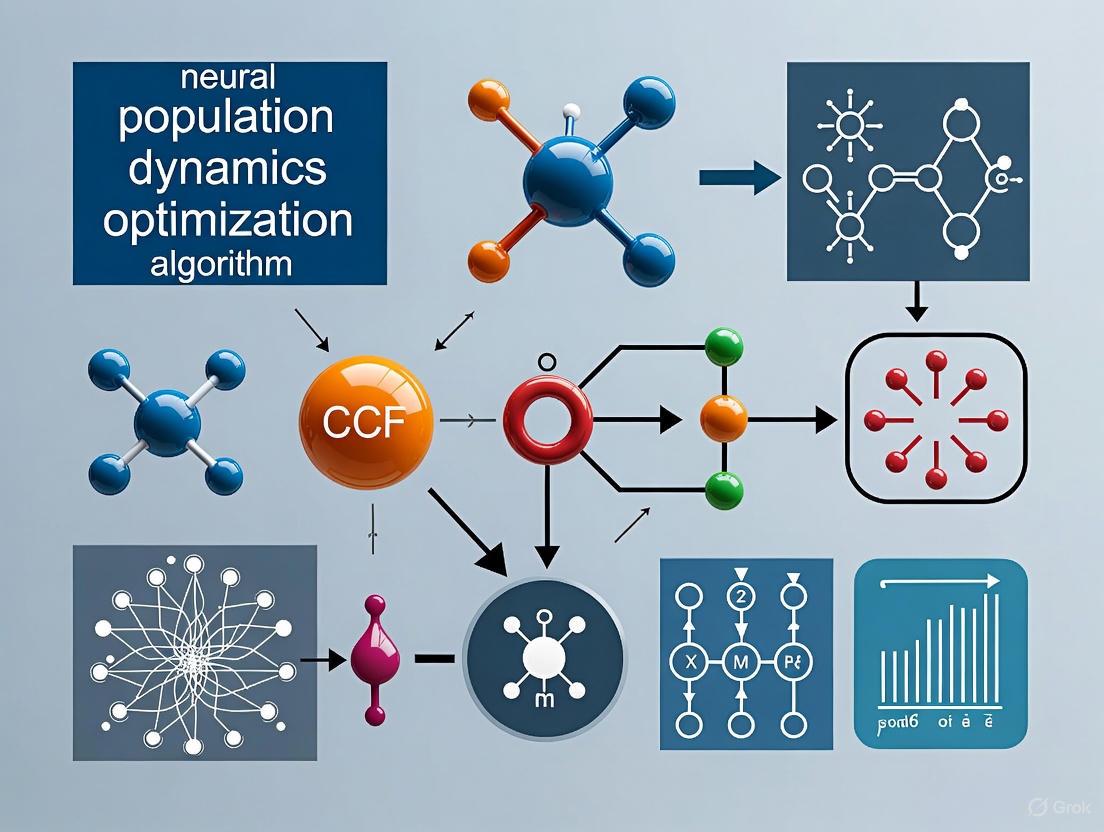
This article provides a comprehensive overview of neural population dynamics optimization algorithms, a cutting-edge framework that combines dynamical systems theory, machine learning, and large-scale neural recordings to understand brain computation.
Neural Population Dynamics Optimization: Algorithms for Brain Computation and Biomedical Innovation
Abstract
This article provides a comprehensive overview of neural population dynamics optimization algorithms, a cutting-edge framework that combines dynamical systems theory, machine learning, and large-scale neural recordings to understand brain computation. Tailored for researchers, scientists, and drug development professionals, we explore the foundational principles of how populations of neurons collectively perform computations through their coordinated temporal evolution. We detail key methodological advances, including low-rank dynamical models, active learning for efficient data collection, and privileged knowledge distillation that integrates behavioral data. The article further addresses central troubleshooting and optimization challenges, such as overcoming local minima and managing high-dimensional data, and provides a rigorous validation framework comparing algorithm performance across biomedical applications. Finally, we discuss the transformative potential of these algorithms in accelerating drug discovery and improving clinical trial design.
The Core Principles of Neural Population Dynamics and Their Computational Role
Defining Computation Through Neural Population Dynamics (CTD)
Computation Through Neural Population Dynamics (CTD) is a foundational framework in modern neuroscience for understanding how neural circuits perform computations. This approach posits that the brain processes information through the coordinated, time-varying activity of populations of neurons, which can be formally described using dynamical systems theory [1] [2]. The core insight of CTD is that cognitive functions—including decision-making, motor control, timing, and working memory—emerge from the evolution of neural population states within a low-dimensional neural manifold [2] [3]. This stands in contrast to perspectives that focus on individual neuron coding, instead emphasizing that collective dynamics are fundamental to neural computation [4].
The CTD framework has gained prominence due to significant advances in experimental techniques that enable simultaneous recording of large neural populations, coupled with computational developments in modeling and analyzing high-dimensional dynamical systems [2] [4]. This framework provides a powerful lens through which researchers can interpret complex neural data, formulate testable hypotheses about neural function, and even develop novel brain-inspired optimization algorithms, such as the Neural Population Dynamics Optimization Algorithm (NPDOA) [5].
Mathematical Foundations of Neural Population Dynamics
Core Dynamical Systems Formulation
At the heart of CTD is the formal treatment of a neural population as a dynamical system. The activity of a population of N neurons is represented by an N-dimensional vector, x(t), where each element represents the firing rate of a single neuron at time t [2]. The evolution of this neural population state is governed by the equation:
[ \frac{dx}{dt} = f(x(t), u(t)) ]
Here, (f) is a function—potentially nonlinear—that captures the intrinsic dynamics of the neural circuit, including the effects of synaptic connectivity and neuronal biophysics. The variable (u(t)) represents external inputs to the circuit from other brain areas or sensory pathways [2] [6]. This formulation allows the trajectory of neural activity through state space to be modeled as a dynamical system, analogous to physical systems like pendulums or springs [2].
Linear Approximations and Fixed Point Analysis
While neural dynamics are often nonlinear, linear approximations around fixed points provide valuable analytical insights. A linear dynamical system (LDS) is described by:
[ x(t+1) = Ax(t) + Bu(t) ]
Here, (A) is the dynamics matrix that determines how the current state evolves, and (B) is the input matrix that determines how external inputs affect the state [6] [4]. The fixed points of the system—where (dx/dt = 0)—are critical for understanding its computational capabilities. Around these points, dynamics can be characterized as attractors (stable states), repellers (unstable states), or oscillators [6]. These dynamical motifs are thought to underpin various cognitive functions, such as memory retention (via attractors) and rhythmic pattern generation (via oscillators) [6].
State Space Representation and Dimensionality Reduction
The concept of state space is central to visualizing and analyzing neural population dynamics. Each axis in this space represents the activity of one neuron (or a latent factor), and the instantaneous activity of the entire population is a single point in this high-dimensional space [2]. Over time, this point traces a path called the neural trajectory [2].
A key observation in neural data is that these trajectories often lie on a low-dimensional neural manifold, despite the high dimensionality of the native state space [3] [4]. This means that although thousands of neurons may be recorded, their coordinated activity can be described using many fewer variables. Dimensionality reduction techniques like Principal Component Analysis (PCA) are essential tools for identifying these manifolds and visualizing the underlying neural trajectories [2] [3].
Table 1: Key Mathematical Concepts in Neural Population Dynamics
| Concept | Mathematical Representation | Neural Interpretation | Computational Role |
|---|---|---|---|
| Neural Population State | (x(t) = [x1(t), x2(t), ..., x_N(t)]) | Firing rates of N neurons at time t | Represents the current state of the population |
| Dynamics Function | (\frac{dx}{dt} = f(x(t), u(t))) | Intrinsic circuit properties & connectivity | Determines how the state evolves over time |
| Fixed Points | (f(x^, u^) = 0) | Stable or unstable equilibrium states | Attractors for memory, decision states |
| Linear Approximation | (\frac{d\delta x}{dt} = A\delta x(t) + B\delta u(t)) | Local dynamics around an operating point | Enables analytical analysis of stability |
| Neural Manifold | Low-dimensional subspace embedded in high-dimensional state space | Collective modes of population activity | Constrains and guides neural computation |
Experimental and Methodological Approaches
Measuring and Analyzing Neural Population Activity
Experimental investigation of CTD requires simultaneous recording from many neurons. Modern techniques include high-density electrophysiology, calcium imaging, and neuropixels probes that can monitor hundreds to thousands of neurons simultaneously across multiple brain areas [4]. The typical workflow involves:
- Neural State Extraction: Preprocessing raw neural recordings (spikes or fluorescence) to obtain firing rates or deconvolved activity for each neuron [2].
- Dimensionality Reduction: Applying PCA or other methods to identify the low-dimensional neural manifold and project high-dimensional data into this subspace [3].
- Dynamics Identification: Using statistical methods to infer the dynamical system (f) that best describes the observed neural trajectories [2] [3].
Recent advances include methods like MARBLE (MAnifold Representation Basis LEarning), which uses geometric deep learning to decompose on-manifold dynamics into local flow fields and map them into a common latent space [3]. This allows for comparison of neural computations across sessions, individuals, or even species.
Perturbation Experiments to Test Causality
A critical advancement in CTD research is the move from observational studies to causal perturbation experiments. These involve manipulating neural activity and observing how the system responds, thus testing hypotheses about computational mechanisms [4]. Two primary approaches are:
- Within-Manifold Perturbations: Displacing the neural state along dimensions of the naturally occurring neural manifold. This tests whether specific dimensions are causally related to behavior [4].
- Outside-Manifold Perturbations: Pushing the neural state into dimensions not typically visited during natural behavior. This can reveal latent computational capacities or stability properties [4].
Techniques for implementing these perturbations include optogenetics, electrical microstimulation, and even task manipulations that alter sensory-motor contingencies [4].
CTD Experimental Workflow: From data acquisition to computational interpretation
The Neural Population Dynamics Optimization Algorithm (NPDOA)
From Biological Principles to Optimization Framework
The Neural Population Dynamics Optimization Algorithm (NPDOA) is a novel brain-inspired meta-heuristic optimization method that directly translates principles of CTD into an algorithmic framework for solving complex optimization problems [5]. In NPDOA, potential solutions to an optimization problem are represented as neural populations, with each decision variable corresponding to a neuron and its value representing the firing rate of that neuron [5]. The algorithm simulates the activities of interconnected neural populations during cognition and decision-making, implementing three core strategies derived from neural population dynamics [5].
Core Dynamics Strategies in NPDOA
NPDOA implements three fundamental strategies that balance exploration and exploitation, mirroring computations in biological neural systems:
- Attractor Trending Strategy: This strategy drives neural populations toward optimal decisions, ensuring exploitation capability. It mimics how neural populations converge toward stable states associated with favorable decisions [5].
- Coupling Disturbance Strategy: This strategy deviates neural populations from attractors by coupling them with other neural populations, thereby improving exploration ability. It prevents premature convergence by introducing controlled disruptions [5].
- Information Projection Strategy: This strategy controls communication between neural populations, enabling a transition from exploration to exploitation. It regulates the impact of the other two dynamics strategies on neural states [5].
These strategies work together to maintain the crucial balance between exploring new solution spaces and exploiting promising regions, a challenge faced by both artificial optimization algorithms and biological neural systems [5].
Table 2: Experimental Protocols for Studying Neural Population Dynamics
| Protocol/Technique | Key Measurements | Analytical Methods | Insights Gained |
|---|---|---|---|
| Delay Reaching Task | Neural activity during preparation and movement phases [6] | Analysis of preparatory activity as initial conditions [6] | How initial neural states determine subsequent motor outputs |
| Integration-Based Tasks | Neural trajectories during evidence accumulation [7] | Identification of integration dynamics and attractor states [7] | Mechanisms of decision-making and working memory |
| Multi-Area Recordings | Simultaneous neural activity from connected brain areas [4] | Communication subspace (CS) analysis [4] | How information is selectively communicated between areas |
| Optogenetic Perturbations | Neural trajectory changes following targeted perturbations [4] | Comparison of pre- and post-perturbation dynamics [4] | Causal evidence for computational mechanisms |
| Pharmacological Manipulations | Changes in neural dynamics and behavior [4] | Altered dynamics matrices (A) in LDS models [4] | How circuit properties influence computation |
NPDOA Algorithm Structure: Balancing exploration and exploitation through neural-inspired strategies
Research Toolkit: Essential Methods and Reagents
Table 3: Research Reagent Solutions for Neural Population Dynamics Studies
| Tool/Technique | Type | Primary Function | Key Applications in CTD |
|---|---|---|---|
| High-Density Electrophysiology (Neuropixels) [4] | Measurement | Record hundreds to thousands of neurons simultaneously | Measuring neural population states across brain areas |
| Optogenetics [4] | Perturbation | Precisely control specific neural populations with light | Causal testing of computational hypotheses via within/outside-manifold perturbations |
| Dimensionality Reduction (PCA, t-SNE, UMAP) [3] | Analytical | Identify low-dimensional neural manifolds | Visualizing and analyzing neural trajectories in reduced state spaces |
| Recurrent Neural Networks (RNNs) [2] [7] | Modeling | Trainable dynamical systems for task modeling | Modeling how neural circuits perform computations through dynamics |
| Linear Dynamical Systems (LDS) [4] | Modeling | Linear approximation of neural dynamics | Baseline models for neural population dynamics; analytical tractability |
| MARBLE [3] | Analytical | Geometric deep learning for neural dynamics | Comparing dynamics across conditions, sessions, and individuals |
| Multi-Plasticity Network (MPN) [7] | Modeling | Network with synaptic modulations during inference | Studying computational capabilities of synaptic dynamics without recurrence |
| Pharmacological Agents (e.g., muscimol) [4] | Perturbation | Transiently alter circuit dynamics | Testing how changes in dynamics matrix (A) affect computation |
The framework of Computation Through Neural Population Dynamics represents a paradigm shift in how neuroscientists conceptualize brain function. By viewing neural computation through the lens of dynamical systems, researchers can leverage powerful mathematical tools to explain how neural circuits give rise to behavior. The CTD perspective has already yielded significant insights into motor control, decision-making, working memory, and timing [1] [2].
Future research directions include expanding CTD to model brain-wide computations across multiple interacting areas [4], developing more sophisticated methods for comparing neural computations across individuals and species [3], and further refining brain-inspired algorithms like NPDOA for solving complex engineering problems [5]. As measurement technologies continue to advance, enabling even larger-scale neural recordings, the CTD framework will likely play an increasingly central role in unraveling the mysteries of neural computation and developing novel artificial intelligence systems inspired by brain principles.
The brain's remarkable computational abilities emerge not from the isolated firing of individual neurons, but from the collective, time-varying activity of large neural populations. Understanding these population dynamics represents a fundamental challenge in modern neuroscience. The dynamical systems framework provides a powerful approach to this challenge, treating neural circuit activity as trajectories through a high-dimensional state space, governed by deterministic and stochastic differential equations [8]. This perspective represents a paradigm shift from descriptive phenomenological models towards a mechanistic understanding of neural computation.
This framework is catalyzing a transformation in precision psychiatry and therapeutic development. By moving beyond static correlations and focusing on the temporal evolution of neural circuit function, it offers a path to detect neuropsychiatric risk prior to the emergence of overt symptoms and to monitor treatment response through quantitative, physiology-based biomarkers [9]. The core thesis is that mental and neurological disorders are ultimately disorders of neural circuit dynamics that develop and change over time, suggesting that monitoring these dynamics can provide crucial personalized information about disease trajectory and treatment efficacy [9].
Theoretical Foundations
From Neural Activity to Dynamical Systems
At its core, the dynamical systems framework for neural circuits posits that the neuroelectric field—the electromagnetic field generated by the synchronized activity of neurons—forms a dynamical system whose properties can be quantified from electrophysiological measurements [9]. This field is considered the physical substrate for all cognition and behavior, serving as the receptor of all sensory input and the physical effector of all movement [9].
The mathematical foundation typically involves describing neural population activity through differential equations that capture how the system state evolves over time. A common formulation for recurrent neural networks (RNNs), which serve as key computational models, is:
[ \tau\dot{x}(t) = -x(t) + Jr(t) + Bu(t) + b ]
Here, (x(t)) represents the synaptic currents, (r(t)) represents the firing rates, (J) is the recurrent connectivity matrix, (Bu(t)) represents external inputs, and (b) is a bias term [8]. This equation captures the essential dynamics of how neural populations integrate inputs over time and transform them into patterns of activity.
Key Computational Principles
Recent theoretical advances have identified several key principles of neural computation within the dynamical systems framework:
- Latent Computing: Neural computations are often low-dimensional, embedded within high-dimensional neural dynamics through latent processing units that enable robust coding despite representational drift in individual neurons [10].
- Manifold Constraint: Neural population dynamics typically evolve on low-dimensional manifolds—smooth subspaces within the high-dimensional state space—that constrain and shape the computational trajectories [3].
- Compositionality: Circuits can perform multiple tasks through compositional representations that combine a shared computational core with specialized neural modules, allowing flexibility and generalization [11].
Table 1: Core Theoretical Concepts in Neural Population Dynamics
| Concept | Mathematical Description | Computational Role |
|---|---|---|
| State Space | High-dimensional space where each axis represents one neuron's firing rate | Provides complete description of population activity at any moment |
| Trajectories | Path through state space over time, ( \vec{x}(t) ) | Encodes temporal evolution of neural processing |
| Attractors | States toward which the system evolves (fixed points, limit cycles) | Underlies stable memory storage and decision states |
| Manifolds | Low-dimensional subspaces ( \mathcal{M} ) constraining trajectories | Reduces dimensionality, reveals computational organization |
| Stability | Lyapunov exponents, Jacobian eigenvalues | Determines robustness to noise and perturbation |
Computational Methodologies
Dynamical Feature Extraction from Neural Data
Extracting dynamical features from experimental recordings requires specialized methodologies. For electrophysiological data such as EEG, the pipeline typically involves:
- Signal Acquisition: Using high-density EEG sensors to measure the neuroelectric field at millisecond resolution [9].
- State Space Reconstruction: Employing embedding techniques to reconstruct the underlying dynamical system from observed time series.
- Feature Quantification: Computing dynamical properties such as stability, oscillatory modes, and attractor landscapes using model-free approaches from dynamical systems theory [9].
These extracted features serve as quantitative proxies for neural circuit function and can be combined with personal and clinical data in machine learning models to create risk prediction models for psychiatric conditions [9].
Advanced Algorithms for Modeling Population Dynamics
Recent methodological advances have significantly improved our ability to infer neural population dynamics:
MARBLE (MAnifold Representation Basis LEarning) uses geometric deep learning to decompose on-manifold dynamics into local flow fields and map them into a common latent space [3]. The method represents the dynamics as a vector field (Fc = (f1(c), \ldots, fn(c))) anchored to a point cloud (Xc = (x1(c), \ldots, xn(c))) of neural states, then approximates the unknown manifold by a proximity graph to define tangent spaces and parallel transport between nearby vectors [3].
Cross-population Prioritized Linear Dynamical Modeling (CroP-LDM) specifically addresses the challenge of distinguishing shared dynamics across brain regions from within-region dynamics [12]. By prioritizing cross-population prediction accuracy in its learning objective, it ensures extracted dynamics correspond to genuine interactions rather than being confounded by within-population dynamics.
iJKOnet approaches learning population dynamics from a different angle, framing it as an energy minimization problem in probability space and leveraging the Jordan-Kinderlehrer-Otto (JKO) scheme for efficient time discretization [13]. This method combines the JKO framework with inverse optimization techniques to learn the underlying stochastic dynamics from observed marginal distributions at discrete time points.
Table 2: Quantitative Comparison of Neural Population Dynamics Methods
| Method | Theoretical Foundation | Dynamical Features Captured | Scalability | Key Application |
|---|---|---|---|---|
| MARBLE [3] | Geometric deep learning, manifold theory | Local flow fields, fixed point structure | ~1000 neurons | Within- and across-animal decoding |
| CroP-LDM [12] | Prioritized linear dynamical systems | Cross-region directional interactions | Multi-region recordings | Identifying dominant interaction pathways |
| AutoLFADS [14] | Sequential variational autoencoders | Single-trial latent dynamics | Large-scale populations (~1000 neurons) | Motor, sensory, cognitive areas |
| iJKOnet [13] | Wasserstein gradient flows, JKO scheme | Population-level stochastic evolution | Population-level data | Single-cell genomics, financial markets |
Workflow for Neural Population Dynamics Analysis
The following diagram illustrates a generalized computational workflow for analyzing neural population dynamics, integrating elements from multiple methodologies described in the search results:
Figure 1: Computational workflow for clinical application of neural population dynamics, from raw data acquisition to clinical validation.
Experimental Protocols and Validation
Protocol 1: Identifying Neural Manifolds with MARBLE
Objective: To learn interpretable representations of neural population dynamics and identify the underlying manifold structure during cognitive tasks [3].
Procedure:
- Data Collection: Simultaneously record single-neuron activity from relevant brain regions (e.g., premotor cortex in macaques during reaching, hippocampus in rats during navigation) at sampling rates ≥1 kHz.
- Preprocessing: Calculate firing rates using Gaussian kernel smoothing (σ = 20-50 ms). Organize data into trials aligned to behavioral events.
- Manifold Learning:
- Input: Neural firing rates {x(t; c)} for trials under condition c.
- Construct proximity graph to approximate underlying manifold.
- Define local flow fields (LFFs) around each neural state.
- Train geometric deep learning architecture to map LFFs to latent vectors zi using contrastive learning.
- Validation: Assess within- and across-animal decoding accuracy of behavioral variables. Compare neural trajectories across conditions using optimal transport distance between latent distributions.
Key Outputs: Low-dimensional latent representations that parametrize high-dimensional neural dynamics; quantitative similarity metric between dynamical systems across conditions and animals [3].
Protocol 2: Tracking Cross-Population Dynamics with CroP-LDM
Objective: To quantify directional interactions between neural populations in different brain regions, prioritizing shared dynamics over within-region dynamics [12].
Procedure:
- Neural Recording: Simultaneously record multi-unit activity from at least two brain regions (e.g., motor and premotor cortex) during structured behavioral tasks.
- Data Preparation: Bin spike counts into 10-20 ms time bins. Define source and target populations.
- Model Fitting:
- Initialize CroP-LDM with prioritized learning objective for cross-population prediction.
- Learn latent states representing shared dynamics using subspace identification.
- Optionally perform causal (filtering) or non-causal (smoothing) inference.
- Interaction Quantification: Calculate partial R² metric to quantify non-redundant information flow between regions. Identify dominant interaction pathways.
Key Outputs: Interpretable measures of directional influence between brain regions; low-dimensional latent states capturing shared dynamics [12].
Protocol 3: Automated Single-Trial Inference with AutoLFADS
Objective: To automatically infer accurate single-trial neural population dynamics without extensive manual hyperparameter tuning [14].
Procedure:
- Data Preparation: Segment neural data (spike counts) into trials or overlapping continuous segments. For self-paced behaviors, use overlapping segments without trial alignment.
- Automated Hyperparameter Optimization:
- Implement coordinated dropout (CD) to prevent identity overfitting.
- Use Population-Based Training (PBT) with evolutionary algorithms for dynamic hyperparameter adjustment.
- Distribute training over dozens of workers simultaneously.
- Model Selection: Use validation likelihood as reliable metric (enabled by CD regularization).
- Rate Inference: Merge inferred firing rates from overlapping segments using weighted combination.
Key Outputs: Denoised single-trial firing rates; latent factors; inputs capturing task-related structure [14].
The Scientist's Toolkit
Table 3: Essential Research Reagents and Computational Tools
| Tool/Resource | Function/Purpose | Example Application |
|---|---|---|
| High-Density EEG | Measures neuroelectric field dynamics at millisecond resolution | Precision psychiatry brain function checkups [9] |
| Multi-electrode Arrays | Simultaneously records hundreds of neurons across brain regions | Studying cross-population dynamics [12] |
| MARBLE Algorithm | Learns manifold-constrained neural representations | Identifying consistent dynamics across animals [3] |
| AutoLFADS Framework | Automated inference of single-trial dynamics | Modeling less structured, naturalistic behaviors [14] |
| CroP-LDM | Prioritizes learning of shared cross-region dynamics | Identifying dominant interaction pathways [12] |
| iJKOnet | Learns population dynamics from distribution snapshots | Single-cell genomics, financial markets [13] |
| RNNs (vanilla, E-I) | Biologically plausible models of neural computation | Testing circuit mechanisms of decision making [11] |
| Optimal Control Tools | Computes efficient stimulation for modulating dynamics | Controlling oscillations and synchrony [15] |
Applications in Psychiatric Research and Drug Development
The dynamical systems framework offers particularly promising applications in psychiatric research and therapeutic development through several key approaches:
Neural Trajectory Monitoring for Precision Psychiatry
A fundamental application involves reconceptualizing mental health as a trajectory through time rather than a fixed state [9]. This enables:
- Risk Detection Prior to Symptom Emergence: By monitoring changes in neural circuit function through brief, routine EEG measurements analyzed using dynamical systems theory, it may be possible to detect neurophysiological changes that precede observable symptoms [9].
- Personalized Treatment Monitoring: Treatment can be viewed as an intervention designed to redirect a patient's neural trajectory toward more desirable states, with dynamical features providing quantitative metrics of treatment efficacy [9].
- Objective Biomarkers: Dynamical features extracted from EEG provide objective, physiology-based proxies for neural circuit function that complement subjective clinical assessments [9].
Circuit Mechanisms of Decision Making for Cognitive Disorders
Research into the neural basis of economic choice reveals how recurrent neural networks implement value-based decision making through specific circuit mechanisms [11]. Key findings include:
- Two-Stage Computation: Value computation occurs upstream in feedforward pathways where learned input weights store subjective preferences, while value comparison is implemented within recurrent circuits via competitive recurrent inhibition [11].
- Compositional Representations: Single networks can perform multiple tasks through compositional codes combining shared computational cores with specialized modules [11].
These mechanisms provide testable hypotheses for disorders of decision making (e.g., addiction, impulsivity) and suggest potential targets for therapeutic intervention.
Control of Neural Oscillations for Therapeutic Intervention
Optimal control theory applied to neural population models enables precise manipulation of oscillatory dynamics [15]. This approach offers potential for:
- Synchronization Modulation: Controlling synchrony in pathologically synchronized networks (e.g., Parkinson's disease tremors).
- State Switching: Driving transitions between stationary and oscillatory states or between different oscillatory patterns.
- Novel Cost Functionals: Using Fourier, cross-correlation, or variance-based costs to target oscillations without specifying exact reference trajectories [15].
Future Directions
The dynamical systems framework continues to evolve with several promising research directions:
- Integration with Molecular Mechanisms: Future work must bridge the gap between circuit-level dynamics and molecular/cellular processes, potentially through multi-scale modeling approaches.
- Closed-Loop Therapeutic Applications: Real-time monitoring of neural trajectories could enable closed-loop neuromodulation systems that automatically adjust stimulation parameters based on detected state transitions.
- Cross-Species Validation: Developing methods like MARBLE that identify consistent dynamics across animals [3] will be crucial for translating findings from animal models to human applications.
- Network-Level Integration: Combining within-region dynamical analysis with cross-region interaction mapping to understand how distributed neural circuits coordinate to produce cognition and behavior.
As these methodologies mature and become more widely adopted, the dynamical systems framework promises to transform both our fundamental understanding of neural computation and our approach to diagnosing and treating neuropsychiatric disorders.
A fundamental shift is occurring in neurophysiology: the population doctrine is drawing level with the single-neuron doctrine that has long dominated the field [16]. This doctrine posits that the fundamental computational unit of the brain is the population, not the individual neuron [16]. Neural population dynamics describe how the activities across a population of neurons evolve over time due to local recurrent connectivity and inputs from other neural populations [17]. These dynamics provide a framework for understanding neural computation, with studies modeling them to gain insight into processes underlying decision-making, timing, and motor control [18].
The core insight is that neural population activity evolves on low-dimensional manifolds—smooth subspaces within the high-dimensional space of all possible neural activity patterns [19] [20]. This means that while we might record from hundreds of neurons, their coordinated activity traces out trajectories in a much lower-dimensional space [18]. Understanding the structure of these manifolds and the dynamics that unfold upon them has become central to modern neuroscience [20].
Table: Key Concepts in Neural State Space Analysis
| Concept | Definition | Computational Significance |
|---|---|---|
| State Space | Neuron-dimensional space where each axis represents one neuron's activity | Provides spatial view of neural population states as vectors with direction and magnitude [16] |
| Manifold | Low-dimensional subspace where neural population dynamics actually evolve | Reflects underlying computational structure; enables dimensionality reduction [19] [20] |
| Neural Trajectory | Time course of neural population activity patterns in characteristic order | Reveals computational processes through evolution of population state over time [21] |
| Flow Field | Dynamical system governing how neural state evolves from any given point | Determines possible paths and computations; reflects network connectivity [21] |
| Attractor | Stable neural state or pattern toward which dynamics evolve | Implements memory, decisions, or stable motor outputs [5] [22] |
Theoretical Foundations of Neural State Spaces
The State Space Framework
For a population of d neurons, the neural state space is a d-dimensional space where each axis represents the firing rate of one neuron [16]. At each moment in time, the population's activity forms a vector—the neural state—occupying a specific point in this space [16]. As time progresses, this point moves, tracing a neural trajectory that represents the temporal evolution of population activity [16] [18].
The neural state vector has both direction and magnitude [16]. The direction reflects the pattern of activity across neurons, potentially encoding information such as object identity in inferotemporal cortex [16]. The magnitude represents the total activity level across the population and may predict behavioral outcomes like memory performance [16].
Manifolds and Low-Dimensional Structure
Despite the high dimensionality of the neural state space, empirical evidence shows neural population dynamics typically evolve on low-dimensional manifolds [19] [18] [20]. This low-dimensional structure arises from correlations in neural activity and constraints imposed by network connectivity [18]. The discovery of this structure enables powerful dimensionality reduction techniques, making analysis of complex neural data tractable.
Figure 1: The conceptual workflow from high-dimensional neural activity to computation via low-dimensional manifolds and trajectories.
Analytical Methodologies and Visualization Techniques
Dimensionality Reduction for Manifold Identification
Identifying low-dimensional manifolds requires specialized dimensionality reduction techniques:
- Principal Component Analysis (PCA): Linear method that finds orthogonal directions of maximum variance [20]
- Targeted Dimensionality Reduction (TDR): Linear method designed for neural data with specific targeting [20]
- Gaussian Process Factor Analysis (GPFA): Probabilistic method that extracts smooth, low-dimensional latent trajectories from noisy neural data [21]
- t-SNE and UMAP: Nonlinear manifold learning methods that preserve local structure [20]
These techniques transform high-dimensional neural data into more interpretable low-dimensional visualizations while preserving essential dynamical features.
Analyzing Neural Trajectories and Dynamics
Once neural trajectories are identified in low-dimensional state spaces, several analytical approaches characterize their properties:
- Trajectory Geometry: Examining the shape, curvature, and separation of trajectories associated with different behaviors or cognitive states [21]
- Distance Metrics: Quantifying relationships between neural states using Euclidean distance, vector angles, or Mahalanobis distance (which accounts for covariance structure between neurons) [16]
- Dynamic Flow Fields: Characterizing the vector fields that describe how neural states evolve from any given point in state space [21]
Table: Comparison of Neural State Space Analysis Methods
| Method | Type | Key Features | Limitations |
|---|---|---|---|
| PCA | Linear | Finds maximal variance directions; computationally efficient | Misses nonlinear structure; may obscure relevant dynamics |
| GPFA | Probabilistic | Extracts smooth trajectories; handles noise effectively | Complex implementation; requires parameter tuning |
| LFADS (Latent Factor Analysis via Dynamical Systems) | Nonlinear (RNN) | Infers single-trial dynamics; models underlying dynamical system | Requires substantial data; complex training [23] [20] |
| MARBLE (Manifold Representation Basis Learning) | Geometric Deep Learning | Maps local flow fields; enables cross-system comparison; unsupervised [19] [20] | New method with limited track record; computationally intensive |
| CEBRA (Consistent EmBeddings of Recordings using Auxiliary variables) | Representation Learning | Learns joint behavior-neural embeddings; high decoding accuracy | Often requires behavioral supervision for cross-animal consistency [20] |
The MARBLE Framework for Neural Dynamics
The MARBLE (MAnifold Representation Basis LEarning) framework represents a recent advancement in analyzing neural population dynamics [19] [20]. This unsupervised geometric deep learning method:
- Decomposes on-manifold dynamics into local flow fields (LFFs) that capture dynamical behavior in local neighborhoods [20]
- Uses contrastive learning to map LFFs into a common latent space without requiring behavioral supervision [20]
- Provides a well-defined similarity metric (optimal transport distance) to compare dynamics across conditions, sessions, or animals [20]
- Operates in both embedding-aware and embedding-agnostic modes, enabling comparison across different neural recordings [20]
Figure 2: The MARBLE analytical workflow for obtaining interpretable representations of neural dynamics.
Experimental Protocols for Neural State Space Analysis
Experimental Design Considerations
Studies investigating neural population dynamics typically employ:
- Large-Scale Neural Recordings: Simultaneous monitoring of dozens to hundreds of neurons using techniques like two-photon calcium imaging, multi-electrode arrays, or Neuropixels [17] [18] [21]
- Structured Behavioral Tasks: Tasks with well-defined cognitive processes (decision-making, motor planning, memory) to link neural dynamics to computation [21]
- Causal Perturbations: Techniques like optogenetics or electrical stimulation to test hypotheses about dynamical mechanisms [18]
Protocol: Measuring Neural Dynamics with Two-Photon Imaging and Optogenetics
This protocol measures neural population dynamics in mouse cortex using two-photon calcium imaging combined with two-photon holographic optostimulation [17]:
- Surgical Preparation: Prepare transgenic mice expressing calcium indicators (e.g., GCaMP) and channelrhodopsin in excitatory neurons.
- Neural Recording: Record neural population activity at 20Hz using two-photon calcium imaging of a 1mm×1mm field of view containing 500-700 neurons [17].
- Photostimulation Design: Define 100 unique photostimulation groups, each targeting 10-20 randomly selected neurons [17].
- Trial Structure: For each trial:
- Deliver a 150ms photostimulus to a selected neuron group
- Follow with a 600ms response period before next trial begins
- Repeat for ~2000 trials across 25 minutes [17]
- Data Preprocessing: Extract calcium traces from recorded images and convert to firing rate estimates.
- Dimensionality Reduction: Apply GPFA or PCA to obtain low-dimensional neural trajectories.
- Dynamical Modeling: Fit dynamical systems models (e.g., low-rank autoregressive models) to the neural trajectories [17].
Protocol: Brain-Computer Interface (BCI) Constraint Testing
This protocol tests constraints on neural trajectories using a BCI paradigm in non-human primates [21]:
- Neural Recording: Implant multi-electrode array in motor cortex and record from ~90 neural units [21].
- State Extraction: Transform neural activity into 10D latent states using causal Gaussian Process Factor Analysis (GPFA) [21].
- BCI Mapping: Create intuitive "movement-intention" mapping that projects 10D latent states to 2D cursor position.
- Behavioral Task: Train animals to perform two-target BCI task moving cursor between diametrically opposed targets.
- Trajectory Analysis: Identify natural neural trajectories during successful task performance.
- Separation-Maximizing Projection: Find 2D projection that maximizes separation between A-to-B and B-to-A trajectories.
- Flexibility Testing: Challenge animals to produce neural trajectories in time-reversed order or follow prescribed paths in neural state space [21].
The Scientist's Toolkit: Research Reagent Solutions
Table: Essential Tools for Neural Population Dynamics Research
| Tool/Technique | Function | Example Applications |
|---|---|---|
| Two-Photon Calcium Imaging | Records activity from hundreds to thousands of neurons simultaneously with cellular resolution | Monitoring neural population dynamics in rodent cortex during behavior [17] |
| Multi-Electrode Arrays | Records extracellular action potentials from dozens to hundreds of neurons | Investigating motor cortex dynamics during primate reaching and BCI tasks [21] |
| Two-Photon Holographic Optogenetics | Precisely stimulates experimenter-specified groups of individual neurons | Causal perturbation of neural populations to test dynamical models [17] |
| Dimensionality Reduction Algorithms (PCA, GPFA) | Extracts low-dimensional manifolds from high-dimensional neural data | Identifying neural trajectories underlying cognitive processes [18] [21] |
| Recurrent Neural Network (RNN) Models | Models nonlinear neural dynamics and generates testable predictions | Theorizing about computational mechanisms implemented by neural circuits [18] |
| Geometric Deep Learning (MARBLE) | Learns interpretable representations of neural dynamics on manifolds | Comparing neural computations across animals and conditions [19] [20] |
Applications in Cognitive and Clinical Neuroscience
Revealing Computational Mechanisms
Neural state space analysis has provided insights into diverse cognitive functions:
- Decision-Making: Neural trajectories in parietal and prefrontal cortex exhibit dynamics consistent with evidence accumulation toward decision boundaries [16] [18]
- Working Memory: Persistent neural states implement memory maintenance through attractor dynamics [16] [18]
- Motor Control: Motor cortex trajectories follow consistent paths that correspond to movement kinematics [21]
- Semantic Cognition: Semantic knowledge is organized in attractor landscapes where concept similarity reflects neural state proximity [22]
Clinical and Translational Applications
Understanding neural population dynamics holds promise for:
- Brain-Machine Interfaces: Decoding neural trajectories enables more naturalistic prosthetic control [21]
- Neurological Disorders: Aberrant neural dynamics may underlie conditions like Parkinson's disease, schizophrenia, and epilepsy
- Drug Development: Assessing how pharmacological interventions affect neural dynamics could provide new therapeutic evaluation metrics
Integration with Neural Population Dynamics Optimization
The visualization and analysis of neural state spaces directly informs the development of Neural Population Dynamics Optimization Algorithms (NPDOA) [5]. These brain-inspired meta-heuristic optimization methods implement three key strategies derived from neural population principles:
- Attractor Trending Strategy: Drives solutions toward optimal decisions, ensuring exploitation capability [5]
- Coupling Disturbance Strategy: Deviates solutions from attractors through coupling mechanisms, improving exploration ability [5]
- Information Projection Strategy: Controls communication between solution populations, enabling transition from exploration to exploitation [5]
This bio-inspired approach demonstrates how principles extracted from neural state space analysis can inform algorithm development in other domains, creating a virtuous cycle between neuroscience and computational optimization.
Neural state spaces provide a powerful framework for visualizing and analyzing population activity and trajectories. The population doctrine—that neural computation occurs at the level of populations rather than individual neurons—has reshaped modern neuroscience [16]. By combining large-scale neural recordings with sophisticated analytical techniques, researchers can now identify low-dimensional manifolds, track neural trajectories, and characterize the dynamical flow fields that implement neural computation.
These approaches have revealed fundamental constraints on neural activity [21] and provided insights into how cognitive processes emerge from network-level dynamics. As analytical methods like MARBLE continue to advance [19] [20], and as recording technologies enable even larger-scale monitoring of neural populations, state space analysis will undoubtedly yield further insights into the computational principles of brain function.
The integration of neural state space analysis with optimization algorithms further demonstrates the bidirectional exchange between neuroscience and computer science, where principles extracted from brain function can inspire novel computational methods with broad applicability [5].
Neural population dynamics represent a fundamental framework for understanding how collective neural activity gives rise to cognition. This technical review examines the mechanisms by which neural populations support three core cognitive functions: decision-making, motor control, and working memory. We explore how dynamics emerge from circuit-level interactions and how these processes are increasingly being formalized through optimization algorithms such as the Neural Population Dynamics Optimization Algorithm (NPDOA). By synthesizing recent experimental and computational advances, we provide a comprehensive overview of population coding principles, their manifestation across brain regions, and their implications for developing brain-inspired computational methods. The integration of neuroscientific findings with optimization frameworks offers promising avenues for both understanding neural computation and advancing artificial intelligence.
Neural population dynamics refer to the time-varying patterns of activity across ensembles of neurons that collectively encode information and drive behavior. Rather than focusing on single-neuron responses, this approach examines how cognitive representations emerge from the coordinated activity of neural populations [22]. Population dynamics provide a mechanistic link between synaptic-level processes and system-level cognitive functions, operating through low-dimensional manifolds that constrain neural activity trajectories [3].
The theoretical foundation of population dynamics originates from the understanding that representations in the central nervous system are encoded as patterns of activity involving highly interconnected neurons distributed across multiple brain regions [22]. These dynamics are characterized by several key properties: (1) trajectories in state space that evolve over time during cognitive processes, (2) attractor states that represent stable network configurations corresponding to specific representations or decisions, and (3) transitions between states that implement cognitive operations such as decision formation or memory recall [24].
Recent methodological advances have enabled unprecedented access to population-level activity through large-scale electrophysiology, calcium imaging, and fMRI, revealing that neural dynamics operate on multiple timescales and are distributed brain-wide rather than being confined to specific regions [25]. This distributed nature suggests that cognitive functions emerge from interactions across multiple neural systems, each contributing distinct computational properties to the overall process.
Theoretical Foundations and Mathematical Frameworks
Population Coding and Representation
In population coding frameworks, information is represented not by individual neurons but by patterns of activity across neural ensembles. This distributed representation provides robustness to noise and enables complex computations through population vectors and basis functions [22]. The mathematics underlying these representations typically involves high-dimensional state spaces where each dimension corresponds to the activity of one neuron, with cognitive processes mapping to trajectories through this space.
A key concept is the neural manifold—a low-dimensional subspace that captures the majority of task-relevant variance in population activity. Within this manifold, different cognitive states correspond to distinct locations, and cognitive operations correspond to movements through the manifold [3]. Formally, if we represent a population of N neurons' activity as a vector x(t) = [x₁(t), x₂(t), ..., x_N(t)]^T, the neural manifold hypothesis states that these points lie near a d-dimensional subspace where d ≪ N.
Dynamical Systems Approaches
Neural population dynamics are frequently modeled using dynamical systems theory, which describes how neural states evolve over time according to differential equations of the form:
[ \frac{dx}{dt} = F(x, u, t) ]
where x represents the neural state, u represents inputs, and F defines the dynamics [24]. These equations can capture various dynamical regimes including fixed points (attractors), limit cycles, and chaotic dynamics, each of which may subserve different cognitive functions.
Attractor dynamics are particularly important for understanding cognitive functions such as working memory and decision-making. In these models, basins of attraction correspond to different memory states or decision alternatives, with the depth of these basins determining the stability of representations [24]. Noise-driven transitions between attractors can model stochastic decision processes or memory errors.
Table 1: Key Mathematical Frameworks for Neural Population Dynamics
| Framework | Core Principle | Applications | Limitations |
|---|---|---|---|
| Attractor Networks | Dynamics converge to stable states (attractors) | Working memory, decision-making | Often requires fine-tuning of parameters |
| Linear Dynamical Systems | Dynamics approximated as linear transformations | Dimensionality reduction, neural decoding | May oversimplify nonlinear neural dynamics |
| Nonlinear Oscillators | Coupled oscillators with nonlinear interactions | Motor control, rhythmic movements | Complex analysis, many parameters |
| Gaussian Processes | Probabilistic framework for neural trajectories | Modeling uncertainty in neural dynamics | Computationally intensive for large populations |
The Neural Population Dynamics Optimization Algorithm (NPDOA)
The NPDOA represents a novel brain-inspired metaheuristic that formalizes principles of neural population dynamics into an optimization framework [5]. This algorithm implements three core strategies derived from neural systems:
Attractor trending strategy: Drives neural populations toward optimal decisions, ensuring exploitation capability by converging toward stable states associated with favorable decisions.
Coupling disturbance strategy: Deviates neural populations from attractors through coupling with other neural populations, improving exploration ability by disrupting convergence to suboptimal states.
Information projection strategy: Controls communication between neural populations, enabling transition from exploration to exploitation by regulating information transmission.
In NPDOA, each decision variable represents a neuron, with its value corresponding to the neuron's firing rate. The algorithm simulates activities of interconnected neural populations during cognition and decision-making, with neural states transferring according to neural population dynamics [5]. This framework provides a powerful approach for solving complex optimization problems while simultaneously offering insights into neural computation principles.
Decision-Making
Neural Mechanisms of Evidence Accumulation
Decision-making involves gradually accumulating sensory evidence toward a threshold that triggers a choice. This process is implemented in neural circuits through ramping activity that integrates evidence over time [24]. Neurophysiological studies across species demonstrate that during perceptual decisions, neural populations in parietal, prefrontal, and premotor cortices exhibit firing rates that gradually increase until reaching a decision threshold, at which point a choice is initiated [24] [25].
The dynamics of decision formation can be visualized in state space as a trajectory moving from an initial undecided state toward decision-selective attractor states [24]. The speed and trajectory of this movement depend on both the strength of sensory evidence and the architecture of the underlying neural circuits. In such frameworks, reaction time differences and accuracy trade-offs emerge naturally from the dynamics of the evidence accumulation process.
Brain-wide studies in mice performing visual change detection tasks reveal that evidence integration occurs not only in traditional decision areas but distributed across most brain regions, including frontal cortex, thalamus, basal ganglia, midbrain, and cerebellum [25]. This suggests highly parallelized evidence accumulation mechanisms rather than serial processing through a limited number of areas.
Experimental Protocols for Studying Decision Dynamics
Key experiments investigating decision-making dynamics often employ perceptual decision tasks where subjects report judgments about sensory stimuli while neural activity is recorded. A classic paradigm is the random-dots motion (RDM) direction discrimination task, where subjects judge the net direction of motion in a dynamic dot display [24]. The difficulty is controlled by varying the motion coherence, allowing researchers to examine how evidence quality affects neural dynamics.
Analysis methods include:
- Single-neuron tuning analysis: Examining how firing rates of individual neurons correlate with stimulus features or choices.
- Population decoding: Using pattern classifiers to read out decision variables from population activity.
- Dynamical systems analysis: Fitting dynamical models to neural trajectories to identify underlying computational principles.
Recent technical advances enable large-scale recordings across multiple brain regions simultaneously during decision tasks. For example, Neuropixels probes allow monitoring of thousands of neurons across the mouse brain, revealing distributed representations of decision variables [25]. These experiments typically involve:
- Training animals on decision tasks with controlled sensory evidence
- Implanting electrodes or performing calcium imaging across multiple regions
- Recording neural activity during task performance
- Analyzing temporal dynamics of evidence representation using generalized linear models or dimensionality reduction techniques
Diagram 1: Neural Dynamics of Decision-Making
Table 2: Brain Regions Implicated in Decision-Making and Their Contributions
| Brain Region | Contribution to Decision-Making | Key Dynamics | Experimental Evidence |
|---|---|---|---|
| Posterior Parietal Cortex | Evidence accumulation, sensorimotor transformation | Ramping activity toward decision threshold | Monkey neurophysiology during RDM tasks [24] |
| Prefrontal Cortex | Executive control, rule representation, value coding | Stable working memory representations, decision-related activity | Monkey and human recording studies [24] [26] |
| Premotor Cortex | Action selection, motor preparation | Choice-selective activity before movement | Mouse brain-wide recordings [25] |
| Striatum | Action valuation, selection | Activity correlated with chosen value, action selection | Mouse fMRI and electrophysiology [25] |
Working Memory
Stable and Dynamic Memory Representations
Working memory (WM)—the ability to maintain and manipulate information over short periods—relies on both stable and dynamic neural population codes. Traditional models proposed that WM is maintained through persistent activity in prefrontal cortex (PFC) neurons [26]. However, recent evidence reveals a more complex picture where WM representations can transform and evolve over the delay period while still preserving information.
Human fMRI studies using multivariate decoding have demonstrated coexisting stable and dynamic neural representations of WM content across multiple cortical visual field maps [26]. Surprisingly, these studies found greater dynamics in early visual cortex compared to high-level visual and frontoparietal cortex, challenging traditional hierarchical models of WM maintenance.
Population dynamics during WM tasks often exhibit representational reformatting, where the neural code transforms into formats more proximal to upcoming behavior. For example, during a memory-guided saccade task, V1 population activity initially encodes a narrowly tuned activation centered on the peripheral memory target, which then spreads inward toward foveal locations, forming a vector along the trajectory of the forthcoming memory-guided saccade [26]. This suggests that WM representations are not static but actively transform to support subsequent actions.
Experimental Protocols for Assessing Working Memory Dynamics
Standard protocols for investigating WM dynamics include:
- Delayed response tasks: Subjects encode a stimulus, maintain it during a delay period, then respond based on the memorized information.
- Continuous report tasks: Subjects reproduce continuous features (e.g., orientation, color) of remembered stimuli.
- Sequence memory tasks: Subjects remember and reproduce sequences of items or locations.
Analysis approaches focus on:
- Temporal decoding: Training classifiers at different time points to assess how information content changes over time
- Neural trajectory analysis: Visualizing population activity paths in low-dimensional space
- Cross-temporal generalization: Testing whether classifiers trained at one time point generalize to other time points, indicating stable representations
Advanced neuroimaging techniques such as population receptive field mapping have made these neural dynamics interpretable by relating BOLD signals to underlying neural representations [26]. These methods allow researchers to visualize how specific visual features are represented and transformed in neural populations during WM maintenance.
Diagram 2: Working Memory Dynamics and Reformatting
Motor Control
From Preparation to Execution
Motor control involves the transformation of movement intentions into precisely coordinated muscle activations. Neural population dynamics play a crucial role in this process, with distinct dynamical regimes for movement preparation versus execution [25]. During preparation, neural populations in motor and premotor cortices exhibit activity patterns that encode upcoming movements while the body remains still, demonstrating a clear dissociation between movement planning and execution.
Brain-wide recordings in mice performing decision-making tasks reveal that preparatory activity is distributed across dozens of brain regions, not just traditional motor areas [25]. This preparatory activity forms a neural subspace that is distinct from the subspace active during movement execution, allowing for independent control of preparation and implementation. The transition from preparation to execution is marked by a collapse of the preparatory subspace and activation of execution-related patterns.
The relationship between evidence accumulation and motor preparation is particularly revealing. In areas that accumulate evidence, shared population activity patterns encode both visual evidence and movement preparation, with these representations being distinct from movement-execution dynamics [25]. This suggests that learning aligns evidence accumulation with action preparation across distributed brain regions.
Experimental Approaches to Motor Dynamics
Studying motor dynamics requires techniques that can capture both planning and execution phases with high temporal precision. Common approaches include:
- Reach-to-target tasks: Subjects move their hand from a starting position to targets, allowing study of trajectory formation and correction.
- Postural maintenance tasks: Subjects maintain specific postures against perturbations, revealing stability mechanisms.
- Sequential movement tasks: Subjects execute movement sequences, illuminating chunking and timing mechanisms.
Analysis methods focus on:
- Neural manifolds: Identifying low-dimensional subspaces that capture movement-related variance
- Condition-invariant dynamics: Discovering neural patterns that are consistent across similar movements
- Neural trajectories: Tracking the evolution of population activity through state space during movement
Recent technical advances such as markerless motion capture combined with large-scale neural recordings enable comprehensive investigation of how neural dynamics relate to detailed kinematic features [25]. These approaches reveal that motor cortex does not simply represent movement parameters but implements dynamics that generate appropriate temporal patterns for movement control.
Analysis Methods and Computational Tools
Advanced Analysis Techniques
Understanding neural population dynamics requires specialized analytical approaches that can extract meaningful patterns from high-dimensional neural data. Several key methods have emerged:
Dimensionality reduction techniques such as Principal Component Analysis (PCA), Gaussian Process Factor Analysis (GPFA), and variational autoencoders (VAEs) identify low-dimensional structure in neural population activity [3]. These methods project high-dimensional neural data into meaningful subspaces where dynamics can be visualized and interpreted.
Manifold learning approaches including UMAP, t-SNE, and the recently developed MARBLE (MAnifold Representation Basis LEarning) framework go beyond linear dimensionality reduction to capture nonlinear structure in neural dynamics [3]. MARBLE specifically decomposes on-manifold dynamics into local flow fields and maps them into a common latent space using unsupervised geometric deep learning.
Dynamical systems modeling fits formal models to neural data to identify underlying computational principles. These include linear dynamical systems, switching linear dynamical systems, and recurrent neural network models that can capture both the continuous evolution and discrete transitions in neural activity [24].
The Scientist's Toolkit: Research Reagent Solutions
Table 3: Essential Research Tools for Studying Neural Population Dynamics
| Tool/Category | Function/Purpose | Example Applications | Key Considerations |
|---|---|---|---|
| Neuropixels Probes | High-density electrophysiology recording from hundreds of neurons simultaneously | Brain-wide recording of decision-making in mice [25] | Requires specialized implantation surgery and data processing pipelines |
| Two-Photon Calcium Imaging | Optical recording of neural population activity with cellular resolution | Monitoring cortical population dynamics during learning | Limited penetration depth, typically cortical |
| Virus-Based Tools (GCaMP, jGCaMP) | Genetically encoded calcium indicators for monitoring neural activity | Large-scale population imaging in specific cell types | Expression time, potential toxicity at high levels |
| Dimensionality Reduction Software | Algorithms for identifying low-dimensional neural manifolds | PCA, UMAP, MARBLE for analyzing population dynamics [3] | Choice of algorithm depends on data structure and scientific question |
| Neural Decoding Tools | Classifiers for extracting information from population activity | Readout of decision variables or movement intentions | Cross-validation essential to avoid overfitting |
| Optogenetics | Precise manipulation of specific neural populations | Causal testing of population dynamics hypotheses | Limited to genetically targeted populations, potential network effects |
Methodological Framework for Experimental Investigation
Integrated Experimental Design
Comprehensive investigation of neural population dynamics across cognitive functions requires carefully designed experiments that combine behavioral tasks with neural recordings and perturbations. An effective experimental framework includes:
Task design with parametric manipulation: Systematic variation of sensory evidence, memory demands, or motor requirements to probe different dynamical regimes.
Large-scale neural recording: Simultaneous monitoring of neural activity across multiple brain regions using Neuropixels, calcium imaging, or other high-yield techniques.
Population-level analysis: Application of dimensionality reduction, decoding, and dynamical systems analysis to identify population codes.
Causal manipulation: Optogenetic or chemogenetic perturbation of specific neural populations to test necessity and sufficiency.
For example, a comprehensive experiment might involve training mice on a memory-guided decision task while recording from dozens of brain regions using Neuropixels, then applying dimensionality reduction to identify neural manifolds, and finally using optogenetics to perturb specific population activity patterns at key decision points [25].
Data Analysis Pipeline
A standardized analysis pipeline for population dynamics typically includes:
Preprocessing: Spike sorting, calcium trace deconvolution, or BOLD signal preprocessing to extract neural activity.
Dimensionality reduction: Application of PCA, FA, or nonlinear methods to identify low-dimensional neural manifolds.
Neural decoding: Training classifiers or regression models to read out task variables from neural activity.
Dynamical systems analysis: Fitting dynamical models to neural trajectories and identifying fixed points, limit cycles, or other dynamical features.
Cross-condition alignment: Using methods like CCA or MARBLE to align neural representations across sessions, subjects, or conditions [3].
This pipeline enables researchers to move from raw neural data to interpretable dynamical portraits of cognitive processes, facilitating comparison across studies and species.
Neural population dynamics provide a powerful framework for understanding how distributed neural activity gives rise to cognition. Across decision-making, working memory, and motor control, we observe consistent principles: cognitive representations emerge from trajectories through low-dimensional neural manifolds, distributed brain regions contribute to cognitive computations, and learning shapes neural dynamics to support task performance.
The formalization of these principles in optimization algorithms like NPDOA demonstrates the bidirectional value between neuroscience and computational methods [5]. Neuroscience provides inspiration for novel algorithms, while computational formalization offers testable hypotheses about neural function.
Future research directions include:
- Cross-species comparisons of population dynamics to identify conserved computational principles
- Longitudinal studies of how neural dynamics change during learning and development
- Integration of molecular and systems levels to understand how microcircuit properties give rise to population dynamics
- Clinical applications of dynamics-based approaches to diagnose and treat neurological disorders
As recording technologies continue to improve, providing access to larger neural populations across more brain regions, population dynamics approaches will likely play an increasingly central role in unraveling the neural basis of cognition.
Key Experimental Evidence from Multiple Brain Regions
Understanding how the brain makes decisions requires studying how groups of neurons, or neural populations, work together across different brain areas. Research on neural population dynamics seeks to uncover the computational principles that govern these complex, distributed processes. A central focus in this field is the development of optimization algorithms that can explain how neural circuits efficiently transform sensory information into decisions and actions. This whitepaper synthesizes key experimental evidence from multiple brain regions, highlighting how diverse neural populations implement core computations, with particular relevance for developing novel therapeutic strategies in neurological and psychiatric disorders.
Quantitative Evidence from Key Brain Regions
Studies recording from multiple brain areas simultaneously have revealed that evidence accumulation is not confined to a single "decision center" but is a distributed process implemented by distinct neural dynamics in different regions.
Table 1: Distinct Evidence Accumulation Signatures Across Rat Brain Regions [27]
| Brain Region | Abbreviation | Key Finding | Characteristic Neural Dynamics |
|---|---|---|---|
| Anterior-dorsal Striatum | ADS | Near-perfect accumulation of sensory evidence. | Graded representation of accumulated evidence; reflects decision vacillation. |
| Frontal Orienting Fields | FOF | Unstable accumulator favoring early evidence. | Activity appears categorical but is driven by unstable integration sensitive to early input. |
| Posterior Parietal Cortex | PPC | Graded evidence accumulation. | Weaker correlates of graded accumulation compared to ADS. |
| Whole-Animal Behavior | (N/A) | Distinct from all recorded neural models. | Suggests behavioral-level accumulation is constructed from multiple neural-level accumulators. |
Table 2: Brain-Wide Encoding of Decision Variables in Mice [25]
| Neural Encoding Type | Prevalence Across Brain Regions | Key Observation |
|---|---|---|
| Sensory Evidence (Stimulus) | Sparse (5-45% of neurons), but distributed. | Found in visual areas, frontal cortex, basal ganglia, hippocampus, cerebellum; absent in orofacial motor nuclei. |
| Lick Preparation | Substantial fraction, distributed globally. | Activity build-up preceding movement, observed across dozens of regions. |
| Lick Execution | Widespread (>50% of neurons). | Dominant signal across the brain, indicating global recruitment for action. |
Detailed Experimental Protocols
The findings summarized above were made possible by rigorous experimental designs and advanced recording techniques.
- Subject and Training: Data were collected from 11 well-trained, food-restricted rats performing at a high level.
- Task Design: Rats listened to two simultaneous streams of randomly timed auditory clicks from left and right speakers. After the click train ended, they were required to orient to the side that had more clicks to receive a reward.
- Data Collection and Analysis: Researchers analyzed 37,179 behavioral choices and recordings from 141 neurons from the FOF, PPC, and ADS. Only neurons with significant tuning for choice during the stimulus period (two-sample t-test, p<0.01) were included.
- Computational Modeling: A unified latent variable model was developed to infer probabilistic evidence accumulation models jointly from choice data, neural activity, and precisely controlled stimuli. This framework allowed for the direct comparison of accumulation models that best described neural activity in each region versus the model that best described the animal's choices.
- Subject and Training: Head-fixed, food-restricted mice were trained on a visual change detection task. They had to report a sustained increase in the speed of a visual grating by licking a reward spout, while remaining stationary during evidence presentation.
- Task Design: The stimulus speed fluctuated noisily, and mice had to integrate this ambiguous evidence over time (3-15.5 seconds). The design dissociated sensory evidence from early movement-related activity.
- Data Collection: Dense recordings were performed using Neuropixels probes from 15,406 units across 51 brain regions (cortex, basal ganglia, thalamus, midbrain, cerebellum, etc.), combined with high-speed videography of face and pupil movements.
- Data Analysis: Single-cell Poisson generalized linear models (GLMs) were used to identify neurons significantly encoding visual evidence, lick preparation, and lick execution. A cross-validated nested test held out a predictor of interest to assess its unique contribution to neural activity.
Visualization of Core Concepts
Unified Modeling of Neural and Behavioral Data
Distributed Evidence-to-Action Transformation
The Scientist's Toolkit: Research Reagent Solutions
Table 3: Essential Reagents and Tools for Neural Population Dynamics Research
| Item | Function/Application |
|---|---|
| Neuropixels Probes | High-density silicon electrodes for simultaneous recording from hundreds to thousands of neurons across multiple brain regions [25]. |
| Poisson Generalized Linear Models (GLMs) | Statistical models for identifying how task variables (sensory evidence, choice, action) are encoded in neural spiking activity [25]. |
| Latent Variable Models | Computational framework for inferring shared, unobserved variables (e.g., accumulated evidence) that jointly explain neural activity and behavior [27]. |
| Task-Control Software | Precisely controlled presentation of sensory stimuli (e.g., auditory clicks, visual gratings) and behavioral contingency management [27] [25]. |
| High-Speed Videography | Tracking of facial movements and pupil dynamics to correlate neural activity with nuanced behaviors and arousal states [25]. |
Key Algorithms and Models: From Theory to Biomedical Application
Low-Rank Linear Dynamical Systems for Efficient Dimensionality Reduction
Low-rank linear dynamical systems (LDS) represent a powerful computational framework for extracting interpretable, low-dimensional latent dynamics from high-dimensional neural population recordings. These models address a fundamental challenge in modern neuroscience: understanding how coordinated activity across many neurons gives rise to brain function, while overcoming the curse of dimensionality that plagues direct analysis of high-dimensional neural data. The core principle involves constraining the dynamics of a neural population to evolve within a low-dimensional subspace, characterized by a low-rank connectivity matrix that captures the essential computational structure of the circuit.
The mathematical foundation of low-rank LDS begins with the state-space formulation, where observed neural activity (\bm{x}(t) \in \mathbb{R}^N) from N neurons is governed by latent dynamics (\bm{z}(t) \in \mathbb{R}^K) with K << N. The system evolves according to:
[\bm{z}(t) = \bm{A}\bm{z}(t-1) + \bm{\epsilon}(t)] [\bm{x}(t) = \bm{C}\bm{z}(t) + \bm{\omega}(t)]
where (\bm{A} \in \mathbb{R}^{K \times K}) is the state transition matrix, (\bm{C} \in \mathbb{R}^{N \times K}) is the observation matrix, and (\bm{\epsilon}(t)), (\bm{\omega}(t)) represent process and observation noise respectively. The low-rank constraint is implemented by factorizing the connectivity matrix (\bm{W} \in \mathbb{R}^{N \times N}) as (\bm{W} = \bm{U}\bm{V}^T), where (\bm{U}, \bm{V} \in \mathbb{R}^{N \times K}) with K << N. This factorization dramatically reduces the number of parameters from O(N²) to O(NK), enabling robust estimation from limited data while revealing the underlying computational structure [28].
In the broader context of neural population dynamics optimization research, low-rank LDS provides a principled approach to solving the inverse problem of inferring latent dynamics and connectivity from partially observed neural activity. Recent advances have focused on extending these models to capture more complex neural phenomena, including disentangled representations, cross-population interactions, and nonlinear dynamics, while maintaining interpretability and computational efficiency.
Theoretical Foundations and Mathematical Frameworks
Core Mathematical Principles
The theoretical underpinnings of low-rank LDS stem from dynamical systems theory and statistical inference. The low-rank constraint on neural connectivity reflects a fundamental organizational principle of neural circuits: that high-dimensional neural activity is driven by a limited number of collective modes or neural ensembles. Mathematically, this is expressed through the eigen-decomposition of the connectivity matrix (\bm{W} = \sum{i=1}^K \lambdai \bm{u}i \bm{v}i^T), where each mode (\lambdai) represents a dynamical timescale with corresponding spatial pattern (\bm{u}i) and input projection (\bm{v}_i) [28].
From a statistical perspective, learning low-rank LDS involves maximizing the likelihood of observed neural data under the model constraints. The complete-data log-likelihood for a sequence of T observations is given by:
[\mathcal{L}(\theta) = \sum_{t=1}^T \log p(\bm{x}(t) | \bm{z}(t); \bm{C}) + \log p(\bm{z}(t) | \bm{z}(t-1); \bm{A}) - \text{regularization terms}]
where (\theta = {\bm{A}, \bm{C}, \bm{Q}, \bm{R}}) represents all model parameters, with (\bm{Q}) and (\bm{R}) being noise covariance matrices. The low-rank constraint is typically enforced through regularization or explicit parameterization, such as the Disentangled Recurrent Neural Network (DisRNN) framework which encourages group-wise independence among latent dimensions [28].
Disentangled Low-Rank Representations
A significant advancement in low-rank LDS is the incorporation of disentanglement principles to assign distinct computational roles to different latent dimensions. Traditional approaches using singular value decomposition (SVD) yield orthogonal components that are not necessarily independent or semantically meaningful. The DisRNN framework addresses this limitation by introducing a partial correlation penalty that encourages disentanglement between groups of latent dimensions while allowing flexible within-group entanglement [28].
This disentangled approach is formalized through a modified objective function that combines the standard model likelihood with a disentanglement penalty:
[\mathcal{L}{\text{dis}}(\theta) = \mathcal{L}(\theta) - \gamma \sum{g \neq g'} \text{Corr}(\bm{z}g, \bm{z}{g'})]
where (\gamma) controls the strength of disentanglement, and (\bm{z}g), (\bm{z}{g'}) represent different groups of latent variables. This formulation allows the model to identify independent latent subspaces that evolve separately, potentially corresponding to distinct cognitive processes or computational functions, as demonstrated in motor and decision-making tasks [28].
Table 1: Comparison of Low-Rank LDS Variants and Their Mathematical Properties
| Model Variant | Rank Constraint | Dynamics Formulation | Key Mathematical Features | Optimal Use Cases |
|---|---|---|---|---|
| Standard Low-Rank LDS | Fixed rank K | Linear Gaussian | EM algorithm with subspace constraints | Basic dimensionality reduction; preliminary analysis |
| DisRNN (Disentangled RNN) | Group-wise low-rank | Nonlinear with partial disentanglement | Variational inference with correlation penalties | Identifying independent neural computations |
| CroP-LDM (Cross-Population) | Prioritized cross-population rank | Linear with prioritization objective | Preferential subspace identification | Cross-regional neural interactions |
| LINT (Low-Rank Inference) | Fixed rank K with SVD parameterization | Linear with history convolution | SVD of connectivity matrix (\bm{W} = \bm{A}\bm{B}) | Interpretable connectivity analysis |
Experimental Protocols and Methodologies
Model Fitting and Validation Framework
Implementing low-rank LDS requires careful attention to experimental design and validation. The core protocol begins with neural data preprocessing, including spike sorting, binning, and normalization, followed by model selection, parameter estimation, and rigorous validation. For a typical analysis of motor cortical data, the following standardized protocol ensures reproducible results [12]:
Neural Recording and Preprocessing: Neural activity is recorded using multi-electrode arrays implanted in relevant brain regions (e.g., M1, PMd). Spike sorting identifies individual neurons, and firing rates are computed in non-overlapping time bins (typically 10-50ms). The data is then z-scored to normalize firing rates across neurons.
Model Selection and Rank Determination: The optimal latent dimensionality K is determined using cross-validation on held-out neural data. Standard approaches include comparing log-likelihood on test data, predictive (R^2), or information criteria (AIC/BIC). For monkey motor cortical data, typical ranks range from 5-20 for populations of 100-200 neurons [12].
Parameter Estimation: Model parameters are estimated using expectation-maximization (EM) or variational inference. The E-step infers latent states given parameters using Kalman filtering/smoothing, while the M-step updates parameters given the complete-data likelihood. For DisRNN models, stochastic gradient descent with the disentanglement penalty is employed [28].
Model Validation: The fitted model is validated through multiple approaches: (a) predictive accuracy on held-out data, (b) reconstruction of known experimental conditions from latent space, (c) comparison of inferred connectivity with anatomical constraints, and (d) simulation-based checks to ensure dynamical stability.
Cross-Population Dynamics Protocol
The CroP-LDM (Cross-Population Prioritized Linear Dynamical Modeling) protocol specifically addresses the challenge of identifying interactions between neural populations while avoiding confounding by within-population dynamics [12]. This method employs a prioritized learning objective that emphasizes accurate prediction of target population activity from source population activity:
Population Definition: Two neural populations are defined (e.g., from different brain regions). For within-region analysis, non-overlapping neuron groups within the same region are used.
Prioritized Objective Specification: The learning objective is formulated to prioritize cross-population prediction:
[\min{\theta} \|\bm{X}{\text{target}} - f(\bm{X}_{\text{source}}; \theta)\|^2 + \lambda \|\theta\|^2]
where (f(\cdot)) represents the cross-population dynamical mapping, and (\lambda) controls regularization.
Causal vs. Non-Causal Inference: CroP-LDM supports both causal (filtering) and non-causal (smoothing) inference of latent states. Causal inference uses only past neural data for interpretability of information flow, while non-causal inference uses both past and future data for higher accuracy with noisy recordings [12].
Interaction Quantification: The strength of cross-population interactions is quantified using a partial (R^2) metric that measures the non-redundant information one population provides about another, accounting for within-population dynamics.
Table 2: Key Experimental Metrics for Validating Low-Rank LDS Performance
| Validation Metric | Calculation Method | Interpretation | Acceptance Criteria | ||
|---|---|---|---|---|---|
| Predictive (R^2) | (1 - \frac{\sum(\bm{x}{\text{true}} - \bm{x}{\text{pred}})^2}{\sum(\bm{x}_{\text{true}} - \bar{\bm{x}})^2}) | Out-of-sample prediction accuracy | >0.7 for strong fit; >0.4 for moderate fit | ||
| Latent Dimension Consistency | Cross-validated log-likelihood across splits | Stability of identified latent space | <10% variation across data splits | ||
| Dynamical Stability | Maximum eigenvalue of (\bm{A}) matrix | Stability of inferred dynamics | ( | \lambda_{\text{max}} | < 1) for stability |
| Disentanglement Metric | Correlation between latent groups | Independence of latent processes | ( | \rho | < 0.3) between groups |
| Cross-Population (R^2) | Partial (R^2) for target prediction | Strength of between-region interactions | >0.3 for significant interactions |
Implementation and Computational Considerations
Algorithmic Workflows and Architecture
Implementing low-rank LDS requires structured computational workflows that balance expressivity and interpretability. The following diagram illustrates the complete experimental pipeline for cross-population neural dynamics analysis using the CroP-LDM framework:
Neural Dynamics Analysis Workflow
The DisRNN framework implements a specialized architecture for disentangled dynamics learning, combining low-rank constraints with group-wise independence. The following diagram details its core computational structure:
DisRNN Architecture with Disentangled Dynamics
The Scientist's Toolkit: Essential Research Reagents
Table 3: Essential Computational Tools for Low-Rank LDS Research
| Tool/Category | Specific Implementation | Function/Purpose | Key Features |
|---|---|---|---|
| Dynamical Modeling Frameworks | CroP-LDM (Python/MATLAB) | Cross-population dynamics with prioritization | Causal/non-causal inference; partial R² metrics |
| Disentangled Dynamics | DisRNN (PyTorch/TensorFlow) | Group-wise independent latent dynamics | VAE framework; correlation penalties |
| Neural Data Preprocessing | SpikeInterface, FRAME | Spike sorting, binning, normalization | Standardized pipelines; quality metrics |
| Model Validation Suites | DynaBench, NeuroBench | Standardized benchmarking | Cross-validated metrics; stability tests |
| Visualization Tools | NeuroVis, LatentSpaceViz | Latent trajectory visualization | Phase portraits; connectivity graphs |
| High-Performance Computing | GPU-accelerated EM | Handling large-scale neural recordings | Parallel Kalman smoothing; distributed training |
Applications in Neuroscience and Drug Development
Neural Connectivity and Dynamics Analysis
Low-rank LDS has proven particularly valuable for identifying interpretable neural connectivity patterns and dynamics. In motor cortex studies, these models have revealed how preparatory and movement-related activity evolve in low-dimensional subspaces, with distinct latent dimensions corresponding to different movement parameters. The CroP-LDM framework applied to bilateral motor and premotor cortical recordings demonstrated dominant information flow from PMd to M1, consistent with known anatomical hierarchy, and identified stronger within-hemisphere interactions in the hemisphere contralateral to movement [12].
The DisRNN approach has shown superior performance in identifying functionally specialized latent subspaces in monkey M1 and mouse voltage imaging data. By enforcing group-wise independence, the model successfully disentangled dynamics related to different task variables (e.g., target direction, movement preparation, and execution) that were entangled in standard low-rank models. This disentanglement enables more precise interpretation of how different computational functions are implemented in neural circuits [28].
Drug Development Applications
In pharmaceutical research, low-rank LDS approaches are increasingly integrated into Model-Informed Drug Development (MIDD) frameworks, particularly for optimizing preclinical-to-clinical translation. By identifying low-dimensional neural representations of drug effects, these models can predict pharmacological efficacy and safety more efficiently than traditional high-dimensional approaches [29] [30].
Key applications include:
Target Identification and Validation: Low-rank LDS can identify neural circuit mechanisms affected by disease states, providing quantitative biomarkers for target validation. In neurological and psychiatric disorders, these models detect subtle alterations in neural dynamics that precede behavioral manifestations.
Lead Optimization: By modeling dose-response relationships in low-dimensional neural spaces, researchers can more efficiently optimize compound selection. The DisRNN framework is particularly valuable for identifying whether candidate compounds affect specific neural computations versus causing broad, non-specific effects [28].
Preclinical Prediction Accuracy: Low-rank LDS improves translation from animal models to humans by identifying conserved low-dimensional neural dynamics across species. This approach addresses a fundamental challenge in neuroscience-based drug discovery: reconciling species differences in neural anatomy while preserving functional similarities in computational dynamics [30].
Biomarker Development: The latent dimensions identified by low-rank LDS can serve as quantitative biomarkers for patient stratification and treatment response monitoring in clinical trials, particularly for neurological and psychiatric disorders where traditional biomarkers are lacking.
The field of low-rank linear dynamical systems continues to evolve with several promising research directions. Integration with deep learning approaches, particularly through variational autoencoders and normalizing flows, is enhancing the ability to capture nonlinear dynamics while maintaining interpretability. The development of multi-scale frameworks that connect low-dimensional population dynamics to molecular and cellular mechanisms represents another frontier, potentially bridging gaps between systems neuroscience and drug discovery.
In the context of neural population dynamics optimization research, future work will likely focus on adaptive methods that can track time-varying dynamics during learning or disease progression, and unified frameworks that simultaneously model neural activity and behavior. For drug development, the increasing availability of large-scale neural recordings from human iPSC-derived neurons and organoids presents opportunities for applying low-rank LDS to human-specific neural systems in vitro.
As recording technologies continue to scale to larger neuron counts and broader brain coverage, low-rank LDS will remain essential for extracting interpretable principles from complex neural data. Their mathematical transparency, computational efficiency, and biological interpretability position these methods as foundational tools in both basic neuroscience and translational drug development.
Active Learning and Optimal Design for Informative Neural Perturbations
Active Learning (AL) represents a machine learning paradigm that strategically selects the most informative data points for labeling or acquisition, thereby maximizing model performance while minimizing experimental costs [31]. In the context of neural population dynamics, AL algorithms are revolutionizing how neuroscientists design perturbation experiments to efficiently identify the underlying dynamical systems governing neural computation [17]. This approach is particularly valuable given the constraints on time and resources in neurophysiological experiments, where traditional passive observation methods often lead to inefficient data collection—oversampling some neural activity regions while missing others entirely [17].
The integration of AL with neural population dynamics optimization algorithms creates a powerful framework for causal circuit identification. By treating neural states as solutions and decision variables as neuronal firing rates, researchers can simulate the activities of interconnected neural populations during cognition and decision-making [5]. This brain-inspired approach to optimization leverages three core strategies: attractor trending for driving neural states toward optimal decisions, coupling disturbance for exploring new state spaces, and information projection for regulating the transition between exploration and exploitation [5]. These strategies enable researchers to develop more effective meta-heuristic algorithms for probing neural circuit function.
Theoretical Foundations of Neural Population Dynamics
Modeling Neural Population Dynamics
Neural population dynamics describe how activities across neuronal ensembles evolve over time due to recurrent connectivity and external inputs. Accurately identifying these dynamics provides critical insights into the computations performed by neural populations supporting motor control, decision making, working memory, and learning [17]. Dynamical systems models form the cornerstone of this research, with low-dimensional structure serving as a fundamental principle—neural population dynamics frequently reside in subspaces of significantly lower dimension than the total number of recorded neurons [17] [3].
The mathematical foundation typically begins with a discrete-time linear dynamical system model. For a neural population of d simultaneously recorded neurons, let $xt ∈ ℝ^d$ represent the true neural activity at time *t*, $yt ∈ ℝ^d$ denote the noisy measured activity, and $u_t ∈ ℝ^d$ indicate the photostimulus intensity applied. An autoregressive model of order k (AR-k) captures the temporal evolution as follows:
$$ x{t+1} = \sum{s=0}^{k-1} [As x{t-s} + Bs u{t-s}] + v, \quad yt = xt + w_t $$
where $wt ∼ N(0,σ^2 Id)$ represents measurement noise, $As ∈ ℝ^{d×d}$ and $Bs ∈ ℝ^{d×d}$ describe the coupling between neurons and stimulus at time lag s, and v accounts for baseline neural activity [17]. The matrices $As$ capture intrinsic neural dynamics, while $Bs$ encode how perturbations affect the population.
Low-Dimensional Structure and Manifold Learning
Evidence from experimental neuroscience consistently demonstrates that neural population dynamics evolve on low-dimensional manifolds [3]. This observation justifies the incorporation of low-rank constraints into dynamical models, substantially reducing parameter counts and improving identifiability. The low-rank autoregressive model parameterizes the dynamics matrices as:
$$ As = D{As} + U{As} V{As}^⊤, \quad Bs = D{Bs} + U{Bs} V{Bs}^⊤ $$
where $D$ are diagonal matrices accounting for neuron-specific autocorrelations and direct photostimulation responses, while the low-rank components $UV^⊤$ capture population-level interactions [17]. This parameterization reflects the observation that neural dynamics are dominated by a small number of latent dimensions, a property leveraged by methods like MARBLE (MAnifold Representation Basis LEarning), which decomposes dynamics into local flow fields over neural manifolds [3].
Table 1: Comparison of Neural Dynamical Models
| Model Type | Key Parameters | Assumptions | Applications |
|---|---|---|---|
| Full AR Model | $As, Bs ∈ ℝ^{d×d}$ | Linear dynamics | Baseline modeling |
| Low-Rank AR Model | $U,V ∈ ℝ^{d×r}$, $r≪d$ | Low-dimensional dynamics | Efficient system identification |
| MARBLE | Local flow fields | Manifold structure | Cross-animal comparisons |
Active Learning Frameworks for Neural Perturbations
Algorithmic Foundations
Active learning for neural perturbations operates through an iterative cycle of model estimation, uncertainty quantification, and informative stimulus selection. The fundamental algorithm proceeds as follows:
- Initialization: Collect an initial dataset of neural responses to random perturbations
- Model Fitting: Estimate parameters of the neural dynamical model
- Uncertainty Quantification: Compute predictive uncertainties across possible stimuli
- Stimulus Selection: Choose perturbations that maximize information gain
- Data Acquisition: Apply selected stimuli and record neural responses
- Iteration: Return to step 2 until desired accuracy is achieved [17]
This approach demonstrates significant efficiency improvements, obtaining in some cases a two-fold reduction in the amount of data required to reach a given predictive power compared to passive methods [17]. The core innovation lies in formalizing the selection criterion for informative perturbations, often based on optimal experimental design principles from statistics.
Uncertainty Quantification Methods
Uncertainty quantification plays a pivotal role in active learning for neural dynamics. Two primary approaches dominate the field:
Monte Carlo Dropout: This method uses dropout as a stochastic regularization technique during both training and inference, enabling epistemic uncertainty quantification by performing multiple forward passes with different dropout masks [31]. Regions where the model exhibits high variability across passes indicate high uncertainty, making them promising targets for additional data collection.
Low-Rank Matrix Recovery: This approach exploits the low-dimensional structure of neural dynamics to bound estimation error. Novel analyses of nuclear-norm regularization provide quantification of estimation error in terms of individual measurements, departing from classical analyses that assume symmetric measurement sets satisfying restricted isometry properties [17].
Experimental Protocols for Informative Neural Perturbations
Two-Photon Holographic Optogenetics with Calcium Imaging
The following protocol details the experimental setup for implementing active learning in neural perturbation studies:
Equipment and Reagents:
- Two-photon microscope capable of holographic photostimulation
- Transgenic mice expressing Channelrhodopsin-2 in target neuronal populations
- Calcium indicator (e.g., GCaMP6f or jGCaMP7s)
- Headplate for head-fixed experiments
- Behavioral apparatus (optional, for task engagement)
Procedure:
Surgical Preparation:
- Perform cranial window implantation over the target brain region (e.g., motor cortex)
- Inject AAV vectors expressing calcium indicators and opsins as needed
- Allow 2-4 weeks for expression before imaging
Experimental Setup:
Data Acquisition:
- Record neural activity at 20Hz using two-photon calcium imaging
- Implement trial structure: 150ms photostimulus delivery followed by 600ms response period [17]
- Interleave trials with different photostimulation patterns based on active learning selections
- Continue for approximately 25 minutes, acquiring ~2000 photostimulation trials total [17]
Active Learning Integration:
- Between trials, update the dynamical model based on newly recorded responses
- Calculate information gain for candidate stimulation patterns
- Select the most informative pattern for the next trial
Table 2: Research Reagent Solutions for Neural Perturbation Experiments
| Reagent/Tool | Function | Example Specifications |
|---|---|---|
| Two-photon Microscope | Neural activity imaging | 20Hz imaging rate, 1mm×1mm FOV |
| Holographic Photostimulation System | Precise neural perturbation | 150ms stimulus duration, 10-20 neurons per target |
| Calcium Indicators (GCaMP) | Neural activity reporting | GCaMP6f or jGCaMP7s variants |
| Opsins (Channelrhodopsin) | Neural perturbation | ChR2 expressed in target populations |
| Data Analysis Pipeline | Dynamical system identification | Custom MATLAB/Python code implementing active learning |
Workflow Visualization
Active Learning Workflow: The iterative process for informative neural perturbations.
Optimal Design Principles for Neural Experiments
Design Criteria for Network Experiments
Optimal design of neural perturbation experiments must account for the network structure of neural populations, where nodes (neurons) are interconnected rather than independent observational units. This requires specialized design criteria that address two primary goals:
- Efficiently estimate treatment effects (direct neural perturbation impacts)
- Accurately quantify network adjustments (indirect effects through connectivity) [32]
Alphabetic optimality criteria provide a mathematical framework for designing efficient experiments. For neural perturbations, A-optimality (minimizing the trace of the parameter covariance matrix) and D-optimality (minimizing the determinant of the parameter covariance matrix) are particularly relevant. These criteria lead to designs that are balanced or nearly balanced, ensuring that treatments are distributed as evenly as possible across the neural population while accounting for network adjacency relationships [32].
Incorporating Network Adjustments
The statistical model for network-adjusted neural experiments can be formulated as:
$$ y = Xα + Zτ + ε $$
where y represents the neural response, X is the treatment design matrix encoding which neurons received photostimulation, α quantifies the direct treatment effects, Z captures network adjustment effects based on adjacency relationships, and τ represents the strength of these network influences [32]. The covariance structure accounts for both network effects and measurement noise:
$$ \text{Cov}(y) = στ^2 ZZ^⊤ + σϵ^2 I_N $$
Optimal designs depend on the unknown variance parameters $στ^2$ and $σϵ^2$, requiring robust approaches that perform well across a range of possible parameter values [32].
Applications and Validation
Motor Cortex Circuit Identification
The active learning approach for neural perturbations has been successfully applied to identify dynamics in mouse motor cortex. Using two-photon calcium imaging during holographic photostimulation, researchers demonstrated that actively selected stimulation patterns yielded substantially more accurate estimates of neural population dynamics with fewer measurements compared to passive baselines [17]. This validation involved both synthetic data with known ground truth and real neural recordings, confirming the practical utility of the method in biological settings.
Cross-System Consistency with MARBLE
The MARBLE framework provides a powerful approach for comparing neural dynamics across different systems or individuals. By representing neural states as local flow fields over manifolds and mapping them into a common latent space, MARBLE enables unsupervised discovery of consistent latent representations across networks and animals without requiring auxiliary signals [3]. This capability is particularly valuable for determining whether different neural populations implement similar computational strategies, facilitated by a well-defined similarity metric based on optimal transport distances between latent distributions.
MARBLE Framework: The processing pipeline for neural population dynamics.
Performance Metrics and Benchmarks
Table 3: Performance Comparison of Active vs. Passive Learning
| Metric | Passive Learning | Active Learning | Improvement |
|---|---|---|---|
| Data required for target accuracy | Baseline | ~50% of baseline | 2× reduction [17] |
| Model predictive power | Reference level | Significant enhancement | Substantial [17] |
| Cross-system consistency | Limited | Greatly improved | Enabled via MARBLE [3] |
| Identification of causal interactions | Indirect | Direct and efficient | Enhanced [17] |
The integration of active learning with neural population dynamics optimization represents a paradigm shift in neural circuit investigation. By combining precise perturbation technologies with algorithmic stimulus selection, researchers can now efficiently identify causal mechanisms in neural computation. The theoretical foundation in optimal design theory ensures statistical efficiency, while brain-inspired optimization algorithms provide effective search strategies in high-dimensional spaces.
Future developments will likely focus on scaling these approaches to larger neural populations, incorporating nonlinear dynamical models, and integrating them with behavioral tasks to understand how neural dynamics support specific cognitive functions. Additionally, the application of these methods to drug discovery [33] [34] and the study of neurological disorders presents promising translational avenues. As neural recording and perturbation technologies continue to advance, active learning approaches will play an increasingly vital role in unraveling the complexity of neural computation.
Deep Learning and Recurrent Neural Networks (RNNs) as Models of Neural Dynamics
The quest to understand how the brain performs computation represents a central aim of systems neuroscience. A powerful framework for understanding neural computation uses neural dynamics—the principles governing how neural circuit activity changes over time—to explain how goal-directed input-output transformations occur [35]. This perspective has gained renewed attention through advances in artificial neural network research, particularly through the study of Recurrent Neural Networks (RNNs), which serve as both computational tools for data analysis and conceptual models of brain function [36]. The dynamics of neural populations commonly evolve on low-dimensional manifolds, providing a fundamental constraint that shapes neural information processing [3]. Mapping out the interaction pathways among different brain regions remains a challenging problem in neuroscience, as tasks carried out by the brain rely on coordination among several distinct regions [12]. The emerging field of neural population dynamics optimization algorithm research seeks to develop methods that can infer these latent dynamical processes from experimental data and interpret their relevance in computational tasks, thereby bridging the gap between massive neural datasets and interpretable accounts of neural computation.
Theoretical Foundations: From Neural Computations to Dynamical Systems
The Hierarchy of Neural Information Processing
Any satisfying account of neural computation needs to span three conceptual levels: computational, algorithmic, and implementation [35]. The computational level defines what goal a system is trying to accomplish, described as a mapping from inputs to outputs tuned to achieve specific behaviorally-relevant goals (e.g., memory, sensory integration, or motor control). The algorithmic level specifies the set of rules that enact a particular computation, which in the computation-through-dynamics (CtD) framework are built from neural dynamics. Formally, neuronal circuits learn a D-dimensional latent dynamical system ż = f(z, u) and corresponding output projection x = h(z) whose time-evolution approximates the input/output mapping. The implementation level concerns how these dynamics emerge from the physical biology of neural circuits (synapses, neuromodulators, neuron types, etc.), where relatively low-dimensional dynamics become embedded into an N-dimensional neural activity space (where N >> D) [35].
RNNs as Models of Neural Computation
Recurrent neural networks represent a broad class of models that encompass feed-forward architectures as a special case but extend to fully connected systems without any layered structure [36]. Due to their built-in feedback, RNNs can learn robust representations and are ideally suited to process sequences of data, perform sequential-decision tasks, and act as autonomous dynamical systems that continuously update their internal state even without external input. The long-term behavior of free-running RNNs is controlled by the statistics of neural connection weights, particularly the density (d) of non-zero connections and the balance (b) between excitatory and inhibitory connections [36]. These parameters determine whether the network dynamics display periodic, chaotic, or fixed-point attractors, with different dynamical regimes potentially optimized for distinct computational functions.
Table 1: Dynamical Regimes in RNNs and Their Computational Properties
| Dynamical Regime | Network Characteristics | Computational Properties | Information Import Capacity |
|---|---|---|---|
| Fixed Point | Predominantly excitatory connections (b ≫ 0) | Stable, reproducible dynamics | Low information import |
| Oscillatory | Predominantly inhibitory connections (b ≪ 0) | Rhythmic, periodic patterns | Moderate information import |
| Chaotic | Balanced connections (b ≈ 0) | High sensitivity to inputs | High information import |
| Edge of Chaos | Transition region between regimes | Maximizes computational capability | Peak information import |
The Manifold Hypothesis in Neural Population Dynamics
A fundamental insight in modern neuroscience is that neural population dynamics often evolve on low-dimensional smooth subspaces called neural manifolds [3]. From this perspective, several works have focused on how the geometry or topology of neural manifolds relates to the underlying task or computation. This manifold structure provides a powerful inductive bias for developing decoding algorithms and assimilating data across experiments [3]. The dynamics of neural populations can be described by a vector field Fₐ = (f₁(a), ..., fₙ(a)) anchored to a point cloud Xₐ = (x₁(a), ..., xₙ(a)), where n is the number of sampled neural states. This formulation enables the decomposition of neural dynamics into local flow fields that capture short-term dynamical effects of perturbations [3].
Methodological Approaches: Inferring Dynamics from Neural Data
Data-Driven Dynamics Modeling
Although an interpretable account of a neural circuit requires understanding across all three conceptual levels, researchers typically only have direct access to observations from the implementation level—recorded neural activity. Therefore, the field needs methods that can accurately infer algorithmic features (dynamics f, embedding g, latent activity z) from these neural observations [35]. In recent years, a new class of "data-driven" (DD) models has emerged that are trained to reconstruct recorded neural activity as a product of low-dimensional dynamics and embedding models (f̂, ĝ, respectively) [35]. The primary challenge in this domain is that even near-perfect reconstruction of neural activity does not guarantee that the inferred dynamics accurately represent the underlying system.
Geometric Deep Learning for Neural Dynamics: The MARBLE Framework
The MARBLE (MAnifold Representation Basis LEarning) framework represents a cutting-edge approach that decomposes on-manifold dynamics into local flow fields and maps them into a common latent space using unsupervised geometric deep learning [3]. This method takes as input neural firing rates and user-defined labels of experimental conditions under which trials are dynamically consistent. MARBLE approximates the unknown neural manifold by a proximity graph and uses it to define a tangent space around each neural state and a notion of smoothness between nearby vectors [3]. The architecture consists of three key components: (1) gradient filter layers that give the best p-th order approximation of the local flow field; (2) inner product features with learnable linear transformations that make latent vectors invariant to different embeddings of neural states; and (3) a multilayer perceptron that outputs the latent vector [3].
Cross-Population Prioritized Linear Dynamical Modeling (CroP-LDM)
For studying interactions between brain regions, CroP-LDM provides a specialized framework that learns cross-population dynamics in terms of a set of latent states using a prioritized learning approach, ensuring they are not confounded by within-population dynamics [12]. This method addresses the key challenge that shared dynamics across two regions may be masked by, mistaken for, or confounded by within-region dynamics. CroP-LDM learns a dynamical model that prioritizes the extraction of cross-population dynamics over within-population dynamics by setting the learning objective to be accurate prediction of the target neural population activity from the source neural population activity [12]. The framework supports inference of dynamics both causally in time using only past neural data at each time-step (filtering), and non-causally in time using all data at each time-step (smoothing), providing flexibility based on data quality and analysis goals.
Table 2: Comparison of Neural Dynamics Modeling Approaches
| Method | Theoretical Foundation | Primary Application | Key Advantages | Limitations |
|---|---|---|---|---|
| MARBLE | Geometric Deep Learning | Within-population dynamics on manifolds | Interpretable latent representations; unsupervised operation | Complex architecture; multiple hyperparameters |
| CroP-LDM | Linear Dynamical Systems | Cross-population dynamics | Prioritizes cross-population dynamics; causal inference possible | Linear assumptions may limit expressivity |
| LFADS | Nonlinear Dynamical Systems | Single-trial neural dynamics | Models trial-to-trial variability; generative framework | Requires initial conditions alignment |
| pi-VAE | Physics-Informed Variational Autoencoders | Latent dynamics discovery | Incorporates physical constraints; flexible representation | Complex training; potential identifiability issues |
| CEBRA | Contrastive Learning | Neural behavioral mapping | Can use time, behavior, or mixed supervision; consistent embeddings | Requires supervision for cross-animal alignment |
The Computation-through-Dynamics Benchmark (CtDB)
To address validation challenges in neural dynamics modeling, the Computation-through-Dynamics Benchmark (CtDB) provides a standardized platform with three key components: (1) synthetic datasets that reflect computational properties of biological neural circuits, (2) interpretable metrics for quantifying model performance, and (3) a standardized pipeline for training and evaluating models with or without known external inputs [35]. Traditional validation using low-dimensional chaotic attractors (e.g., Lorenz systems) presents limitations as these systems don't "do" anything—they lack both intended computation and external inputs that are fundamental features of goal-oriented neural circuits [35]. CtDB instead uses proxy systems with computational properties obtained by training dynamics models to perform specific tasks, creating "task-trained" (TT) models that better reflect the challenges of real neural data analysis.
Key Experimental Findings and Quantitative Relationships
Fluctuation-Learning Relationships in Neural Systems
A fundamental relationship between spontaneous neural dynamics and learning speed has been theoretically derived and empirically validated, establishing that learning speed is proportional to the covariance between pre-learning spontaneous activity and the network's input-evoked response [37]. This fluctuation-learning relationship applies broadly across tasks including input-output mapping and time-series generation. For Hebb-type learning rules specifically, initial learning speed scales with the variance of activity along target and input directions [37]. This provides a theoretical basis for experimental observations that greater spontaneous neural activity before learning correlates with higher learning speed in brain-computer interface studies with monkeys, and that behavioral variabilities before learning correlate with speeds of learning new behaviors.
Table 3: Fluctuation-Learning Relationship Across Neural Systems
| System Type | Learning Paradigm | Mathematical Relationship | Experimental Validation |
|---|---|---|---|
| Rate-Based RNNs | Input-Output Mapping | Δx*/Δt ∝ Cov(spontaneous activity, input-evoked response) | Numerical simulations across connectivity regimes |
| Associative Memory | Hebbian Learning | Learning speed ∝ Variance along target direction × (Neural response)² | Pattern storage and retrieval tasks |
| Sequence Generation | Temporal Learning | Sequence learning speed ∝ Fluctuation in sequence-relevant dimensions | Complex sequence production tasks |
| Biological Neural Circuits | Brain-Computer Interface | Learning rate ∝ Pre-learning variability in relevant neural dimensions | Monkey BCI experiments |
Information Import in RNNs
The capacity of neural networks to import external information represents a crucial precondition for practical applications. Quantitative measures of information import, including input-to-state correlation C(xₜ, sₜ₊₁) and mutual information I(xₜ, sₜ₊₁), reveal that information import is maximal not at the classical "edge of chaos" but surprisingly in the low-density chaotic regime and at the border between chaotic and fixed point regimes [36]. Furthermore, a novel resonance phenomenon called Import Resonance (IR) has been identified, where information import shows a peak-like dependence on the coupling strength between the RNN and its external input [36]. This complements previously discovered Recurrence Resonance (RR), where correlation and mutual information of successive system states peak for a certain amplitude of noise added to the system. Both IR and RR can be exploited to optimize information processing in artificial neural networks and likely play crucial roles in biological neural systems.
Population Code Dynamics in Categorical Perception
Categorical perception provides a rich paradigm for studying how neural population dynamics support cognitive functions. A recurrent neural network model that approximates hierarchical Bayesian estimation can account for a wide variety of neurophysiological and cognitive phenomena related to categorical perception [38]. The model implements online inference through interacting populations of hue-selective neurons and category-selective neurons, with dynamics described by:
rᵢ(t) = Φ(∑ⱼ Wᵢⱼʳʳ rⱼ(t-1) + ∑ₖ Wᵢₖʳᶜ cₖ(t) + Iᵢ(t))
where rᵢ(t) represents the activity of the i-th hue-selective neuron, cₖ(t) represents category-selective neuron activity, Wᵢⱼʳʳ and Wᵢₖʳᶜ are synaptic weights, and Iᵢ(t) is bottom-up sensory input [38]. This framework explains task-dependent modulation of neural response, clustering of neural population representation, temporal evolution of perceptual color memory, and non-uniform discrimination thresholds as different aspects of a single model.
Table 4: Essential Research Tools for Neural Dynamics Research
| Resource Type | Specific Examples | Function/Purpose | Key Applications |
|---|---|---|---|
| Data-Driven Modeling Frameworks | MARBLE, LFADS, pi-VAE, CEBRA, CroP-LDM | Infer latent dynamics from neural population recordings | Discovering low-dimensional manifolds; cross-animal alignment; cross-region dynamics |
| Benchmarking Platforms | Computation-through-Dynamics Benchmark (CtDB) | Standardized evaluation of dynamics models | Model validation; performance comparison; method development |
| Synthetic Neural Systems | Task-Trained (TT) models; Biophysical simulators | Generate synthetic data with known ground-truth dynamics | Method validation; controlled hypothesis testing |
| Neural Recording Technologies | High-density electrode arrays; Two-photon calcium imaging | Measure neural population activity with single-cell resolution | Large-scale neural monitoring; population code analysis |
| Analysis Metrics | Dynamics alignment scores; Reconstruction accuracy; Behavioral decoding | Quantify performance of dynamics models | Model evaluation; method selection; experimental design |
Experimental Protocols and Methodologies
Protocol for Mapping Neural Manifolds Using MARBLE
- Data Preparation: Collect neural firing rates {x(t; c)} across multiple trials and conditions. Ensure trials under fixed condition c are dynamically consistent.
- Manifold Approximation: Construct a proximity graph from the neural state point cloud Xₐ = (x₁(a), ..., xₙ(a)) to approximate the underlying neural manifold.
- Tangent Space Definition: Define a tangent space around each neural state and establish a notion of smoothness (parallel transport) between nearby vectors.
- Local Flow Field Extraction: Decompose the vector field into local flow fields (LFFs) defined for each neural state i as the vector field at most a distance p from i over the graph.
- Geometric Deep Learning: Process LFFs through the MARBLE architecture consisting of gradient filter layers, inner product features, and a multilayer perceptron to obtain latent representations.
- Unsupervised Training: Train the network using contrastive learning objectives that leverage the continuity of LFFs over the manifold.
- Distance Computation: Compute distances between latent representations of different conditions using optimal transport distance d(P꜀, P꜀') to reflect dynamical overlap [3].
Protocol for Measuring Information Import in RNNs
- Network Preparation: Initialize RNNs with statistically controlled weight matrices parameterized by balance (b) and density (d) of connections.
- Dynamical Regime Characterization: For free-running networks without external input, compute the average correlation Cₛₛ = C(sₜ, sₜ₊₁) between subsequent system states to identify dynamical regimes (fixed point, oscillatory, chaotic).
- Input Coupling: Apply external input signals to the RNN with varying coupling strengths.
- Information Import Quantification: Calculate input-to-state correlation C(xₜ, sₜ₊₁) as the root-mean-square average of all pairwise neural correlations between momentary input and subsequent system state.
- Mutual Information Computation: Compute mutual information I(xₜ, sₜ₊₁) between input and subsequent state vectors.
- Phase Diagram Construction: Generate phase diagrams C(b, d) and I(b, d) across the parameter space of balance and density.
- Import Resonance Identification: Identify peak information import at specific coupling strengths between RNN and external input [36].
Protocol for Validating Dynamics Models Using CtDB
- Dataset Selection: Choose appropriate synthetic datasets from CtDB that reflect computational properties of biological neural circuits relevant to the research question.
- Model Training: Train data-driven dynamics models to reconstruct neural activity from the synthetic datasets.
- Multi-Metric Evaluation: Assess model performance using interpretable metrics including:
- Dynamics alignment scores between inferred and ground-truth dynamics
- Reconstruction accuracy of neural activity
- Behavioral decoding performance from latent states
- Prediction accuracy on held-out data
- Ablation Studies: Perform controlled ablations to identify critical model components and potential failure modes.
- Comparison with Baselines: Compare performance with established baseline methods using standardized evaluation protocols [35].
The study of deep learning and recurrent neural networks as models of neural dynamics has revealed fundamental principles of neural computation. The manifold hypothesis provides a powerful framework for understanding how high-dimensional neural activity evolves in low-dimensional subspaces to support behavior [3]. The fluctuation-learning relationship establishes a quantitative link between spontaneous neural variability and learning capacity [37]. Cross-population dynamics can be systematically studied using prioritized approaches that dissociate shared dynamics from within-population dynamics [12]. As the field advances, key challenges remain in developing methods that can accurately infer dynamics from increasingly large-scale neural recordings, while maintaining interpretability and biological plausibility. The integration of mechanistic models from computational neuroscience with powerful deep learning approaches represents a promising path forward for unraveling how neural dynamics give rise to cognition and behavior.
Neural population dynamics optimization algorithm research focuses on developing computational models that can accurately describe the coordinated activity of groups of neurons. These dynamics are fundamental to brain function, encoding sensory information, motor commands, and cognitive states [39]. A key challenge in this field is understanding the intricate relationship between neural activity and observable behavior, particularly when perfectly paired neural-behavioral datasets are unavailable in real-world scenarios [40]. The BLEND (Behavior-guided Neural population dynamics modeling via privileged knowledge distillation) framework represents a significant advancement in this domain by addressing a critical research question: how to develop a model that performs well using only neural activity as input during inference, while simultaneously benefiting from insights gained from behavioral signals during training [40] [41]. This approach is particularly valuable for applications in therapeutic development for neurological disorders and the creation of more effective brain-computer interfaces, where understanding behaviorally relevant neural patterns is essential [39].
The integration of behavioral data as a guiding signal for neural dynamics modeling marks an important paradigm shift in computational neuroscience. Traditional methods often rely on either intricate model designs or oversimplified assumptions about neural-behavioral relationships [40]. BLEND circumvents these limitations through its novel application of privileged knowledge distillation, a technique that considers behavior as "privileged information" – data available only during training but not at inference [40] [42]. This framework is model-agnostic, meaning it can enhance existing neural dynamics modeling architectures without requiring specialized models to be developed from scratch, thus offering flexibility and broad applicability across various research contexts [40].
Technical Foundations of BLEND Framework
Core Architecture and Knowledge Distillation Process
The BLEND framework employs a teacher-student knowledge distillation paradigm specifically adapted for neural population dynamics modeling. In this architecture, a teacher model is trained with access to both behavioral observations (privileged features) and neural activities (regular features). A student model is then distilled from the teacher using only neural activity, learning to implicitly incorporate the behavioral insights without direct access to behavioral data during inference [40]. This approach differs from conventional knowledge distillation methods, which typically focus on model compression or transferring knowledge between architectures of different sizes [43].
The mathematical foundation of BLEND draws from privileged knowledge distillation principles, where the teacher model leverages supplementary information to develop a more robust representation of the underlying neural dynamics. The student model then learns to approximate the teacher's functionality while being restricted to the same input space available during deployment. This process enables the student to develop behavioral awareness indirectly through the guidance provided by the teacher during training [40] [42]. The framework avoids making strong assumptions about the precise relationship between behavior and neural activity, allowing it to capture complex, nonlinear interactions that might be missed by more constrained approaches [40].
BLEND Workflow and System Components
The following diagram illustrates the complete BLEND framework, from training through deployment:
BLEND Framework: Training and Inference Pipeline
Experimental Evaluation and Performance Metrics
Quantitative Results Across Diverse Tasks
BLEND has demonstrated significant performance improvements across multiple neural data modeling tasks. Extensive experiments conducted by the framework's developers show substantial enhancements in both behavioral decoding accuracy and transcriptomic neuron identity prediction [40] [41].
Table 1: BLEND Performance Improvements Over Baseline Methods
| Evaluation Metric | Performance Improvement | Task Context |
|---|---|---|
| Behavioral Decoding | >50% improvement | Neural population activity modeling |
| Transcriptomic Neuron Identity Prediction | >15% improvement | Neuron classification task |
| Model Flexibility | Model-agnostic implementation | Compatible with various architectures |
The performance gains demonstrated by BLEND are particularly notable given the framework's model-agnostic design. Unlike specialized approaches that require custom architectures, BLEND can enhance existing neural dynamics models without developing specialized solutions from scratch [40]. This flexibility suggests the framework could be widely adopted across diverse research contexts where behaviorally relevant neural dynamics are being studied.
Comparative Analysis with Alternative Approaches
BLEND operates within a rich ecosystem of neural population dynamics modeling approaches. Alternative methods include MARBLE (MAnifold Representation Basis LEarning), which uses geometric deep learning to decompose dynamics into local flow fields [3], and CroP-LDM (Cross-population Prioritized Linear Dynamical Modeling), which prioritizes learning cross-population dynamics over within-population dynamics [12]. Another recent approach, EAG (Energy-based Autoregressive Generation), employs energy-based transformers to learn temporal dynamics in latent space [39].
Table 2: Comparison of Neural Population Dynamics Modeling Approaches
| Method | Core Methodology | Behavior Integration | Key Advantages |
|---|---|---|---|
| BLEND | Privileged knowledge distillation | Behavior as privileged info during training | Model-agnostic, no strong assumptions |
| MARBLE | Geometric deep learning on manifolds | User-defined condition labels | Interpretable latent representations |
| CroP-LDM | Prioritized linear dynamical modeling | Not explicitly addressed | Focus on cross-region dynamics |
| EAG | Energy-based autoregressive generation | Conditional generation capability | Computational efficiency |
What distinguishes BLEND from these alternative approaches is its specific focus on leveraging behavioral signals as privileged information during training while maintaining the ability to operate with only neural activity during inference. This addresses a practical constraint commonly faced in real-world applications where behavioral measurements may be intermittently available or costly to collect continuously [40].
Implementation Protocols and Research Toolkit
Experimental Workflow for BLEND Implementation
Implementing the BLEND framework involves a structured experimental workflow that can be adapted to various neural data modalities. The following diagram details the step-by-step process:
BLEND Experimental Protocol: Step-by-Step Workflow
Successfully implementing BLEND requires specific computational tools and methodological components. The following table details the essential "research reagents" for applying this framework:
Table 3: BLEND Research Reagent Solutions
| Research Reagent | Function | Implementation Notes |
|---|---|---|
| Neural Recording System | Captures population neural activity | Neuropixels, two-photon calcium imaging, or electrophysiology arrays |
| Behavioral Tracking Apparatus | Quantifies behavioral variables | Motion capture, video tracking, or sensor-based systems |
| Temporal Alignment Algorithm | Synchronizes neural and behavioral data | Critical for teacher model training |
| Base Neural Dynamics Model | Core architecture for dynamics modeling | Can be LFADS, STNDT, or other existing models |
| Knowledge Distillation Controller | Manages teacher-student training process | Implements distillation strategies |
| Privileged Feature Encoder | Processes behavioral data for teacher model | Architecture depends on behavior modality |
| Model Validation Suite | Assesses performance across metrics | Includes neural prediction and behavior decoding tests |
The model-agnostic nature of BLEND means researchers can integrate it with their preferred neural dynamics modeling architecture, whether based on recurrent neural networks, transformers, or other deep learning approaches [40]. This flexibility significantly lowers the barrier to adoption for labs with existing modeling pipelines.
Advanced Applications and Integration Scenarios
Integration with Complementary Methodologies
BLEND can be effectively combined with other advanced neural data analysis approaches to address complex research questions. For instance, integrating BLEND with geometric manifold learning approaches like MARBLE could potentially yield more interpretable latent representations that capture both behavioral relevance and underlying neural manifold structure [3]. Similarly, BLEND could incorporate energy-based modeling principles from approaches like EAG to improve computational efficiency during generation of behaviorally guided neural dynamics [39].
Another promising integration pathway involves combining BLEND with cross-population dynamics modeling approaches like CroP-LDM [12]. This hybrid approach could enable researchers to prioritize behaviorally relevant dynamics that are shared across neural populations in different brain regions, potentially revealing how distributed neural circuits coordinate to produce behavior. Such integrations represent the next frontier in neural population dynamics optimization algorithm research, moving beyond isolated methodologies toward comprehensive frameworks that address multiple challenges simultaneously.
Applications in Pharmaceutical and Biomedical Research
The BLEND framework has significant implications for pharmaceutical and biomedical research, particularly in the development of therapies for neurological disorders. By establishing more accurate relationships between neural population dynamics and behavior, BLEND can enhance the evaluation of potential therapeutic interventions in preclinical models [44]. For example, in drug development for Parkinson's disease, BLEND could help identify how candidate compounds normalize pathological neural dynamics in basal ganglia-thalamocortical circuits and correlate these changes with improvements in motor behavior [39].
In the context of brain-computer interfaces (BCIs) for motor restoration, BLEND's ability to decode behavior from neural activity alone makes it particularly valuable for developing more robust decoding algorithms [39]. The framework's distillation process results in student models that maintain high behavioral decoding accuracy without requiring continuous behavioral measurement, which is often impractical in clinical BCI applications. Furthermore, BLEND's improved transcriptomic neuron identity prediction capability [40] could accelerate the characterization of cell-type-specific effects in pharmaceutical research, potentially identifying how different neuron classes contribute to both behavior and treatment responses.
Future Directions and Methodological Evolution
The development of BLEND represents an important milestone in neural population dynamics research, but several avenues for enhancement remain. Future iterations could explore more sophisticated distillation strategies, potentially incorporating ideas from large language model distillation where progressive distillation techniques have shown remarkable efficiency [43]. Additionally, as the field moves toward increasingly complex behavioral characterization, BLEND could be extended to handle multimodal behavioral data, where different behavior dimensions are treated as distinct privileged information sources.
Another promising direction involves adapting BLEND to handle the challenge of "representational drift" – the phenomenon where neural representations of consistent behaviors change over time despite behavioral stability [3]. By treating temporal context as a form of privileged information, BLEND could potentially learn to compensate for such drift, maintaining consistent behavioral decoding performance across recording sessions. As neural recording technologies continue to advance, enabling larger population monitoring over extended periods, frameworks like BLEND that can effectively leverage behavioral context while remaining practical for deployment will become increasingly essential for translating neural dynamics research into clinical applications.
The integration of artificial intelligence (AI), particularly neural population dynamics optimization algorithms, is revolutionizing drug discovery. This paradigm shift addresses the inefficiencies of traditional methods, which are often costly, time-consuming, and plagued by high failure rates [45]. Neural population algorithms, inspired by the dynamics of biological neural ensembles, provide a powerful framework for modeling complex biological systems and optimizing therapeutic interventions. This technical guide details the application of these advanced computational techniques across target identification, lead optimization, and clinical trial enhancement, providing researchers with actionable methodologies and protocols to accelerate pharmaceutical innovation.
Neuronal population models capture variability across multiple electrophysiological measures from healthy, diseased, and drug-treated phenotypes, moving beyond simplistic population means to address clinical heterogeneity [46]. The core premise is to treat disease states and drug effects as transitions within a high-dimensional space of neural or cellular dynamics. By modeling populations, researchers can identify coherent sets of interventions that effectively shift a diseased population's profile back toward a healthy state. This approach is particularly valuable for central nervous system (CNS) disorders, where physiological variability at the cellular level is pervasive and must be accounted for in therapeutic design [46]. Techniques such as Latent Factor Analysis via Dynamical Systems (LFADS), a deep learning method utilizing recurrent neural networks (RNNs), exemplify this by inferring single-trial latent neural dynamics and extracting denoised underlying rates from observed, variable biological data [47].
Target Identification
Target identification involves discovering and validating molecular targets that play a key role in disease mechanisms. Population-based modeling offers a robust framework for this initial stage.
Population of Models (PoMs) for Phenotypic Characterization
This methodology involves building computational populations that reflect the heterogeneity of both healthy and diseased cellular phenotypes.
- Experimental Protocol:
- Data Acquisition: Collect high-content in vitro electrophysiological data from healthy (Wild-Type, WT) and diseased models. For Huntington's disease (HD), this includes passive membrane properties (e.g., resting membrane potential, input resistance) and active properties (e.g., firing rates, rheobase) from striatal Medium Spiny Neurons (MSNs) [46].
- Model Building: Construct a population of computational models of the target cell (e.g., MSNs) by varying key parameters, such as ion channel conductances, to generate a diverse set of models that collectively reflect the experimentally observed heterogeneity in both WT and HD phenotypes [46].
- Phenotypic Stratification: Use convex hull analysis in a multi-dimensional feature space to visualize and quantify the separation between the WT and HD phenotypic populations. The convex hull represents the smallest convex set enclosing all data points for a given phenotype [46].
- Virtual Drug Screening: Employ evolutionary optimization algorithms to design "virtual drugs"—defined as specific combinations of ion channel modulations. The algorithm searches for the set of modulations that most effectively transitions the HD model population's excitability profile back within the bounds of the WT convex hull [46].
- Efficacy Scoring: Rank virtual drug candidates using metrics that quantify the shift in the population distribution.
- Euclidean Distance (ED3): Measures the shift in the population mean in a 3D feature space.
- Wasserstein Distance: A more robust metric that accounts for differences in both the mean and covariance (the shape) of the population distributions [46]. An effective virtual drug should minimize both distances relative to the WT profile.
Table 1: Efficacy Metrics for a PDE10 Inhibitor (PDE10i) in a Huntington's Disease Model [46]
| Phenotype Comparison | Euclidean Distance (ED3) (Normalized) | Wasserstein Distance (Normalized) |
|---|---|---|
| HD vs. WT | 1.00 | 1.00 |
| HD + PDE10i vs. WT | 0.60 | 0.98 |
The data in Table 1 illustrates that while the PDE10i candidate advanced to clinical trials successfully shifted the population mean closer to the WT mean (40% reduction in ED3), it failed to recapture the covariance structure of the healthy population (only 2% improvement in Wasserstein distance), potentially predicting its subsequent clinical failure [46].
Explainable Graph Neural Networks for Target Discovery
Graph Neural Networks (GNNs) have emerged as transformative tools for target identification by natively representing molecules as graphs, where atoms are nodes and bonds are edges [48] [49].
- Experimental Protocol:
- Molecular Representation: Convert drug molecules from SMILES strings into molecular graphs using toolkits like RDKit [48].
- Node Feature Enhancement: Compute sophisticated node (atom) features using a circular algorithm inspired by Extended-Connectivity Fingerprints (ECFPs). This incorporates the chemical properties of an atom and its local environment, including atomic number, charge, number of hydrogens, and aromaticity [48].
- Model Training: Train an explainable GNN (XGDP) model to predict drug response (e.g., IC50 values from the GDSC database) using molecular graphs and gene expression profiles from cancer cell lines (e.g., from CCLE) [48].
- Target Interpretation: Leverage deep learning attribution algorithms like GNNExplainer and Integrated Gradients to interpret the trained model. These methods identify salient functional groups within a drug molecule and highlight significant genes in cancer cells that the model deems critical for predicting response, thereby revealing potential mechanisms of action [48].
Diagram 1: Explainable GNN for Target Identification
Lead Optimization
Once a target is identified, lead optimization focuses on improving the potency, selectivity, and safety of candidate compounds.
Optimizing Therapeutic Targets with Population-Based Modeling
The virtual drugs identified in the target identification phase represent multi-target modulation profiles. The heuristic approach of evolutionary optimization can identify these coherent sets of ion channel modulations that outperform single-target modulators, offering a more holistic strategy for recovering a healthy phenotypic state from a diseased one [46].
- Experimental Protocol:
- Define Search Space: Establish the set of ion channels or biological parameters to be modulated by the virtual drug.
- Evolutionary Optimization: Apply an optimization algorithm (e.g., Differential Evolution) to explore the combination space. Each candidate solution is a vector of modulation levels for each target.
- Fitness Evaluation: For each virtual drug candidate, simulate its effect on the entire HD model population. The fitness function is a composite of the efficacy metrics (e.g., a weighted sum of ED3 and Wasserstein distance reduction) [46].
- Candidate Selection: Select the top-performing virtual drug candidates that most effectively restore the HD population's excitability features to the WT state. These candidates propose a specific, multi-target therapeutic hypothesis for experimental validation.
Molecular Optimization with Graph Neural Networks
GNNs accelerate lead optimization by predicting molecular properties and generating novel molecular structures with desired characteristics.
- Experimental Protocol:
- Property Prediction: Train a GNN on large chemical databases to predict key ADMET (Absorption, Distribution, Metabolism, Excretion, Toxicity) properties and bioactivity from the molecular graph structure [49].
- Generative Design: Employ generative GNN models for de novo drug design. These models learn the chemical rules and structural patterns associated with desired properties and can generate novel, synthetically accessible molecular structures that are optimized for specific targets [49].
- Virtual Screening: Use the trained GNN models to rapidly screen massive virtual chemical libraries (e.g., ZINC), prioritizing a subset of high-scoring candidates for synthesis and experimental testing, drastically reducing time and cost [49] [45].
Table 2: Key AI Tools in Lead Optimization
| Tool Name | Type | Primary Application in Lead Optimization |
|---|---|---|
| AtomNet [45] | Deep Learning (Convolutional Neural Network) | Structure-based drug design by predicting binding affinity. |
| Generative GNNs [49] | Graph Neural Network | De novo design of novel molecular structures with optimized properties. |
| XGDP Framework [48] | Explainable GNN | Predicting drug response and interpreting key molecular substructures. |
Clinical Trial Enhancement
A major cause of clinical trial failure is the inability to account for population heterogeneity. AI-driven approaches can refine trial design and patient stratification.
In-Silico Triaging and Patient Stratification
Population-based modeling provides a quantitative framework for preclinical scoring and trial design.
- Experimental Protocol:
- Generate In-silico Cohorts: Create virtual patient cohorts by sampling from the well-characterized populations of models (PoMs) that represent biological and pathophysiological heterogeneity [46].
- Simulate Drug Response: Apply candidate drugs (e.g., the virtual drugs from Section 2.1) to the in-silico diseased cohort and simulate the response for each virtual patient.
- Quantify Efficacy Penetrance: Calculate the proportion of the virtual patient population that shows a statistically significant recovery towards the healthy phenotype. This provides a robust, population-level efficacy metric beyond average effects [46].
- Stratify Responders: Use clustering or classification algorithms on the pre-treatment features of the virtual patients to identify sub-populations that are most responsive to the treatment, informing enrollment criteria for clinical trials.
Diagram 2: In-Silico Clinical Trial Workflow
The Scientist's Toolkit: Research Reagent Solutions
The following table details essential computational tools and datasets for implementing the described methodologies.
Table 3: Essential Resources for AI-Driven Drug Discovery
| Item Name | Function / Application | Source / Example |
|---|---|---|
| RDKit | Open-source cheminformatics toolkit for converting SMILES to molecular graphs and computing molecular descriptors. | [48] |
| GDSC Database | Genomic of Drug Sensitivity in Cancer database, providing drug response data (IC50) for a panel of cancer cell lines. | [48] |
| CCLE | Cancer Cell Line Encyclopedia, providing genomic and gene expression data for a wide array of cancer cell lines. | [48] |
| Population of Models (PoMs) | Computational framework using heterogeneous models to capture biological variability and test virtual drugs. | [46] |
| GNNExplainer | Model-level explanation tool for GNNs, identifying important subgraphs and node features for predictions. | [48] |
| AlphaFold | Deep learning system for highly accurate protein structure prediction, aiding target identification and SBDD. | [45] |
| Differential Evolution Algorithm | A metaheuristic optimization algorithm used for training neural networks and searching for optimal virtual drug combinations. | [50] [46] |
The application of neural population dynamics optimization algorithms and advanced AI models like GNNs marks a paradigm shift in drug discovery. By moving beyond population averages to explicitly model and leverage biological heterogeneity, these methods enable more precise target identification, more effective multi-target lead optimization, and more predictive clinical trial planning. The integration of explainable AI ensures that these "black box" models provide actionable insights into drug mechanisms. As these technologies mature, they promise to significantly reduce attrition rates, lower development costs, and accelerate the delivery of novel therapies for diseases with high unmet need.
Overcoming Computational and Practical Challenges in Dynamics Modeling
Addressing the Local Minima Problem in High-Dimensional Parameter Spaces
The problem of local minima presents a significant challenge in the optimization of high-dimensional, non-convex functions, a common scenario in fields ranging from machine learning to computational neuroscience. This technical guide explores how principles from neural population dynamics—specifically the Neural Population Dynamics Optimization Algorithm (NPDOA)—offer a novel framework for navigating complex loss surfaces. By mimicking the brain's ability to process information and make optimal decisions through coordinated neural population activity, NPDOA implements a balanced strategy of exploration and exploitation that effectively avoids premature convergence to suboptimal solutions. We present comprehensive experimental protocols, quantitative comparisons, and practical implementations that demonstrate the superiority of brain-inspired approaches for optimization in high-dimensional spaces.
The Nature of Non-Convex Optimization
In the context of neural networks and complex biological systems, optimization inherently involves non-convex functions with multiple optima, where only one represents the global optimum [51]. The loss surfaces in these high-dimensional parameter spaces contain numerous local minima, saddle points, and flat regions that can trap conventional optimization algorithms. The challenge is particularly acute in deep learning applications where the dimensionality can reach millions of parameters, creating an incredibly complex optimization landscape.
Recent research has revealed that in high-dimensional spaces, saddle points are actually more problematic than local minima [51]. These points are characterized by very small gradients that cause optimization to stagnate, as seen in functions like the Rosenbrook function, which has a global minimum located within a long, narrow valley that is difficult to navigate due to flat regions with minimal gradients.
Neural Population Dynamics as an Inspirational Framework
The emerging field of neural population dynamics examines how interconnected neural populations in the brain perform computations through their temporal evolution [2]. This framework provides a powerful metaphor for optimization: just as neural populations navigate a high-dimensional state space to drive goal-directed behavior, optimization algorithms can be designed to navigate loss surfaces in parameter space. The brain's remarkable ability to make optimal decisions across diverse situations suggests that mimicking its operational principles could lead to more robust optimization methods [5].
The Neural Population Dynamics Optimization Algorithm (NPDOA) represents a concrete implementation of this approach, treating optimization variables as neurons in a neural population and their values as firing rates [5]. This perspective enables a fundamentally different approach to balancing exploration and exploitation in high-dimensional spaces.
Theoretical Foundations of Neural Population Dynamics
Dynamical Systems Perspective
From a mathematical perspective, neural population dynamics can be described using dynamical systems theory [2]. The fundamental equation governing these dynamics is:
[ \frac{dx}{dt} = f(x(t), u(t)) ]
Where (x) is an N-dimensional vector representing the firing rates of all neurons in a population (the neural population state), and (u) represents external inputs to the neural circuit. In this formulation, neural population responses reflect underlying dynamics resulting from intracellular dynamics, circuitry connecting neurons, and inputs to the circuit.
This dynamical systems approach enables the reduction of high-dimensional neural data to lower-dimensional representations without significant loss of information [2]. Similarly, in optimization, we can project high-dimensional parameter spaces to more manageable subspaces while preserving the essential structure needed for effective navigation.
Cognitive Maps for Problem Solving
Recent research has shown that learning a suitable cognitive map of the problem space enables planning and problem-solving capabilities [52]. The Cognitive Map Learner (CML) creates through local synaptic plasticity an internal model of the problem space whose high-dimensional geometry reduces planning to a simple heuristic: choose as the next action one that points in the direction of the given goal.
This approach shares similarities with Transformers in that it creates embeddings of external tokens into a high-dimensional internal model, but unlike Transformers, it doesn't require deep learning or large datasets [52]. The CML learns through self-supervised learning by predicting the next sensory input after carrying out an action, enabling it to recombine learned experiences from different exploration paths.
The Neural Population Dynamics Optimization Algorithm (NPDOA)
Core Architecture and Mechanisms
The NPDOA is a swarm intelligence meta-heuristic algorithm inspired by brain neuroscience that simulates the activities of interconnected neural populations during cognition and decision-making [5]. In this algorithm, each solution is treated as a neural population state, with decision variables representing neurons and their values representing firing rates.
The algorithm implements three fundamental strategies derived from neural population dynamics:
- Attractor Trending Strategy: Drives neural states toward different attractors to approach stable states associated with favorable decisions, ensuring exploitation capability.
- Coupling Disturbance Strategy: Causes interference in neural populations and disrupts the tendency of their states toward attractors, improving exploration ability.
- Information Projection Strategy: Controls communication between neural populations, enabling a transition from exploration to exploitation.
These strategies work in concert to maintain a dynamic balance between exploring new regions of the parameter space and exploiting promising areas already discovered.
Implementation Details
The NPDOA can be formalized as follows. For a population of (N) neural states (solutions) in a D-dimensional search space, the update rules incorporate all three strategies:
- Attractor update: (xi^{t+1} = xi^t + \alpha \cdot (Ak - xi^t))
- Coupling disturbance: (xi^{t+1} = xi^t + \beta \cdot (xj^t - xk^t))
- Information projection: (x_i^{t+1} = \gamma \cdot \text{Attractor} + (1-\gamma) \cdot \text{Coupling})
Where (\alpha), (\beta), and (\gamma) are adaptive parameters that control the influence of each strategy, and (A_k) represents the k-th attractor toward which neural states converge.
Table 1: Key Parameters in NPDOA
| Parameter | Description | Effect on Optimization |
|---|---|---|
| (\alpha) | Attractor strength | Controls exploitation intensity |
| (\beta) | Coupling coefficient | Governs exploration magnitude |
| (\gamma) | Information projection weight | Balances exploration-exploitation tradeoff |
| Population size | Number of neural states | Affects diversity and computational cost |
| Convergence threshold | Stability criterion | Determines termination condition |
Comparative Analysis of Optimization Approaches
Classical Optimization Methods
Traditional approaches to neural network optimization include momentum-based methods and adaptive learning rate algorithms [51]. Momentum helps dampen oscillations in high-curvature regions by adding a fraction of the previous update to the current update, analogous to physical momentum. Nesterov momentum extends this concept by first making a step in the direction of the velocity vector before computing the gradient.
Adaptive learning rate methods like AdaGrad, RMSProp, and Adam adjust learning rates for each parameter individually based on historical gradient information. While these methods can improve convergence, they often struggle with the complex loss surfaces of high-dimensional non-convex problems, particularly with ill-conditioned Hessian matrices that indicate poor local curvature [51].
Meta-Heuristic Algorithms
Meta-heuristic algorithms provide alternative approaches for complex optimization problems. The main categories include:
- Evolutionary Algorithms: Mimic natural evolution through selection, crossover, and mutation operations [5]
- Swarm Intelligence Algorithms: Inspired by collective behavior of natural organisms like birds and bees [5]
- Physics-Inspired Algorithms: Based on physical phenomena like simulated annealing and gravitational forces [5]
- Mathematics-Inspired Algorithms: Rely on mathematical formulations without metaphorical inspiration [5]
While these algorithms have shown success in various domains, they often face challenges with premature convergence and proper balance between exploration and exploitation [5].
Table 2: Performance Comparison of Optimization Algorithms
| Algorithm | Exploration Capability | Exploitation Capability | Convergence Speed | Local Minima Avoidance |
|---|---|---|---|---|
| Gradient Descent | Low | Medium | Slow | Poor |
| Momentum SGD | Low | High | Medium | Poor |
| Genetic Algorithm | High | Medium | Slow | Good |
| Particle Swarm | High | High | Medium | Good |
| NPDOA | High | High | Fast | Excellent |
Experimental Protocols and Methodologies
Benchmark Evaluation Framework
To validate the effectiveness of NPDOA, comprehensive experiments should be conducted using standardized benchmark problems and practical engineering challenges [5]. The experimental framework should include:
Benchmark Problems: A diverse set of single-objective optimization functions with known global optima, including unimodal, multimodal, and composition functions with varying dimensionalities.
Practical Engineering Problems: Real-world challenges such as compression spring design, cantilever beam design, pressure vessel design, and welded beam design problems that involve nonlinear and nonconvex objective functions with constraints [5].
Performance Metrics: Multiple quantitative measures including convergence speed, solution accuracy, success rate, and computational complexity.
The experimental setup should compare NPDOA against at least nine other meta-heuristic algorithms to ensure statistical significance of results [5].
Neural Population Activity Modeling
For neuroscience applications, active learning approaches can be employed to efficiently identify neural population dynamics [17]. The experimental protocol involves:
Neural Recording: Using two-photon calcium imaging to measure activity across hundreds of neurons in mouse motor cortex at 20Hz [17].
Photostimulation: Employing two-photon holographic optogenetics to deliver precise photostimuli to targeted groups of 10-20 neurons [17].
Data Collection: Conducting approximately 25-minute recording sessions with 2000 photostimulation trials, each consisting of a 150ms photostimulus followed by a 600ms response period [17].
Model Fitting: Using low-rank autoregressive models to capture the low-dimensional structure in neural population dynamics and infer causal interactions between neurons.
This approach enables active design of photostimulation patterns that maximize information gain for identifying neural population dynamics, potentially reducing required data by up to 50% compared to passive approaches [17].
Visualization of Neural Population Dynamics
NPDOA Framework Diagram
Active Learning for Neural Dynamics
Research Reagent Solutions
Table 3: Essential Research Tools for Neural Population Dynamics Studies
| Research Tool | Function | Application in Optimization |
|---|---|---|
| Two-photon Calcium Imaging | Records neural activity at cellular resolution | Provides experimental data for validating neural dynamics models [17] |
| Holographic Optogenetics | Enables precise photostimulation of neuron groups | Allows causal perturbation of neural circuits to identify dynamics [17] |
| Neuropixels Probes | High-density neural recording electrodes | Enables large-scale neural population recording without spike sorting [53] |
| Low-rank Autoregressive Models | Captures low-dimensional neural dynamics | Provides efficient parameterization of high-dimensional dynamics [17] |
| Cognitive Map Learners | Learns internal models of problem spaces | Enables efficient planning and navigation in high-dimensional spaces [52] |
| Privileged Knowledge Distillation | Transfers knowledge from behavior to neural models | Enhances neural representations using behavioral guidance [54] |
Advanced Applications and Extensions
Behavior-Guided Neural Dynamics Modeling
The BLEND framework represents an advanced approach that incorporates behavioral signals as privileged information to guide neural dynamics modeling [54]. This method employs a teacher-student distillation paradigm where:
- A teacher model is trained on both behavior observations (privileged features) and neural activities (regular features)
- A student model is then distilled using only neural activity as input
- The student model benefits from behavioral guidance during training but operates solely on neural data during inference
This approach has demonstrated over 50% improvement in behavioral decoding and over 15% improvement in transcriptomic neuron identity prediction compared to methods without behavior guidance [54].
Multiunit Activity for Neural State Estimation
Recent research has shown that for population analyses, spike sorting has minimal impact on estimates of neural state [53]. Multiunit activity creates a random projection of the low-dimensional neural state, enabling accurate estimation of neural population dynamics without the computational burden of spike sorting. This approach unlocks existing data for new analyses and informs the design of electrode arrays for both laboratory and clinical use [53].
The neural population dynamics perspective offers a powerful framework for addressing the local minima problem in high-dimensional parameter spaces. By mimicking the brain's approach to information processing and decision-making, the Neural Population Dynamics Optimization Algorithm and related methods provide effective strategies for navigating complex loss surfaces.
Future research directions include:
- Developing more sophisticated models of neural population dynamics that incorporate biological constraints
- Extending the framework to multi-objective optimization problems
- Exploring applications in clinical settings such as brain-computer interfaces
- Investigating the relationship between different neural coding principles and optimization performance
As we continue to unravel the principles of neural computation, we can expect further innovations in optimization algorithms that leverage the brain's remarkable ability to find optimal solutions in high-dimensional spaces.
Strategies for Managing Non-Linearities and Complex Temporal Dynamics
Neural population dynamics optimization algorithm (NPDOA) research represents a frontier in computational neuroscience and bio-inspired engineering, focusing on how coordinated activity patterns in neuron ensembles encode and process information over time. Understanding these dynamics is crucial for deciphering brain function and developing advanced artificial intelligence systems. The core challenge in this field lies in effectively managing the inherent non-linearities and complex temporal dynamics that characterize neural systems across multiple scales—from single neurons to large populations. These complex dynamics are not merely obstacles to overcome but represent fundamental computational mechanisms that enable sophisticated information processing, adaptation to perceptual demands, and stable representation of temporal information [55] [56].
The strategic importance of this research extends beyond theoretical neuroscience into practical applications including brain-computer interfaces (BCIs), therapeutic interventions for neurological disorders, and the development of more efficient artificial intelligence architectures. Real-time sensory processing and perception depend critically on sub-second temporal dynamics of neural responses, which must flexibly adapt to different behavioral contexts and perceptual demands [55] [39]. This technical guide synthesizes current methodologies and experimental protocols for analyzing and optimizing these complex dynamics, providing researchers with a comprehensive framework for advancing both theoretical understanding and practical applications in neural engineering.
Theoretical Foundations of Neural Population Dynamics
Core Principles and Definitions
Neural population dynamics refer to the time-evolving patterns of activity across ensembles of neurons that collectively encode sensory information, motor commands, and cognitive states. These dynamics operate across multiple temporal scales, from millisecond-level spiking activity to sustained representations lasting minutes or longer. Three fundamental principles govern these dynamics:
- Low-Dimensional Manifolds: High-dimensional neural activity often evolves within low-dimensional subspaces, where population trajectories between neural states facilitate information processing and behavior generation [39].
- Temporal Flexibility: Neural systems dynamically adjust their response characteristics based on behavioral context, shifting between transient and sustained firing modes to optimize processing speed and stability [55].
- Heterogeneous Timescales: Neurons within populations exhibit diverse intrinsic time constants, from rapid transient responses to extremely slow, persistent activities that collectively enable temporal information processing across multiple scales [56].
The neural population dynamics optimization algorithm (NPDOA) formalizes these principles into a brain-inspired meta-heuristic framework that treats the neural state of a population as a potential solution to optimization problems. Each decision variable represents a neuron, with its value corresponding to the firing rate. This approach simulates interconnected neural populations during cognition and decision-making through three core strategies: attractor trending for exploitation, coupling disturbance for exploration, and information projection for regulating the transition between exploration and exploitation phases [5].
Mathematical Frameworks for Modeling Dynamics
Dynamical Mean Field Theory (DMFT) provides a powerful mathematical framework for analyzing large-scale population dynamics by reducing high-dimensional neural dynamics to effective low-dimensional equations. This approach is particularly valuable for studying networks with highly heterogeneous time constants, such as those containing neurons with graded-persistent activity (GPA) that can maintain firing for several minutes without external input [56]. The DMFT framework reveals how heterogeneous time constants shift chaos-order transition points and expand the network's dynamical region, creating conditions preferable for temporal information computation.
For modeling single neurons with and without graded-persistent activity, an analytically tractable two-dimensional model captures essential dynamics:
Where x represents neural activity, a is an auxiliary variable with potentially slow dynamics (e.g., intracellular calcium concentration), I(t) is external input, γ is the decay rate of the auxiliary variable, and β is the feedback strength. When γ is small, the model exhibits graded-persistent activity, while large γ values produce normal neuronal responses without persistency [56].
Table 1: Key Mathematical Frameworks for Neural Population Dynamics
| Framework | Core Function | Applicable Context | Key Insights |
|---|---|---|---|
| Dynamical Mean Field Theory (DMFT) | Reduces high-dimensional dynamics to low-dimensional equations | Large-scale heterogeneous networks | Heterogeneous time constants expand dynamical regime for temporal computation |
| Energy-based Models (EBMs) | Define probability distributions through energy functions | Efficient generation of neural spike trains | Enables direct sampling from learned distributions with minimal computational overhead |
| Factor Analysis | Identifies latent trajectories of population activity | Analysis of neural state transitions | Population activity makes more direct transitions during active behavioral states |
| Strictly Proper Scoring Rules | Evaluates probabilistic forecasts for generative modeling | Training generative models of neural dynamics | Enables autoregressive generation while preserving trial-to-trial variability |
Computational Methods for Analyzing Temporal Dynamics
Energy-Based Autoregressive Generation Framework
The Energy-based Autoregressive Generation (EAG) framework represents a significant advancement in modeling neural population dynamics, addressing the fundamental trade-off between computational efficiency and high-fidelity modeling. This approach employs an energy-based transformer that learns temporal dynamics in latent space through strictly proper scoring rules, enabling efficient generation while maintaining realistic population and single-neuron spiking statistics [39]. The framework operates through two distinct stages:
Stage 1: Neural Representation Learning This initial stage employs autoencoder architectures to obtain compact latent representations from high-dimensional neural spiking data. The process maps spike trains to a low-dimensional latent space under a Poisson observation model with temporal smoothness constraints, typically reducing dimensionality from thousands of neurons to dozens of latent dimensions while preserving essential dynamical features [39].
Stage 2: Energy-based Latent Generation The core innovation of EAG lies in this stage, where an energy-based autoregressive framework predicts missing latent representations through masked autoregressive modeling. Unlike diffusion-based approaches that require computationally expensive iterative sampling, EAG enables efficient generation while achieving state-of-the-art performance, delivering up to 96.9% speed-up over diffusion-based methods while maintaining or improving generation quality [39].
The EAG framework supports both unconditional generation for studying intrinsic neural dynamics and conditional generation for modeling behavior-neural relationships. Applications demonstrate its capability to generalize to unseen behavioral contexts and improve motor BCI decoding accuracy by up to 12.1% when trained with EAG-generated synthetic neural data [39].
Optimization Algorithms for Neural Dynamics
Meta-heuristic optimization algorithms provide powerful approaches for navigating the complex, high-dimensional parameter spaces associated with neural population models. The Neural Population Dynamics Optimization Algorithm (NPDOA) represents a novel brain-inspired approach that specifically addresses the challenges of non-linear dynamics and temporal complexity through three biologically-plausible strategies [5]:
- Attractor Trending Strategy: Drives neural populations toward optimal decisions by leveraging attractor dynamics, thereby ensuring exploitation capability in promising regions of the solution space.
- Coupling Disturbance Strategy: Deviates neural populations from attractors through coupling with other neural populations, improving exploration ability and preventing premature convergence to local optima.
- Information Projection Strategy: Controls communication between neural populations, enabling a smooth transition from exploration to exploitation phases throughout the optimization process.
This approach demonstrates particular effectiveness on nonlinear and nonconvex optimization problems that commonly arise in practical applications, including compression spring design, cantilever beam design, pressure vessel design, and welded beam design problems [5]. The algorithm's performance stems from its balanced approach to exploration and exploitation, mirroring the flexible dynamics observed in biological neural systems during different behavioral states.
Table 2: Computational Methods for Neural Dynamics Analysis
| Method | Core Mechanism | Advantages | Limitations |
|---|---|---|---|
| NPDOA | Three-strategy brain-inspired optimization | Balanced exploration-exploitation; Handles non-convex problems | Requires parameter tuning; Computational cost scales with dimensions |
| EAG Framework | Energy-based autoregressive generation | High efficiency (96.9% faster than diffusion); Preserves spiking statistics | Complex implementation; Requires substantial training data |
| Temporal Neural Operator (TNO) | Neural operator for spatio-temporal learning | Resolution invariance; Long-term extrapolation capability | Specialized architecture; Computationally intensive training |
| Dynamic Spatio-Temporal Pruning | Prunes spatial and temporal redundancy | Reduces parameters by 98%; Improves efficiency on temporal datasets | Primarily for SNNs; Requires careful balance to maintain performance |
Experimental Protocols and Methodologies
Large-Scale Electrophysiology Protocols
Investigating neural population dynamics requires recording from hundreds of simultaneously active neurons with high temporal precision. The following protocol outlines standard methodology for capturing temporal dynamics in mouse primary visual cortex, adaptable to other brain regions:
Equipment Setup:
- Utilize 4-shank Neuropixel 2.0 probes for large-scale electrophysiology [55]
- Head-fix mice on a polystyrene wheel allowing free locomotion
- Present visual stimuli on a truncated dome covering a large portion of the visual field (-120° to 0° azimuth and -30° to 80° elevation)
- Use dot field stimuli moving in the naso-temporal direction with varying visual speeds (0, 16, 32, 64, 128, 256°/s)
- Maintain 1-second stimulus duration with 1-second grey screen inter-stimulus intervals
Data Collection Parameters:
- Define trials from 200 ms pre-stimulus onset to 800 ms post-stimulus offset
- Classify trials as locomotion when mean speed >3 cm/s and remains >0.5 cm/s for >75% of trial duration
- Classify trials as stationary when mean speed <0.5 cm/s and remains <3 cm/s for >75% of trial duration
- Record from hundreds of simultaneously recorded neurons (typically 300+ "good" units per session)
- Maintain stable recording conditions across behavioral states to ensure comparability
Analysis Pipeline:
- Preprocess spike sorting to isolate single units
- Calculate peri-stimulus time histograms (PSTHs) with appropriate smoothing kernels
- Characterize temporal response dynamics using descriptive functions (Decay, Rise, Peak, Trough, or Flat)
- Compute sustainedness index as the ratio of baseline-corrected mean to peak firing rates
- Analyze pairwise correlation dynamics across different time windows
- Apply Factor Analysis or related dimensionality reduction techniques to identify latent population trajectories [55]
This protocol enables researchers to quantify how single-neuron temporal dynamics shift from transient to sustained response modes during different behavioral states, and how these changes facilitate rapid emergence of stimulus tuning and more stable encoding.
Synthetic Data Generation and Validation
Data scarcity represents a significant challenge in neural population research, particularly for developing and validating computational models. The following protocol outlines methodology for generating and validating synthetic neural data using the EAG framework:
Training Procedure:
- Obtain latent representations from neural spiking data using established autoencoder architectures
- Train energy-based transformer using strictly proper scoring rules for temporal dynamics in latent space
- Implement autoregressive generation with appropriate context windows
- For conditional generation, incorporate behavioral covariates as additional inputs
Validation Metrics:
- Compare statistical properties of generated vs. real neural data (firing rate distributions, inter-spike interval histograms)
- Evaluate population-level metrics (pairwise correlations, dimensionality, decoding performance)
- Assess temporal dynamics (autocorrelations, cross-correlations, stimulus response alignment)
- Validate generalization capability using held-out behavioral contexts or stimulus conditions
Application Testing:
- Utilize synthetic data to augment training sets for BCI decoders
- Quantify improvement in decoding accuracy compared to baseline models
- Test model robustness to neural variability and noise conditions
- Evaluate computational efficiency relative to alternative generation methods [39]
This protocol enables researchers to generate high-quality synthetic neural data that preserves essential statistical properties of real neural populations while enabling specific manipulations that would be difficult or impossible to achieve experimentally.
Visualization and Analysis Tools
Conceptual Framework of Neural Population Dynamics Optimization
The following diagram illustrates the core components and interactions within the Neural Population Dynamics Optimization Algorithm (NPDOA), highlighting its three principal strategies for managing non-linearities and temporal dynamics:
Neural Population Dynamics Optimization Framework
This framework demonstrates how the three core strategies—attractor trending, coupling disturbance, and information projection—interact to balance exploration and exploitation while navigating complex solution landscapes with non-linear dynamics and temporal constraints [5].
Energy-Based Autoregressive Generation Workflow
The EAG framework implements a sophisticated two-stage approach for efficient generation of neural population dynamics, as visualized in the following workflow:
EAG Two-Stage Generation Workflow
This workflow illustrates the sequential process where raw spike data is first compressed into latent representations, followed by energy-based generation in the latent space, with optional conditioning on behavioral covariates for targeted applications [39].
Research Reagent Solutions
Table 3: Essential Research Tools for Neural Population Dynamics Studies
| Research Tool | Specifications | Primary Function | Example Applications |
|---|---|---|---|
| Neuropixel 2.0 Probes | 4-shank configuration; Simultaneous recording from 300+ units | Large-scale electrophysiology with high temporal resolution | Capturing population dynamics across cortical layers [55] |
| Dynamic Mean Field Theory | Analytical framework for heterogeneous networks | Theoretical analysis of population dynamics | Predicting effects of GPA neurons on network dynamics [56] |
| Strictly Proper Scoring Rules | Energy score, logarithmic score, Brier score | Training objective for generative models | Enabling efficient autoregressive generation of spike trains [39] |
| Spatio-Temporal Pruning Algorithms | LAMPS-based spatial pruning; Adaptive temporal pruning | Model compression for efficient simulation | Achieving 98% parameter reduction in SNNs [57] |
| Behavioral State Classification | Locomotion speed thresholds (>3 cm/s) | Contextual analysis of neural dynamics | Comparing stationary vs. locomotion neural processing [55] |
The strategic management of non-linearities and complex temporal dynamics in neural populations represents both a fundamental challenge and opportunity in computational neuroscience and neural engineering. The methodologies and experimental protocols outlined in this technical guide provide researchers with comprehensive tools for investigating and leveraging these dynamics across multiple scales—from single neurons with graded-persistent activity to large-scale population dynamics. The continuing development of brain-inspired optimization algorithms like NPDOA and efficient generation frameworks like EAG promises to accelerate both theoretical understanding and practical applications in neural engineering.
Future research directions should focus on several key areas: developing more sophisticated theoretical frameworks for understanding highly heterogeneous neural populations, creating more efficient algorithms that scale to increasingly large neural recordings, and improving the integration between empirical data collection and computational modeling. Additionally, translating insights from biological neural population dynamics to artificial intelligence systems represents a promising pathway for developing more adaptive, efficient, and robust machine learning architectures. As these fields continue to converge, the strategic management of non-linearities and temporal dynamics will remain central to advancing our understanding of neural computation and engineering novel applications in neurotechnology.
In the field of computational neuroscience, a central challenge is the accurate identification of neural population dynamics—the rules that govern how the coordinated activity of groups of neurons evolves over time to drive cognition and behavior. The process of collecting the large-scale neural activity data required for this is often constrained by expensive and time-consuming experimental trials. This whitepaper details a suite of advanced algorithmic frameworks designed to maximize data efficiency, enabling researchers to extract robust dynamical models from a limited number of experimental trials. We synthesize recent advances, including active learning for optimal experimental design and privileged knowledge distillation for leveraging auxiliary data, providing a technical guide for scientists and drug development professionals aiming to accelerate research in neural circuit function and dysfunction.
Understanding neural population dynamics is fundamental to unraveling how the brain performs computations. Significant work has identified rich structure in the coordinated activity of interconnected neural populations, which can be described using a dynamical systems framework [2]. In this framework, the firing rates of a population of neurons, its state, evolve over time according to dynamical rules shaped by the underlying circuit. The core pursuit is to identify these rules from experimental data.
However, the traditional two-stage process of recording neural activity during a task and then fitting a model is inherently inefficient and correlational [17]. It offers limited control over how the neural state space is sampled, potentially leading to redundant data or a failure to probe informative regions. Furthermore, in real-world settings, paired neural and behavioral data—often crucial for contextualizing dynamics—may only be partially available [54]. These constraints are acutely felt in drug development and other applied research where experimental trials are precious. Consequently, optimizing data efficiency is not merely a technical convenience but a critical enabler for rapid scientific progress.
Core Algorithms for Data-Efficient Neural Dynamics Modeling
This section explores specific algorithmic strategies designed to maximize the information gained from each experimental trial.
Active Learning for Optimal Experimental Design
Active learning is a machine learning technique that strategically selects the most informative data points for labeling to reduce the total amount of training data required [58]. In the context of neural population dynamics, this translates to designing experimental perturbations that most efficiently inform a dynamical model.
A seminal application uses two-photon holographic optogenetics to perform active stimulation of neural ensembles. The methodology involves:
- Low-Rank Autoregressive Modeling: Neural population activity is first modeled using a low-rank autoregressive (AR) model. This model captures the low-dimensional structure of the dynamics and infers causal interactions between neurons. The model parameterizes coupling matrices as a sum of diagonal and low-rank components, efficiently capturing both individual neuron autocorrelation and population-wide interactions [17].
- Active Stimulation Design: An active learning procedure selects photostimulation patterns that target this low-dimensional structure. By choosing stimuli that optimally reduce uncertainty in the model parameters, this approach achieves a more than two-fold reduction in the amount of data required to reach a given predictive power compared to passive stimulation baselines [17].
The active learning workflow can be implemented through various strategies, including uncertainty sampling, query by committee, and density-based methods [58]. The following diagram visualizes the active learning cycle for neural stimulation.
Privileged Knowledge Distillation with BLEND
A common data limitation is the absence of paired behavioral data during model deployment, even if it was available during training. To address this, the BLEND framework treats behavior as "privileged information"—data available only at training time—and uses knowledge distillation to transfer its insights to a model that uses only neural activity.
The BLEND algorithm works as follows [54]:
- Problem Formulation: The input is neural spiking data
xand (during training) paired behavioral observations. - Teacher Model: A teacher model is trained on both neural activities (regular features) and behavior observations (privileged features). This model learns a rich representation of the neural dynamics that are informed by behavior.
- Knowledge Distillation: A student model, which takes only neural activity as input, is then trained to mimic the internal representations or predictions of the teacher model. This distills the behavior-guided understanding from the teacher into the student.
- Deployment: At inference time, the student model can perform well using only neural activity, having benefited from the behavioral context during training.
This model-agnostic approach reports over 50% improvement in behavioral decoding and over 15% improvement in transcriptomic neuron identity prediction compared to models not using this guidance [54]. The process is summarized below.
Prioritized Learning for Cross-Population Dynamics
When studying interactions between multiple brain regions, shared dynamics can be confounded by within-population dynamics. Cross-population Prioritized Linear Dynamical Modeling (CroP-LDM) addresses this by prioritizing the learning of cross-population dynamics [12].
- Prioritized Objective: Instead of jointly maximizing the data log-likelihood of all activities, CroP-LDM's learning objective is the accurate prediction of a target neural population's activity from a source population's activity.
- Interpretability and Efficiency: This explicit prioritization dissociates cross- and within-population dynamics, ensuring the extracted latent states correspond purely to interactions. This approach allows CroP-LDM to represent cross-region dynamics accurately using lower-dimensional latent states than prior methods, enhancing data efficiency [12].
Quantitative Performance of Data-Efficient Algorithms
The following tables summarize the performance gains reported for the algorithms discussed.
Table 1: Performance improvement of the BLEND framework on benchmark tasks. [54]
| Benchmark Task | Performance Improvement | Key Metric |
|---|---|---|
| Neural Latents Benchmark '21 | >50% relative improvement | Behavioral decoding accuracy |
| Multi-modal Calcium Imaging | >15% relative improvement | Transcriptomic identity prediction |
Table 2: Data efficiency gains from active learning for neural dynamics. [17]
| Method | Data Requirement Reduction | Context |
|---|---|---|
| Active Stimulation Design | Up to two-fold | Required to reach a given predictive power on real and synthetic neural data |
Experimental Protocols for Validation
To ensure robust validation of data-efficient neural dynamics models, the following detailed protocols should be implemented.
Protocol for Active Learning with Photostimulation
This protocol is adapted from experiments in mouse motor cortex [17].
- Neural Recording: Simultaneously record neural population activity using two-photon calcium imaging (e.g., at 20Hz) from a field of view containing hundreds of neurons.
- Photostimulation Setup:
- Define a set of ~100 unique photostimulation groups, each targeting 10-20 randomly selected neurons.
- Each trial consists of a 150ms photostimulus delivered to one group, followed by a 600ms response period.
- Model Fitting and Active Selection:
- Initialization: Fit an initial low-rank autoregressive model to a small set of randomly selected stimulation trials.
- Iteration: For each subsequent trial, the active learning algorithm calculates the photostimulation pattern that is expected to maximally reduce uncertainty in the model parameters.
- Update: Apply the selected photostimulation, record the neural response, and update the dynamical model.
- Termination: Continue until model performance (e.g., prediction accuracy on held-out data) converges.
Protocol for Behavior-Guided Distillation (BLEND)
This protocol outlines the training and evaluation of the BLEND framework [54].
- Data Preparation: Obtain a dataset of simultaneous neural activity recordings (e.g., spike counts or calcium imaging traces) and quantified behavior observations (e.g., kinematic data, task variables) across multiple trials.
- Model Training Phase:
- Teacher Training: Train the teacher model (which can be any neural dynamics architecture like an RNN or Transformer) using both the neural data
xand behavior data as input. The objective is to jointly predict future neural activity and behavior. - Student Distillation: Train the student model (with the same or simpler architecture) using only neural data
xas input. The loss function includes both the prediction error for neural activity and a distillation loss (e.g., Kullback–Leibler divergence) that minimizes the difference between the student and teacher's latent representations or output distributions.
- Teacher Training: Train the teacher model (which can be any neural dynamics architecture like an RNN or Transformer) using both the neural data
- Model Evaluation:
- Primary Metric: Evaluate the final student model on a held-out test set where only neural data is available. Key metrics include the accuracy of decoding behavior from neural activity and the quality of predicted neural dynamics.
- Baseline Comparison: Compare the student's performance against a baseline model trained without knowledge distillation on the same neural data.
The Scientist's Toolkit: Essential Research Reagents
The following table details key computational tools and methodological components essential for implementing the described data-efficient algorithms.
Table 3: Key components of a data-efficient neural dynamics research pipeline.
| Tool / Component | Function in Research | Application Example |
|---|---|---|
| Two-Photon Holographic Optogenetics | Enables precise, cellular-resolution excitation of specified ensembles of neurons. | Causal perturbation for active learning of neural population dynamics [17]. |
| Simultaneous Calcium Imaging | Measures ongoing and induced activity across a population of hundreds of neurons. | Provides the output data (neural responses) for model fitting [17]. |
| Low-Rank Dynamical Models | Captures the low-dimensional latent structure that often underlies high-dimensional neural population activity. | Serves as the target model for efficient estimation in active learning and CroP-LDM [17] [12]. |
| Privileged Information Framework | A learning paradigm that utilizes auxiliary data (e.g., behavior) available only during training. | Foundational theory for the BLEND knowledge distillation approach [54]. |
| Recurrent Neural Networks (RNNs) | A class of artificial neural networks designed for sequence data and modeling temporal dependencies. | Can be used as a flexible, nonlinear model for neural dynamics within the BLEND framework [54]. |
The pressing need to decipher complex neural circuits with limited experimental resources has driven the development of sophisticated data-efficient algorithms. Frameworks like active learning for optimal experimental design, privileged knowledge distillation (BLEND) for leveraging auxiliary data, and prioritized modeling (CroP-LDM) for targeted inference, represent a paradigm shift from passive data collection to intelligent, adaptive sampling. By integrating these methodologies, researchers and drug development professionals can significantly accelerate the identification of neural population dynamics, thereby shortening the path from neural data to neuroscientific insight and therapeutic application.
Mitigating Algorithmic Bias and Interpreting Complex Model Outputs
Algorithmic bias presents a significant challenge in machine learning, where models make systematic and unfair decisions that disproportionately affect specific groups based on characteristics such as race, gender, or socioeconomic status [59] [60]. In the context of neural population dynamics optimization algorithm research—which focuses on developing biologically-inspired computational models—ensuring fairness and interpretability is paramount, particularly when these models inform critical applications in drug development and healthcare.
Biased algorithms can perpetuate and amplify existing societal inequalities. For instance, a seminal study found that a healthcare algorithm systematically underestimated the healthcare needs of Black patients, potentially limiting their access to care management programs [61]. Similarly, commercial facial recognition systems have demonstrated dramatically lower accuracy for darker-skinned women compared to lighter-skinned men, with accuracy dropping from over 99% to just 65.3% in one documented case [59]. Such biases can stem from multiple sources, including unrepresentative training data, flawed algorithmic design, and human biases embedded during development [60].
This technical guide provides researchers and drug development professionals with comprehensive methodologies for quantifying, mitigating, and interpreting algorithmic bias within complex models, with particular emphasis on applications in biomedical research and neural population dynamics optimization.
Algorithmic Bias Mitigation Strategies
Statistical approaches to mitigating algorithmic bias can be implemented at three distinct stages of the machine learning lifecycle: pre-processing, in-processing, and post-processing [59]. Each approach offers distinct advantages and limitations for research applications.
Table 1: Algorithmic Bias Mitigation Approaches
| Mitigation Stage | Core Methodology | Advantages | Limitations | Research Context Applicability |
|---|---|---|---|---|
| Pre-processing | Adjusts training data through resampling, reweighting, or relabeling [61] | Addresses bias at its source; Model-agnostic | Can be expensive/difficult to collect more data; No theoretical guarantees on bias mitigation [59] | Suitable when balanced datasets can be curated without introducing new artifacts |
| In-processing | Modifies training process/loss function to incorporate fairness constraints [61] [59] | Provides theoretical fairness guarantees; End-to-end optimization | Requires model retraining; Computationally intensive [59] | Ideal for new model development with explicit fairness objectives |
| Post-processing | Adjusts model outputs after training using threshold adjustment, calibration, or reject option classification [61] | Computationally efficient; No retraining required; Works with black-box models [61] | May require group membership information; Can be perceived as less elegant [59] | Optimal for deploying pre-trained models in clinical settings with limited resources |
Post-Processing Methods: Practical Implementation for Research Models
Post-processing methods offer particular utility for research teams implementing pre-trained models, as they don't require access to training data or model retraining [61]. The effectiveness of these methods has been empirically validated in healthcare applications:
- Threshold Adjustment: Modifies decision thresholds for different demographic groups to ensure equitable outcomes. This approach demonstrated bias reduction in 8 out of 9 trials reviewed in healthcare classification models [61].
- Reject Option Classification: Allows the model to abstain from low-confidence predictions that may disproportionately affect underrepresented groups. This method showed bias reduction in approximately 5 out of 8 trials [61].
- Calibration: Adjusts probability estimates to be better calibrated across different subgroups. This technique demonstrated bias reduction in approximately 4 out of 8 trials [61].
Figure 1: Workflow of post-processing bias mitigation methods. These computationally efficient techniques adjust model outputs after training without requiring model retraining or access to underlying data [61].
Implementation of these methods involves careful consideration of the fairness-accuracy trade-off. While optimizing for fairness can sometimes impact overall accuracy, studies indicate that post-processing methods typically result in minimal accuracy loss when properly calibrated [61].
Framework for Quantifying Algorithmic Bias
Robust evaluation extends beyond aggregate accuracy metrics to examine how model performance varies across subgroups. A comprehensive bias quantification framework should analyze how external factors (e.g., demographic or clinical variables) influence the entire distribution of predictive performance and errors [62].
Advanced Bias Metrics and Evaluation Protocols
Table 2: Algorithmic Bias Evaluation Framework
| Evaluation Dimension | Metrics | Experimental Protocol | Interpretation Guidelines |
|---|---|---|---|
| Overall Performance | Accuracy, F1-score, AUC-ROC | Standard cross-validation with demographic stratification | Compare against inter-rater agreement levels (e.g., 75-80% in sleep scoring [62]) |
| Subgroup Disparities | Difference in equal opportunity, demographic parity, predictive rate parity | Analysis of performance metrics across age, gender, ethnicity subgroups | Flag differences >5% as potentially significant; statistical testing recommended |
| Error Distribution Analysis | Quantile analysis (1%, 2.5%, 5%, 25%, 50%, 75%, 95%, 97.5%, 99%) | Distributional modeling of errors across subgroups using GAMLSS [62] | Identify subgroups with consistently high-error quantiles |
| Clinical Impact Assessment | Region of Practical Equivalence (ROPE), probability of bias | Compute proportion of predictions within clinically acceptable error bounds [62] | Determine clinical significance beyond statistical significance |
The implementation of this framework requires:
- Demographically Balanced Data Splitting: Use anticlustering algorithms to ensure representative distributions of protected attributes across training and test sets [62].
- Distributional Modeling: Employ generalized additive models for location, scale, and shape (GAMLSS) to quantify how external factors influence error distributions [62].
- Interactive Visualization: Develop exploratory tools (e.g., R Shiny applications) to dynamically investigate bias patterns across multiple demographic and clinical dimensions [62].
Interpreting Complex Model Outputs
Model interpretability is essential for building trust, debugging model behavior, and meeting regulatory requirements in healthcare and pharmaceutical applications [63]. Interpretability answers three fundamental questions: (1) Which features matter most? (2) How does each feature influence the prediction? (3) Can a human understand and trust the model's reasoning? [63]
SHAP (SHapley Additive exPlanations) for Model Interpretation
SHAP provides a unified approach to interpreting model predictions based on game theory, allocating feature importance fairly by calculating the marginal contribution of each feature across all possible combinations [63] [64].
Figure 2: SHAP interpretation framework. SHAP values explain model predictions by fairly allocating contribution credit to each feature based on game theory principles [63].
The mathematical foundation of SHAP values derives from Shapley values in cooperative game theory:
[ \phii = \sum{S \subseteq N \setminus {i}} \frac{|S|!(|N|-|S|-1)!}{|N|!} [f(S \cup {i}) - f(S)] ]
Where (\phi_i) is the Shapley value for feature (i), (N) is the set of all features, (S) is a subset of features excluding (i), and (f) is the model prediction function [63].
Implementation Guidelines for SHAP Analysis
- Global Interpretation: Use SHAP summary plots to visualize overall feature importance and impact direction across the entire dataset [63] [64].
- Local Interpretation: Employ force plots to explain individual predictions, showing how each feature pushed the model output higher or lower for a specific case [63].
- Dependence Analysis: Create partial dependence plots to reveal relationships between specific features and model predictions, helping identify potential nonlinearities and interactions [64].
- Bias Detection: Apply SHAP to identify features correlating with protected attributes that may be driving discriminatory model behavior [63].
Best practices for SHAP implementation include validating interpretations with domain experts, avoiding application to highly correlated features (which can unpredictably distribute credit), and using FastTreeSHAP or GPU-accelerated versions for large datasets [63].
Experimental Protocols for Bias Assessment
Unsupervised Bias Detection Protocol
For scenarios where protected attributes are unavailable or collecting them raises privacy concerns, unsupervised bias detection methods offer a viable alternative:
- Data Preparation: Format data in tabular form with uniform data types (all numerical or all categorical). Select a bias variable column representing performance metrics (e.g., error rate, accuracy) [65].
- Hyperparameter Configuration: Set iterations (default=3), minimal cluster size (default=1% of rows), and bias variable interpretation direction (higher/lower values preferred) [65].
- Hierarchical Bias-Aware Clustering (HBAC): Apply the HBAC algorithm to identify clusters with significant deviations in the bias variable:
- Split data into train/test sets (80/20 ratio)
- Iteratively apply k-means (numerical) or k-modes (categorical) clustering
- Select clusters with highest standard deviation in bias variable
- Continue until maximum iterations reached or minimum cluster size violated [65]
- Statistical Validation: Perform one-sided Z-test to compare bias variable means between the most deviating cluster and the remainder of the dataset. For significant results, examine feature differences using t-tests (numerical) or χ² tests (categorical) with Bonferroni correction [65].
This approach successfully identified proxies for students with non-European migration backgrounds in a Dutch public sector risk profiling algorithm, specifically finding clusters with above-average vocational education students living far from their parents' address [65].
Bias Mitigation Experimental Framework
When evaluating bias mitigation interventions, researchers should implement:
- Baseline Establishment: Measure pre-intervention model performance across subgroups using comprehensive metrics from Table 2.
- Mitigation Application: Implement one or more mitigation strategies (pre-, in-, or post-processing) appropriate for the research context.
- Effectiveness Quantification: Document changes in subgroup performance disparities, overall accuracy trade-offs, and computational requirements.
- Statistical Testing: Use appropriate statistical tests (e.g., paired t-tests, bootstrap confidence intervals) to determine significance of observed changes.
- Clinical/Practical Significance Assessment: Evaluate whether observed improvements translate to meaningful impact in the target application domain.
Research Reagent Solutions Toolkit
Table 3: Essential Tools for Algorithmic Bias Research
| Tool/Category | Specific Implementation | Function | Application Context |
|---|---|---|---|
| Bias Detection Libraries | Unsupervised Bias Detection (pip install unsupervised-bias-detection) [65] | Identifies performance disparities without protected attributes | Model auditing where demographic data is unavailable |
| Model Interpretation Frameworks | SHAP (SHapley Additive exPlanations) [63] [64] | Explains individual predictions and overall model behavior | Interpreting complex models across healthcare applications |
| Bias Mitigation Algorithms | AIF360, Fairlearn | Implements pre-, in-, and post-processing bias mitigation | Integrating fairness constraints into model development |
| Statistical Analysis Environment | R with gamlss package [62] | Distributional modeling of errors and performance metrics | Comprehensive bias quantification across subgroups |
| Interactive Visualization | R Shiny [62] | Dynamic exploration of bias patterns across demographics | Communicating results to diverse stakeholders |
| Model Evaluation Frameworks | Custom frameworks based on Table 2 metrics | Comprehensive performance and bias assessment | Standardized model validation in regulatory contexts |
Mitigating algorithmic bias and interpreting complex model outputs represent essential competencies for researchers working with neural population dynamics optimization algorithms, particularly in drug development and healthcare applications. The frameworks and methodologies presented in this technical guide provide a comprehensive approach to ensuring that computational models advance scientific discovery without perpetuating or amplifying existing disparities.
The most effective bias mitigation strategies typically combine multiple approaches: careful data curation (pre-processing), explicit fairness constraints during training (in-processing), and calibrated output adjustments (post-processing). Similarly, robust model interpretation requires both global understanding of overall model behavior and local explanations of individual predictions.
As regulatory scrutiny of AI systems intensifies—exemplified by the EU AI Act and FDA guidance on AI/ML-enabled medical devices—systematic bias assessment and interpretation will become increasingly formalized requirements in computational research pipelines [62]. By adopting these practices early, researchers can develop more equitable, transparent, and ultimately more effective neural population dynamics optimization algorithms for biomedical applications.
Handling Noisy, Incomplete, and Unpaired Neural-Behavioral Datasets
The advancement of neural population dynamics research hinges on our ability to extract meaningful computational principles from large-scale neural recordings, which are often compromised by noise, missing data, and imperfect alignment with behavioral variables. This technical guide synthesizes cutting-edge methodologies for handling these data quality challenges within the broader context of neural population dynamics optimization algorithm research. We present a systematic framework encompassing novel computational tools, validation protocols, and integrative analysis strategies that enable researchers to recover robust dynamical features from imperfect datasets. By providing standardized approaches for data denoising, imputation, and alignment, this whitepaper aims to accelerate discovery in neural computation and facilitate the translation of these findings to therapeutic development.
Neural population dynamics research investigates how coordinated activity across ensembles of neurons gives rise to brain function, using approaches that treat neurons as nodes in a dynamical network [66]. The field has progressed through technological advances enabling simultaneous recording of hundreds to thousands of neurons, yet these datasets present significant analytical challenges [66] [67]. The core data challenges manifest in three primary dimensions: noise from measurement limitations and intrinsic neural variability, incompleteness from unrecorded neurons or technical dropouts, and unpaired records where neural and behavioral observations lack temporal alignment or correspond to different experimental conditions.
The fundamental insight driving methodological innovation is that neural population activity evolves on low-dimensional manifolds, allowing for the application of geometric and topological approaches to recover structure from imperfect data [3] [67]. Network science provides scalable analytical tools for visualizing and quantifying interactions across arbitrarily large neural recordings by treating neurons as nodes and their interactions as links [66]. This framework remains productive even when data quality is suboptimal, enabling researchers to track changes in population dynamics over time, quantify effects of circuit manipulations, and quantitatively define theoretical concepts such as cell assemblies.
Theoretical Foundations: Neural Population Dynamics in Imperfect Data Environments
The Manifold Hypothesis of Neural Computation
A central principle in modern neuroscience is that neural population dynamics inhabit low-dimensional manifolds within the high-dimensional state space of all possible neural activities [3]. This manifold structure arises from constraints imposed by network architecture, synaptic properties, and behavioral demands. Formally, if we consider the activity of d neurons as a point in d-dimensional space, the temporal evolution of population activity traces trajectories along a manifold with intrinsic dimensionality much lower than d [3]. This hypothesis enables powerful inference procedures even when data are compromised.
The manifold perspective provides a theoretical foundation for handling incomplete recordings. If neural dynamics are constrained to a low-dimensional subspace, then the activity of unrecorded neurons can be partially inferred from the population structure observed in recorded neurons [3]. Similarly, noise reduction becomes more tractable when neural trajectories are known to be smooth at the population level, allowing denoising algorithms to leverage continuity constraints along the manifold.
Network Theory Approaches to Noisy Neural Data
Network science provides a mathematical framework for analyzing multineuron recordings by representing neurons as nodes and their interactions as links [66]. This approach separates the choice of interaction metric from the network topology analysis, making it particularly adaptable to noisy data conditions. Whether using linear measures (correlation coefficients) or nonlinear measures (transfer entropy, mutual information), the same topological analyses can be applied to reveal population structure [66]. A key advantage for handling data challenges is that network approaches can capture dominant neurons, clustering patterns, and efficiency of population dynamics even when individual neuronal recordings are compromised.
Methodological Framework for Data Quality Challenges
Denoising Strategies for Neural Population Recordings
Geometric Deep Learning for Denoising: The MARBLE (MAnifold Representation Basis LEarning) framework employs geometric deep learning to denoise neural population data by decomposing dynamics into local flow fields and mapping them into a common latent space [3]. This approach leverages the manifold structure to differentiate true neural dynamics from noise by enforcing smoothness constraints along the neural manifold. The method uses a proximity graph to approximate the underlying manifold and defines tangent spaces around each neural state to enable denoising while preserving the fixed-point structure of the dynamics [3].
Noisier2Noise Adaptation for Unpaired Data: Originally developed for image denoising, the Noisier2Noise approach can be adapted to neural data by training networks to denoise without clean training examples or paired noisy examples [68]. This method requires only a single noisy realization of each training example and a statistical model of the noise distribution, making it particularly valuable for neural data where ground truth is inaccessible. The approach works for various noise models, including spatially structured noise common in neural recordings [68].
Table 1: Denoising Algorithms for Neural Population Data
| Method | Principles | Noise Type | Data Requirements |
|---|---|---|---|
| MARBLE | Geometric deep learning, local flow fields | Additive Gaussian, structured neural noise | Neural firing rates across multiple trials [3] |
| Noisier2Noise | Statistical learning from single noisy examples | Arbitrary additive, multiplicative Bernoulli | Unpaired noisy neural data, noise distribution model [68] |
| Rastermap | Sorting and visualization of population patterns | Trial-to-trial variability, measurement noise | Large-scale neural recordings across time [67] |
Handling Incomplete Neural Data
Manifold-Aware Imputation: For missing neurons or temporal gaps in recordings, manifold learning methods enable informed imputation by leveraging the low-dimensional structure of population dynamics. The Rastermap algorithm provides a powerful approach for organizing neurons based on similarity of activity patterns, creating an ordering where nearby neurons have similar functional properties [67]. This ordering enables intelligent imputation of missing data by borrowing information from neurons with similar response profiles.
Multi-Plasticity Networks as Models for Partial Observation: The Multi-Plasticity Network (MPN) framework offers insights for handling incomplete data by demonstrating how synaptic modulations alone can process task-relevant information without recurrent connections [7]. This approach shows that computation can occur through synaptic mechanisms even when neuronal activity observations are partial or indirect, suggesting analysis strategies that focus on synaptic-level information processing.
Aligning Unpaired Neural-Behavioral Data
MARBLE for Cross-Condition Alignment: The MARBLE framework enables alignment of neural dynamics across different conditions, sessions, or even animals by mapping local flow fields into a shared latent space [3]. This approach uses unsupervised geometric deep learning to find consistent latent representations that parametrize high-dimensional neural dynamics during cognitive tasks, enabling robust comparison across unpaired datasets.
Rastermap for Population Structure Discovery: Rastermap facilitates the discovery of structure in unpaired data by sorting neurons based on similarity of their activity patterns, creating a visualization that reveals how different neural ensembles relate to behavior even without precise temporal alignment [67]. The algorithm combines two features commonly observed in neural activity: power law scaling of eigenvalue variances and sequential firing of neurons, making it particularly robust to mismatches in behavioral reporting.
Diagram 1: Neural data processing workflow for imperfect datasets.
Experimental Protocols and Validation
Benchmarking with Ground Truth Simulations
Realistic Neural Population Simulations: Establishing ground truth through realistic simulations is essential for validating methods addressing data challenges. The Rastermap approach uses simulations containing multiple sub-modules with different spatiotemporal signatures, including: sequential firing modules modeling place cells; sensory response modules with wide tuning curves; neurons with varying response durations and latencies; and power law-structured modules representing spontaneous activity [67]. These benchmarks enable quantitative evaluation of how well algorithms can recover known structure from noisy, incomplete data.
Performance Metrics: Key metrics for evaluating method performance include:
- Fraction of correctly ordered triplets: Measures preservation of local structure within functional modules [67]
- Percent contamination: Quantifies how broken up a module is in the recovered structure [67]
- Optimal transport distance: Measures distance between latent representations of different conditions [3]
Table 2: Validation Metrics for Neural Data Processing Methods
| Metric | Calculation | Interpretation | Ideal Value |
|---|---|---|---|
| Correctly ordered triplets | Fraction of neuron triples preserving ground truth ordering | Local structure preservation | ~1.0 |
| Module contamination | Percentage of foreign neurons within module boundaries | Global structure preservation | ~0.0 |
| Optimal transport distance | Distance between latent distributions across conditions | Cross-session consistency | Lower indicates better alignment |
| Contrast-to-Noise Ratio | Signal power relative to noise power | Denoising effectiveness | Higher indicates better denoising |
Cross-Validation Frameworks
Within-Animal and Across-Animal Validation: MARBLE enables a robust validation framework by discovering consistent latent representations across networks and animals without auxiliary signals [3]. This provides a well-defined similarity metric for neural computations that is not dependent on behavioral labels, allowing researchers to assess whether data processing methods preserve biologically meaningful signals.
Temporal Cross-Validation: For methods addressing incomplete data, temporal cross-validation assesses how well imputed or denoised data predicts held-out timepoints. This approach is particularly valuable for evaluating methods that leverage the sequential nature of neural population dynamics.
Table 3: Essential Research Reagents and Computational Tools
| Resource | Type | Function | Application Context |
|---|---|---|---|
| MARBLE | Geometric deep learning algorithm | Infers interpretable latent representations from neural dynamics | Handling unpaired data across sessions/animals [3] |
| Rastermap | Visualization and sorting algorithm | Orders neurons by similarity of activity patterns | Discovering structure in noisy large-scale recordings [67] |
| Multi-Plasticity Networks | Computational framework | Models computation through synaptic modulations | Analyzing incomplete neural observations [7] |
| Local Flow Fields | Analytical construct | Encodes local dynamical context around neural states | Denoising and dynamics recovery [3] |
| Proximity Graphs | Mathematical representation | Approximates underlying neural manifold | Handling incomplete recordings [3] |
Implementation Guide: From Theory to Practice
Workflow Integration
Implementing these methods requires careful integration of several processing stages. Begin with data quality assessment to characterize the nature and extent of data challenges, then select appropriate methods based on the primary limitations. For datasets with substantial noise, begin with MARBLE or Noisier2Noise approaches [3] [68]. For incomplete recordings, leverage manifold-aware imputation using Rastermap ordering [67]. For unpaired neural-behavioral data, employ cross-condition alignment through shared latent spaces [3].
Parameter Selection and Optimization
Each method requires careful parameter selection:
- MARBLE: Key parameters include the proximity graph construction method (e.g., k-nearest neighbors or epsilon balls) and the order
pfor local flow field approximation [3] - Rastermap: The locality parameter
wbalances global and local similarity structure, while the number of clusters (typically ~100) controls granularity [67] - MPN analysis: Timescale parameters for synaptic modulations must be matched to experimental paradigm [7]
Diagram 2: Decision framework for method selection based on data challenges.
Handling noisy, incomplete, and unpaired neural-behavioral datasets requires a principled approach grounded in the manifold hypothesis of neural computation. The methods outlined in this whitepaper—including geometric deep learning for denoising, manifold-aware imputation for incomplete data, and shared latent spaces for aligning unpaired recordings—provide a robust toolkit for advancing neural population dynamics research. As the field progresses, future developments will likely focus on integrated solutions that simultaneously address multiple data challenges, more sophisticated benchmarking frameworks, and increased computational efficiency for ultra-large-scale recordings. By adopting these standardized approaches, researchers can accelerate discovery of neural computational principles and their translation to therapeutic applications.
Benchmarking Performance and Validating Model Predictions
In the field of neural population dynamics optimization algorithm research, the primary goal is to develop computational models that accurately capture the fundamental principles of computation in biological neural networks. This pursuit is grounded in the understanding that coordinated activity patterns within populations of neurons form a dynamical system, where the temporal evolution of population activity constitutes the computation itself [2]. The fidelity of such models is paramount, as high-fidelity models not only advance our theoretical understanding of brain function but also accelerate therapeutic interventions and improve neural engineering applications, such as motor brain-computer interfaces (BCIs) [39]. Evaluating model fidelity necessitates a rigorous framework of quantitative metrics, chief among them being prediction accuracy and generalization. Prediction accuracy measures a model's ability to replicate observed neural activity and behavioral outputs, while generalization assesses its performance on unseen data and in novel behavioral contexts. This guide provides an in-depth examination of these core metrics, their methodological underpinnings, and their application in validating the next generation of neural population dynamics models.
Theoretical Foundations of Neural Population Dynamics
The neural population dynamics framework posits that the collective activity of a group of neurons can be described as a dynamical system. In this formulation, the firing rates of N neurons form an N-dimensional state vector, x(t), whose temporal evolution is governed by the equation:
dx/dt = f(x(t), u(t))
Here, f is a function capturing the intrinsic dynamics resulting from cellular properties and circuit connectivity, and u(t) represents external inputs to the circuit [2]. This mathematical description allows neuroscientists to analyze neural population activity through the lens of dynamical systems theory, seeking to understand how specific computations—from sensory processing and decision-making to motor control—are implemented through the temporal evolution of population activity [2].
Computation through dynamics (CTD) implies that the trajectories of neural population activity in state space are not arbitrary but are constrained by the underlying network architecture [21]. Empirical evidence from BCI experiments demonstrates that these natural neural trajectories are remarkably robust and difficult to violate, suggesting they reflect fundamental computational mechanisms embedded in the network's connectivity [21]. This theoretical foundation sets the stage for why quantitative metrics for model fidelity are essential: a high-fidelity model must not only reproduce static activity patterns but must also accurately capture the temporal structure and constraints of these population-level dynamics.
Quantitative Metrics and Evaluation Frameworks
Core Metrics for Model Fidelity
The evaluation of models for neural population dynamics involves a multifaceted approach, assessing performance across several dimensions including prediction accuracy, generalization, and computational efficiency. The table below summarizes the key quantitative metrics used in the field.
Table 1: Key Quantitative Metrics for Evaluating Neural Population Dynamics Models
| Metric Category | Specific Metric | Definition and Purpose | Common Benchmarks/Values |
|---|---|---|---|
| Prediction Accuracy | Mean Squared Error (MSE) / Coefficient of Determination (R²) | Measures the average squared difference between the actual and predicted neural activity or behavior. Assesses the model's explanatory power for variance in the data. | High R² values on held-out test data from the same experimental context [69]. |
| Generalization | Performance on Unseen Behavioral Contexts | Evaluates the model's ability to generate accurate neural dynamics or decode behavior in experimental conditions not seen during training. | Maintained high decoding accuracy or low neural prediction error in new contexts [39]. |
| Generalization | Performance on Unseen Neural Data | Assesses the model's ability to predict the activity of held-out neurons or to generalize across sessions or subjects. | Accurate prediction of single-neuron spiking statistics and trial-to-trial variability [39]. |
| Behavioral Decoding | Decoding Accuracy / F1-Score | For models that also decode behavior, this measures the accuracy or F1-score of predicting behavioral variables (e.g., choice, movement) from neural activity. | Up to 12.1% improvement in BCI decoding accuracy when training decoders with synthetic data from a high-fidelity model [39]. |
| Computational Efficiency | Training/Inference Speed & Resource Use | Measures the computational resources (time, memory) required for training and for generating predictions or latent states. | 96.9% speed-up in generation over diffusion-based methods demonstrated by the EAG framework [39]. |
| Dimensionality Reduction Quality | Behavior-Predictive Power of Latent States | Evaluates how well the low-dimensional latent states extracted by the model can predict behavior, compared to the full neural population or other methods. | Lower-dimensional yet more behavior-predictive latent states than alternative methods [69]. |
Advanced and Specialized Metrics
Beyond the core metrics, advanced evaluation frameworks have been developed to probe specific aspects of model fidelity. The Mean Error Correlation Coefficient (MECC) is a specialized metric used to evaluate the correlation of errors in models applied to medical data analysis, providing a nuanced view of prediction quality in high-stakes domains [70]. Temporal Generalization Analysis is another powerful technique, where a decoder trained at one time point is tested at all other time points. This reveals the stability and dynamics of neural representations; a stable code is indicated by high off-diagonal decoding performance, while a dynamic code is revealed when decoding performance is significantly higher on the diagonal [71]. Furthermore, the geometry of neural subspaces can be quantified by measuring the principal angles between subspaces estimated from different time periods. Smaller angles indicate greater representational stability over time, a metric that has been shown to vary systematically across the cortical hierarchy [71].
Experimental Protocols for Metric Validation
Protocol 1: Validating Generative Models with Unseen Behavioral Contexts
Objective: To test a model's ability to generalize by evaluating its performance on neural data recorded during a behavioral task that was not used during model training.
Methodology:
- Model Training: Train the neural dynamics model (e.g., an Energy-based Autoregressive Generation model) on a dataset containing paired neural activity and behavioral data from a specific set of tasks or contexts [39].
- Conditional Generation: Use the trained model to generate synthetic neural activity conditioned on behavioral variables from a held-out, novel behavioral context.
- Fidelity Assessment: Compare the generated neural activity to the empirically recorded neural data from the same novel context. This involves:
- Statistical Similarity: Ensuring the synthetic data matches the trial-to-trial variability and single-neuron spiking statistics of the real data [39].
- Decoding Utility: Using the synthetically generated neural data to train a behavioral decoder, then testing this decoder on the real, held-out neural data. A successful model will show high decoding accuracy, demonstrating that its synthetic data preserved behaviorally relevant dynamics [39].
Interpretation: An improvement in decoding accuracy (e.g., up to 12.1% [39]) when using synthetic data for decoder training indicates that the model has successfully learned the underlying, generalizable mapping between behavior and neural dynamics, rather than merely memorizing the training set.
Protocol 2: Testing the Robustness of Neural Trajectories via Brain-Computer Interface
Objective: To empirically test the hypothesis that natural neural trajectories are fundamental to the network's computational mechanism by challenging the system to violate these dynamics.
Methodology:
- Baseline Establishment: Record neural population activity (e.g., from motor cortex) while an animal performs a simple BCI task, such as moving a cursor between two targets. Identify the natural, time-evolving neural trajectories for these movements [21].
- Identify Dynamics: Use dimensionality reduction (e.g., Gaussian Process Factor Analysis) to visualize the neural trajectories in a low-dimensional state space. Identify a projection where the neural paths for opposing movements (e.g., A→B vs B→A) are distinct and exhibit characteristic dynamics, such as curvature [21].
- Challenge the System: Change the BCI mapping so that the cursor now reports the animal's neural activity in the separation-maximizing projection, making the inherent dynamics visible. Then, challenge the animal to alter these natural trajectories, for example, by attempting to straighten the curved cursor path or even traverse the natural path in a time-reversed manner [21].
- Quantify Constraint: Measure the animal's ability to violate the natural neural trajectories. The key metric is the failure to significantly alter the intrinsic neural dynamics despite strong incentive, providing evidence that the natural time courses are robust constraints imposed by the underlying network [21].
Interpretation: The inability of an animal to volitionally violate the natural time courses of neural population activity, even with direct visual feedback and reward motivation, provides strong empirical support that these dynamics are a fundamental property of the network. A high-fidelity model must therefore replicate these constrained trajectories, not just their endpoints.
Protocol 3: Dissociating Behaviorally-Relevant Dynamics with DPAD
Objective: To prioritize and accurately model the specific components of neural population dynamics that are most relevant for predicting behavior.
Methodology:
- Model Architecture: Employ the Dissociative Prioritized Analysis of Dynamics (DPAD) framework, which uses a two-section recurrent neural network (RNN). The first section is dedicated to learning behaviorally relevant latent states with priority, while the second section learns other, behaviorally irrelevant neural dynamics [69].
- Prioritized Training: Train the model using a four-step optimization process. The initial steps exclusively optimize the first RNN section and the behavior readout function to predict behavior. Subsequent steps optionally train the second section to account for residual neural activity not explained by the first section [69].
- Evaluation: Compare the behavior prediction accuracy of DPAD's latent states against those from non-prioritized models (e.g., standard RNNs or LFADS). The evaluation should also test the flexibility of the model's nonlinearities by searching over different configurations of linear and nonlinear functions for the neural input, recursion, and behavior readout [69].
Interpretation: A model that successfully dissociates dynamics will achieve superior behavior prediction accuracy from a lower-dimensional latent state. Furthermore, hypothesis testing regarding the origin of nonlinearity (e.g., finding that nonlinearities are primarily in the behavior readout) provides a more interpretable and mechanistically insightful model of the neural-behavioral transformation [69].
Visualization of Methodologies
Neural Trajectory Constraint Testing
The following diagram illustrates the experimental protocol for testing the robustness of neural trajectories using a brain-computer interface, as described in Protocol 2.
Diagram 1: Workflow for testing neural trajectory constraints with BCI.
Architecture for Dissociating Neural Dynamics
The DPAD framework uses a structured architecture to separate behaviorally relevant dynamics from other neural signals, which is key to its evaluation capabilities.
Diagram 2: DPAD architecture for dissociating neural dynamics.
The Scientist's Toolkit: Essential Research Reagents
The following table catalogues key computational tools, algorithms, and data types that form the essential "research reagents" for conducting experiments in neural population dynamics optimization.
Table 2: Key Reagents for Neural Population Dynamics Research
| Reagent Category | Specific Tool/Algorithm | Function and Application |
|---|---|---|
| Modeling Frameworks | Energy-based Autoregressive Generation (EAG) | An efficient generative framework that uses an energy-based transformer to learn temporal dynamics in latent space, enabling high-quality generation of neural data with realistic statistics [39]. |
| Modeling Frameworks | Dissociative Prioritized Analysis of Dynamics (DPAD) | A nonlinear dynamical modeling approach using a two-section RNN to dissociate and prioritize behaviorally relevant neural dynamics from other neural activity [69]. |
| Modeling Frameworks | Recurrent Neural Networks (RNNs) / LFADS | A foundational class of models used for nonlinear dynamical systems identification and for smoothing single-trial neural population activity [2] [69]. |
| Data Types | Paired Neural-Behavioral Datasets | Simultaneously recorded neural activity (spikes, LFP, fMRI) and behavioral variables (choices, movements). Essential for training and validating models that link dynamics to function [27] [72]. |
| Data Types | Population Receptive Field (pRF) Maps | Models that characterize the response properties of neural populations to stimuli in sensory space. Used to visualize and interpret neural dynamics in an interpretable coordinate frame (e.g., visual field) [71]. |
| Experimental Paradigms | Brain-Computer Interface (BCI) | A platform that provides real-time feedback of neural activity, allowing for causal probing of the limits and constraints of neural function [21]. |
| Experimental Paradigms | Evidence Accumulation Tasks | Behavioral tasks (e.g., pulse-based auditory decisions) that engage cognitive processes known to be supported by specific neural dynamics, providing a rich testbed for models [27]. |
| Evaluation Metrics | Temporal Generalization Analysis | A decoding-based method to assess the stability or dynamics of a neural code over time by testing cross-decoding performance across different time points [71]. |
| Evaluation Metrics | Principal Angle Analysis | A geometric measure of the similarity between neural subspaces estimated at different times, quantifying the stability of population representations [71]. |
| Optimization Algorithms | NeuroEvolve | A brain-inspired mutation optimization algorithm that dynamically adjusts mutation factors based on feedback, enhancing exploration and exploitation in model training, particularly for medical data [70]. |
The rigorous quantification of model fidelity through prediction accuracy and generalization is the cornerstone of progress in neural population dynamics research. As this guide has outlined, a comprehensive evaluation strategy must employ a suite of metrics and experimental protocols, from temporal generalization analysis and behavioral decoding accuracy to stringent tests of generalization in unseen contexts. The emerging consensus from cutting-edge studies is that the most powerful models are those that not only achieve high quantitative scores but also capture the fundamental, network-imposed constraints on neural trajectories [21] and successfully dissociate behaviorally relevant dynamics from other neural signals [69]. The continued development and standardization of these quantitative metrics, supported by the tools and protocols detailed herein, will enable researchers to build models of neural computation that are not only highly accurate but also truly explanatory, thereby accelerating discoveries in basic neuroscience and their translation to clinical applications.
The field of optimization forms the cornerstone of modern machine learning and scientific discovery, driving advancements from drug development to artificial intelligence. Two dominant paradigms have emerged: traditional gradient-based methods and population-based optimization techniques. While gradient-based algorithms use derivative information to navigate loss landscapes, population-based approaches employ stochastic search inspired by natural phenomena [73]. This analysis frames this comparison within a rapidly emerging research frontier: Neural Population Dynamics Optimization Algorithm (NPDOA). This brain-inspired meta-heuristic represents a significant evolution in population-based methods by simulating the decision-making processes of interconnected neural populations in the brain [5].
The fundamental distinction between these paradigms lies in their core operational principles. Gradient-based methods excel in high-dimensional parameter spaces with abundant data, leveraging precise gradient information for efficient local convergence. In contrast, population-based algorithms maintain multiple candidate solutions simultaneously, enabling robust exploration of complex fitness landscapes without requiring derivative information [73]. This whitepaper provides researchers, scientists, and drug development professionals with a technical comparison of these approaches, with particular emphasis on how brain-inspired algorithms like NPDOA are advancing the capabilities of population-based optimization.
Fundamental Mechanisms and Theoretical Foundations
Gradient-Based Optimization Methods
Gradient-based algorithms leverage derivative information from the objective function to guide the search process. These methods have evolved significantly from fundamental Stochastic Gradient Descent (SGD), which provides O(1/√T) convergence guarantees for convex objectives [73]. Key innovations have focused on addressing ill-conditioned landscapes through momentum acceleration and adaptive preconditioning.
Adaptive Moment Estimation (Adam) and its variants represent state-of-the-art in gradient-based optimization. Adam combines momentum with per-parameter learning rates, but suffers from regularization inefficiency as it scales regularization gradients proportionally to historical gradient magnitudes [73]. AdamW addresses this by decoupling weight decay from gradient scaling, ensuring consistent regularization independent of adaptive preconditioners. This modification has demonstrated 15% relative test error reduction on benchmark datasets like CIFAR-10 and ImageNet [73].
Further innovations include AdamP, which introduces Projected Gradient Normalization to address suboptimal optimization in layers where functionality depends primarily on parameter direction rather than magnitude [73]. These specialized adaptations highlight how gradient methods have evolved to handle specific architectural challenges in deep learning systems.
Population-Based Optimization Methods
Population-based optimization employs stochastic search strategies inspired by natural systems, maintaining multiple candidate solutions that evolve through generations [73]. These methods are particularly valuable when gradient information is unavailable, noisy, or insufficient for navigating complex, multimodal landscapes.
Evolution Strategies (ES) operate on populations of individuals, evaluating performance against an objective function, keeping the best individuals, and creating variations through mutation [74]. Modern variants include Covariance Matrix Adaptation ES (CMA-ES), which captures interrelated parameter dependencies through an incrementally-estimated covariance matrix [74]. Natural Evolutionary Strategies (NES), including Exponential NES (xNES) and Separable NES (sNES), use fitness evaluations to estimate the local gradient of the fitness function toward higher expected fitness [74].
The OpenAI-ES algorithm represents a significant advancement, employing an isotropic Gaussian distribution with fixed variance for mutations while using the Adam stochastic optimizer to update the population distribution center [74]. This approach has demonstrated competitive performance on complex benchmarks including MuJoCo locomotion problems, scaling effectively to search spaces with hundreds of thousands of parameters.
Neural Population Dynamics Optimization Algorithm (NPDOA)
NPDOA represents a novel brain-inspired meta-heuristic that simulates the activities of interconnected neural populations during cognition and decision-making [5]. The algorithm treats neural states as solutions, with decision variables representing neurons and their values representing firing rates. NPDOA implements three core strategies derived from theoretical neuroscience:
- Attractor Trending Strategy: Drives neural populations toward optimal decisions, ensuring exploitation capability by converging toward stable neural states associated with favorable decisions [5].
- Coupling Disturbance Strategy: Deviates neural populations from attractors by coupling with other neural populations, improving exploration ability through controlled interference [5].
- Information Projection Strategy: Controls communication between neural populations, enabling transition from exploration to exploitation by regulating the impact of the other two dynamics strategies [5].
This bio-inspired approach represents a significant innovation in balancing exploration and exploitation, with demonstrated effectiveness on both benchmark and practical optimization problems [5].
Comparative Analysis: Performance and Applications
Table 1: Characteristic Comparison Between Optimization Paradigms
| Characteristic | Gradient-Based Methods | Population-Based Methods | NPDOA |
|---|---|---|---|
| Core Mechanism | Gradient descent via derivative information | Stochastic population evolution | Brain-inspired neural dynamics |
| Exploration Capability | Limited to local gradient information | High, through population diversity | Balanced via coupling disturbance |
| Exploitation Capability | High, through precise gradient direction | Moderate, through selection pressure | High via attractor trending |
| Theoretical Guarantees | Convergence proofs for convex cases | Limited theoretical foundations | Emerging empirical validation |
| Scalability | Excellent for high-dimensional parameters | Computational cost increases with dimensions | Demonstrated on benchmark problems |
| Handling Non-Convexity | Prone to local optima | Excellent through global search | Specialized dynamics for transition |
| Derivative Requirement | Requires differentiable objectives | No derivative requirements | No derivative requirements |
Table 2: Application Domains and Representative Algorithms
| Application Domain | Gradient-Based Methods | Population-Based Methods |
|---|---|---|
| Deep Learning Training | AdamW, AdamP, LAMB [73] | - |
| Hyperparameter Tuning | NovoGrad, Look-ahead [73] | CMA-ES, NOA [73] |
| Feature Selection | - | HHO, AVOA, AOA [73] |
| Drug Development | - | Population PK models [75] |
| Continuous Control | PPO, DQN [76] [74] | OpenAI-ES, CMA-ES [74] |
| Medical Diagnosis | - | OptiNet-CKD (POA) [77] |
Analysis of Comparative Strengths and Limitations
The comparative analysis reveals complementary strengths between optimization paradigms. Gradient-based methods demonstrate superior efficiency in high-dimensional deep learning training, with algorithms like AdamW and AdamP achieving state-of-the-art performance on computer vision benchmarks [73]. Their precise gradient utilization enables rapid convergence in smooth, differentiable landscapes.
Population-based methods excel in scenarios where gradient information is incomplete or unreliable. In drug development, population pharmacokinetic models using non-linear mixed effects models (NLMEMs) effectively account for variability among individuals through random effects, providing more robust analysis than traditional approaches [75]. Similarly, in medical diagnosis, the OptiNet-CKD framework combining deep neural networks with population optimization achieved 100% accuracy on chronic kidney disease prediction by avoiding local minima that plague gradient-based approaches [77].
NPDOA represents a synthesis of strengths from both paradigms, incorporating precise convergence mechanisms through its attractor trending strategy (exploitation) while maintaining robust exploration through coupling disturbance [5]. This brain-inspired approach shows particular promise for complex optimization problems requiring adaptive balance between exploration and exploitation phases.
Experimental Protocols and Methodologies
Protocol: Benchmarking NPDOA Performance
The Neural Population Dynamics Optimization Algorithm was evaluated through systematic experiments comparing its performance with nine established meta-heuristic algorithms on benchmark problems and practical engineering challenges [5]. The experimental methodology followed these key steps:
- Implementation Framework: All algorithms were implemented using PlatEMO v4.1, a multi-objective optimization software platform, ensuring consistent comparison conditions.
- Hardware Configuration: Experiments were run on a computer system with an Intel Core i7-12700F CPU (2.10 GHz) and 32 GB RAM, providing standardized computational resources.
- Benchmark Selection: The evaluation incorporated diverse benchmark problems including non-linear, non-convex objective functions with varying complexity and modality characteristics.
- Practical Validation: The algorithm was further tested on real-world engineering design problems including compression spring design, cantilever beam design, pressure vessel design, and welded beam design.
- Performance Metrics: Comprehensive evaluation considered solution quality, convergence speed, and computational efficiency across problem types.
Results demonstrated that NPDOA offers distinct advantages for addressing many single-objective optimization problems, validating the effectiveness of its brain-inspired dynamics strategies [5].
Protocol: Evaluating Neuro-Evolutionary Strategies
A systematic analysis of modern neuro-evolutionary strategies for continuous control optimization provides insights into population-based method evaluation [74]:
- Algorithm Selection: The study compared OpenAI-ES, CMA-ES, xNES, and sNES across qualitatively different benchmark problems to avoid bias toward specific problem characteristics.
- Performance Scaling: Evaluation specifically assessed how methods scale with respect to the number of parameters and problem complexity.
- Hyperparameter Robustness: Algorithms were tested across different hyperparameter settings to evaluate sensitivity and robustness.
- Component Analysis: Critical algorithm components were isolated through ablation studies, particularly examining the contribution of virtual batch normalization and weight decay in OpenAI-ES.
- Reward Function Sensitivity: The study uniquely evaluated how reward functions optimized for reinforcement learning perform with evolutionary strategies and vice versa, revealing inherent biases in comparative evaluations.
This comprehensive protocol revealed that OpenAI-ES outperforms or equals other evolutionary approaches across all considered problems, with its advantage primarily attributable to the Adam stochastic optimizer rather than specific normalization techniques [74].
Visualization of Optimization Approaches
Gradient-Based Optimization Workflow
Gradient-Based Optimization Workflow
Population-Based Optimization Workflow
Population-Based Optimization Workflow
NPDOA Neural Dynamics
NPDOA Neural Dynamics
The Scientist's Toolkit: Essential Research Reagents
Table 3: Key Research Tools and Software for Optimization Research
| Tool/Software | Type | Primary Function | Application Context |
|---|---|---|---|
| PlatEMO v4.1 [5] | Software Platform | Multi-objective Optimization | Benchmarking NPDOA and comparative algorithm studies |
| PopED [75] | R Package | Design Evaluation & Optimization | Population pharmacokinetics modeling and analysis |
| TensorFlow 2.10 [73] | Deep Learning Framework | Automatic Differentiation | Implementing and testing gradient-based optimization methods |
| PyTorch 2.1.0 [73] | Deep Learning Framework | Dynamic Computation Graphs | Gradient-based algorithm development and experimentation |
| CMA-ES [74] | Algorithm Implementation | Covariance Matrix Adaptation | Benchmarking against evolutionary strategies |
| OpenAI-ES [74] | Algorithm Implementation | Natural Evolutionary Strategy | Comparative analysis of modern neuro-evolution methods |
This comparative analysis reveals the complementary strengths of gradient-based and population-based optimization paradigms. Gradient methods excel in high-dimensional, differentiable landscapes where precise convergence is paramount, while population approaches demonstrate superior performance in complex, non-convex environments where gradient information is limited or deceptive. The emerging Neural Population Dynamics Optimization Algorithm represents a significant innovation, incorporating brain-inspired mechanisms to balance exploration and exploitation through attractor trending, coupling disturbance, and information projection strategies.
For researchers and drug development professionals, these insights highlight the importance of selecting optimization approaches aligned with problem characteristics. Gradient methods remain essential for training deep learning models, while population-based approaches offer powerful alternatives for complex systems modeling, hyperparameter optimization, and challenging real-world problems with rugged fitness landscapes. Future research directions include developing hybrid approaches that leverage the strengths of both paradigms, enhancing theoretical understanding of population dynamics, and expanding the application of bio-inspired optimization strategies like NPDOA to increasingly complex scientific and engineering challenges.
Chronic Kidney Disease (CKD) represents a formidable global health challenge, characterized by a progressive decline in kidney function that often remains asymptomatic until advanced stages. The disease is classified into five stages, culminating in end-stage renal disease (ESRD), which necessitates dialysis or transplantation for patient survival [78]. The economic impact is substantial, with a relatively small proportion of U.S. Medicare CKD patients contributing to a disproportionately high share of Medicare expenses [78]. Traditional diagnostic approaches, reliant on clinical evaluations and biochemical investigations such as blood urea nitrogen (BUN), serum creatinine, and estimated glomerular filtration rate (eGFR), often detect CKD only in its later stages, limiting opportunities for early intervention [79]. This diagnostic gap has catalyzed the exploration of artificial intelligence (AI) and machine learning (ML) to enable earlier and more accurate prediction.
Within this technological landscape, a novel bio-inspired computing paradigm has emerged: the Neural Population Dynamics Optimization Algorithm (NPDOA). Drawing inspiration from theoretical neuroscience, NPDOA simulates the decision-making processes of interconnected neural populations in the brain [5]. This algorithm embodies a broader thesis in computational intelligence: that mimicking the brain's efficient information processing and optimization capabilities can yield superior performance in complex tasks like medical prediction. This case study examines how principles derived from neural population dynamics research can be leveraged to achieve state-of-the-art performance in predicting Chronic Kidney Disease, offering a framework that balances robust exploration of solution spaces with precise exploitation of optimal diagnostic patterns.
Theoretical Foundation: Neural Population Dynamics Optimization
The Neural Population Dynamics Optimization Algorithm (NPDOA) is a brain-inspired meta-heuristic method that treats each potential solution to an optimization problem as a neural state within a population [5]. Its core premise is modeling how interconnected neural populations in the brain evolve toward optimal decisions during cognitive tasks. The algorithm's architecture is built upon three principal strategies, each fulfilling a distinct computational role.
Core Operational Strategies of NPDOA
Attractor Trending Strategy: This component drives neural populations toward stable states associated with favorable decisions, ensuring the algorithm's exploitation capability. It guides the search process toward regions of the solution space with historically good performance, analogous to the brain reinforcing successful decision pathways [5].
Coupling Disturbance Strategy: This mechanism introduces deviations by coupling neural populations with others in different states, thereby improving exploration ability. It prevents premature convergence to local optima by maintaining population diversity, mirroring how neural circuits explore alternative solutions when faced with novel challenges [5].
Information Projection Strategy: This component regulates information transmission between neural populations, enabling a smooth transition from exploration to exploitation. It controls the influence of the attractor trending and coupling disturbance strategies, ensuring a balanced search process that adapts to the problem landscape [5].
When applied to complex optimization problems like CKD prediction, NPDOA offers distinct advantages over conventional gradient-based optimizers. By maintaining a diverse population of solutions and leveraging its balanced exploration-exploitation dynamics, NPDOA effectively navigates high-dimensional, noisy parameter spaces while avoiding suboptimal local minima, a common limitation in medical diagnostic models [77].
Current State of CKD Prediction
Established Machine Learning Approaches
Numerous machine learning methodologies have been employed for CKD prediction, with varying degrees of success. Research has demonstrated that ensemble methods, which combine multiple models, frequently outperform individual classifiers. One study evaluating nine classifiers found that ensemble learning methods surpassed individual models in robustness and generalization [80]. Similarly, an ensemble model incorporating Random Forest, XGBoost, and LightGBM achieved an AUC of 0.89 (95% CI: 0.87-0.91) for predicting renal function decline, outperforming traditional Cox models (AUC: 0.82) and standard machine learning approaches [81].
Table 1: Performance Comparison of Traditional ML Models for CKD Prediction
| Model Category | Specific Algorithms | Reported Performance | Key Strengths |
|---|---|---|---|
| Ensemble Methods | Random Forest, XGBoost, Voting Classifier | Accuracy up to 99.75% [80], AUC: 0.89 [81] | High robustness, excellent generalization [80] [81] |
| Deep Learning | Deep Neural Networks (DNN), CNN, Hybrid Architectures | Accuracy: 95-99.85% [80] [82] | Captures complex, non-linear feature relationships [77] |
| Traditional ML | SVM, KNN, Logistic Regression, Decision Trees | Accuracy: 86-98.5% [80] [79] | Interpretability, computational efficiency [79] |
Limitations of Conventional Optimization in Deep Learning
Despite their promising results, deep learning models for CKD prediction face significant optimization challenges. Conventional gradient-based optimization methods, such as stochastic gradient descent and its variants, are prone to becoming trapped in local minima, especially when dealing with the complex, high-dimensional, and often imbalanced data characteristic of medical datasets [77]. This limitation can result in suboptimal model performance, reduced generalizability, and increased risk of overfitting. Population-based optimization approaches like NPDOA present a promising alternative by exploring the solution space more broadly before converging to an optimum.
Implementation of NPDOA for Enhanced CKD Prediction
The OptiNet-CKD Framework
The integration of NPDOA within a deep learning pipeline for CKD prediction has been operationalized in frameworks such as OptiNet-CKD [77]. This paradigm integrates a Deep Neural Network (DNN) with a Population Optimization Algorithm (POA), which conceptually aligns with the principles of NPDOA. Unlike gradient-based methods that adjust model parameters (weights and biases) through error backpropagation, the POA/NPDOA initializes a population of networks and perturbs their parameters to explore the solution space more extensively [77]. This approach helps evade local minima and fosters the development of models with stronger generalization capabilities for complex medical data.
Table 2: Key Phases of the OptiNet-CKD Framework with NPDOA Integration
| Phase | Core Activity | NPDOA Strategy Applied |
|---|---|---|
| Data Preprocessing | Handles missing data, feature scaling, and addresses dataset imbalances (e.g., 400 records with numerical/categorical features) [77] | Not directly applied |
| Population Initialization | Creates a diverse set of initial DNNs with varied weights and architectures [77] | Coupling Disturbance Strategy (promotes diversity) |
| Fitness Evaluation | Assesses each network's performance using metrics like accuracy, F1-score, and ROC AUC [77] | Information Projection Strategy (evaluates progress) |
| Population Evolution | Iteratively perturbs and recombines network parameters based on fitness [77] | Attractor Trending & Coupling Disturbance |
| Model Selection | Selects the best-performing network configuration from the population after convergence [77] | Attractor Trending Strategy (exploits best solution) |
Experimental Workflow and Model Architecture
The experimental workflow for implementing an NPDOA-enhanced prediction model involves a structured, multi-stage process that integrates data preparation, model optimization, and validation.
Performance Outcomes and Comparative Analysis
Implementation of population-optimized deep learning models for CKD prediction has demonstrated remarkable results. The OptiNet-CKD framework, utilizing a population optimization approach, achieved perfect scores across multiple metrics: 100% accuracy, 1.0 precision, 1.0 recall, 1.0 F1-score, and 1.0 ROC-AUC [77]. These results substantially outperformed traditional models like logistic regression and decision trees, as well as basic deep neural networks without population optimization [77].
Other studies integrating advanced optimization with neural networks have reported similarly impressive outcomes. A hybrid architecture combining AlexNet and ConvNeXt for kidney disease classification from CT images achieved 99.85% accuracy, with a custom optimization technique inspired by Adam that dynamically adjusted step size based on gradient norms [82]. This demonstrates the broader applicability of sophisticated optimization strategies across different data modalities in nephrology.
Table 3: Comparative Performance: NPDOA-Optimized vs. Traditional Models
| Model Type | Accuracy | Precision | Recall | F1-Score | ROC-AUC |
|---|---|---|---|---|---|
| NPDOA-Optimized DNN (OptiNet-CKD) | 100% [77] | 1.0 [77] | 1.0 [77] | 1.0 [77] | 1.0 [77] |
| Traditional Machine Learning | 86-99.75% [80] | 0.86-0.997 [80] | 0.86-0.997 [80] | 0.86-0.997 [80] | 0.82-0.89 [81] |
| Basic Deep Neural Networks | 95% [80] | 0.95 [80] | 0.95 [80] | 0.95 [80] | 0.94 [80] |
| Ensemble Machine Learning | 97.5-99.75% [80] [81] | 0.975-0.997 [80] [81] | 0.975-0.997 [80] [81] | 0.975-0.997 [80] [81] | 0.89 [81] |
The Scientist's Toolkit: Research Reagent Solutions
Implementing effective CKD prediction models requires specific computational and data resources. The following table outlines essential components for developing NPDOA-enhanced prediction frameworks.
Table 4: Essential Research Reagents for CKD Prediction Research
| Reagent Category | Specific Instances | Function in Experimental Setup |
|---|---|---|
| Computational Frameworks | PlatEMO v4.1 [5], RapidMiner [79], AIMIC [82] | Provides environment for algorithm development, data preprocessing, and model evaluation [5] [79] |
| Dataset Resources | BMC Dataset (258 CKD, 124 non-CKD) [80], CKD UCI Dataset (400 records) [77], Private Insurer Data (1,446 patients) [83] | Supplies labeled patient data for model training and validation; includes demographics, lab values, and outcomes [77] [80] [83] |
| Optimization Algorithms | Neural Population Dynamics Optimization (NPDOA) [5], Population Optimization Algorithm (POA) [77], Custom Adam-based Optimizer [82] | Enhances model training by navigating complex parameter spaces and avoiding local minima [5] [77] |
| Model Architectures | Deep Neural Networks (DNN) [77], Hybrid AlexNet-ConvNeXt [82], Ensemble Models (RF, XGBoost, LightGBM) [81] | Serves as predictive backbone; different architectures suit various data types (tabular, imaging) [77] [82] [81] |
| Validation Tools | 5-fold and 10-fold Cross-Validation [80], External Multi-center Validation [81], SHAP Analysis [81] | Ensures model robustness, generalizability, and provides interpretability for clinical adoption [80] [81] |
Ablation Study: NPDOA Component Analysis
To validate the individual contribution of each NPDOA strategy, a systematic ablation study can be performed. This involves selectively removing or modifying core components and observing the impact on performance.
The ablation analysis reveals that each NPDOA component contributes uniquely to model performance. The attractor trending strategy is crucial for exploitation and convergence speed, guiding the population toward optimal regions of the solution space [5]. Models lacking this component demonstrate slow convergence and failure to refine promising solutions. The coupling disturbance strategy enables effective exploration by maintaining population diversity [5]. Its absence leads to premature convergence to suboptimal solutions, a common failure mode in traditional optimizers. The information projection strategy balances exploration and exploitation phases [5]. Without this regulatory mechanism, the search process becomes unstable and inefficient, oscillating between excessive exploration and premature exploitation.
The integration of Neural Population Dynamics Optimization Algorithm principles with deep learning architectures represents a significant advancement in CKD prediction capabilities. The NPDOA framework, with its balanced approach to exploration and exploitation inspired by neural computation, enables the development of models that achieve superior predictive performance while mitigating common optimization challenges like local minima entrapment.
These optimized models show direct clinical relevance, potentially transforming CKD management through earlier detection of high-risk patients, enabling timely interventions that could delay disease progression [78] [83]. Furthermore, the demonstrated ability of these models to maintain robust performance across diverse patient populations and clinical settings enhances their potential for integration into routine clinical workflows as decision support tools [81].
Future research directions should focus on expanding multi-center validation to enhance model generalizability, incorporating temporal feature engineering to capture disease progression dynamics [81], and developing more sophisticated interpretation frameworks to bridge the gap between model predictions and clinical decision-making. As neural population dynamics research continues to evolve, further refinements to these bio-inspired optimization algorithms promise to unlock additional performance gains in medical prediction tasks, ultimately improving patient outcomes in nephrology and beyond.
Validating Causal Inference from Photostimulation Experiments
Inferring causal relationships within neural circuits is a fundamental challenge in systems neuroscience. Traditional observational studies of neural activity can identify correlations but cannot establish causality, as they are often confounded by unmeasured variables and common inputs [84] [85]. Photostimulation techniques, particularly two-photon holographic optogenetics, have emerged as a powerful interventional tool to overcome these limitations. They enable precise, experimenter-specified activation of individual neurons or neural ensembles while simultaneously measuring the evoked activity across the population [17] [86].
However, the enormous space of possible photostimulation patterns, combined with the time-consuming and resource-intensive nature of these experiments, creates a pressing need for rigorous validation frameworks. This guide details how causal inference methods can be validated within neural population dynamics optimization research, providing neuroscientists and drug development professionals with methodologies to ensure their interventional experiments yield trustworthy causal conclusions.
Neural Population Dynamics and Causal Inference
The Core Challenge: From Correlation to Causation
Neural population dynamics describe how the activities across a population of neurons evolve over time due to local recurrent connectivity and external inputs [17] [86]. The primary goal of causal inference in this context is to move beyond descriptive models of these dynamics to identify the causal influence that stimulating one neuron or group of neurons exerts on others in the network.
The key challenge is that neural population dynamics are high-dimensional, noisy, and governed by complex, often nonlinear interactions. Without careful experimental design and validation, inferred causal relationships may reflect statistical artifacts or confounded influences rather than true underlying mechanisms [84].
The Role of Active Learning and Optimization
Recent advances address this challenge by framing the identification of neural population dynamics as an active learning and optimization problem. Instead of using a fixed, pre-specified set of photostimulations, active learning procedures adaptively select the most informative stimulation patterns based on data collected thus far [17] [86].
Table: Key Concepts in Active Learning for Neural Dynamics
| Concept | Description | Benefit |
|---|---|---|
| Active Stimulation Design | Algorithmically selecting which neurons to stimulate to best inform a dynamical model | Can reduce required data by up to 50% compared to passive methods [17] |
| Low-Rank Structure | Leveraging the fact that neural dynamics often evolve on low-dimensional manifolds | Enables efficient estimation and reduces computational complexity [17] [3] |
| Prioritized Learning | Explicitly prioritizing cross-population dynamics over within-population dynamics | Prevents confounding and improves interpretability of interactions [12] |
Validation Frameworks and Synthetic Data Generation
The Credence Framework for Realistic Validation
A critical component of validating causal inference methods is the ability to test them against ground truth. The Credence framework introduces a deep generative model-based approach for this purpose [84] [85]. It generates synthetic data that are "anchored at the empirical distribution for the observed sample," making them virtually indistinguishable from real neural data. This allows researchers to:
- Specify ground truth for the form and magnitude of causal effects
- Define confounding bias as explicit functions of covariates
- Evaluate the relative performance of causal estimation methods on data similar to their actual experimental samples
Benchmarking Causal Methods with Synthetic Data
When applying frameworks like Credence, it is essential to benchmark multiple causal inference methods against the known ground truth. Performance should be evaluated based on:
- Accuracy: How well the method recovers the true causal effects
- Precision: The variability of estimates across different synthetic datasets
- Robustness: Performance under different levels of confounding and noise
Table: Quantitative Results from Credence Validation (Hypothetical Data)
| Causal Inference Method | Average Treatment Effect Bias | Confidence Interval Coverage | Computational Time (s) |
|---|---|---|---|
| Propensity Score Matching | 0.23 ± 0.11 | 0.87 | 42 |
| Doubly Robust Estimation | 0.11 ± 0.07 | 0.93 | 58 |
| Targeted Maximum Likelihood | 0.09 ± 0.05 | 0.95 | 127 |
| G-Methods | 0.14 ± 0.08 | 0.91 | 76 |
Experimental Protocols for Causal Validation
Low-Rank Autoregressive Model Fitting
A proven methodology for modeling neural population responses to photostimulation involves fitting low-rank autoregressive (AR) models [17] [86]. The detailed protocol consists of:
- Data Collection: Record neural population activity using two-photon calcium imaging (typically at 20Hz) in response to photostimulation trials. Each trial should include a 150ms photostimulus delivered to 10-20 randomly selected neurons, followed by a 600ms response period [17].
- Model Specification: Implement an AR model that relates future neural activity to both past activity and photostimuli. For discrete time t, let x_t ∈ R^d represent the true neural activity across d imaged neurons, y_t ∈ R^d represent the noisy measured activity, and u_t ∈ R^d represent the photostimulus intensity. The AR(k) model is specified as: x_{t+1} = Σ_{s=0}^{k-1} [A_s x_{t-s} + B_s u_{t-s}] + v y_t = x_t + w_t with w_t ∼ N(0, σ² I_d) where A_s and B_s are coupling matrices, and v is a baseline activity offset [17].
- Low-Rank Parameterization: Incorporate low-dimensional structure by redefining matrices A_s and B_s as diagonal plus low-rank: A_s = D_{A_s} + U_{A_s} V_{A_s}^⊤ and B_s = D_{B_s} + U_{B_s} V_{B_s}^⊤, where D are diagonal matrices and U, V are low-rank factors for a predefined rank r [17].
- Parameter Estimation: Fit model coefficients using regularized least squares, with cross-validation to select the optimal rank r and model order k.
Active Learning for Optimal Stimulation Design
Once a preliminary model is fitted, an active learning procedure can be implemented to optimally select subsequent stimulation patterns [17]:
- Initialization: Begin with a passive phase using random stimulation patterns to collect an initial dataset.
- Model Update: Fit the low-rank AR model to the current data.
- Uncertainty Quantification: For each candidate stimulation pattern, compute the expected reduction in uncertainty about model parameters, focusing on the nuclear norm of the covariance matrix.
- Pattern Selection: Choose the stimulation pattern that maximizes this expected information gain.
- Iteration: Repeat steps 2-4 until a stopping criterion is met (e.g., budget exhausted or parameter uncertainty falls below threshold).
Cross-Population Prioritized Linear Dynamical Modeling
For studying interactions between distinct neural populations (e.g., across different brain regions), the Cross-population Prioritized Linear Dynamical Modeling (CroP-LDM) method provides a specialized validation approach [12]:
- Objective Specification: Define the learning objective to prioritize accurate prediction of the target neural population activity from the source population activity, explicitly dissociating cross-population from within-population dynamics.
- Model Architecture: Implement a state-space model where latent states capture shared dynamics, with separate observation models for source and target populations.
- Inference: Estimate latent states using either causal filtering (using only past data) or non-causal smoothing (using all data), depending on interpretability needs and data quality.
- Validation Metric: Compute a partial R² metric to quantify the non-redundant information that one population provides about another, ensuring that identified cross-population dynamics are not already explained by within-population dynamics.
The Scientist's Toolkit: Essential Research Reagents and Materials
Table: Key Research Reagent Solutions for Causal Photostimulation Experiments
| Reagent/Equipment | Function | Implementation Details |
|---|---|---|
| Two-Photon Holographic Optogenetics System | Enables precise photostimulation of experimenter-specified groups of individual neurons | Provides cellular-resolution optogenetic control; typically targets 10-20 neurons per stimulation trial [17] |
| Two-Photon Calcium Imaging | Measures ongoing and evoked activity across neural populations | Typically records at 20Hz from a 1mm×1mm field of view containing 500-700 neurons [17] |
| Genetically Encoded Calcium Indicators (e.g., GCaMP6s) | Reports neural activity as fluorescence changes | Enables monitoring of population dynamics; expressed in target neurons [87] |
| Low-Rank Autoregressive Modeling Software | Infers causal interactions from photostimulation data | Custom implementations in Python/MATLAB; incorporates nuclear norm regularization [17] |
| Real-Time Experimental Platforms (e.g., improv) | Orchestrates adaptive experiments with real-time modeling and closed-loop control | Manages data flow between acquisition, analysis, and stimulation hardware; enables model-guided experimental designs [87] |
| Credence or Similar Validation Framework | Generates realistic synthetic data for method validation | Deep generative models anchored to empirical data distributions; allows specification of ground truth causal effects [84] [85] |
Advanced Methodologies and Integration Approaches
Geometric Deep Learning for Manifold Representations
The MARBLE (MAnifold Representation Basis LEarning) framework provides an advanced approach for learning interpretable representations of neural population dynamics using geometric deep learning [3]. This method:
- Decomposes neural dynamics into local flow fields over the underlying neural manifold
- Maps these flow fields into a common latent space using unsupervised learning
- Provides a well-defined similarity metric to compare dynamics across conditions, sessions, or animals
This approach is particularly valuable for validating causal inferences across different experimental contexts, as it can identify consistent dynamical patterns despite changes in the specific neurons being recorded.
Real-Time Adaptive Experimental Platforms
Software platforms like improv enable a tighter integration between modeling and experimentation through real-time adaptive designs [87]. These systems:
- Centralize data streams from neural recording, behavioral monitoring, and stimulation hardware
- Perform real-time model fitting as data is collected
- Use current model estimates to select optimal experimental manipulations (e.g., photostimulation patterns)
- Provide visualization interfaces for experimenter oversight
Validating causal inference in photostimulation experiments requires a multifaceted approach that combines rigorous experimental design, appropriate computational models, and careful benchmarking against ground truth. The integration of active learning methods with low-rank dynamical modeling provides a powerful framework for efficiently identifying causal relationships in neural circuits. Meanwhile, validation platforms like Credence enable researchers to quantitatively assess the performance of their causal inference methods on realistic synthetic data where ground truth is known.
As neural population dynamics optimization algorithms continue to evolve, the validation methodologies outlined in this guide will be essential for ensuring that causal claims in systems neuroscience are built on a solid foundation. For drug development professionals, these validated causal inference approaches offer the potential to more precisely identify neural targets and mechanisms underlying behavior and disease.
Cross-Region and Cross-Species Validation of Dynamical Models
Validation stands as a critical pillar in computational neuroscience, ensuring that models of neural population dynamics are not only descriptive but also predictive and generalizable. This guide details the core principles and methodologies for the rigorous cross-region and cross-species validation of dynamical models, framing them within the broader research objective of developing optimized neural population dynamics algorithms. For researchers and drug development professionals, such validation is a prerequisite for translating computational findings into mechanistic insights or therapeutic applications. It moves beyond simply fitting models to data and instead tests their ability to capture fundamental, conserved computational principles of brain function [12] [88]. The following sections provide a technical deep-dive into computational frameworks, experimental protocols, and quantitative benchmarks, culminating in a practical toolkit for implementing these validation strategies.
Core Computational Frameworks
Cross-Region Neural Dynamics Modeling
A principal challenge in modeling interactions across brain regions is that shared dynamics can be confounded by strong within-population dynamics. To address this, Cross-population Prioritized Linear Dynamical Modeling (CroP-LDM) has been developed. This framework prioritizes learning dynamics that are predictive across populations over those that are specific to a single population [12].
- Prioritized Learning Objective: Unlike methods that jointly maximize the data log-likelihood of all activity, CroP-LDM's objective is the accurate prediction of a target neural population's activity from a source population. This explicit prioritization dissociates cross-population from within-population dynamics, ensuring the extracted latent states reflect genuine interactions [12].
- Flexible Inference: The framework supports both causal filtering (inferring latent states using only past neural data) and non-causal smoothing (using all data). Causal inference is vital for temporal interpretability and establishing information flow, while non-causal inference can offer superior state estimation in noisy data regimes [12].
- Validation and Application: CroP-LDM has been validated using multi-regional recordings from the motor and premotor cortices of non-human primates. It successfully identified dominant interaction pathways, such as the stronger explanatory power of premotor (PMd) activity for motor cortex (M1) activity than vice versa, demonstrating its ability to yield biologically consistent interpretations [12].
Cross-Species Regulatory Sequence & Dynamics Modeling
Transferring models across species presents unique challenges, including rapid sequence evolution and differences in functional organization. Machine learning approaches have made significant strides in this domain.
- Multi-Genome Convolutional Neural Networks: For predicting regulatory sequence activity (e.g., gene expression), deep convolutional neural networks can be trained simultaneously on data from multiple species, such as human and mouse. This multi-genome training leverages the vast amount of functional genomics data from model organisms and improves model accuracy for both species by teaching the network conserved regulatory grammars [88].
- Performance Gains: Joint training on human and mouse data has been shown to improve test-set prediction accuracy for 94% of human and 98% of mouse gene expression (CAGE) datasets, with average correlation increases of 0.013 and 0.026, respectively [88].
- Model Transfer for Variant Analysis: A powerful application is using models trained entirely on mouse data to analyze human genetic variants. These cross-species models can accurately predict variant effects on human gene expression and provide unique insights into the genetic basis of disease, effectively leveraging biological states explored in mice that are unavailable for human study [88].
Advanced Architectures for Generalization
Recent advances in deep learning are specifically tackling issues of generalization and domain shift in neural data analysis.
- Energy-based Autoregressive Generation (EAG): This framework uses an energy-based transformer to learn temporal dynamics in a latent space, enabling highly efficient and high-fidelity generation of neural population dynamics. Its conditional generation capabilities allow it to generalize to unseen behavioral contexts, a key form of validation for the model's capture of underlying computations [39].
- SEEG-Net for Cross-Subject Pathology Detection: In a clinical context, SEEG-Net was designed to detect pathological brain activity across different subjects (patients). It introduces a novel Focal Domain Generalization loss (FDG-loss) function specifically to address the cross-subject domain shift problem, where data distributions differ significantly between individuals. This enhances the model's robustness and generalizability [89].
Quantitative Benchmarking
The following tables summarize key quantitative findings from the cited research, providing a benchmark for expected performance in cross-region and cross-species validation.
Table 1: Benchmarking Cross-Region Dynamic Model Performance
| Model / Method | Key Metric | Performance Outcome | Validation Context |
|---|---|---|---|
| CroP-LDM [12] | Accuracy in learning cross-population dynamics | More accurate than recent static/dynamic methods (e.g., Semedo et al. 2019, Gokcen et al. 2022) | Multi-regional NHP motor/premotor cortex recordings |
| CroP-LDM [12] | Dimensionality efficiency | Represents dynamics using lower-dimensional latent states than prior methods | Within- vs. cross-region analysis in NHP cortex |
| SEEG-Net [89] | Sensitivity in pathological activity detection | Achieves state-of-the-art sensitivity on cross-subject evaluation | Clinical stereoelectroencephalography (SEEG) from epilepsy patients |
Table 2: Benchmarking Cross-Species Model Performance
| Model / Method | Key Metric | Performance Outcome | Validation Context |
|---|---|---|---|
| Multi-Genome CNN [88] | Avg. Pearson correlation (Human CAGE) | Increase of +0.013 vs. human-only model | Prediction of gene expression from DNA sequence |
| Multi-Genome CNN [88] | Avg. Pearson correlation (Mouse CAGE) | Increase of +0.026 vs. mouse-only model | Prediction of gene expression from DNA sequence |
| Multi-Genome CNN [88] | Dataset improvement rate (CAGE) | 94% of human, 98% of mouse datasets improved | Prediction of gene expression from DNA sequence |
Experimental Protocols & Workflows
Protocol 1: Validating Cross-Region Dynamics with CroP-LDM
This protocol is designed to quantify directed interactions between two neural populations (e.g., in different brain areas) [12].
- Neural Data Collection & Preprocessing: Simultaneously record multi-unit activity or local field potentials from the source and target brain regions during a behavioral task. Preprocess the data (e.g., spike sorting, binning). For the cited study, neural data was from NHPs performing a 3D reach-and-grasp task, with arrays implanted in M1, PMd, PMv, and PFC [12].
- Model Fitting: Fit the CroP-LDM model to the source and target population activity. The model is configured to prioritize the prediction of the target population.
- Causal vs. Non-Causal Inference: Run the model in both causal (filtering) and non-causal (smoothing) modes to compare the interpretability of information flow versus the accuracy of latent state estimation.
- Quantifying Interaction Strength: Use a metric like the partial R² to quantify the non-redundant information the source population provides about the target population, accounting for the target's own within-population dynamics.
- Control Analysis (Within-Region): Perform a control analysis by applying the same pipeline to two non-overlapping neural populations within the same brain region. This establishes a baseline for interaction strength and tests the model's specificity.
- Pathway Identification: To identify dominant pathways, fit separate models with different region pairs (e.g., A→B and B→A). The direction with higher predictive power indicates the dominant interaction pathway.
Protocol 2: Cross-Species Model Training & Transfer
This protocol outlines the process for training a model on multiple species and applying it to analyze another species, as used in regulatory genomics [88].
- Data Curation: Assemble large compendia of functional genomics data (e.g., DNase-seq, ChIP-seq, CAGE) from both the primary (e.g., human) and secondary (e.g., mouse) species. Ensure homologous genomic regions are identified and that the train/validation/test splits are structured so that homologous regions do not cross splits, preventing overestimation of generalization accuracy.
- Multi-Species Model Architecture: Implement a deep convolutional neural network (e.g., based on the Basenji framework) that takes DNA sequence as input and predicts functional profiles. The architecture shares all parameters between species except for the final output layer.
- Joint Training: Train the model jointly on sequences and profiles from both species. The model learns a shared set of convolutional filters that represent conserved regulatory sequence motifs.
- Cross-Species Transfer: To apply a mouse-trained model to human sequences, feed the human sequence into the network. The shared parameters, which have learned general regulatory grammars from mouse data, will generate predictions for the human regulatory activity.
- Variant Effect Prediction: Use the cross-species model to score the effect of a human genetic variant by comparing the model's predictions for the reference and alternate alleles. This can provide insights into the molecular mechanisms of disease-associated non-coding variants.
The workflow for this cross-species validation protocol is summarized in the diagram below.
The Scientist's Toolkit
This section details essential reagents, data resources, and computational tools required for the experiments described in this guide.
Table 3: Key Research Reagents and Resources
| Item Name | Function / Application | Example / Source |
|---|---|---|
| Multi-electrode Array | Simultaneous neural recording from multiple brain regions. | 32-137 electrode arrays (e.g., in NHP M1, PMd, PMv, PFC) [12]. |
| Stereoelectroencephalography (SEEG) | Intracranial recording of pathological activity in drug-resistant epilepsy. | Used for cross-subject model validation in SEEG-Net [89]. |
| Functional Genomics Data | Training labels for cross-species regulatory models. | Public compendia from ENCODE & FANTOM (DNase, ChIP-seq, CAGE) [88]. |
| Neural Latents Benchmark | Standardized datasets for comparing neural population dynamics models. | Includes MCMaze and Area2bump datasets [39]. |
| Basenji Framework | Software for predicting regulatory activity from DNA sequence. | Used for multi-species model training [88]. |
| Partial R² Metric | Quantifies the non-redundant predictive power between neural populations. | Used in CroP-LDM to isolate cross-population information [12]. |
| Focal Domain Generalization (FDG) Loss | Handles imbalanced data and distribution shift in cross-subject models. | A key component of the SEEG-Net architecture [89]. |
The rigorous validation of dynamical models across regions and species is no longer an optional exercise but a fundamental requirement for progress in computational neuroscience and neuroengineering. The frameworks and protocols detailed herein provide a roadmap for establishing that a model captures generalizable computational principles rather than idiosyncratic features of a single dataset. As the field moves toward more complex models and ambitious applications, such as targeted therapeutic intervention and high-frecision brain-computer interfaces, the principles of cross-region and cross-species validation will be integral to developing robust, interpretable, and truly useful algorithms for understanding the brain.
Conclusion
The development of sophisticated optimization algorithms for neural population dynamics represents a paradigm shift in computational neuroscience and biomedicine. By synthesizing insights from foundational principles, methodological innovations, targeted troubleshooting, and rigorous validation, we establish that these algorithms are not merely analytical tools but are essential for uncovering the core computations of the brain. The future of this field lies in creating more interpretable, robust, and scalable models that can handle the immense complexity of neural data. For biomedical research, the implications are profound. These algorithms promise to revolutionize drug discovery by providing more accurate models of disease states and neural circuits, predicting drug efficacy and toxicity with greater precision, and optimizing clinical trials through improved patient stratification and monitoring of neural outcomes. As these tools mature, they will increasingly bridge the gap between neural computation and clinical application, paving the way for novel therapeutics and a deeper understanding of brain health and disease.
References
- 1. Through Computation Neural Population Dynamics [https://pubmed.ncbi.nlm.nih.gov/32640928/]
- 2. Computation Through Neural Population Dynamics - PMC [https://pmc.ncbi.nlm.nih.gov/articles/PMC7402639/]
- 3. MARBLE: interpretable representations of neural ... [https://www.nature.com/articles/s41592-024-02582-2]
- 4. Measurement, manipulation and modeling of brain-wide neural ... [https://www.nature.com/articles/s41467-020-20371-1?error=cookies_not_supported&code=56e30ca6-1311-42ba-8257-c899b93427c0]
- 5. Neural population dynamics optimization algorithm [https://www.sciencedirect.com/science/article/abs/pii/S0950705124008281]
- 6. Computation Through Neural Population Dynamics Part 1 [https://xanderladd.github.io/reviews/review13/]
- 7. of Neural with synaptic modulations population dynamics computing [https://elifesciences.org/articles/83035]
- 8. Neural circuits as computational dynamical systems [https://www.sciencedirect.com/science/article/abs/pii/S0959438814000166]
- 9. A dynamical systems framework for precision psychiatry [https://www.nature.com/articles/s41746-025-01984-6]
- 10. [2502.14337] Latent computing by biological neural networks [https://arxiv.org/abs/2502.14337]
- 11. A neural circuit framework for economic choice [https://pmc.ncbi.nlm.nih.gov/articles/PMC11952538/]
- 12. Prioritized learning of cross-population neural dynamics [https://pmc.ncbi.nlm.nih.gov/articles/PMC12337745/]
- 13. Inverse Optimization Meets JKO Scheme [https://arxiv.org/html/2506.01502v2]
- 14. A large-scale neural network training framework for ... [https://pmc.ncbi.nlm.nih.gov/articles/PMC9825111/]
- 15. A framework for optimal control of oscillations and ... [https://www.frontiersin.org/journals/computational-neuroscience/articles/10.3389/fncom.2024.1483100/full]
- 16. The population doctrine in cognitive neuroscience - PMC [https://pmc.ncbi.nlm.nih.gov/articles/PMC8725976/]
- 17. Active learning of neural population dynamics using two ... [https://pmc.ncbi.nlm.nih.gov/articles/PMC12466919/]
- 18. Measurement, manipulation and modeling of brain-wide ... [https://www.nature.com/articles/s41467-020-20371-1]
- 19. [2304.03376] Interpretable statistical representations of neural ... [https://arxiv.org/abs/2304.03376]
- 20. MARBLE: interpretable representations of neural ... population [https://www.nature.com/articles/s41592-024-02582-2?error=cookies_not_supported]
- 21. Dynamical constraints on neural population activity [https://www.nature.com/articles/s41593-024-01845-7]
- 22. Frontiers | Neural and Cognitive Function Population Dynamics [https://www.frontiersin.org/journals/human-neuroscience/articles/10.3389/fnhum.2020.00050/full]
- 23. Interpretable statistical representations of neural ... population [https://www.alphaxiv.org/overview/2304.03376v4]
- 24. Neural dynamics and circuit mechanisms of decision-making [https://pmc.ncbi.nlm.nih.gov/articles/PMC4065788/]
- 25. Brain-wide dynamics linking sensation to action during ... [https://www.nature.com/articles/s41586-024-07908-w]
- 26. Neural population dynamics of human working memory [https://www.sciencedirect.com/science/article/pii/S0960982223010394]
- 27. Neural population dynamics underlying evidence ... [https://elifesciences.org/articles/84955]
- 28. A Disentangled Low-Rank RNN Framework for Uncovering ... [https://arxiv.org/html/2511.13899v1]
- 29. Advancing drug development with “Fit-for-Purpose” modeling ... [https://pmc.ncbi.nlm.nih.gov/articles/PMC12436579/]
- 30. 2025 Drug Development Trends | Xyzagen Industry Forecast [https://xyzagen.com/2025-drug-development-trends-the-evolution-of-innovation-a-xyzagen-industry-forecast/]
- 31. Active learning with physics-informed neural networks for ... [https://arxiv.org/html/2511.20574]
- 32. Optimal designs for network experimentation with ... [https://www.sciencedirect.com/science/article/abs/pii/S0378375825000631]
- 33. Active Learning-Based Prediction of Drug Combination ... [https://pubmed.ncbi.nlm.nih.gov/40304271/]
- 34. Optimizing drug design by merging generative AI with a ... [https://www.nature.com/articles/s42004-025-01635-7]
- 35. Computation-through-Dynamics Benchmark - PubMed Central [https://pmc.ncbi.nlm.nih.gov/articles/PMC11839132/]
- 36. Dynamics and Information Import in Recurrent Neural Networks [https://pmc.ncbi.nlm.nih.gov/articles/PMC9091337/]
- 37. Fluctuation-learning relationship in recurrent neural networks [https://www.nature.com/articles/s41467-025-64976-w]
- 38. Population Code Dynamics in Categorical Perception [https://www.nature.com/articles/srep22536]
- 39. Energy-based Autoregressive Generation for Neural ... [https://arxiv.org/html/2511.17606v1]
- 40. Behavior-guided Neural Population Dynamics Modeling ... [https://arxiv.org/abs/2410.13872]
- 41. Behavior-guided Neural Population Dynamics Modeling ... [https://api.semanticscholar.org/arXiv:2410.13872]
- 42. Improved Peptide Docking with Privileged Knowledge ... [https://pmc.ncbi.nlm.nih.gov/articles/PMC10723353/]
- 43. Knowledge Distillation and Dataset Distillation of Large ... [https://arxiv.org/html/2504.14772v1]
- 44. Recent developments in molecular modeling tools and ... [https://www.sciencedirect.com/science/article/pii/S0731708523006052]
- 45. Artificial intelligence revolution in drug discovery [https://www.sciencedirect.com/science/article/pii/S037851732500626X]
- 46. Neuronal population models reveal specific linear ... [https://pmc.ncbi.nlm.nih.gov/articles/PMC8577087/]
- 47. Inferring single-trial neural population dynamics using ... [https://pmc.ncbi.nlm.nih.gov/articles/PMC6380887/]
- 48. Drug discovery and mechanism prediction with explainable ... [https://www.nature.com/articles/s41598-024-83090-3]
- 49. Graph neural networks driven acceleration in drug discovery [https://www.sciencedirect.com/science/article/pii/S2211383525006884]
- 50. A novel metaheuristic population algorithm for optimising the connection weights of neural networks | Evolving Systems [https://link.springer.com/article/10.1007/s12530-024-09641-1]
- 51. Neural Network Optimization [https://medium.com/data-science/neural-network-optimization-7ca72d4db3e0]
- 52. Local prediction-learning in high-dimensional spaces ... [https://www.nature.com/articles/s41467-024-46586-0]
- 53. Accurate Estimation of Neural Population Dynamics ... [https://www.sciencedirect.com/science/article/pii/S0896627319304283]
- 54. BLEND: Behavior-guided Neural Population Dynamics ... [https://arxiv.org/html/2410.13872v1]
- 55. Flexible neural population dynamics govern the speed and ... [https://www.nature.com/articles/s41467-024-50563-y]
- 56. Dynamical mean-field theory for a highly heterogeneous ... [https://pmc.ncbi.nlm.nih.gov/articles/PMC12456838/]
- 57. Dynamic spatio-temporal pruning for efficient spiking ... [https://www.frontiersin.org/journals/neuroscience/articles/10.3389/fnins.2025.1545583/full]
- 58. Maximizing Efficiency: Using Active Learning to Reduce ... [https://medium.com/@tejupathak/maximizing-efficiency-using-active-learning-to-reduce-training-data-volume-cdcd802e8596]
- 59. Building AI Fairness by Reducing Algorithmic Bias [https://tepperspectives.cmu.edu/all-articles/building-ai-fairness-by-reducing-algorithmic-bias/]
- 60. Addressing AI bias: a human-centric approach to fairness [https://www.ey.com/en_us/insights/emerging-technologies/addressing-ai-bias-a-human-centric-approach-to-fairness]
- 61. Post-processing methods for mitigating algorithmic bias in ... [https://bmcdigitalhealth.biomedcentral.com/articles/10.1186/s44247-025-00166-4]
- 62. Beyond accuracy: a framework for evaluating algorithmic ... [https://www.nature.com/articles/s41598-025-06019-4]
- 63. ⭐ **The Ultimate 2025 Guide to Model Interpretability [https://medium.com/@dewasheesh.rana/the-ultimate-2025-guide-to-model-interpretability-29a297adf51a]
- 64. Beyond the Black Box: Interpreting ML models with SHAP [https://cfp.pydata.org/berlin2025/talk/SB88M7/]
- 65. Unsupervised bias detection tool [https://algorithmaudit.eu/technical-tools/bdt/]
- 66. Dynamical networks: Finding, measuring, and tracking neural ... [https://pmc.ncbi.nlm.nih.gov/articles/PMC6063717/]
- 67. Rastermap: a discovery method for neural population ... [https://www.nature.com/articles/s41593-024-01783-4]
- 68. 2 Noisier : Learning to Denoise from Noise Unpaired Noisy Data [https://arxiv.org/abs/1910.11908]
- 69. Dissociative and prioritized modeling of behaviorally ... [https://www.nature.com/articles/s41593-024-01731-2]
- 70. NeuroEvolve: A brain-inspired mutation optimization ... [https://www.sciencedirect.com/science/article/pii/S2666307425000415]
- 71. Neural population dynamics of human working memory - PMC [https://pmc.ncbi.nlm.nih.gov/articles/PMC10528783/]
- 72. BLEND: Behavior-guided Neural Population Dynamics ... [https://arxiv.org/html/2410.13872v3]
- 73. Recent Advances in Optimization Methods for Machine ... [https://www.mdpi.com/2227-7390/13/13/2210]
- 74. Efficacy of Modern Neuro-Evolutionary Strategies for ... [https://pmc.ncbi.nlm.nih.gov/articles/PMC7805676/]
- 75. Design Evaluation and Optimization of Population ... [https://www.mdpi.com/2227-7390/11/21/4407]
- 76. evolving dynamic neural networks using genetic algorithms ... [https://link.springer.com/article/10.1007/s10462-025-11382-9]
- 77. A population based optimization of convolutional neural ... [https://www.nature.com/articles/s41598-025-99270-8]
- 78. Study Used AI Models to Improve Prediction of Chronic ... [https://www.heinz.cmu.edu/media/2025/August/study-used-ai-models-to-improve-prediction-of-chronic-kidney-disease-progression-to-end-stage-renal-disease]
- 79. Predictive Analysis of Chronic Kidney Disease in Machine ... [https://www.mdpi.com/2673-4591/107/1/118]
- 80. Clinical Application of Machine Learning Models for Early- ... [https://pmc.ncbi.nlm.nih.gov/articles/PMC12563217/]
- 81. Ensemble machine learning for predicting renal function ... [https://www.frontiersin.org/journals/medicine/articles/10.3389/fmed.2025.1598065/full]
- 82. Integrating neural networks with advanced optimization ... [https://pmc.ncbi.nlm.nih.gov/articles/PMC11408592/]
- 83. Predicting chronic kidney disease progression with artificial ... [https://bmcnephrol.biomedcentral.com/articles/10.1186/s12882-024-03545-7]
- 84. Validating Causal Inference Methods [https://proceedings.mlr.press/v162/parikh22a.html]
- 85. [PDF] Validating Causal Inference Methods [https://www.semanticscholar.org/paper/Validating-Causal-Inference-Methods-Parikh-Varjao/7b34720fe63f93cae6ff6208b20bc638f6380e8d]
- 86. Active learning of neural population dynamics using two ... [https://arxiv.org/html/2412.02529v4]
- 87. A software platform for real-time and adaptive ... [https://www.nature.com/articles/s41467-025-64856-3]
- 88. - Cross regulatory sequence activity prediction species [https://journals.plos.org/ploscompbiol/article?id=10.1371/journal.pcbi.1008050]
- 89. SEEG-Net: An explainable and deep learning-based cross ... [https://www.sciencedirect.com/science/article/pii/S0010482522004851]